
Best Portable Power Station for RV Boondocking: 6 Picks (1,000Wh vs 2,000Wh)
Boondocking sizing starts with daily watt-hours, not marketing names. Here are six stations from roughly 1,000 Wh weekend units to 2,048 Wh rigs for longer off-grid trips — with the loads each one actually covers.
Updated
What RV boondocking actually asks of a battery
The question isn't which station is biggest. It's how many watt-hours you burn between charges — and whether the unit can carry your biggest single load without tripping. Get those two numbers and the shortlist shrinks fast.
Boondocking here means dry camping in a camper, van, or travel trailer: no shore power, maybe a solar panel, and a fridge that runs all night. It is not whole-home backup, and it is not a generator replacement for a 30-amp rig running an air conditioner for days. If that's your job, size up well past this list.
- Hard requirement 1: enough usable Wh for one overnight cycle of your fridge plus lights, fans, and device charging.
- Hard requirement 2: continuous AC output above your heaviest startup load — a microwave or coffee maker, not the fridge.
- Hard requirement 3: a recharge path you'll actually use — AC at a campground pedestal, 12V while driving, or solar input.
- Hard requirement 4: weight you can lift into the camper alone. Past roughly 40 lb, plan on a cart or a second pair of hands.
Quick picks
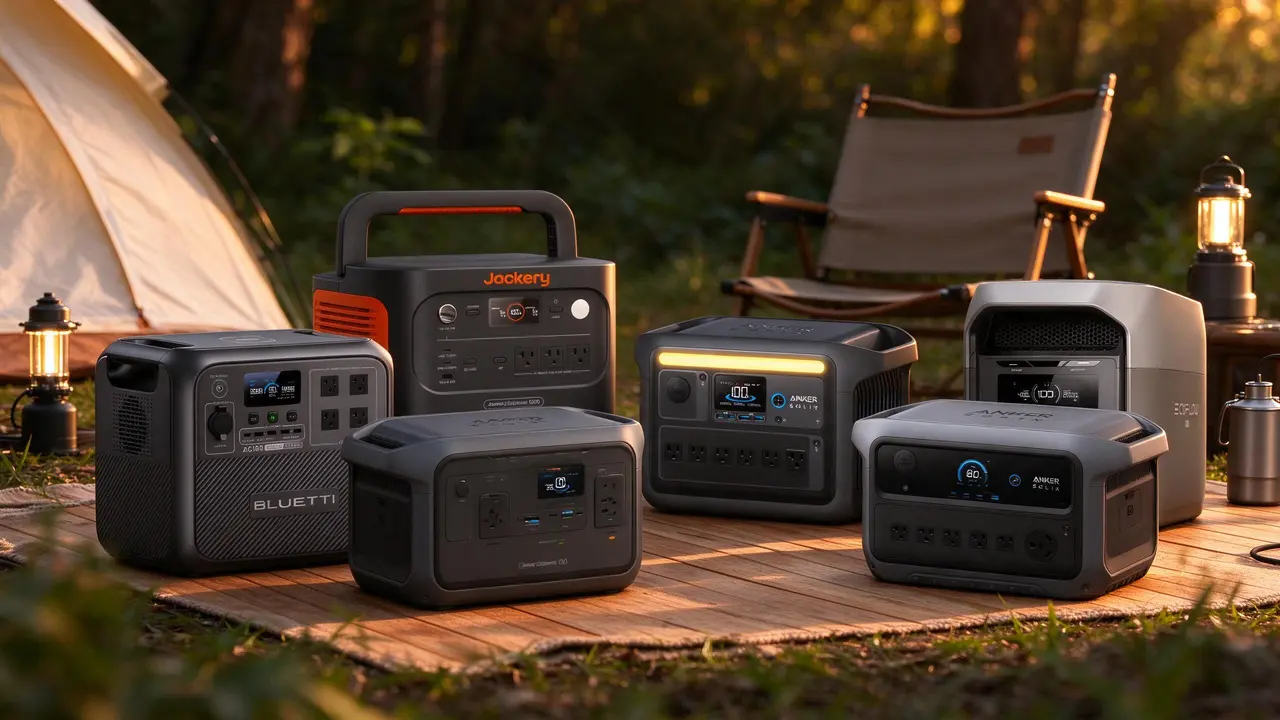
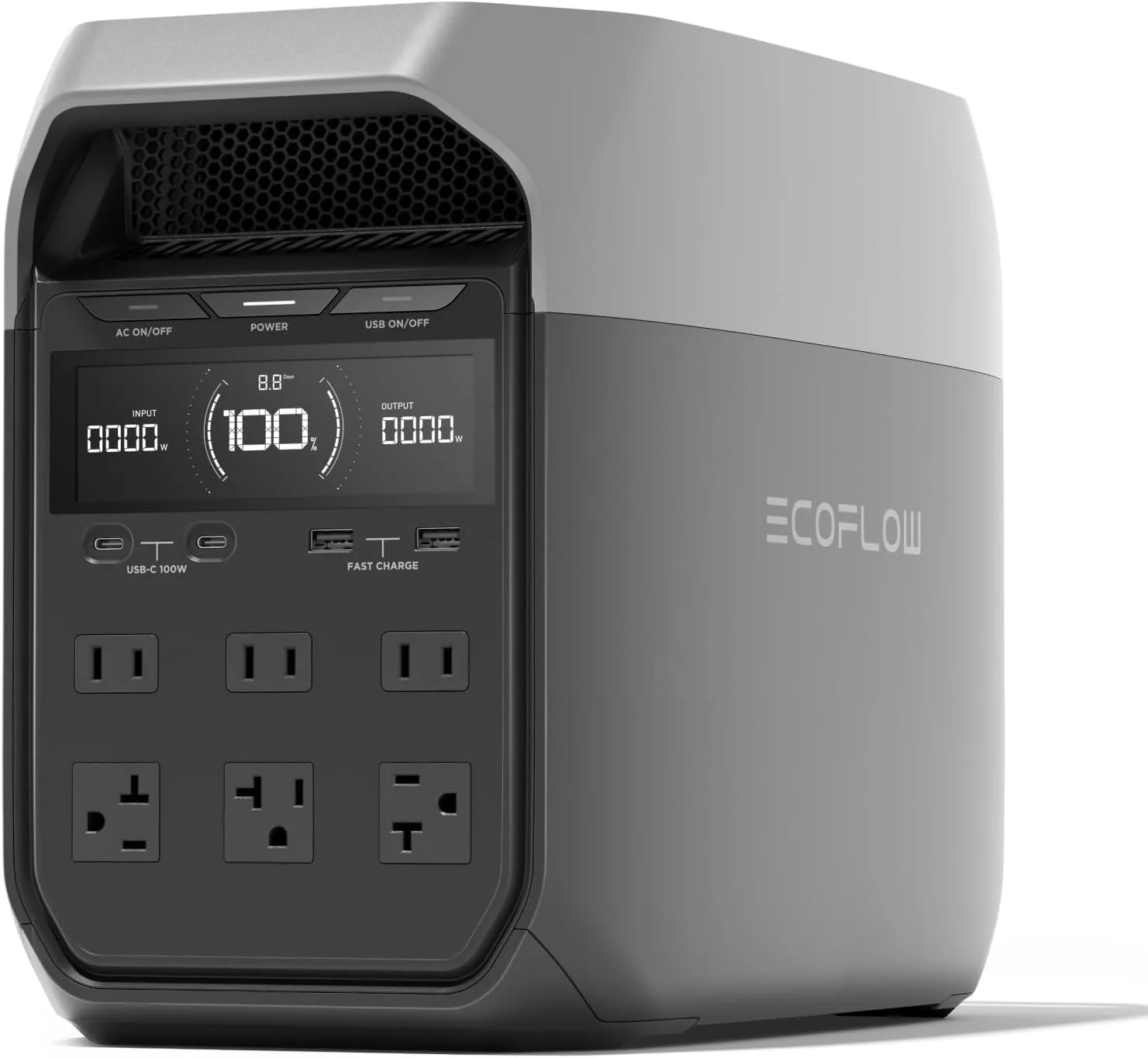
Top pick for most boondockers: EcoFlow DELTA 3. It has the continuous output to run a microwave burst and the overnight capacity for a fridge, fan, and CPAP together, at 27.6 lb.
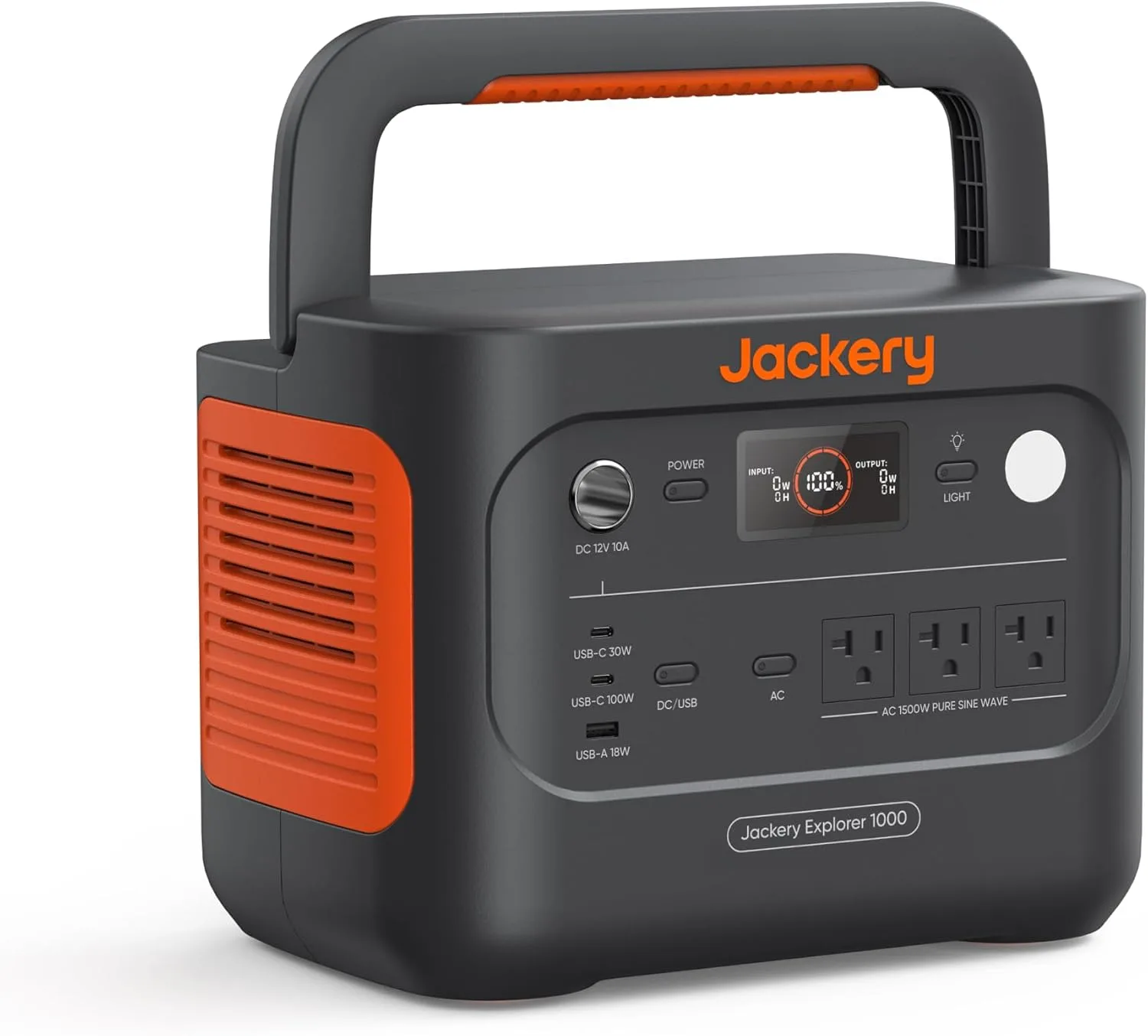
Runner-up: Jackery Explorer 1000 v2 Portable Power Station,1070Wh,1500W. Lighter and cheaper, with the quietest overnight charging mode of the group — the pick if you never plan to push past 1,500 W.
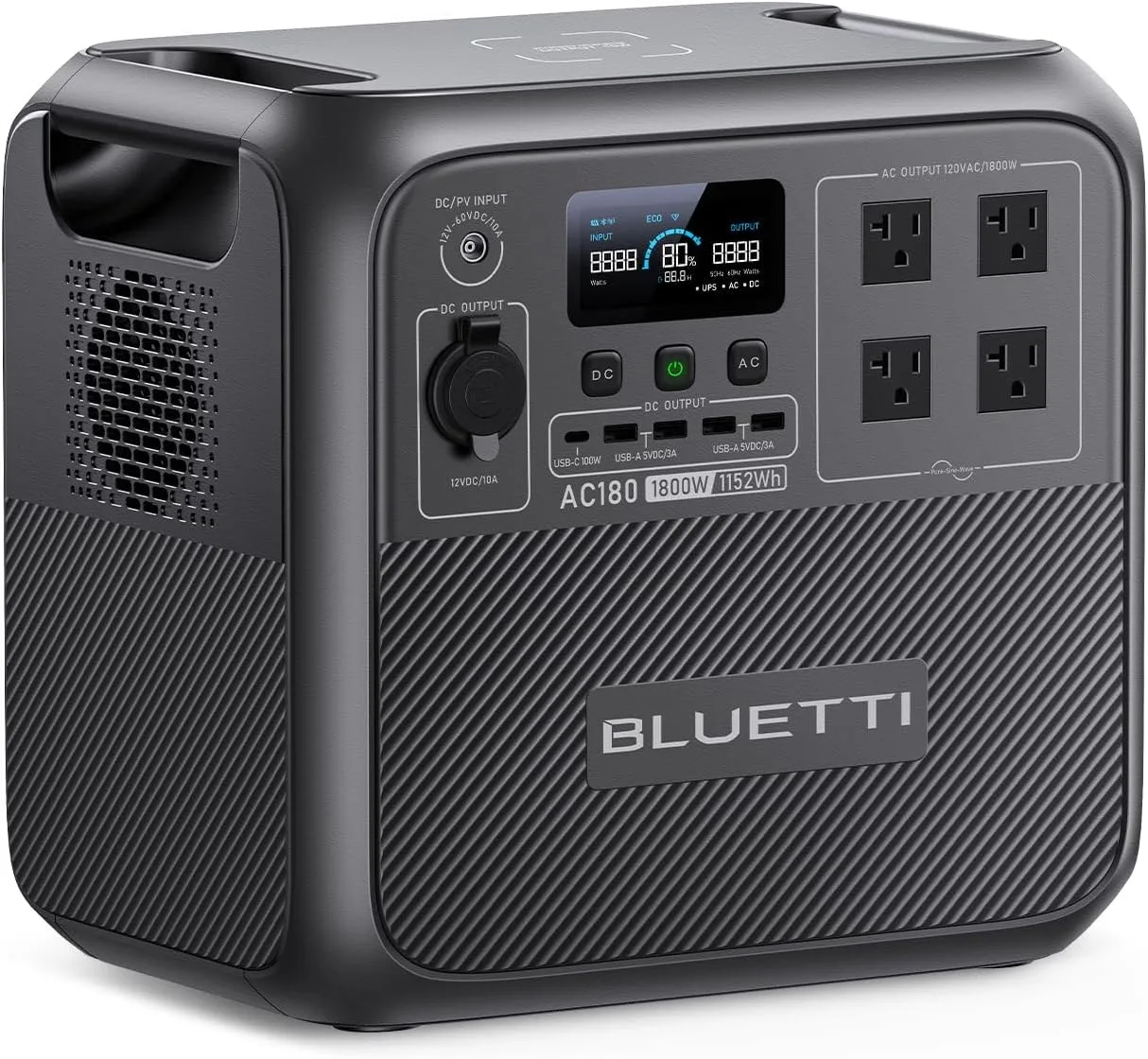
Also consider: BLUETTI AC180 if budget leads and you want the lowest nameplate cost per Wh here at $0.43/Wh — but budget for its ~20 W idle draw and 35.3 lb weight.
EcoFlow DELTA 3
Highlights
- 1024Wh rated capacity
- 1800W continuous AC
- 3600W surge
- LiFePO4 chemistry
- Up to 500W solar input
- 27.6 lb (~12.5 kg)
Best for
- DELTA 3: small appliances and tools that need ~1800W continuous, not just phone charging
- Essentials bridge at home (fridge cycles, router) when sized to the Wh
Jackery Explorer 1000 v2 Portable Power Station,1070Wh,1500W
Highlights
- 1070Wh rated capacity
- 1500W continuous AC
- LiFePO4 chemistry
- Up to 400W solar input
- 23.8 lb (~10.8 kg)
- About $559 list
Best for
- Explorer 1000 v2: weekend camping when 23.8 lb carry weight matters as much as 1070Wh
- Essentials bridge at home (fridge cycles, router) when sized to the Wh
BLUETTI Portable Power Station AC180, 1152Wh LiFePO4 Battery Backup w/ 2 1800W
Highlights
- 1152Wh rated capacity
- 1800W continuous AC
- LiFePO4 chemistry
- Up to 500W solar input
- 35.3 lb (~16.0 kg)
- About $499 list
Best for
- AC180: most Wh per list dollar in mid-size LiFePO4 shortlists (~1152Wh)
- Home essentials when 1800W continuous matters more than a light carry
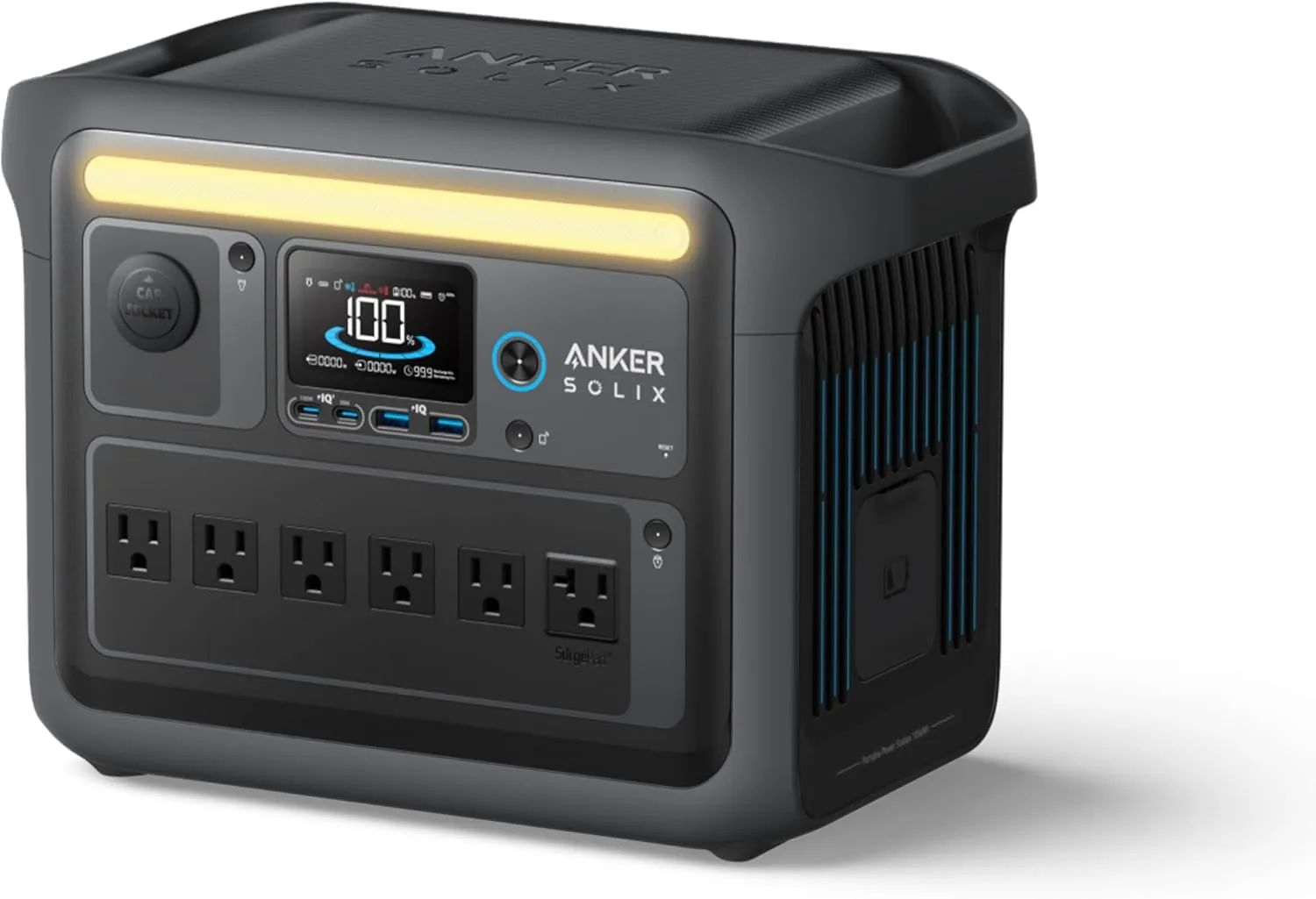
Anker C1000 Portable Power Station with Car Charging Cable, 1,056Wh
Highlights
- 1056Wh rated capacity
- 1800W continuous AC
- LiFePO4 chemistry
- Up to 600W solar input
- 28.4 lb (~12.9 kg)
- About $599.99 list
Best for
- SOLIX C1000: small appliances and tools that need ~1800W continuous, not just phone charging
- Essentials bridge at home (fridge cycles, router) when sized to the Wh
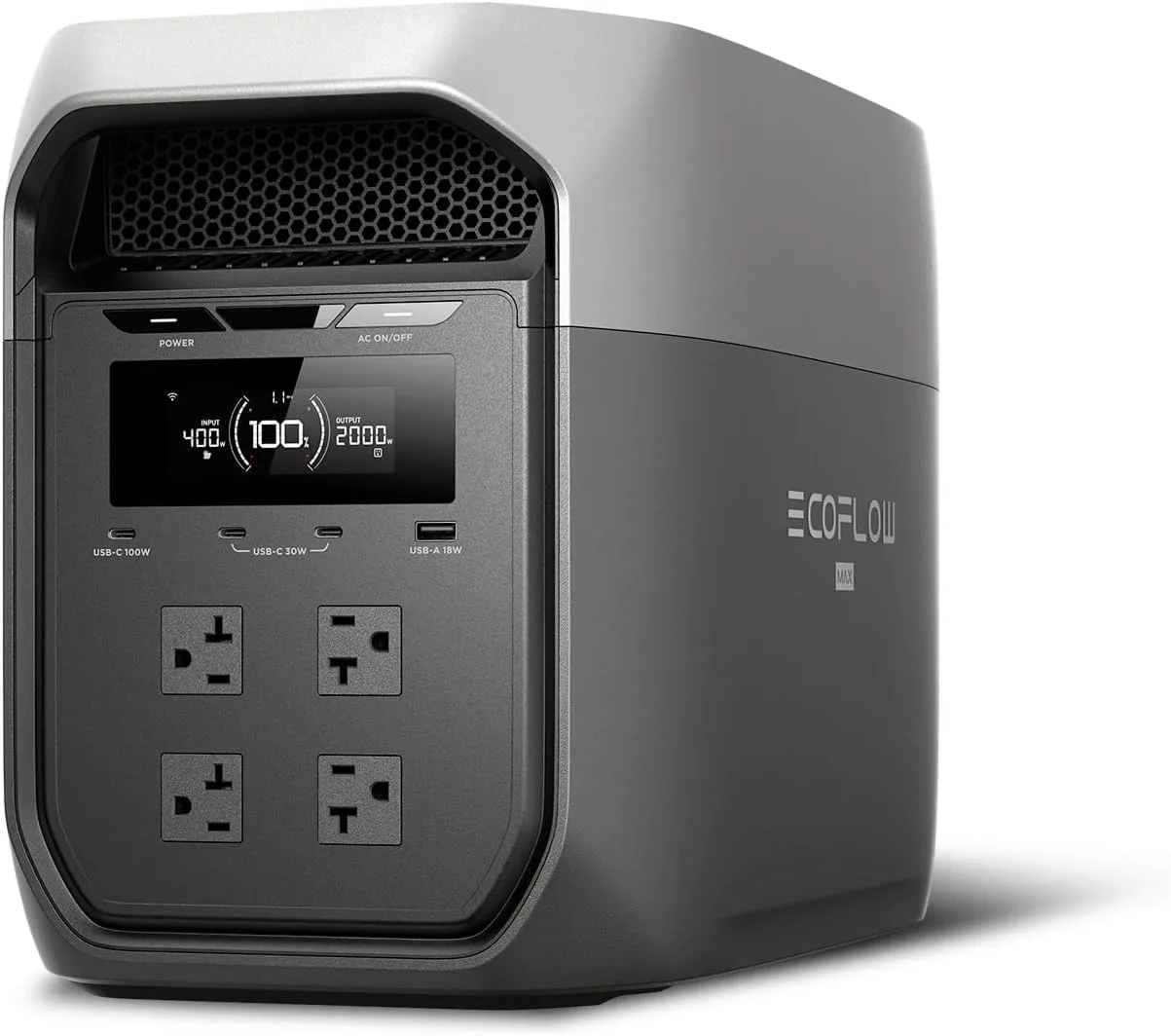
EcoFlow DELTA 3 Max Portable Power Station, 2048Wh LFP Battery
Highlights
- 2048Wh rated capacity
- 2400W continuous AC
- 4800W surge
- LiFePO4 chemistry
- Up to 500W solar input
- 44.8 lb (~20.3 kg)
Best for
- DELTA 3 Max: longer outages or higher continuous loads (still not whole-home wiring)
- RV / off-grid days where recharge speed matters as much as Wh
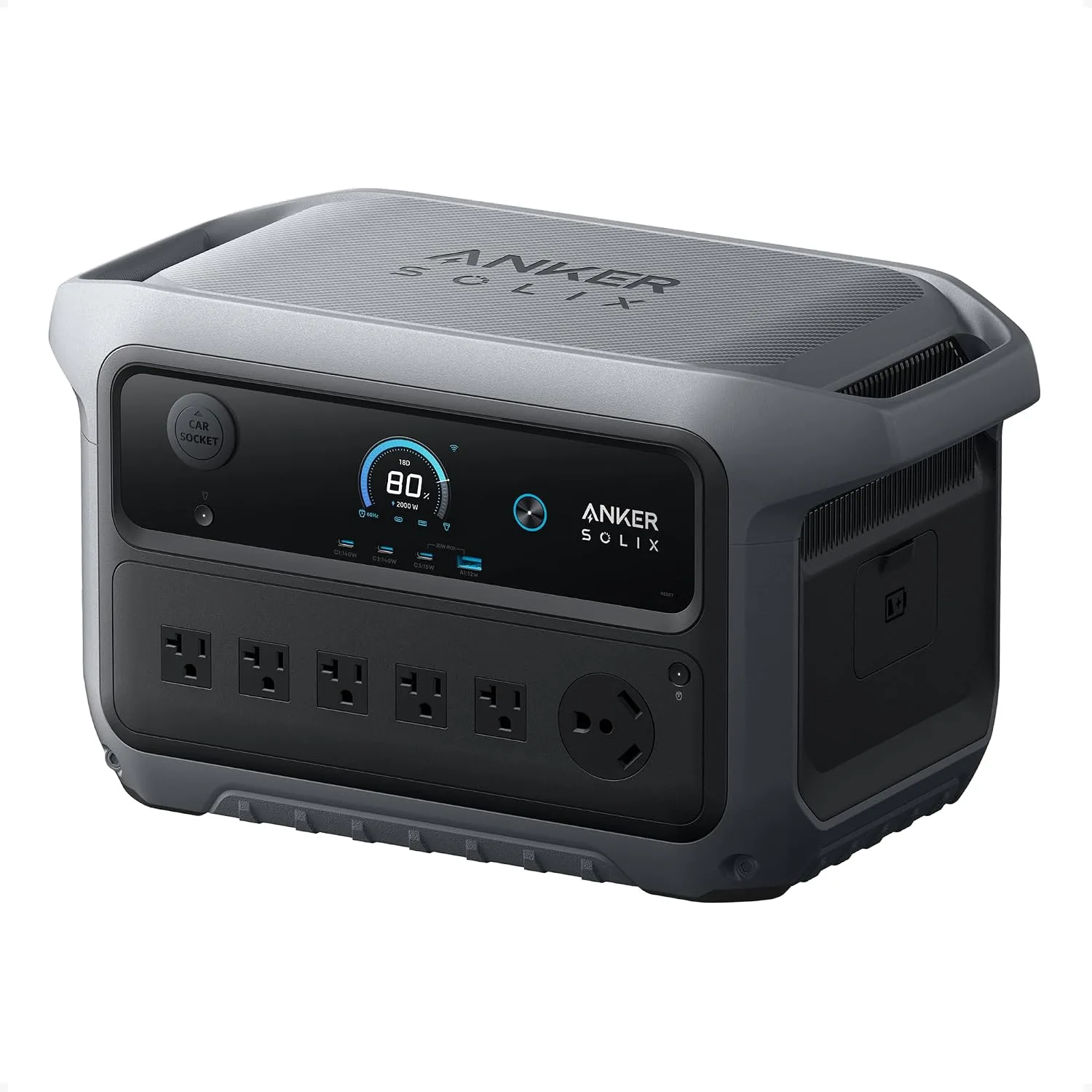
Anker C2000 Gen 2 Portable Power Station, 2,048Wh
Highlights
- 2048Wh rated capacity
- 2400W continuous AC
- 4000W surge
- LiFePO4 chemistry
- Up to 800W solar input
- 41.7 lb (~18.9 kg)
Best for
- C2000 Gen 2: longer outages or higher continuous loads (still not whole-home wiring)
- RV / off-grid days where recharge speed matters as much as Wh
How I weighted these six
I scored each station on four things: usable capacity for an overnight boondocking cycle (35%), continuous output against real camper loads (25%), recharge speed and solar input (20%), and portability by listed weight (20%). Owner themes from the reviews on file shaped the notes under each pick but didn't move the numbers — specs come from the listings.
My checks are home-user and camper-use comparisons grounded in those owner themes plus the listing specs; they are not lab-bench measurements. Where a manufacturer hasn't published a figure, I say so rather than guess. One note on money: every price below is the current list price, and these are Amazon Associates links — picks are fit-led, not commission-led.
Why the DELTA 3 edges the Explorer 1000 v2 at the top: the EcoFlow carries 1,800 W continuous against Jackery's 1,500 W, which is the difference between starting a small microwave and not, and it adds two USB-C ports to Jackery's single listed port. Jackery answers back with 46 fewer Wh of capacity but 3.8 lb less weight and a $140 lower list price — enough that a weight-conscious van owner could reasonably flip the order.
Full scoreboard on those weights — EcoFlow DELTA 3 (list $699): capacity 9/10, output 8/10 (1,800 W clears a microwave but trails the 2,400 W units), recharge 8/10, portability 8/10. Jackery Explorer 1000 v2 Portable Power Station,1070Wh,1500W (list $559): capacity 8/10, output 6/10 (1,500 W won't start a 1,700 W air fryer), recharge 8/10, portability 9/10. Anker C1000 (list $599): capacity 8/10, output 8/10, recharge 8/10, portability 7/10 (feels heavier than its 28.4 lb listing). BLUETTI AC180 (list $499): capacity 9/10, output 8/10, recharge 7/10 (real solar input fell short of panel ratings in one owner report), portability 6/10 (35.3 lb). EcoFlow DELTA 3 Max (list $1,199): capacity 10/10, output 9/10, recharge 9/10, portability 5/10 (44.8 lb). Anker C2000 Gen 2 (list $1,499): capacity 10/10, output 9/10, recharge 8/10 (800 W solar cap), portability 6/10 (41.7 lb). That is why the pick splits by job rather than one universal winner.
Scenario draw bands: what a boondocking day pulls
These are typical draw bands, not measurements of your rig. Add them up for your own overnight cycle, then leave 15–20% headroom for inverter losses and idle draw.
Worked example: a 60 W fridge running 10 hours (600 Wh) + a CPAP at 30 W for 8 hours (240 Wh) + a 20 W fan for 8 hours (160 Wh) = 1,000 Wh. With 20% headroom that's 1,200 Wh — which points at the 1,024 Wh DELTA 3 only if you skip the microwave, or at the 2,048 Wh DELTA 3 Max / C2000 Gen 2 if you want the fridge to run multiple days without recharging.
| Load | Typical draw | Notes |
|---|---|---|
| 12V/DC fridge (compressor) | 40–70 W running; several hundred W surge at compressor start | The overnight baseline; runtime is the number owners track |
| CPAP (no humidifier) | 20–40 W | Add ~50–100 W if you run the heated humidifier |
| Box fan / 12V fan | 15–40 W | Low draw but runs all night — multiply by hours |
| Microwave | 900–1,200 W | Short bursts; needs continuous output above the rating |
| Coffee maker | 600–1,000 W | Brew cycle only, a few minutes |
| Laptop + phone charging | 50–100 W combined | Small but constant across the evening |
Spec snapshot: the six picks side by side
List prices and listing specs only, as of the date of this article. Ratings are Amazon listing aggregates, not owner proof.
| Product | List price | Capacity (Wh) | Output (W) | Weight (lb) | Rating |
|---|---|---|---|---|---|
| EcoFlow DELTA 3 | $699 | 1024 Wh | 1800 W | 27.6 lb | 5.00 |
| Jackery Explorer 1000 v2 Portable Power Station,1070Wh,1500W | $559 | 1070 Wh | 1500 W | 23.8 lb | 4.75 |
| Anker C1000 Portable Power Station | $599.99 | 1056 Wh | 1800 W | 28.4 lb | 4.88 |
| BLUETTI AC180 | $499 | 1152 Wh | 1800 W | 35.3 lb | 4.85 |
| EcoFlow DELTA 3 Max Portable Power Station, 2048Wh LFP Battery | $1,199 | 2048 Wh | 2400 W | 44.8 lb | 5.00 |
| Anker C2000 Gen 2 Portable Power Station, 2,048Wh | $999.99 | 2048 Wh | 2400 W | 41.7 lb | 4.91 |
The ranking
Order follows the weights above. Where a station loses, it's usually on output headroom or weight, not capacity.
#1 EcoFlow DELTA 3 — the do-most-of-it pick
At $699 you get 1,024 Wh and 1,800 W continuous, which covers a fridge, fan, CPAP, and a microwave burst in the same evening. Capacity is still capacity, too — a big fridge can eat a full charge in a day.
- Suits: van and camper owners who want one station for overnight loads plus the occasional high-draw appliance.
- Skip if: you need to run a large fridge for multiple days without recharging — step up to the 2,048 Wh units, the EcoFlow DELTA 3 Max or Anker C2000 Gen 2.
- Owner theme (DELTA 3): fast charging and app control come up repeatedly; one owner notes a large portable fridge ran 24 hours on a charge.
#2 Jackery Explorer 1000 v2 — lighter and quieter
The Explorer 1000 v2 lists at $559 for 1,070 Wh and 1,500 W, and at 23.8 lb it's the easiest lift here. Its quiet mode drops noise enough to sleep through the night while still running a fridge and a portable AC together.
It's the pick if your heaviest load stays under 1,500 W. A 1,700 W air fryer is out of reach, and a large sliding miter saw won't start — the blade barely turned in one owner's test. Normal recharge runs about 1 hour 40 minutes; the one-hour emergency mode reverts after each use.
- Suits: boondockers who prioritize weight and overnight quiet over raw output.
- Skip if: you want to run a microwave or air fryer — 1,500 W continuous won't cover it.
- Owner theme (Explorer 1000 v2): a 12-quart DC fridge ran three days in eco mode, dropping only to 43%.
#3 Anker C1000 — the camper backpower specialist
$599 buys 1,056 Wh and 1,800 W, and the C1000's strength is backpowering a whole camper through the shore hookup. One owner ran a truck camper for about 24 hours on microwave, furnace, water heater, lights, and pump within limits.
Two things to plan around: it feels heavier in hand than the 28.4 lb listing suggests, and the included AC cable is short at about 4–5 feet. The app needed a firmware update before it behaved in one owner's case.
- Suits: camper owners who want to feed the rig through shore power and skip the generator during quiet hours.
- Skip if: you'll be carrying it any distance or need a long AC cord out of the box.
- Owner theme (C1000): recharged from 1% to 100% in about 1 hour 32 minutes on AC.
#4 BLUETTI AC180 — lowest nameplate cost per Wh
At $499 for 1,152 Wh and 1,800 W, the AC180 is the cheapest per nameplate Wh on this list at $0.43/Wh. It also does double duty as a UPS — one owner's basement circuit switched over without a blink.
The trade-off is idle draw: about 20 W per hour with the inverter on, which eats a real share of capacity on small overnight loads. It's also the heaviest unit in this 1,024–2,048 Wh capacity class at 35.3 lb, and the wireless charging pad on top quit after a few seconds for one owner.
- Suits: budget-led buyers who want UPS behavior and don't mind a heavier unit.
- Skip if: your overnight loads are tiny — the idle draw will cost you hours.
- Owner theme (AC180): real solar input fell well short of panel ratings — 161 W from a 200 W panel on a clear day.
#5 EcoFlow DELTA 3 Max — for longer off-grid stretches
$1,199 gets you 2,048 Wh and 2,400 W, which is the class where multi-day fridge duty becomes realistic. One owner ran an iceco VL45Pro fridge at 36°F for over five days on a single charge, and the 10 ms transfer makes it a credible UPS for a camper's router and laptop.
It's 44.8 lb, so this is a move-it-and-leave-it unit, not a carry-it-to-the-fire one. USB output tops out at 100 W, which one owner wished were 140 W.
- Suits: boondockers doing week-long trips who want fridge capacity and UPS behavior in one box.
- Skip if: you need to carry the station between spots daily, or want high-watt USB fast charging.
- Owner theme (DELTA 3 Max): recharged from 29% to 100% in a little over an hour during a real outage.
#6 Anker C2000 Gen 2 — RV air conditioner territory
The C2000 Gen 2 lists at $1,499 for 2,048 Wh and 2,400 W, and it's the only station here with an owner report of starting a 50-amp RV air conditioner without a soft-start kit — about an hour of runtime on that load. That's a brief cooling window, not all-night AC, and whether your AC starts depends on the specific unit and whether it has a soft-start.
Two limits matter for boondocking. Pass-through mode caps at 15 A when plugged into a 15 A household outlet, so you must unplug to get full output. And solar input is capped at 800 W, which one owner found low for a unit this size. At 41.7 lb, it's a two-hand move.
- Suits: RV owners who want to run an air conditioner briefly and keep medical devices alive overnight.
- Skip if: you plan to charge and draw high current at the same time, or want maximum solar headroom.
- Owner theme (C2000 Gen 2): recharged from 25% to 100% in 1 hour 1 minute during a hurricane outage.
What goes wrong on a boondocking trip
Most disappointments trace to one of these, not to a bad station.
- Sizing to nameplate Wh instead of usable Wh — inverter losses and idle draw can cost 15–25% of the number on the box.
- Ignoring startup surge — a fridge that draws 60 W running can pull several hundred watts for a second at compressor start.
- Assuming solar will keep up — real panel output runs well under rated wattage, and a cloudy day can cut it by two-thirds.
- Forgetting the recharge path — a station you can only charge from a wall outlet is a problem at a dry campsite.
- Carrying weight you can't lift alone — anything past roughly 40 lb wants a cart.
Who should pick something else
This list is built for dry camping with a fridge, fans, lights, and device charging. It is the wrong tool for two other jobs.
If you're running a 30-amp rig with air conditioning for days, or want whole-home backup during outages, you need a transfer switch and a much larger system — not a portable station. And if you're backpacking or tent camping without a vehicle, even the 23.8 lb Explorer is too much to carry; a small 300–500 Wh unit is the right size.
What owners wish they'd known before buying
These are the gaps that show up after the first trip, drawn from the owner themes on file.
- Cycle life: LiFePO4 cells are rated for many more cycles than older chemistries, but capacity fades over years — plan for a station to lose usable Wh before it stops working.
- Cold-weather derating: capacity and charging slow in freezing temperatures, so a winter boondocking trip needs more headroom than a summer one.
- Warranty and support: owner reports on app quirks and firmware updates (the C1000 needed one) suggest checking the support process before you rely on the app.
- Idle draw: the AC180's ~20 W/hour inverter draw is the clearest example — small overnight loads can lose hours to it.
- Solar reality: the AC180 owner's 161 W from a 200 W panel is a reminder to size solar for real-world output, not the panel label.
What owners keep telling me
Across the reviews on file, the themes line up with the specs more than the marketing does. Fridge runtime is the number owners actually track, and the 2,048 Wh units are the ones reporting multi-day stretches. The 1,024–2,048 Wh reports overnight and single-day cycles.
The recurring complaints are weight, idle draw, and app quirks — not capacity. If you buy for the overnight cycle and leave headroom for losses, you'll land in the right class.
Frequently asked
How many watt-hours do I need for RV dry camping?
A typical overnight cycle — fridge, fan, lights, CPAP, and device charging — lands around 800–1,200 Wh. Add 15–20% headroom for losses, which puts most boondockers in the 1,024–2,048 Wh capacity class or just above.
Will the Anker C2000 Gen 2 run my RV air conditioner?
One owner started a 50-amp RV AC without a soft-start kit and got about an hour of runtime. That's a short cooling window, not all-night AC — plan around it, and note that startup success depends on the specific AC unit and whether it has a soft-start.
How fast do these recharge from a campground pedestal?
The fastest here recharge in about an hour: the DELTA 3 Max from 29% to 100% in a little over an hour, the C2000 Gen 2 from 25% to 100% in 1 hour 1 minute. The Explorer 1000 v2's normal mode runs about 1 hour 40 minutes.
When is the $499 BLUETTI AC180 enough, and when should I step up?
The AC180 is enough if your overnight loads are modest and you want the lowest nameplate cost per Wh ($0.43/Wh) plus UPS behavior. Step up to the $699 DELTA 3 if you need more continuous output headroom or lighter weight, and to the 2,048 Wh units if you need multi-day fridge duty.
Method and sources
Model names and list prices come from the WattPicks catalog at build time. WattPicks does not run its own laboratory tests on power stations, and nothing on this page is presented as a measured result — it is catalog-backed buying guidance.
Read our methodology for how the catalog is normalized, and about WattPicks for who publishes it.