
Goal Zero Yeti 1500 vs Yeti 700: Backup or Camping?
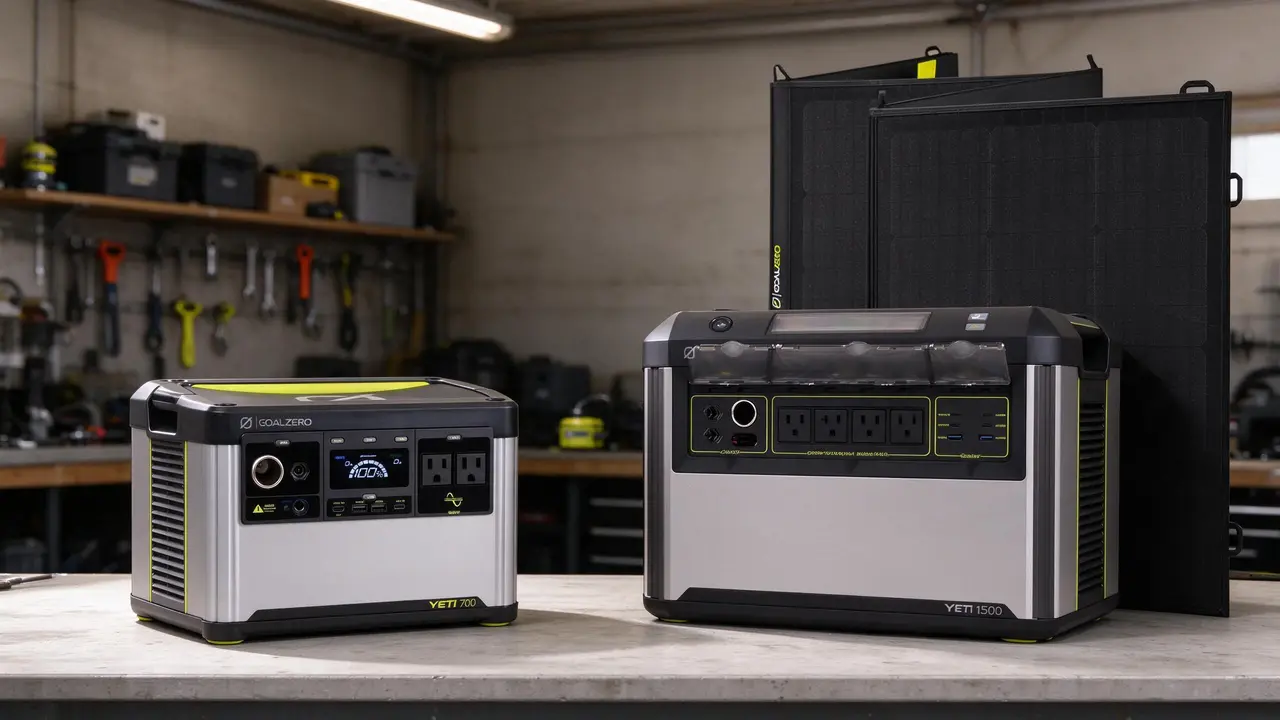
Two Goal Zero stations, two very different jobs. The Yeti 1500 is a 2,000 W home-backup box you can wheel to the fridge; the Yeti 700 is a 20.3 lb grab-and-go for CPAP and laptops. Here's which one fits your outage plan.
Updated
Two ways to solve the same problem
The buying question here isn't which Yeti is better. It's whether your outage plan is a whole-room load or a bag you can carry. The Goal Zero Yeti 1500 Portable Power Station is a 1,505 Wh, 2,000 W box that sits on a desk or near the fridge and runs real appliances. The Goal Zero Yeti 700 is a 677 Wh, 600 W unit that weighs 20.3 lb and lives in a closet or the back of a car.
That split decides almost everything else. If you need to keep a refrigerator, a workstation, and a few lights alive through a multi-day storm, the 1500's capacity and output are the point. If you need to run a CPAP with humidifier overnight and charge phones, the 700 does it at half the weight and half the price. Neither is a substitute for a transfer switch or a generator for central HVAC — this page is not for whole-home wiring decisions.
I based the owner notes below on the review pack on file and the listing specs. Those are home-user checks, not lab-bench measurements.
- Yeti 1500: 1,505 Wh, 2,000 W continuous, 52.8 lb, $1,499.95 — home backup and multi-device desk duty.
- Yeti 700: 677 Wh, 600 W continuous, 20.3 lb, $699.95 — CPAP, laptops, WiFi, and camping.
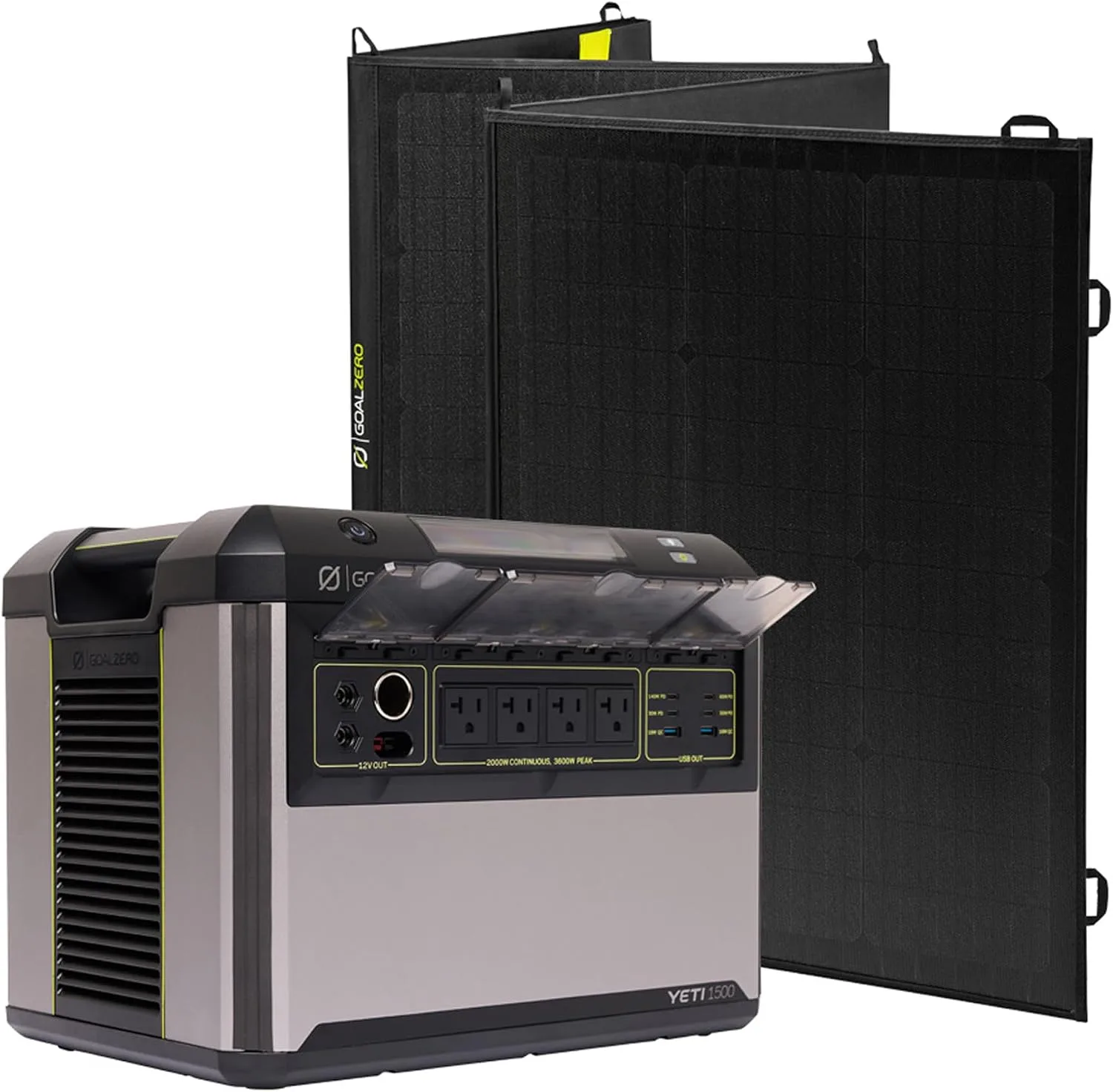
Goal Zero Yeti 1500 Portable Power Station
Highlights
- 1505Wh rated capacity
- 2000W continuous AC
- 3600W surge
- LiFePO4 chemistry
- Up to 900W solar input
- 52.8 lb (~23.9 kg)
Best for
- Yeti 1500: longer outages or higher continuous loads (still not whole-home wiring)
- RV / off-grid days where recharge speed matters as much as Wh
- Best parked near the vehicle or cabin — not a long carry to a tent
Strengths
- Yeti 1500: 1505Wh pack with 2000W continuous / 3600W surge — size loads to both numbers
- 52.8 lb (~23.9 kg) is a park-and-use chassis — plan a short path, not a trail hike
- 15ms-class UPS switchover on the listing — useful when a router restart would hurt
- Owners on file: 5/5 · 6 helpful — Without a doubt Goal Zero's best power station yet. I've been a customer for many years and…
Watch-outs · not ideal when
- At 52.8 lb (~23.9 kg), Yeti 1500 is a poor tent-hike companion — plan a cart or leave it in the vehicle
- High continuous output on Yeti 1500 tempts big loads — Wh still runs out on kettles and A/C
- Rated 900W solar on Yeti 1500 is optimistic; shade and cables cut real watts
- LiFePO4 helps longevity, but Yeti 1500 still hates freezing charge temps on winter trips
Owner voices
Short takes from public retail reviews — paraphrased or translated when long or non-English; meaning kept close to the original.
“5/5 · 6 helpful — Without a doubt Goal Zero's best power station yet. I've been a customer for many years and always find the products to be durable and reliable. Happy to report this new station continues the trend.…”
“5/5 · 5 helpful — Enjoying using my Goal Zero Yeti 1500. The unit recharges in an hour or less and provides quiet power for several days. Running power tools and various chargers works flawlessly. End result is to use…”
“5/5 · 4 helpful — We love the Yeti 1500 Portable Power Station. When the power goes out, we no longer need to fire up the gas-powered generator and run a cord from outdoors. We simply plug in an appliance, light, comp…”
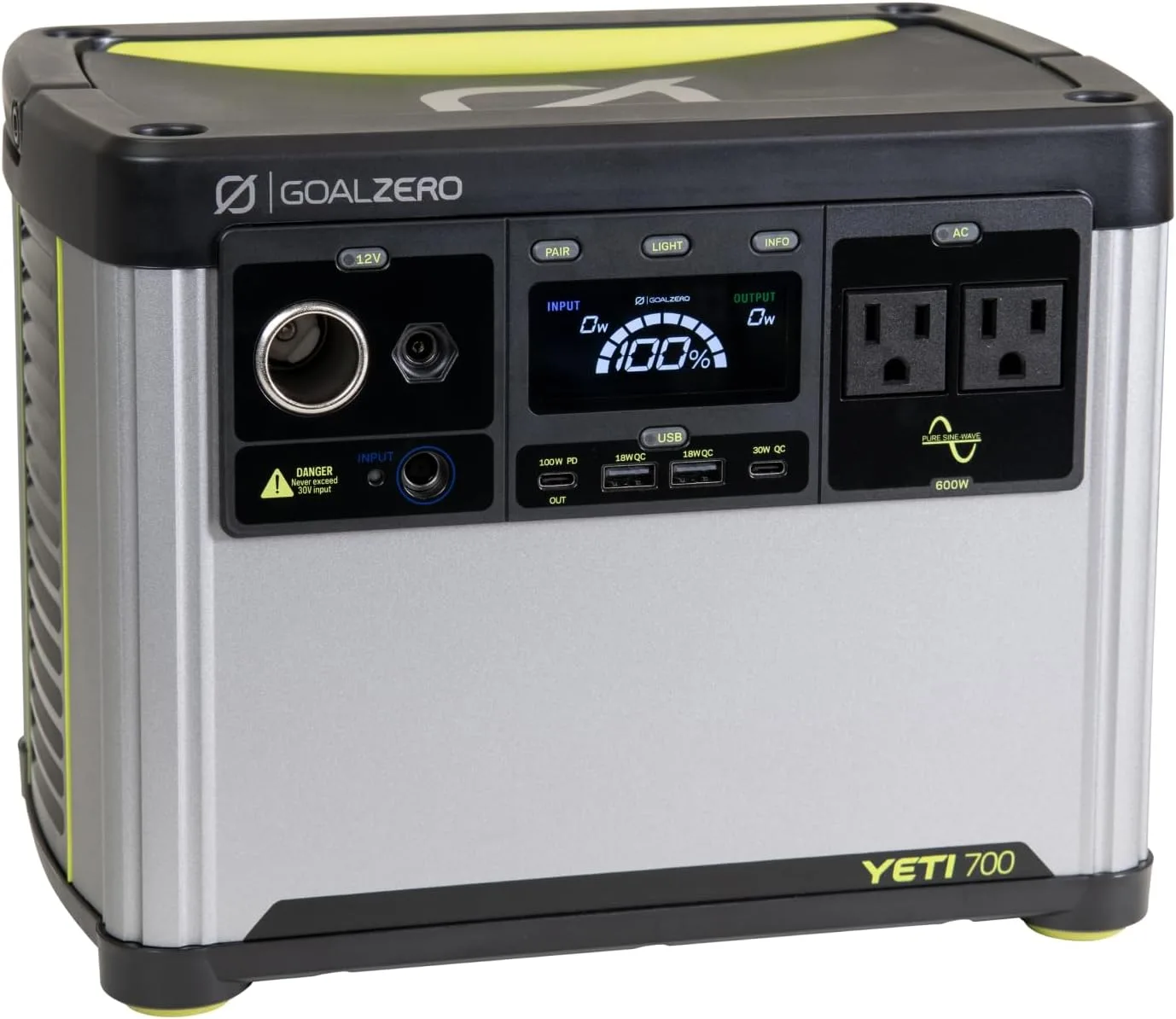
Goal Zero Yeti 700
Highlights
- 677Wh rated capacity
- 600W continuous AC
- 1000W surge
- LiFePO4 chemistry
- Up to 200W solar input
- 20.3 lb (~9.2 kg)
Best for
- Yeti 700: weekend camping when 20.3 lb carry weight matters as much as 677Wh
- Essentials bridge at home (fridge cycles, router) when sized to the Wh
- Solar top-ups up to ~200W when panels and weather cooperate
Strengths
- Yeti 700: 677Wh pack with 600W continuous / 1000W surge — size loads to both numbers
- 20.3 lb (~9.2 kg) is the lightest-class carry in this band — easier stairs and car packing
- Yeti 700 uses LiFePO4 — cycle-life claims usually beat older NMC marketing lines
- Owners on file: Theme: Customers find the power station reliable, with one mentioning it runs all their equipment through the…
Watch-outs · not ideal when
- Yeti 700 is still a bridge for essentials — not a transfer-switch whole-home system
- Usable energy on Yeti 700 is below the 677Wh label once the inverter is working
- Rated 200W solar on Yeti 700 is optimistic; shade and cables cut real watts
- LiFePO4 helps longevity, but Yeti 700 still hates freezing charge temps on winter trips
Owner voices
Short takes from public retail reviews — paraphrased or translated when long or non-English; meaning kept close to the original.
“Theme: Customers find the power station reliable, with one mentioning it runs all their equipment through the night. The battery life receives positive feedback, with multiple customers noting it charges quickly from…”
“Theme: Battery life (10)”
“5/5 · 19 helpful — I bought this 700 since I have a full size CPAP machine with the humidifier that I need when I go camping. Was able to charge multiple other devices over night (phone, hearing aid, watch) while I wa…”
Spec snapshot: capacity, output, weight, price
All numbers below come from the listings. The listing aggregates are 4 out of 5 on 13 ratings for the 1500 and 4.4 out of 5 on 40 ratings for the 700 — thin on the 1500, so treat owner themes as directional rather than settled.
I'm Avery Nolan, WattPicks founding editor. My checks here are home-user checks grounded in the owner themes on file plus listing specs; they are not lab-bench measurements. I weighted outage-fit and owner-reported reliability highest, then portability and price per Wh, because those are the decisions this comparison turns on.
As an Amazon Associate, WattPicks earns from qualifying purchases. Picks are fit-led, not commission-led.
| Product | Price | Capacity (Wh) | Output (W) | Weight (lb) | Rating |
|---|---|---|---|---|---|
| Goal Zero Yeti 1500 Portable Power Station | $1499.95 | 1505 Wh | 2000 W | 52.8 lb | 4 |
| Goal Zero Yeti 700 | $699.95 | 677 Wh | 600 W | 20.3 lb | 4.4 |
Where the Yeti 1500 wins: the outage you actually sit through
The 1500's headline is recharge speed. The owner pack on file reports that on wall power it can go from roughly half to full in under an hour, and that pace held across a few top-ups. That matters in an outage because you can recharge during a window of grid power and go back to running loads.
Owners on file loaded it the way a home user would — a workstation with AC and DC gear running together — and it carried the spread without tripping. In one reported storm outage, an owner moved it from desk to fridge and ran both in sequence. Another owner ran an ice chest and a refrigerator for four hours at a time across a three-day outage, recharging on solar in between.
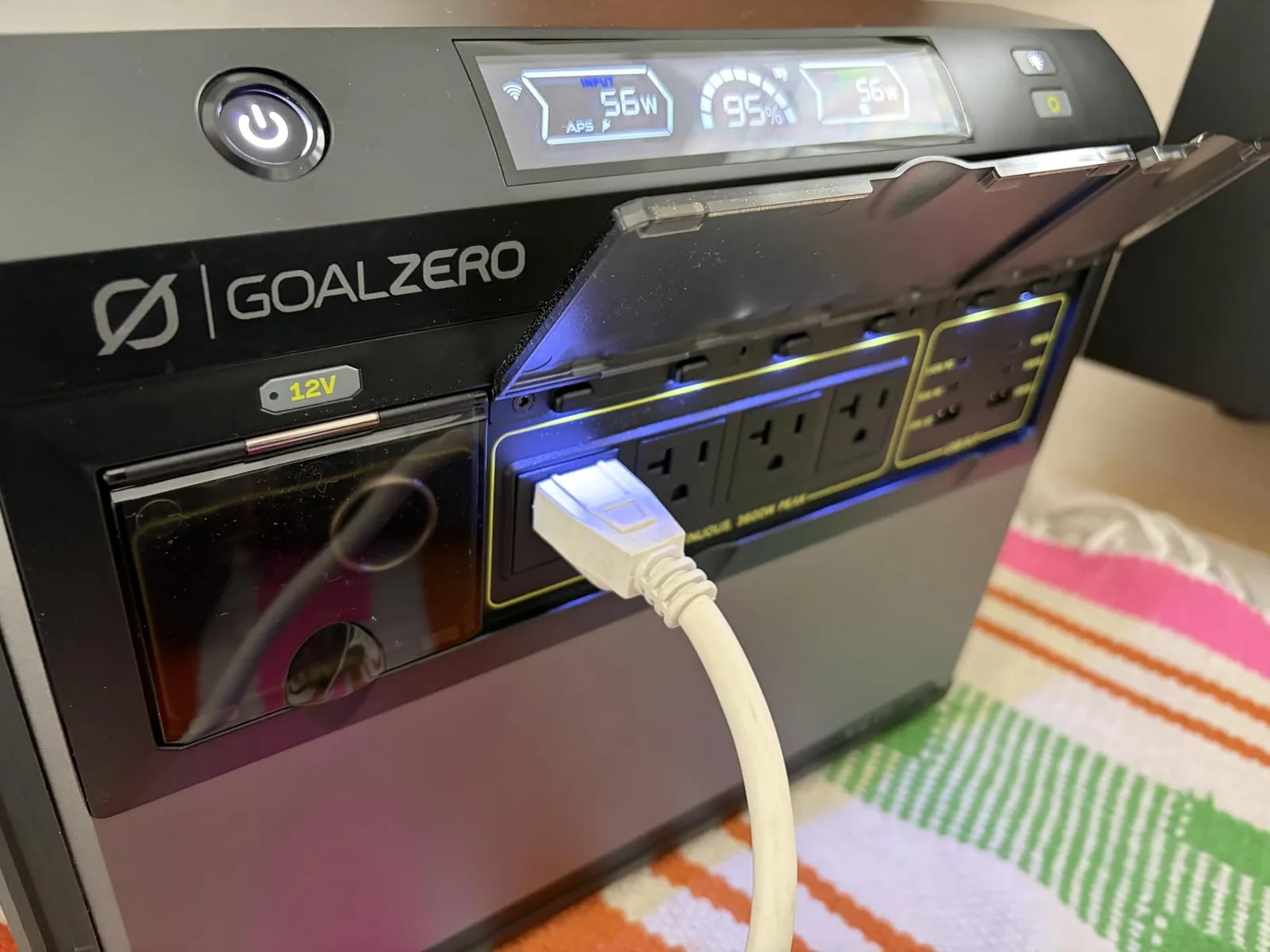
The aluminum shell, chunky handles, and lit port doors read as camping-ready too. Port selection is generous: AC×4, USB-C×4, USB-A×2, and a car outlet, so you never have to choose between devices. The app is a quiet win — watching live draw makes you more deliberate about what you plug in.
Metrics that matter for this job: watt-hours and continuous watts. The 1,505 Wh capacity and 2,000 W output are what let it run a fridge and a desk setup; weight and portability are secondary here.
- Enough for: a fridge plus router and lights through a multi-day outage, with wall or solar top-ups.
- Enough for: a full desk setup — monitor, laptop, chargers — running at once.
- Not for: central AC, electric heat, or anything that needs more than 2,000 W continuous.
Where the Yeti 700 wins: the load you carry, not wheel
The most demanding reported night on the 700 was a full-size CPAP with the humidifier running, plus a phone, watch, and hearing aids charging alongside. It finished under half drained. That is the whole reason this size exists — CPAP batteries that can't run a humidifier leave you short, and owners on file bought the 700 for exactly that.
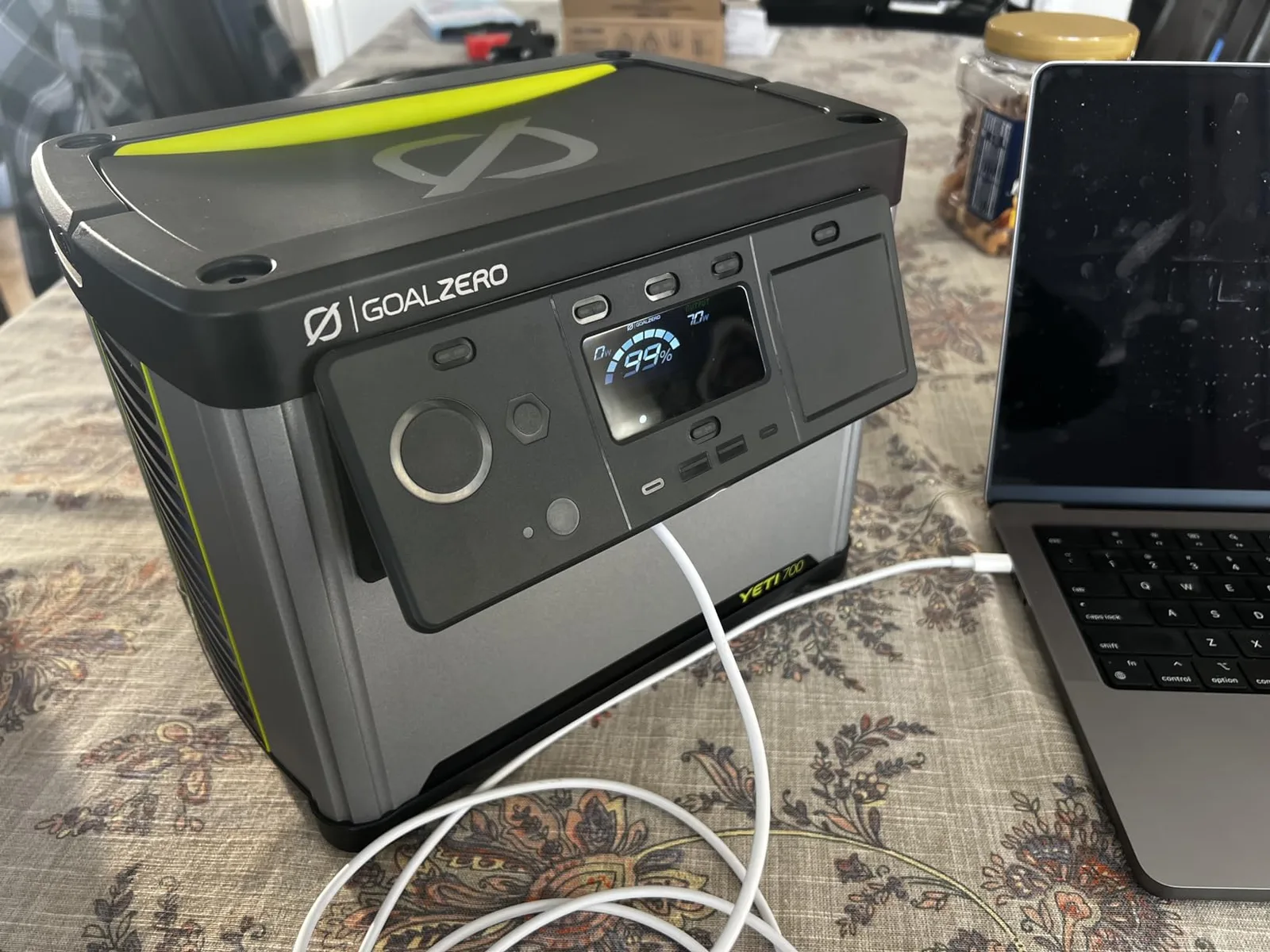
Wall recharge is quick enough that owners topped it up during daytime drives and brought it into the tent at night. At home, one owner has left it plugged in as a UPS for the WiFi, and it also carried a laptop and modem through an outage. The form factor is the other win: compact enough to grab and go, and it holds charge between trips. Ports are AC×2, USB-C×3, USB-A×2, and a car outlet — enough for a small desk or a tent.
The cracks are real. The most repeated theme across owners is units failing — one buyer is on a third replacement after two died, both venting smoke, according to the owner pack. Replacements have come through, but getting there took months of unanswered tickets and dropped calls for some. Runtime on a small 12V fridge is modest; one owner got roughly 18–24 hours where a larger rival ran days.
Metrics that matter for this job: weight and CPAP runtime. The 20.3 lb carry weight and overnight CPAP capacity are what make it useful; watt-hours and watts are secondary for small devices.
- Enough for: CPAP with humidifier overnight plus phone and watch charging.
- Enough for: laptop, modem, and router as a short-run UPS.
- Not for: fridge duty beyond about a day, or any appliance above 600 W continuous.
The trade-off that decides it
The 1500 costs $1,499.95 and weighs 52.8 lb. The 700 costs $699.95 and weighs 20.3 lb. On nameplate dollars per watt-hour the 1500 is slightly cheaper at $1.00/Wh versus $1.03/Wh, but that gap is small enough that price per Wh should not drive the choice. Capacity and output should.
If your outage plan includes a refrigerator, the 1500's 1,505 Wh and 2,000 W are the difference between running it and not. If your plan is a CPAP and a laptop, the 700's 677 Wh is enough and the 20.3 lb weight is the reason you'll actually use it. Buying the 1500 for camping means hauling 52.8 lb for capacity you may not need. Buying the 700 for fridge backup means accepting roughly a day of runtime at best.
Owner themes worth weighing before you buy
On the 1500, the high-helpful reviews cluster around fast recharge, build quality, and storm-outage use. The caveats are thinner but serious: one owner hit error codes that neither the manual nor support could pin down, and a multi-year owner reported the unit and charger overheating and smoking. Support response times are a recurring concern: owners describe slow ticket replies and difficulty reaching a human, though no specific timelines are given in the pack. Treat those as open questions, not settled verdicts — the review pack is small.
On the 700, owners praise CPAP overnight runtime, fast wall charging, and the grab-and-go size. The repeated caveat is unit failure: multiple owners report dead units or smoke, with replacements shipped but support slow to reach. One owner also found fridge runtime short of a larger competitor. If you buy either, register it, keep the receipt, and watch for heat issues.
Warranty terms for both units are set by Goal Zero and are not detailed in the owner pack; check the current listing for the applicable warranty period and any model-revision notes before you buy.
- Yeti 1500 owner theme: fast recharge and rugged build are the most-cited wins; support gap and one overheating report are the flags.
- Yeti 700 owner theme: CPAP and small-device backup are the wins; repeated failures and slow support are the flags.
Pick-one rules and when to walk away
Buy the Goal Zero Yeti 1500 Portable Power Station if your outage plan includes a refrigerator, a workstation, or both, and you can lift 52.8 lb or keep it on a cart. Buy the Goal Zero Yeti 700 if your critical load is a CPAP, a laptop, and a router, and you want something you can carry to a tent or a different room.
Walk away from both if you need to run central HVAC, electric heat, or a well pump without a transfer switch — these are portable stations, not home wiring. Walk away from the 700 if fridge runtime is your priority; size up. Walk away from the 1500 if portability is the whole point; 52.8 lb gets old fast.
Frequently asked
Can the Yeti 700 run a full-size CPAP with humidifier overnight?
Owners on file report yes, finishing under half drained with phone and watch charging alongside. That is a home-user report, not a lab measurement.
Can the Yeti 1500 run a refrigerator?
Owners describe running a fridge for hours at a time during outages, with solar or wall top-ups between. Runtime depends on the fridge's draw and duty cycle.
Which is cheaper per Wh?
On nameplate, the Yeti 1500 is $1.00/Wh and the Yeti 700 is $1.03/Wh — close enough that capacity and output should decide.
Do either of these replace a transfer switch?
No. They are portable stations with AC outlets, not hardwired home backup.
Method and sources
Model names and list prices come from the WattPicks catalog at build time. WattPicks does not run its own laboratory tests on power stations, and nothing on this page is presented as a measured result — it is catalog-backed buying guidance.
Read our methodology for how the catalog is normalized, and about WattPicks for who publishes it.