
Best Solar Generator for Off-Grid: 5 Picks Ranked
Off-grid autonomy is a solar-input problem as much as a capacity one. Here are five stations ranked by usable capacity, panel wattage, and recharge speed — with the panel each one actually needs.
Updated
What off-grid actually demands from a solar generator
The question I get most is some version of: how many watt-hours do I need to stop worrying about the sun? The honest answer is that watt-hours are only half of it. A 3,840 Wh box with a weak charge controller is less useful off-grid than a 2,048 Wh box that refills in an afternoon.
So this page ranks stations for off-grid autonomy — meaning you can run a real load overnight and get back to full on panels the next day, without a wall outlet in the loop. That is a different job than home backup, where the grid does the refilling and UPS transfer time matters more than solar input. If you're sizing for a blackout, this isn't your page.
Two hard requirements fall out of that. First, the station needs enough continuous AC output for the loads you'll actually run — a fridge compressor's startup draw is not the same as its running draw. Second, you need to know what panel wattage the unit accepts, because that number, not capacity, sets your daily energy budget. Where a manufacturer hasn't published solar input, I say so instead of guessing.
One more thing before the picks: panels are frequently sold separately, and on some of these units the adapter cable is too. I flag that per pick, because a $1,199 station that needs $200 of accessories to accept a panel isn't a $1,199 off-grid solution.
To make the sizing concrete: a typical off-grid day might be a 12V fridge cycling at about 50W average (1,200 Wh/day), a Starlink at 50–75W for 8 hours (400–600 Wh), and lights plus phone charging at 20W for 5 hours (100 Wh). That's roughly 1,700–1,900 Wh per day. A 2,048 Wh station covers one such day with little margin; a 3,840 Wh unit covers two. Match your daily draw to capacity, then check that the solar input can replace that draw in a reasonable number of sun hours.
Quick picks: top, runner-up, also-consider
Top pick for a fixed off-grid site — AFERIY AF-P310. The only unit here with capacity to spare for a two-night gap in the weather, and the only one whose owners describe recharging fast off a real array. Caveat: its max solar input is not published, so verify that spec with the seller before you buy.
Runner-up for a van or a station you carry — EcoFlow DELTA 3 Max. Half the weight of the AFERIY, 2,400 W continuous, and the cleanest UPS behavior in the pack. If you're van/portable, start at #2.
Also consider — Anker C2000 Gen 2 Portable Power Station, 2,048Wh. Same capacity class as the EcoFlow, faster AC recharge in owner reports, but its 800W solar ceiling is the tightest input cap in this shortlist.
The two DJI units are here for different reasons: the DYM2000L has the highest continuous output per pound in the group, and the DYM1000V2H is the cheapest per nameplate Wh at $0.46/Wh. Neither is my first off-grid pick, and the ranking explains why. Budget tradeoff: the DYM2000L costs $1,299 for 2,048 Wh and 3,000 W, while the DYM1000V2H costs $469.99 for 1,024 Wh and 1,000 W — you pay roughly 2.8× for double the capacity and triple the output, but both need separate solar adapters.
Cheapest adequate for the 1,700–1,900 Wh/day scenario: the EcoFlow DELTA 3 Max at $1,199 covers one such day with margin and is the lowest-cost 2 kWh unit here — but confirm its solar input before you rely on it as a full-time off-grid refill.
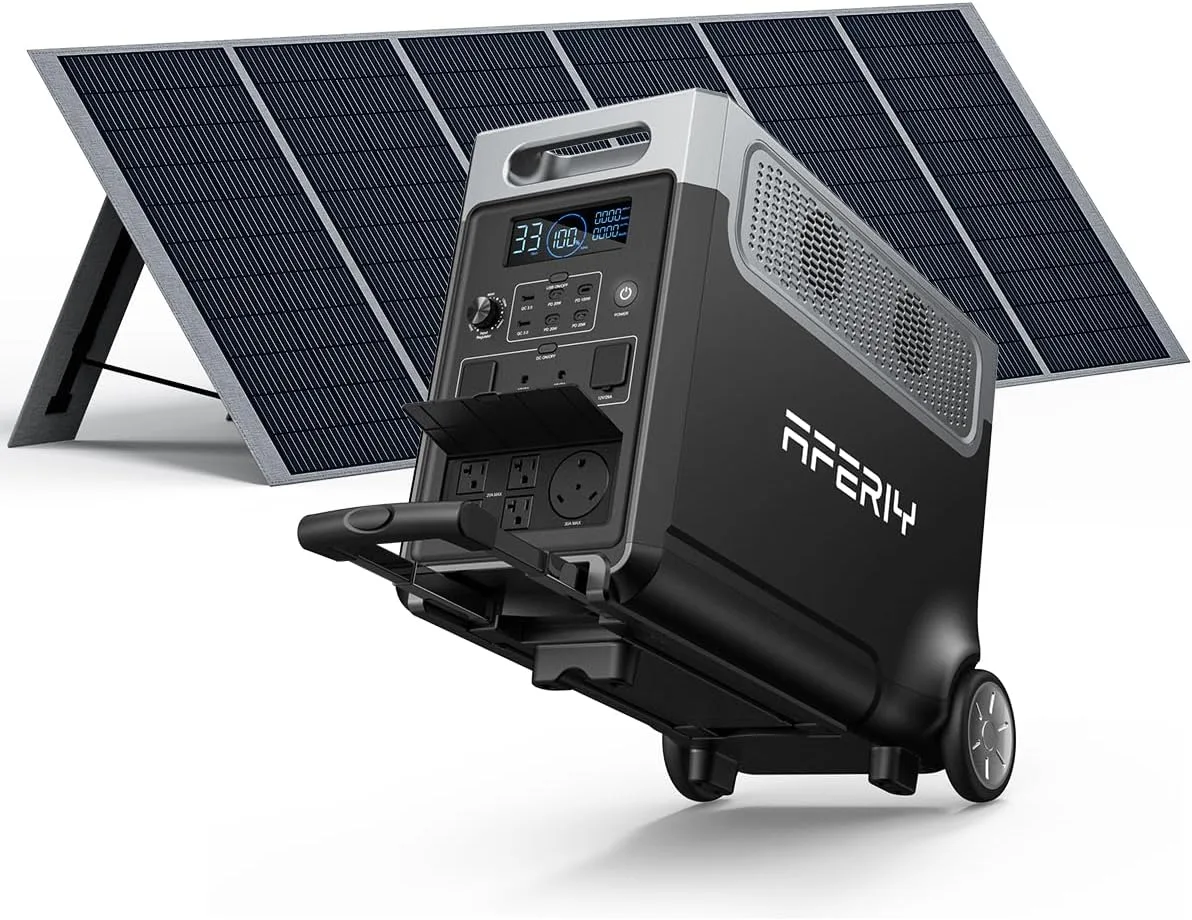
AFERIY Solar Generator 3840Wh Portable Power Station with 400W Solar Panel
Highlights
- 3840Wh rated capacity
- 3600W continuous AC
- 131.6 lb (~59.7 kg)
- About $1799 list
Best for
- AF-P310: longer outages or higher continuous loads (still not whole-home wiring)
- RV / off-grid days where recharge speed matters as much as Wh
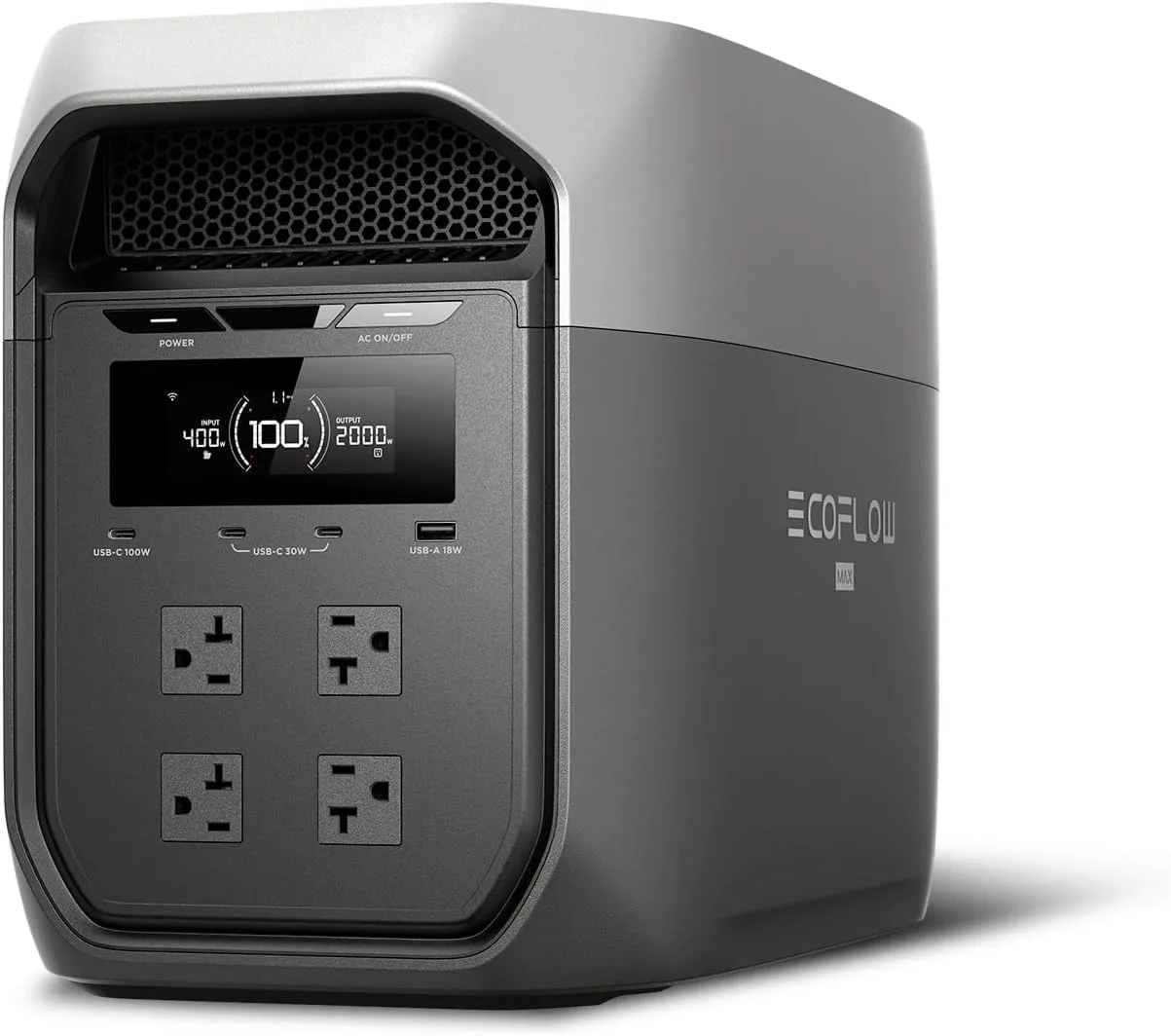
EcoFlow DELTA 3 Max Portable Power Station, 2048Wh LFP Battery
Highlights
- 2048Wh rated capacity
- 2400W continuous AC
- 4800W surge
- LiFePO4 chemistry
- Up to 500W solar input
- 44.8 lb (~20.3 kg)
Best for
- DELTA 3 Max: longer outages or higher continuous loads (still not whole-home wiring)
- RV / off-grid days where recharge speed matters as much as Wh
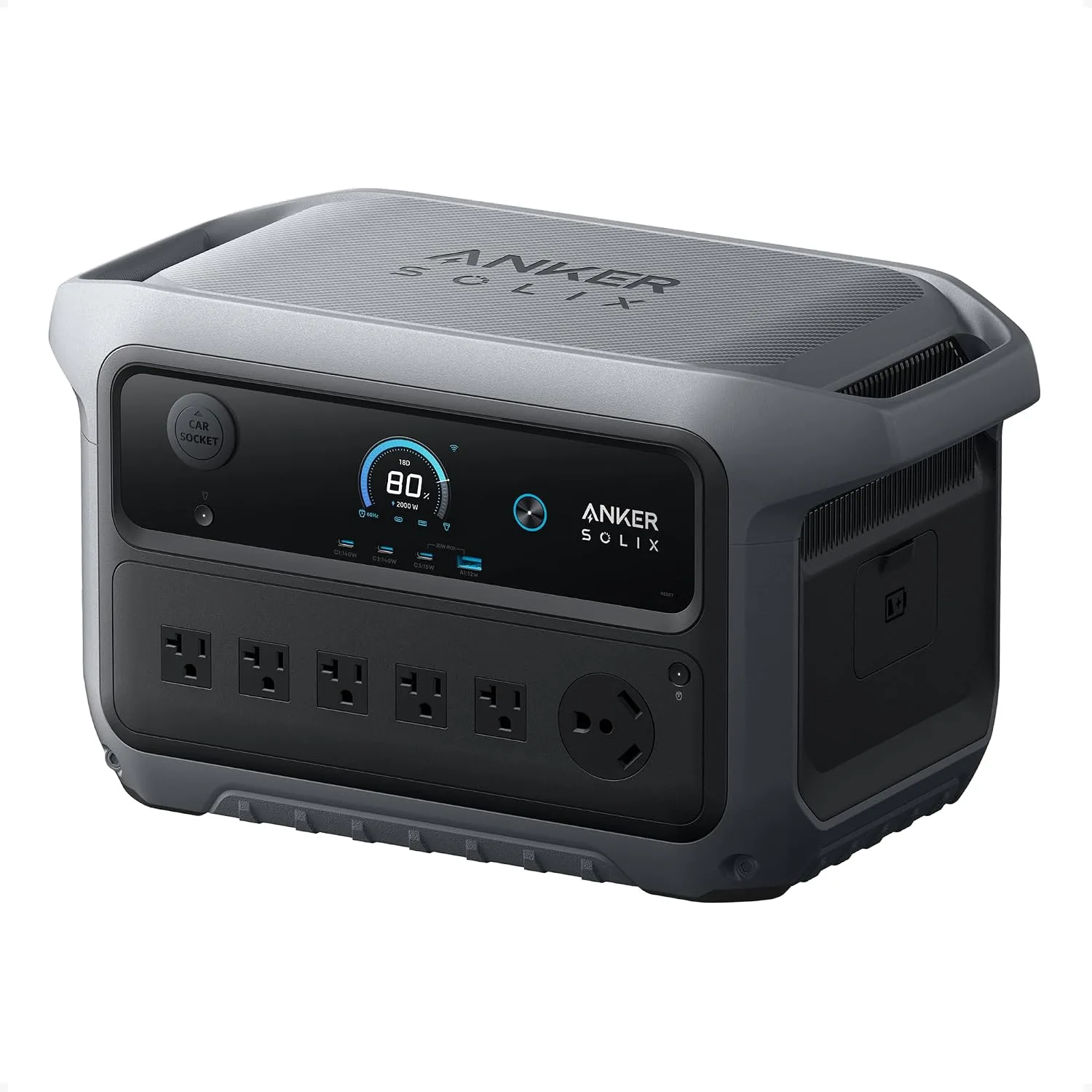
Anker C2000 Gen 2 Portable Power Station, 2,048Wh
Highlights
- 2048Wh rated capacity
- 2400W continuous AC
- 4000W surge
- LiFePO4 chemistry
- Up to 800W solar input
- 41.7 lb (~18.9 kg)
Best for
- C2000 Gen 2: longer outages or higher continuous loads (still not whole-home wiring)
- RV / off-grid days where recharge speed matters as much as Wh
How I weighted this, and what the numbers come from
I weighted four things: usable capacity and output headroom (30%), solar input and recharge speed (30%), portability and noise for camp/van use (20%), and owner-reported reliability plus accessory burden (20%). The 30/30 split is deliberate — off-grid, a big battery you can't refill is dead weight, and a fast-refilling battery that browns out your fridge is worse.
Why those weights and not others: capacity alone rewards marketing numbers, and this category has plenty of those. Solar input is the constraint that actually bites on day three of a trip. Portability and noise matter because most off-grid buyers are moving the thing by hand and sleeping near it. And owner reliability gets real weight because a station that faults in the field is a trip-ender, not an inconvenience.
On method: these are home-user checks grounded in the owner themes on file plus the listing specs — not lab-bench measurements, and not an invented third-party score. Where an owner's report and a spec disagree, the spec wins for numbers and the owner report becomes a caveat.
Tracing #1 over #2: the AFERIY AF-P310 wins on capacity and output headroom outright — 3,840 Wh and 3,600 W against 2,048 Wh and 2,400 W for the EcoFlow DELTA 3 Max. The EcoFlow closes most of that gap on recharge speed and UPS behavior, and it's dramatically easier to move at 44.8 lb versus 131.6 lb. But for a cabin or RV where the station stays put and panels do the refilling, the AFERIY's extra 1,792 Wh is the difference between one overnight and two. That's why it leads despite the weight and the MPPT caveats — but its unpublished solar input is a real gap, so verify that before committing.
Reader takeaway on the two DJI units: the DYM2000L is the higher-output, higher-capacity option at $1,299, while the DYM1000V2H is the budget entry at $469.99 with half the capacity and a third of the continuous watts. Neither includes a solar adapter, so factor that into the total.
Specs to confirm before you buy: max solar input wattage is not published on the AFERIY AF-P310, EcoFlow DELTA 3 Max, or DJI DYM2000L listings — ask the seller for that figure, and treat those three picks as provisional on that one spec until confirmed. The Anker C2000 Gen 2 publishes an 800W solar cap; the DJI DYM1000V2H's solar path runs through a proprietary SDC adapter sold separately.
Scenario facts: the five stations side by side
Prices below are list prices. Ratings are the listing aggregate, which is a popularity signal, not proof of owner satisfaction — the owner themes get their own treatment further down.
| Product | Price | Capacity (Wh) | Output (W) | Weight (lb) | Rating |
|---|---|---|---|---|---|
| DJI DYM2000L | $1299 | 2048 Wh | 3000 W | 47.8 lb | 4.4 |
| DJI DYM1000V2H | $469.99 | 1024 Wh | 1000 W | 33 lb | 4.3 |
| AFERIY AF-P310 | $1799 | 3840 Wh | 3600 W | 131.6 lb | 4.4 |
| Anker C2000 Gen 2 Portable Power Station, 2,048Wh | $1499 | 2048 Wh | 2400 W | 41.7 lb | 4.7 |
| EcoFlow DELTA 3 Max Portable Power Station, 2048Wh LFP Battery | $1199 | 2048 Wh | 2400 W | 44.8 lb | 4.7 |
The ranking
Ranked by the weights above, not by price or brand recognition. Every price is list price.
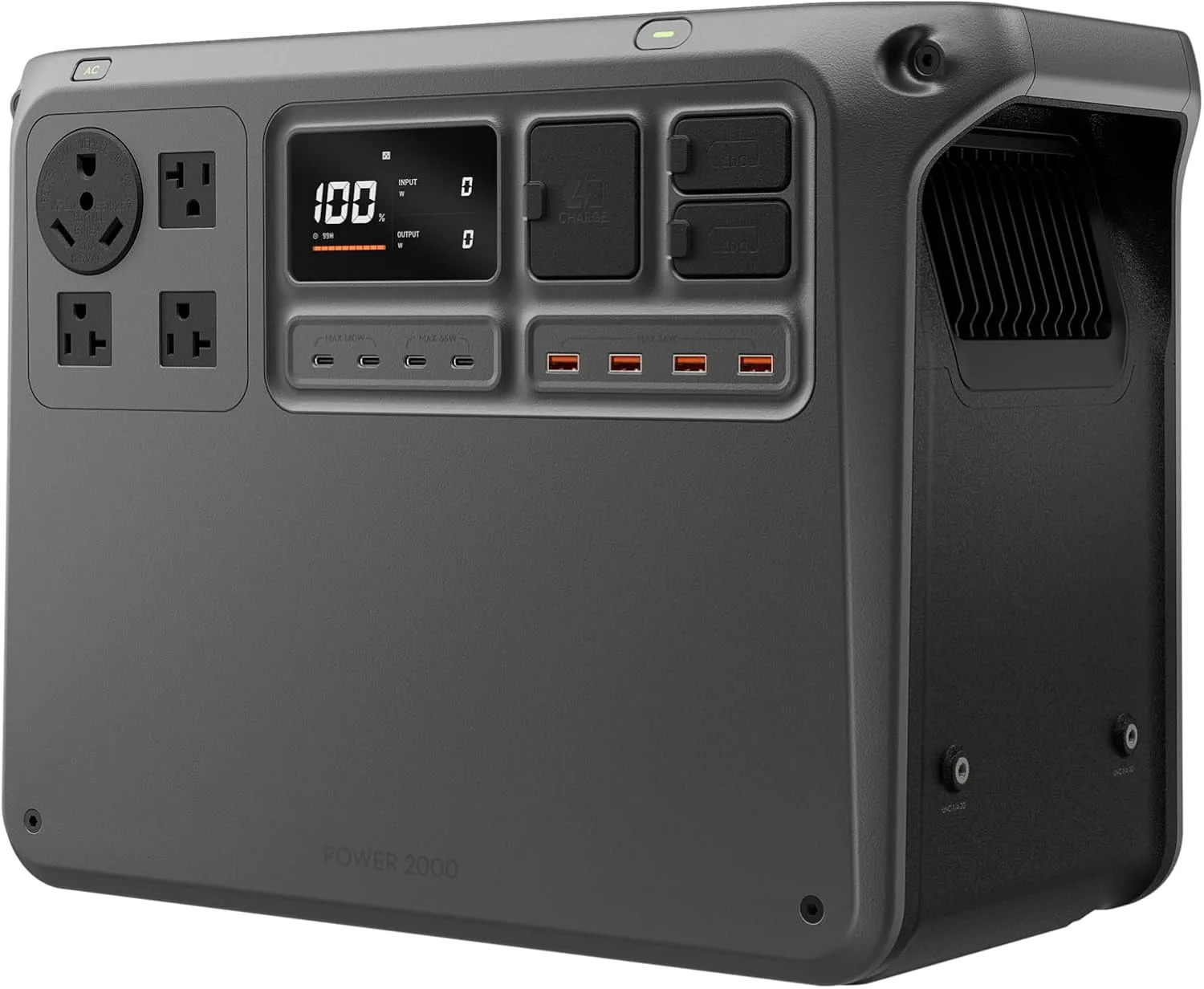
Compact Size, 3000W Stable Output, Fast Recharge, Electric Generator for Home, Camping & RVs, Off-Grid
Highlights
- 2048Wh rated capacity
- 3000W continuous AC
- 47.8 lb (~21.7 kg)
- About $1299 list
Best for
- Compact Size: longer outages or higher continuous loads (still not whole-home wiring)
- RV / off-grid days where recharge speed matters as much as Wh
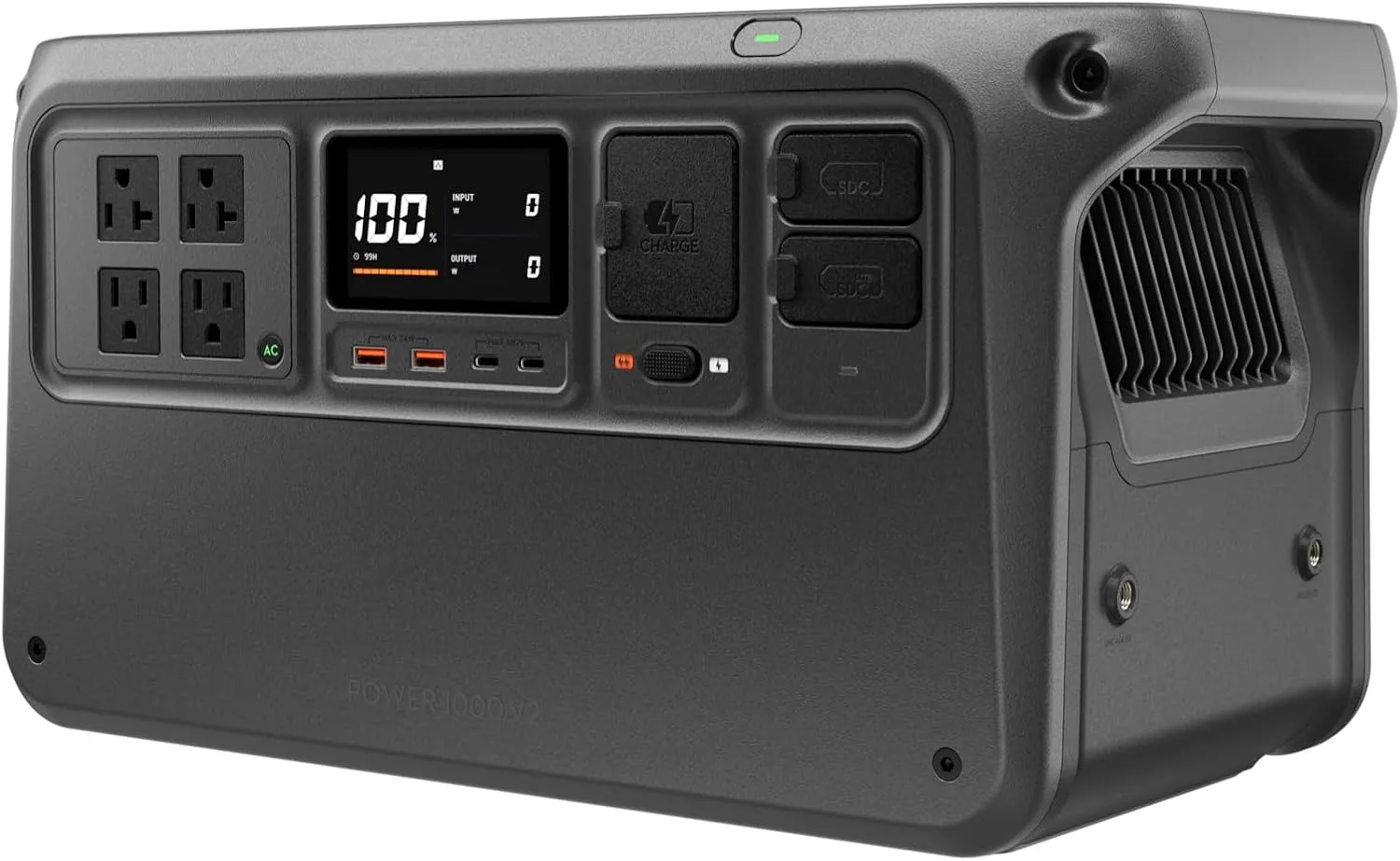
Compact Size, 2600W Stable Output, 0-80% Recharge in 37 Mins, Electric Generator for Home, Camping, RVs, Off-Grid
Highlights
- 1024Wh rated capacity
- 1000W continuous AC
- 33 lb (~15.0 kg)
- About $469.99 list
Best for
- Compact Size: budget quiet camping / light outage loads when list price leads
- Park-and-use backup — at 33 lb (~15.0 kg) this is a poor long hike companion
#1 AFERIY AF-P310 — the capacity play
$1,799 for 3,840 Wh and 3,600 W continuous. That's $0.47/Wh on the nameplate, second-cheapest in this group and the only unit with enough headroom to run a fridge, a Starlink, and lights without doing arithmetic first.
Owner reports describe RV use where the fridge, LED lights, TV, and Starlink all ran, and it would start an AC even though it wouldn't sustain two. A laptop, 4K monitor, and small coffee maker ran with room to spare. Solar recharge off four 445W panels was genuinely fast — the kind of refill rate that makes a multi-day off-grid stay plausible.
The caveats are not small. It weighs 131.6 lb, so this is a wheel-it-and-leave-it station, not a carry. Multiple owners report MPPT charge controller failures, which is exactly the component you're relying on off-grid. One unit arrived with half the LCD dead and charged at roughly 700W; the exchange took weeks of sporadic support email. On a large RV, a microwave tripped it into fault after about 30 seconds. The cooling fan is louder than the EcoFlow or Jackery units owners compared it to.
Suits: a cabin, a parked RV, or a job site where the station lives in one place and panels do the refilling. Skip if: you need to carry it, you can't tolerate a possible MPPT failure mid-season, or you want responsive support as part of the deal.
Solar input wattage for this unit is not published on the listing — the listing describes a bundled 400W panel and 1.5-hour combined AC+solar recharge, but doesn't state a max solar input figure I'd quote. Because this is the #1 pick, treat that missing spec as a verify-before-buy item: confirm the max solar input with the seller before you commit.
#2 EcoFlow DELTA 3 Max — the one you can actually move
$1,199, 2,048 Wh, 2,400 W, 44.8 lb. On nameplate $/Wh that's $0.59, mid-pack. What it buys you is portability and the best UPS behavior in this shortlist.
Owner reports describe setting it up as a UPS for a PC, WiFi modem, and routers, and the 10ms transfer kept the internet up through outages with no dropouts. Charging is quick — full in a little over an hour, and one unit went from 29% to 100% in just over an hour during an actual neighborhood outage while running a laptop, modem, and three pedestal fans. On a fridge run, an iceco VL45Pro held 36°F for a little over five days. The app and storm guard are the least fiddly of the group.
Where it falls short off-grid: no 140W USB output, it caps at 100W, which one highly-rated owner flagged. Another measured average full-charge runtime around 6 hours, shorter than the capacity suggests. And most of the detailed praise is early-ownership — long-term durability isn't well covered in the pack, so treat that as an open question rather than a settled one.
Suits: van life, a station you move between rooms, or anyone who wants UPS-grade switching. Skip if: you need marathon single-charge runtime or high-watt USB-C.
Solar input wattage isn't stated on this listing either — I'm not going to quote a number the listing doesn't publish.
#3 Anker C2000 Gen 2 — fast refill, capped input
$1,499 for 2,048 Wh and 2,400 W, at 41.7 lb. That's $0.73/Wh on the nameplate — the most expensive per Wh here, and the reason it sits third despite the highest listing aggregate in the group.
The recharge story is the strongest of the 2 kWh units. One owner went from 25% to 100% in about an hour during a hurricane outage. It carried a fridge and standalone freezer easily, and with the extra battery a large French-door fridge for over a day. It started a 50-amp RV AC through a 30-amp adapter with no soft-start and ran it about an hour. At home it handled a miter saw, a 120V drill, and cordless tool battery charging on a fence build.
The off-grid problem is the input ceiling: solar tops out at 800W, which is low for this capacity and the tightest cap in this shortlist. Pass-through is also limited — plugged into a 15A outlet, pulling more than 15A from the 30A outlet trips it, so you have to unplug to get full output. It's 41.7 lb, fine for some, a struggle for others. No hard-copy manual; setup lives in the app, and runtime estimates drift with cycling appliances.
Suits: storm backup and job-site loads where AC refilling is available and you want fast turnaround. Skip if: solar is your primary input, or you need full output while plugged into a household circuit.
#4 DJI DYM2000L — output per pound, with a seller caveat
$1,299, 2,048 Wh, and 3,000 W continuous — the highest continuous output of the three 2 kWh units here, at 47.8 lb. That's $0.63/Wh.
Owner reports describe it running as a UPS for several devices through winter-storm outages and holding up. In heavier work it punched above its class: high-power tools and an electric rope winch ran fine, and a Starlink, a large mini-LED TV, and a pellet grill ran simultaneously for hours. It started an RV AC that a 2,000W gas generator couldn't, though only for about 45 minutes. Off-grid, a CPAP with the humidifier off lasted six nights. One owner also noted the unit's display showed a persistent low-battery warning even after a full recharge, which required a firmware update to clear.
The caveat that keeps it out of the top three is not performance — it's provenance and accessories. At least some listings are gray-market imports. One unit arrived set for 50Hz and threw an 'err 43' code mid-charge, stopping every minute or so; DJI confirmed it was a Hong Kong domestic model. Another owner's unit died at about 85% and read 0% on recharge after roughly three weeks. Support outcomes split badly: one replacement after weeks, another owner nearly seven weeks without a repair case number. And no standard solar cable is in the box — one owner paid extra for cables and a mod.
Suits: device-level UPS duty and job-site loads, if you can verify the seller is authorized. Skip if: you can't confirm the seller, or you want solar input without buying adapters.
Max solar input for this listing is unlisted — ask the seller for the figure before you plan an array around it.
#5 DJI DYM1000V2H — cheapest per Wh, smallest battery
$469.99 for 1,024 Wh and 1,000 W at 33 lb. At $0.46/Wh it is the cheapest per nameplate Wh in this shortlist — that's a real distinction and the reason it's here at all.
Owner reports describe it as the quiet one: the fan only spun up during fast AC charging or heavy AC output, so it slept next to an RV without a peep. Coffee machine, kettle, freezer, car fridge, lights, and phone/drone charging all at once, still with juice by morning. A fridge ran nearly 20 hours; a fridge cooler went about three days. Wall recharge was roughly an hour.
But 1,024 Wh is a small battery for off-grid autonomy, and the accessory situation is the worst here. Nothing for solar, 12V, or car charging comes in the box — every input beyond AC and USB runs through DJI's proprietary SDC port, so the WiFi dongle, solar adapter, and car adapter are all separate purchases. One highly-rated owner disputes the 10ms UPS claim outright, reporting it shut off on AC interruption rather than switching, with usable energy around 900Wh and 24–30W idle draw. After about six months, one unit overheated and refused to charge above roughly 80°F ambient.
Suits: a light, quiet weekend unit for a small load where you'll mostly charge from the wall. Skip if: you need multi-day autonomy, true UPS switching for sensitive gear, or standard solar input without buying into SDC adapters.
What goes wrong off-grid
These are the failure modes I'd plan around, drawn from the owner themes on file rather than hypotheticals.
Buying capacity without checking the input cap. A 2 kWh station capped at 800W solar needs a long, sunny day to refill. If your trip is three days and the middle one is overcast, capacity you can't refill is just weight.
Assuming the box has everything. Three of these five need adapters or cables sold separately to accept a panel — and on the DJI units that's a proprietary SDC ecosystem, not a standard MC4-to-XT60 cable. Budget for it before you compare prices.
Treating surge marketing as continuous output. A unit rated 2,400 W continuous may start an RV AC and still not sustain it. Match your buy-rule to the continuous number, never the peak.
Ignoring charge-controller reliability. MPPT failures show up repeatedly in the AFERIY owner reports. That's the one component standing between you and a refilled battery, and it's not something a spec sheet tells you.
Moving a 131.6 lb station by yourself. The AFERIY has a pull handle, but it's a two-person lift into a truck bed. If you're solo and mobile, weight is a spec, not a footnote.
Who should pick something else
If your goal is whole-home backup during an outage, none of these is the right purchase on its own. A 2 kWh station runs a fridge and a few circuits for hours, not a house for days. You want a transfer switch and a generator, or a station explicitly sized against your critical-circuit load — the DJI DYM2000L owner who noted you'd need an extra battery or two to three units for whole-home coverage was being accurate, not modest.
If you need true UPS behavior for medical or server gear, be careful. The EcoFlow DELTA 3 Max has the cleanest 10ms transfer story in this group. The DJI DYM1000V2H has a highly-rated owner disputing its UPS claim outright, and the AFERIY's UPS is load-dependent per its own listing. Don't buy a disputed UPS for a CPAP without a backup plan.
If you're a backpacker or a tent camper moving on foot, all five are wrong. The lightest here is 33 lb. Look at smaller, lighter power stations in the 300–1,000 Wh class instead.
And if you want a station that accepts a standard solar panel without buying a proprietary adapter first, the EcoFlow and Anker are the least friction — the DJI units will cost you extra before a single panel connects.
What owners actually report
Theme summaries from the review packs on file, weighted toward the highly-rated reviews. Listing aggregates are noted for context only.
AFERIY AF-P310 (listing aggregate 4.4, 226 ratings): owners praise RV and off-grid output and expandability, and flag MPPT failures and slow support as the recurring weak points.
EcoFlow DELTA 3 Max (4.7, 650): the 10ms UPS and fast recharge come up repeatedly; the 100W USB ceiling and shorter-than-expected runtime are the consistent gripes.
Anker C2000 Gen 2 (4.7, 726): fast recharge and storm-outage performance dominate; the 800W solar cap and 15A pass-through limit are the noted limits.
DJI DYM2000L (4.4, 807): reliability and output get praise; gray-market units, error codes, and support friction get the critical reviews.
DJI DYM1000V2H (4.3, 1201): quiet operation and fast recharge are the strengths; the SDC accessory ecosystem and a disputed UPS claim are the caveats.
One disclosure: this page uses Amazon Associates links, and purchases through them may earn a commission. The ranking follows the weights above, not commission rates. I'm Avery Nolan, WattPicks founding editor — capacity, output, and price-per-Wh guidance across the catalogue, with no lab claims.
Frequently asked
How much solar do I need to keep the AFERIY AF-P310 topped up?
The listing doesn't publish a max solar input figure, so I won't invent one. What owners describe is recharging fast off four 445W panels, and a bundled 400W panel with a 1.5-hour combined AC+solar recharge. Size your array to your daily draw, not to a number I guessed.
Can the Anker C2000 Gen 2 run a fridge overnight and refill on solar the next day?
Running a fridge overnight is well within its owner reports. Refilling is the constraint: solar tops out at 800W, so a full recovery from a heavy overnight draw takes most of a good sunny day.
Which of these is cheapest per watt-hour?
The DJI DYM1000V2H at $0.46/Wh on the nameplate. The AFERIY AF-P310 is next at $0.47/Wh, then the EcoFlow DELTA 3 Max at $0.59/Wh, the DJI DYM2000L at $0.63/Wh, and the Anker C2000 Gen 2 at $0.73/Wh.
Do any of these include a solar panel?
The AFERIY listing describes a bundled 400W panel, and notes the panel and station ship separately. The other four list no panel in the box, and the DJI units also need a separate adapter before a panel connects.
How can I verify the DJI DYM2000L isn't a gray-market unit?
Check that the seller is an authorized DJI dealer, confirm the unit is set for 60Hz US operation (not 50Hz), and ask about the serial number and warranty coverage before buying. Owner reports include a Hong Kong domestic model that threw an 'err 43' code, so seller verification is the main safeguard.
Method and sources
Model names and list prices come from the WattPicks catalog at build time. WattPicks does not run its own laboratory tests on power stations, and nothing on this page is presented as a measured result — it is catalog-backed buying guidance.
Read our methodology for how the catalog is normalized, and about WattPicks for who publishes it.