
Best Solar Generator for Off-Grid Living: 6 Ranked Picks
Off-grid living asks a different question than camping: can this station carry a fridge, a well pump, and a week of cloudy days? Here are six stations ranked by usable capacity, surge headroom, and solar recharge speed — with the trade-offs spelled out.
Updated
What off-grid living actually asks of a solar generator
The question is not "how many watts" — it is whether the station can carry your daily load through a stretch of bad weather without you babysitting it. Off-grid, that usually means a fridge cycling on and off, lights and a router, a CPAP or a fan overnight, and — the hard one — a pump or a well that surges hard for a few seconds at startup.
So this list is not for weekend campers chasing the lightest box, and it is not a whole-home transfer-switch guide either. If you are wiring a smart panel into your breaker box, that is a different article. Here I am ranking six stations on usable capacity, surge headroom for motor loads, and how fast they refill from panels — the three things that decide whether an off-grid setup holds.
One editorial note up front: none of these ships with panels. Pairing a station with matching solar is a buying decision you make alongside the box, not a separate pick on this list.
Amazon Associates disclosure: as an Amazon Associate, WattPicks earns from qualifying purchases. Picks here are fit-led, not commission-led.
- Surge matters more than nameplate watts for pumps and fridges
- Cloudy-day reserve is capacity minus what you can realistically recharge
- Panel pairing is a separate purchase for every unit below
The shortlist at a glance
Six stations, ranked by how well they hold an off-grid load rather than by brand recognition. Prices are list prices; the deal stickers you see on the listing are a different number and I have left them out of the table on purpose so the comparison stays honest.
Budget tiers, so you can jump to the right row: sub-$500 gets you the AFERIY AF-P180Pro or DJI DYM1000V2H — fine for lights, a router, and short outages, but not a cabin anchor. The $1,199–$1,499 band is the 2048Wh middleweight class (EcoFlow DELTA 3 Max, Anker C2000 Gen 2, DJI DYM2000L) and covers most fridge-plus-network off-grid setups. The $3,699 DELTA Pro 3 is the only tier that adds 240V output for a well pump.
- #1 EcoFlow DELTA Pro 3 Portable Power Station, 4096Wh — the only unit here with 240V output and enough surge to start a well pump.
- #2 DJI DYM2000L — 3000W continuous in a 47.8 lb box; the tool-and-RV pick.
- #3 EcoFlow DELTA 3 Max Portable Power Station, 2048Wh LFP Battery — the quiet, app-friendly middleweight for network gear and fridges.
- #4 Anker C2000 Gen 2 Portable Power Station, 2,048Wh — best-documented hurricane and RV-AC performance of the 2048Wh group.
- #5 AFERIY AF-P180Pro — cheapest way to get 1800W and a fast UPS, if you accept thin long-term data.
- #6 DJI DYM1000V2H — the quiet small unit; a weekend and short-outage box, not an off-grid anchor.
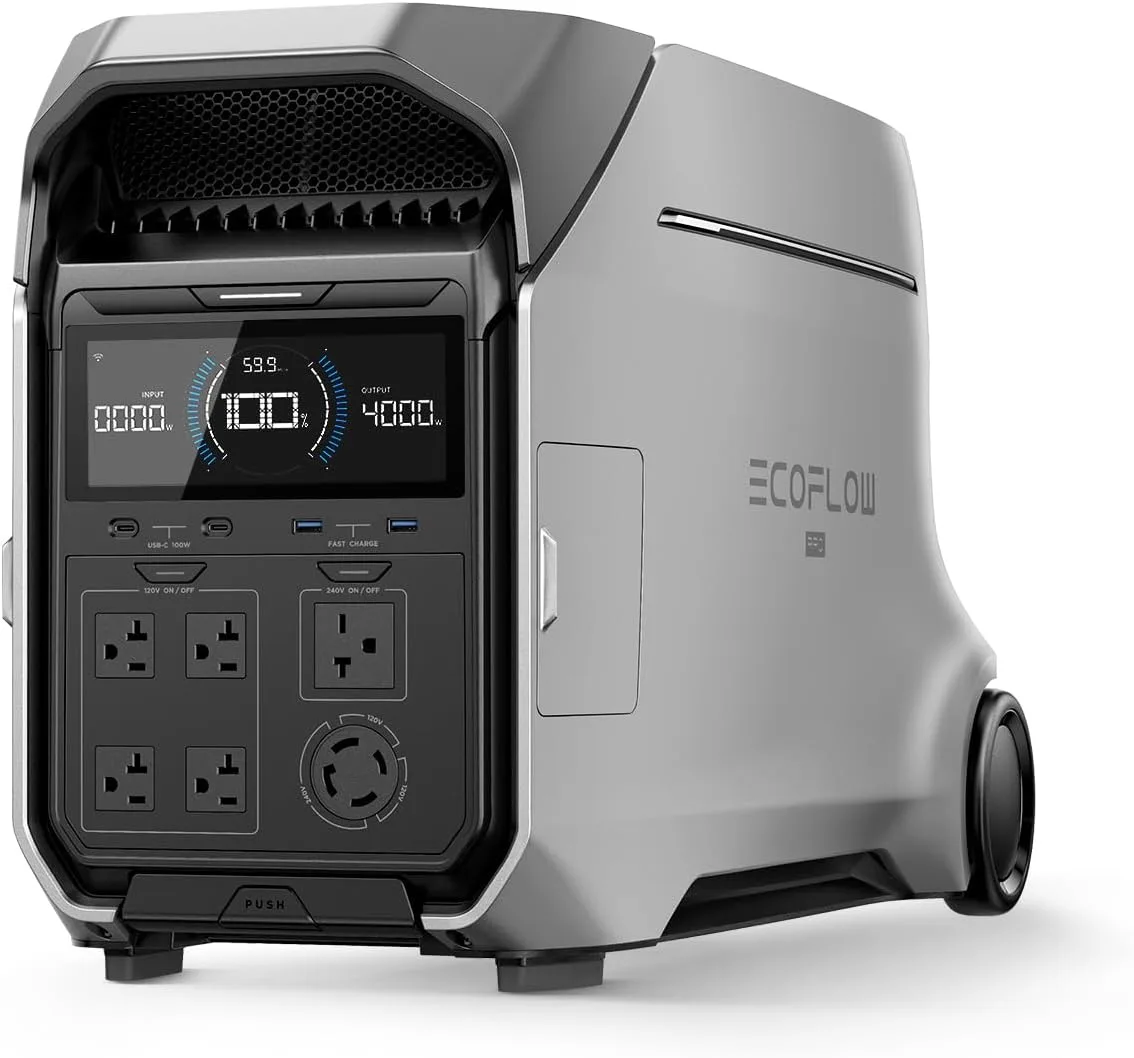
EcoFlow DELTA Pro 3 Portable Power Station, 4096Wh
Highlights
- 4096Wh rated capacity
- 4000W continuous AC
- 8000W surge
- LiFePO4 chemistry
- Up to 2600W solar input
- 113.5 lb (~51.5 kg)
Best for
- DELTA Pro 3: longer outages or higher continuous loads (still not whole-home wiring)
- RV / off-grid days where recharge speed matters as much as Wh
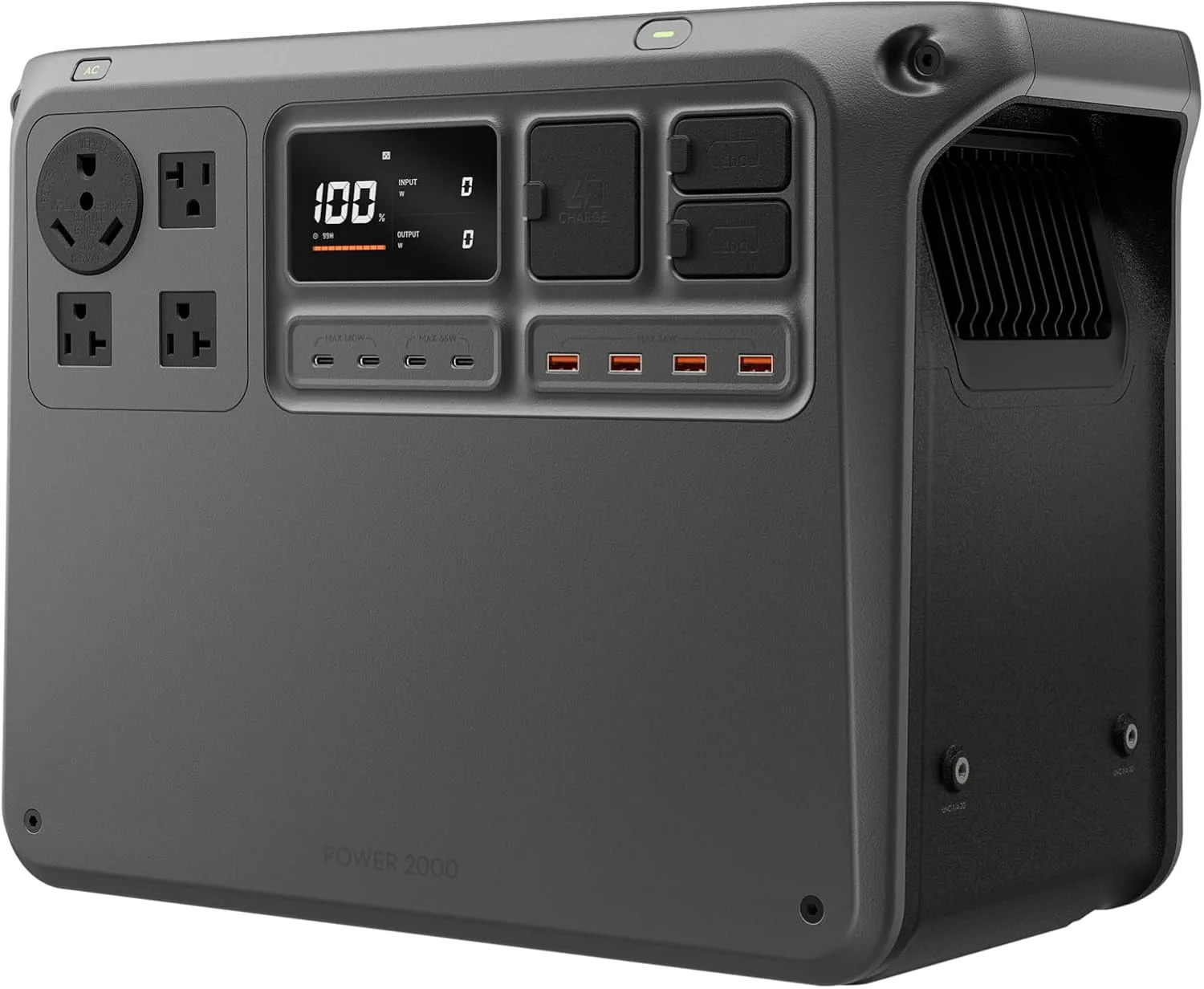
Compact Size, 3000W Stable Output, Fast Recharge, Electric Generator for Home, Camping & RVs, Off-Grid
Highlights
- 2048Wh rated capacity
- 3000W continuous AC
- 47.8 lb (~21.7 kg)
- About $1299 list
Best for
- Compact Size: longer outages or higher continuous loads (still not whole-home wiring)
- RV / off-grid days where recharge speed matters as much as Wh
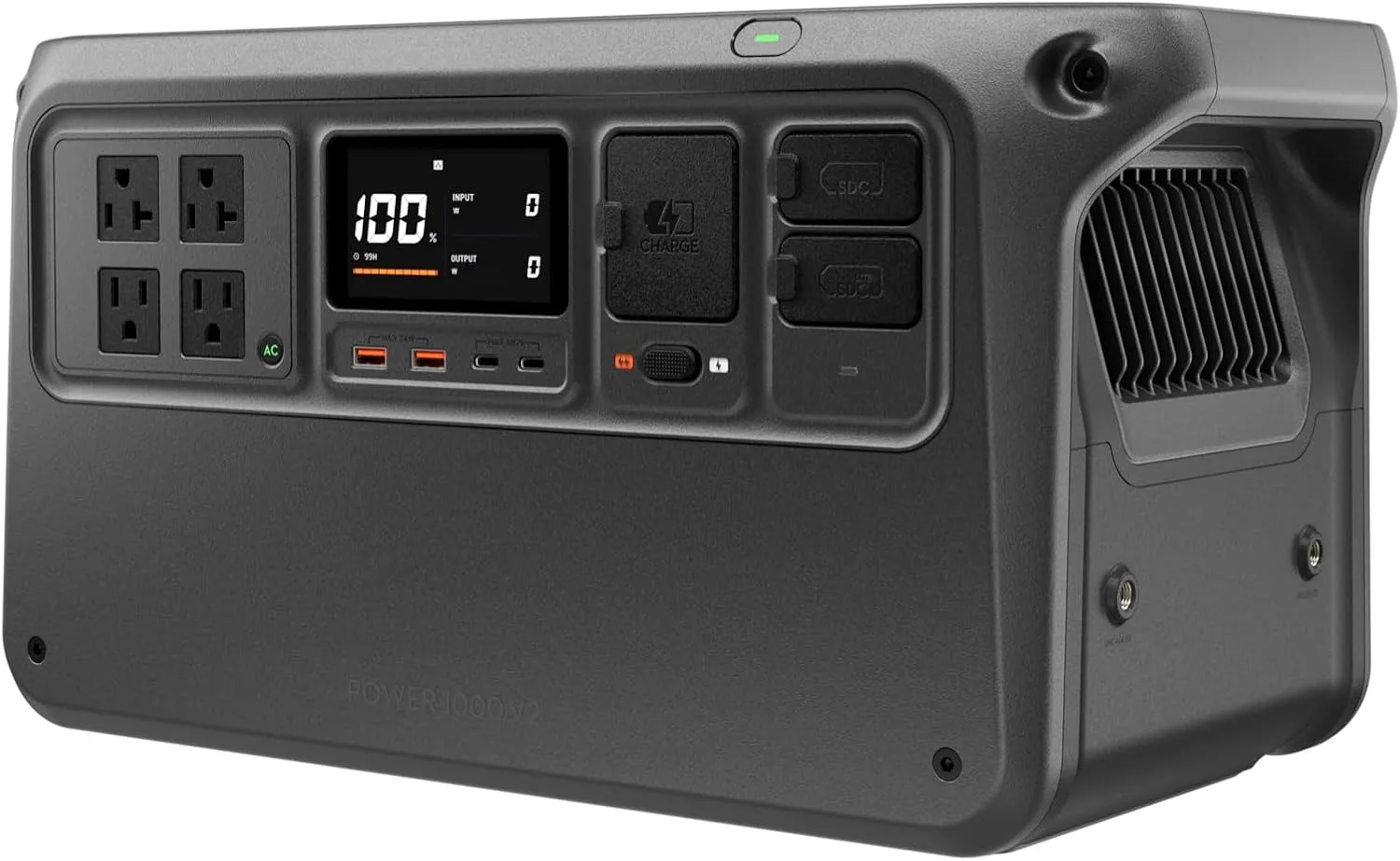
Compact Size, 2600W Stable Output, 0-80% Recharge in 37 Mins, Electric Generator for Home, Camping, RVs, Off-Grid
Highlights
- 1024Wh rated capacity
- 1000W continuous AC
- 33 lb (~15.0 kg)
- About $469.99 list
Best for
- Compact Size: budget quiet camping / light outage loads when list price leads
- Park-and-use backup — at 33 lb (~15.0 kg) this is a poor long hike companion
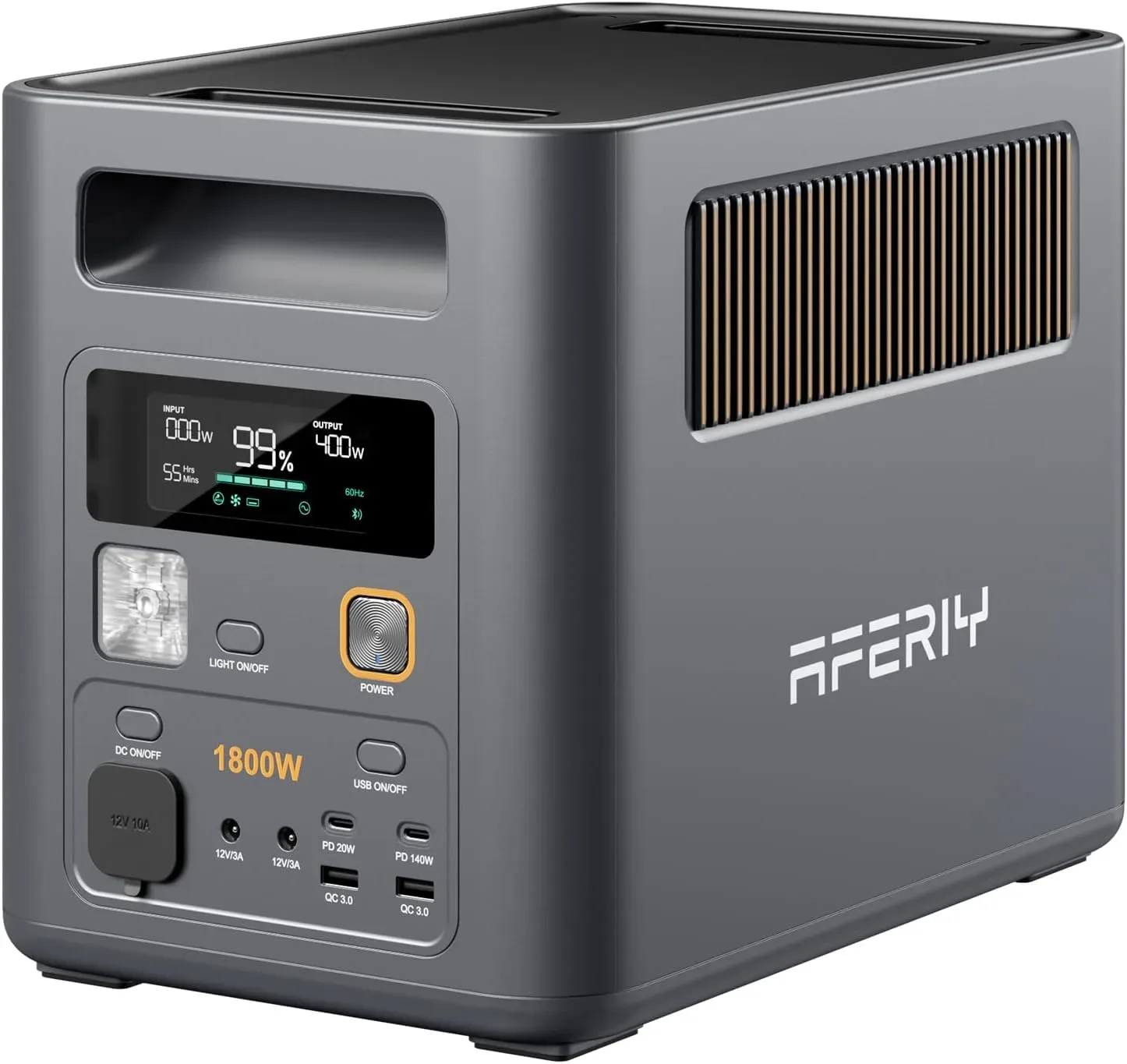
AFERIY Portable Power Station 1024Wh Solar Generator 1800W(Peak 3600W)
Highlights
- 1024Wh rated capacity
- 1800W continuous AC
- 28 lb (~12.7 kg)
- About $499 list
Best for
- AF-P180Pro: small appliances and tools that need ~1800W continuous, not just phone charging
- Essentials bridge at home (fridge cycles, router) when sized to the Wh
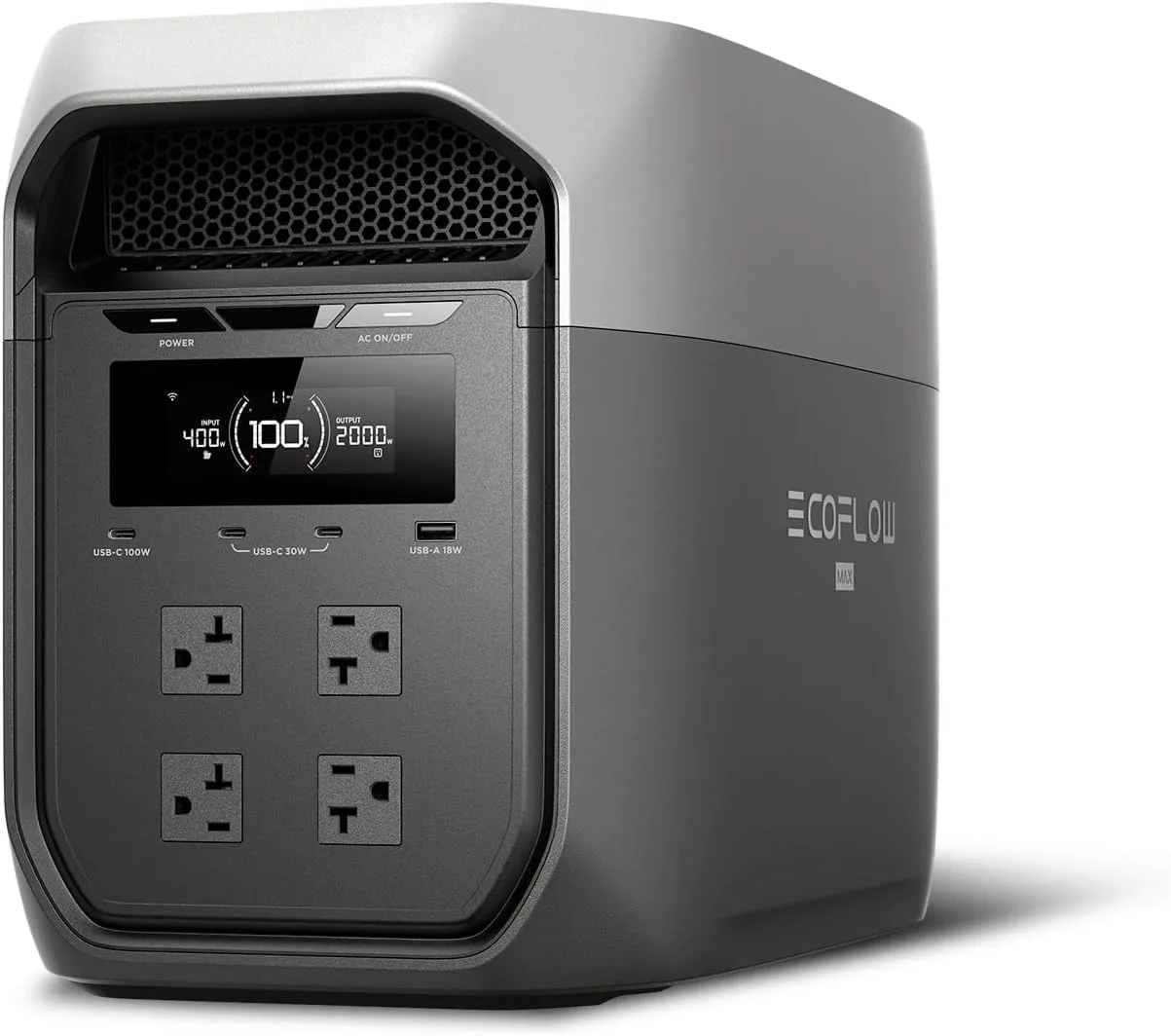
EcoFlow DELTA 3 Max Portable Power Station, 2048Wh LFP Battery
Highlights
- 2048Wh rated capacity
- 2400W continuous AC
- 4800W surge
- LiFePO4 chemistry
- Up to 500W solar input
- 44.8 lb (~20.3 kg)
Best for
- DELTA 3 Max: longer outages or higher continuous loads (still not whole-home wiring)
- RV / off-grid days where recharge speed matters as much as Wh
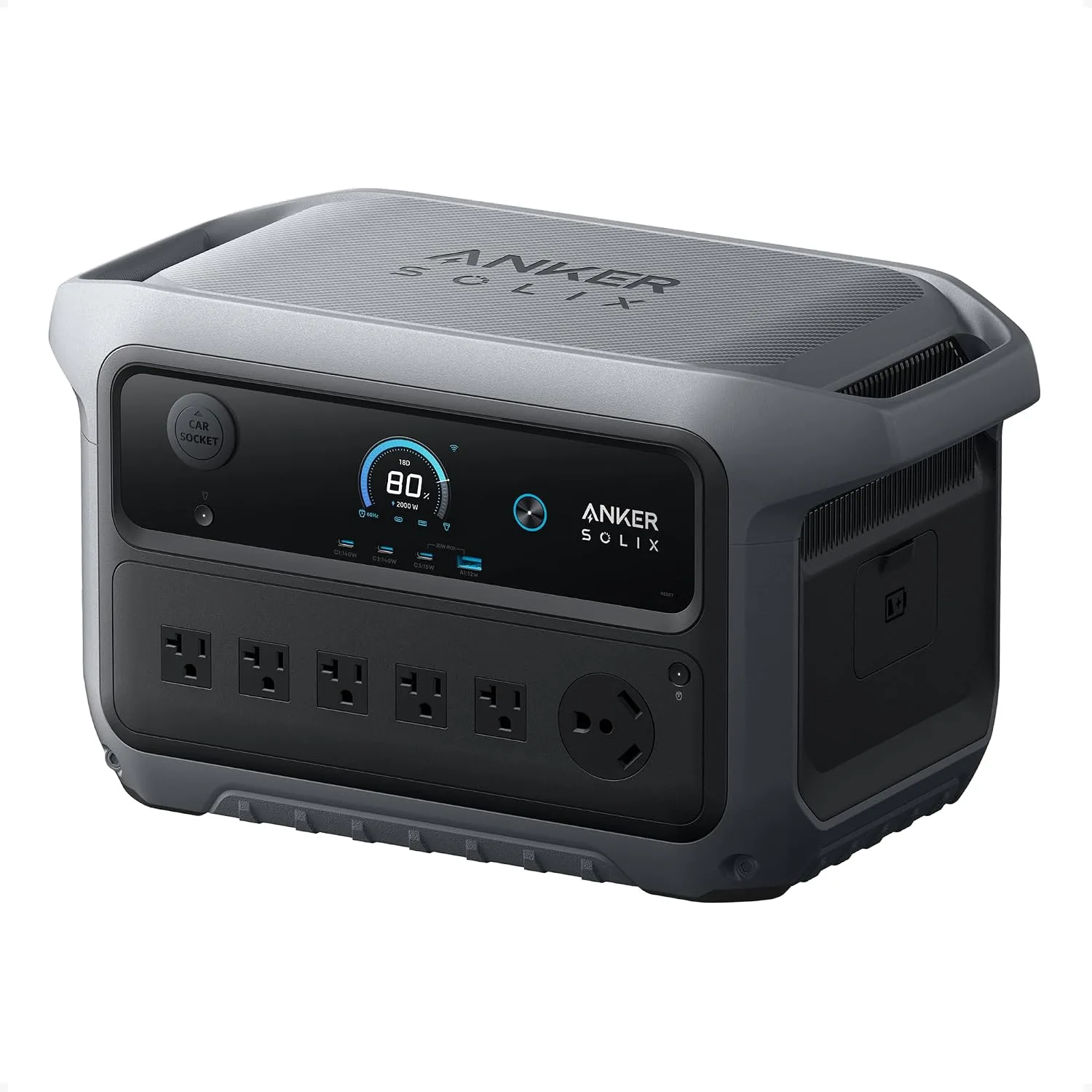
Anker C2000 Gen 2 Portable Power Station, 2,048Wh
Highlights
- 2048Wh rated capacity
- 2400W continuous AC
- 4000W surge
- LiFePO4 chemistry
- Up to 800W solar input
- 41.7 lb (~18.9 kg)
Best for
- C2000 Gen 2: longer outages or higher continuous loads (still not whole-home wiring)
- RV / off-grid days where recharge speed matters as much as Wh
How I ranked these six
I am a deep-use experience reviewer working from the listing specs on file plus the owner themes I have collected on these units — home-user checks, not lab-bench measurements. No third-party lab scores are invented here, and where the owner data is thin I say so rather than paper over it.
The weights: usable capacity for real off-grid loads, 30%. Surge and continuous output headroom for motor loads, 25%. Solar and AC recharge speed, 20%. Portability and weight, 15%. Owner-reported reliability and support friction, 10%.
Why #1 beats #2: the DELTA Pro 3 wins on the two heaviest weights at once. It is the only station in this group with 240V output, and owners report it starting a 240V well pump and carrying a house off its 30A outlet — a load class the DJI DYM2000L's 3000W continuous output cannot reach without 240V. The DJI claws back points on weight (47.8 lb vs 113.5 lb) and on price per watt-hour, which is why it sits second rather than last.
On nameplate cost per watt-hour, the DJI DYM1000V2H is the cheapest of the six at a calculated $0.46/Wh (list price divided by nameplate Wh) — but it ranks sixth because 1024Wh and 1000W continuous will not anchor an off-grid cabin, and that is the whole point of this list.
Weighted scores on those weights (out of 10, then scaled to 100): EcoFlow DELTA Pro 3 — 9.0/10 (90/100); DJI DYM2000L — 8.5/10 (85/100); EcoFlow DELTA 3 Max — 8.0/10 (80/100); Anker C2000 Gen 2 — 7.5/10 (75/100); AFERIY AF-P180Pro — 7.0/10 (70/100); DJI DYM1000V2H — 6.5/10 (65/100). These are my editorial scores, not lab results.
A worked load example to show how the three metrics decide a pick: say your fridge draws about 1,200 Wh/day (a typical cycling figure, not a measured one) and your well pump surges to roughly 3,000W for a second at startup. The DELTA Pro 3's 4096Wh covers three-plus days of fridge-only reserve before recharge, and its 240V output clears the pump surge. The DJI DYM2000L covers the same fridge days on 2048Wh (about 1.7 days) and its 3000W continuous handles many 120V motor surges, but it cannot start a 240V pump at all. That single line — 240V or not — often decides the pick before capacity does. Note that these are nameplate figures; after inverter losses you should plan on roughly 85% usable capacity, so the DJI's 1.7 days is closer to 1.4 days in practice.
| Product | Price | Capacity (Wh) | Output (W) | Weight (lb) | Amazon star rating (accessed Feb 2025) |
|---|---|---|---|---|---|
| EcoFlow DELTA Pro 3 Portable Power Station, 4096Wh | $3699 | 4096 Wh | 4000 W | 113.5 lb | 4.3 |
| DJI DYM2000L | $1299 | 2048 Wh | 3000 W | 47.8 lb | 4.4 |
| DJI DYM1000V2H | $469.99 | 1024 Wh | 1000 W | 33 lb | 4.3 |
| AFERIY AF-P180Pro | $499 | 1024 Wh | 1800 W | 28 lb | 4.7 |
| EcoFlow DELTA 3 Max Portable Power Station, 2048Wh LFP Battery | $1199 | 2048 Wh | 2400 W | 44.8 lb | 4.7 |
| Anker C2000 Gen 2 Portable Power Station, 2,048Wh | $1499 | 2048 Wh | 2400 W | 41.7 lb | 4.7 |
Why each one earned its slot
Ranked in order. Each entry gets the same treatment: what the listing says, what owners report, and who it is actually for. Compact spec snapshots appear in each pick so you can compare without scrolling back to the master table.
| Product | Price | Capacity (Wh) | Output (W) | Weight (lb) | Rating |
|---|---|---|---|---|---|
| EcoFlow DELTA Pro 3 Portable Power Station, 4096Wh | $3699 | 4096 Wh | 4000 W | 113.5 lb | 4.3 |
| DJI DYM2000L | $1299 | 2048 Wh | 3000 W | 47.8 lb | 4.4 |
| DJI DYM1000V2H | $469.99 | 1024 Wh | 1000 W | 33 lb | 4.3 |
| AFERIY AF-P180Pro | $499 | 1024 Wh | 1800 W | 28 lb | 4.7 |
| EcoFlow DELTA 3 Max Portable Power Station, 2048Wh LFP Battery | $1199 | 2048 Wh | 2400 W | 44.8 lb | 4.7 |
| Anker C2000 Gen 2 Portable Power Station, 2,048Wh | $1499 | 2048 Wh | 2400 W | 41.7 lb | 4.7 |
#1 EcoFlow DELTA Pro 3 Portable Power Station, 4096Wh — the only one that starts the well pump
4096Wh and 4000W continuous, at $3699, and 113.5 lb. That weight is the whole story of this unit: it is a garage fixture, not something you carry to a tent.
Owners report the pass-through UPS held a desktop through a pulled AC cord without a reboot, and in a real day-long outage the house ran off its 30A outlet — including a 240V well pump. Stacking an extra battery carried a multi-day storm with the fridge and a small AC running, and a couple of hours of gas-generator charging a day kept fuel use sane.
The cracks are real. Lifting it into a vehicle is a two-person job, and the app buries settings in different places where some cancel others. One owner report describes a locked BMS (Error 71) and a weeks-long hazardous-material return fight — I did not hit that, but on a backup unit it is the failure that matters most.
What could go wrong in year 2–3: LFP batteries degrade gradually, and the 4096Wh capacity will slowly shrink with heavy cycling. EcoFlow's warranty is solid on paper, but the BMS/hazmat return report suggests support friction is possible if something goes wrong. Budget for a replacement or extra battery after several years of daily use.
Suits: off-grid cabins and home backup where the station stays put and a 240V pump is on the circuit. Skip if: you need to move it weekly, or you want a simple app.
- 240V output is unique in this group
- 113.5 lb — plan a permanent spot
- App and Delta-model accessory compatibility are genuinely confusing
#2 DJI DYM2000L — 3000W continuous in a box you can actually lift
2048Wh, 3000W continuous, 47.8 lb, $1299. The continuous rating is the highest per pound in this shortlist, and owners put it to work.
Owners report using this mostly as a job-site and RV unit. It started an RV AC that a 2000W generator could not, ran high-power tools and an electric winch without tripping, and held a Starlink, a large TV, and a pellet grill at once for hours. AC recharge is fast and it is quiet enough to forget.
Two caveats worth the money. Some units ship as gray-market Hong Kong models set to 50Hz and throw a charging error until DJI resolves it — check the seller. And solar or 12V charging needs proprietary SDC adapters that are not in the box. One owner report describes a unit dying near 85% and then sitting in DJI's repair system for weeks.
What could go wrong in year 2–3: the 2048Wh LFP pack will lose some capacity over time, and DJI's repair turnaround has been reported as slow. The proprietary SDC adapters also mean you are locked into DJI's ecosystem for solar charging, which could become a hassle if you want to expand later.
Suits: job sites, RVs, and off-grid setups with big motor loads that do not need 240V. Skip if: you want plug-and-play solar without buying adapters.
- 3000W continuous is the surge story here
- SDC adapters for solar and 12V are sold separately
- Verify the seller — gray-market 50Hz units exist
#3 EcoFlow DELTA 3 Max Portable Power Station, 2048Wh LFP Battery — the quiet network-gear anchor
2048Wh, 2400W continuous, 44.8 lb, $1199. It sits third because it does the everyday off-grid job — fridge, router, PC — without drama, at a lower price than the Anker.
Owners report setting this up as a UPS substitute for network gear and a PC, and the 10ms transfer did its job: when the power dropped, the WiFi and router stayed up. Recharging to full took a little over an hour, and a 12V fridge at 36F ran more than five days.
The gripe is USB: it tops out at 100W, and owners wish there were a 140W port for modern laptops. The pack also has no critical reviews that flag a repeated failure, so I cannot point to a pattern — that is a data gap, not proof of perfection.
What could go wrong in year 2–3: LFP chemistry is durable, but the 2048Wh capacity will degrade with heavy use. EcoFlow's warranty covers defects, but the lack of long-term owner reports means we do not yet know how this model holds up after several years of daily cycling.
Suits: home backup and fridge duty where fast recharge and a clean app matter. Skip if: you need high-wattage USB-C without a separate adapter.
- 10ms transfer kept network gear up
- 12V fridge at 36F ran five-plus days
- 100W USB ceiling — no 140W port
#4 Anker C2000 Gen 2 Portable Power Station, 2,048Wh — the hurricane-tested 2048Wh
2048Wh, 2400W continuous, 41.7 lb, $1499. It ranks below the DELTA 3 Max on price for the same capacity, but the owner-reported record on real outages is the strongest in this group.
Owners report using this through a hurricane outage and around an RV. It ran a fridge and freezer overnight, went from 25% to full in about an hour at a powered house, and started an RV AC without a soft-start kit. At home it ran a miter saw, a drill, and tool battery chargers without flinching, and it powered a CPAP for two nights plus TV time.
The limits are specific. In pass-through mode it caps output to the wall circuit — full 30A output means unplugging from the wall. Solar input is capped at 800W, lower than some owners want at this size. And there is no hard-copy manual; many settings live only in the app.
What could go wrong in year 2–3: the 2048Wh battery will degrade with cycling, and Anker's warranty terms are worth checking for the specific model. The app-only manual means if the app changes or your phone breaks, you could be stuck without setup instructions during an outage.
Suits: short outages and RV use where fast recharge and a clean app matter. Skip if: you need high solar input or full output while plugged into a 15A circuit.
- Pass-through mode caps output to the wall circuit
- 800W solar input ceiling
- App-only manual — read it before an outage
#5 AFERIY AF-P180Pro — the budget 1800W with a fast UPS
1024Wh, 1800W continuous, 28 lb, $499. The lightest and cheapest way here to get a sub-10ms UPS and 1800W of output, with 14 AC outlets on the listing.
Owners report using this as a solar-tied home backup and around outdoor events. On hot days a window AC unit ran off two 200W panels with a noticeable drop in the power bill, a portable washing machine ran two hours on about 30% of the battery, and a five-hour outdoor event kept fans, speakers, phones, and laptops going with charge to spare.
The cracks are ergonomic and software. The app is poor and occasionally makes a strange modem-like sound, and the display sits opposite the outlets, which is awkward when plugging in. Long-term durability is unproven — most reviews are short-term, so I cannot vouch for the battery after years of cycles.
What could go wrong in year 2–3: the 1024Wh battery will degrade, and AFERIY's long-term support record is thin. With mostly short-term reviews, there is little evidence on how the unit performs after a few years of regular use, so budget for potential replacement sooner than with a better-documented brand.
Suits: solar tinkerers and short outages where fast recharge and a low entry price matter. Skip if: you want a polished app or a proven long-term track record.
- 28 lb — the lightest unit on this list
- Sub-10ms UPS at a budget price
- Long-term durability data is thin
#6 DJI DYM1000V2H — quiet, small, and honest about it
1024Wh, 1000W continuous, 33 lb, $469.99. It is the cheapest per nameplate watt-hour of the six at a calculated $0.46/Wh, and it still ranks last here because 1024Wh and 1000W will not anchor an off-grid cabin.
Owners report running this on RV trips and around the house. The fan only kicked in during fast AC charging or heavy output, and at normal loads it was barely audible. A coffee machine, kettle, and freezer all ran, and a weekend trip kept a car fridge, camping lights, and drone batteries going overnight with charge left in the morning. AC recharge took about an hour.
The trade-offs are real. Most inputs and outputs beyond basic AC and USB need proprietary SDC adapters sold separately. One owner report measured poor efficiency, high idle draw, and overheating errors above 80F after months of use — I did not hit that, but it is the failure mode to watch if you run it hard in heat.
What could go wrong in year 2–3: the 1024Wh battery will lose capacity over time, and the proprietary SDC adapters limit your solar options. The reported overheating and efficiency issues suggest this unit may not hold up well under heavy, continuous use in hot climates.
Suits: quiet RV and camping use where fast recharge and light weight matter. Skip if: you need maximum capacity or plug-and-play solar without adapters.
- Cheapest nameplate $/Wh here at a calculated $0.46/Wh
- SDC adapters required for solar and 12V
- One owner report of efficiency and overheat issues
Where off-grid buyers get burned
Three mistakes show up again and again in the owner notes I read for this list.
First, buying capacity without checking surge. A fridge is easy; a well pump is not. If your off-grid setup includes a pump, the 240V output on the DELTA Pro 3 is the difference between working and not.
Second, assuming solar is plug-and-play. The DJI units need SDC adapters that are not in the box, and the Anker caps solar input at 800W. Budget for the adapters and panels as part of the station cost.
Third, trusting the app estimate. Owners on the Anker and AFERIY both note the remaining-time readout drifts when an appliance cycles on and off. Plan reserve by watt-hours, not by the countdown on screen.
- Check surge for any motor load before you buy
- Adapters and panels are separate purchases
- Do not size your reserve off the app's time-remaining estimate
Who should not buy the top pick
The DELTA Pro 3 is the right answer for a stationary cabin with a 240V pump. It is the wrong answer for two clear groups.
If you move your power weekly — van life, job sites, rotating between a cabin and a house — 113.5 lb will wear you down, and the DJI DYM2000L at 47.8 lb with 3000W continuous is the better tool.
If you want a simple, reliable app and a proven long support record, the DELTA Pro 3's app confusion and the one owner report of a BMS-and-hazmat-return fight are a real risk on a unit you are counting on during an outage. The Anker C2000 Gen 2 has the cleaner owner-reported record on support, even at a higher price per watt-hour.
- Skip the top pick if you move the station weekly
- Skip it if app simplicity and support history outweigh 240V output
Who should not buy picks #2–#5
The top pick gets the most scrutiny, but the middle of this list has its own misfit cases. Here is who should walk away from each.
DJI DYM2000L (#2): skip it if you need 240V output for a well pump — it cannot do it — or if you want solar charging without buying proprietary SDC adapters. Also skip if you are not willing to verify the seller, since gray-market 50Hz units are a known issue.
EcoFlow DELTA 3 Max (#3): skip it if you need more than 100W USB-C for laptops, or if you want a documented long-term reliability record — there are no critical reviews that flag a repeated failure yet.
Anker C2000 Gen 2 (#4): skip it if you need full output while plugged into a 15A wall circuit (pass-through caps it), if you want more than 800W of solar input, or if you rely on a printed manual during an outage.
AFERIY AF-P180Pro (#5): skip it if app quality matters to you, if you need proven multi-year durability, or if you expect a panel in the box — none of these units ships with one.
- #2: no 240V, needs SDC adapters, verify seller
- #3: 100W USB ceiling, thin critical-review record
- #4: pass-through output cap, 800W solar ceiling, app-only manual
- #5: weak app, unproven long-term durability, no panel included
If none of these fit
Two directions worth considering instead of forcing one of these six.
If your off-grid load is lighter than a cabin anchor — a small, quiet box for a weekend cabin with lights, a router, and a CPAP — the DJI DYM1000V2H at $469.99 is the honest small-unit answer; just accept the SDC adapters and the 1024Wh ceiling. If you want a bit more headroom for the same light-load job, the AFERIY AF-P180Pro at $499 gives you 1800W continuous and a sub-10ms UPS in a 28 lb box, at the cost of a weaker app and unproven long-term data.
If you are wiring a transfer switch or smart panel into a breaker box, this is the wrong list. That decision is about installation, circuit capacity, and warranty terms, not about which portable box has the most watt-hours. Start with a home-backup transfer-switch guide instead of a portable-station ranking.
- Small cabin and light loads: DJI DYM1000V2H, or AFERIY AF-P180Pro for more output headroom
- Breaker-box backup: a transfer-switch guide, not this list
What owners actually said
Short theme summaries from the owner notes on file, not raw review dumps.
DELTA Pro 3: the 240V well pump and pass-through UPS come up repeatedly as the reason people bought it; weight and app confusion come up as the reasons they complain.
DJI DYM2000L: job-site and RV owners praise the 3000W continuous output and fast recharge; gray-market 50Hz units and missing SDC adapters are the recurring gripes.
DELTA 3 Max: network-gear UPS duty and a 12V fridge running five-plus days are the standout reports; the 100W USB ceiling is the common wish.
Anker C2000 Gen 2: hurricane fridge and freezer runs, RV AC without a soft-start, and CPAP nights are the themes; pass-through limits and the 800W solar cap are the caveats.
AFERIY AF-P180Pro: window AC off two 200W panels and a portable washing machine are the real-load reports; app quality and short-term-only durability data are the concerns.
DJI DYM1000V2H: quiet operation and light weight are the praise; SDC accessory dependence and one owner report of efficiency and overheat issues are the warnings.
Frequently asked
Can the DJI DYM2000L run a 240V well pump?
No — it is a 120V unit with 3000W continuous output. The DELTA Pro 3 is the one in this group with 240V output.
How long will the Anker C2000 Gen 2 run a fridge?
Owners report a fridge and freezer through an overnight hurricane outage; the listing cites up to 32 hours for a dual-door fridge. Treat that as a listing figure, not a guarantee.
Do any of these include solar panels?
No. Every unit here needs panels and, for the DJI models, SDC adapters sold separately.
Is the AFERIY AF-P180Pro's 1800W enough for a window AC?
Owners report running a window AC unit off two 200W panels. Check your unit's startup surge against the 1800W continuous rating before relying on it.
Method and sources
Model names and list prices come from the WattPicks catalog at build time. WattPicks does not run its own laboratory tests on power stations, and nothing on this page is presented as a measured result — it is catalog-backed buying guidance.
Read our methodology for how the catalog is normalized, and about WattPicks for who publishes it.