
Goal Zero Yeti 300 vs Jackery Explorer 300: Small Power Pick
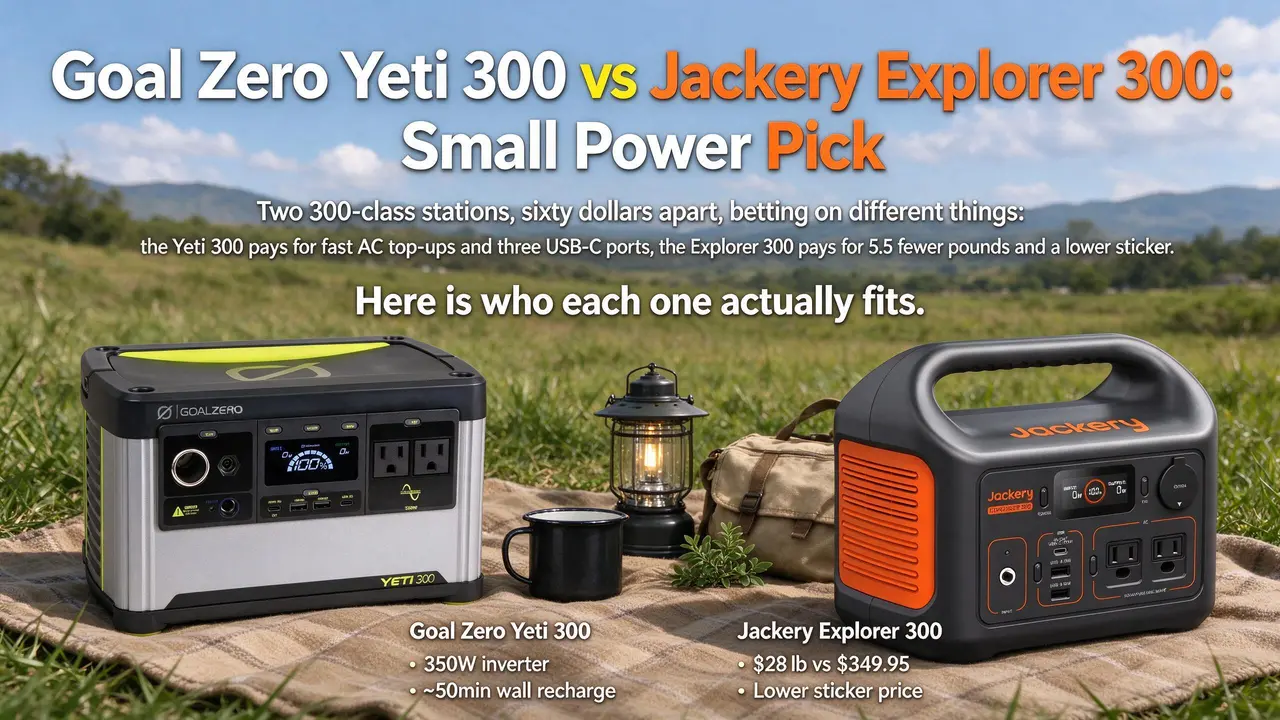
Two 300-class stations, sixty dollars apart, betting on different things: the Yeti 300 pays for fast AC top-ups and three USB-C ports, the Explorer 300 pays for 5.5 fewer pounds and a lower sticker. Here is who each one actually fits.
Updated
At a glance
Two 300-class stations, sixty dollars apart, betting on different things: the Yeti 300 pays for fast AC top-ups and three USB-C ports, the Explorer 300 pays for 5.5 fewer pounds and a lower sticker. Here is who each one actually fits.
Same money, different bets
You are shopping the 300 Wh class, and these two land within about sixty dollars of each other. That is close enough that the sticker stops deciding it. What separates them is where each brand spent the budget.
The Goal Zero Yeti 300 Portable Power Station bets on charging speed and port variety: a 350 W inverter, three USB-C ports, and a claimed 0-to-100% wall recharge in roughly 50 minutes. The Jackery Explorer 300 bets on weight and price: 8.2 lb against 13.7 lb, $289 against $349.95, and the lower nameplate cost per watt-hour at $1.00/Wh versus $1.18/Wh.
Neither is a whole-home backup. Both are small-station tools for phones, laptops, fans, lights, a CPAP, and short outages. If you need to run a fridge or a window AC, this comparison is not your page.
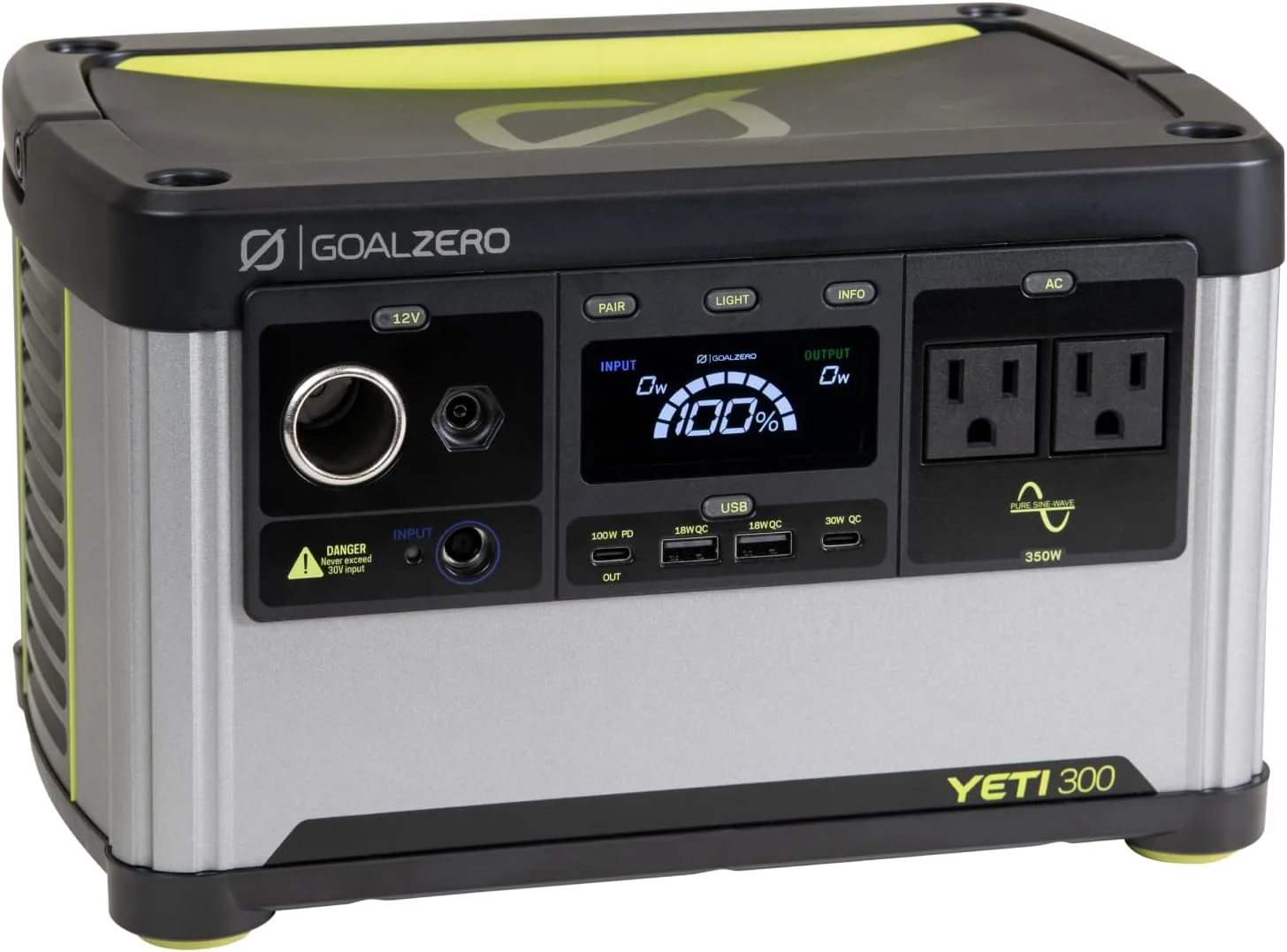
Goal Zero Yeti 300 Portable Power Station
Highlights
- 297Wh rated capacity
- 350W continuous AC
- 600W surge
- LiFePO4 chemistry
- Up to 200W solar input
- 13.7 lb (~6.2 kg)
Best for
- Yeti 300: phones, cameras and a laptop on short trips
- Travel kits when you need quiet pack power, not appliance runtime
- Brief desk backup for router and lights — not a fridge for days
Strengths
- Yeti 300: 297Wh pack with 350W continuous / 600W surge — size loads to both numbers
- 13.7 lb (~6.2 kg) is the lightest-class carry in this band — easier stairs and car packing
- Yeti 300 uses LiFePO4 — cycle-life claims usually beat older NMC marketing lines
- Owners on file: 1/5 · 36 helpful — I was stoked for this product given its light weight and functionality but I am incredibly…
Watch-outs · not ideal when
- Yeti 300's small Wh class empties fast with a kettle, hair dryer or space heater
- 350W continuous will not hold heating elements or many compressor surges for long
- Rated 200W solar on Yeti 300 is optimistic; shade and cables cut real watts
- Airline and pack limits may still block Yeti 300 even when the weight looks friendly
Owner voices
Short takes from public retail reviews — paraphrased or translated when long or non-English; meaning kept close to the original.
“1/5 · 36 helpful — I was stoked for this product given its light weight and functionality but I am incredibly disappointed. I took this out on 2 separate camping trips and it died both nights charging a single phone.…”
“3/5 · 9 helpful — I have a laptop and T Mobile whole house wifi connected. I use it to power my "mobile office". It powers the 2 devices for about 4 hours - then it is at 10% remaining. It works, it's quiet but I expe…”
“5/5 · 7 helpful — I have owned many goal zero products over the years and have found them to be among the best in the industry. While there are cheaper options out there, the quality doesn't match up to Goal Zero. The…”
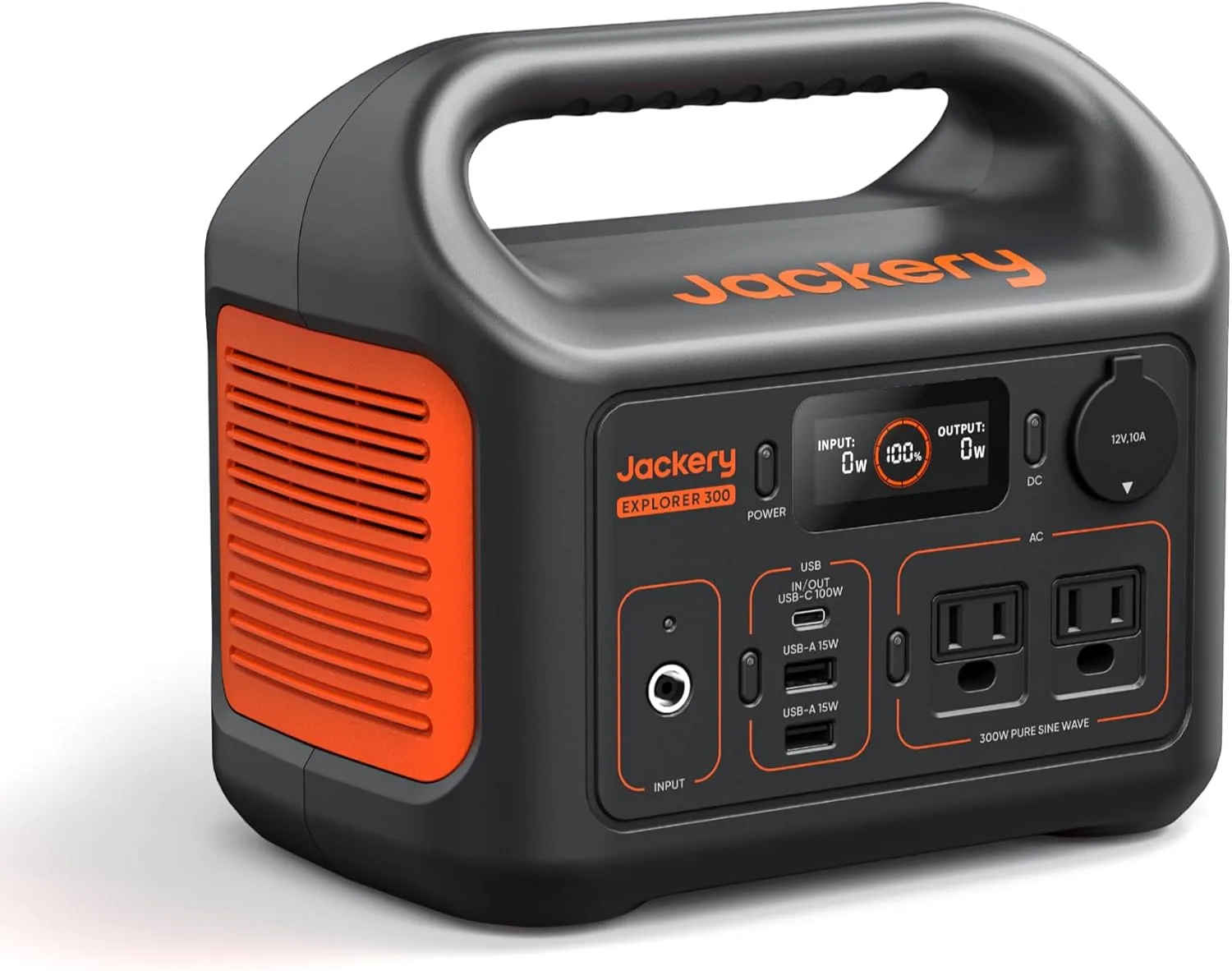
Jackery Explorer 300 Portable Power Station,292Wh
Highlights
- 288Wh rated capacity
- 300W continuous AC
- 600W surge
- LiFePO4 chemistry
- 8.2 lb (~3.7 kg)
- About $289 list
Best for
- Explorer 300 v2: phones, cameras and a laptop on short trips
- Travel kits when you need quiet pack power, not appliance runtime
- Brief desk backup for router and lights — not a fridge for days
Strengths
- Explorer 300 v2: 288Wh pack with 300W continuous / 600W surge — size loads to both numbers
- 8.2 lb (~3.7 kg) is the lightest-class carry in this band — easier stairs and car packing
- 10ms-class UPS switchover on the listing — useful when a router restart would hurt
- Owners on file: It went well for the first time using it. Powers of fans and light computer equipment charged quickly.
Watch-outs · not ideal when
- Explorer 300 v2's small Wh class empties fast with a kettle, hair dryer or space heater
- 300W continuous will not hold heating elements or many compressor surges for long
- Solar input unpublished for Explorer 300 v2 — do not assume a same-day off-grid refill
- Airline and pack limits may still block Explorer 300 v2 even when the weight looks friendly
Owner voices
Short takes from public retail reviews — paraphrased or translated when long or non-English; meaning kept close to the original.
“It went well for the first time using it. Powers of fans and light computer equipment charged quickly.”
“Don't be tricked into buying a refurbished product. They do not make it obvious that you are buying refurbished and have a short warranty. Then fail shortly after the warranty is up. I'm going to try Bluetti because t…”
“Easy to carry, and convienant when needed!”
Spec snapshot
Everything below comes from the listings and our catalogue card, not from a bench. Ratings are retailer aggregate scores, not owner-verified evidence; sample sizes are not disclosed on the listings.
| Product | List price | Capacity (Wh) | Output (W) | Weight (lb) | Rating |
|---|---|---|---|---|---|
| Goal Zero Yeti 300 Portable Power Station | $349.95 | 297 Wh | 350 W | 13.7 lb | 4.02 |
| Jackery Explorer 300 | $289 | 288 Wh | 300 W | 8.2 lb | 3.93 |
Where the money went
Four configuration differences do most of the work here.
Ports. The Yeti 300 carries AC×1, USB-C×3, USB-A×2, and a car port. The Explorer 300 carries AC×2, USB-C×1, USB-A×15, and a car port. If your household is USB-C-native — laptops, recent phones, a tablet — the Goal Zero spreads that load across three ports without a dongle. The Jackery's single USB-C is output-only per owner reports, so it will not recharge the station either.
Recharge speed. Goal Zero claims about 50 minutes to full from AC in high-speed mode. Jackery owners report roughly 3 to 4.5 hours from the wall. That gap matters if you are topping up between errands rather than overnight.
Weight. 13.7 lb versus 8.2 lb. Five and a half pounds is the difference between one-hand carry and a two-hand lift for some buyers, and it is the single most repeated praise point in Explorer 300 owner notes.
Battery chemistry and cycle claims. Both listings advertise LiFePO4 with 4,000+ cycles. Treat those as manufacturer claims; neither is independently verified on file. Confirm cycle rating and warranty terms on the listing before purchase.
One accessory note: neither unit ships with a solar panel. If you plan to recharge off-grid, budget for a panel separately on either side.
- Yeti 300: 3× USB-C, 1× AC, 350 W continuous
- Explorer 300: 1× USB-C (output-only), 2× AC, 300 W continuous
- Wall recharge: ~50 min claimed (Goal Zero) vs ~3–4.5 hr owner-reported (Jackery)
- Weight: 13.7 lb vs 8.2 lb
- Solar panel: sold separately on both
The spec that decides it
Two numbers should drive your choice, and they are not the ones on the box front.
The first is USB-C count. If you are charging a USB-C laptop plus a phone plus a tablet on the same evening, the Yeti 300's three USB-C ports are the difference between a clean setup and a rotating cable schedule. The Explorer 300's single USB-C port is fine for one device at a time.
The second is weight against your actual carry pattern. At 8.2 lb the Explorer 300 is a toss-in-the-car unit; owners describe carrying it one-handed and handing it to parents in their 80s. At 13.7 lb the Yeti 300 is still portable, but it is a deliberate pick-up. If the station lives on a shelf and only moves during outages, weight barely matters. If it rides in a backpack or gets carried up stairs, it matters a lot.
The 50 W output gap (350 W vs 300 W) is real but narrow. Neither unit should be asked to run a load near its ceiling for long. A concrete example: a small appliance with a startup surge around 320 W — such as a compact blender or a shop vacuum — may trip the Explorer 300's 300 W inverter while the Yeti 300's 350 W ceiling can absorb the brief spike. Check your device's startup wattage before assuming either will run it.
Real owner trade-offs
Owner notes on the Yeti 300 split sharply, and the split is worth reading before you buy.
On the positive side, owners describe charging a laptop, phone, tablet, and small gadgets at once during camping trips, and one ran a WiFi router and TV for about two hours during an apartment outage. Fast AC recharge comes up repeatedly.
On the negative side, one camper reported the unit dying both nights while charging a single phone on two separate trips — a single failure report that may point to a defective unit rather than a design flaw, but it is the kind of report you want to test against during the return window. Another owner running a laptop plus a whole-house WiFi modem hit 10% in about four hours, short of a full workday. A third blew a fuse in a Jeep charging from the cigarette lighter at a high rate; dropping the charge rate fixed it.
The Explorer 300 owner notes are more consistent and skew toward portability and CPAP use. One owner ran a CPAP for four nights (about 35 hours) on a single charge with a DC adapter and the humidifier off, finishing at 2%. Another ran a 42-inch TV, laptop, phone, heating pad, and small coffee maker for over six hours during a 24-hour outage and still had 43% left.
The recurring Explorer 300 caveats: it will not run a fridge or AC for sustained periods, the auto-power-off feature can interrupt very low-draw devices (a trickle-charging phone or a small sensor may not draw enough to keep the inverter awake), there is no built-in light, and the USB-C port is output-only. One owner had a battery fail at nine months; Jackery replaced it under warranty after some back-and-forth.
Read those paragraphs side by side and the pattern is clear: the Explorer 300 has a larger, more consistent owner base to draw from, and the Yeti 300's smaller sample includes at least one outlier failure report. That is not proof of a quality gap — it is a reason to test your specific unit early either way.
- Yeti 300 owner theme: fast recharge and multi-device charging praised; runtime complaints on heavier loads
- Explorer 300 owner theme: light carry and CPAP nights praised; small-appliance ceiling and auto-off flagged
- Both: solar recharge depends on a panel you buy separately
Buy the one that…
Buy the Goal Zero Yeti 300 Portable Power Station if you charge several USB-C devices at once and want the fastest wall top-up in this pair — and you are willing to pay $349.95 and carry 13.7 lb for it. It is the better fit for a desk-side or shelf-side station that gets topped up between uses. Skip it if you need to carry the station up stairs daily or if you expect near-continuous loads above 300 W.
Buy the Jackery Explorer 300 if weight and price lead your list, or if you are buying for someone who needs to lift the station themselves. At $289, 8.2 lb, and $1.00/Wh nameplate, it is the lighter and cheaper bet, and the owner base is deep enough that you can find reports matching almost any use case you have in mind. Skip it if you need more than one USB-C port or if you rely on very low-draw devices that the auto-power-off may interrupt.
Walk away from both if you need to run a refrigerator, a window AC, or anything that draws near or above 300 W continuously. Neither unit is built for that, and no amount of owner enthusiasm changes the inverter rating.
One method note: these checks are grounded in owner themes on file plus listing specs, not lab-bench measurements. Ratings shown are retailer aggregates. As an Amazon Associate, WattPicks earns from qualifying purchases; picks here are fit-led, not commission-led. I am WattPicks' founding editor, covering portable power capacity, output, and price-per-Wh across the catalogue.
Frequently asked
Can the Jackery Explorer 300 run a CPAP overnight?
Owner reports say yes, with conditions. One owner ran a CPAP for four nights on a single charge using a DC adapter with the humidifier off. With heat and humidity on, expect far less. The Yeti 300 has no comparable CPAP-specific owner report on file, so I would not promise the same runtime from it.
Which one recharges faster from a wall outlet?
Goal Zero claims about 50 minutes to full in high-speed mode on the Yeti 300. Jackery owners report roughly 3 to 4.5 hours on the Explorer 300. Those are listing and owner figures, not bench numbers.
Do either of these include a solar panel?
No. Both listings sell the panel separately. Budget for one if off-grid recharge is part of your plan.
Can either run a full-size refrigerator?
No. At 350 W and 300 W continuous respectively, neither is sized for a refrigerator's startup draw. For that job, look at a larger station class.
Can I charge either unit from a car 12V socket safely?
Yes, with caveats. Both have a car port input, but one Yeti 300 owner blew a fuse charging from a cigarette lighter at a high rate; dropping the charge rate fixed it. Use a lower charge setting and check your vehicle's accessory fuse rating before relying on 12V charging.
Method and sources
Model names and list prices come from the WattPicks catalog at build time. WattPicks does not run its own laboratory tests on power stations, and nothing on this page is presented as a measured result — it is catalog-backed buying guidance.
Read our methodology for how the catalog is normalized, and about WattPicks for who publishes it.