
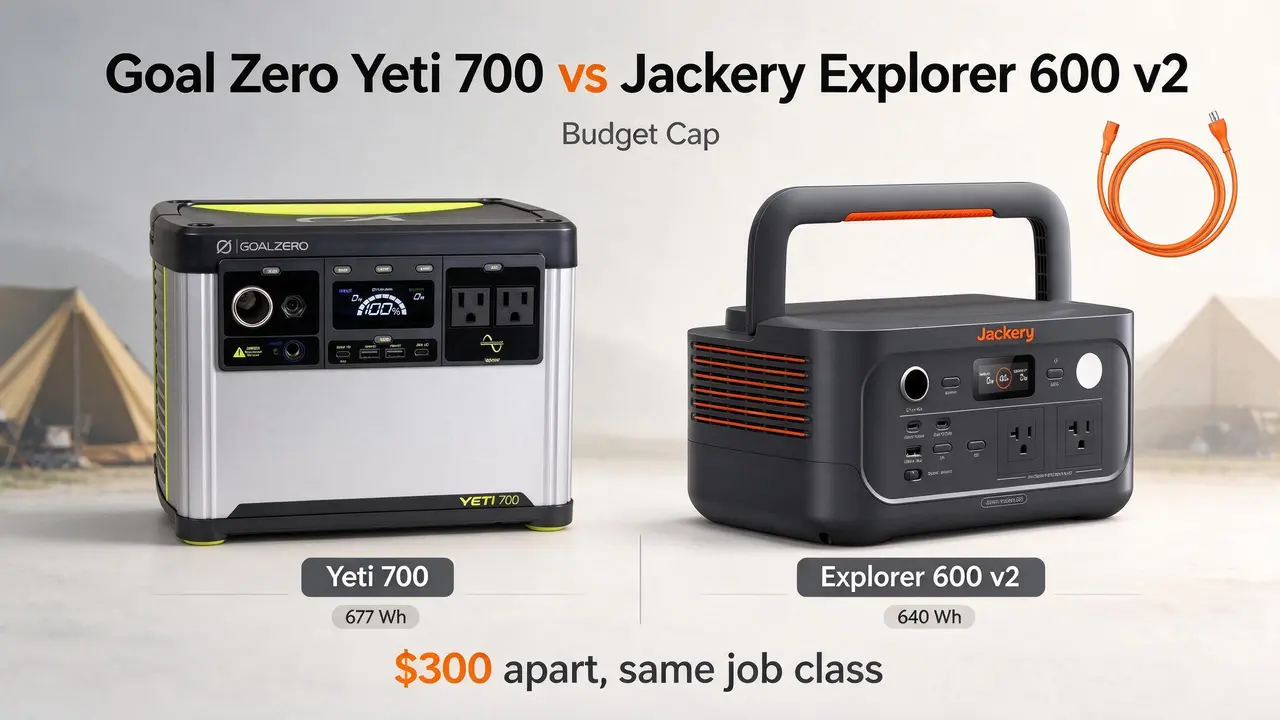
Goal Zero Yeti 700 vs Jackery Explorer 600 v2: Budget Cap
Two mid-size LiFePO4 stations that sit $300 apart but land in the same job class. The Jackery Explorer 600 v2 wins on price and weight; the Goal Zero Yeti 700 buys you more headroom, more ports, and app control — if the reliability reports don't spook you.
Updated
At a glance
Two mid-size LiFePO4 stations that sit $300 apart but land in the same job class. The Jackery Explorer 600 v2 wins on price and weight; the Goal Zero Yeti 700 buys you more headroom, more ports, and app control — if the reliability reports don't spook you.
Same money class, different bets
If your budget tops out around $700 and you need a mid-size station for outages, camping, or CPAP duty, these two are the obvious pairing. They're close in capacity — 677 Wh versus 640 Wh — but they are not close in price, and that gap is the whole decision.
The Goal Zero Yeti 700 bets on headroom: 600 W continuous, three USB-C ports, app monitoring, and a build that owners describe as sturdier than most. The Jackery Explorer 600 v2 bets on value: $399, 14.1 lb, and a 6,000-cycle LiFePO4 rating that undercuts the Yeti's 4,000-cycle claim on paper.
One boundary up front: neither is a whole-home backup. These run a fridge, a CPAP, lights, and phones — not a furnace or a well pump. If that's your job, you want a transfer switch and a bigger unit, not either of these.
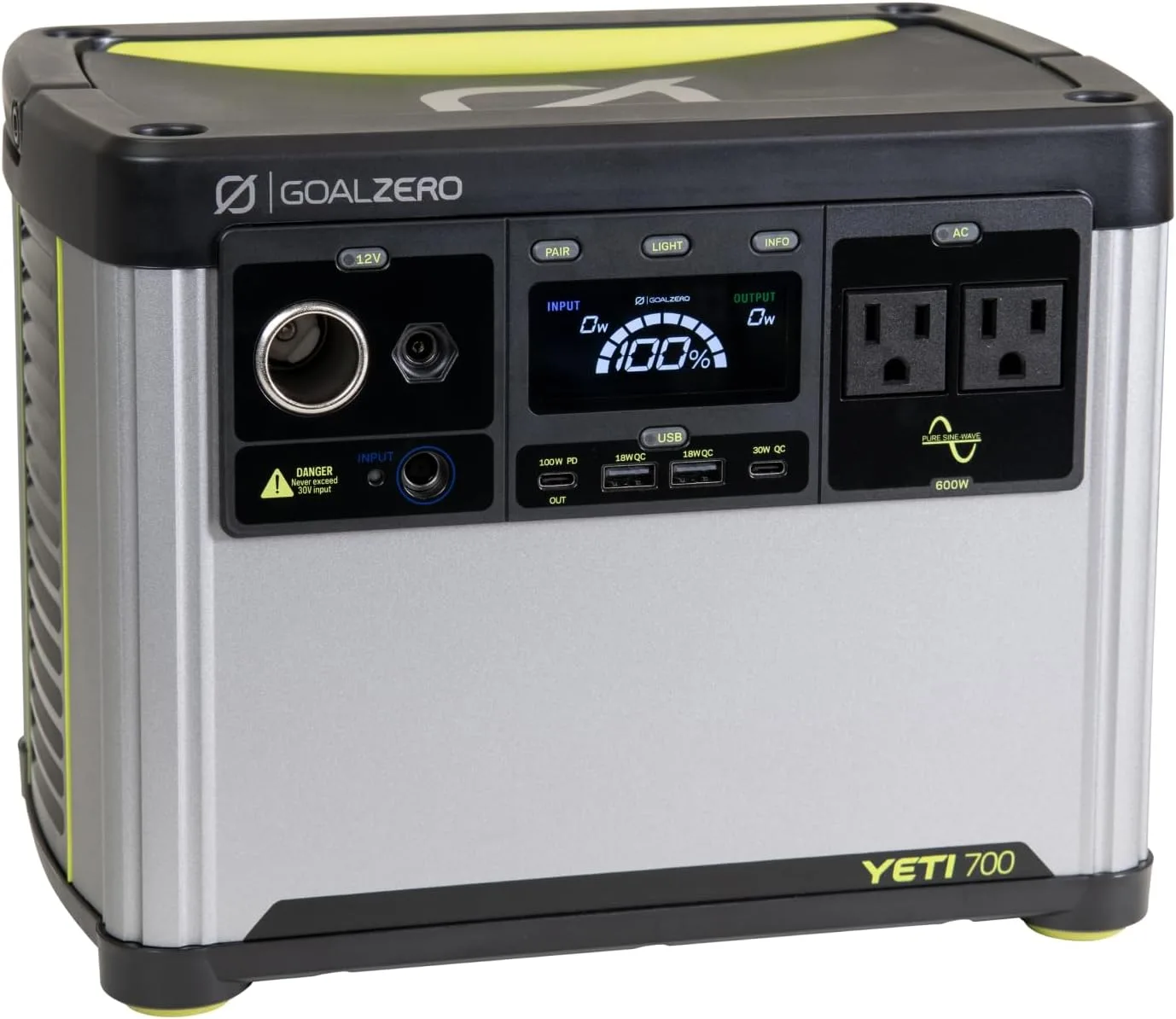
Goal Zero Yeti 700
Highlights
- 677Wh rated capacity
- 600W continuous AC
- 1000W surge
- LiFePO4 chemistry
- Up to 200W solar input
- 20.3 lb (~9.2 kg)
Best for
- Yeti 700: weekend camping when 20.3 lb carry weight matters as much as 677Wh
- Essentials bridge at home (fridge cycles, router) when sized to the Wh
- Solar top-ups up to ~200W when panels and weather cooperate
Strengths
- Yeti 700: 677Wh pack with 600W continuous / 1000W surge — size loads to both numbers
- 20.3 lb (~9.2 kg) is the lightest-class carry in this band — easier stairs and car packing
- Yeti 700 uses LiFePO4 — cycle-life claims usually beat older NMC marketing lines
- Owners on file: 5/5 · 19 helpful — I bought this 700 since I have a full size CPAP machine with the humidifier that I need wh…
Watch-outs · not ideal when
- Yeti 700 is still a bridge for essentials — not a transfer-switch whole-home system
- Usable energy on Yeti 700 is below the 677Wh label once the inverter is working
- Rated 200W solar on Yeti 700 is optimistic; shade and cables cut real watts
- LiFePO4 helps longevity, but Yeti 700 still hates freezing charge temps on winter trips
Owner voices
Short takes from public retail reviews — paraphrased or translated when long or non-English; meaning kept close to the original.
“5/5 · 19 helpful — I bought this 700 since I have a full size CPAP machine with the humidifier that I need when I go camping. Was able to charge multiple other devices over night (phone, hearing aid, watch) while I wa…”
“5/5 · 13 helpful — Great size to keep my laptop PC online in the middle of no where. Not enough juice to run appliances but lights NP. It is a bit heavy, but the size is great for packing (like oversized ammo box). Se…”
“5/5 · 8 helpful — My original review was not a positive one because our system quit working and we could not get any customer service response while they were doing some kind of system switch over, but since the origi…”
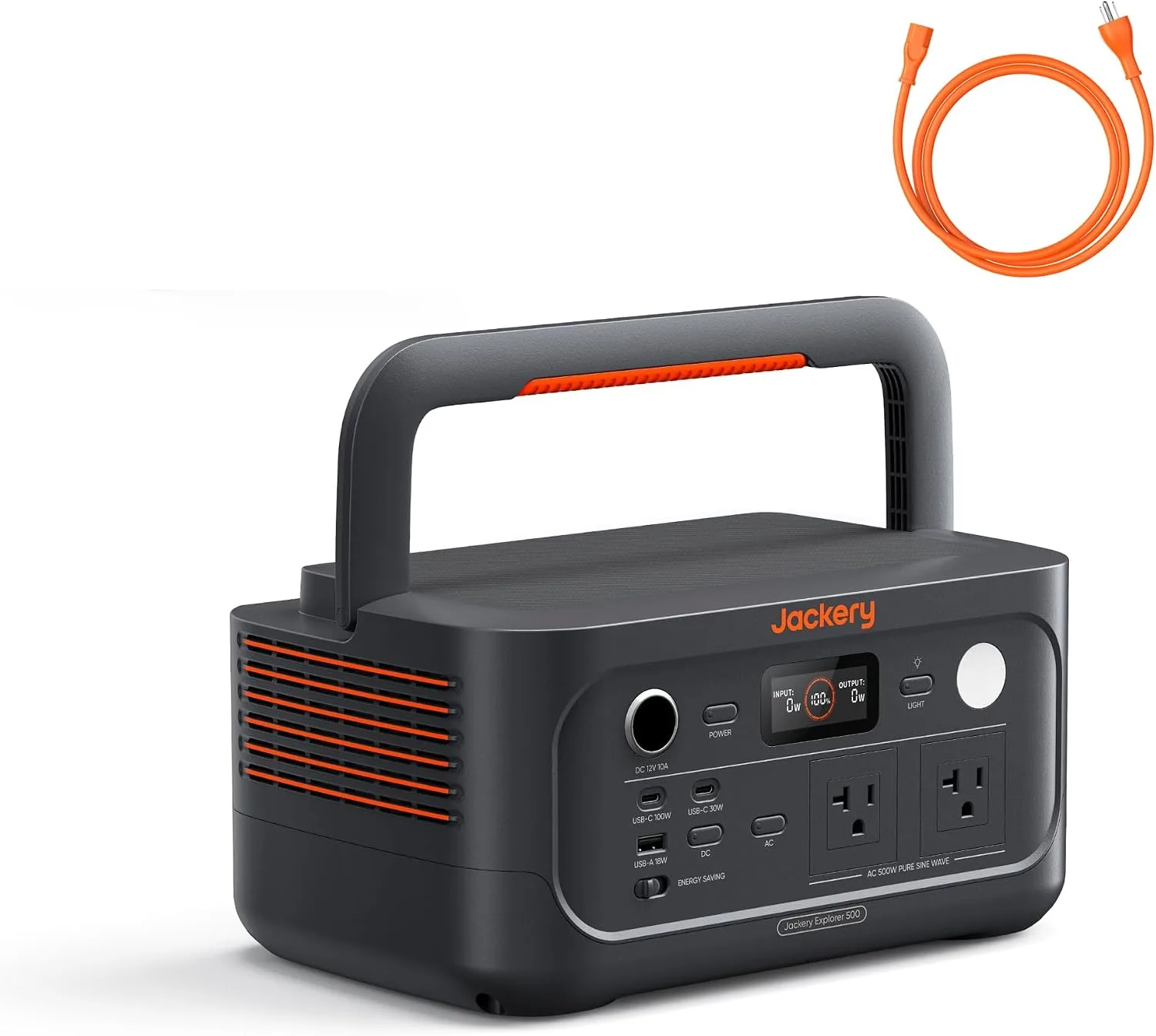
Jackery Explorer 500 v2 Power Station, 512Wh/500W, AC Cable Included
Highlights
- About $399 list
- Jackery catalog listing
- Specs from manufacturer listings
Best for
- Explorer 600 v2: most Wh-per-dollar in this ~500Wh band for weekend fridge/CPAP math
- Car-camp carry at 14.1 lb when review depth matters as much as peak watts
- Skip if you need >500W continuous for small appliances that surge hard
Strengths
- Jackery Explorer 500 v2 Power Station, 512Wh/500W, AC Cable Included: capacity not published on file — compare only what the listing actually states
- Jackery Explorer 500 v2 Power Station, 512Wh/500W, AC Cable Included: quiet battery output suits campsites with generator bans
- Owners on file: Purchased the unit for camping, but also for emergency use when the power goes out! It will open my garage do…
- About $399 list in the Hub catalog — confirm live retail before you buy
Watch-outs · not ideal when
- Jackery Explorer 500 v2 Power Station, 512Wh/500W, AC Cable Included is still a bridge for essentials — not a transfer-switch whole-home system
- No Wh on file for Jackery Explorer 500 v2 Power Station, 512Wh/500W, AC Cable Included — do not invent runtime math from the product name
- Solar input unpublished for Jackery Explorer 500 v2 Power Station, 512Wh/500W, AC Cable Included — do not assume a same-day off-grid refill
- Airline and pack limits may still block Jackery Explorer 500 v2 Power Station, 512Wh/500W, AC Cable Included even when the weight looks friendly
Owner voices
Short takes from public retail reviews — paraphrased or translated when long or non-English; meaning kept close to the original.
“Purchased the unit for camping, but also for emergency use when the power goes out! It will open my garage doors, provide temporary light and power fans for the wood stove when the power goes out in the winter storms.…”
“Nice smaller more portable addition to have along with my Explorer 2000 V2, but like the other review mentioned disappointed it doesn't at least have WiFi connectivity to the Jackery App.”
“New model is great but a little disappointed that a new v2 model is missing the Bluetooth and/or WiFi support.”
Spec snapshot
Prices are list; ratings are listing aggregates, not owner proof. Weight in lb, capacity in Wh, output in continuous W. Usable Wh is typically lower than nameplate capacity on both units.
| Product | List price | Capacity (Wh) | Output (W) | Weight (lb) | Rating |
|---|---|---|---|---|---|
| Goal Zero Yeti 700 | $699.95 | 677 Wh | 600 W | 20.3 lb | 4.17 |
| Jackery Explorer 600 v2 | $399 | 640 Wh | 500 W | 14.1 lb | 4.60 |
Where the money went
Four configuration differences explain most of the $300 gap.
Output headroom. The Yeti 700's 600 W continuous clears the Explorer 600 v2's 500 W by 100 W. That matters if you're running a small fridge compressor or a power tool that spikes near the ceiling — the Jackery's 500 W continuous is the tighter constraint.
Ports. The Yeti 700 carries AC×2, USB-C×3, USB-A×2, and a car port. The Explorer 600 v2 carries AC×2, USB-C×1, USB-A×1, and a car port. If your household is USB-C heavy, the Yeti's three USB-C ports are a real convenience; the Jackery's single USB-C is the most-cited limitation in its owner reviews.
Weight. The Jackery is 14.1 lb; the Yeti is 20.3 lb. Six pounds is the difference between one-hand carry and a two-hand lift — worth noting if this lives in a closet and comes out during storms.
Battery and cycles. Both are LiFePO4. Goal Zero claims 4,000+ cycles; Jackery claims 6,000. On paper the Jackery wins the longevity claim, though neither number is something I can verify from a listing. Treat both as listing figures, not tested results, and weigh them against each unit's warranty terms.
- Yeti 700: 600 W continuous, AC×2 / USB-C×3 / USB-A×2 / car×1, 20.3 lb, 677 Wh
- Explorer 600 v2: 500 W continuous, AC×2 / USB-C×1 / USB-A×1 / car×1, 14.1 lb, 640 Wh
- Both LiFePO4; cycle claims differ (4,000+ vs 6,000) — listing figures only
- Nameplate $/Wh: Yeti $1.03/Wh; Jackery $0.62/Wh — the Jackery is the cheaper-per-Wh unit
The spec that decides it
For most buyers, the deciding number is continuous output, not capacity. The two units are within 37 Wh of each other — that's minutes of runtime at typical loads, not hours. The 100 W output gap is the bigger practical difference.
If your load sits between 500 W and 600 W — a small fridge on startup, a shop tool, a space heater on low — the Jackery is out of spec and the Yeti is in. If your load stays under 500 W, the Jackery's lower price and lighter weight win the argument.
The second deciding factor is ports. Three USB-C ports versus one is the difference between charging a laptop, a phone, and a tablet natively, or juggling a USB-A adapter.
Real owner trade-offs
The owner reports on these two read very differently, and that's the part a spec table can't show you.
On the Yeti 700, the high-helpful reviews are warm: a CPAP user ran a full-size machine with humidifier overnight plus phone, watch, and hearing aids, and still had reserve by morning. A MacBook Pro owner charged at 100 W and liked the app for battery health and port toggling. A Houston owner kept phones, tablets, fans, and lanterns going through a 48-hour hurricane outage. But the critical thread is reliability: one owner is on a third replacement after two units vented smoke and died, and another had a unit fail inside a year and spent months chasing support before it was made right. A fridge test landed at roughly 18–24 hours, short of a full day.
On the Explorer 600 v2, the themes skew toward value and versatility. A CPAP owner using a DC adapter got multiple nights per charge — about 15% used over 5.5 hours in one stretch. A family road trip kept three Switches, three iPads, and multiple phones charged through the built-in USB-A ports plus adapters. Outage and cabin owners ran lights, fans, a TV, and a small fridge, and pass-through charging let the unit run devices while recharging. The critical thread: output shut off on its own four or five times during fridge use, requiring a manual restart; no USB-C and only one AC outlet felt limiting; and the DC output connector was hard to source aftermarket.
- Yeti 700: strong CPAP and outage reports, but smoke/failure reports and a fridge runtime shortfall are the caveats to weigh
- Explorer 600 v2: strong value and versatility reports, but output auto-shutoff and the single USB-C are the recurring complaints
- Both: customer service eventually resolved failures, but response time varied
Buy the one that…
Buy the Goal Zero Yeti 700 if your load lands between 600 W and 600 W, you want three USB-C ports and app monitoring, and you're willing to pay $699.95 for headroom and build quality — with the caveat that the reliability reports are real and worth keeping support channels handy.
Buy the Jackery Explorer 600 v2 if your load stays under 500 W, you want the lighter 14.1 lb unit at $399, and you're comfortable adding a USB-C adapter and checking on fridge runs. It's the cheaper-per-Wh pick at $0.62/Wh versus $1.03/Wh, and the 6,000-cycle claim is the longer one on paper.
Walk away from both if you need whole-home backup, a 240 V load, or unattended fridge operation without checking on it — those jobs want a transfer switch and a larger station, not either of these.
What this comparison is based on
I'm Avery Nolan, founding editor at WattPicks, covering portable power capacity, output, and price-per-Wh across the catalogue. My checks here are home-user reads grounded in owner themes on file plus listing specs — not lab-bench measurements.
Specs, prices, and ratings come from the product listings; owner themes are paraphrased from high-helpful reviews on file. As an Amazon Associate, WattPicks earns from qualifying purchases — picks are fit-led, not commission-led.
Frequently asked
Can the Jackery Explorer 600 v2 run a CPAP overnight?
Owners report multiple nights per charge using a DC adapter rather than the AC brick — one saw about 15% used over 5.5 hours. The AC adapter path is less efficient, so plan around the DC route.
Does the Goal Zero Yeti 700 have USB-C?
Yes — three USB-C ports per the listing, plus two USB-A and a car port. The Jackery Explorer 600 v2 has one USB-C, one USB-A, and a car port.
Which is cheaper per Wh?
The Jackery Explorer 600 v2 at $0.62/Wh nameplate, versus the Goal Zero Yeti 700 at $1.03/Wh. That's list price divided by nameplate capacity, not usable Wh.
Can either run a full-size fridge?
Owners report short runs — roughly 18–24 hours on the Yeti 700 in one fridge test, and intermittent output shutoff on the Explorer 600 v2 during fridge use. Neither is a set-and-forget fridge solution.
Method and sources
Model names and list prices come from the WattPicks catalog at build time. WattPicks does not run its own laboratory tests on power stations, and nothing on this page is presented as a measured result — it is catalog-backed buying guidance.
Read our methodology for how the catalog is normalized, and about WattPicks for who publishes it.