
Goal Zero Yeti 1500 vs OUPES Exodus 700: Backup Bet
Two backup stations, two very different bets: one buys you 1,505 Wh and 2,000 W of headroom, the other buys you panels in the box and a 13.9 lb frame. Here is how to pick when the money is not the same.
Updated
At a glance
Two backup stations, two very different bets: one buys you 1,505 Wh and 2,000 W of headroom, the other buys you panels in the box and a 13.9 lb frame. Here is how to pick when the money is not the same.
- Buy the OUPES if the budget ceiling is real and you want panels included on day one.
- Buy the Goal Zero if 700 W continuous will trip on your loads and you can carry 52.8 lb.
Same money? No — same decision
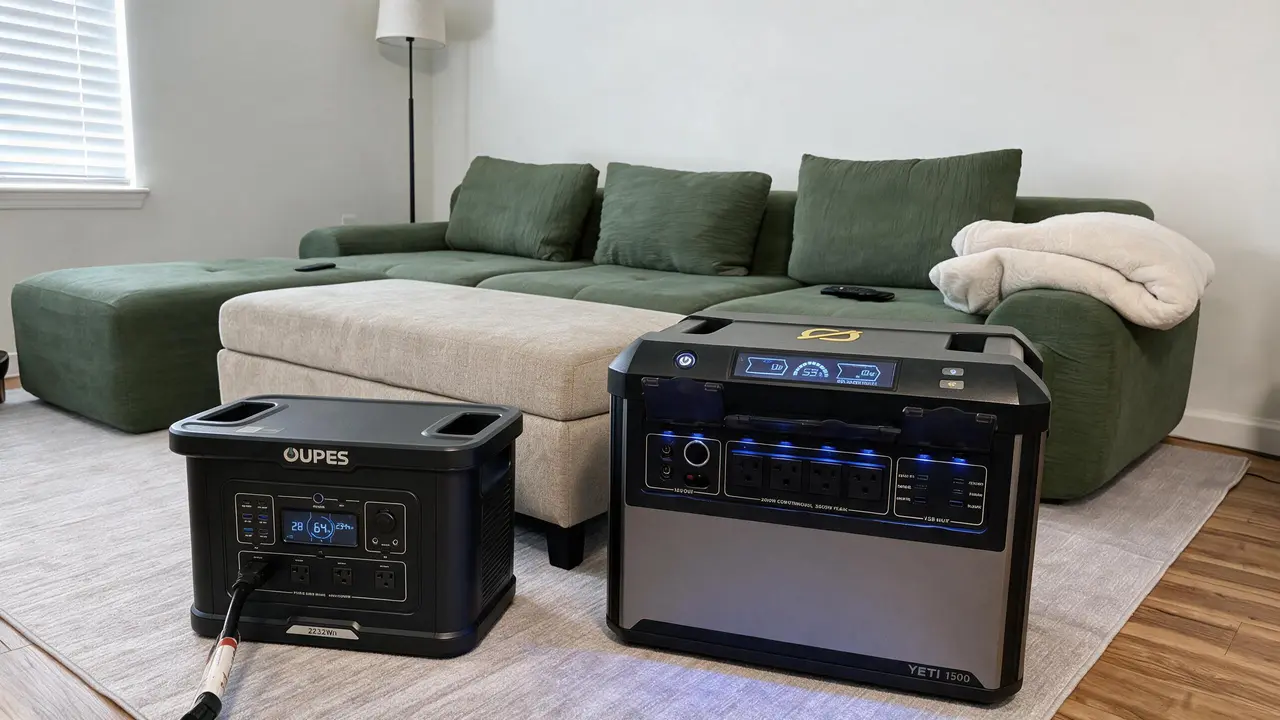
These two are not a coin flip. The Goal Zero Yeti 1500 Portable Power Station is a $1,499.95 bet on headroom: 1,505 Wh and 2,000 W of continuous AC, in a 52.8 lb aluminum box. The OUPES Exodus 700 Solar Generator with 240W Panels Included, 576Wh is a $699.99 bet on being ready cheaply — a 576 Wh, 700 W station that ships with a 240 W panel and weighs 13.9 lb.
So the honest framing is not "which is better." It is: are you buying capacity and output, or are you buying a complete solar kit at roughly half the money? Everything below hangs off that.
One boundary up front: this is a two-way comparison of backup stations for outages, fridge duty, and off-grid top-ups. If you need whole-home backup wired through a transfer switch, neither of these is that product — and if you only need to charge a phone and a laptop, both are overkill.
A note on sourcing: I work from the listing specs plus owner themes on file for each unit, and my checks are home-user comparisons, not lab-bench measurements. One Amazon Associates disclosure — picks here are fit-led, not commission-led.
- Buy the OUPES if the budget ceiling is real and you want panels included on day one.
- Buy the Goal Zero if 700 W continuous will trip on your loads and you can carry 52.8 lb.
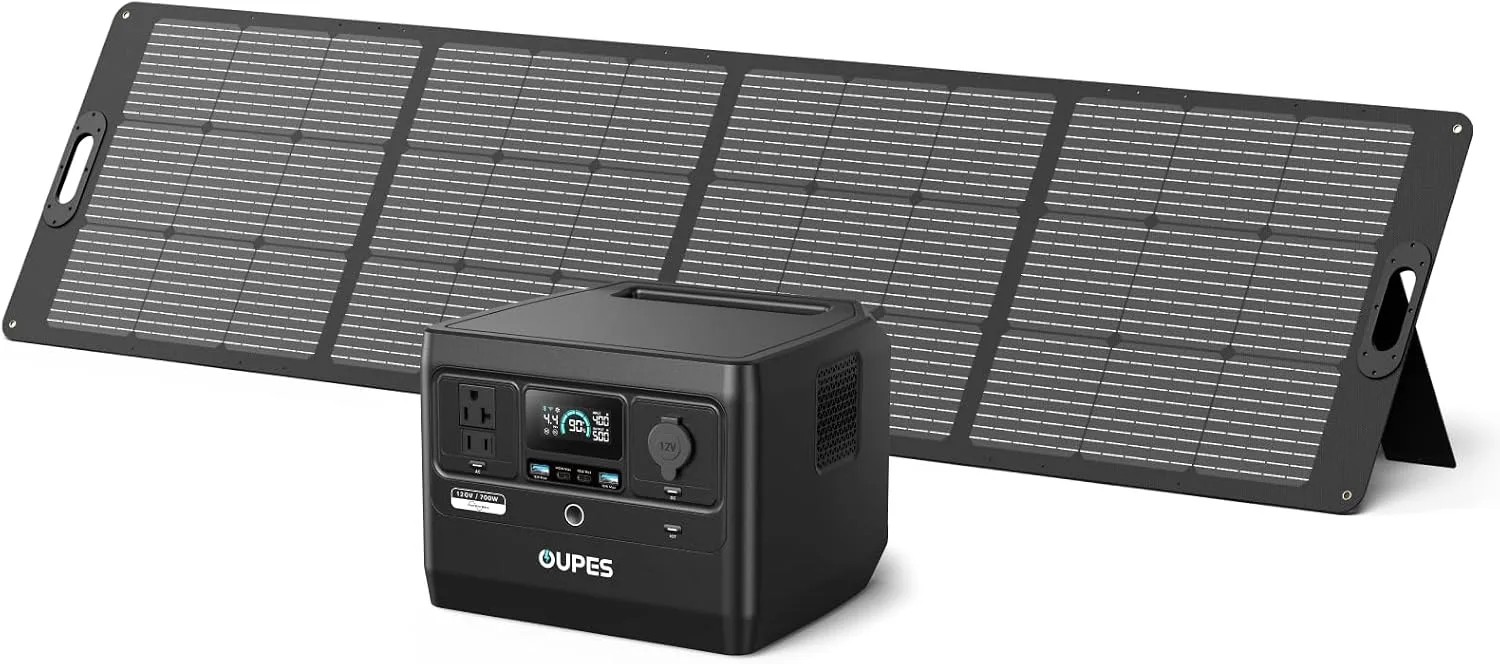
OUPES Exodus 700 Solar Generator with 240W Panels Included, 576Wh
Highlights
- 576Wh rated capacity
- 700W continuous AC
- 1200W surge
- LiFePO4 chemistry
- Up to 240W solar input
- 13.9 lb (~6.3 kg)
Best for
- Exodus 700: highest continuous watts (700W) for mini-fridge + laptop without watt anxiety
- Car camping when inverter headroom beats brand-name ecosystem
- Skip if you need the cheapest Wh or the thickest owner sample
Strengths
- Exodus 700: 576Wh pack with 700W continuous / 1200W surge — size loads to both numbers
- 13.9 lb (~6.3 kg) is the lightest-class carry in this band — easier stairs and car packing
- 10ms-class UPS switchover on the listing — useful when a router restart would hurt
- About $699.99 list in the Hub catalog — confirm live retail before you buy
Watch-outs · not ideal when
- Exodus 700 is still a bridge for essentials — not a transfer-switch whole-home system
- Usable energy on Exodus 700 is below the 576Wh label once the inverter is working
- Rated 240W solar on Exodus 700 is optimistic; shade and cables cut real watts
- LiFePO4 helps longevity, but Exodus 700 still hates freezing charge temps on winter trips
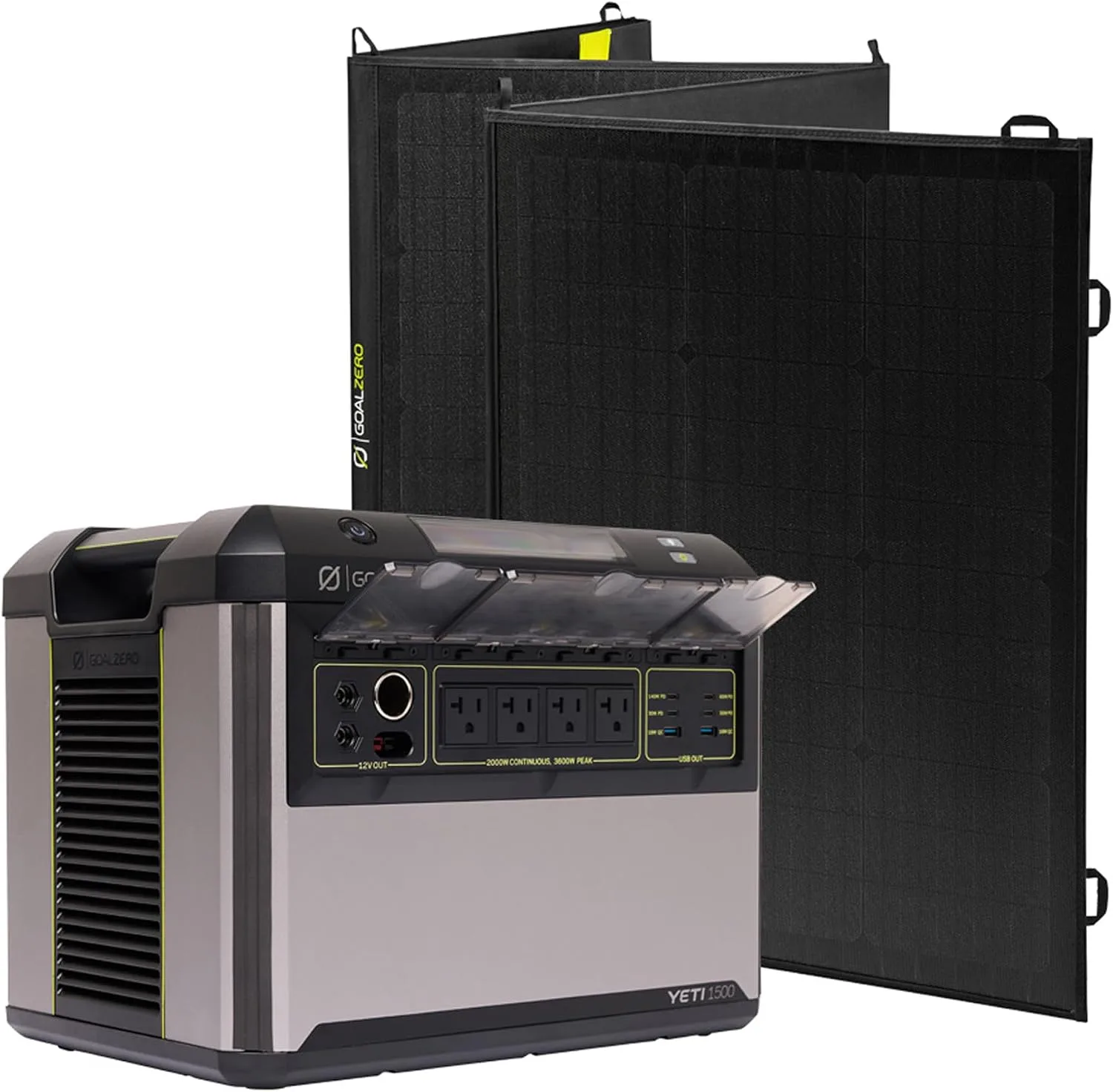
Goal Zero Yeti 1500 Portable Power Station
Highlights
- 1505Wh rated capacity
- 2000W continuous AC
- 3600W surge
- LiFePO4 chemistry
- Up to 900W solar input
- 52.8 lb (~23.9 kg)
Best for
- Yeti 1500: longer outages or higher continuous loads (still not whole-home wiring)
- RV / off-grid days where recharge speed matters as much as Wh
- Best parked near the vehicle or cabin — not a long carry to a tent
Strengths
- Yeti 1500: 1505Wh pack with 2000W continuous / 3600W surge — size loads to both numbers
- 52.8 lb (~23.9 kg) is a park-and-use chassis — plan a short path, not a trail hike
- 15ms-class UPS switchover on the listing — useful when a router restart would hurt
- Owners on file: 5/5 · 6 helpful — Without a doubt Goal Zero's best power station yet. I've been a customer for many years and…
Watch-outs · not ideal when
- At 52.8 lb (~23.9 kg), Yeti 1500 is a poor tent-hike companion — plan a cart or leave it in the vehicle
- High continuous output on Yeti 1500 tempts big loads — Wh still runs out on kettles and A/C
- Rated 900W solar on Yeti 1500 is optimistic; shade and cables cut real watts
- LiFePO4 helps longevity, but Yeti 1500 still hates freezing charge temps on winter trips
Owner voices
Short takes from public retail reviews — paraphrased or translated when long or non-English; meaning kept close to the original.
“5/5 · 6 helpful — Without a doubt Goal Zero's best power station yet. I've been a customer for many years and always find the products to be durable and reliable. Happy to report this new station continues the trend.…”
“5/5 · 5 helpful — Enjoying using my Goal Zero Yeti 1500. The unit recharges in an hour or less and provides quiet power for several days. Running power tools and various chargers works flawlessly. End result is to use…”
“5/5 · 4 helpful — We love the Yeti 1500 Portable Power Station. When the power goes out, we no longer need to fire up the gas-powered generator and run a cord from outdoors. We simply plug in an appliance, light, comp…”
Spec snapshot: the numbers side by side
Prices below are list prices, not deal stickers. Ratings are listing aggregates and should be read as thin signal, especially the Goal Zero's 13 ratings.
The nameplate math is worth saying out loud: at $1.00/Wh the Yeti 1500 is the cheaper station per nameplate Wh of the two, while the OUPES lands at $1.22/Wh — but the OUPES price includes a 240 W panel, which the Yeti does not.
| Product | Price | Capacity (Wh) | Output (W) | Weight (lb) | Rating |
|---|---|---|---|---|---|
| OUPES Exodus 700 Solar Generator with 240W Panels Included, 576Wh | $699.99 | 576 Wh | 700 W | 13.9 lb | 4.4 |
| Goal Zero Yeti 1500 Portable Power Station | $1499.95 | 1505 Wh | 2000 W | 52.8 lb | 4 |
Where the money actually went
Four configuration differences do most of the work here, and they point in opposite directions.
Capacity and output. The Yeti 1500 carries roughly 2.6× the watt-hours and nearly 3× the continuous AC output. That is not a spec-sheet flex — it is the difference between running a fridge plus a space heater and having to choose. The OUPES at 700 W continuous is fine for a fridge, a CPAP, lights, and device charging, but a 1,500 W space heater or a big microwave is out of bounds.
Solar in the box. The OUPES listing bundles a 240 W folding panel and claims a 0–80% recharge in about two hours on it. The Yeti 1500's listing does not include a panel — you buy solar separately, and that cost sits on top of the $1,499.95. If "works during a multi-day outage without grid power" is the actual goal, price the panel before you compare totals.
Ports. Both are generous. The Yeti 1500 lists AC×4, USB-C×4, USB-A×2, and a 12V car outlet; the OUPES lists AC×2, USB-C×2, USB-A×2, and a car outlet. Two AC outlets versus four matters more than it sounds once a fridge, a router, and a lamp are all plugged in.
Build and chemistry. The Yeti 1500 uses an aluminum shell with rubber bumpers and an IPX4 rating, and the listing cites LiFePO4 rated for 4,000 cycles. The OUPES also lists LiFePO4, in a plastic 13.9 lb body. For a station that lives in a garage and gets dragged to a job site, the aluminum matters; for one that sits on a shelf until the lights flicker, it matters less.
- Capacity gap: 1,505 Wh vs 576 Wh — the Yeti runs longer at any given load.
- Output gap: 2,000 W vs 700 W continuous — the OUPES cannot start high-draw appliances the Yeti can.
- Solar: OUPES includes a 240 W panel; Yeti 1500 does not — budget for one.
- Ports: 4 AC + 4 USB-C on the Yeti vs 2 AC + 2 USB-C on the OUPES.
The spec that decides it
If I had to pick one number, it is continuous output: 2,000 W versus 700 W. Add up what you actually want running at the same time during an outage. Fridge (roughly 100–200 W running, higher on startup), router, a few lights, a laptop — that fits inside 700 W with room to spare. Add a space heater, a microwave, or a coffee maker cycling alongside the fridge and you are past it.
The second deciding number is weight: 13.9 lb versus 52.8 lb. The OUPES is a one-hand carry; the Yeti is a two-person lift or a cart, and owners on both sides mention the weight. If the station has to go up and down stairs or into a car trunk regularly, that gap will annoy you more than any spec on the page.
Recharge speed is the tiebreaker. Both listings claim very fast wall charging — the Yeti 1500 says 0–80% in under an hour, and the OUPES claims 0–80% in about two hours on its included panel. Owners on both sides back up the fast-charge claim, which makes either one practical to top up between outage waves rather than rationing.
What owners actually report
Themes, not quotes — and remember both listings have modest review counts, so read these as patterns rather than proof.
On the OUPES side, the recurring story is outage value. Owners describe running a fridge, a coffee maker, and phone charging through a long outage while drawing only a small slice of capacity, and one owner uses it as a pass-through UPS for a fridge because the switchover is fast enough that the compressor does not stall. The complaints are consistent too: it is heavier than expected to move around, and Bluetooth/Wi-Fi app pairing drops for some users. There is also a single longer-term report of an error code and a dead unit after about a year with slow support follow-up — one voice, not a pattern, but a reason to register the warranty on day one.
On the Goal Zero side, owners lead with recharge speed and build. Multiple reviewers describe going from half to full in well under an hour, and one ran a fridge plus a full work-station setup through a winter storm outage. The aluminum shell, grab handles, and port lights get consistent praise. The caveats are sharper: owners call it heavy, one hit error codes that support could only answer with generic reset advice and returned the unit at their own shipping cost before Amazon stepped in, and a separate long-term report described overheating and smoking after two years of careful use. Thin evidence — but the kind of thing that argues for registering the warranty and not charging it unattended overnight.
- OUPES owners: strong outage runtime per charge, fast wall charging, reliable fridge UPS behavior.
- OUPES gripes: weight, flaky app pairing, one long-term error-code report.
- Goal Zero owners: sub-hour recharge, rugged aluminum build, live-draw app.
- Goal Zero gripes: weight, unexplained error codes, one long-term overheating report.
Buy the one that…
Buy the Goal Zero Yeti 1500 Portable Power Station if your outage loads include anything high-draw — a space heater, a microwave, power tools — or if you want the longest runtime per charge and can live with 52.8 lb and buying solar separately. It is the station for a house that loses power for days, not hours.
Buy the OUPES Exodus 700 Solar Generator with 240W Panels Included, 576Wh if your realistic load list is a fridge, a CPAP, lights, and devices, and you want a complete solar-ready kit for $699.99 without a second purchase. It is the better fit for apartment dwellers, campers, and anyone who has to carry the thing.
Walk away from both if you need transfer-switch wiring, whole-home backup, or a station light enough to toss in a backpack — none of that is here. And if you are undecided, the tiebreaker is simple: write down your outage load list in watts. Under 700 W and you will save money with the OUPES; over it, the Yeti 1500 is the only one of the two that will carry it.
- Pick Goal Zero if: loads exceed 700 W, runtime matters more than portability, budget is not the constraint.
- Pick OUPES if: loads stay under 700 W, you want panels included, and you move the station yourself.
- Skip both if: you need whole-home transfer-switch backup or sub-15 lb portability.
Frequently asked
Can the OUPES Exodus 700 run a full-size refrigerator?
On paper, yes — a fridge typically draws 100–200 W running, well inside 700 W continuous, though startup surge is higher and the listing cites a 1,200 W surge figure. Runtime is the limit: 576 Wh means hours, not days, unless you recharge from the included 240 W panel.
Can the Goal Zero Yeti 1500 run a space heater?
A 1,500 W heater fits inside its 2,000 W continuous rating, but it will drain 1,505 Wh in roughly an hour at full draw. Treat it as a short-burst load, not an all-night one.
Do I need to buy solar panels for the Yeti 1500?
The listing does not include a panel, so yes — budget for one if off-grid recharging is part of your plan. The OUPES listing includes a 240 W panel.
Which is easier to move during an outage?
The OUPES at 13.9 lb is a one-hand carry; the Yeti 1500 at 52.8 lb needs two hands or a cart. Owners on both sides flag weight as the main physical annoyance.
Method and sources
Model names and list prices come from the WattPicks catalog at build time. WattPicks does not run its own laboratory tests on power stations, and nothing on this page is presented as a measured result — it is catalog-backed buying guidance.
Read our methodology for how the catalog is normalized, and about WattPicks for who publishes it.