
Anker SOLIX S2000 vs Jackery Explorer 2000 Plus
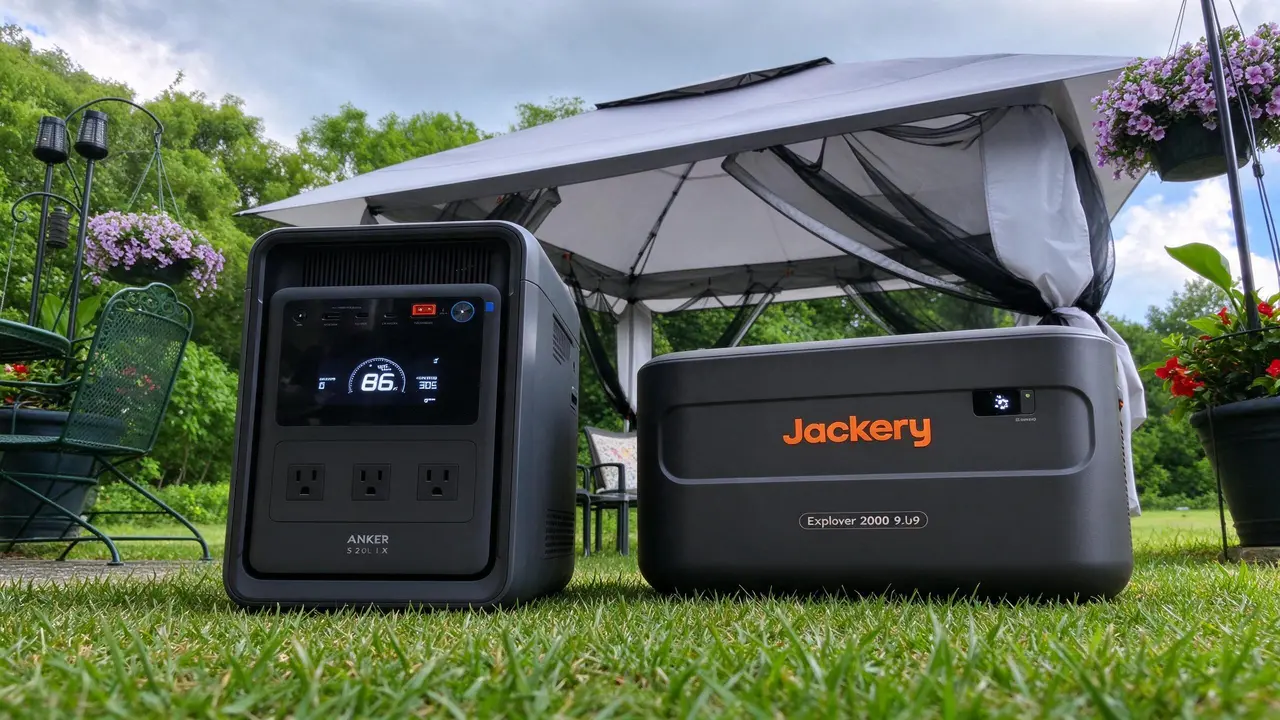
Two $799 boxes, two very different bets: one is a self-contained 1,500 W station, the other is a 2,043 Wh expansion pack that only pays off if you already own the Jackery base. Here's how to tell which one your outage plan actually needs.
Updated
At a glance
Two $799 boxes, two very different bets: one is a self-contained 1,500 W station, the other is a 2,043 Wh expansion pack that only pays off if you already own the Jackery base. Here's how to tell which one your outage plan actually needs.
- If you own no Jackery base station, the Anker is the only one of these two that works on day one.
- If you already run an Explorer 2000 Plus, the Jackery pack doubles your runtime for the same $799.
Same money, different bets
Both boxes list at $799, and on nameplate dollars per watt-hour they are close enough to call a tie — $0.40/Wh for the Anker SOLIX S2000 Portable Power Station, 2,010Wh against $0.39/Wh for the for Explorer 2000 Plus Series Portable Power Station. That is where the resemblance stops.
The Anker is a complete station: 2,010 Wh, 1,500 W of continuous AC, eight outlets, and an app that runs the thing. The Jackery is a 2,043 Wh battery pack built to dock onto an Explorer 2000 Plus base station you already own. Buy the Jackery without that base and you have a very expensive brick.
So the real question is not which is better. It is whether you are buying your first outage box or adding runtime to a platform you're already in. This comparison is not for someone shopping a 1 kWh starter unit or a whole-home standby generator — different money, different job.
A note on method: these picks come from owner themes on file plus the listing specs, not lab-bench measurements. The star figures are listing aggregates, not proof of owner sentiment. Some links here are Amazon Associates links, and the picks are fit-led, not commission-led.
- If you own no Jackery base station, the Anker is the only one of these two that works on day one.
- If you already run an Explorer 2000 Plus, the Jackery pack doubles your runtime for the same $799.
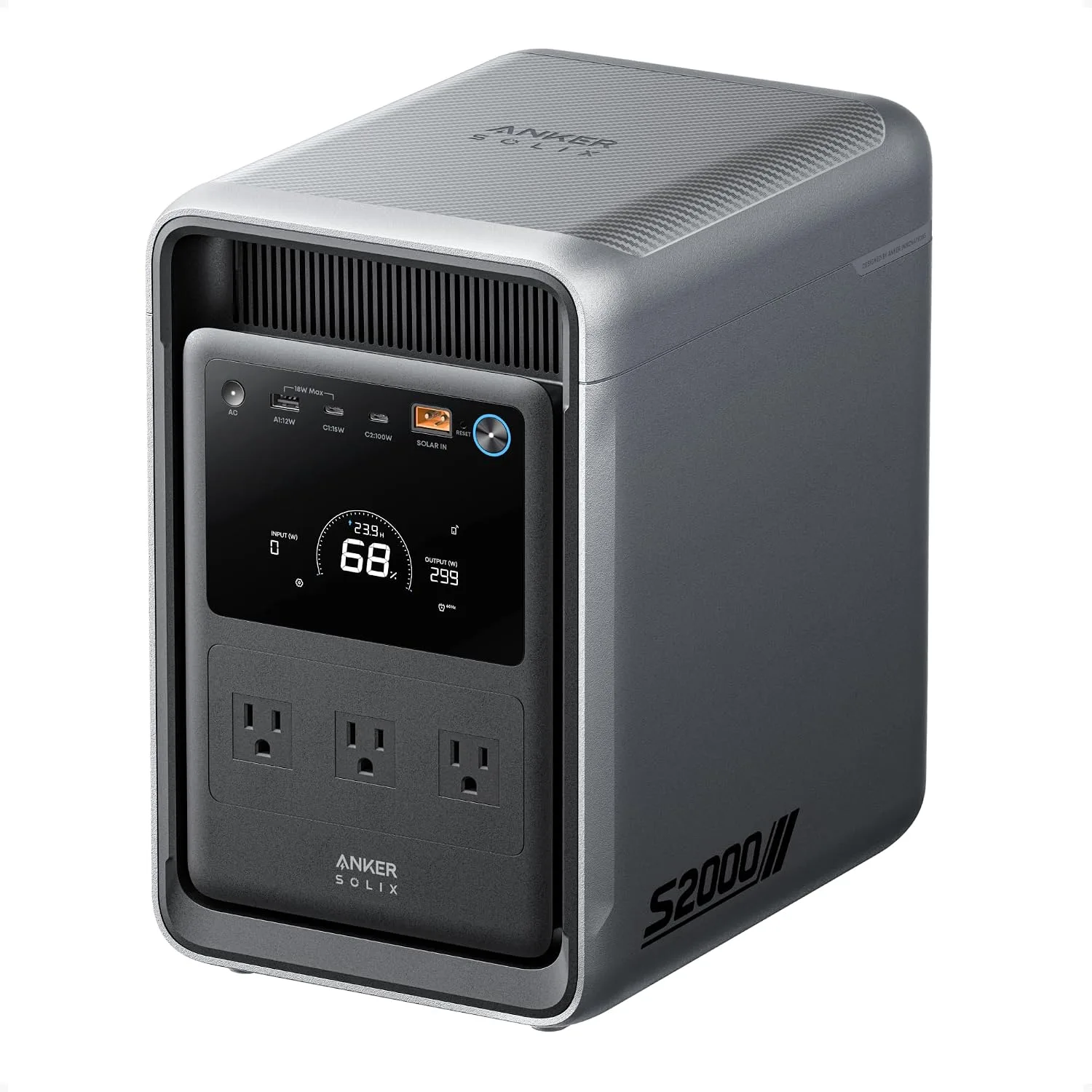
Anker S2000 Portable Power Station, 2,010Wh
Highlights
- 2010Wh rated capacity
- 1500W continuous AC
- 3000W surge
- LiFePO4 chemistry
- 35.7 lb (~16.2 kg)
- About $1199 list
Best for
- SOLIX S2000: longer outages or higher continuous loads (still not whole-home wiring)
- RV / off-grid days where recharge speed matters as much as Wh
- Users who will pair solar or expand rather than buy a second small pack
Strengths
- SOLIX S2000: 2010Wh pack with 1500W continuous / 3000W surge — size loads to both numbers
- 35.7 lb (~16.2 kg) is a park-and-use chassis — plan a short path, not a trail hike
- 10ms-class UPS switchover on the listing — useful when a router restart would hurt
- About $1199 list in the Hub catalog — confirm live retail before you buy
Watch-outs · not ideal when
- 35.7 lb (~16.2 kg) is a two-hand lift; skip it if you walk more than a short path to camp
- High continuous output on SOLIX S2000 tempts big loads — Wh still runs out on kettles and A/C
- Solar input unpublished for SOLIX S2000 — do not assume a same-day off-grid refill
- LiFePO4 helps longevity, but SOLIX S2000 still hates freezing charge temps on winter trips
Spec snapshot
Prices are list prices, not sale stickers. The Jackery's continuous AC output is not published on the listing I worked from, so it reads n/a — the 1,500 W figure owners mention belongs to the base station, not this pack. In practice, the pack's output ceiling is whatever the Explorer 2000 Plus base delivers (1,500 W continuous per the base spec).
| Product | List price | Capacity (Wh) | Output (W) | Weight (lb) | Rating |
|---|---|---|---|---|---|
| Anker SOLIX S2000 Portable Power Station, 2,010Wh | $1,199 | 2010 Wh | 1500 W | 35.7 lb | 4.89 |
| for Explorer 2000 Plus Series Portable Power Station | $799 | 2043 Wh | n/a (not on file; base station rated 1,500 W continuous) | 43.65 lb | 4.60 |
Where the money went
Strip the marketing and the $799 buys four different things depending on which box you pick.
Inverters and outlets. Anker spends on a 1,500 W continuous inverter with a 3,000 W peak and eight AC outlets split front and rear. Jackery spends nothing here — the pack has no inverter of its own; it borrows the base station's.
Battery and expansion. Jackery puts its money into stackability: up to five packs onto one Explorer 2000 Plus, and the listing claims a path to 24 kWh and 6,000 W when you parallel two bases. Anker's 2,010 Wh is fixed — there is no expansion battery for this model.
Control and monitoring. The Anker app is the differentiator: remote monitoring, adjustable charge speed down to low-and-silent rates, charge/discharge percentage caps, UPS mode, and daily/weekly kWh graphs. The Jackery pack has no app of its own; you manage it through the base station, and owners report the base won't let you choose whether the pack or the base drains first.
Weight and portability. Anker is 35.7 lb with built-in handles; Jackery is 43.65 lb and, per owners, light enough to shift around but not something you carry far. Neither is a backpack unit.
- Anker: inverter, outlets, app, UPS switchover — all in the box.
- Jackery: capacity only; the smarts and the sockets live in the base station.
- Anker solar input caps at one 400 W panel; Jackery charges separately off Jackery solar panels.
- Anker has no 12V DC port per the listing; plan your 12V loads around that.
The spec that decides it
One number settles most of these decisions: 1,500 W continuous. That is the Anker's published AC output, and it is what lets owners run a window AC, an induction cooker, an air fryer, a microwave, and a rice cooker off one box. If your outage plan includes any of those, the Anker is the only one of the two that can do it alone.
The second number is 2,043 Wh versus 2,010 Wh — a rounding error on its own. It only matters multiplied by five. If you already own the Explorer 2000 Plus, the Jackery pack takes you from roughly 2 kWh to 4 kWh for $799, and that is a cheaper path to more runtime than buying a second station.
Weight is the tiebreaker for the carry-it-around crowd: 35.7 lb against 43.65 lb, both with handles, neither a one-hand-forever lift.
Real owner trade-offs
The Anker reviews read like outage diaries. One owner rode out a 30-hour outage with room gear plugged in and topped the unit back to full in about 1.5 hours at a steady 1,200 W. Another replaced a desktop UPS and noted the sub-10 ms switchover kept networked PCs from rebooting, with standby draw far below the old lead-acid box. A third started an 8,000 BTU wall AC that a small gas generator bogged down on.
The caveats are just as consistent. Owners flag that this model takes no expansion battery, won't charge from a cigarette lighter, and caps solar at a single 400 W panel — one buyer wished he'd gone straight to 400 W panels. A third-party lighter cable overheated in one owner's trial; the Anker cable is the fix.
The Jackery reviews are cabin and storm-prep stories. One off-grid owner runs a gas generator about 2.5 hours morning and evening to charge a stack of Jackerys, then hears nothing but birds the rest of the day while fridges and lights run on stored power. Another calls it a great way to add capacity while keeping each box movable.
The friction is all in the coupling. You must power the base station off to add or remove a pack, so no hot-swapping a freshly charged unit mid-outage. Generator-charging the pack while the base is in use caps output at 1,500 W, and exceeding it shuts the base down. And the base won't let you pick drain order — owners say it seems to do different things at different times. Several also note the price stings.
- Anker owners: fast recharge, quiet at moderate rates, app control praised; solar and expansion limits are the recurring gripes.
- Jackery owners: capacity and LiFePO4 longevity praised; base-station coupling quirks and cost are the recurring gripes.
Buy the one that…
Buy the Anker SOLIX S2000 Portable Power Station, 2,010Wh if you are starting from zero and want one box that runs a fridge, a window AC, or a home-office UPS without buying anything else. It is the lower-risk first purchase for most readers, and the app is genuinely useful during a multi-day outage.
Buy the for Explorer 2000 Plus Series Portable Power Station only if an Explorer 2000 Plus base is already in your garage. Then $799 for roughly double the runtime is the smarter spend — provided you can live with powering the base down to swap packs and the 1,500 W ceiling while generator-charging.
Walk away from both if you need stackable capacity and don't own a Jackery base, or if you want lighter-socket charging and all-day solar from a big array — neither box delivers that at this price. Also walk away if you need a 12V DC port (Anker lacks one) or if you require hot-swap capability (Jackery requires powering down the base).
If your job is X, watch metric Y: running a fridge → capacity (Wh); running a window AC → continuous output (W); backing up a home office → UPS switchover time (ms); adding runtime to an existing Jackery base → expansion capacity (Wh).
Frequently asked
Can I use the Jackery Explorer 2000 Plus expansion pack without a base station?
No. The pack has no inverter or outlets of its own; it must dock onto an Explorer 2000 Plus base station to deliver power.
What is the continuous AC output of the Jackery expansion pack?
The pack itself does not publish a continuous AC output; it relies on the base station, which is rated at 1,500 W continuous.
Does the Anker SOLIX S2000 support expansion batteries?
No. The S2000's 2,010 Wh capacity is fixed; there is no expansion battery option for this model.
Which unit is better for a home-office UPS?
The Anker S2000, because it has a built-in UPS mode with sub-10 ms switchover (per owner reports) and app monitoring; the Jackery pack depends on the base station for any UPS function.
Method and sources
Model names and list prices come from the WattPicks catalog at build time. WattPicks does not run its own laboratory tests on power stations, and nothing on this page is presented as a measured result — it is catalog-backed buying guidance.
Read our methodology for how the catalog is normalized, and about WattPicks for who publishes it.