
Anker SOLIX S2000 vs Jackery Explorer 2000 v2: 2 kWh Duel
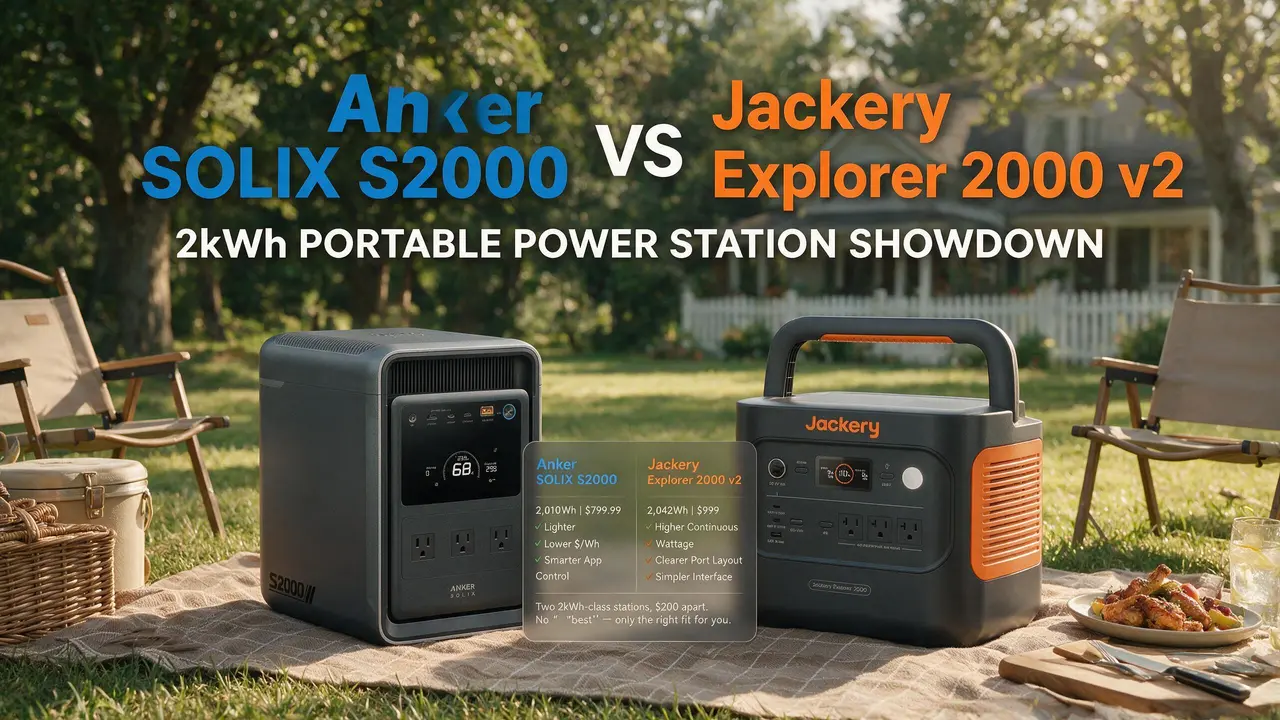
Two 2 kWh stations, $200 apart. The Anker SOLIX S2000 bets on a lower price and a smarter app; the Jackery Explorer 2000 v2 bets on more continuous watts and a simpler, standalone setup. Here's which one fits your outage plan.
Updated
At a glance
Two 2 kWh stations, $200 apart. The Anker SOLIX S2000 bets on a lower price and a smarter app; the Jackery Explorer 2000 v2 bets on more continuous watts and a simpler, standalone setup. Here's which one fits your outage plan.
- Anker SOLIX S2000: $799.99, 2010 Wh, 1500 W continuous, 35.7 lb — lower price, lighter, app-heavy.
- Jackery Explorer 2000 v2: $999, 2042 Wh, 2200 W continuous, 39.5 lb — more watts, simpler standalone use.
Same money, different bets
At $799.99 for the Anker SOLIX S2000 and $999 for the Jackery Explorer 2000 v2, you're paying roughly the same for two 2 kWh-class stations — but the $200 gap buys you different things. The Anker bets on a lower sticker, a lighter body, and an app that lets you tune almost everything. The Jackery bets on raw continuous output and a standalone, no-phone-needed experience.
This comparison is for buyers who need a 2 kWh station for home outage backup, UPS duty, or off-grid work — not for campers who only need a few hundred watt-hours. If your loads stay under 1,500 W and you want the most control per dollar, the Anker leads. If you need to run a 2,200 W appliance or want a station that works without an app, the Jackery is the one to beat.
One disclosure: we may earn a commission from Amazon Associates links. Picks are fit-led, not commission-led.
- Anker SOLIX S2000: $799.99, 2010 Wh, 1500 W continuous, 35.7 lb — lower price, lighter, app-heavy.
- Jackery Explorer 2000 v2: $999, 2042 Wh, 2200 W continuous, 39.5 lb — more watts, simpler standalone use.
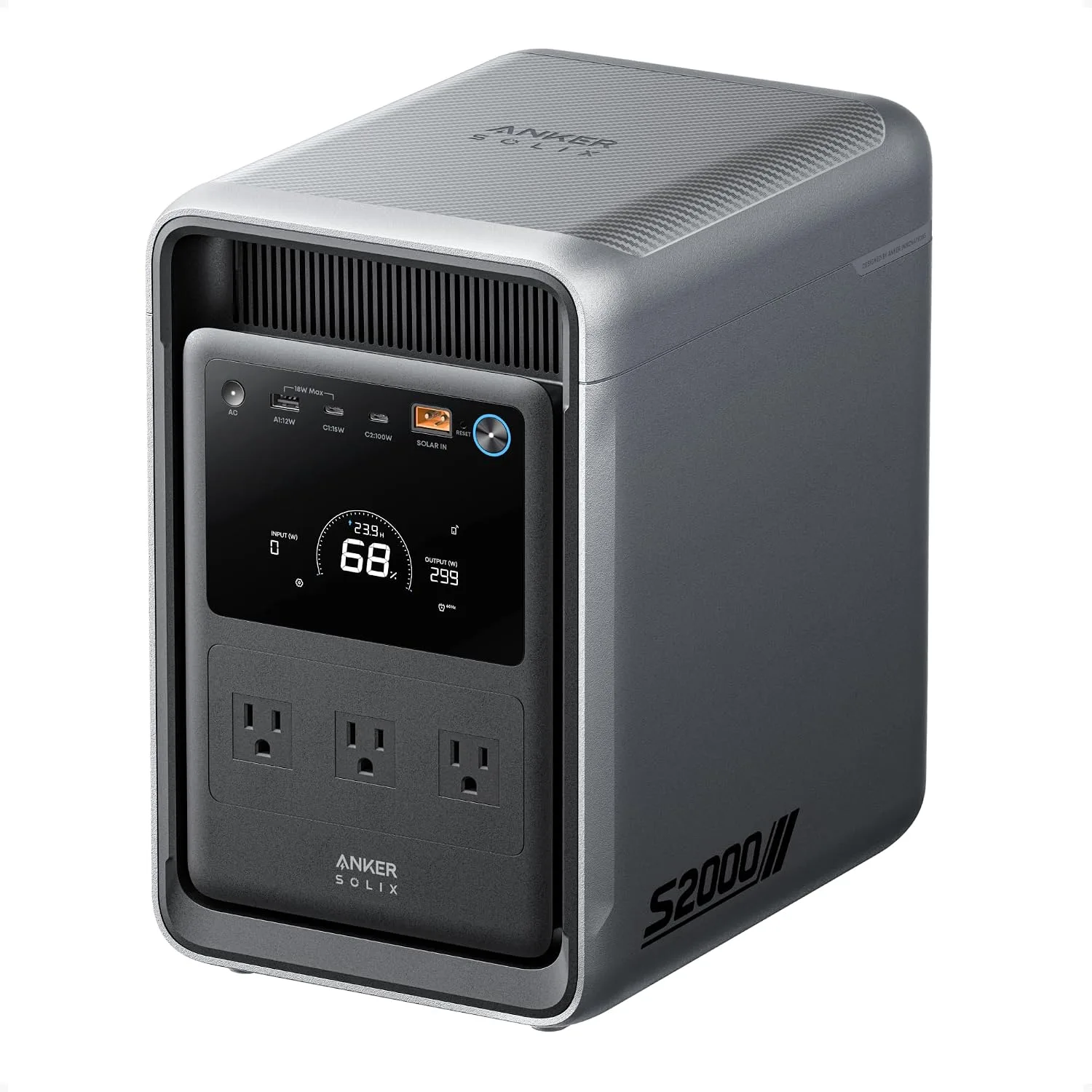
Anker S2000 Portable Power Station, 2,010Wh
Highlights
- 2010Wh rated capacity
- 1500W continuous AC
- 3000W surge
- LiFePO4 chemistry
- 35.7 lb (~16.2 kg)
- About $1199 list
Best for
- SOLIX S2000: longer outages or higher continuous loads (still not whole-home wiring)
- RV / off-grid days where recharge speed matters as much as Wh
- Users who will pair solar or expand rather than buy a second small pack
Strengths
- SOLIX S2000: 2010Wh pack with 1500W continuous / 3000W surge — size loads to both numbers
- 35.7 lb (~16.2 kg) is a park-and-use chassis — plan a short path, not a trail hike
- 10ms-class UPS switchover on the listing — useful when a router restart would hurt
- About $1199 list in the Hub catalog — confirm live retail before you buy
Watch-outs · not ideal when
- 35.7 lb (~16.2 kg) is a two-hand lift; skip it if you walk more than a short path to camp
- High continuous output on SOLIX S2000 tempts big loads — Wh still runs out on kettles and A/C
- Solar input unpublished for SOLIX S2000 — do not assume a same-day off-grid refill
- LiFePO4 helps longevity, but SOLIX S2000 still hates freezing charge temps on winter trips
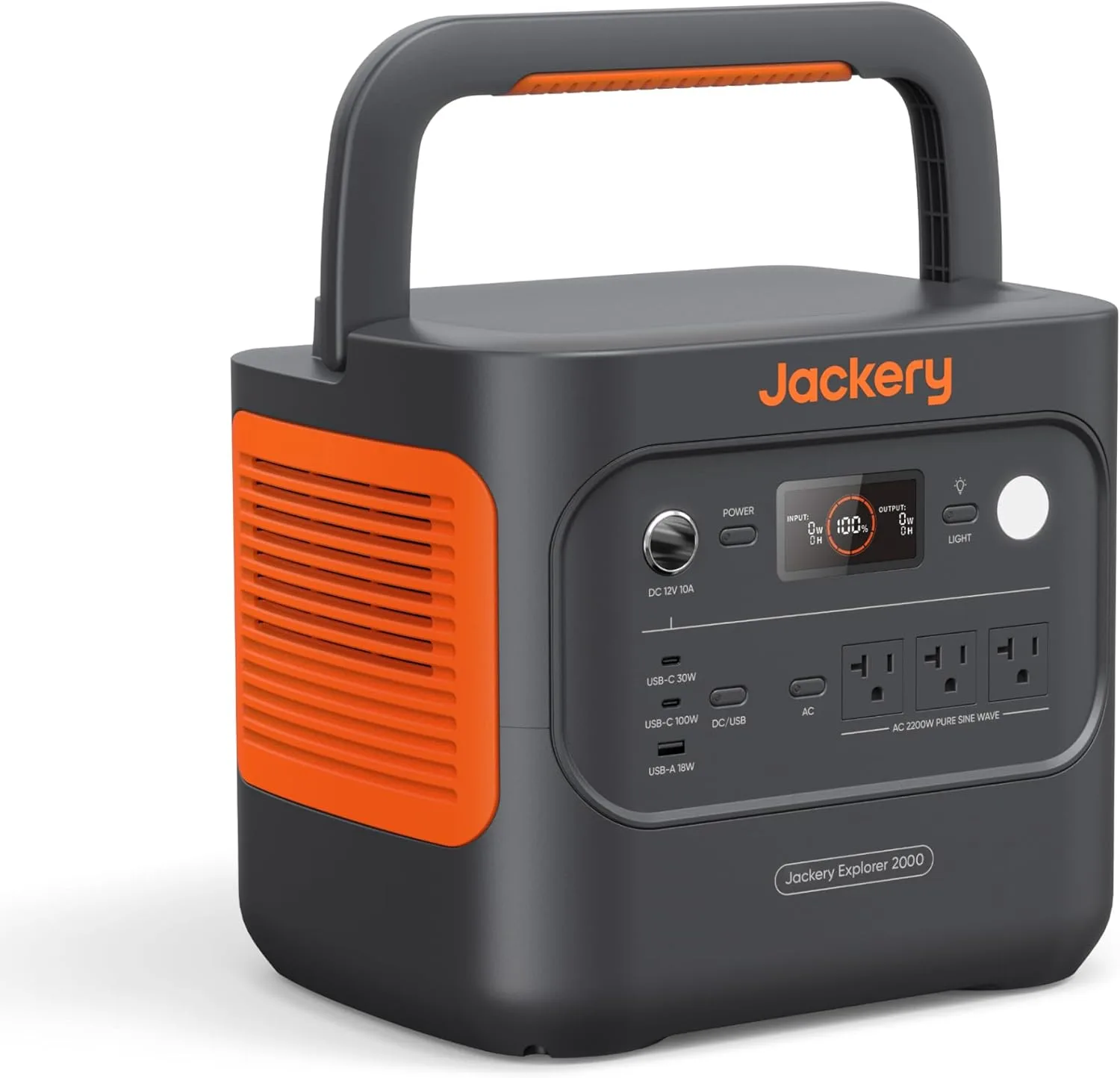
Jackery Explorer 2000 v2 Portable Power Station, 2042Wh
Highlights
- 2042Wh rated capacity
- 2200W continuous AC
- LiFePO4 chemistry
- 39.5 lb (~17.9 kg)
- About $999 list
Best for
- Explorer 2000 v2: longer outages or higher continuous loads (still not whole-home wiring)
- RV / off-grid days where recharge speed matters as much as Wh
- Users who will pair solar or expand rather than buy a second small pack
Strengths
- Explorer 2000 v2: 2200W continuous on a 2042Wh pack — more headroom for small appliances than 1kW-class peers
- 39.5 lb (~17.9 kg) is a park-and-use chassis — plan a short path, not a trail hike
- 20ms-class UPS switchover on the listing — useful when a router restart would hurt
- Owners on file: Replaces a Jackery Explorer as power for my cabin. This is the perfect all-weekend solution for a cabin, camp…
Watch-outs · not ideal when
- 39.5 lb (~17.9 kg) is a two-hand lift; skip it if you walk more than a short path to camp
- High continuous output on Explorer 2000 v2 tempts big loads — Wh still runs out on kettles and A/C
- Solar input unpublished for Explorer 2000 v2 — do not assume a same-day off-grid refill
- LiFePO4 helps longevity, but Explorer 2000 v2 still hates freezing charge temps on winter trips
Owner voices
Short takes from public retail reviews — paraphrased or translated when long or non-English; meaning kept close to the original.
“Replaces a Jackery Explorer as power for my cabin. This is the perfect all-weekend solution for a cabin, camper or RV. Ditto, certainly will get used for large group cookouts and campouts. We have a plug-in generator…”
“Tested unit on a iceco VL60ProD, unit ran perfectly for days. 2000v will be mainly used as a backup power supply for our travel trailer and occasionally for intermittent power outages at home.”
“Great customer service and fast response.”
Methodology
This comparison is based on listing specs from the WattPicks catalogue and owner themes from high-helpful reviews on file — not lab-bench measurements. I weighted continuous output (35%), price per Wh (25%), owner-reported reliability and caveats (20%), app and charging control (10%), and weight/portability (10%). The Anker wins on price per Wh and app control; the Jackery wins on continuous output. The Jackery's capacity inconsistency in one high-helpful review is the main reason it doesn't take the top spot for most buyers, despite its higher output.
Avery Nolan is the WattPicks founding editor, covering portable power station capacity, output, and price-per-Wh guidance across the catalogue — no lab claims.
Scoreboard on those weights — Anker SOLIX S2000 Portable Power Station, 2,010Wh (list $799.99): High where list price and published capacity match the job, Med on continuous watts; Jackery Explorer 2000 v2 Portable Power Station, 2042Wh (list $999): High on continuous watts and ports, Med on price. That is why the pick splits by job rather than one universal winner.
Spec snapshot
Prices are list prices from the WattPicks catalogue; the Jackery's current $999 deal is not used in this table. Ratings are listing aggregates, not owner proof.
| Product | List price | Capacity (Wh) | Output (W) | Weight (lb) | Rating |
|---|---|---|---|---|---|
| Anker SOLIX S2000 Portable Power Station, 2,010Wh | $1,199 | 2010 Wh | 1500 W | 35.7 lb | 4.89 |
| Jackery Explorer 2000 v2 Portable Power Station, 2042Wh | $999 | 2042 Wh | 2200 W | 39.5 lb | 4.80 |
Where the money went
The Anker's $200 savings show up in the parts you interact with daily: the app, the charging flexibility, and the weight. The Jackery's extra spend goes into the inverter and the standalone hardware — more continuous watts, a slightly larger battery, and a design that doesn't require a phone to unlock its features.
Here's how the two compare on the configuration points that matter most for outage buyers.
- Output headroom: Jackery 2200 W vs Anker 1500 W. The Jackery can run a 2,000 W-class appliance (like a large microwave or space heater) that would trip the Anker's inverter. The Anker handles most fridges, CPAPs, routers, and small kitchen appliances, but not a 2,200 W load.
- Battery capacity: Jackery 2042 Wh vs Anker 2010 Wh — a 32 Wh difference, basically a rounding error. Neither wins on capacity alone.
- Weight and portability: Anker 35.7 lb vs Jackery 39.5 lb. The Anker is about 4 lb lighter, which matters if you're carrying it up stairs or loading it into a car. Both have built-in handles.
- App and charging control: The Anker's app is the standout — adjustable charge rate down to 100 W, quiet-time scheduling, charge/discharge limits, and energy tracking. The Jackery works without an app, but its UPS setup instructions are unclear and one owner reported E6 errors during setup. The Jackery does have a 100 W USB-C PD port; the Anker's USB-C and USB-A port counts are not on file, so we can't compare port-for-port.
The spec that decides it
For most home-outage buyers, the deciding spec is continuous output, not capacity. The Jackery's 2200 W inverter means you can run a 2,000 W appliance — a large microwave, a space heater, a hair dryer — without tripping. The Anker's 1500 W ceiling is enough for a fridge (typically 100–200 W running, with a startup surge), a CPAP (30–60 W), a router (10–20 W), and a laptop (60–100 W) all at once, but it will not run a 2,200 W load.
The second deciding factor is the app. If you want to schedule quiet charging, cap the battery at 80% to prolong life, or track energy use by day and week, the Anker is the only one of the two that does that well. If you want a station that works out of the box without a phone, the Jackery is simpler — though its UPS setup is less clear than it should be.
Real owner trade-offs
Owner reviews on file for both units skew toward outage backup and UPS replacement, which matches this page's angle. The Anker's high-helpful reviews praise its quiet charging, sub-10 ms UPS switchover (as reported by owners, not a lab measurement), and app control; the caveats are about expansion limits (no extended battery, no cigarette-lighter charging, single 400 W solar panel max). The Jackery's high-helpful reviews praise its ability to run a full kitchen during an outage and its customer service; the caveats are more serious — one reviewer measured effective capacity far below the 2042 Wh rating (about 600 Wh in one test) due to idle power loss, though a second test showed closer-to-expected drain. A ticking fan and a flexing AC socket also show up.
Neither set of reviews is a lab test, and the Jackery's capacity inconsistency is worth verifying early if you buy one.
- Anker SOLIX S2000: Owners report powering a room's essentials through a 30-hour outage, recharging from 33% to full in about 1.5 hours at 1,200 W, and running an 8,000 BTU wall AC that a Honda EU2200 struggled to start. Caveats: no extended battery, no cigarette-lighter charging, 400 W solar max.
- Jackery Explorer 2000 v2: Owners report running a microwave, toaster oven, and dual hot plate during a Christmas outage, and a 10,000 BTU AC plus air fryer. Caveats: one high-helpful reviewer measured ~600 Wh effective capacity vs 2042 Wh rated due to idle loss (second test closer to expected); fan ticking; AC socket flex; unclear UPS setup.
Buy the one that…
Buy the Anker SOLIX S2000 if you want the lowest price per watt-hour in this pair ($0.40/Wh vs $0.49/Wh), a lighter body, and an app that lets you tune charging and monitor energy use — and your loads stay under 1,500 W.
Buy the Jackery Explorer 2000 v2 if you need to run a 2,000 W-class appliance, want a station that works without a phone, or value Jackery's customer service track record — and you're willing to verify capacity early and accept the fan and socket quirks.
- Skip the Anker if you need to run a 2,200 W load or want to add an extended battery later.
- Skip the Jackery if you want the lowest $/Wh or if a ticking fan or flexing socket would bother you.
Frequently asked
Can the Anker SOLIX S2000 run a 2,200 W appliance?
No — its continuous output is 1500 W. The Jackery Explorer 2000 v2 is rated at 2200 W continuous and can run a 2,000 W-class load.
Which one is cheaper per Wh?
The Anker at $0.40/Wh vs the Jackery at $0.49/Wh, based on list prices.
Do both have USB-C?
The Jackery has USB-C×2 and USB-A×2 on file. The Anker's USB-C and USB-A port counts are not on file, so we can't confirm or deny USB-C on the Anker — check the listing before you buy.
Which is better for UPS duty?
The Anker's sub-10 ms switchover (owner-reported) and app-based UPS mode are well-reviewed. The Jackery's 20 ms switchover is also fine for most gear, but its UPS setup instructions are unclear and one owner reported E6 errors during setup.
Method and sources
Model names and list prices come from the WattPicks catalog at build time. WattPicks does not run its own laboratory tests on power stations, and nothing on this page is presented as a measured result — it is catalog-backed buying guidance.
Read our methodology for how the catalog is normalized, and about WattPicks for who publishes it.