
Jackery Explorer 2000 v2 vs BLUETTI AC200PL: Which 2kWh Fits?
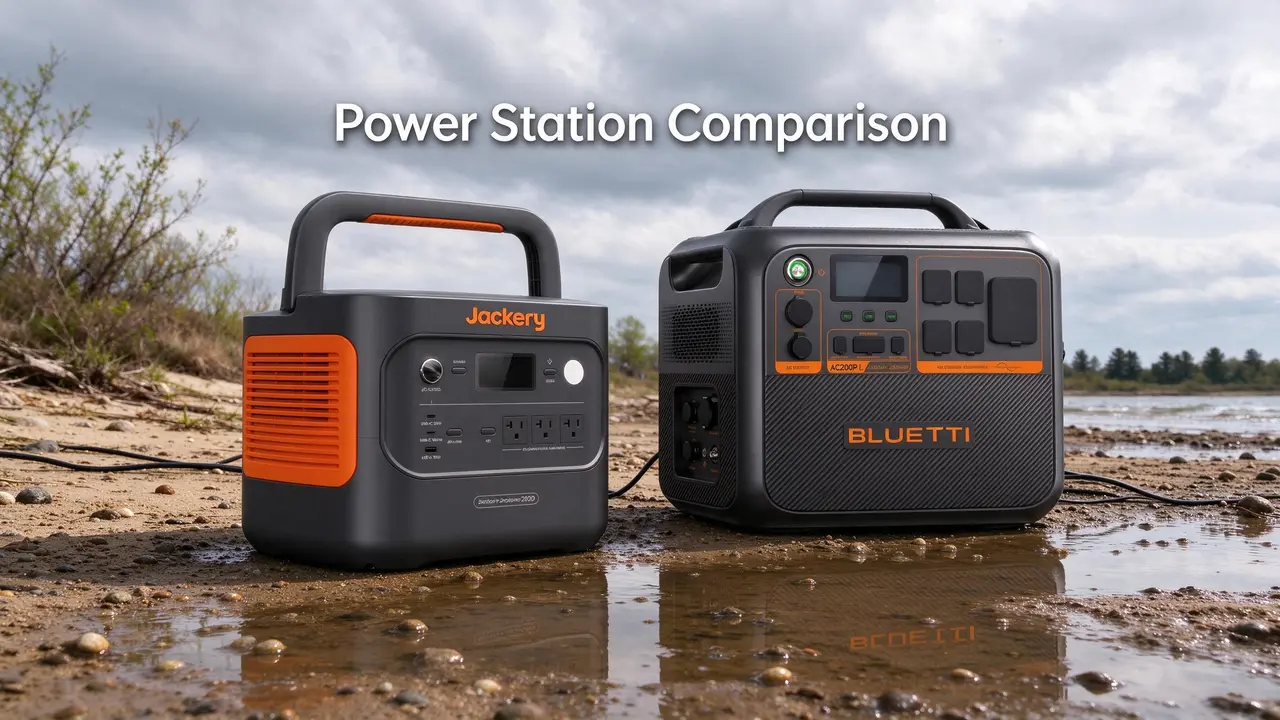
Two 2kWh stations, $100 apart, with very different bets: the Jackery is 39.5 lb and built for portability, the BLUETTI is 62.4 lb with more outlets and a lower list price. Here is who should pick which, and who should walk away from both.
Updated
At a glance
Two 2kWh stations, $100 apart, with very different bets: the Jackery is 39.5 lb and built for portability, the BLUETTI is 62.4 lb with more outlets and a lower list price. Here is who should pick which, and who should walk away from both.
- Jackery bet: lighter body and faster to move; fewer AC outlets (3).
- BLUETTI bet: more outlets and lower list price per Wh; much heavier (62.4 lb).
Same money, different bets
At $999 for the Jackery Explorer 2000 v2 Portable Power Station, 2042Wh and $899 for the BLUETTI AC200PL, you are choosing between two 2kWh-class stations that solve different problems. The Jackery bets on weight and portability: 39.5 lb, 2200 W continuous, and a compact body you can actually move between rooms or load into a car. The BLUETTI bets on outlet count and list-price value: 62.4 lb, 2400 W continuous, 12 AC outlets, and a lower nameplate $/Wh at $0.44 versus $0.49 for the Jackery.
This is not a page for someone who needs 3,000 W for a well pump or a 5kWh whole-home setup. Both units top out at 2200–2400 W continuous, so a standard fridge, router, CPAP, fans, lights, and a microwave one at a time are fair game. A central AC compressor, electric range, or simultaneous high-draw appliances are not.
- Jackery bet: lighter body and faster to move; fewer AC outlets (3).
- BLUETTI bet: more outlets and lower list price per Wh; much heavier (62.4 lb).
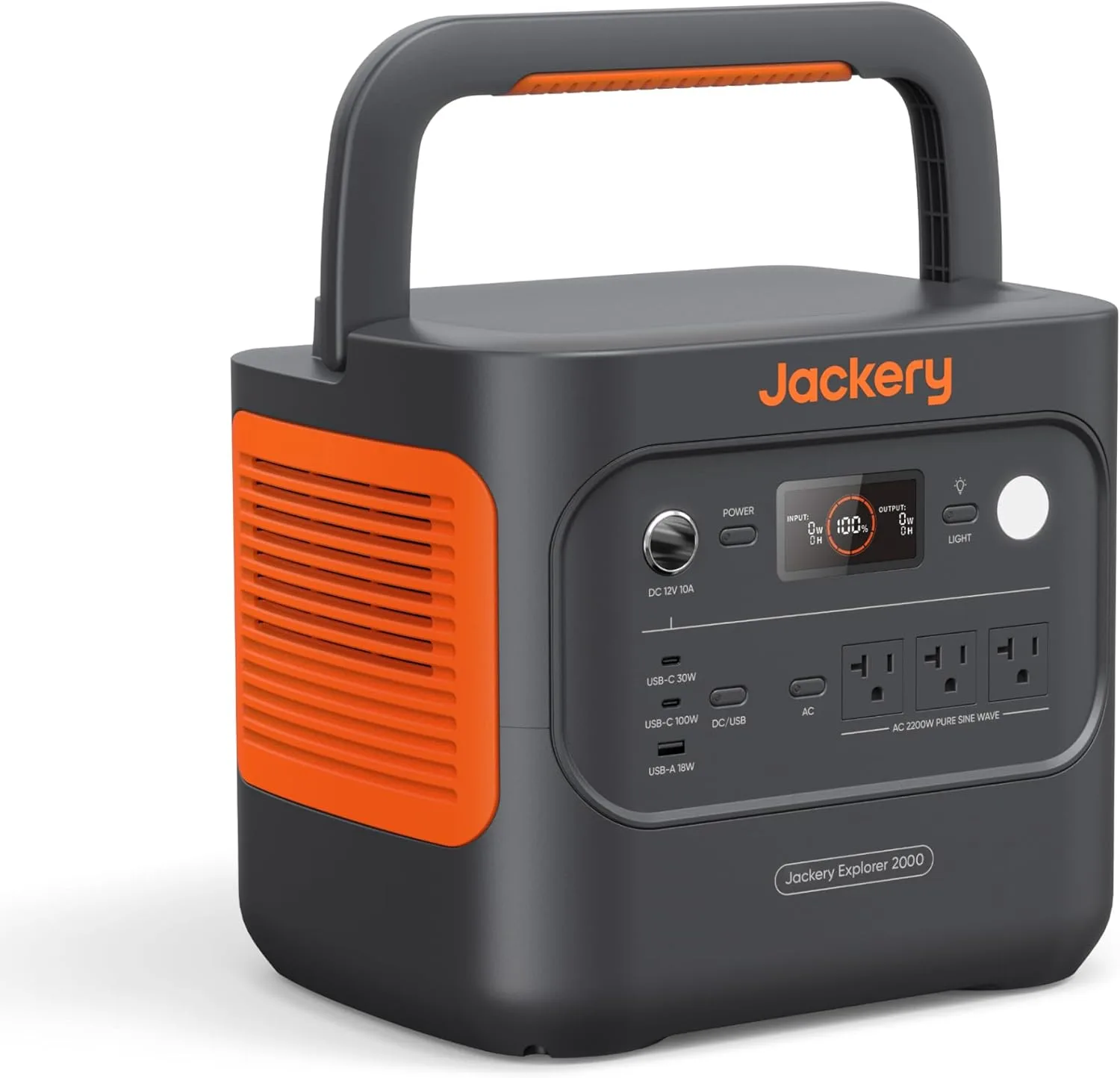
Jackery Explorer 2000 v2 Portable Power Station, 2042Wh
Highlights
- 2042Wh rated capacity
- 2200W continuous AC
- LiFePO4 chemistry
- 39.5 lb (~17.9 kg)
- About $999 list
Best for
- Explorer 2000 v2: longer outages or higher continuous loads (still not whole-home wiring)
- RV / off-grid days where recharge speed matters as much as Wh
- Users who will pair solar or expand rather than buy a second small pack
Strengths
- Explorer 2000 v2: 2200W continuous on a 2042Wh pack — more headroom for small appliances than 1kW-class peers
- 39.5 lb (~17.9 kg) is a park-and-use chassis — plan a short path, not a trail hike
- 20ms-class UPS switchover on the listing — useful when a router restart would hurt
- Owners on file: Replaces a Jackery Explorer as power for my cabin. This is the perfect all-weekend solution for a cabin, camp…
Watch-outs · not ideal when
- 39.5 lb (~17.9 kg) is a two-hand lift; skip it if you walk more than a short path to camp
- High continuous output on Explorer 2000 v2 tempts big loads — Wh still runs out on kettles and A/C
- Solar input unpublished for Explorer 2000 v2 — do not assume a same-day off-grid refill
- LiFePO4 helps longevity, but Explorer 2000 v2 still hates freezing charge temps on winter trips
Owner voices
Short takes from public retail reviews — paraphrased or translated when long or non-English; meaning kept close to the original.
“Replaces a Jackery Explorer as power for my cabin. This is the perfect all-weekend solution for a cabin, camper or RV. Ditto, certainly will get used for large group cookouts and campouts. We have a plug-in generator…”
“Tested unit on a iceco VL60ProD, unit ran perfectly for days. 2000v will be mainly used as a backup power supply for our travel trailer and occasionally for intermittent power outages at home.”
“Great customer service and fast response.”
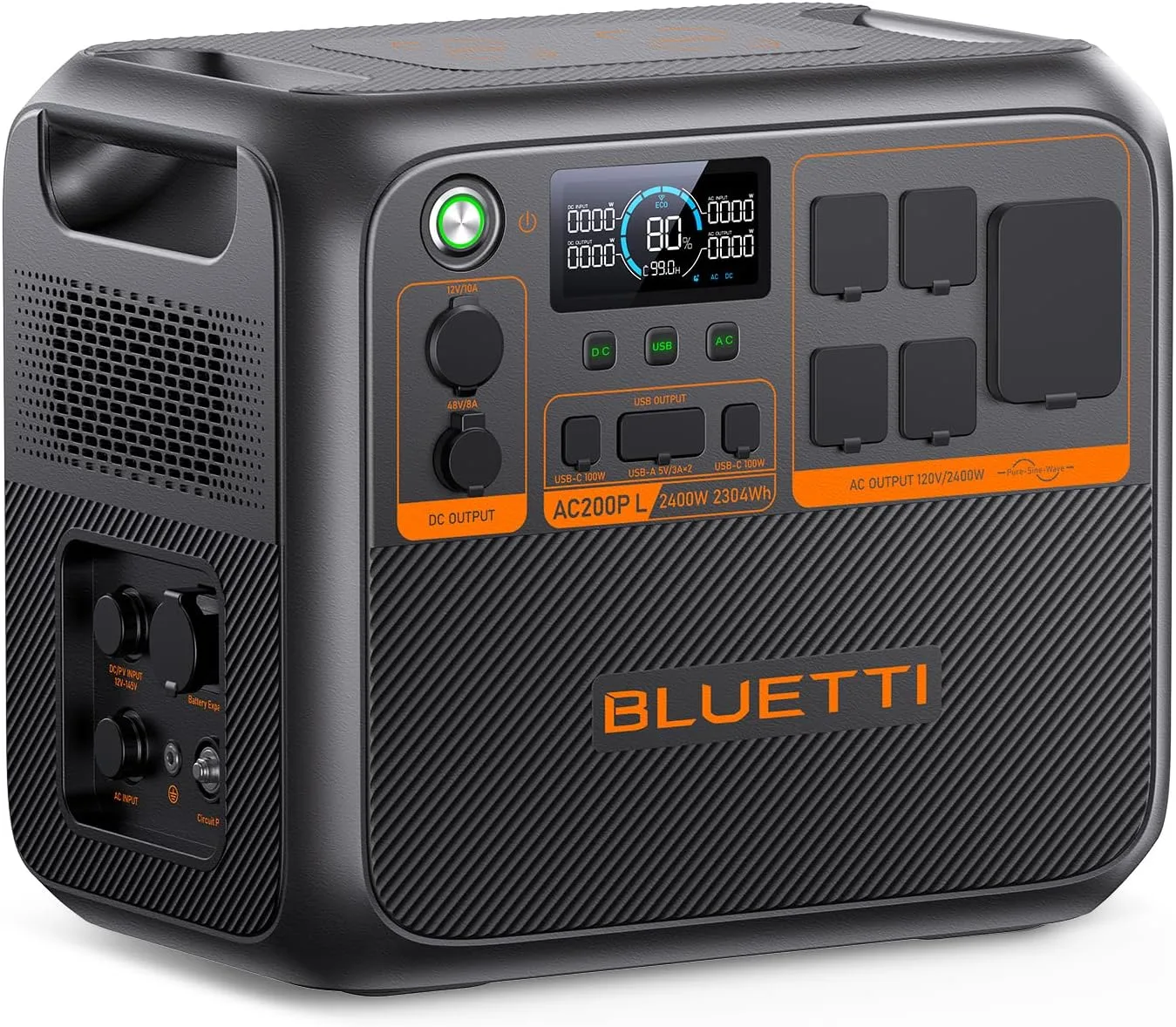
BLUETTI AC200PL Portable Power Station 2304Wh 2400W LiFePO4 Solar Generator
Highlights
- 2304Wh rated capacity
- 2400W continuous AC
- LiFePO4 chemistry
- Up to 1200W solar input
- 62.4 lb (~28.3 kg)
- About $899 list
Best for
- AC200L: longer outages or higher continuous loads (still not whole-home wiring)
- RV / off-grid days where recharge speed matters as much as Wh
- Best parked near the vehicle or cabin — not a long carry to a tent
Strengths
- AC200L: 2400W continuous on a 2304Wh pack — more headroom for small appliances than 1kW-class peers
- 62.4 lb (~28.3 kg) is a park-and-use chassis — plan a short path, not a trail hike
- 2400W continuous headroom covers more small appliances than 1kW-class inverters
- About $899 list in the Hub catalog — confirm live retail before you buy
Watch-outs · not ideal when
- At 62.4 lb (~28.3 kg), AC200L is a poor tent-hike companion — plan a cart or leave it in the vehicle
- High continuous output on AC200L tempts big loads — Wh still runs out on kettles and A/C
- Rated 1200W solar on AC200L is optimistic; shade and cables cut real watts
- LiFePO4 helps longevity, but AC200L still hates freezing charge temps on winter trips
Methodology and disclosure
I am Avery Nolan, WattPicks founding editor. My checks here are home-user checks grounded in owner themes on file plus listing specs; they are not lab-bench measurements. I weighted the comparison toward the decisions that actually change the pick: weight and portability (30%), outlet count and continuous output (25%), recharge and solar input (20%), owner-reported reliability and caveats (15%), and list price per Wh (10%). The Jackery wins the weight and portability weight; the BLUETTI wins outlet count, continuous output, solar ceiling, and list price per Wh. That is why the pick flips based on whether the unit travels or stays put.
As an Amazon Associate, WattPicks earns from qualifying purchases. Picks are fit-led, not commission-led. Prices and specs are from the listings on file and can change; verify before you buy.
Scoreboard on those weights — Jackery Explorer 2000 v2 Portable Power Station, 2042Wh (list $999): High where list price and published capacity match the job, Med on continuous watts; BLUETTI AC200PL (list $899): High on continuous watts and ports, Med on price. That is why the pick splits by job rather than one universal winner.
Spec snapshot
Numbers below come from the product listings and WattPicks catalogue. Ratings are listing aggregates, not owner proof. Weight is in pounds; capacity in Wh; output in continuous W.
| Product | List price | Capacity (Wh) | Output (W) | Weight (lb) | Rating |
|---|---|---|---|---|---|
| Jackery Explorer 2000 v2 Portable Power Station, 2042Wh | $999 | 2042 Wh | 2200 W | 39.5 lb | 4.80 |
| BLUETTI AC200PL | $899 | 2048 Wh | 2400 W | 62.4 lb | 5.00 |
Where the money went
The Jackery’s budget clearly went into the enclosure and cell-to-body construction. At 39.5 lb it is roughly 23 lb lighter than the BLUETTI, and the listing claims it is 41% lighter and 34% smaller than typical 2kWh LiFePO4 stations. That matters if the unit lives in a closet and gets carried to the kitchen during an outage. The trade-off is outlet count: 3 AC ports, 2 USB-C, 2 USB-A, and 1 car port. For a fridge plus a router plus a lamp, that is enough. For a family room with a TV, soundbar, cable box, and two phone chargers, you will be reaching for a power strip.
BLUETTI put the money into I/O and output headroom. The AC200PL lists 12 AC outlets (including a 30A TT30 port and a 48V/8A DC port), plus USB-A and a car port. The USB-C count is not confirmed on the listing I have, so I will not claim it is absent. Continuous output is 2400 W, 200 W above the Jackery. The cost is weight: 62.4 lb is a two-person lift for most people, and the listing’s own details field shows a 72 lb shipping figure, which is a reminder that this is not a grab-and-go unit.
Both use LiFePO4 chemistry, which is the buyer-relevant point: you get the longer cycle life and safer thermal profile rather than the lighter-but-shorter-lived NMC packs. Jackery claims up to 10 years; BLUETTI claims 3000+ cycles, also framed as a 10-year lifespan. Neither claim is independently verified here.
Recharge speed is close on paper. Jackery lists 0–80% in 66 minutes on AC fast charge, or a full charge in 102 minutes via the app’s Emergency Super Charging mode, and solar in as few as 6 hours with 400 W panels. BLUETTI lists 0–80% in 60 minutes with a 2400 W AC input and up to 1200 W solar input, full in 1.9–3.8 hours. The BLUETTI’s higher solar ceiling is the bigger practical difference if you plan to recharge off panels.
- AC outlets: Jackery 3 vs BLUETTI 12 (listing).
- Continuous output: Jackery 2200 W vs BLUETTI 2400 W.
- Weight: Jackery 39.5 lb vs BLUETTI 62.4 lb.
- Solar input ceiling: Jackery 400 W (listing) vs BLUETTI 1200 W (listing).
- USB-C: Jackery lists 2; BLUETTI USB-C count unknown on file — do not assume absence.
The spec that decides it
For most buyers, weight is the deciding spec. A 2kWh station only helps if it is in the room where the outage happens. The Jackery’s 39.5 lb is still heavy — owners describe it as a two-hand lift for stairs — but it is 22.9 lb lighter than the BLUETTI, and that gap is the difference between “I can move this myself” and “I need help.” If the unit will sit in a basement as a UPS and never travel, the BLUETTI’s weight penalty costs you nothing.
The second deciding spec is outlet count and output. The BLUETTI’s 12 AC outlets and 2400 W continuous give you more simultaneous loads and a little more headroom for a microwave or space heater. The Jackery’s 3 AC outlets and 2200 W are enough for a fridge, router, and a few small devices, but you will need a power strip for a full entertainment setup. Neither unit should be asked to run a central AC compressor or an electric range.
Real owner trade-offs
Owner feedback on the Jackery centers on fridge backup and pass-through. One high-helpful reviewer ran a fridge through the unit during an outage and got about a day of runtime while opening the door and using the water dispenser normally; the same reviewer described killing the breaker with the unit plugged into the wall and the fridge on battery, and the fridge lights never flickered. That pass-through behavior is the feature to test on day one. The caveats are equally consistent: with a small AC load, the app projected far less runtime than the rated capacity math suggests, and the percentage estimate drifted near empty. A separate reviewer flagged a solar-charging pulse bug that required a firmware push (v1.1) to fix — free, but not automatic. The 120V socket face flexing when pushing a cord in came up too.
BLUETTI owner themes lean toward UPS duty and camping. One reviewer set the unit up as a basement UPS for a TV, router, and lamps and reported instant switchover with no blink when wall power was cut; the display showed remaining runtime clearly. Another ran a box fan overnight and a portable car fridge over a multi-day camping trip without reliability issues. The recurring caveat is inverter idle draw: with the AC output on, the unit consumes power even with little plugged in, so small loads drain faster than the math implies. The top wireless charging pad was unreliable for at least one reviewer — it connected then quit after a few seconds. Solar input in real conditions tracked well below the panel’s rated wattage, which is normal but worth planning around.
Both listings carry firmware-update advice from owners. Neither is a reason to skip the unit, but both are reasons to check for updates before you rely on solar or small-load runtime estimates.
- Jackery owner theme: seamless pass-through for fridge backup; idle draw and solar pulse bug are the honest caveats.
- BLUETTI owner theme: instant UPS switchover and camping reliability; inverter idle draw and flaky wireless charger are the caveats.
Buy the one that…
Buy the Jackery Explorer 2000 v2 Portable Power Station, 2042Wh if you need to move the unit between rooms or load it into a car, and your outage plan is a fridge, router, a few lights, and phone charging. It is the lighter 2kWh station here, and the pass-through switchover owners describe is the right feature for a fridge backup. Skip it if you need more than 3 AC outlets without a power strip, or if you plan to run small loads for days — the idle draw will eat your runtime estimate.
Buy the BLUETTI AC200PL if the unit will live in one place as a basement UPS or RV/camping power source, and you want more outlets, 2400 W continuous, and a lower list price per Wh. It is the cheaper station on nameplate $/Wh at $0.44 versus $0.49, and the 12 AC outlets mean fewer power strips. Skip it if you need to carry it up stairs regularly or rely on wireless charging — 62.4 lb is a two-person lift for many people, and the wireless pad has been unreliable for at least one owner.
Walk away from both if your outage plan includes a central AC compressor, electric range, or well pump above 2400 W continuous, or if you need more than ~2kWh without expansion. The BLUETTI lists expansion up to 8448 Wh with B300/B210P/B230 batteries; the Jackery listing does not show a comparable expansion path on file. If you need whole-home backup, a transfer switch and a larger system are the right conversation, not a portable station.
Frequently asked
Can the Jackery Explorer 2000 v2 run a fridge overnight?
Owners report roughly a day of fridge runtime with normal door opening, but small AC loads drain faster than the rated math due to idle draw. Plan on a full recharge between outage rounds.
Which is cheaper per Wh?
On nameplate $/Wh, the BLUETTI AC200PL is $0.44/Wh versus $0.49/Wh for the Jackery Explorer 2000 v2. That is list price, not a sale price.
Can either run a 2400 W space heater?
The BLUETTI lists 2400 W continuous, so a 2400 W heater is at the ceiling and not a comfortable continuous load. The Jackery lists 2200 W continuous, so a 2400 W heater is above its rating. Neither is the right tool for sustained high-watt heating.
Method and sources
Model names and list prices come from the WattPicks catalog at build time. WattPicks does not run its own laboratory tests on power stations, and nothing on this page is presented as a measured result — it is catalog-backed buying guidance.
Read our methodology for how the catalog is normalized, and about WattPicks for who publishes it.