
Jackery Explorer 500 v2 vs BLUETTI EB3A: Budget Power Pick
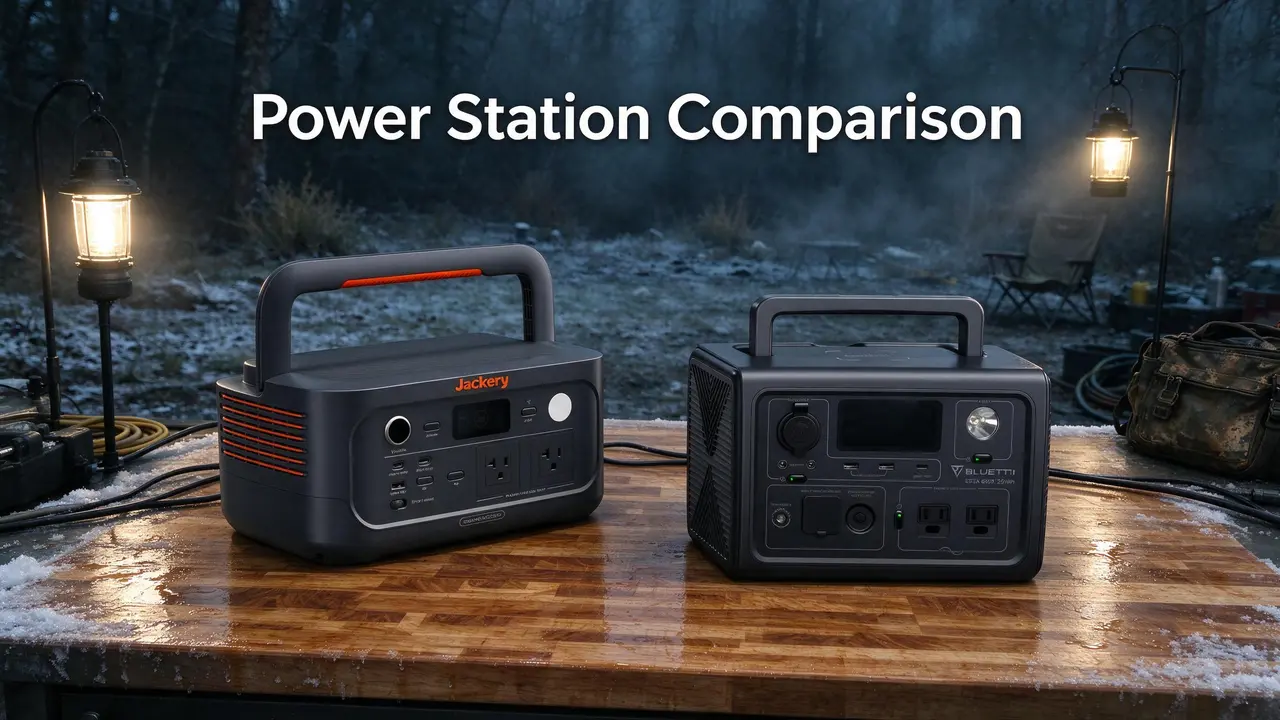
Two small power stations, two different bets: the Jackery buys you capacity and a regulated 12V rail; the BLUETTI buys you watts and a lighter pack. Here is how the money splits, and which one fits your outage or campsite.
Updated
At a glance
Two small power stations, two different bets: the Jackery buys you capacity and a regulated 12V rail; the BLUETTI buys you watts and a lighter pack. Here is how the money splits, and which one fits your outage or campsite.
- Jackery bet: more Wh (512Wh), regulated 12V, LiFePO4 rated 6,000 cycles — heavier at 14.1 lb.
- BLUETTI bet: more continuous W (600W), lighter at 10.1 lb, LiFePO4 rated 3,000 cycles — about half the capacity.
Same money, different bets
These two are not the same tool wearing different badges. The Jackery Explorer 500 v2 Power Station, 512Wh/500W, AC Cable Included puts its budget into capacity and a regulated 12V DC rail — the kind of thing that keeps a camping fridge alive overnight. The BLUETTI EB3A Portable Power Station puts its budget into a 600W inverter and a 10.1 lb body you can actually carry to a tailgate.
A note on the Jackery model name: the WattPicks catalogue card lists it as the Explorer 600 v2, but the Amazon title and bullets read Explorer 500 v2. I am using the listing title and the 512Wh capacity from the product name string as the authoritative figures for this comparison. If you order, confirm the exact model number and capacity on the box.
This is a comparison for people deciding between two small stations, not a whole-home backup guide. Neither unit will run a well pump, a space heater, or a 240V dryer. If that is your job, stop here and look at a transfer-switch setup instead.
- Jackery bet: more Wh (512Wh), regulated 12V, LiFePO4 rated 6,000 cycles — heavier at 14.1 lb.
- BLUETTI bet: more continuous W (600W), lighter at 10.1 lb, LiFePO4 rated 3,000 cycles — about half the capacity.
How I weighed these two
I am a home-user reviewer working from owner themes on file and listing specs — not lab-bench measurements. My weights: capacity and runtime 35%, output and load handling 25%, weight and portability 15%, recharge and solar behavior 15%, owner-reported reliability and service 10%. Every weight is scored in the pick above.
The Jackery wins on capacity (35%) and the regulated 12V rail, which is why it takes the outage and fridge job. The BLUETTI wins on output (25%) and weight (15%), which is why it takes the carry-and-burst job. The 10% reliability weight is where the BLUETTI loses ground — the minority of shutdown reports are enough to keep it from being the default pick.
One disclosure: as an Amazon Associate, WattPicks earns from qualifying purchases. Picks here are fit-led, not commission-led. I am Avery Nolan, WattPicks founding editor — portable power capacity, output, and price-per-Wh guidance across the catalogue, no lab claims.
Scoreboard on those weights — Jackery Explorer 500 v2 Power Station, 512Wh/500W, AC Cable Included (list $399): High on capacity and price-per-Wh, Med on continuous watts; BLUETTI EB3A Portable Power Station (list $n/a): High on continuous watts and ports, Med on price (unavailable). That is why the pick splits by job rather than one universal winner.
Spec snapshot
Prices are list prices from the WattPicks catalogue. The BLUETTI list price is n/a (not on file); I am not going to guess a street price. Ratings are listing aggregates, not owner proof. Review counts are not on file and are omitted.
| Product | Price | Capacity (Wh) | Output (W) | Weight (lb) | Rating |
|---|---|---|---|---|---|
| Jackery Explorer 500 v2 Power Station, 512Wh/500W, AC Cable Included | $399 | 512 Wh | 500 W | 14.1 lb | 4.7 |
| BLUETTI EB3A Portable Power Station | n/a (not on file) | 268 Wh | 600 W | 10.1 lb | 4.1 |
Where the money went — and the spec that decides it
Four configuration choices separate these units, and each one tells you what the maker thought you would pay for. Capacity is the biggest split: the Jackery carries 512 Wh (from the product name string); the BLUETTI carries 268 Wh. That is roughly 1.9× the stored energy for the Jackery — the difference between running a small fridge overnight and running it for a few hours.
Output goes the other way. The BLUETTI's 600W continuous inverter beats the Jackery's 500W. Owners on file ran a 400W chainsaw charger and a 1200W coffee maker via power-lift mode on the EB3A. The Jackery's 500W ceiling is fine for lamps, fans, laptops, and a pellet-stove surge, but a countertop ice maker tripped it even when the meter showed under 500W.
Weight and chemistry: the BLUETTI is 10.1 lb, the Jackery 14.1 lb. Both use LiFePO4, but the cycle ratings differ — 3,000 for the EB3A, 6,000 for the Jackery per the listing. For a buyer, that is a decade-of-use claim versus a longer decade-of-use claim; neither is a lab-verified figure here.
Ports are the fourth split, and the Jackery's are the weaker hand. The catalogue card lists AC×2, USB-C×1, USB-A×1, car×1. The BLUETTI card lists AC×2, USB-A×2, car×1, with USB-C unknown — I will not claim it is absent. One high-helpful Jackery owner complained about a single AC outlet onboard USB-C; the catalogue says two AC and one USB-C, so treat that owner note as a caution about real-world outlet crowding, not a spec sheet.
For most shoppers, capacity decides this one. If your job is keeping a fridge, a CPAP, or a router alive through an outage, the Jackery's 512 Wh gives you more runway per charge. Owners on file ran a DC fridge/freezer for 15 hours and still had over 50% left; another ran a camping fridge all night and into the next afternoon with 45% remaining. That is the kind of margin the BLUETTI's 268 Wh cannot match.
The second deciding spec is the regulated 12V DC output on the Jackery. Owners specifically called it out as the reason they picked it over competitors — the 12V rail held steady under load, which matters for DC fridges and radios that error out on voltage sag. The BLUETTI's strength is the opposite: a 600W inverter that can punch above its class for short bursts, plus fast AC recharge (about an hour and 20 minutes in silent mode per one owner).
So the decision rule is simple. If you need stored energy and a stable 12V rail, the Jackery wins. If you need to run a 500W-plus device for a short window and carry the unit in one hand, the BLUETTI wins.
- Capacity: 512 Wh (Jackery) vs 268 Wh (BLUETTI).
- Continuous output: 500 W (Jackery) vs 600 W (BLUETTI).
- Weight: 14.1 lb (Jackery) vs 10.1 lb (BLUETTI).
- Cycle rating per listing: 6,000 (Jackery) vs 3,000 (BLUETTI).
Real owner trade-offs
The owner record on both units is mixed, and the caveats are worth more than the praise. These are themes from a small sample of owner reviews on file — not a statistically representative survey.
Jackery owners praise the fridge runtime and pass-through charging, but the critical threads are consistent: one AC outlet feels tight, small solar panels (60W) will not kickstart charging — a 100W panel worked — and customer service is inconsistent. One detailed owner described a slow warranty resolution for a defective DC output; others praised quick responses. The listing aggregate is 4.7, but that is a listing number, not a verdict on your unit.
BLUETTI owners praise the fast recharge, the 600W output, and UPS pass-through — one ran a box fan all day at 99-100% charge on solar. The caveats are louder: fan noise and controller buzzing even in silent mode, app quirks (account required, Bluetooth showing other users' units), and a minority of reports about random shutdowns at 0% or charging failures. The listing aggregate is 4.1.
Neither owner base is clean. If you need a unit with a spotless service record, neither of these is that unit — and I would say so plainly.
Buy the one that…
Buy the Jackery Explorer 500 v2 Power Station, 512Wh/500W, AC Cable Included if you need the most stored energy in this pair, you plan to run a DC fridge or 12V gear, and you can live with 14.1 lb and a 500W ceiling. Skip it if you need to run a 500W-plus appliance for more than a few minutes, or if you want the lightest pack.
Buy the BLUETTI EB3A Portable Power Station if you need 600W continuous for short bursts, you value the 10.1 lb carry weight, and you accept the 268 Wh capacity and the fan/app caveats. Skip it if your outage plan depends on overnight fridge runtime or if fan noise in a bedroom would bother you.
Walk away from both if you are sizing for a whole-home outage. These are small stations for camping, tailgates, and device backup — not transfer-switch replacements. For that job, read our guide to transfer switch vs smart panel wiring before you spend anything.
- Jackery: strong fridge/12V reports; weak on outlet count, small-panel charging, and service consistency.
- BLUETTI: strong on output and recharge speed; weak on fan noise, app behavior, and a minority of reliability reports.
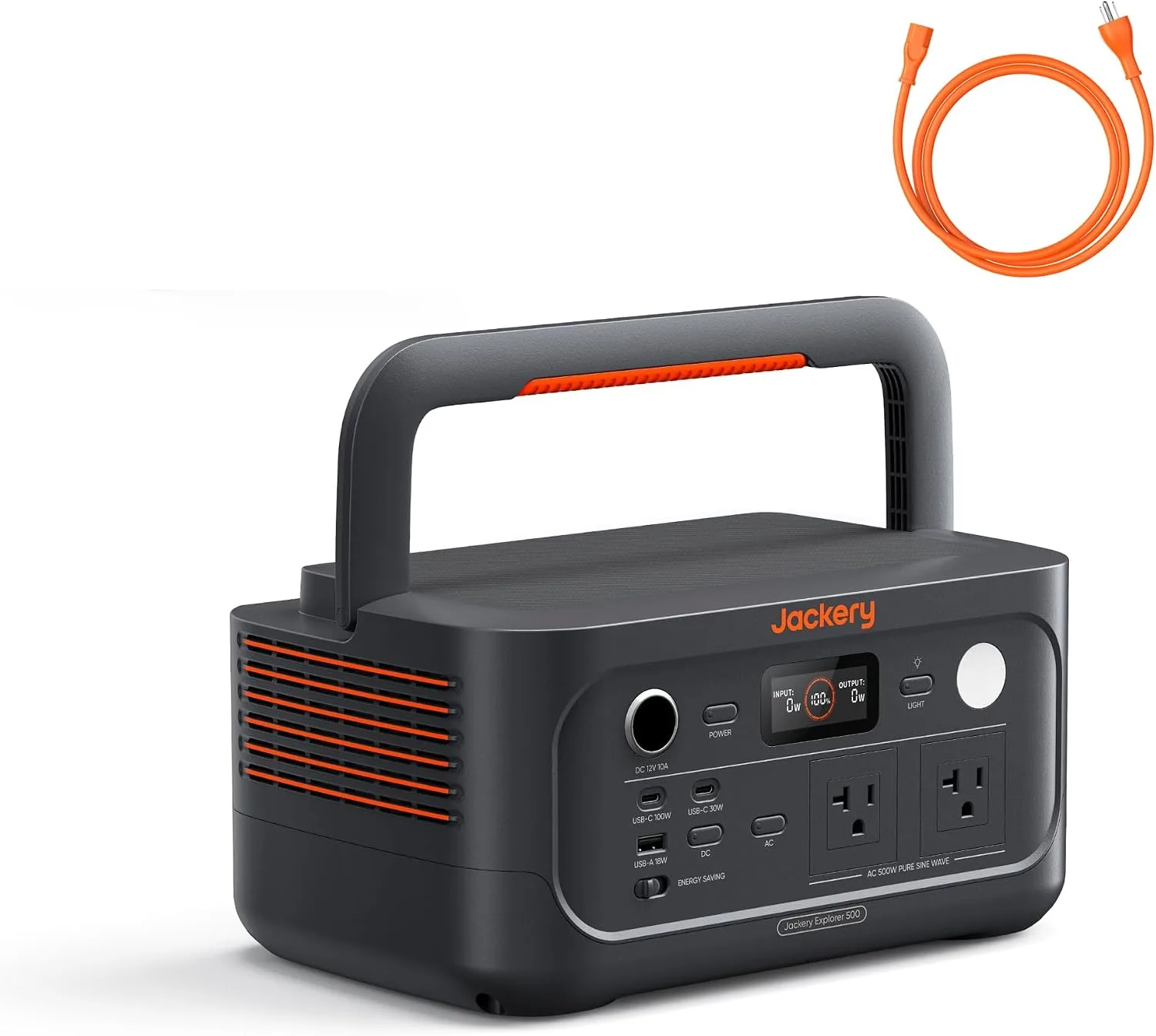
Jackery Explorer 500 v2 Power Station, 512Wh/500W, AC Cable Included
Highlights
- 640Wh rated capacity
- 500W continuous AC
- 1000W surge
- LiFePO4 chemistry
- Up to 200W solar input
- 14.1 lb (~6.4 kg)
Best for
- Explorer 600 v2: most Wh-per-dollar in this ~500Wh band for weekend fridge/CPAP math
- Car-camp carry at 14.1 lb when review depth matters as much as peak watts
- Skip if you need >500W continuous for small appliances that surge hard
Strengths
- Explorer 600 v2: 640Wh pack with 500W continuous / 1000W surge — size loads to both numbers
- 14.1 lb (~6.4 kg) is the lightest-class carry in this band — easier stairs and car packing
- 10ms-class UPS switchover on the listing — useful when a router restart would hurt
- Owners on file: Theme: Customers find the power station maintains 100% charge and is well worth the money, particularly notin…
Watch-outs · not ideal when
- Explorer 600 v2 is still a bridge for essentials — not a transfer-switch whole-home system
- 500W continuous will not hold heating elements or many compressor surges for long
- Rated 200W solar on Explorer 600 v2 is optimistic; shade and cables cut real watts
- LiFePO4 helps longevity, but Explorer 600 v2 still hates freezing charge temps on winter trips
Owner voices
Short takes from public retail reviews — paraphrased or translated when long or non-English; meaning kept close to the original.
“Theme: Customers find the power station maintains 100% charge and is well worth the money, particularly noting it saves on utility bills. The device provides ample power, with one customer reporting it ran a 32" TV an…”
“Theme: Phone Charging (331)”
“Theme: Refrigerator (208)”
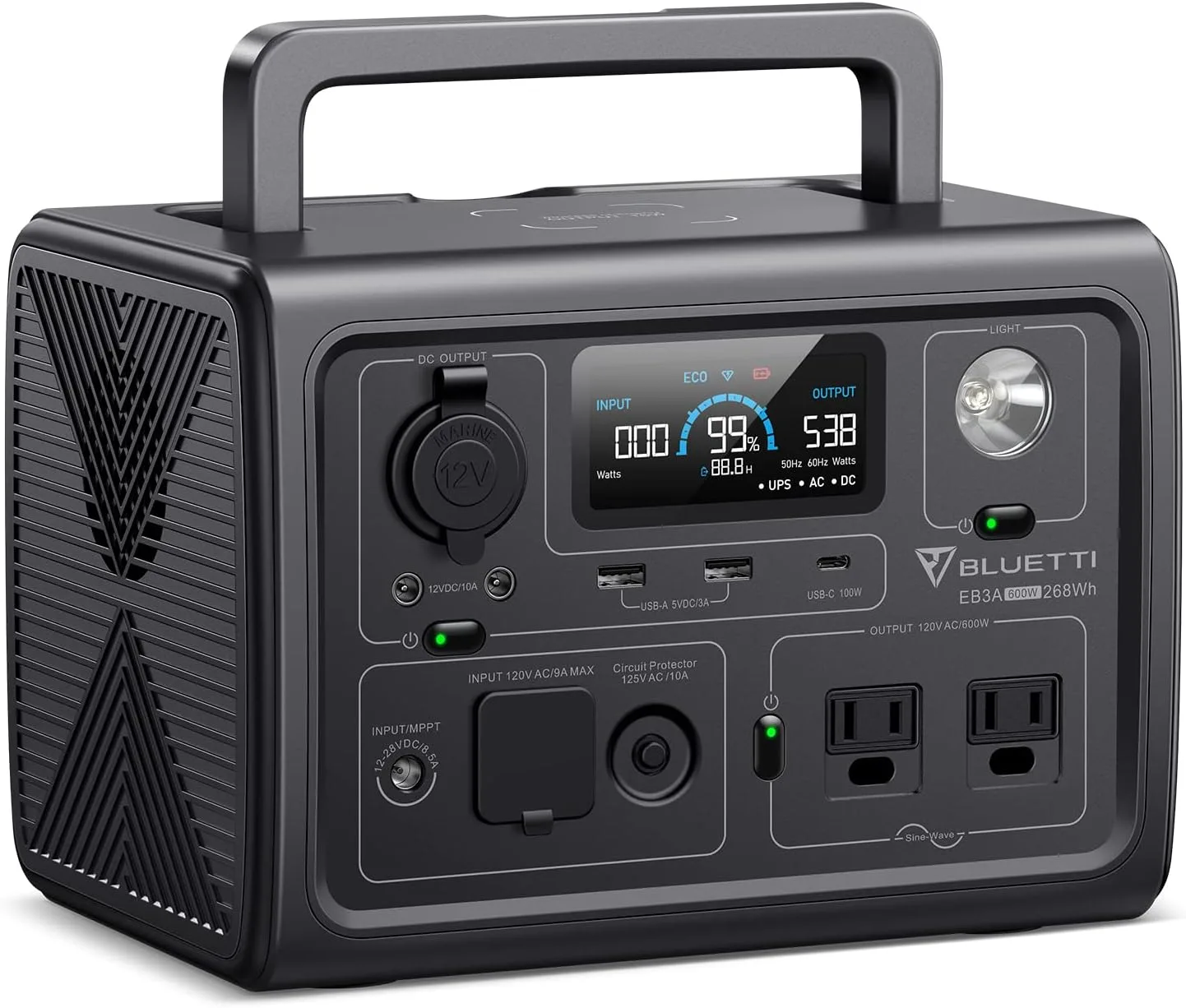
BLUETTI EB3A Portable Power Station
Highlights
- 268Wh rated capacity
- 600W continuous AC
- 1200W surge
- LiFePO4 chemistry
- Up to 200W solar input
- 10.1 lb (~4.6 kg)
Best for
- bluetti-eb3a: phones, cameras and a laptop on short trips
- Travel kits when you need quiet pack power, not appliance runtime
- Brief desk backup for router and lights — not a fridge for days
Strengths
- bluetti-eb3a: 268Wh pack with 600W continuous / 1200W surge — size loads to both numbers
- 10.1 lb (~4.6 kg) is the lightest-class carry in this band — easier stairs and car packing
- bluetti-eb3a uses LiFePO4 — cycle-life claims usually beat older NMC marketing lines
- Owners on file: Theme: Powering Appliances (106)
Watch-outs · not ideal when
- bluetti-eb3a's small Wh class empties fast with a kettle, hair dryer or space heater
- Usable energy on bluetti-eb3a is below the 268Wh label once the inverter is working
- Rated 200W solar on bluetti-eb3a is optimistic; shade and cables cut real watts
- Airline and pack limits may still block bluetti-eb3a even when the weight looks friendly
Owner voices
Short takes from public retail reviews — paraphrased or translated when long or non-English; meaning kept close to the original.
“Theme: Phone Charging (225)”
“Theme: Powering Appliances (106)”
“Theme: Outdoor Electronics (27)”
Frequently asked
Can the BLUETTI EB3A run a CPAP overnight?
Owners on file report about 10.5 hours with the heater off. That is owner experience from a small sample, not a lab runtime, and your pressure settings will change it.
Will the Jackery run a mini-fridge?
Owners report a DC fridge/freezer for 15 hours with over 50% left, and a camping fridge overnight into the next afternoon. AC fridges draw more; check the label.
Does the Jackery have USB-C?
The catalogue card lists USB-C×1. One owner review says no USB-C, but that review may reflect an older or different model — trust the card, and confirm the model number on the box.
Which is better for a power outage?
The Jackery, on capacity and the regulated 12V rail. The BLUETTI is better for short high-watt bursts and portability.
Method and sources
Model names and list prices come from the WattPicks catalog at build time. WattPicks does not run its own laboratory tests on power stations, and nothing on this page is presented as a measured result — it is catalog-backed buying guidance.
Read our methodology for how the catalog is normalized, and about WattPicks for who publishes it.