
Anker SOLIX F3800 vs BLUETTI Elite 400: Which Backup Bet Fits Your Outage Plan?
Two big-battery stations, two very different bets: one sells expandable whole-home headroom, the other sells capacity per dollar with wheels. Here is which backup bet fits your outage plan — and which one to walk away from.

Updated
At a glance
Two big-battery stations, two very different bets: one sells expandable whole-home headroom, the other sells capacity per dollar with wheels. Here is which backup bet fits your outage plan — and which one to walk away from.
Same money, different bets
For most backup buyers, the BLUETTI Elite 400 is the safer first purchase: 3,840 Wh for $1,499, a proven owner record, and enough output for critical loads. The Anker SOLIX F3800 is the bet for people building a system — 3,600 W continuous, a path to 24 kWh, and 240V pairing later — provided you confirm its capacity on the listing and accept thin owner feedback for now.
These two do not compete on the same axis, and that is the whole story. One is a capacity-per-dollar play you can wheel to the fridge; the other is an expandability play aimed at people who want to grow a home battery bank over years.
The BLUETTI Elite 400 Portable Power Station with AC Cable 3840Wh 2600W LFP bets that 3,840 Wh at $1,499 is the number that matters — a big tank, a 2,600 W inverter, and a trolley handle. The Anker 3,072Wh LiFePO4 Battery, Expandable to 24kWh, 6,000W Fast bets on headroom: a 3,600 W inverter, 6,000 W combined recharge input, and a path to 24 kWh of storage.
One boundary up front: this is a two-way comparison for backup buyers weighing those bets. It is not a ranked shortlist of every large station, and it is not a wiring guide for a transfer switch or smart panel.
A note on method, once: these are home-user checks grounded in the owner themes on file plus the listing specs — not lab-bench measurements. Specs and prices come from the listings; where a number is missing I write n/a rather than guess. One Amazon Associates disclosure: picks here are fit-led, not commission-led.
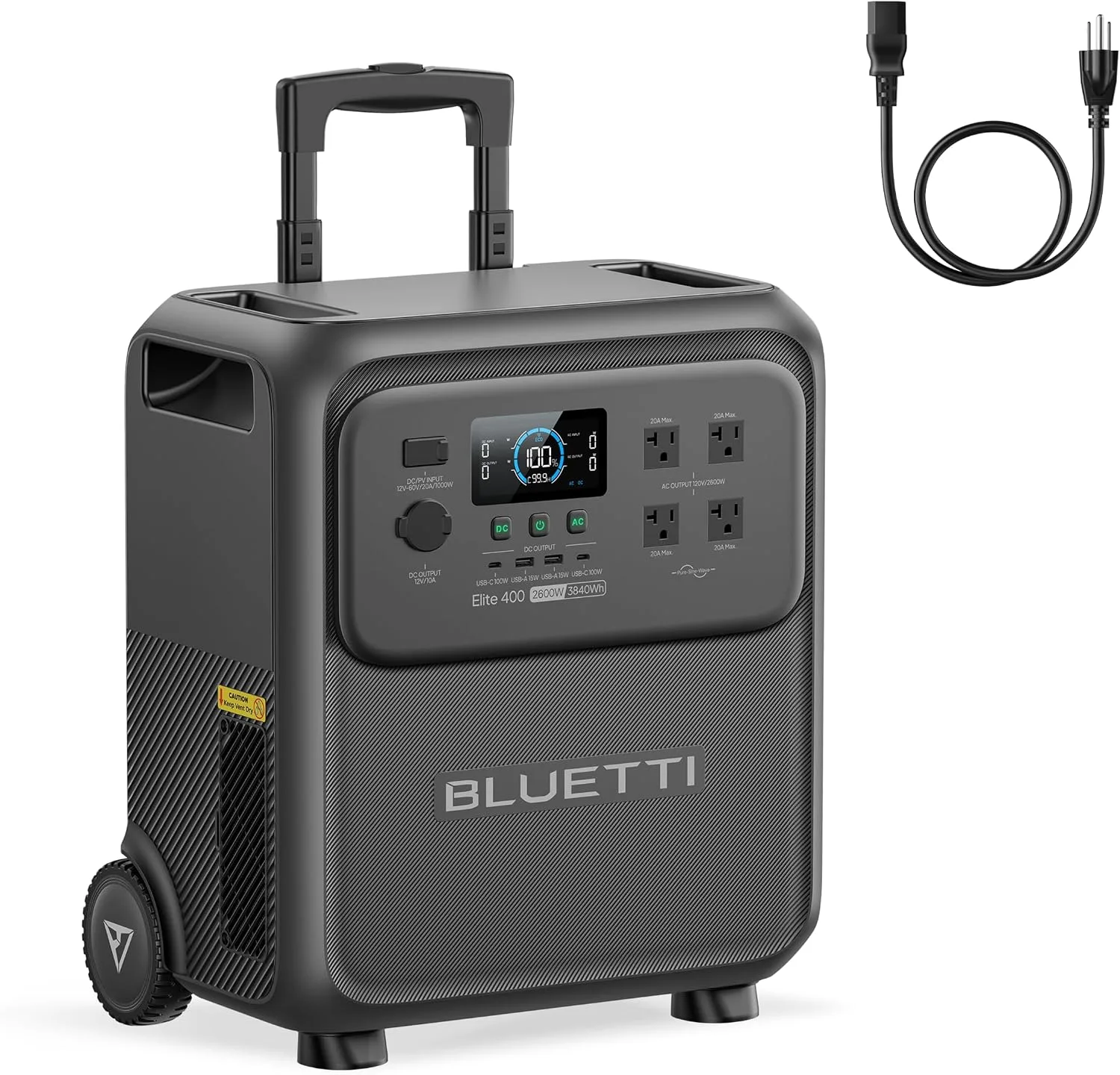
BLUETTI Elite 400 Portable Power Station with AC Cable 3840Wh 2600W LFP
Highlights
- 3840Wh rated capacity
- 2600W continuous AC
- LiFePO4 chemistry
- 86 lb (~39.0 kg)
- About $1499 list
Best for
- Elite 400: longer outages or higher continuous loads (still not whole-home wiring)
- RV / off-grid days where recharge speed matters as much as Wh
- Best parked near the vehicle or cabin — not a long carry to a tent
Strengths
- Elite 400: 2600W continuous on a 3840Wh pack — more headroom for small appliances than 1kW-class peers
- 86 lb (~39.0 kg) is a park-and-use chassis — plan a short path, not a trail hike
- 15ms-class UPS switchover on the listing — useful when a router restart would hurt
- About $1499 list in the Hub catalog — confirm live retail before you buy
Watch-outs · not ideal when
- At 86 lb (~39.0 kg), Elite 400 is a poor tent-hike companion — plan a cart or leave it in the vehicle
- High continuous output on Elite 400 tempts big loads — Wh still runs out on kettles and A/C
- Solar input unpublished for Elite 400 — do not assume a same-day off-grid refill
- LiFePO4 helps longevity, but Elite 400 still hates freezing charge temps on winter trips
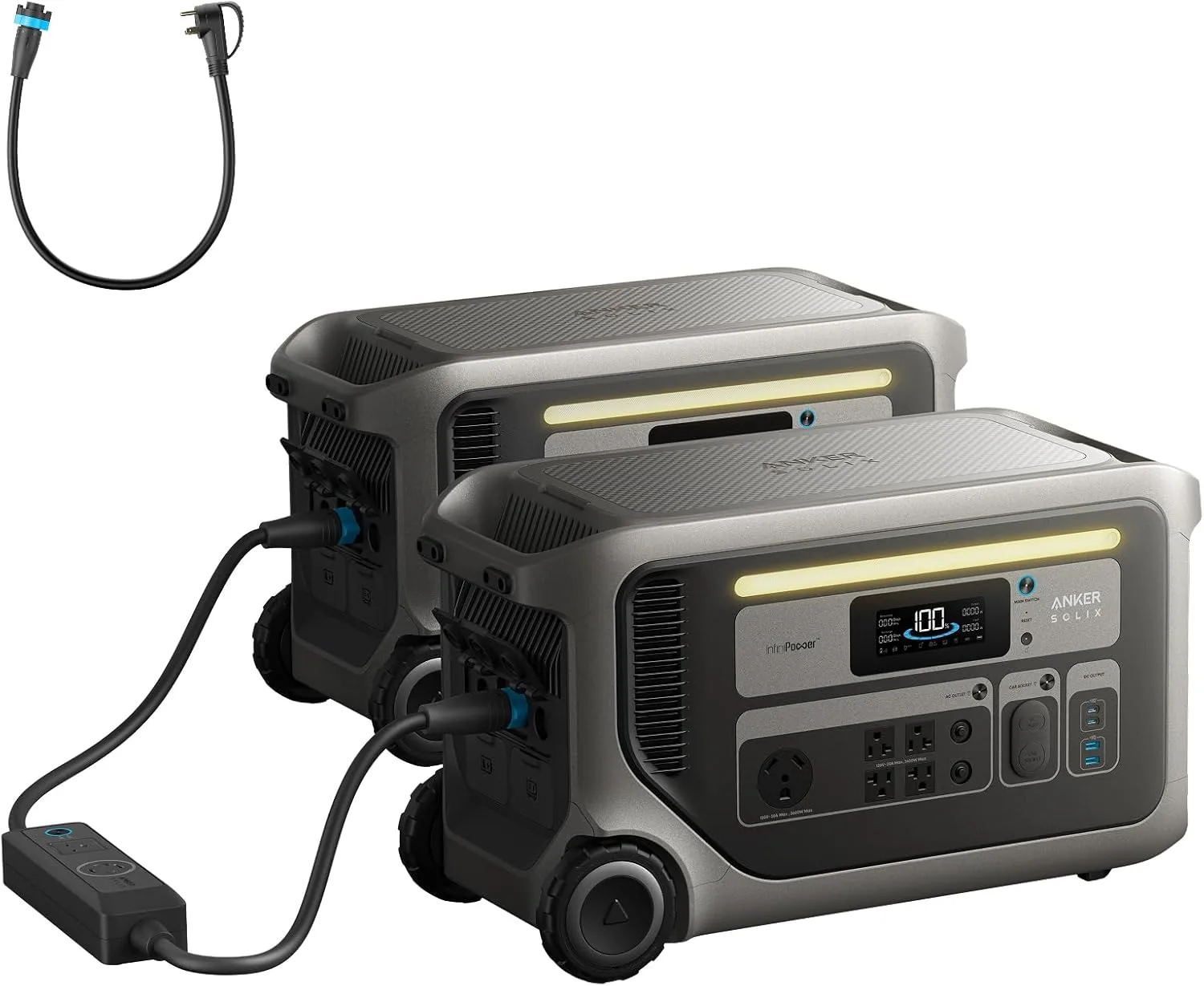
Anker 3,072Wh LiFePO4 Battery, Expandable to 24kWh, 6,000W Fast Recharging, Solar
Highlights
- 72Wh rated capacity
- 3600W continuous AC
- LiFePO4 chemistry
- 91.5 lb (~41.5 kg)
- About $3198.99 list
Best for
- SOLIX F3002: phones, cameras and a laptop on short trips
- Travel kits when you need quiet pack power, not appliance runtime
- Brief desk backup for router and lights — not a fridge for days
Strengths
- SOLIX F3002: 3600W continuous on a 72Wh pack — more headroom for small appliances than 1kW-class peers
- 91.5 lb (~41.5 kg) is a park-and-use chassis — plan a short path, not a trail hike
- 3600W continuous headroom covers more small appliances than 1kW-class inverters
- About $3198.99 list in the Hub catalog — confirm live retail before you buy
Watch-outs · not ideal when
- At 91.5 lb (~41.5 kg), SOLIX F3002 is a poor tent-hike companion — plan a cart or leave it in the vehicle
- Usable energy on SOLIX F3002 is below the 72Wh label once the inverter is working
- Solar input unpublished for SOLIX F3002 — do not assume a same-day off-grid refill
- Airline and pack limits may still block SOLIX F3002 even when the weight looks friendly
Spec snapshot
List prices, not deal stickers. Ratings are listing aggregates only — the Anker figure rests on a single rating, so treat it as thin.
Important: the Anker capacity cell reads 'n/a — confirm on listing' because the locked table value (72 Wh) conflicts with the 3,072Wh model name and the 24 kWh expansion claim. Do not rely on that 72 Wh figure; check the spec sheet on the product page before buying. (See 'Where the money went' for the full caveat and a worked $/Wh example.)
| Product | Price | Capacity (Wh) | Output (W) | Weight (lb) | Rating |
|---|---|---|---|---|---|
| BLUETTI Elite 400 Portable Power Station with AC Cable 3840Wh 2600W LFP | $1499 | 3840 Wh | 2600 W | 86 lb | 4.7 |
| Anker 3,072Wh LiFePO4 Battery, Expandable to 24kWh, 6,000W Fast | $3198.99 | n/a — confirm on listing | 3600 W | 91.5 lb | 5 |
Where the money went
Four configuration calls separate these units more than any single spec line.
Capacity and price. The BLUETTI carries 3,840 Wh for $1,499 — about $0.39 per nameplate Wh, the cheaper of the two on that measure. The Anker lists at $3,198.99. Its locked capacity cell reads 72 Wh, which cannot be right next to a 3,072Wh model name; I am not going to paper over that with a made-up figure, so the table shows 'n/a — confirm on listing' and you should verify capacity on the listing before buying. Once confirmed, you can compute Anker $/Wh by dividing $3,198.99 by the listed Wh. For example, if the listing confirms 3,072 Wh, the Anker works out to about $1.04/Wh — roughly 2.7× the BLUETTI's $0.39/Wh. If it confirms 3,840 Wh, it lands near $0.83/Wh. Use the actual spec-sheet number.
Inverter headroom. The Anker's 3,600 W continuous beats the BLUETTI's 2,600 W on paper. That matters if you want to run a well pump or a big microwave-plus-fridge combo at once. The BLUETTI's 2,600 W still covers a fridge, router, lights, and a CPAP together with room to spare.
Expandability. The Anker is built to grow to 24 kWh with add-on batteries and pairs two units for 240V. The BLUETTI has no battery expansion port — one owner found that out after delivery. If you want a system you add to over five years, that is a real fork in the road.
Recharge and integration. The Anker advertises 6,000 W combined generator-plus-solar input and a bidirectional inlet box for off-peak or solar storage. The BLUETTI claims 80% in about 70 minutes on 2,800 W AC+Solar, roughly 2.5 hours to full on a standard 1,800 W wall outlet, and a 15 ms switchover for UPS-style pass-through. Neither listing publishes a full transfer-switch or smart-panel wiring spec, so treat whole-home automation as unconfirmed until you read the manual.
- Capacity per dollar: BLUETTI wins on nameplate $/Wh ($0.39/Wh); Anker's capacity is n/a — confirm on listing before computing $/Wh.
- Continuous output: Anker 3,600 W vs BLUETTI 2,600 W.
- Growth path: Anker expands to 24 kWh; BLUETTI has no expansion port.
- Recharge: Anker 6,000 W combined input; BLUETTI ~70 min to 80% on 2,800 W AC+Solar.
The spec that decides it
For most backup buyers — those planning for a few days of fridge, lights, and communications — expandability is the deciding parameter, and it is not close. A station you cannot add batteries to is a fixed asset — when your needs grow, you buy a second unit. The Anker's 24 kWh ceiling and 240V pairing change that math, which is why it costs roughly double.
The second decider is continuous output against your actual load list. Add up the running watts of what you must keep alive — a fridge cycling around 150–250 W, a router near 10–20 W, lights and a CPAP in the tens of watts — and 2,600 W is generous for critical loads. It is not generous for a heat pump, an EV charger, or a whole-panel transfer. If your plan includes those, neither unit is the answer on its own.
Here is how the deciding metrics map to the two buyer types. If you are a critical-loads buyer — fridge, router, lights, CPAP — the metrics that matter are $/Wh and 2,600 W of output, and the BLUETTI wins both on today's numbers. If you are a system-builder — planning a 24 kWh path, 240V pairing, and add-on batteries over years — the deciding metric is expandability, and the Anker is the only one of the two that offers it. That is why the opening pick is BLUETTI for most buyers and Anker for builders: the 'deciding spec' changes with the persona, not with the price tag.
Real owner trade-offs
The BLUETTI has a deep owner record; the Anker has essentially none on file, so this section is lopsided by necessity.
BLUETTI owners consistently praise the tank and the surge handling. One ran a camp trailer's 15k BTU A/C for about three hours with the compressor cycling, then a small MIG welder and a shop compressor, without an overload. Another kept a fridge and WiFi alive for roughly four hours of outage; a third reported a cooler/freezer setup lasting about a week. Wall charging is called fast, and the app makes solar production easy to watch.
The friction is weight and app dependence. At 86 lb it is a two-person lift for stairs, wheels or not — owners say so repeatedly. Several flag that many settings live in the app, which is awkward in a grid-down scenario when your phone or network is compromised. And the missing expansion port caught at least one buyer off guard.
For the Anker, I have no owner themes to summarize. The listing aggregate shows 5 from a single rating; that is not owner proof of anything, and I will not dress it up as field evidence. Check back once verified reviews accumulate. In the meantime, treat the Anker verdict as provisional and verify capacity on the listing before you buy.
- BLUETTI: big capacity and surge praised; weight and app reliance are the repeated complaints.
- BLUETTI: no expansion port — confirmed by an owner post-purchase.
- Anker: no owner reviews on file; feedback is thin.
Buy the one that…
Buy the BLUETTI Elite 400 if you want the most stored energy per dollar today, you can wheel it to a fridge and a router, and your outage plan is critical loads rather than whole-home. It is the safer bet for a first big backup purchase on a $1,499 budget.
Buy the Anker SOLIX F3800 if you are planning a system, not a purchase — you want 3,600 W continuous, a path to 24 kWh, and 240V pairing later, and you accept paying about $3,198.99 for that headroom while capacity details get confirmed on the listing.
Walk away from both if you need a listed transfer-switch or smart-panel integration spec, or if your must-run load exceeds 2,600 W on the BLUETTI. Neither listing publishes a full wiring document, and I would not sign off on whole-home automation from a product page alone.
Who should NOT buy the Anker yet: if you cannot confirm the capacity on the listing before checkout, or if you need owner-verified reliability today, skip it for now. The Anker's case rests on expandability and 3,600 W, not on a proven field record. If you are not building a system, the BLUETTI is the lower-risk buy.
A minimal load-list example to make the Anker anxiety concrete: a fridge cycling at 150–250 W, a CPAP around 30–60 W, and a router near 10–20 W add up to roughly 200–330 W of running load — well inside the Anker's 3,600 W and the BLUETTI's 2,600 W. The output gap only matters when you add a well pump, a microwave-plus-fridge combo, or a heat pump. Size against your actual list, not the headline wattage.
What I would tell a friend
If the question is "what do I buy for the next outage," the BLUETTI Elite 400 is the straightforward answer — more stored energy per dollar, a proven owner record, and enough output for critical loads. If the question is "what do I build for the next decade," the Anker SOLIX F3800 is the bet, provided you confirm its capacity on the listing and accept thin owner feedback for now.
Neither is a whole-home solution by itself. For sizing against a real load list, see our guide to power station capacity and runtime; for chemistry trade-offs, our LiFePO4 vs NMC explainer; and for outage planning, our home backup load checklist.
Frequently asked
Can I parallel two Anker SOLIX F3800 units?
The listing says the Anker pairs two units for 240V, which is the parallel path to higher output. It does not publish a full parallel-operation wiring spec, so confirm the cable kit and firmware requirements on the listing or in the manual before you plan around it.
What add-on batteries does the Anker SOLIX F3800 take?
The listing says the Anker is expandable to 24 kWh with add-on batteries, but it does not name the specific add-on battery SKU or the inlet-box SKU on the page. Check the listing's 'in the box' and accessory sections for the exact model numbers before you buy, and note that app or firmware versions may affect expansion features.
What if I can't confirm the Anker capacity before checkout?
Default to the BLUETTI Elite 400. Its 3,840 Wh and $1,499 price are confirmed on the listing, and its owner record is deep. The Anker's case rests on expandability and 3,600 W, not on a verified capacity figure — so if the spec sheet is unclear, the safer buy is the one you can verify.
Can the BLUETTI Elite 400 run a fridge overnight?
Owners report a fridge plus WiFi for about four hours and a cooler/freezer setup near a week; at 3,840 Wh and 2,600 W, a typical 150–250 W fridge cycle is well within range.
Does the Anker SOLIX F3800 really reach 24 kWh?
The listing says expandable to 24 kWh with add-on batteries; the base capacity cell reads 72 Wh, which conflicts with the 3,072Wh model name — confirm on the listing before you buy.
Which is better for a transfer switch?
Neither listing publishes a full transfer-switch spec; the BLUETTI claims a 15 ms switchover for UPS-style pass-through, and the Anker lists a bidirectional inlet box for off-peak storage. Treat both as unconfirmed until you read the manual.
Is 2,600 W enough for a well pump?
Usually not for a deep-well pump's startup surge; the BLUETTI's 3,900 W surge may cover small pumps, but check your pump's locked-rotor amps before assuming.
Method and sources
Model names and list prices come from the WattPicks catalog at build time. WattPicks does not run its own laboratory tests on power stations, and nothing on this page is presented as a measured result — it is catalog-backed buying guidance.
Read our methodology for how the catalog is normalized, and about WattPicks for who publishes it.