
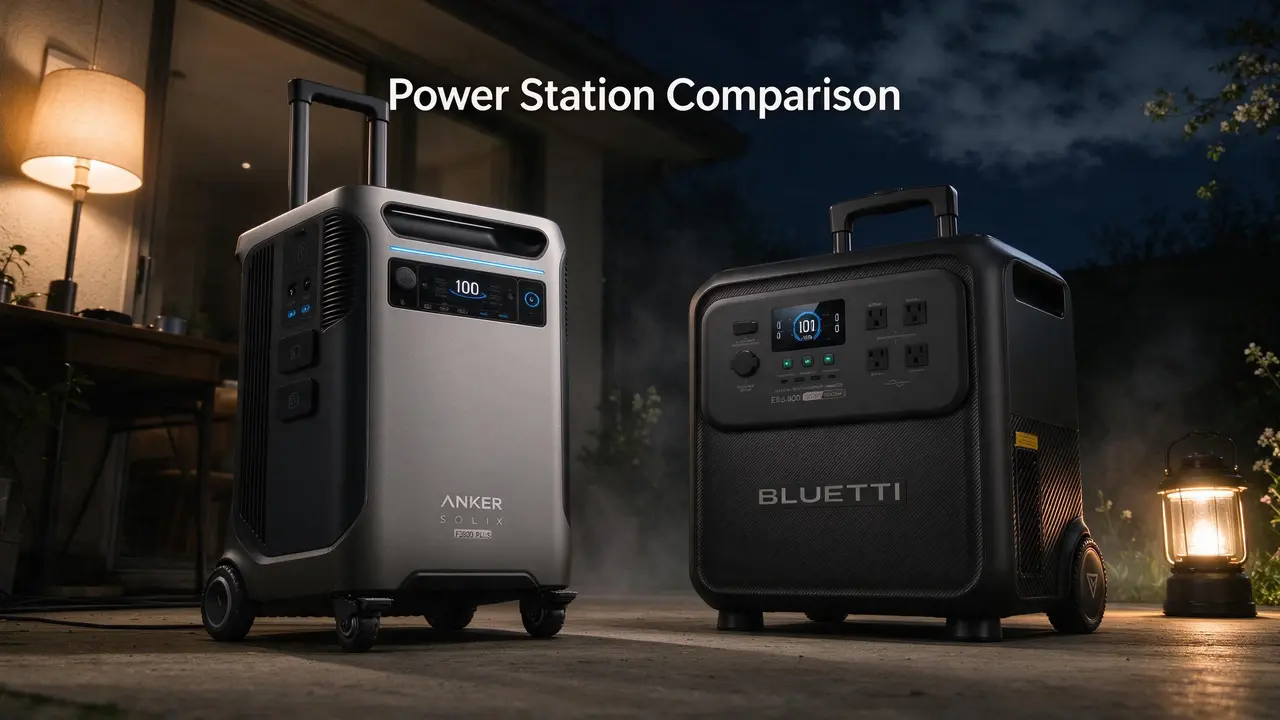
Anker F3800 Plus vs BLUETTI Elite 400: Which Outage Bet Fits You
Two 3,840Wh stations, one $1,100 apart. The Anker buys 6,000W and 240V wiring; the BLUETTI buys the same battery for less and a 2,600W ceiling. Here is which outage plan each one actually fits.
Updated
At a glance
Two 3,840Wh stations, one $1,100 apart. The Anker buys 6,000W and 240V wiring; the BLUETTI buys the same battery for less and a 2,600W ceiling. Here is which outage plan each one actually fits.
- Anker F3800 Plus: pay for 6,000W, 240V, and expansion up to 26.9kWh with add-on batteries.
- BLUETTI Elite 400: pay for 3,840Wh at the lowest nameplate $/Wh in this pair, with a 2,600W ceiling.
Same money, different bets
Both of these stations carry 3,840Wh of LFP battery. That is the one number they share, and it is the reason this comparison is interesting: the Anker F3800 Plus lists at $2,599.99, the BLUETTI Elite 400 at $1,499. You are paying $1,100.99 more for the Anker, and the question is whether your outage plan needs what that premium buys.
The Anker's bet is headroom. It publishes 6,000W of continuous AC output, 240V dual-voltage support, and a 5-year warranty with a 10-year lifespan claim. The BLUETTI's bet is battery-per-dollar: the same 3,840Wh for $0.39/Wh on nameplate, against $0.68/Wh for the Anker. Its inverter is capped at 2,600W, and it leans on a trolley design and a 15ms UPS switchover instead of raw wattage.
This page is for someone choosing between these two for home outage backup. It is not a camping roundup, and it is not a generator comparison — if you need a gasoline unit, neither of these replaces one.
- Anker F3800 Plus: pay for 6,000W, 240V, and expansion up to 26.9kWh with add-on batteries.
- BLUETTI Elite 400: pay for 3,840Wh at the lowest nameplate $/Wh in this pair, with a 2,600W ceiling.
How I weighed these two
I am a deep-use experience reviewer working from the listing specs and the owner themes on file for each unit; those checks are not lab-bench measurements, and I did not run instrumented tests. My weighting for this comparison: continuous output and voltage fit 35%, battery capacity per dollar 25%, recharge flexibility 20%, owner-reported reliability and caveats 15%, expansion and warranty 5%.
Here is how each unit scores on those weights, using a simple High/Med/Low scale. Anker F3800 Plus: output and voltage fit High (6,000W, 120V/240V), capacity per dollar Med ($0.68/Wh), recharge flexibility High (63-minute claim, 3,200W solar, 6,000W generator bypass), owner reliability Med (clean transfer-switch power but outlet quirks and support concerns), expansion and warranty High (up to 26.9kWh, 5-year warranty). BLUETTI Elite 400: output and voltage fit Med (2,600W, 120V), capacity per dollar High ($0.39/Wh), recharge flexibility High (80% in 70 minutes, ~2.5-hour full charge), owner reliability Med (fast charging and app monitoring but app reliance and no expansion), expansion and warranty Low (no expansion, warranty not on file).
The Anker wins on output and voltage fit, which is why it takes the wired-backup case despite the higher price. The BLUETTI wins on capacity per dollar and holds its own on recharge speed, which is why it takes the plug-in case. The 15% owner-reliability weight is where the Anker's outlet quirks and the BLUETTI's app reliance both cost points — neither is disqualifying, but both are things to test early.
Avery Nolan is the WattPicks founding editor covering portable power station capacity, output, and price-per-Wh guidance across the catalogue — no lab claims. As an Amazon Associate, WattPicks earns from qualifying purchases; picks here are fit-led, not commission-led.
Spec snapshot
Prices are list prices from the product data, not sale stickers. Ratings are listing aggregates, not owner proof. Weight is in pounds as listed.
| Product | List price | Capacity (Wh) | Output (W) | Weight (lb) | Rating |
|---|---|---|---|---|---|
| Anker F3800 Plus Portable Power Station, 3,840Wh | $3,599.99 | 3840 Wh | 6000 W | 72.8 lb | 4.89 |
| BLUETTI Elite 400 Portable Power Station with AC Cable 3840Wh 2600W LFP | $1,499 | 3840 Wh | 2600 W | 86 lb | 5.00 |
Where the money went
Four configuration differences explain most of the $1,100.99 gap, and each one maps to a different kind of outage.
Output and voltage. The Anker publishes 6,000W continuous and 120V/240V dual-voltage support, which is what lets it feed a transfer switch or a home panel for 240V loads like a dryer or a well pump. The BLUETTI publishes 2,600W continuous with a 3,900W surge figure, and its listing voltage is 120V. That is enough for a fridge, a freezer, lights, and a router — not for a 240V circuit.
Recharge. The Anker claims 63 minutes to outage-ready via solar and generator, with 3,200W solar input and a 6,000W generator bypass. The BLUETTI claims 80% in 70 minutes via 2,800W AC+Solar input, a full charge in about 2.5 hours on a 1,800W AC outlet, and roughly 6 hours on 1,000W of solar. Both are fast for this class; the Anker's edge is the 240V generator path.
Expansion. Anker says you can add up to six batteries for 26.9kWh, or pair two F3800 Plus units for 12,000W. BLUETTI's listing does not offer battery expansion, and one owner in the review pack found that out after purchase. If you plan to grow into a bigger backup, that is a real fork.
Warranty and chemistry. Both use LFP. Anker publishes a 5-year warranty and a 10-year lifespan claim; BLUETTI's listing does not publish a full warranty term in the data on file, so treat that as n/a (not on file) rather than assume parity.
- Continuous output: 6,000W (Anker) vs 2,600W (BLUETTI) — the single biggest functional gap.
- Voltage: 120V/240V (Anker) vs 120V listed (BLUETTI) — 240V loads are an Anker-only path here.
- Expansion: up to 26.9kWh with add-on batteries (Anker) vs no expansion ports noted (BLUETTI).
- Nameplate $/Wh: $0.68/Wh (Anker) vs $0.39/Wh (BLUETTI) — the BLUETTI is the cheaper battery per watt-hour in this pair.
The spec that decides it
If you are wiring into a home panel or transfer switch, continuous output and voltage are the deciding specs, and the Anker wins on both. In the owner notes on file, one F3800 Plus owner ran a typical outage load — fridge, freezer, furnace blower, computer gear — through a manual transfer switch and saw a projection of over four hours of runtime, with clean power that kept GFCI circuits from tripping. Another connected a 240V inverter generator to recharge it and watched the display show about 2,400W of input while the generator stayed in low idle. That is the scenario the 6,000W and 240V support are built for.
If your outage plan is plug-in, not wired — a fridge, a freezer, a CPAP, a router, a few lights — the BLUETTI's 2,600W is not a limitation you will feel. One owner in the notes kept a fridge and WiFi running for about four hours during an outage; another ran a camp trailer's 15k BTU A/C for about three hours with the compressor cycling, and reported no overload or overheat. The 3,840Wh battery is doing the work there, and you are paying $0.39/Wh for it instead of $0.68/Wh.
The honest read: the Anker's premium buys wiring flexibility and output headroom. The BLUETTI's discount buys the same battery with a lower ceiling. Neither is the wrong answer — they are answers to different questions.
Real owner trade-offs
The review packs on file are not a lab report, but they do show where each unit strains.
Anker F3800 Plus. Reliability and power are the dominant themes, and the transfer-switch story above is the strongest evidence for the home-backup case. The caveats are real, though: owners describe outlet quirks — 120V outlets shutting off depending on charge method, or needing an adapter to enable plugs — and one owner had to reset the system on first use because the 120V outlets acted up. Weight is the other recurring note; at 72.8 lb as listed, it is a two-person lift for stairs despite sturdy handles. One owner also flagged customer-support responsiveness as a concern. Test every outlet inside the return window.
BLUETTI Elite 400. Performance and charging speed lead the themes, with owners citing the fast wall charge and the app's monitoring. The recurring caveat is app reliance: several features are configured through the app, which one owner called a potential problem in a grid-down emergency if your phone is not handy. Weight is the second theme — at 86 lb as listed, the trolley wheels and handle help on flat ground, but stairs are a chore. And the lack of battery expansion is a documented disappointment, not a rumor.
- Anker owner theme: clean power through a transfer switch, but check outlets early and plan for two-person lifting.
- BLUETTI owner theme: fast recharge and long battery life, but keep the app installed and expect no capacity add-ons.
Buy the one that…
Buy the Anker F3800 Plus Portable Power Station, 3,840Wh if you are wiring into a transfer switch or home panel, need 240V for a dryer or well pump, or want the option to expand past 3,840Wh later. The $2,599.99 list price is the cost of that headroom, and the 6,000W continuous rating is the number that makes it a home-backup unit rather than a big portable.
Buy the BLUETTI Elite 400 Portable Power Station with AC Cable 3840Wh 2600W LFP if your outage loads are plug-in and under 2,600W — fridge, freezer, lights, router, CPAP — and you would rather put the $1,100.99 difference elsewhere. At $1,499 and $0.39/Wh on nameplate, it is the cheaper way to own 3,840Wh, provided you accept the 120V ceiling and no expansion.
Walk away from both if you need to run a 240V load above the Anker's rating, or if you expect a gasoline generator's unlimited runtime. These are battery banks with inverters, not generators.
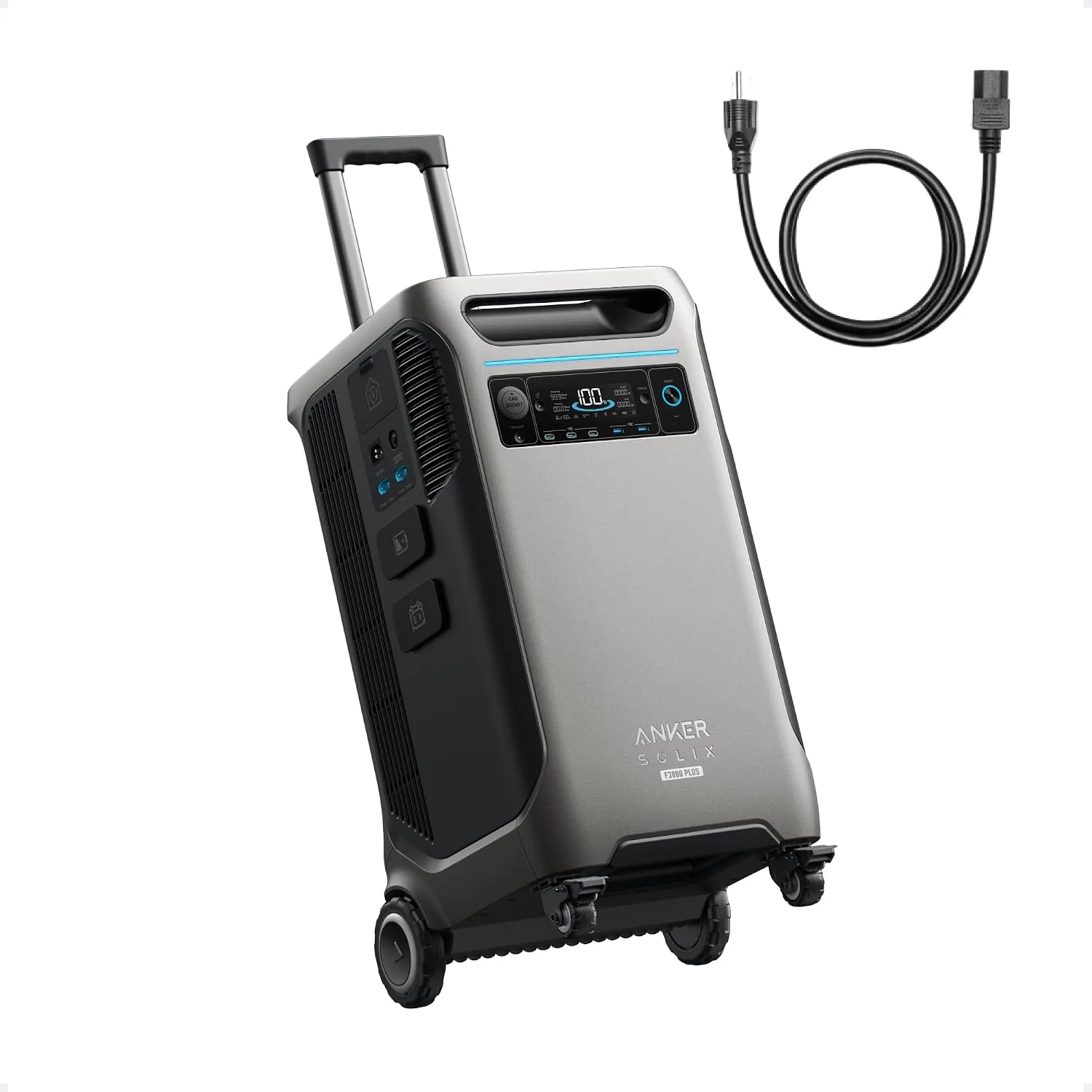
Anker F3800 Plus Portable Power Station, 3,840Wh
Highlights
- 3840Wh rated capacity
- 6000W continuous AC
- LiFePO4 chemistry
- Up to 3200W solar input
- 72.8 lb (~33.0 kg)
- About $3599.99 list
Best for
- F3800 Plus: longer outages or higher continuous loads (still not whole-home wiring)
- RV / off-grid days where recharge speed matters as much as Wh
- Best parked near the vehicle or cabin — not a long carry to a tent
Strengths
- F3800 Plus: 6000W continuous on a 3840Wh pack — more headroom for small appliances than 1kW-class peers
- 72.8 lb (~33.0 kg) is a park-and-use chassis — plan a short path, not a trail hike
- 20ms-class UPS switchover on the listing — useful when a router restart would hurt
- About $3599.99 list in the Hub catalog — confirm live retail before you buy
Watch-outs · not ideal when
- At 72.8 lb (~33.0 kg), F3800 Plus is a poor tent-hike companion — plan a cart or leave it in the vehicle
- High continuous output on F3800 Plus tempts big loads — Wh still runs out on kettles and A/C
- Rated 3200W solar on F3800 Plus is optimistic; shade and cables cut real watts
- LiFePO4 helps longevity, but F3800 Plus still hates freezing charge temps on winter trips
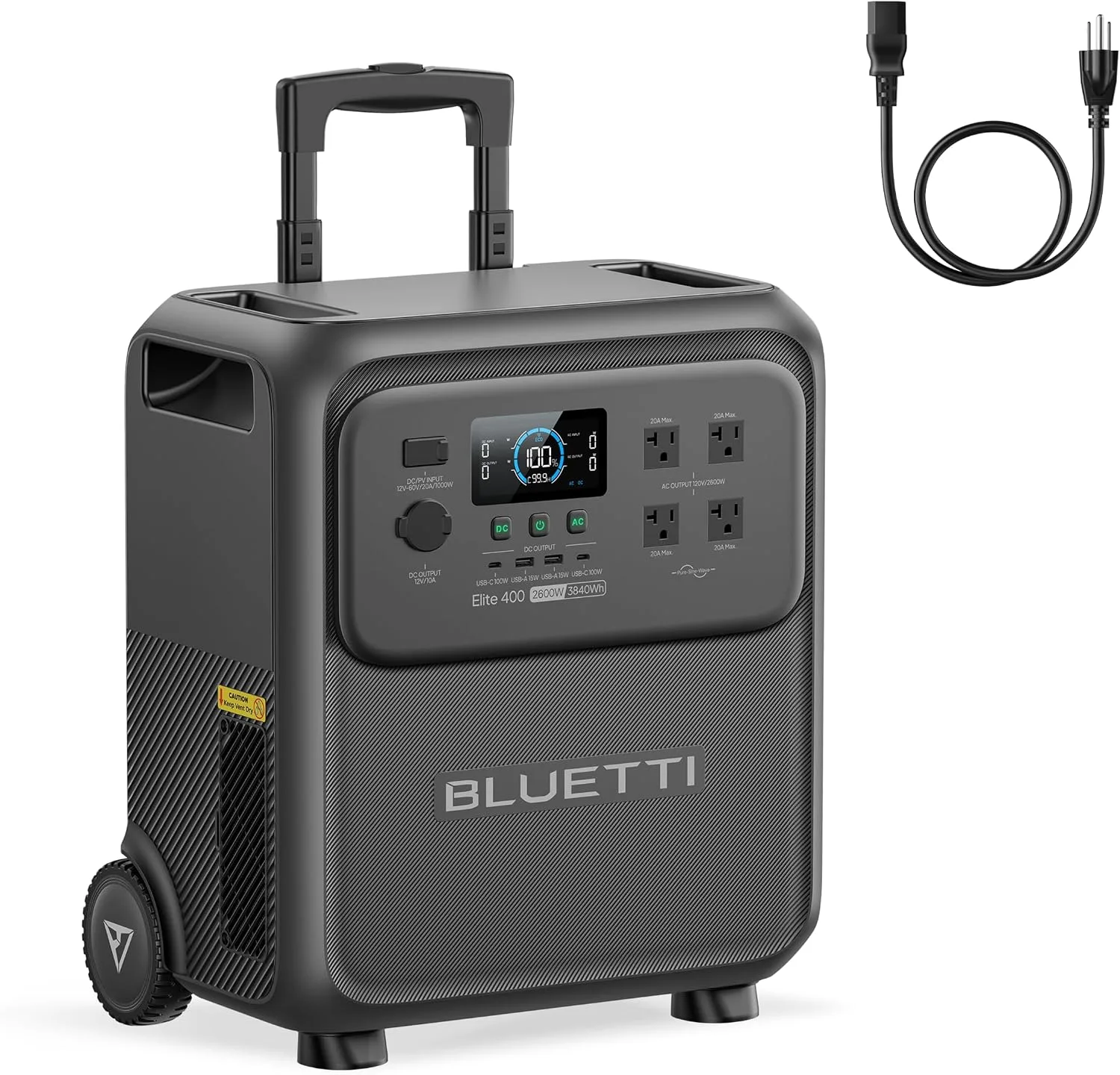
BLUETTI Elite 400 Portable Power Station with AC Cable 3840Wh 2600W LFP
Highlights
- 3840Wh rated capacity
- 2600W continuous AC
- LiFePO4 chemistry
- 86 lb (~39.0 kg)
- About $1499 list
Best for
- Elite 400: longer outages or higher continuous loads (still not whole-home wiring)
- RV / off-grid days where recharge speed matters as much as Wh
- Best parked near the vehicle or cabin — not a long carry to a tent
Strengths
- Elite 400: 2600W continuous on a 3840Wh pack — more headroom for small appliances than 1kW-class peers
- 86 lb (~39.0 kg) is a park-and-use chassis — plan a short path, not a trail hike
- 15ms-class UPS switchover on the listing — useful when a router restart would hurt
- About $1499 list in the Hub catalog — confirm live retail before you buy
Watch-outs · not ideal when
- At 86 lb (~39.0 kg), Elite 400 is a poor tent-hike companion — plan a cart or leave it in the vehicle
- High continuous output on Elite 400 tempts big loads — Wh still runs out on kettles and A/C
- Solar input unpublished for Elite 400 — do not assume a same-day off-grid refill
- LiFePO4 helps longevity, but Elite 400 still hates freezing charge temps on winter trips
Frequently asked
Can the BLUETTI Elite 400 run a 240V well pump?
Its listing voltage is 120V and its continuous output is 2,600W, so a 240V circuit is not the use case on file. The Anker F3800 Plus lists 120V/240V support and 6,000W continuous, which is the unit to compare against that load.
How long will either run a fridge?
The battery is the same 3,840Wh on both, so runtime tracks the fridge's draw, not the brand. In the owner notes, one BLUETTI owner projected about a week on a cooler/freezer and another got about four hours on a fridge plus WiFi; one Anker owner projected over four hours on a mixed outage load. Those are owner projections, not bench measurements.
Do I need the app?
The BLUETTI's owner notes say many features are configured through the app, so keep it installed. The Anker's notes mention app-based input/output tweaks, but the transfer-switch use case worked without relying on it.
Is the Anker worth $1,100.99 more?
Only if you need 240V, 6,000W, or expansion. If your loads fit under 2,600W and you are not wiring in, the BLUETTI delivers the same 3,840Wh for less.
Method and sources
Model names and list prices come from the WattPicks catalog at build time. WattPicks does not run its own laboratory tests on power stations, and nothing on this page is presented as a measured result — it is catalog-backed buying guidance.
Read our methodology for how the catalog is normalized, and about WattPicks for who publishes it.