
EcoFlow RIVER 3 Plus vs Jackery Explorer 300 v2
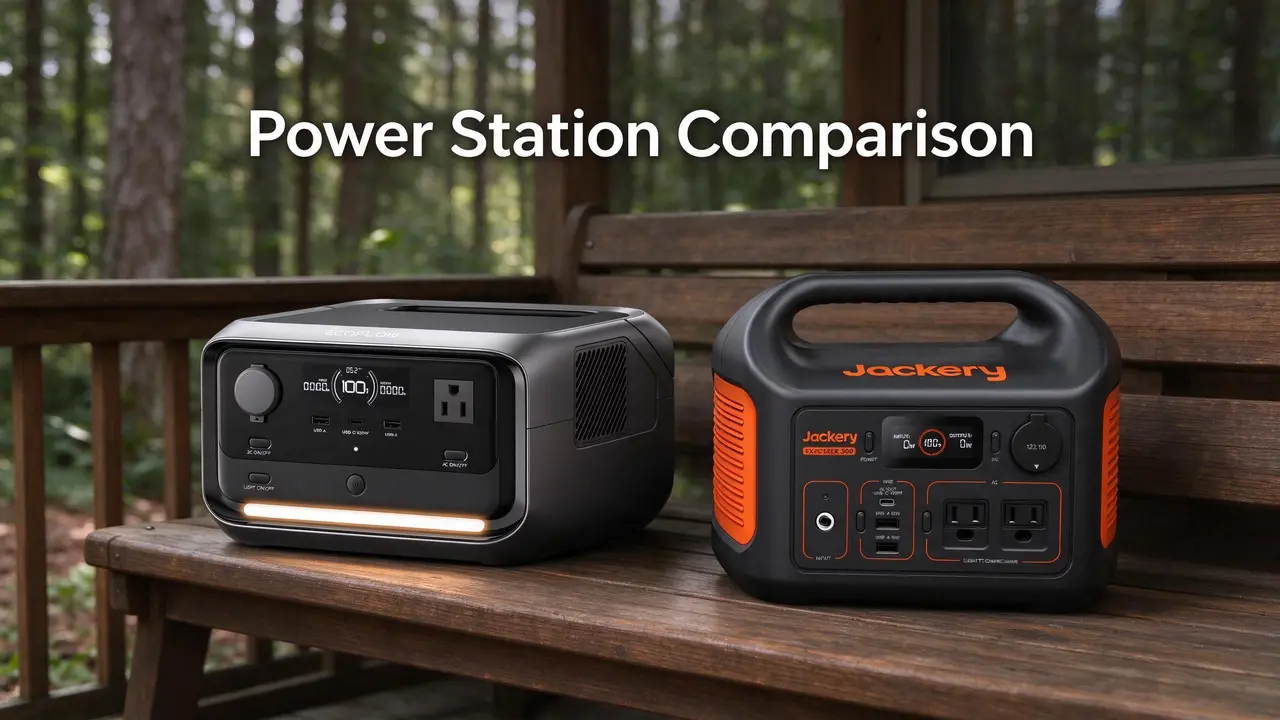
Two mini stations, about the same money, two different bets: the RIVER 3 Plus buys you a 600 W inverter and UPS-grade switchover, the Explorer 300 buys you 8.2 lb of carry weight and the lower nameplate $/Wh. Here is how to pick one without regret.
Updated
At a glance
Two mini stations, about the same money, two different bets: the RIVER 3 Plus buys you a 600 W inverter and UPS-grade switchover, the Explorer 300 buys you 8.2 lb of carry weight and the lower nameplate $/Wh. Here is how to pick one without regret.
Same money, different bets
At $299 and $289 these two are close enough that price should not decide it. What decides it is which compromise you can live with: a heavier box with a bigger inverter, or a lighter box that asks you to keep loads small.
The EcoFlow RIVER 3 Plus bets on headroom. It puts 600 W of continuous AC output and a <10 ms UPS-style transfer into a 10.4 lb shell, which is the sort of thing you notice the moment a desktop or a router is on the other end of the cord.
The Jackery Explorer 300 Portable Power Station,292Wh bets on being carried. At 8.2 lb with an integrated handle it is the one that goes in the car without a second thought — and on nameplate math it is also the cheaper unit per Wh at $1.00/Wh against $1.05/Wh.
Neither is a whole-home backup. If you are shopping for a fridge circuit or a transfer switch, this is the wrong page — that conversation starts well above 1,000 Wh.
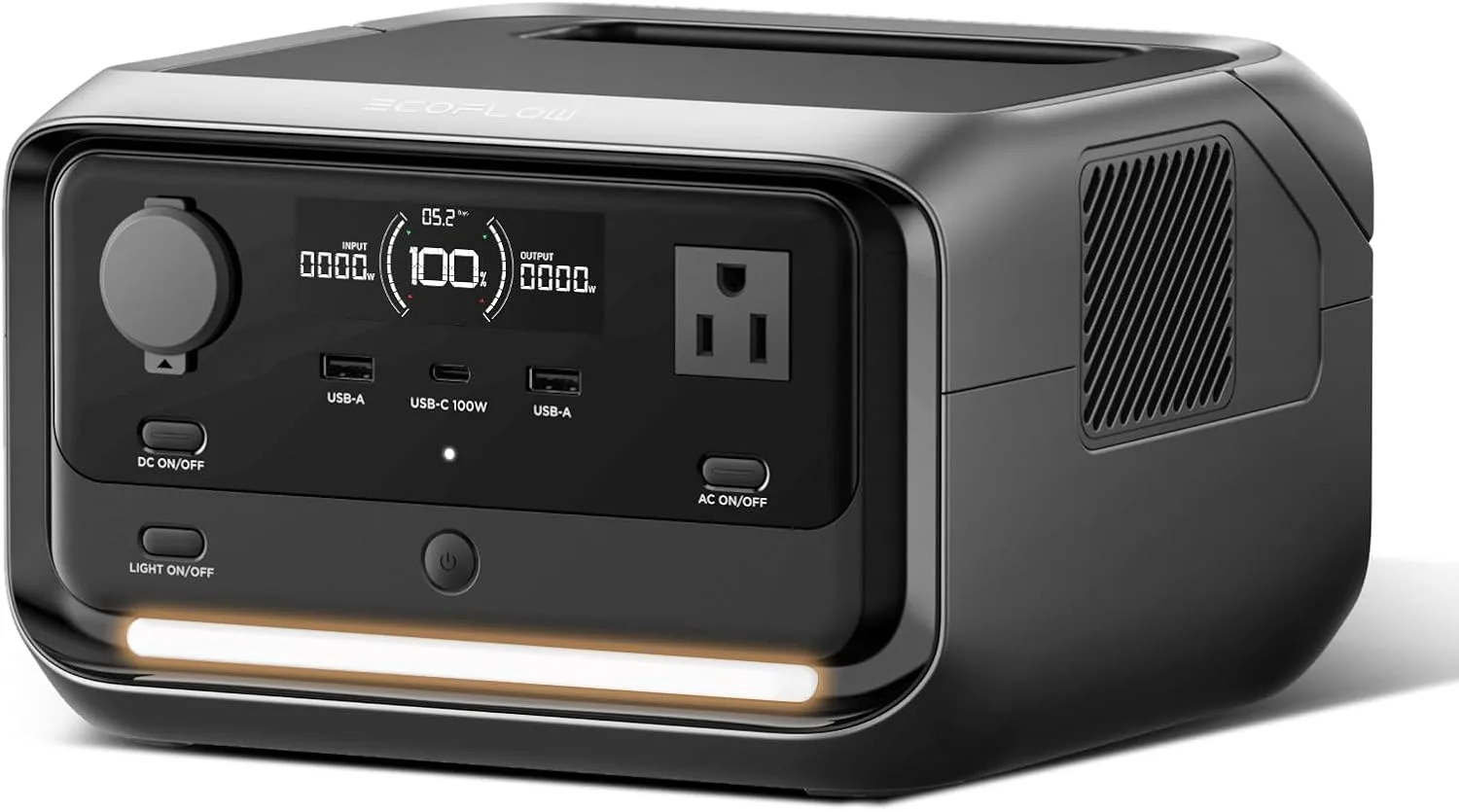
EcoFlow RIVER 3 Plus
Highlights
- 286Wh rated capacity
- 600W continuous AC
- 1200W surge
- LiFePO4 chemistry
- Up to 220W solar input
- 10.4 lb (~4.7 kg)
Best for
- RIVER 3 Plus: phones, cameras and a laptop on short trips
- Travel kits when you need quiet pack power, not appliance runtime
- Brief desk backup for router and lights — not a fridge for days
Strengths
- RIVER 3 Plus: 286Wh pack with 600W continuous / 1200W surge — size loads to both numbers
- 10.4 lb (~4.7 kg) is the lightest-class carry in this band — easier stairs and car packing
- 10ms-class UPS switchover on the listing — useful when a router restart would hurt
- About $299 list in the Hub catalog — confirm live retail before you buy
Watch-outs · not ideal when
- RIVER 3 Plus's small Wh class empties fast with a kettle, hair dryer or space heater
- Usable energy on RIVER 3 Plus is below the 286Wh label once the inverter is working
- Rated 220W solar on RIVER 3 Plus is optimistic; shade and cables cut real watts
- Airline and pack limits may still block RIVER 3 Plus even when the weight looks friendly
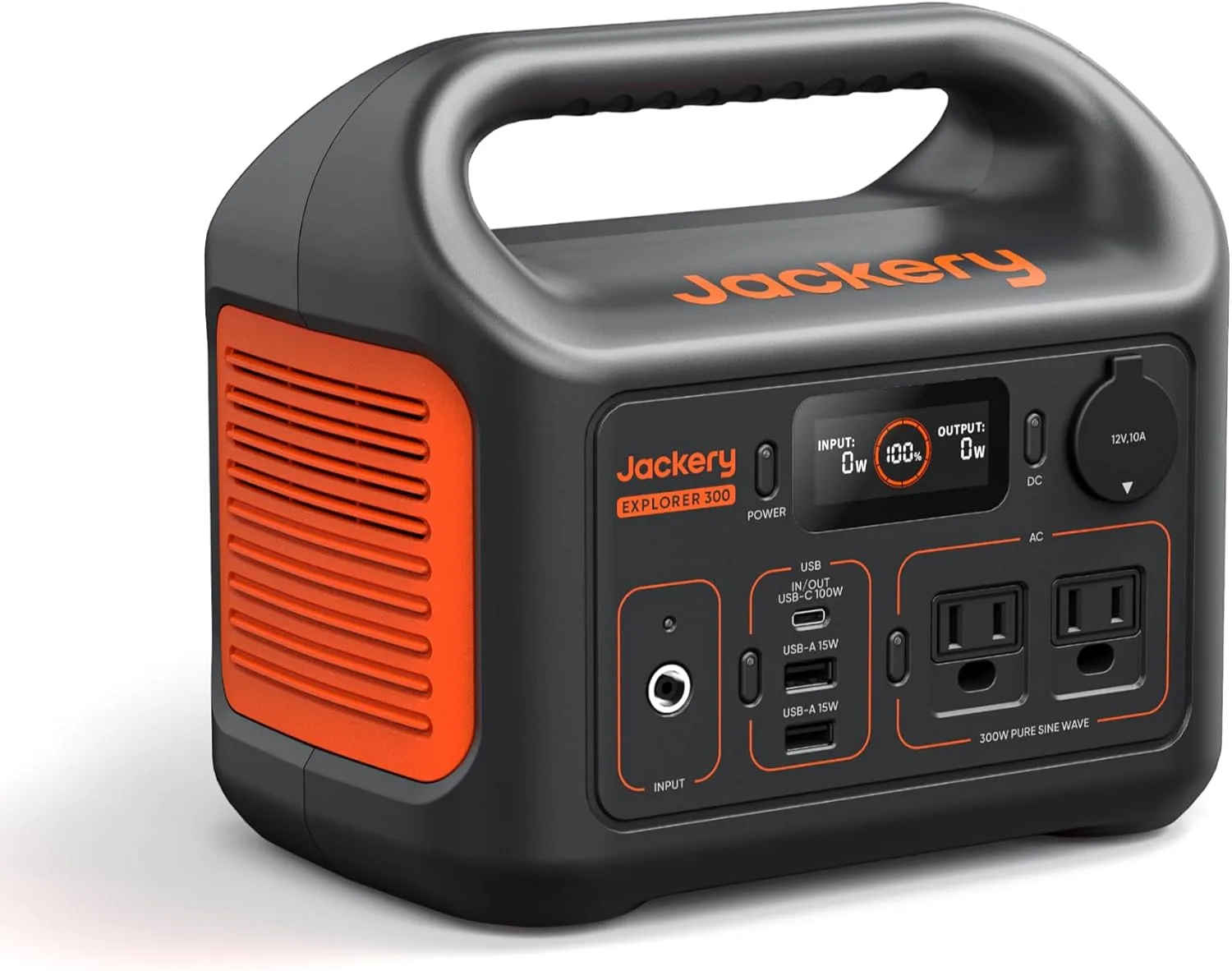
Jackery Explorer 300 Portable Power Station,292Wh
Highlights
- 288Wh rated capacity
- 300W continuous AC
- 600W surge
- LiFePO4 chemistry
- 8.2 lb (~3.7 kg)
- About $289 list
Best for
- Explorer 300 v2: phones, cameras and a laptop on short trips
- Travel kits when you need quiet pack power, not appliance runtime
- Brief desk backup for router and lights — not a fridge for days
Strengths
- Explorer 300 v2: 288Wh pack with 300W continuous / 600W surge — size loads to both numbers
- 8.2 lb (~3.7 kg) is the lightest-class carry in this band — easier stairs and car packing
- 10ms-class UPS switchover on the listing — useful when a router restart would hurt
- Owners on file: It went well for the first time using it. Powers of fans and light computer equipment charged quickly.
Watch-outs · not ideal when
- Explorer 300 v2's small Wh class empties fast with a kettle, hair dryer or space heater
- 300W continuous will not hold heating elements or many compressor surges for long
- Solar input unpublished for Explorer 300 v2 — do not assume a same-day off-grid refill
- Airline and pack limits may still block Explorer 300 v2 even when the weight looks friendly
Owner voices
Short takes from public retail reviews — paraphrased or translated when long or non-English; meaning kept close to the original.
“It went well for the first time using it. Powers of fans and light computer equipment charged quickly.”
“Don't be tricked into buying a refurbished product. They do not make it obvious that you are buying refurbished and have a short warranty. Then fail shortly after the warranty is up. I'm going to try Bluetti because t…”
“Easy to carry, and convienant when needed!”
Spec snapshot
Everything below comes from the listings on file. Where a number is not published, it says so rather than guessing. Ratings are listing aggregates, not owner proof.
| Product | List price | Capacity (Wh) | Output (W) | Weight (lb) | Rating |
|---|---|---|---|---|---|
| EcoFlow RIVER 3 Plus | $299 | 286 Wh | 600 W | 10.4 lb | 5.00 |
| Jackery Explorer 300 Portable Power Station,292Wh | $289 | 288 Wh | 300 W | 8.2 lb | 3.93 |
Where the money went
Capacity is a wash. 286 Wh against 288 Wh is two Wh — noise, not a buying reason. Whatever runtime difference you feel in the field will come from how each unit handles a load, not from the battery label.
The inverter is where the RIVER 3 Plus spends its budget. 600 W continuous means a 500 W device is inside spec rather than leaning on a surge rating. The Explorer 300's 300 W continuous is honest for phones, laptops, lights, fans and a CPAP — and it is the number that rules out most kitchen appliances.
Ports split along the same line. The EcoFlow gives you three AC outlets, one USB-C and two USB-A. The Jackery gives you two AC, one USB-C, a car port, and a long tail of USB-A. If you are charging a family's worth of phones at a campsite, the Jackery's USB-A count is genuinely convenient; if you are running three AC devices at once, the EcoFlow is the only one of the two that can.
Charging speed favors the EcoFlow on paper — the listing claims 0–100% in about an hour on AC and up to 220 W of solar input. The Jackery's listing puts a full AC charge around three hours and 80% in roughly 2.8 hours on a 100 W panel. Owners on both sides describe wall charging as painless; the EcoFlow is simply faster if you are cycling it daily.
Chemistry and cycle life are close enough to call a tie for most buyers: LiFePO4 on both, with the EcoFlow listing 3,000 cycles to 80% and the Jackery listing 4,000-plus to 70%. Different endpoints, so do not read that as a clean win either way.
The RIVER 3 Plus also takes an add-on battery (EB300 or EB600) up to a listed 858 Wh. That is a real escape hatch if you outgrow 286 Wh — and it is the reason I would not call its smaller capacity a dead end. Note that the 858 Wh figure is listing-claimed and applies only with the EB600 fitted; it is not a tested number.
- AC outlets: 3 (EcoFlow) vs 2 (Jackery)
- Continuous output: 600 W vs 300 W
- Weight: 10.4 lb vs 8.2 lb
- Nameplate $/Wh: $1.05 vs $1.00
- Expansion: add-on battery listed for EcoFlow; n/a (not on file) for Jackery
The spec that decides it
Continuous output is the one number that changes what you can plug in. 600 W covers a small microwave's lower settings, a full-size fan, a projector, or a desktop plus monitor without flirting with the limit. 300 W covers the essentials list and nothing above it.
The second deciding spec is the one nobody puts on a badge: transfer behavior. The RIVER 3 Plus lists a <10 ms switchover, and owners describe unplugging it from the wall with a ~113 W load and seeing no glitch at all. If this is going to sit under a router, a NAS, or a work-from-home desk, that is the feature you are paying the extra $10 for.
Weight is the counterargument, and it is not trivial. 10.4 lb versus 8.2 lb is a 27% difference — the kind you feel on the third trip from the car. If the station lives in a closet and comes out twice a year, ignore it. If it rides in a backpack or gets handed to a parent, it matters.
Real owner trade-offs
The review pack on file skews toward exactly the jobs these two are sold for — camping, short outages, CPAP — so the themes below are on-angle rather than incidental. All owner anecdotes below are drawn from the on-file review pack (a handful of owner reports per unit), not from lab testing.
RIVER 3 Plus owners tend to praise the silence and the app. One camper in the on-file review pack ran a 12V cooler overnight in near-100-degree heat inside a car and reported the unit stayed silent and kept the fridge going once topped up. The recurring complaint is input, not output: with a 100 W panel and a 100 W car adapter, that same owner could never push more than 100 W back in, and wished for a second DC input. A separate thread of reports in the pack describes intermittent AC shutdowns, with replacements arriving after a few weeks of back-and-forth. Treat that as a minority pattern, not a certainty — but it is the reason I would keep the receipt and the warranty paperwork tidy.
Explorer 300 owners talk about carrying it. One reviewer in the pack bought it for parents in their 80s specifically because it was light enough for them to move during an outage; another ran a 42-inch TV, a phone, a heating pad and a small coffee maker through a 24-hour outage and still had 43% left after six hours. The CPAP crowd is the most useful signal here: on AC, one owner burned about 40% a night and hit the sub-10 W auto shut-off after 5.5 hours; switching to a DC cord dropped that to roughly 20% a night with no shut-off. That auto shut-off is a feature that behaves like a bug for low-draw devices.
Both listings carry a handful of units that stopped charging within months and were replaced under support. Neither brand has a spotless record in the notes, and neither is a reason to avoid the category.
- RIVER 3 Plus: quiet, app-friendly, UPS-capable — but one DC input caps recharge speed.
- Explorer 300: light enough to hand off, DC cord transforms CPAP runtime — but sub-10 W loads can get cut.
- Both: a small number of early charge failures resolved through support.
Buy the one that…
Buy the EcoFlow RIVER 3 Plus if you need a 600 W ceiling, three AC outlets, or a UPS-style handoff for a router, NAS, or desk. It is the better small-outage tool of the two, and the add-on battery means 286 Wh is not a hard stop. Skip it if you'll never use AC or UPS and want minimum weight — the 10.4 lb shell and the extra $10 buy headroom you won't touch.
Buy the Jackery Explorer 300 Portable Power Station,292Wh if the station will be carried more than it will be plugged in, or if CPAP is the main job — the DC-cord runtime reports are the strongest single-use evidence in this comparison, and 8.2 lb is a real advantage for older users. Skip it if you need to run more than 300 W continuous or want three AC outlets at once; the lower inverter ceiling is the hard limit.
Walk away from both if you are sizing for a refrigerator, a window AC, or anything you would wire through a transfer switch. At 286–288 Wh and 300–600 W, neither is built for that, and the honest answer is a larger class of station — see our guide to sizing a power station for home backup before you spend.
One disclosure: as an Amazon Associate, WattPicks earns from qualifying purchases. These picks follow the load math and the owner themes above, not the commission rate. My checks here are home-user reads of listing specs and owner reports on file — not lab-bench measurements.
Frequently asked
Can either run a CPAP all night?
The Explorer 300 is the better-documented case: owners report roughly 20% per night on a DC cord versus about 40% on AC, where the sub-10 W auto shut-off can end the night early. The RIVER 3 Plus is reported powering a CPAP for several hours, but the pack does not give a full-night figure — plan on a DC cord and test at home first.
Which one charges faster from the wall?
On paper the RIVER 3 Plus, at a listed 0–100% in about an hour versus roughly three hours for the Explorer 300.
Is 300 W enough for a mini fridge?
Not continuously. A 12V cooler is the realistic fridge-adjacent load here, and owners report the RIVER 3 Plus handling one overnight once topped up. A compressor fridge is a larger-station job.
Do I need to buy anything extra?
For CPAP use on the Explorer 300, yes — a DC cord is sold separately and is the difference between one night and several. Solar panels are not included with either unit.
Can I chain the EB300 to the RIVER 3 Plus for a fridge?
The listing claims expansion up to 858 Wh with the EB600 fitted, but that is still far short of what a compressor fridge needs for a day. Chaining batteries adds capacity, not inverter headroom — the 600 W ceiling stays the same.
Which is quieter under load?
Owner reports in the pack describe the RIVER 3 Plus as silent during a 12V cooler run; the Explorer 300's fan behavior under load is not detailed in the on-file notes, so treat quietness as a RIVER 3 Plus talking point rather than a measured comparison.
Method and sources
Model names and list prices come from the WattPicks catalog at build time. WattPicks does not run its own laboratory tests on power stations, and nothing on this page is presented as a measured result — it is catalog-backed buying guidance.
Read our methodology for how the catalog is normalized, and about WattPicks for who publishes it.