
EcoFlow DELTA 3 vs Jackery Explorer 1000 v2: Which Fits Your Load?
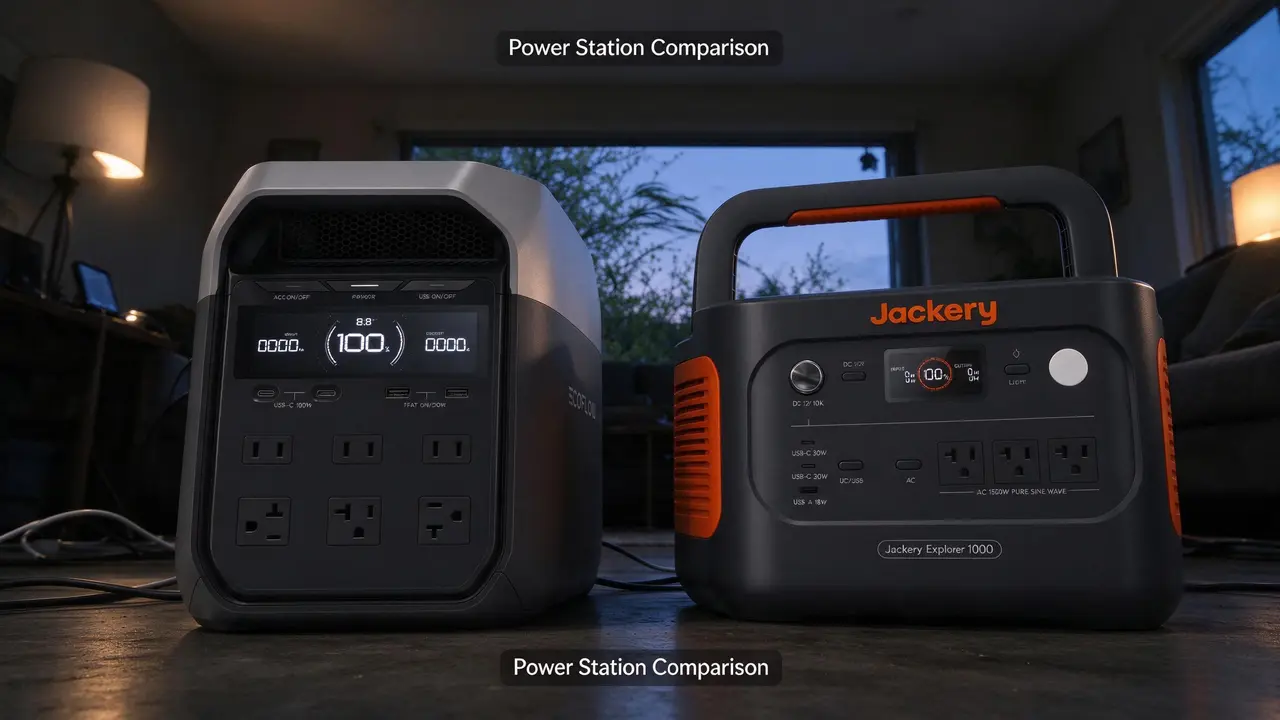
Two 1,000Wh-class stations, $140 apart, with different priorities: the DELTA 3 trades capacity for output and expansion; the Explorer 1000 v2 trades output for lighter weight and a lower list price. Here is how to pick.
Updated
At a glance
Two 1,000Wh-class stations, $140 apart, with different priorities: the DELTA 3 trades capacity for output and expansion; the Explorer 1000 v2 trades output for lighter weight and a lower list price. Here is how to pick.
- EcoFlow DELTA 3: $699 list, 1,024 Wh, 1,800 W, 27.6 lb — output and expansion priority.
- Jackery Explorer 1000 v2: $559 list, 1,070 Wh, 1,500 W, 23.8 lb — capacity and portability priority.
Same money, different priorities
At list price, the EcoFlow DELTA 3 is $699 and the Jackery Explorer 1000 v2 is $559. That $140 gap buys you more continuous output and an expansion path on the EcoFlow; the Jackery answers with more nameplate capacity, less weight, and a lower entry price. Neither is the “right” answer without knowing which loads you actually run.
The DELTA 3 prioritizes headroom: 1,800 W continuous and a 1,024 Wh LFP bank that can grow with EcoFlow’s ecosystem. The Explorer 1000 v2 prioritizes portability and value: 1,070 Wh, 1,500 W continuous, 23.8 lb, and the lower list price. If your heaviest load is a fridge plus a fan, the Jackery’s math works. If you need to start a sump pump (typically 600–1,000 W continuous, with a higher startup surge) or run a diesel heater (often 400–1,500 W continuous depending on model), the EcoFlow’s extra watts matter more than the extra 46 Wh.
This is a listing-spec and owner-theme comparison, not a lab bench shootout. I’m Avery Nolan, WattPicks founding editor; my checks are home-user scenarios grounded in owner reports and published specs. As an Amazon Associate, WattPicks earns from qualifying purchases — picks are fit-led, not commission-led.
- EcoFlow DELTA 3: $699 list, 1,024 Wh, 1,800 W, 27.6 lb — output and expansion priority.
- Jackery Explorer 1000 v2: $559 list, 1,070 Wh, 1,500 W, 23.8 lb — capacity and portability priority.
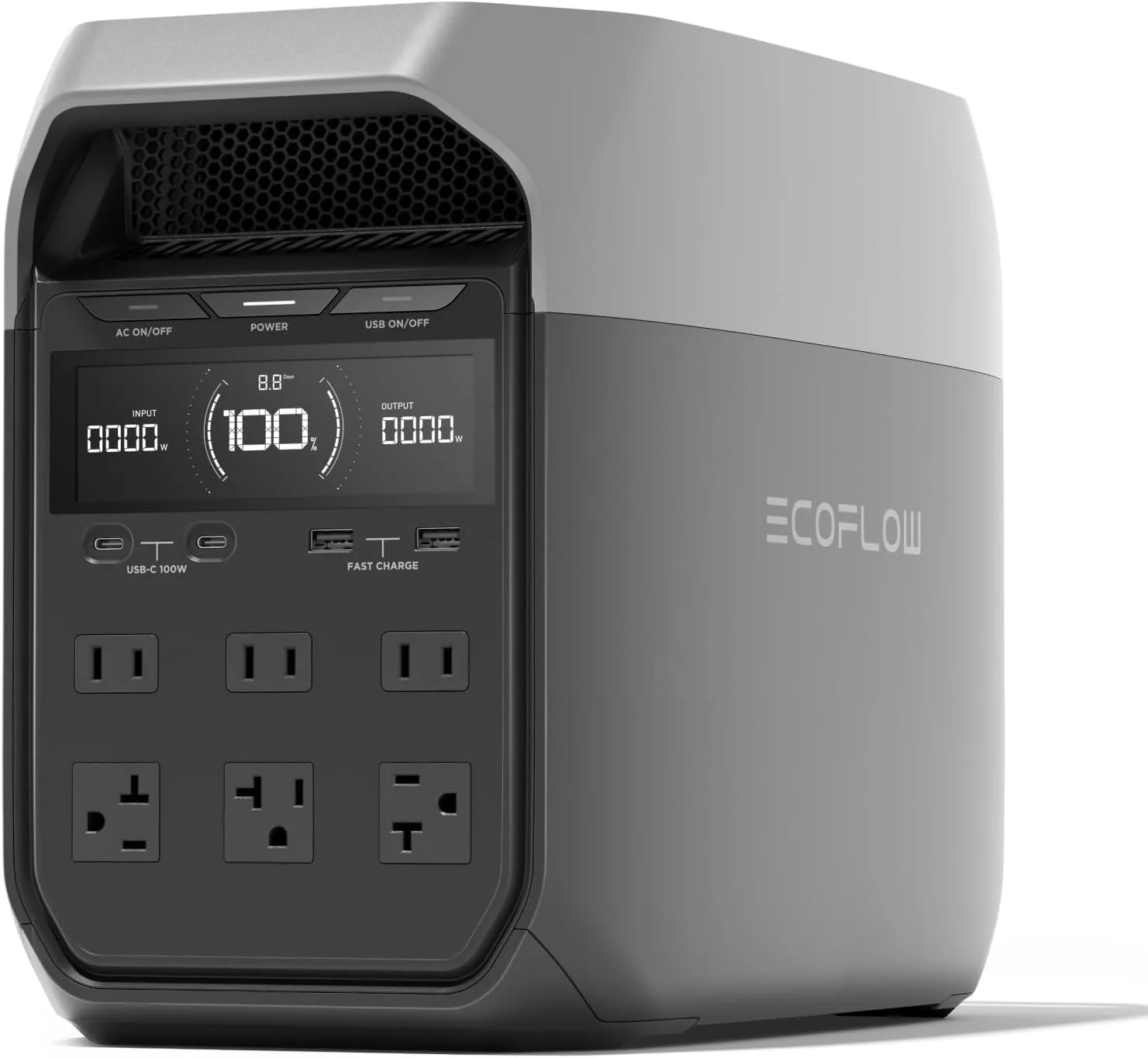
EcoFlow DELTA 3
Highlights
- 1024Wh rated capacity
- 1800W continuous AC
- 3600W surge
- LiFePO4 chemistry
- Up to 500W solar input
- 27.6 lb (~12.5 kg)
Best for
- DELTA 3: small appliances and tools that need ~1800W continuous, not just phone charging
- Essentials bridge at home (fridge cycles, router) when sized to the Wh
- Solar top-ups up to ~500W when panels and weather cooperate
Strengths
- DELTA 3: 1024Wh pack with 1800W continuous / 3600W surge — size loads to both numbers
- 27.6 lb (~12.5 kg) sits in the solo car-camp carry carry band for weekend moves
- 10ms-class UPS switchover on the listing — useful when a router restart would hurt
- About $699 list in the Hub catalog — confirm live retail before you buy
Watch-outs · not ideal when
- DELTA 3 is still a bridge for essentials — not a transfer-switch whole-home system
- Usable energy on DELTA 3 is below the 1024Wh label once the inverter is working
- Rated 500W solar on DELTA 3 is optimistic; shade and cables cut real watts
- LiFePO4 helps longevity, but DELTA 3 still hates freezing charge temps on winter trips
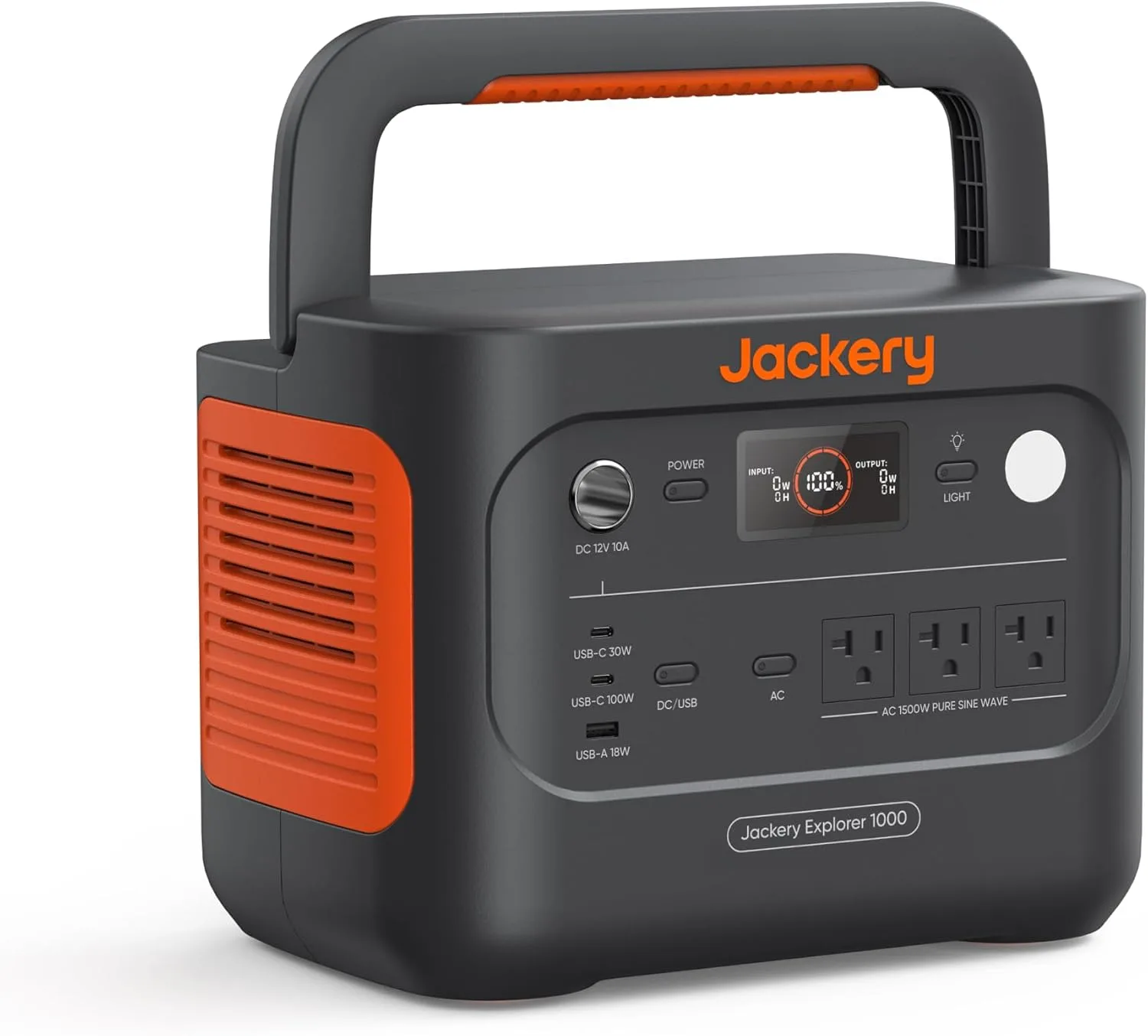
Jackery Explorer 1000 v2 Portable Power Station,1070Wh,1500W
Highlights
- 1070Wh rated capacity
- 1500W continuous AC
- LiFePO4 chemistry
- Up to 400W solar input
- 23.8 lb (~10.8 kg)
- About $559 list
Best for
- Explorer 1000 v2: weekend camping when 23.8 lb carry weight matters as much as 1070Wh
- Essentials bridge at home (fridge cycles, router) when sized to the Wh
- Solar top-ups up to ~400W when panels and weather cooperate
Strengths
- Explorer 1000 v2: 1070Wh with 1500W continuous — enough for fridge cycles if surge on the listing clears the start
- 23.8 lb (~10.8 kg) is the lightest-class carry in this band — easier stairs and car packing
- Explorer 1000 v2 uses LiFePO4 — cycle-life claims usually beat older NMC marketing lines
- Owners on file: Updated to add that customer service contacted me and offered a partial refund so i added 2 more stars. It do…
Watch-outs · not ideal when
- Explorer 1000 v2 is still a bridge for essentials — not a transfer-switch whole-home system
- Usable energy on Explorer 1000 v2 is below the 1070Wh label once the inverter is working
- Rated 400W solar on Explorer 1000 v2 is optimistic; shade and cables cut real watts
- LiFePO4 helps longevity, but Explorer 1000 v2 still hates freezing charge temps on winter trips
Spec snapshot
Prices are list prices as of the publish date; sale stickers come and go. Ratings are listing aggregates, not owner proof. Weight is in pounds.
| Product | List price | Capacity (Wh) | Output (W) | Weight (lb) | Rating |
|---|---|---|---|---|---|
| EcoFlow DELTA 3 | $699 | 1024 Wh | 1800 W | 27.6 lb | 5.00 |
| Jackery Explorer 1000 v2 Portable Power Station,1070Wh,1500W | $559 | 1070 Wh | 1500 W | 23.8 lb | 4.75 |
Where the money went
Four configuration differences explain most of the $140 gap. Start with output: the DELTA 3’s 1,800 W continuous clears the Explorer’s 1,500 W by 300 W. That is the difference between a station that can carry a sump pump’s main pump for roughly eight hours (as one DELTA 3 owner reported) and one that will trip on a 1,700 W air fryer (as an Explorer owner found).
Capacity is the Jackery’s win, but narrowly: 1,070 Wh vs 1,024 Wh is about 4.5% more nameplate energy. In practice, owner reports show both units running a fridge overnight; the Jackery’s extra 46 Wh is not a second night. The bigger practical difference is weight — 23.8 lb vs 27.6 lb. The Explorer is easier to carry up stairs or into a van, and its foldable handle helps.
Ports split by use case. The DELTA 3 lists six AC outlets, two USB-C, two USB-A, and one car port — more AC sockets for plugging in a fridge, fan, and lamp at once. The Explorer 1000 v2 lists three AC outlets, plus USB-C and USB-A. If you need to run several AC loads simultaneously without a power strip, the EcoFlow’s six outlets are the cleaner setup.
Expansion is the quiet decider. According to EcoFlow’s spec page, the DELTA 3 ecosystem supports add-on batteries up to 5 kWh, so the station can grow into a longer outage (this is ecosystem-dependent and requires buying compatible EcoFlow batteries). Jackery’s Explorer 1000 v2 is a standalone unit; there is no published expansion path in the listing. If you plan to add capacity later, the EcoFlow’s higher list price is partly an option premium. If you will never expand, that premium buys you nothing.
- Output: 1,800 W (EcoFlow) vs 1,500 W (Jackery) — 300 W more headroom for pumps and heaters.
- Capacity: 1,070 Wh (Jackery) vs 1,024 Wh (EcoFlow) — 46 Wh more, not a second night.
- Weight: 23.8 lb (Jackery) vs 27.6 lb (EcoFlow) — nearly 4 lb lighter for carrying.
- AC outlets: 6 (EcoFlow) vs 3 (Jackery) — fewer power strips needed.
- Expansion: EcoFlow supports add-on batteries up to 5 kWh (per EcoFlow spec page); Jackery listing shows no expansion path.
The spec that decides it
For most home-backup buyers, continuous output is the deciding number. A fridge cycles at roughly 100–200 W running, but its startup surge can briefly exceed that; a sump pump or a diesel heater can pull 600–1,000 W continuous. The DELTA 3’s 1,800 W gives you more margin before the inverter clips. The Explorer’s 1,500 W is fine for a fridge plus fans, but owners report it refusing a 1,700 W air fryer and stalling on a 12-inch miter saw — those are hard limits, not soft ones.
The second decider is weight and price together. If the station lives in a closet and comes out for outages, 27.6 lb is manageable. If it rides in a van or gets carried to a tailgate, the Explorer’s 23.8 lb and $559 list price are the better fit. The DELTA 3’s extra output is only worth paying for if you actually run a load above 1,500 W.
Runtime sanity check
Use these owner-reported scenarios as a rough guide, not measured runtimes. A fridge-only load (100–200 W running) should last well beyond a night on either unit. Adding a portable AC (often 500–1,000 W continuous) cuts runtime sharply and may approach the Explorer’s 1,500 W ceiling. The sump-pump figure below is owner-reported, not measured.
- DELTA 3 owner theme: all-night small appliances and fast recharge hold up; 99% charge quirk appears over time.
- Explorer 1000 v2 owner theme: fridge + portable AC works; high-watt kitchen and shop tools do not.
- Both: listing aggregate 4.7 — not a substitute for owner detail.
| Scenario | Typical load | EcoFlow DELTA 3 | Jackery Explorer 1000 v2 |
|---|---|---|---|
| Fridge only | 100–200 W running | Overnight (owner reports) | Overnight (owner reports) |
| Fridge + portable AC | ~600–1,200 W combined | Likely works; shorter runtime | Owner ran during outage testing; close to 1,500 W ceiling |
| Sump pump (main pump) | 600–1,000 W continuous | ~8 hours (owner-reported, not measured) | Not recommended; may trip |
| Diesel heater | 400–1,500 W continuous | Likely works | Check heater wattage; may exceed 1,500 W |
Real owner trade-offs
Owner reports on the DELTA 3 cluster around daily small-appliance use and fast recharge. One van-dweller ran a coffee maker, an electric blanket on high all night, a fan all night, and charged a phone, watch, tablet, laptop, and speaker together without a shutdown. Another ran a sump pump’s main pump for about eight hours.
Explorer 1000 v2 owners skew toward hurricane prep and tailgating. One Florida owner ran a refrigerator and a portable AC unit simultaneously during outage testing, fast-charging phones off USB-C; quiet mode let the family sleep while the fridge and fans ran. Another ran a 12-quart DC fridge three days on eco mode with phone top-ups. The limits show up with high-watt appliances: a 1,700 W air fryer is out, a 12-inch sliding miter saw spun a quarter turn and quit. Owners also note no car charger in the box and a Wi-Fi link that drops overnight, requiring a reconnect to check the battery.
- DELTA 3 owner theme: all-night small appliances and fast recharge hold up; 99% charge quirk appears over time.
- Explorer 1000 v2 owner theme: fridge + portable AC works; high-watt kitchen and shop tools do not.
- Both: listing aggregate 4.7 — not a substitute for owner detail.
Buy the one that…
Buy the EcoFlow DELTA 3 if you need more than 1800 W continuous for a pump, heater, or large appliance, or if you want the option to expand capacity later. It is the better fit for a fixed home-backup setup where weight matters less than headroom.
Buy the Jackery Explorer 1000 v2 if your heaviest loads are a fridge, fans, lights, and electronics, and you value the lower list price and nearly 4 lb less weight. It is the better fit for apartment outages, camping, and tailgates where you will carry it.
Walk away from both if you need to run a 1,700 W air fryer, a large miter saw, or whole-home circuits — neither station is sized for that, and a transfer-switch setup is the safer path.
Frequently asked
Can the DELTA 3 run a sump pump?
One owner reported about eight hours on a main pump; check your pump’s continuous wattage against the 1,800 W rating before relying on it.
Can the Explorer 1000 v2 run a fridge and a portable AC at once?
One owner did during outage testing, but the combined load is close to the 1,500 W ceiling — expect shorter runtime than a fridge alone.
Do either include a car charger?
The Explorer 1000 v2 listing says no car charger in the box; the DELTA 3 listing includes an AC charging cable and manual, with car charging not specified.
Which is cheaper per Wh?
At list price, the Jackery Explorer 1000 v2 is $0.52/Wh vs the EcoFlow DELTA 3 at $0.68/Wh — the Jackery is the lower nameplate cost per Wh.
Method and sources
Model names and list prices come from the WattPicks catalog at build time. WattPicks does not run its own laboratory tests on power stations, and nothing on this page is presented as a measured result — it is catalog-backed buying guidance.
Read our methodology for how the catalog is normalized, and about WattPicks for who publishes it.