
BLUETTI AC180 vs Jackery Explorer 1000 v2: Mid-Size Power Pick
Two mid-size stations, two different bets: the AC180 buys watts and UPS switchover; the Explorer 1000 v2 buys lighter carry and quiet runtime. Here is how to pick when the budget is capped.
Updated
At a glance
Two mid-size stations, two different bets: the AC180 buys watts and UPS switchover; the Explorer 1000 v2 buys lighter carry and quiet runtime. Here is how to pick when the budget is capped.
Same money, different bets
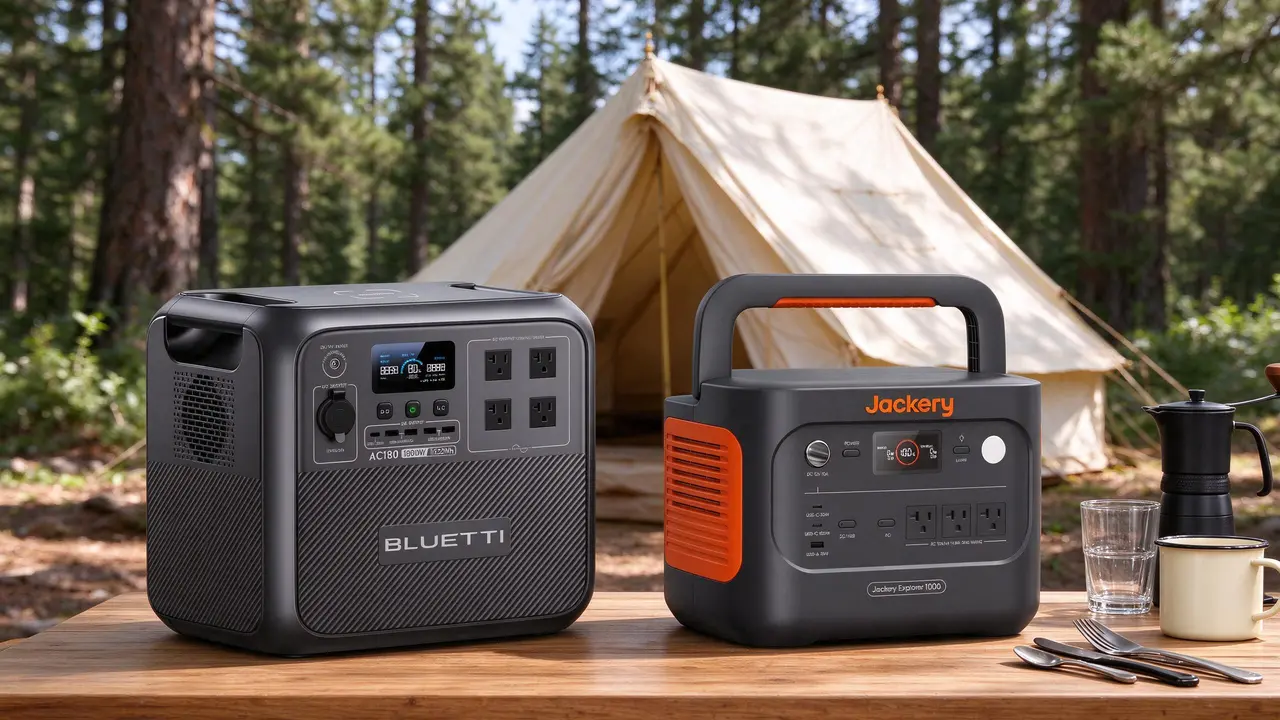
If you are shopping the $500–$560 band for a mid-size station, these two are the obvious finalists. The BLUETTI AC180 leans on raw output and UPS-style switchover: 1,152 Wh and 1,800 W for $499. The Jackery Explorer 1000 v2 leans on lighter carry and quiet runtime: 1,070 Wh and 1,500 W for $559, at 23.8 lb versus 35.3 lb.
Neither is a whole-home backup. Both are outage insurance for a fridge, router, lights, and a few small appliances, or a car-camping power source. The question is which trade-off you can live with when the budget is capped.
Disclosure: as an Amazon Associate, WattPicks earns from qualifying purchases. Picks here are fit-led, not commission-led.
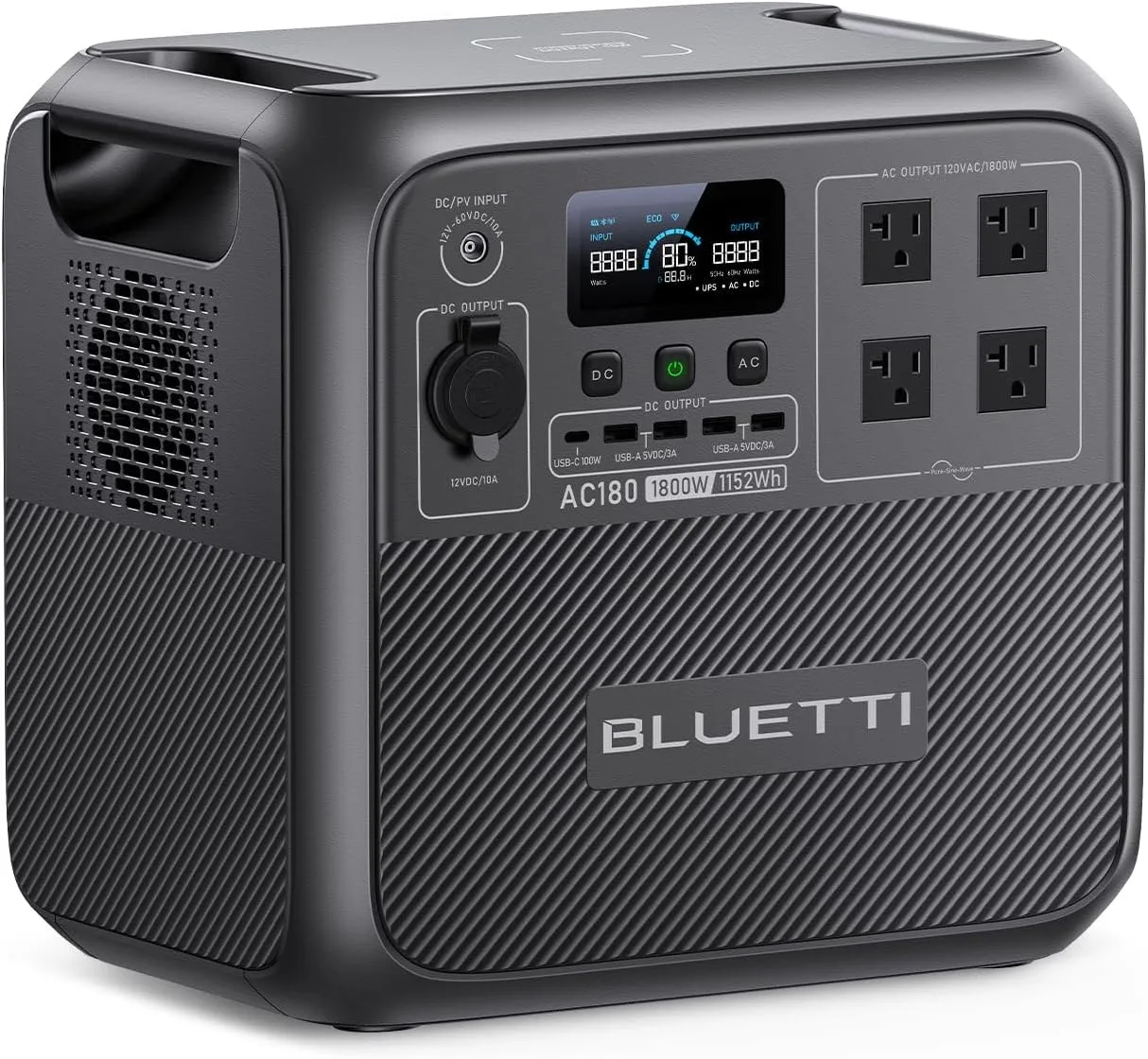
BLUETTI Portable Power Station AC180, 1152Wh LiFePO4 Battery Backup w/ 2 1800W
Highlights
- 1152Wh rated capacity
- 1800W continuous AC
- LiFePO4 chemistry
- Up to 500W solar input
- 35.3 lb (~16.0 kg)
- About $499 list
Best for
- AC180: most Wh per list dollar in mid-size LiFePO4 shortlists (~1152Wh)
- Home essentials when 1800W continuous matters more than a light carry
- Skip if 35.3 lb is too heavy for stairs or frequent car packing
Strengths
- AC180: 1800W continuous on a 1152Wh pack — more headroom for small appliances than 1kW-class peers
- 35.3 lb (~16.0 kg) is a park-and-use chassis — plan a short path, not a trail hike
- 1800W continuous headroom covers more small appliances than 1kW-class inverters
- About $499 list in the Hub catalog — confirm live retail before you buy
Watch-outs · not ideal when
- 35.3 lb (~16.0 kg) is a two-hand lift; skip it if you walk more than a short path to camp
- Usable energy on AC180 is below the 1152Wh label once the inverter is working
- Rated 500W solar on AC180 is optimistic; shade and cables cut real watts
- LiFePO4 helps longevity, but AC180 still hates freezing charge temps on winter trips
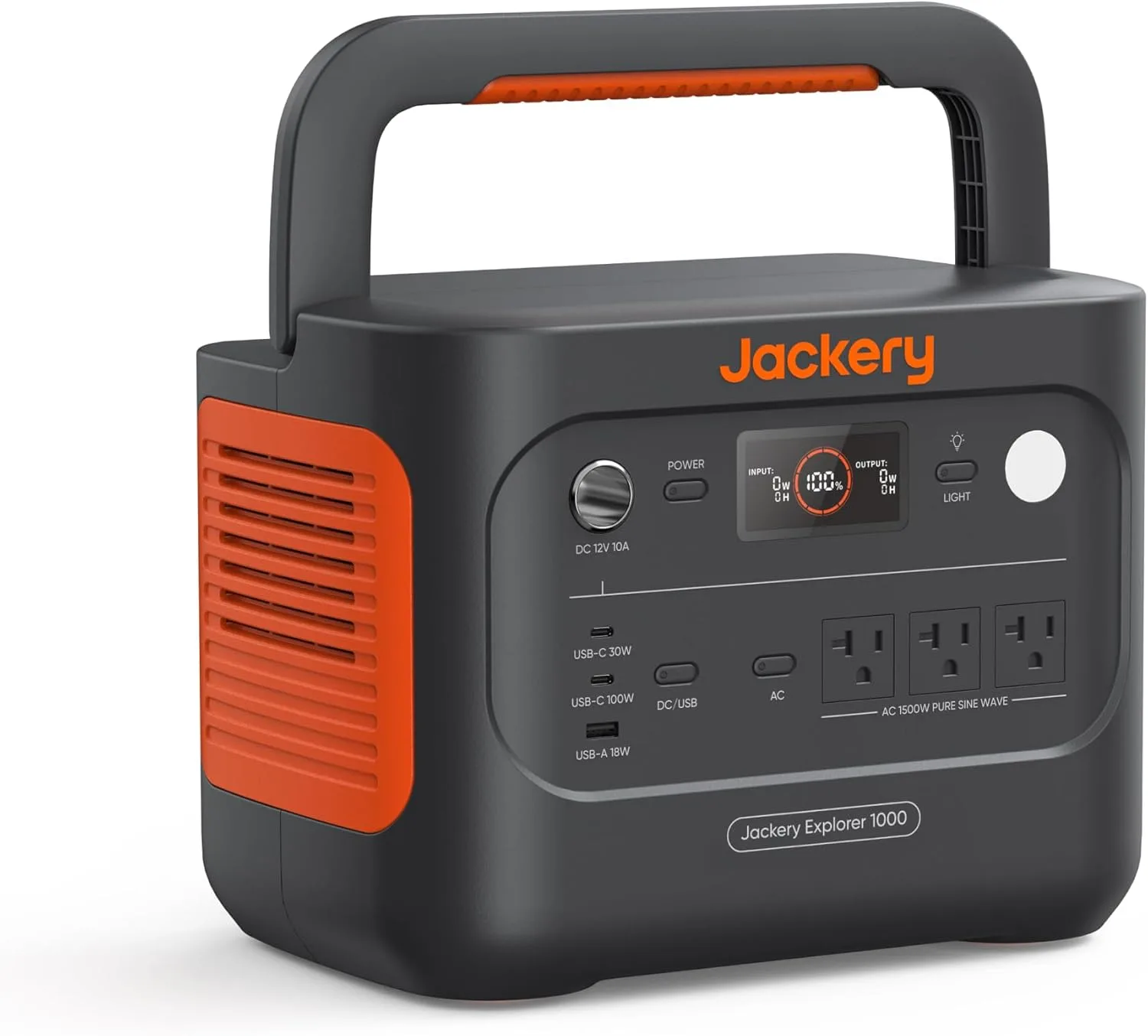
Jackery Explorer 1000 v2 Portable Power Station,1070Wh,1500W
Highlights
- 1070Wh rated capacity
- 1500W continuous AC
- LiFePO4 chemistry
- Up to 400W solar input
- 23.8 lb (~10.8 kg)
- About $559 list
Best for
- Explorer 1000 v2: weekend camping when 23.8 lb carry weight matters as much as 1070Wh
- Essentials bridge at home (fridge cycles, router) when sized to the Wh
- Solar top-ups up to ~400W when panels and weather cooperate
Strengths
- Explorer 1000 v2: 1070Wh with 1500W continuous — enough for fridge cycles if surge on the listing clears the start
- 23.8 lb (~10.8 kg) is the lightest-class carry in this band — easier stairs and car packing
- Explorer 1000 v2 uses LiFePO4 — cycle-life claims usually beat older NMC marketing lines
- Owners on file: Updated to add that customer service contacted me and offered a partial refund so i added 2 more stars. It do…
Watch-outs · not ideal when
- Explorer 1000 v2 is still a bridge for essentials — not a transfer-switch whole-home system
- Usable energy on Explorer 1000 v2 is below the 1070Wh label once the inverter is working
- Rated 400W solar on Explorer 1000 v2 is optimistic; shade and cables cut real watts
- LiFePO4 helps longevity, but Explorer 1000 v2 still hates freezing charge temps on winter trips
Spec snapshot
Prices are list prices from the catalogue, not current sale stickers. Ratings are listing aggregates, not owner proof. Weight is in pounds.
Method: specs come from manufacturer listings; runtime and surge behavior come from aggregated owner reports, not lab-bench testing. Owner themes are paraphrased summaries of retailer reviews, not direct quotes.
| Product | List price | Capacity (Wh) | Output (W) | Weight (lb) | Rating |
|---|---|---|---|---|---|
| BLUETTI AC180 | $499 | 1152 Wh | 1800 W | 35.3 lb | 4.85 |
| Jackery Explorer 1000 v2 | $559 | 1070 Wh | 1500 W | 23.8 lb | 4.75 |
Where the money went
The AC180 puts more of your dollars into the inverter and battery: 1,800 W continuous versus 1,500 W, and 1,152 Wh versus 1,070 Wh. That extra headroom matters if you want to run a space heater, a larger fridge, or a microwave for short bursts. It also carries a nameplate cost of $0.43/Wh against $0.52/Wh for the Jackery — the BLUETTI is the cheaper unit per watt-hour on paper.
The Explorer 1000 v2 spends its premium on portability and quiet operation. At 23.8 lb it is roughly 11.5 lb lighter, and owners repeatedly mention sleeping next to it in quiet mode while it runs a fridge and fans. The AC180 is a move-it-and-leave-it unit at 35.3 lb; the Jackery is carryable for short hauls.
Both use LiFePO4 chemistry, so cycle life is not the differentiator here. The AC180 lists a 5-year warranty; the Jackery listing does not publish a full warranty document in the data on file, so treat that as n/a rather than assume parity.
Recharge speed is close on paper. BLUETTI claims a 1-hour AC recharge at 1,440 W input; Jackery claims 1 hour only with emergency charging enabled in the app, defaulting to 1.7 hours. Owners on both sides report real-world times in the 1.5–2 hour range after calibration.
- AC180: 1,800 W continuous, 1,152 Wh, $0.43/Wh nameplate, 35.3 lb, 5-year warranty listed.
- Explorer 1000 v2: 1,500 W continuous, 1,070 Wh, $0.52/Wh nameplate, 23.8 lb, warranty n/a (not on file).
- Both LiFePO4; both list 1-hour fast charge with caveats (AC180 at 1,440 W input; Jackery via app emergency mode).
The spec that decides it
For most buyers, the deciding number is weight. The Explorer 1000 v2 is 23.8 lb; the AC180 is 35.3 lb. If the station lives in a closet and comes out for outages, that gap is irrelevant. If it rides in a car trunk, gets carried to a campsite, or moves between rooms, the Jackery's lighter build is the difference between using it and dreading it.
The second deciding number is continuous output. The AC180's 1,800 W gives you more headroom for motor-start surges and high-draw appliances. The Explorer 1000 v2's 1,500 W is enough for a fridge, a portable AC, and small tools, but owners report it refusing a 1,700 W air fryer and stalling on a 12-inch sliding miter saw. Check the surge rating of anything with a motor before you count on either unit.
Real owner trade-offs
BLUETTI AC180: The most helpful owner themes are UPS switchover and the runtime display. One owner set it up as a basement circuit backup and reported the router, TV, and lights stayed on without a blink when wall power was cut. The caveat that repeats: idle draw with the inverter on eats capacity, and the manual notes only about 90% of capacity is usable. A 55 W fan that math said would run 16 hours died closer to 10–11. Some units also needed a full drain/recharge and firmware updates before runtime matched expectations.
Jackery Explorer 1000 v2: Owners praise quiet mode and fridge runtime. One ran a fridge and portable AC simultaneously during an outage drill and slept next to it in quiet mode. Another ran a 12V cooler for three days and dropped to about 43%. The caveats: high-surge tools trip it, Wi-Fi sometimes drops overnight, and there are no 12V barrel ports or included car charger. Charging can also behave oddly out of the box until a full cycle recalibrates it.
- AC180: instant UPS switchover kept router and TV on, but idle draw and ~90% usable capacity shorten small-load runtime (owner reports).
- AC180: solar input fell short of panel ratings in clouds and at angle; one off-grid owner saw only a fraction accepted (owner reports).
- Explorer 1000 v2: quiet mode allowed sleeping next to a running fridge and fans; fast AC recharge under two hours in normal mode (owner reports).
- Explorer 1000 v2: 1,700 W air fryer and 12-inch miter saw both failed; corded sanders and shop vac worked but drained fast (owner reports).
Buy the one that…
Buy the BLUETTI AC180 if you want the most watts and watt-hours for the money, you value UPS-style switchover for a router or network gear, and the station will live in one place. It is the better outage-insurance buy at $499, provided you accept the 35.3 lb weight and budget for a day-one calibration cycle.
Buy the Jackery Explorer 1000 v2 if you will actually carry it — to a campsite, a tailgate, or between rooms — and you want quiet overnight operation. At $559 and 23.8 lb it is the more livable unit, but skip it if you need to start big motors or run a 1,700 W appliance. If neither weight nor UPS matters and you just want maximum capacity per dollar, the AC180 wins on nameplate $/Wh.
Don't buy either if you need whole-home backup, regularly run high-surge tools like miter saws or air fryers, or your budget is under $400. These are mid-size stations, not whole-house generators, and neither is built for continuous high-draw loads.
Frequently asked
Can the AC180 run a fridge overnight?
Yes, owners report running a fridge for hours, but idle draw and the 90% usable-capacity note mean you should size loads conservatively. A 1,152 Wh unit will not run a full-size fridge for a full day.
Can the Explorer 1000 v2 run a CPAP?
Owners mention CPAP use in review themes, and 1,070 Wh is ample for a CPAP plus phone charging for a night or two. Check your machine's wattage and any humidifier draw.
Which charges faster from the wall?
On paper both claim about an hour with fast modes enabled. Owners on both sides report 1.5–2 hours in normal mode, and both can need a full cycle before fast charging behaves as advertised.
Do either include solar panels?
No. Solar panels are sold separately for both units, and the Jackery listing notes compatibility only with Jackery panels.
Method and sources
Model names and list prices come from the WattPicks catalog at build time. WattPicks does not run its own laboratory tests on power stations, and nothing on this page is presented as a measured result — it is catalog-backed buying guidance.
Read our methodology for how the catalog is normalized, and about WattPicks for who publishes it.