
Anker SOLIX F3800 Plus vs PECRON E3800LFP: Backup Bet
Two 3,840Wh stations, one budget ceiling, and two very different bets on what home backup should cost. The Anker buys output and 240V headroom; the PECRON buys the same capacity for half the money and asks you to live with the quirks.
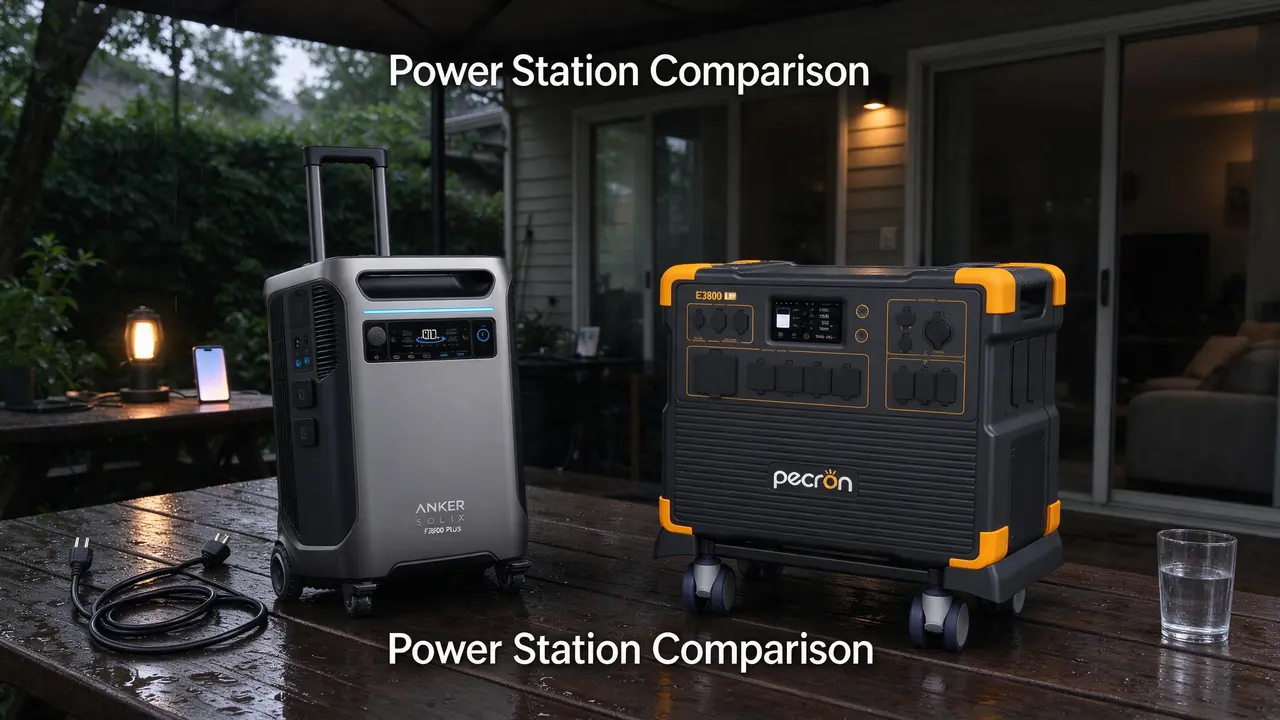
Updated
At a glance
Two 3,840Wh stations, one budget ceiling, and two very different bets on what home backup should cost. The Anker buys output and 240V headroom; the PECRON buys the same capacity for half the money and asks you to live with the quirks.
- Anker: pay for watts, 240V, and recharge speed
- PECRON: pay for capacity per dollar and accept the quirks
Same money, different bets
Here is the question that actually matters: you have a budget ceiling, and both of these stations hold 3,840Wh. Do you spend it on output headroom, or do you spend half of it and keep the rest?
The Anker F3800 Plus Portable Power Station, 3,840Wh bets that you want 6,000W of continuous AC, 240V dual-voltage for a dryer or a well pump, and a 63-minute recharge path. The PECRON E3800LFP bets that 4,200W and the same 3,840Wh is enough for most outage loads — and that $1,299 is a fairer number than $2,599.99.
Neither bet is wrong. They just serve different houses. This is a comparison of listing specs and owner themes on file, not a lab-bench measurement of either unit, and it is not the page for you if you need a sub-1,000Wh camping box or a permanently installed standby generator.
- Anker: pay for watts, 240V, and recharge speed
- PECRON: pay for capacity per dollar and accept the quirks
Methodology and who this is for
I am WattPicks' founding editor, and my checks here are home-user reads grounded in the owner themes on file plus the listing specs — not lab-bench measurements, and not an invented third-party score. Prices are list prices; ratings are listing aggregates and are not treated as owner proof.
As an Amazon Associate, WattPicks earns from qualifying purchases. Picks on this page are fit-led, not commission-led — the cheaper unit wins on cost per watt-hour and the more expensive one wins on output and voltage, and both statements stand on the listing numbers.
For the sizing math behind these numbers, see our guide to portable power station capacity and runtime, and for the chemistry trade-off, LFP vs NMC in home backup. If you are still deciding between a transfer switch and a smart panel, our home backup wiring comparison covers that step before you buy either station.
Scoreboard on those weights — Anker F3800 Plus Portable Power Station, 3,840Wh (list $2599.99): High where list price and published capacity match the job, Med on continuous watts; PECRON E3800LFP (list $1299): High on continuous watts and ports, Med on price. That is why the pick splits by job rather than one universal winner.
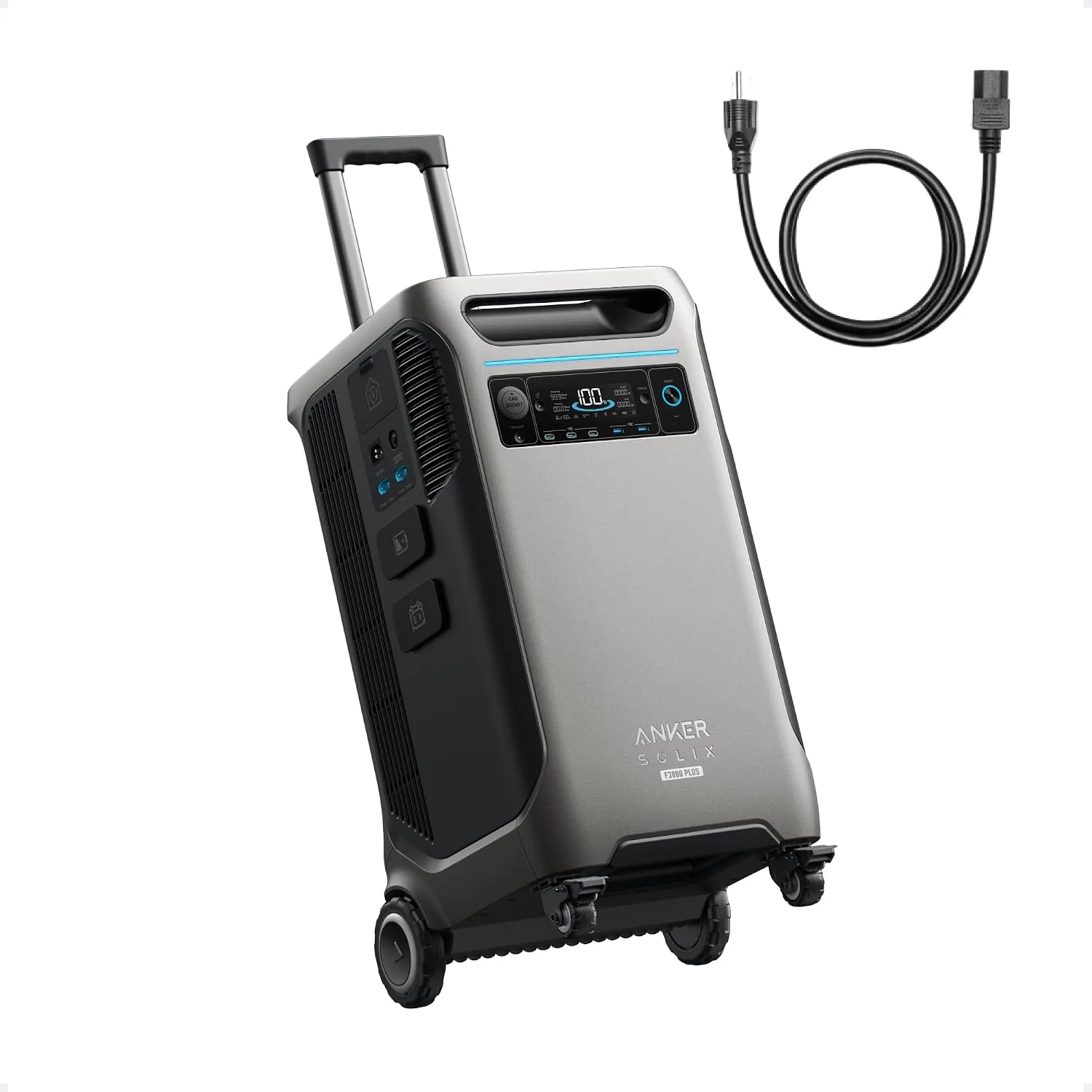
Anker F3800 Plus Portable Power Station, 3,840Wh
Highlights
- 3840Wh rated capacity
- 6000W continuous AC
- LiFePO4 chemistry
- Up to 3200W solar input
- 72.8 lb (~33.0 kg)
- About $3599.99 list
Best for
- F3800 Plus: longer outages or higher continuous loads (still not whole-home wiring)
- RV / off-grid days where recharge speed matters as much as Wh
- Best parked near the vehicle or cabin — not a long carry to a tent
Strengths
- F3800 Plus: 6000W continuous on a 3840Wh pack — more headroom for small appliances than 1kW-class peers
- 72.8 lb (~33.0 kg) is a park-and-use chassis — plan a short path, not a trail hike
- 20ms-class UPS switchover on the listing — useful when a router restart would hurt
- About $3599.99 list in the Hub catalog — confirm live retail before you buy
Watch-outs · not ideal when
- At 72.8 lb (~33.0 kg), F3800 Plus is a poor tent-hike companion — plan a cart or leave it in the vehicle
- High continuous output on F3800 Plus tempts big loads — Wh still runs out on kettles and A/C
- Rated 3200W solar on F3800 Plus is optimistic; shade and cables cut real watts
- LiFePO4 helps longevity, but F3800 Plus still hates freezing charge temps on winter trips
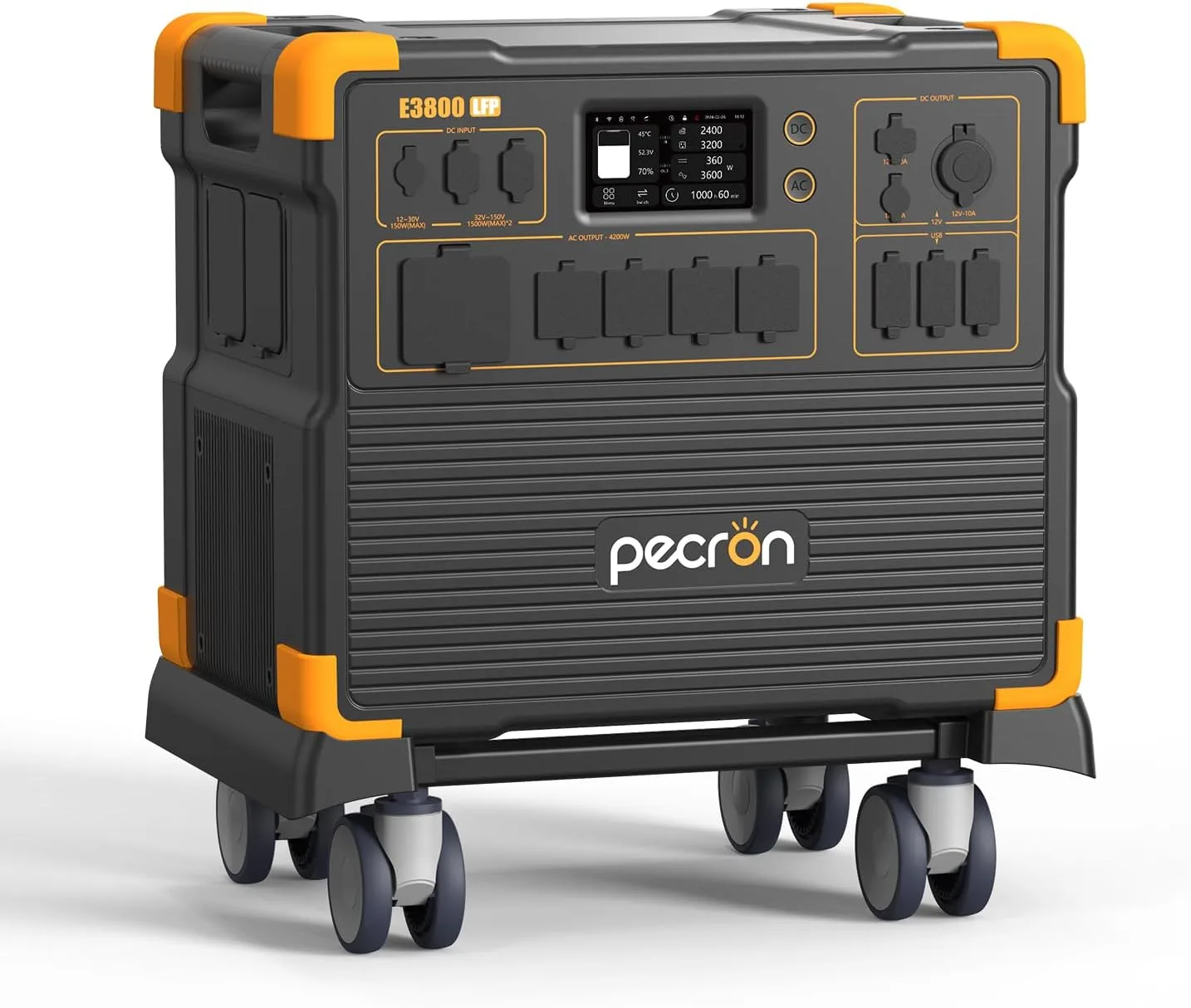
PECRON E3800LFP
Highlights
- 3840Wh rated capacity
- 4200W continuous AC
- LiFePO4 chemistry
- Up to 3000W solar input
- 87.3 lb (~39.6 kg)
- About $1299 list
Best for
- E3800LFP: longer outages or higher continuous loads (still not whole-home wiring)
- RV / off-grid days where recharge speed matters as much as Wh
- Best parked near the vehicle or cabin — not a long carry to a tent
Strengths
- E3800LFP: 4200W continuous on a 3840Wh pack — more headroom for small appliances than 1kW-class peers
- 87.3 lb (~39.6 kg) is a park-and-use chassis — plan a short path, not a trail hike
- 4200W continuous headroom covers more small appliances than 1kW-class inverters
- Owners on file: 5/5 · 29 helpful — Massive capacity, great value. To calibrate the BMS I let it fully charge, then left it pl…
Watch-outs · not ideal when
- At 87.3 lb (~39.6 kg), E3800LFP is a poor tent-hike companion — plan a cart or leave it in the vehicle
- High continuous output on E3800LFP tempts big loads — Wh still runs out on kettles and A/C
- Rated 3000W solar on E3800LFP is optimistic; shade and cables cut real watts
- LiFePO4 helps longevity, but E3800LFP still hates freezing charge temps on winter trips
Owner voices
Short takes from public retail reviews — paraphrased or translated when long or non-English; meaning kept close to the original.
“5/5 · 29 helpful — Massive capacity, great value. To calibrate the BMS I let it fully charge, then left it plugged in several more hours while it balanced cells. Then ran it all the way until it shut off with a 1500W…”
“4/5 · 22 helpful — I waited a bit before reviewing, since I don't really know much of anything about Pecron. I've been running my 450 sf shop/studio, including a 110v mini-split (the runs 24/7) on an E3800 & three EP3…”
“5/5 · 15 helpful — Pretty Decent Power station. Comes with everything needed including wheels which you will need (These are heavy) and I am 71 yrs old. Haven't ran it to zero (0%) yet but to maybe 15/20% and charge f…”
Spec snapshot
Prices are list prices, not deal stickers. Ratings are listing aggregates, not owner proof. Weight is in pounds as listed.
| Product | List price | Capacity (Wh) | Output (W) | Weight (lb) | Rating |
|---|---|---|---|---|---|
| Anker F3800 Plus Portable Power Station, 3,840Wh | $3,599.99 | 3840 Wh | 6000 W | 72.8 lb | 4.89 |
| PECRON E3800LFP | $1,299 | 3840 Wh | 4200 W | 87.3 lb | 4.40 |
Where the money went
Four configuration differences explain almost the entire price gap.
Output and voltage. The Anker lists 6,000W continuous with 120V/240V dual-voltage support, so a dryer or a 240V well pump is on the table. The PECRON lists 4,200W at 120V, with a TT30-R RV outlet. If your outage plan includes a 240V appliance, the PECRON is not a candidate — that is a wiring limit, not a preference.
Recharge. Anker claims 63 minutes via solar plus generator and lists 3,200W solar input with a 6,000W generator bypass. PECRON lists 3,200W AC charging (0–100% in about 1.4 hours with the 30A cable) and 3,000W solar input. Both are fast; the Anker's edge is the 240V generator path.
Ports. The Anker lists AC×15. The PECRON lists AC×5 plus 2× USB-C at 100W and 4× USB-A. On paper the PECRON is the friendlier phone-and-laptop hub; the Anker's USB situation is not on file, so I will not claim either way.
Warranty and cycles. Anker publishes a 5-year warranty and a 10-year lifespan claim on LFP. PECRON lists 3,500+ cycles to 80% capacity but no full warranty document is on file here — treat that as unverified rather than generous.
- Anker: 6,000W, 240V, 63-min recharge claim, 5-year warranty
- PECRON: 4,200W, 120V only, 1.4-hr AC recharge, USB-C onboard
- Anker: AC×15; PECRON: AC×5 + 2× USB-C + 4× USB-A
- PECRON warranty terms: n/a (not on file)
The spec that decides it
Two numbers settle most of these decisions: continuous output and voltage.
If your outage list includes a 240V load — a dryer, a 240V well pump, a mini-split wired for 240V — the Anker is the only one of the two that lists support for it, and the conversation ends there. The 6,000W continuous rating also means a fridge, furnace blower, and computer gear can run together without you doing arithmetic in the dark.
If your list is 120V — fridge, freezer, lights, router, CPAP, a space heater — then 4,200W covers it with room, and the PECRON's $0.34/Wh nameplate cost against the Anker's $0.68/Wh is the number that should decide it. Same capacity, half the money, fewer watts you probably will not use.
Weight cuts the other way. The Anker lists 72.8 lb; the PECRON lists 87.3 lb. Neither is a one-person carry up stairs, and owners on both sides say so. The PECRON ships with a trolley, which helps on flat ground and not at all on a staircase.
Real owner trade-offs
The owner themes on file are more useful than the star averages here, because they describe failure modes rather than satisfaction.
Anker owners describe running a typical outage load through a home transfer switch and seeing the display project over four hours of runtime, with clean power that did not trip GFCI circuits. One tied in a 240V inverter generator, saw roughly 2,400W of input, and the generator stayed in low idle — quiet recharge. The caveats are real: at around 130 lb per one owner's scale it is a two-person lift, some units had 120V outlets shut off depending on charge method, and one owner had to reset the system on first use. Support split owners — one got a fast replacement, another could not reach anyone.
PECRON owners describe a 1500W space heater running well over two hours and a 1/2hp sump pump starting without hesitation, plus a 450 sq ft shop with a 110V mini-split running 24/7 for months. The trolley rolls easily. But the cooling fan is audible below 200W and carries to another floor, setting a charge limit under 100% drops the unit out of UPS mode so it discharges on live shore power, and expansion batteries drained unevenly (roughly 25% to 55%) even after balancing. Support is email-only with overnight turnaround, and one owner's firmware update left the unit unable to output AC.
- Anker: clean power through a transfer switch; outlet quirks reported
- PECRON: sump-pump surge handled; fan noise and UPS charge-limit quirk
- Both: heavy enough that stairs are a two-person job
Buy the one that…
Buy the Anker F3800 Plus Portable Power Station, 3,840Wh if your outage plan includes any 240V load, you want 6,000W of continuous headroom, and the station will live in one place wired to a transfer switch or generator inlet. Walk away if you need to carry it between floors, if you are not prepared to test every outlet on arrival, or if $2,599.99 is above your ceiling — the PECRON does the same capacity for half.
Buy the PECRON E3800LFP if your loads are 120V, you want the most watt-hours per dollar on this page, and the unit can sit somewhere the fan will not bother anyone. Walk away if it needs to live in a bedroom or living room, if you rely on UPS pass-through and might set a charge limit, or if you want phone support rather than email.
One more rule: if you cannot name three appliances you would actually run during an outage, neither of these is your purchase yet. Size the load first, then come back.
Frequently asked
Can the PECRON E3800LFP run a 240V dryer?
No. It lists 4,200W at 120V with a TT30-R RV outlet. The Anker lists 120V/240V dual-voltage support at 6,000W, which is the difference you are paying for.
How long will either run a fridge and furnace blower?
Both hold 3,840Wh, so runtime tracks the same math — divide usable watt-hours by your measured draw. Anker owners reported a display projection of over four hours on a typical outage load; that is an owner observation, not a lab figure.
Does the PECRON have USB-C?
Yes — 2× USB-C at 100W and 4× USB-A are listed. The Anker's USB complement is not on file, so I am not claiming it either way.
Which is cheaper per watt-hour?
On nameplate capacity, the PECRON at $0.34/Wh against the Anker at $0.68/Wh. That is list price divided by listed Wh, not a usable-capacity calculation.
Method and sources
Model names and list prices come from the WattPicks catalog at build time. WattPicks does not run its own laboratory tests on power stations, and nothing on this page is presented as a measured result — it is catalog-backed buying guidance.
Read our methodology for how the catalog is normalized, and about WattPicks for who publishes it.