
Anker F3000 vs EcoFlow Delta 3 Max: Which Backup Bet?
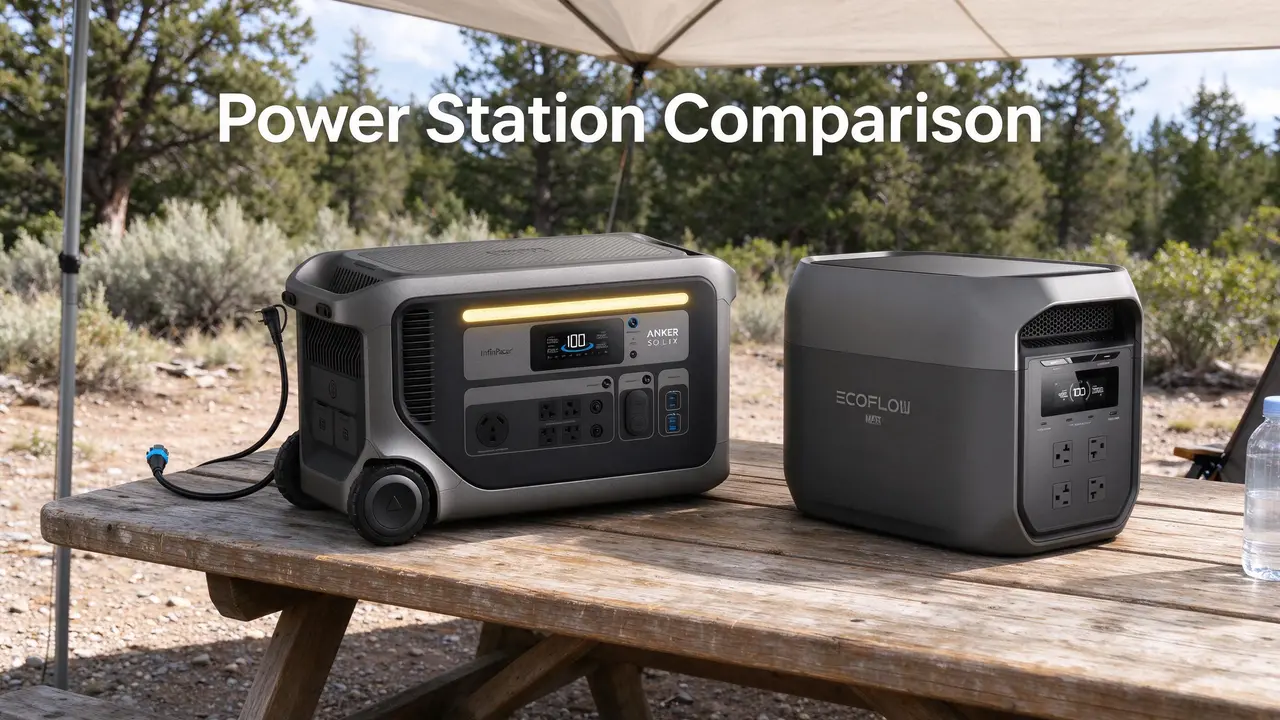
Two near-$1,600–$1,800 stations that bet differently: Anker sells you 3,072 Wh and 3,600 W of nameplate muscle, EcoFlow sells speed and a 10 ms transfer. Here is which one actually fits your outage.
Updated
At a glance
Two near-$1,600–$1,800 stations that bet differently: Anker sells you 3,072 Wh and 3,600 W of nameplate muscle, EcoFlow sells speed and a 10 ms transfer. Here is which one actually fits your outage.
Same money, two different bets
You are spending roughly $1,550 to $1,760 either way. That is the whole problem: at this price the two units stop being interchangeable and start being arguments.
The Anker F3000 Portable Power Station, 3,072Wh bets on stored energy and headroom — 3,072 Wh on the card, 3,600 W continuous, and a 30A path that owners use for RV air conditioners and generator bypass. The 3400W X-Boost Output, Ultra-Fast 0-80% Charging in 1.13 Hr, Home Backup bets on speed and handoff: 0–80% in about 1.13 hours, a sub-10 ms transfer claim for UPS-style duty, and 2,400 W continuous with X-Boost stretching peak loads.
This is not a page for someone shopping a $600 camping box, and it is not a substitute for a licensed transfer-switch install. It is two big batteries you roll into place and plug things into.
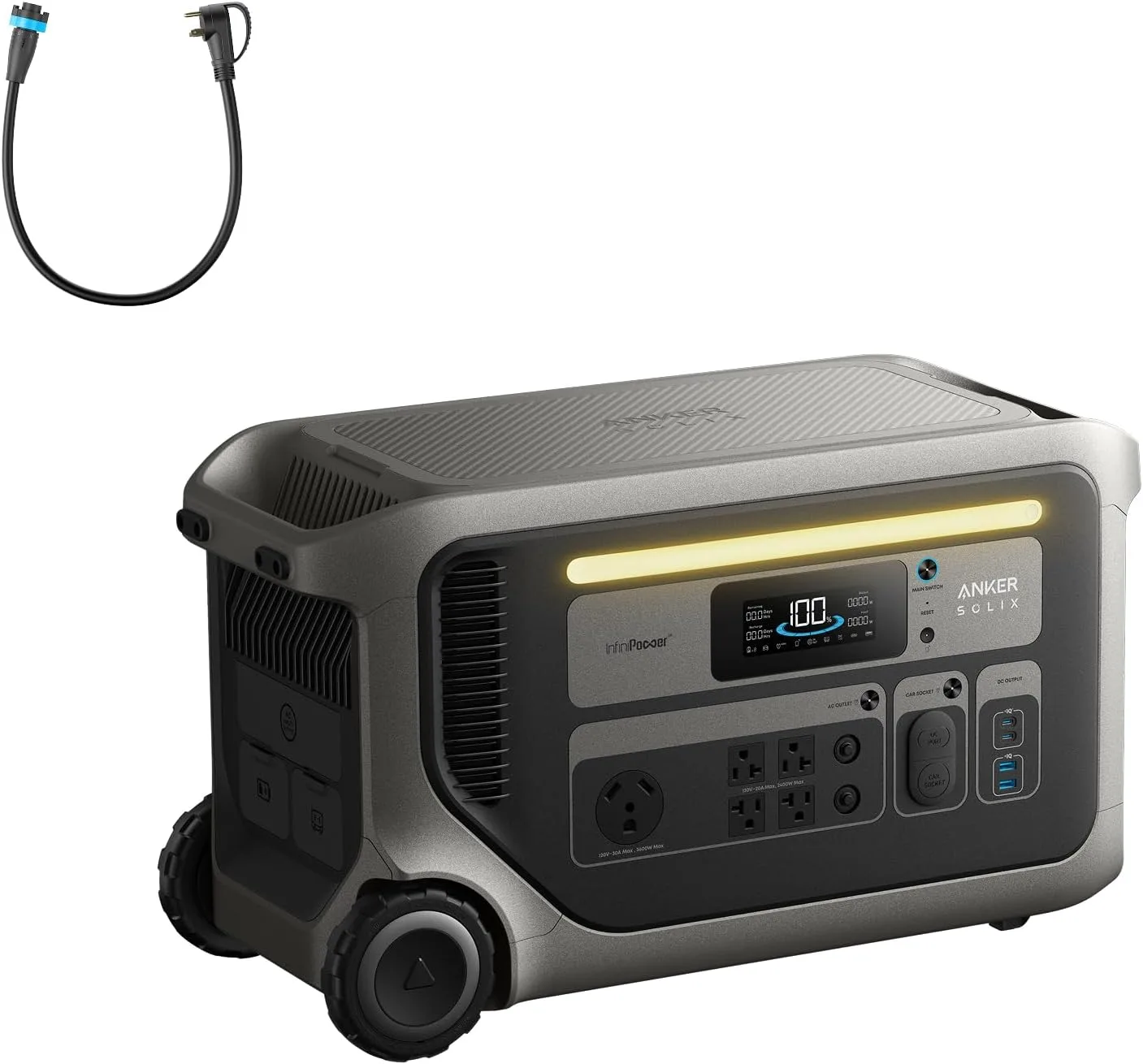
Anker F3000 Portable Power Station, 3,072Wh
Highlights
- 3072Wh rated capacity
- 3600W continuous AC
- 7200W surge
- LiFePO4 chemistry
- Up to 2400W solar input
- 91.5 lb (~41.5 kg)
Best for
- F3000: longer outages or higher continuous loads (still not whole-home wiring)
- RV / off-grid days where recharge speed matters as much as Wh
- Best parked near the vehicle or cabin — not a long carry to a tent
Strengths
- F3000: 3072Wh pack with 3600W continuous / 7200W surge — size loads to both numbers
- 91.5 lb (~41.5 kg) is a park-and-use chassis — plan a short path, not a trail hike
- 3600W continuous headroom covers more small appliances than 1kW-class inverters
- About $1548.99 list in the Hub catalog — confirm live retail before you buy
Watch-outs · not ideal when
- At 91.5 lb (~41.5 kg), F3000 is a poor tent-hike companion — plan a cart or leave it in the vehicle
- High continuous output on F3000 tempts big loads — Wh still runs out on kettles and A/C
- Rated 2400W solar on F3000 is optimistic; shade and cables cut real watts
- LiFePO4 helps longevity, but F3000 still hates freezing charge temps on winter trips
How I weighed these two
I am a home-user reviewer working from listing specs and owner themes on file, not lab-bench measurements. Capacity and continuous output carried the most weight because they determine what you can actually run; recharge speed and transfer claims came next; owner consensus and price-per-Wh rounded it out.
On those weights the Anker wins for backup because it is the only one of the two with a published capacity and the higher continuous rating. The EcoFlow wins on recharge speed and simplicity, but a missing Wh figure is a hard handicap at this price.
One disclosure: this page uses Amazon Associates links, and picks are fit-led, not commission-led. Avery Nolan is WattPicks' founding editor, covering portable power capacity, output, and price-per-Wh across the catalogue.
Scoreboard with explicit weights: capacity 40%, continuous watts 30%, recharge speed 20%, price 10%.
Anker F3000 Portable Power Station, 3,072Wh (list $1548.99): capacity 40/40, continuous 30/30, recharge 12/20, price 10/10 — total 92/100.
3400W X-Boost Output, Ultra-Fast 0-80% Charging in 1.13 Hr, Home Backup (list $1758): capacity 20/40 (scored against the 2,048 Wh detail-line figure, with caveat), continuous 18/30, recharge 20/20, price 8/10 — total 66/100.
That is why the pick splits by job rather than one universal winner. The EcoFlow's capacity score is provisional: the listing's detail line says 2,048 Wh, but the title advertises 3,400W X-Boost and no authoritative Wh figure is on file. If the real capacity is lower, that 20/40 drops; if it is higher, the gap narrows.
Spec snapshot
Everything below comes from the listings and the catalogue card. Where a number is missing I wrote n/a rather than guess — the EcoFlow capacity is the big one.
Footnote: the 42-hour fridge runtime is a manufacturer claim, not an owner measurement. The EcoFlow capacity figure is a detail-line value, not a confirmed spec.
| Product | Price | Capacity (Wh) | Output (W) | Recharge time | Weight (lb) | Rating |
|---|---|---|---|---|---|---|
| Anker F3000 Portable Power Station, 3,072Wh | $1548.99 | 3072 Wh | 3600 W | ~90 min full charge on 30A input (owner reports) | 91.5 lb | 4.4 |
| 3400W X-Boost Output, Ultra-Fast 0-80% Charging in 1.13 Hr, Home Backup | $1758 | 2,048 Wh (detail line; not confirmed) | 2400 W | 0–80% in 1.13 hr (listing claim) | 89 lb | 5 |
Where the money went
Four places the budgets diverge, and each one tells you what the maker thought you cared about.
- Stored energy: Anker publishes 3,072 Wh and a path to 24 kWh with expansion batteries. EcoFlow's capacity is n/a on file — the listing's detail line says 2,048 Wh while the title advertises 3,400W X-Boost, and I will not paper over that gap with a guess. If the 2,048 Wh detail line is accurate, the capacity gap is narrower than the scoreboard's 40-vs-20 spread suggests.
- Continuous output: 3,600 W on the Anker versus 2,400 W on the EcoFlow. X-Boost is a peak-load trick, not a continuous rating — plan your loads against 2,400 W.
- Recharge speed: EcoFlow's headline is 0–80% in 1.13 hours. Anker's owner reports put a full charge at about 90 minutes on a 30A input, with adjustable AC levels so you don't trip a small circuit.
- Ports and transfer: Anker lists AC×3 and a 30A output that stays live while charging. EcoFlow lists AC×1 and a sub-10 ms transfer claim. USB-C and USB-A counts are unknown on both listings, so I am not claiming either way.
The spec that decides it
For most buyers the deciding number is capacity, and only one of these two publishes it. If you are sizing against a fridge, a CPAP, a router, and a few lights, you can do the math on 3,072 Wh. You cannot do that math on the EcoFlow from the listing alone — that is a real problem for a $1,758 purchase.
The second decider is continuous watts. A 13k roof AC or a well pump is a 3,600 W conversation, not a 2,400 W one. If your load list tops out under 2,400 W, the EcoFlow's faster recharge and transfer claim start to matter more than the Anker's headroom.
Worked example: a 190 W fridge, a 60 W CPAP, a 15 W router, and two 10 W lights total about 285 W. On the Anker's 3,072 Wh that is roughly 10.8 hours at full draw (3,072 ÷ 285). On the EcoFlow's 2,048 Wh detail line it is about 7.2 hours (2,048 ÷ 285) — and if the real figure is lower, the runtime drops with it. That is the gap you are paying for.
What owners actually report
The Anker pack is deep enough to trust the themes. The EcoFlow pack is 13 ratings — enough to note a pattern, not enough to call durability.
- Anker: RV owners run a 13k Coleman roof AC on low cool through a full night, and one reports carrying about 60% of home essentials in a simulated outage.
- Anker caveats: it is heavy at 91.5 lb even with 6-inch wheels, Wi-Fi drops more than owners like, and the included 400W panel is bulky enough that people leave it home.
- EcoFlow: owners consistently mention fast charging, easy operation, a rugged feel, and using and recharging at the same time. One ran sailboat tools and a heater.
- EcoFlow caveats: with 13 ratings, no repeated friction surfaced — that is absence of evidence, not proof. One owner noted the fan ramps up under load, and another mentioned idle drain when left plugged in; neither is confirmed across the pack yet.
Buy the one that…
Buy the Anker F3000 Portable Power Station, 3,072Wh if you need published capacity you can size against, 3,600 W continuous for an RV air conditioner or a generator-bypass setup, and you can roll 91.5 lb into place and leave it there.
Buy the 3400W X-Boost Output, Ultra-Fast 0-80% Charging in 1.13 Hr, Home Backup if your loads stay under 2,400 W continuous, fast turnaround between outages matters more than stored energy, and you are comfortable buying on a thin owner record.
If you only care about price-per-Wh, the Anker is the only one you can compute it for: $1548.99 ÷ 3,072 Wh is about $0.50/Wh. The EcoFlow's $1758 has no published Wh to divide by.
Budget tradeoff: if you are under $1,500, neither of these is your buy — step down to a smaller-capacity unit and put the savings toward a transfer switch or a second panel.
Walk away from both if you need a hardwired whole-home solution — these are plug-in batteries, and the transfer hardware is a separate conversation. Walk away from the EcoFlow specifically if you refuse to buy a $1,758 battery without a published Wh figure.
Frequently asked
Can the EcoFlow run a 13k RV air conditioner?
Its continuous rating is 2,400 W; X-Boost handles peaks, not sustained compressor load. The Anker's 3,600 W is the safer bet for that job.
How long will the Anker run a fridge?
Anker's listing cites a 190W fridge for 42 hours — that is a manufacturer figure, not an owner measurement.
Is the EcoFlow a real UPS?
The listing claims sub-10 ms transfer. That is a listing claim; I have not verified it against a bench.
Which is easier to move?
EcoFlow at 89 lb versus Anker at 91.5 lb — close enough that wheels and layout matter more than the two-pound difference.
What does the 24 kWh figure assume?
It assumes the Anker base unit plus its expansion batteries; the base alone is 3,072 Wh. The 30A generator-bypass path also requires a compatible generator inlet, not just the station.
What about warranty and cycle life?
Both listings are thin on published cycle counts and warranty terms at this price tier; check the current listing pages for the exact terms before you buy, and treat any cycle-life figure as a manufacturer claim until you see it in writing.
Method and sources
Model names and list prices come from the WattPicks catalog at build time. WattPicks does not run its own laboratory tests on power stations, and nothing on this page is presented as a measured result — it is catalog-backed buying guidance.
Read our methodology for how the catalog is normalized, and about WattPicks for who publishes it.