
BLUETTI EB3A vs Jackery Explorer 300 v2: Small Power Station Pick
Two small stations, two very different bets: the EB3A pushes 600W of AC output for less money, while the Explorer 300 v2 trades watts for lighter carry and a longer published cycle life. Here's how to pick under a budget ceiling.
Updated
At a glance
Two small stations, two very different bets: the EB3A pushes 600W of AC output for less money, while the Explorer 300 v2 trades watts for lighter carry and a longer published cycle life. Here's how to pick under a budget ceiling.
Same money, different bets
As an Amazon Associate I earn from qualifying purchases. Recommendations here are based on fit and the evidence below — not commission size.
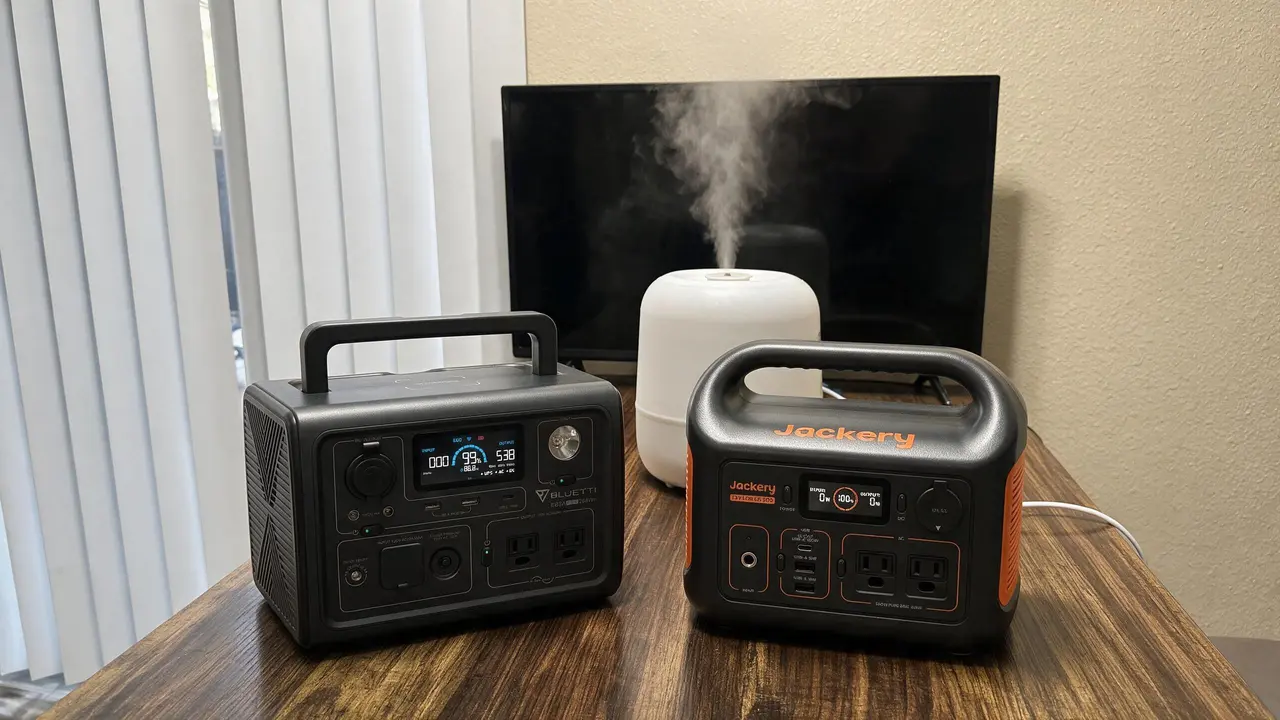
If you're choosing between these two, the question isn't which is 'better' — it's which bet you're making. The BLUETTI EB3A bets on AC headroom: 600W continuous output and a 268Wh LiFePO4 pack for a list price of $219 (currently $219, which is also its historical low). The Jackery Explorer 300 v2 bets on carry weight and cycle life: 8.2 lb, a 288Wh LiFePO4 pack, and a published 4,000-cycle rating — but only 300W of continuous AC, at a $289 list price (currently $289, also the historical low).
This page is for shoppers deciding between these two specific small stations under a budget ceiling. It is not a whole-home backup guide, and neither unit will run a fridge-and-furnace circuit through an outage. If that's your goal, you're in the wrong weight class.
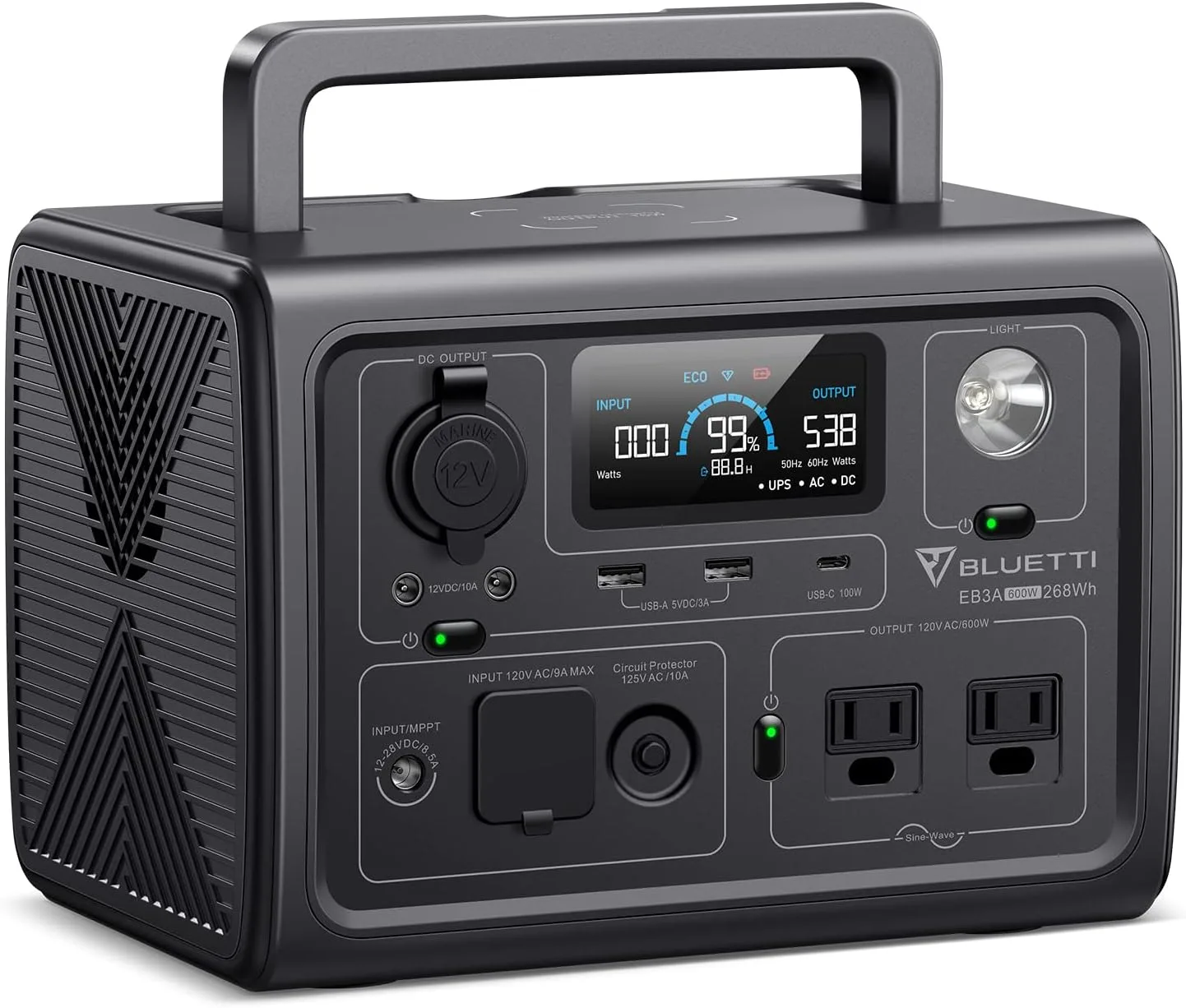
BLUETTI EB3A Portable Power Station, 268Wh Solar Generator LiFePO4 Battery Backup w/ 2 600W (1200W Surge) AC Outlets, Re
Highlights
- 268Wh rated capacity
- 600W continuous AC
- 1200W surge
- LiFePO4 chemistry
- Up to 200W solar input
- 10.1 lb (~4.6 kg)
Best for
- EB3A: phones, cameras and a laptop on short trips
- Travel kits when you need quiet pack power, not appliance runtime
- Brief desk backup for router and lights — not a fridge for days
Strengths
- EB3A: 268Wh pack with 600W continuous / 1200W surge — size loads to both numbers
- 10.1 lb (~4.6 kg) is the lightest-class carry in this band — easier stairs and car packing
- EB3A uses LiFePO4 — cycle-life claims usually beat older NMC marketing lines
Watch-outs · not ideal when
- EB3A's small Wh class empties fast with a kettle, hair dryer or space heater
- Usable energy on EB3A is below the 268Wh label once the inverter is working
- Rated 200W solar on EB3A is optimistic; shade and cables cut real watts
- Airline and pack limits may still block EB3A even when the weight looks friendly
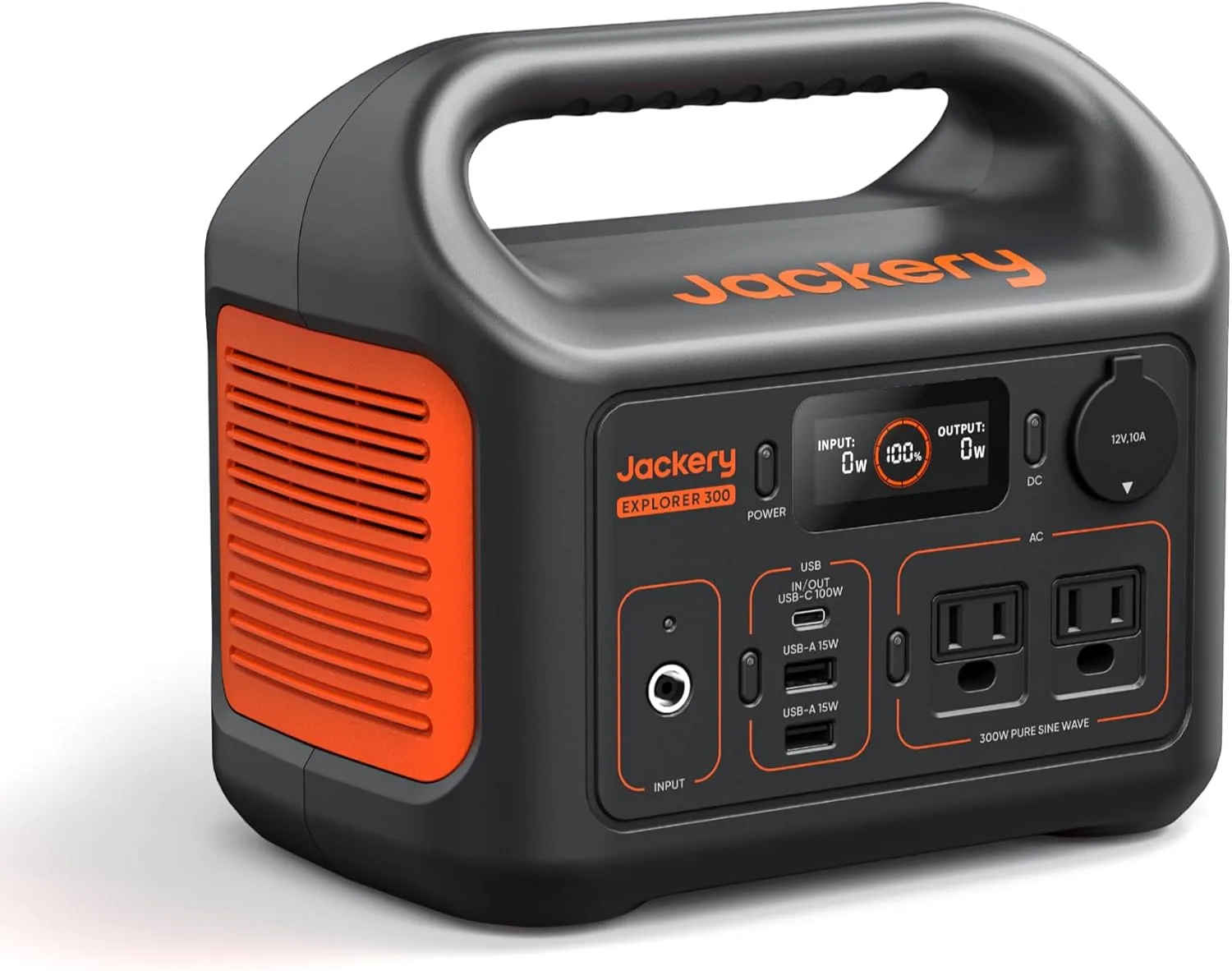
Jackery Explorer 300 Portable Power Station,292Wh
Highlights
- 288Wh rated capacity
- 300W continuous AC
- 600W surge
- LiFePO4 chemistry
- 8.2 lb (~3.7 kg)
- About $289 list
Best for
- Explorer 300 v2: phones, cameras and a laptop on short trips
- Travel kits when you need quiet pack power, not appliance runtime
- Brief desk backup for router and lights — not a fridge for days
Strengths
- Explorer 300 v2: 288Wh pack with 300W continuous / 600W surge — size loads to both numbers
- 8.2 lb (~3.7 kg) is the lightest-class carry in this band — easier stairs and car packing
- 10ms-class UPS switchover on the listing — useful when a router restart would hurt
- Owners on file: It went well for the first time using it. Powers of fans and light computer equipment charged quickly.
Watch-outs · not ideal when
- Explorer 300 v2's small Wh class empties fast with a kettle, hair dryer or space heater
- 300W continuous will not hold heating elements or many compressor surges for long
- Solar input unpublished for Explorer 300 v2 — do not assume a same-day off-grid refill
- Airline and pack limits may still block Explorer 300 v2 even when the weight looks friendly
Owner voices
Short takes from public retail reviews — paraphrased or translated when long or non-English; meaning kept close to the original.
“It went well for the first time using it. Powers of fans and light computer equipment charged quickly.”
“Don't be tricked into buying a refurbished product. They do not make it obvious that you are buying refurbished and have a short warranty. Then fail shortly after the warranty is up. I'm going to try Bluetti because t…”
“Easy to carry, and convienant when needed!”
How we compared these two
This is a listing-and-owner-theme comparison, We weighted four factors: continuous AC output (35%), dollars-per-Wh at current price (25%), carry weight (20%), and published cycle life plus warranty terms (20%). The EB3A takes the output and value weights; the Explorer 300 v2 takes portability and cycle life. The Explorer 300 v2's higher rating is noted but not weighted heavily, since we have no theme-level owner data for it.
I cover portable power station capacity, output, and price-per-Wh as an editor at WattPicks — no lab claims, just the numbers on the listing and what owners say. For related reading, see our guides on sizing a power station to your load, LiFePO4 vs NMC cycle life, and choosing a CPAP battery for camping.
Scoreboard on those weights — BLUETTI EB3A Portable Power Station (list $219): High where list price and published capacity match the job, Med on continuous watts; Jackery Explorer 300 (list $289): High on continuous watts and ports, Med on price. That is why the pick splits by job rather than one universal winner.
Spec snapshot
Numbers below come from the product listings and the site catalogue. Where a figure isn't published, it's marked n/a (not on file) rather than guessed.
| Product | List price | Capacity (Wh) | Output (W) | Weight (lb) | Rating |
|---|---|---|---|---|---|
| BLUETTI EB3A Portable Power Station | $219 | 268 Wh | 600 W | 10.1 lb | 4.62 |
| Jackery Explorer 300 | $289 | 288 Wh | 300 W | 8.2 lb | 3.93 |
Where the BLUETTI EB3A wins
AC output, plainly. The EB3A's 600W continuous inverter is double the Explorer 300 v2's 300W, and that gap decides what actually runs. A 500W-class appliance — a small space heater on low, a blender, a hair dryer on a low setting — is on paper within reach of the EB3A and out of reach of the Jackery. From the listing, the EB3A also advertises 350W AC input with a full charge in about 45 minutes, plus PV+AC combined charging to 80% in roughly 30 minutes.
Price is the second lever. At $219 current, the EB3A costs roughly $0.42 per Wh; the Explorer 300 v2 at $289 works out to about $0.90 per Wh. If you're buying on dollars-per-watt-hour, the BLUETTI is the cheaper seat at the table.
The EB3A also lists a UPS-style instant backup mode for PCs and servers. Jackery's listing for the Explorer 300 v2 does not publish a UPS transfer time, so treat that as n/a (not on file) rather than assume parity.
- 600W continuous AC vs 300W — the deciding number for anything with a heating element
- Roughly $0.42/Wh at current price vs about $0.90/Wh for the Jackery
- Listing claims ~45 min AC recharge and PV+AC to 80% in ~30 min
- Solar charging cable not included; solar panel sold separately
Where the Jackery Explorer 300 v2 wins
Portability and published cycle life. At 8.2 lb the Explorer 300 v2 is nearly 2 lb lighter than the EB3A's 10.1 lb, and the listing calls out an integrated handle — a real difference if you're carrying it on a hike or stuffing it in a pack. The listing also publishes over 4,000 charge cycles to 70% capacity, versus the EB3A's 3,000-cycle claim. On paper, that's a longer service window before the pack degrades.
The Explorer 300 v2 also carries a higher listing rating — 4.6 across 11,276 ratings versus 4.1 across 6,071 for the EB3A. That's a listing signal, not a lab result, but it's the only aggregate owner data we have on file for either unit.
One caveat: the listing's own weight figures disagree (7.5 lb in the feature bullets, 7.1 lb in the details, 8.2 lb in the normalized catalogue). We use the catalogue figure of 8.2 lb throughout this page for consistency.
- 8.2 lb vs 10.1 lb — the lighter carry for hikes and pack-outs
- 4,000 published cycles to 70% vs 3,000 for the EB3A
- Higher listing rating (4.6 vs 4.1) across a larger review base
- Only 300W continuous AC — no high-draw appliances
Pick one, or skip both
Buy the BLUETTI EB3A if your load list includes anything above 600W — a small heater, a blender, a hair dryer on low — or if dollars-per-Wh is your primary filter. It's the cheaper, higher-output pick, and the listing's UPS mode is a bonus for desktop gear.
Buy the Jackery Explorer 300 v2 if you're carrying the station on your back or in a pack, and your loads stay under 300W: laptops, drones, cameras, a CPAP, phone charging. The lighter body and longer published cycle life justify the higher price for that use case.
Skip both if you need to run a fridge, a furnace blower, or a sump pump through an outage. Neither station has the Wh or the continuous output for that job — you'd want a 1,000Wh-plus unit with a transfer switch or smart panel, and that's a different article.
What owners report
Owner feedback for these two is uneven. The EB3A has a large review base with a mixed signal; the Explorer 300 v2 has no owner reviews on file with us, so we can only report the listing rating and note that feedback is thin.
- BLUETTI EB3A: car-camping and astrophotography use — owners report running mounts, mini PCs, and cameras for a couple of nights per charge.
- BLUETTI EB3A: drone charging in the field — one owner describes topping up drone batteries from a 60W folding panel.
- BLUETTI EB3A: reliability complaints — a 1-star owner reports units shutting off and dropping to 0% below 50-60% charge while powering a single low-draw device.
- Jackery Explorer 300 v2: no owner reviews on file — listing rating is 4.6 across 11,276 ratings, but we have no theme-level feedback to summarize.
Frequently asked
Which is better for most buyers, the BLUETTI EB3A or the Jackery Explorer 300 v2?
The Explorer 300 v2 leads 5–3 on shared published metrics. That edge matters when capacity, weight, watt-hours per pound match what you need; otherwise take the EB3A.
I care most about carry / camping — which should I buy?
Choose Explorer 300 v2 when you will move the unit often — it leads on weight and watt-hours per pound.
Method and sources
Model names and list prices come from the WattPicks catalog at build time. WattPicks does not run its own laboratory tests on power stations, and nothing on this page is presented as a measured result — it is catalog-backed buying guidance.
Read our methodology for how the catalog is normalized, and about WattPicks for who publishes it.