
Anker C1000 Gen 2 vs EcoFlow DELTA 3 Plus: Backup Bet
Two 1,024 Wh stations, two different bets: Anker sells speed and lighter carry, EcoFlow sells solar headroom and stackable expansion. Here is which one earns the outlet behind your fridge.
Updated
At a glance
Two 1,024 Wh stations, two different bets: Anker sells speed and lighter carry, EcoFlow sells solar headroom and stackable expansion. Here is which one earns the outlet behind your fridge.
- Anker's bet: fastest wall recharge, lighter carry, 200 W more continuous output
- EcoFlow's bet: house-panel solar input, stackable batteries, UPS-grade switchover
Same money, different bets
Both of these land in the 1,024 Wh class, and on paper they look like twins. They are not. The Anker C1000 Gen 2 Portable Power Station bets on refuel speed and a lighter box — 24.9 lb against 27.6 lb, and a 2,000 W continuous rating against 1,800 W. The EcoFlow DELTA 3 Plus bets on solar headroom and a battery you can grow later, with dual MPPT inputs and stackable expansion up to 5 kWh.
One disclosure before we go: this page carries Amazon Associates links, and picks here are fit-led, not commission-led. What follows is a home-user read of listing specs plus owner themes on file — not lab-bench measurements.
This is not the page for whole-home backup. Neither unit runs a 240 V well pump or a central AC, and neither replaces a transfer switch. It is the page for the fridge, the CPAP, the router, and the desk.
- Anker's bet: fastest wall recharge, lighter carry, 200 W more continuous output
- EcoFlow's bet: house-panel solar input, stackable batteries, UPS-grade switchover
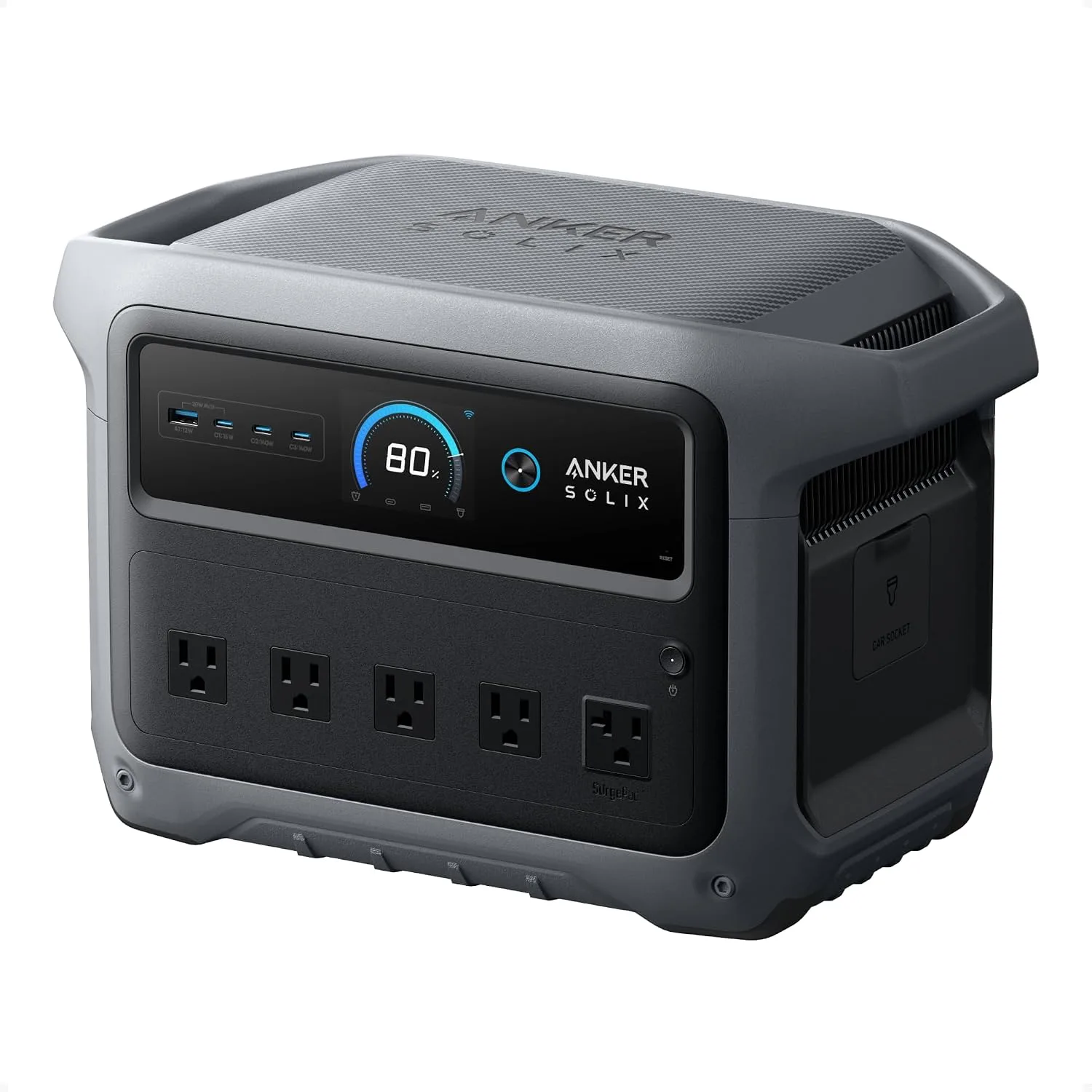
Anker C1000 Gen 2 Portable Power Station
Highlights
- 1024Wh rated capacity
- 2000W continuous AC
- 3000W surge
- LiFePO4 chemistry
- Up to 600W solar input
- 24.9 lb (~11.3 kg)
Best for
- C1000 Gen 2: weekend camping when 24.9 lb carry weight matters as much as 1024Wh
- Essentials bridge at home (fridge cycles, router) when sized to the Wh
- Solar top-ups up to ~600W when panels and weather cooperate
Strengths
- C1000 Gen 2: 1024Wh pack with 2000W continuous / 3000W surge — size loads to both numbers
- 24.9 lb (~11.3 kg) is the lightest-class carry in this band — easier stairs and car packing
- 10ms-class UPS switchover on the listing — useful when a router restart would hurt
- About $799 list in the Hub catalog — confirm live retail before you buy
Watch-outs · not ideal when
- C1000 Gen 2 is still a bridge for essentials — not a transfer-switch whole-home system
- Usable energy on C1000 Gen 2 is below the 1024Wh label once the inverter is working
- Rated 600W solar on C1000 Gen 2 is optimistic; shade and cables cut real watts
- LiFePO4 helps longevity, but C1000 Gen 2 still hates freezing charge temps on winter trips
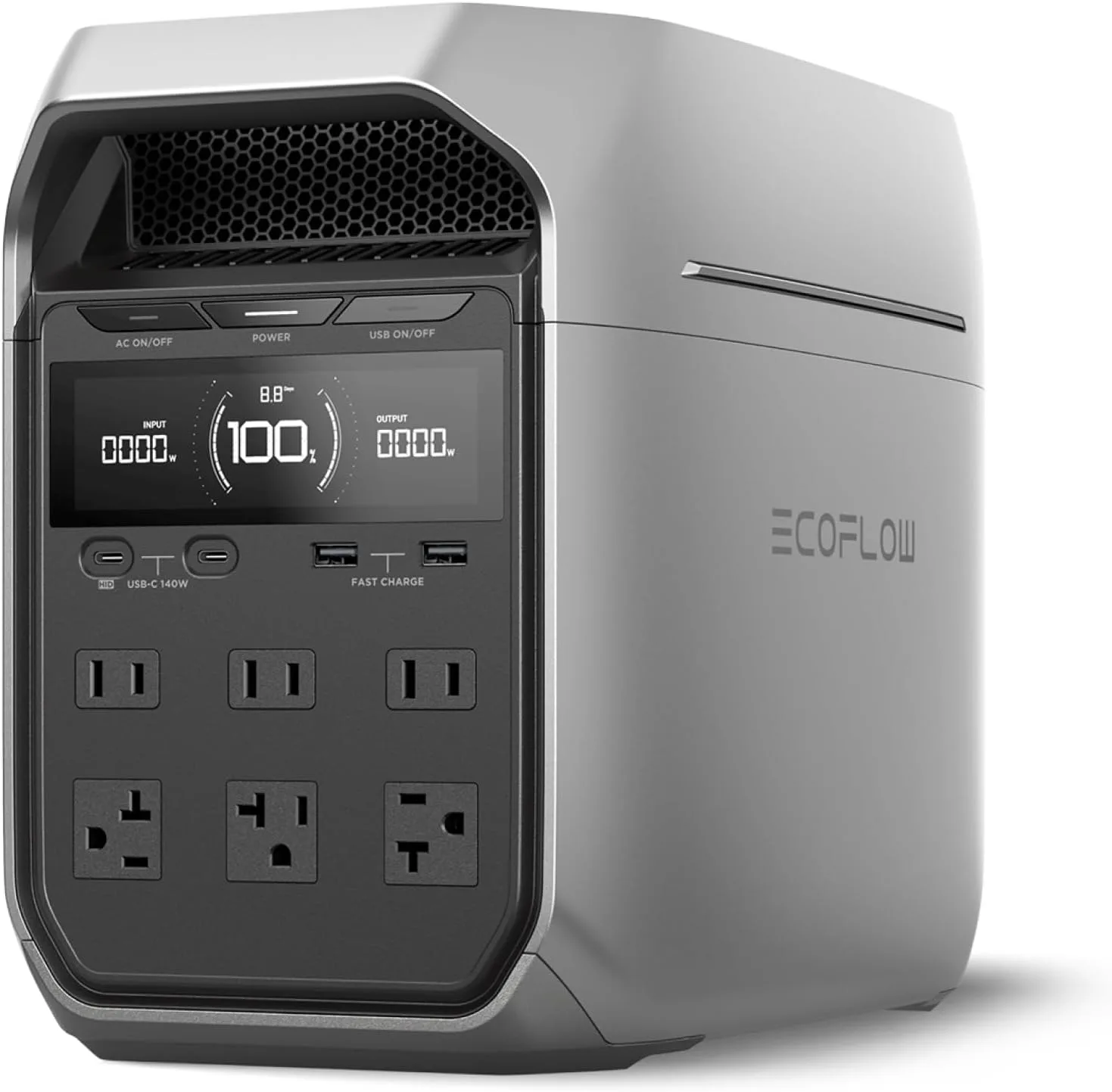
EcoFlow DELTA 3 Plus
Highlights
- 1024Wh rated capacity
- 1800W continuous AC
- 3600W surge
- LiFePO4 chemistry
- Up to 1000W solar input
- 27.6 lb (~12.5 kg)
Best for
- DELTA 3 Plus: small appliances and tools that need ~1800W continuous, not just phone charging
- Essentials bridge at home (fridge cycles, router) when sized to the Wh
- Solar top-ups up to ~1000W when panels and weather cooperate
Strengths
- DELTA 3 Plus: 1024Wh pack with 1800W continuous / 3600W surge — size loads to both numbers
- 27.6 lb (~12.5 kg) sits in the solo car-camp carry carry band for weekend moves
- 10ms-class UPS switchover on the listing — useful when a router restart would hurt
Watch-outs · not ideal when
- DELTA 3 Plus is still a bridge for essentials — not a transfer-switch whole-home system
- Usable energy on DELTA 3 Plus is below the 1024Wh label once the inverter is working
- Rated 1000W solar on DELTA 3 Plus is optimistic; shade and cables cut real watts
- LiFePO4 helps longevity, but DELTA 3 Plus still hates freezing charge temps on winter trips
Spec snapshot
Prices are list where the catalogue has one. EcoFlow's list price is not on file, so the table says so rather than quoting a street number. Ratings are the listing aggregate, not a substitute for owner experience.
| Product | List price | Capacity (Wh) | Output (W) | Weight (lb) | Rating |
|---|---|---|---|---|---|
| Anker C1000 Gen 2 Portable Power Station | $799 | 1024 Wh | 2000 W | 24.9 lb | 4.85 |
| EcoFlow DELTA 3 Plus | $649 | 1024 Wh | 1800 W | 27.6 lb | 4.80 |
Where the money went
Four places the two designs split, and each one tells you what the maker thought you would pay for.
Recharge speed. Anker publishes a 49-minute full recharge at 1,600 W through its HyperFlash path, enabled in the app. EcoFlow publishes 1,500 W AC input to 80% in 40 minutes. Close enough that owners on both sides describe topping up as a non-event — one Anker owner put a night's CPAP draw back in about 15 minutes on a wall outlet.
Solar. This is the widest gap. EcoFlow's dual MPPT inputs take up to 1,000 W of panels, and owners report feeding it house-sized arrays. Anker's listing tops out at 600 W (60 V max) for a 1.8-hour solar refill. If you plan to lean on panels rather than the wall, that is a real difference, not a spec-sheet footnote.
Expansion. EcoFlow stacks DELTA 3, DELTA Pro 3, or DELTA 2 Max batteries up to 5 kWh. Anker's Gen 2 dropped the dedicated expansion port; owners extend it through the XT60 input instead, which is a workaround, not a battery stack.
Ports and output. Anker lists AC×9 and a 2,000 W continuous rating (3,000 W peak). EcoFlow lists AC×6 plus USB-C×2, USB-A×2, and a 12 V car port, at 1,800 W continuous. Anker's USB-C and USB-A counts are not on file, so I am not going to guess at them either way.
- Solar ceiling: 600 W (Anker) vs 1,000 W across two MPPT inputs (EcoFlow)
- Expansion: XT60 input workaround (Anker) vs stackable batteries to 5 kWh (EcoFlow)
- Continuous output: 2,000 W (Anker) vs 1,800 W (EcoFlow)
- Carry weight: 24.9 lb (Anker) vs 27.6 lb (EcoFlow)
The spec that decides it
For most people shopping this class, the deciding number is not capacity — both are 1,024 Wh — it is how you refill it. If your plan is a wall outlet and the occasional 12 V session, Anker's 49-minute recharge and lighter frame win the argument outright.
If your plan involves panels, EcoFlow wins on headroom. Dual MPPT at up to 1,000 W means bigger arrays and faster recovery, and the stackable battery path means the unit can grow past 1,024 Wh without buying a second station. That is the one place these two genuinely diverge in kind rather than degree.
The secondary decider is output. Anker's 2,000 W continuous clears a bit more resistive load than EcoFlow's 1,800 W — though EcoFlow's listing notes X-Boost for resistive appliances above 2,200 W, which is a marketing name for a surge-style behavior, not a higher continuous rating. Treat 1,800 W as the continuous number.
Real owner trade-offs
The owner notes on file are unusually consistent on both sides, and the complaints are specific rather than vague.
Anker owners keep returning to recharge speed and UPS behavior. One ran a TV, console, PC, and a 3D printer mid-print, pulled AC, and nothing blinked. Another used it as a fridge backup through a five-hour outage and was pleased. The recurring gripes: no included case or cable storage, and the solar input clicks on and off in low light hunting for power — noticeable in a quiet room, and easy to forget to reconnect. A couple of owners also flag idle drain over weeks unplugged, though the reports disagree on how fast.
EcoFlow owners lean on the 10 ms switchover and the solar inputs. One kept a small network rack alive for 8+ hours and had to check logs to confirm the power had even flickered. Another ran a refrigerator for 2.5 hours on an 18% drop. The honest cracks: idle consumption is higher than smaller units — one owner estimated roughly 15 W with AC off and about 45 W with AC on — and the 12 V port auto-shuts off after a couple hours unless you disable it in settings, which nearly cost one owner a portable fridge's contents. Weight comes up too; 27.6 lb is portable in the sense that you carry it.
- Anker owner theme: fast wall top-ups make charge anxiety disappear
- Anker owner theme: low-light solar relay clicking is distracting
- EcoFlow owner theme: switchover clean enough to verify in logs
- EcoFlow owner theme: standby draw and 12 V auto-off need setting up front
Buy the one that…
Buy the Anker C1000 Gen 2 Portable Power Station if your backup plan runs on wall outlets and you want the lighter box with more continuous headroom. It suits the CPAP-on-the-nightstand, router-and-fridge-on-outage crowd, and anyone who values a 49-minute recharge over solar ceiling. Skip it if you intend to stack batteries later or leave panels connected in dim conditions.
Buy the EcoFlow DELTA 3 Plus if panels are part of the plan, or if you want a UPS that can grow into a 5 kWh bank without replacing the station. It suits the home-office rack, the long-outage fridge, and the off-grid desk. Skip it if you are weight-sensitive, or if you will leave it idle for days without accounting for standby draw — and set the 12 V timeout before you trust it with a cooler.
One walk-away rule for both: if you need to run a well pump, a central AC, or anything wired for 240 V, neither of these is your answer. That is transfer-switch territory, and a 1,024 Wh portable is the wrong tool.
What I would check before checkout
Two practical notes that are not product picks. First, if solar is in your future, price the panels before the station — a 600 W array for the Anker and a 1,000 W array for the EcoFlow are very different budgets, and the panel cost can rival the station. Second, neither unit ships with a case, and both collect cables fast; budget for storage or you will be hunting XT60 adapters in the dark.
For the wider sizing math behind these numbers, the WattPicks guide to portable power station capacity and runtime walks through the load assumptions. If you are weighing battery chemistry for a decade of daily use, the LiFePO4 cycle-life explainer covers what 4,000 cycles to 80% actually means in years.
Method note, once: these are home-user checks grounded in owner themes on file plus listing specs, and they are not lab-bench measurements. The 4.7 figures are listing aggregates, not owner proof. Prices are list where the catalogue has one; EcoFlow's is not on file, so treat it as a number to verify at checkout.
Frequently asked
Can either run a full-size fridge through an outage?
Owners on both sides report multi-hour fridge runs — roughly 6–12 hours on Anker in one owner's estimate, and about 12.5 hours to 10% on EcoFlow in another's math. Your fridge's duty cycle decides the rest.
Does the Anker have USB-C?
The port count is not on file for this unit, so I will not claim either way. Check the listing before you buy if USB-C charging matters.
Which recharges faster from the wall?
Anker publishes 49 minutes at 1,600 W; EcoFlow publishes 80% in 40 minutes at 1,500 W. Both are fast enough that owners stop thinking about it.
Can I add batteries to the Anker later?
Not as a stack. Gen 2 has no dedicated expansion port; owners feed it through XT60. EcoFlow stacks to 5 kWh.
Method and sources
Model names and list prices come from the WattPicks catalog at build time. WattPicks does not run its own laboratory tests on power stations, and nothing on this page is presented as a measured result — it is catalog-backed buying guidance.
Read our methodology for how the catalog is normalized, and about WattPicks for who publishes it.