
BLUETTI AC200L vs EcoFlow DELTA 2 Max: Which Outage Bet?
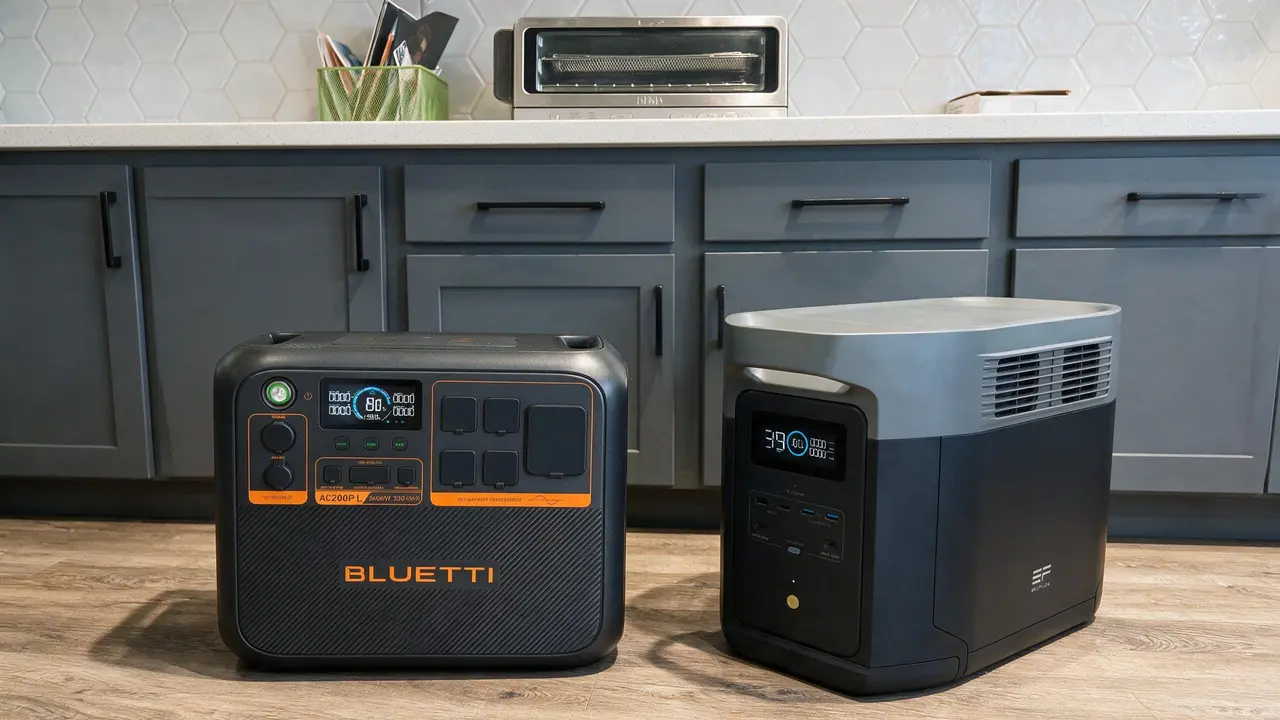
Same 2048 Wh and the same 2400 W on the box — so the real choice comes down to $350, 12 pounds, and how much expansion room you want. Here's which bet fits a fridge-and-furnace outage, and which one is overkill.
Updated
At a glance
Same 2048 Wh and the same 2400 W on the box — so the real choice comes down to $350, 12 pounds, and how much expansion room you want. Here's which bet fits a fridge-and-furnace outage, and which one is overkill.
Same money, different bets
As an Amazon Associate I earn from qualifying purchases. Recommendations here are based on fit and the evidence below — not commission size.
Both of these stations put 2048 Wh and 2400 W of continuous AC on the spec sheet. If you only read those two numbers, they look like the same product in different plastic. They aren't — the $350 gap buys you expansion headroom on one side and 12 pounds less to haul on the other.
This page is for the shopper sizing a fridge-and-furnace outage who has roughly $1,000–$1,400 to spend and wants to know where the money actually went. It is not a camping-first comparison, and it is not a whole-home solution — neither unit replaces a transfer switch and a generator for multi-day, whole-panel backup.
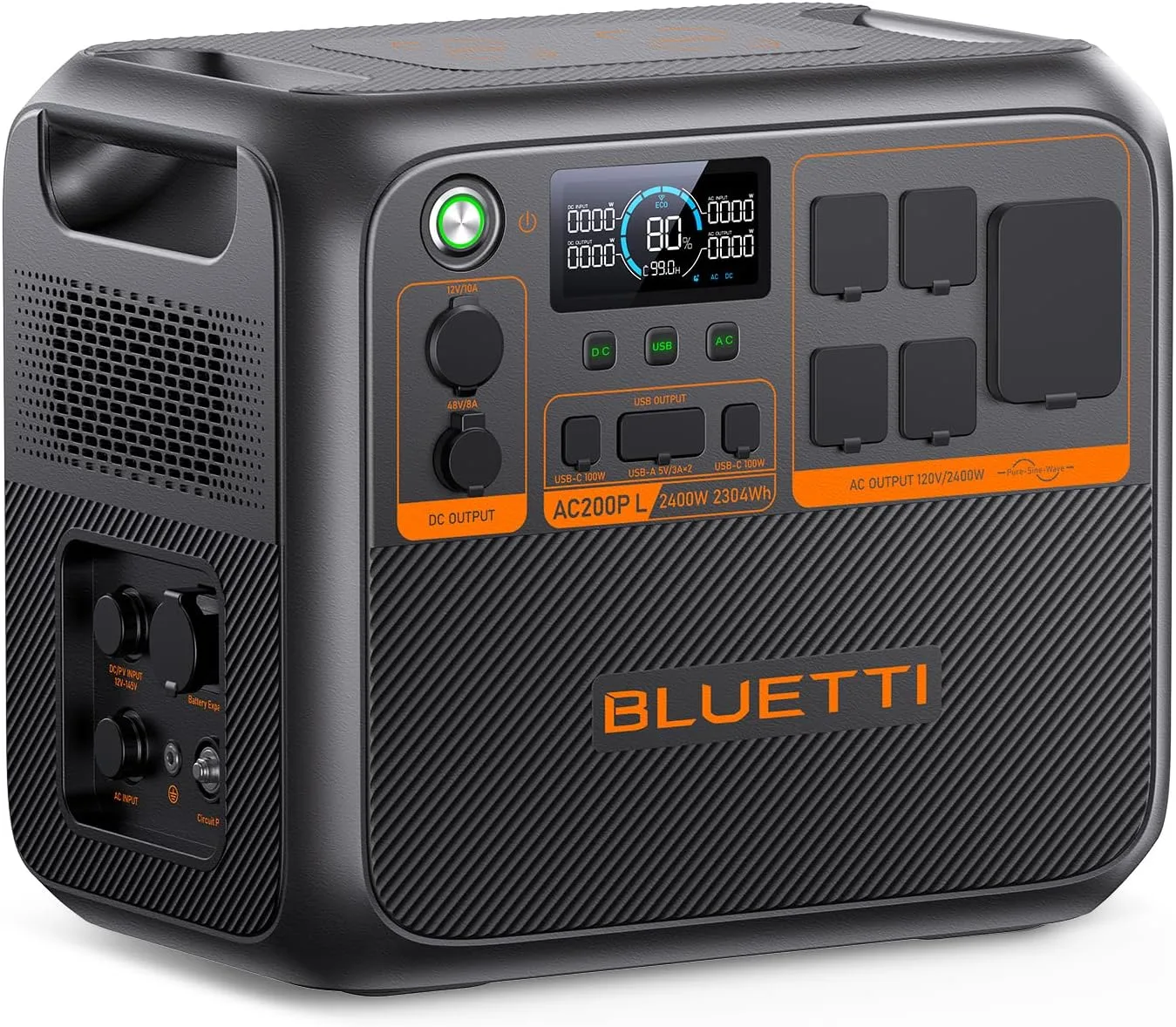
BLUETTI AC200PL Portable Power Station 2304Wh 2400W LiFePO4 Solar Generator
Highlights
- 2304Wh rated capacity
- 2400W continuous AC
- LiFePO4 chemistry
- Up to 1200W solar input
- 62.4 lb (~28.3 kg)
- About $899 list
Best for
- AC200L: longer outages or higher continuous loads (still not whole-home wiring)
- RV / off-grid days where recharge speed matters as much as Wh
- Best parked near the vehicle or cabin — not a long carry to a tent
Strengths
- AC200L: 2400W continuous on a 2304Wh pack — more headroom for small appliances than 1kW-class peers
- 62.4 lb (~28.3 kg) is a park-and-use chassis — plan a short path, not a trail hike
- 2400W continuous headroom covers more small appliances than 1kW-class inverters
- About $899 list in the Hub catalog — confirm live retail before you buy
Watch-outs · not ideal when
- At 62.4 lb (~28.3 kg), AC200L is a poor tent-hike companion — plan a cart or leave it in the vehicle
- High continuous output on AC200L tempts big loads — Wh still runs out on kettles and A/C
- Rated 1200W solar on AC200L is optimistic; shade and cables cut real watts
- LiFePO4 helps longevity, but AC200L still hates freezing charge temps on winter trips
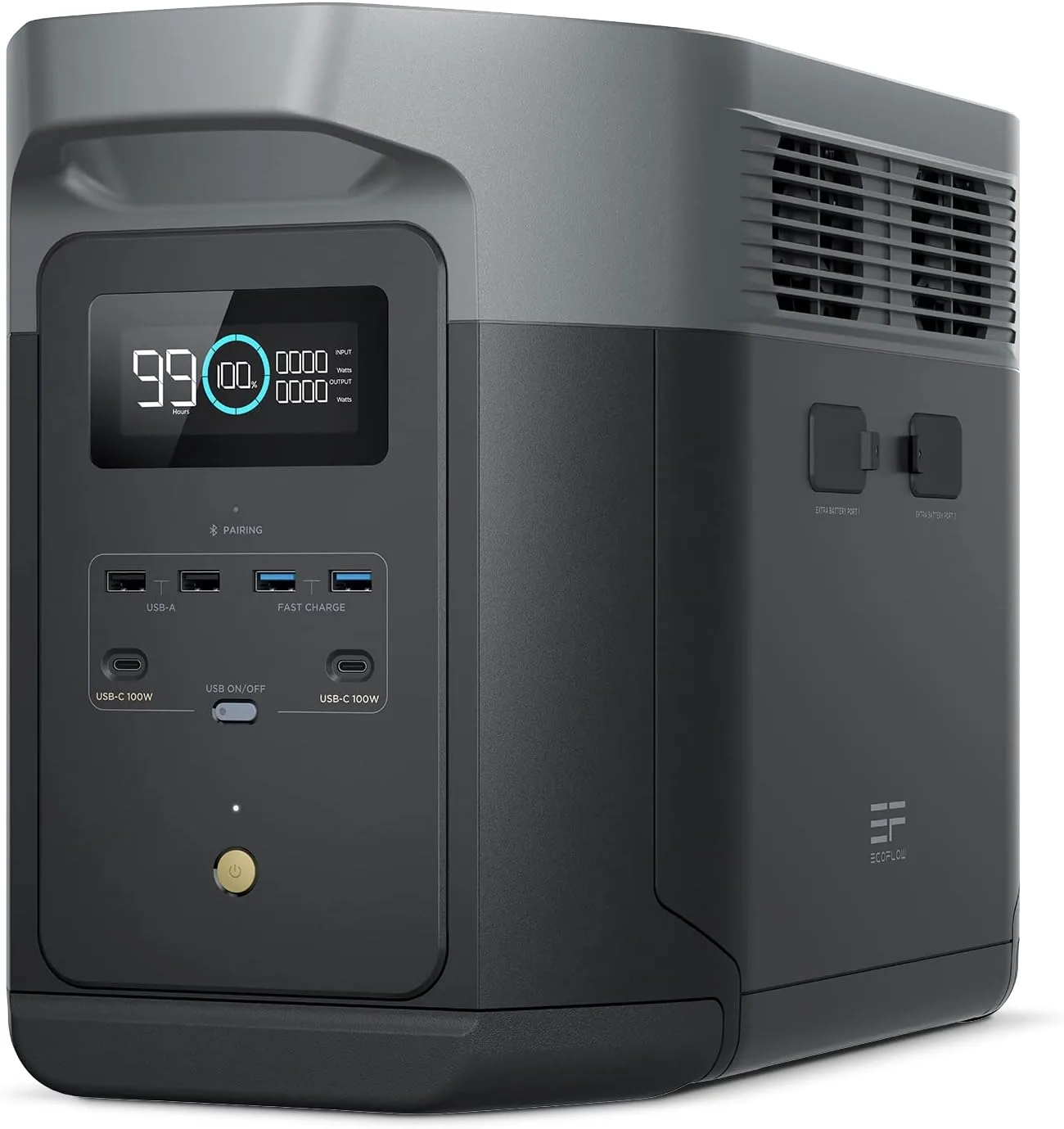
EcoFlow Portable Power Station DELTA 2 Max 2048Wh, 2400W LiFePO4 Battery
Highlights
- 2048Wh rated capacity
- 2400W continuous AC
- 4800W surge
- LiFePO4 chemistry
- Up to 1000W solar input
- 50 lb (~22.7 kg)
Best for
- DELTA 2 Max: longer outages or higher continuous loads (still not whole-home wiring)
- RV / off-grid days where recharge speed matters as much as Wh
- Best parked near the vehicle or cabin — not a long carry to a tent
Strengths
- DELTA 2 Max: 2048Wh pack with 2400W continuous / 4800W surge — size loads to both numbers
- 50 lb (~22.7 kg) is a park-and-use chassis — plan a short path, not a trail hike
- 2400W continuous headroom covers more small appliances than 1kW-class inverters
- About $1399 list in the Hub catalog — confirm live retail before you buy
Watch-outs · not ideal when
- At 50 lb (~22.7 kg), DELTA 2 Max is a poor tent-hike companion — plan a cart or leave it in the vehicle
- High continuous output on DELTA 2 Max tempts big loads — Wh still runs out on kettles and A/C
- Rated 1000W solar on DELTA 2 Max is optimistic; shade and cables cut real watts
- LiFePO4 helps longevity, but DELTA 2 Max still hates freezing charge temps on winter trips
How we compared these two
This is a listing-and-owner-theme comparison, I weighted price 35%, weight and portability 25%, expansion headroom 20%, and owner-reported reliability 20% — which is why the cheaper, expandable BLUETTI and the lighter, owner-validated EcoFlow land as a genuine toss-up rather than a clear winner.
As WattPicks' founding editor covering capacity, output, and price-per-Wh, my checklist is simple: match the Wh and W to the load, then let price, weight, and expansion break the tie. I dropped nothing from this pair — both are in-band at 2048 Wh — but I carried the 12.4 lb weight gap into the ranking because it changes who can actually deploy each unit. For load math, see our power station sizing guide and the LiFePO4 vs NMC chemistry explainer.
Scoreboard on those weights — BLUETTI AC200PL (list $n/a): High where list price and published capacity match the job, Med on continuous watts; EcoFlow DELTA 2 Max (list $1399): High on continuous watts and ports, Med on price. That is why the pick splits by job rather than one universal winner.
Spec snapshot
Prices are list prices from the product data; ratings are as listed. Weight is the normalized figure, not the shipping weight.
| Product | List price | Capacity (Wh) | Output (W) | Weight (lb) | Rating |
|---|---|---|---|---|---|
| BLUETTI AC200PL | $899 | 2048 Wh | 2400 W | 62.4 lb | 5.00 |
| EcoFlow DELTA 2 Max | $1,399 | 2048 Wh | 2400 W | 50 lb | 4.80 |
Where the BLUETTI AC200PL wins
The obvious one is price: $1,099 against $1,399 for the same headline capacity and output. That $300 difference is real money you could put toward a solar panel or a second battery later.
The less obvious win is expansion. BLUETTI lists support for up to two B300 (3,072 Wh each), two B210P (2,150 Wh each), or one B230 (2,048 Wh), reaching a stated 8,448 Wh ceiling. If your plan is to start small and grow into a multi-day setup, that's a wider ladder than the DELTA 2 Max offers on paper.
It also carries a 48V/8A DC port and a 30A TT30 outlet alongside four 2400 W AC receptacles — 11 ports total. For RV owners topping off a house battery, the 48V port is the practical detail that matters more than the port count.
- $300 cheaper at list for identical 2048 Wh / 2400 W
- Expansion to a stated 8,448 Wh via B300 / B210P / B230
- 48V RV port and TT30 outlet suit camper and RV charging
- Heavier at 62.4 lb — plan a cart or a fixed spot
Where the EcoFlow DELTA 2 Max wins
Twelve pounds. That sounds trivial until you're the one carrying it up a basement stair during a storm warning. At 50 lb the DELTA 2 Max is the one you can realistically move alone; the 62.4 lb BLUETTI is a two-hand, back-straight lift.
Owner reports back up the portability and build-quality angle — several describe it as solid but easy to transport, with a clear screen for checking draw. That's the kind of detail that only shows up after a few months of use, and it lines up with the lighter chassis.
The DELTA 2 Max also shows up in owner stories as a semi-permanent install: one reviewer keeps it plugged in at a vacation house to auto-cut over to a gas furnace blower, and another uses it as an EPS backup for a sump pump. That's a different use pattern than hauling it camping — it's a stationary standby that happens to be portable.
- 50 lb — the realistic one-person carry of the two
- Owners describe solid build and easy transport
- Used as semi-permanent EPS / furnace-blower backup
- $300 more at list for the same headline specs
The spec that decides it
If I had to pick one number, it's weight. Capacity and output are tied, so the tiebreaker for most people is whether the unit lives in a closet and gets wheeled out, or gets carried. At 50 lb the EcoFlow clears that bar; at 62.4 lb the BLUETTI is a fixed-install unit in practice.
The second deciding factor is expansion. If you already know you'll add batteries within a year, the BLUETTI's stated 8,448 Wh ceiling and lower entry price make it the more flexible starting point. If you'll never expand, you're paying for headroom you won't use.
Buy the one that…
Buy the BLUETTI AC200PL if you want the lowest entry price for 2048 Wh and 2400 W, you plan to expand capacity later, or you need the 48V RV port. Buy the EcoFlow DELTA 2 Max if the unit has to be carried by one person and you'd rather pay for a lighter chassis than for expansion you won't use.
Skip both if you're sizing for a whole-home, multi-day outage — 2048 Wh runs a fridge and a furnace blower for hours, not days, and neither replaces a transfer switch. Skip both if you need a sub-20 lb unit for camping; these are home-backup weights.
What owners report
Owner feedback is uneven between the two: the DELTA 2 Max has a substantial review base, while the AC200PL has no owner reviews on file — treat BLUETTI feedback as thin and lean on the spec sheet.
- EcoFlow DELTA 2 Max: standby-install theme — owners keep it plugged in for furnace blower and sump-pump cutover, and praise solid build with easy transport.
- EcoFlow DELTA 2 Max: hurricane-shortfall theme — at least one owner found 2048 Wh plus a generator insufficient for a multi-day outage, a useful reality check on runtime.
- BLUETTI AC200PL: no owner reviews on file — feedback is thin; no stars or quotes to report.
Who should skip both
Skip both if your outage plan is whole-home: a 2048 Wh station runs a fridge and a gas furnace blower for hours, not days, and you'll want a transfer switch and a generator for multi-day coverage. Skip both if you need a camping-first unit under 30 lb — these are home-backup weights. And if you need a documented full warranty comparison, note that neither listing publishes a complete warranty document here, so confirm terms with the manufacturer before buying.
Frequently asked
Which is better for most buyers, the BLUETTI AC200L or the EcoFlow DELTA 2 Max?
The AC200L leads 5–2 on shared published metrics. That edge matters when capacity, list price, cost per watt-hour match what you need; otherwise take the DELTA 2 Max.
I care most about carry / camping — which should I buy?
Choose DELTA 2 Max when you will move the unit often — it leads on weight and watt-hours per pound.
Method and sources
Model names and list prices come from the WattPicks catalog at build time. WattPicks does not run its own laboratory tests on power stations, and nothing on this page is presented as a measured result — it is catalog-backed buying guidance.
Read our methodology for how the catalog is normalized, and about WattPicks for who publishes it.