
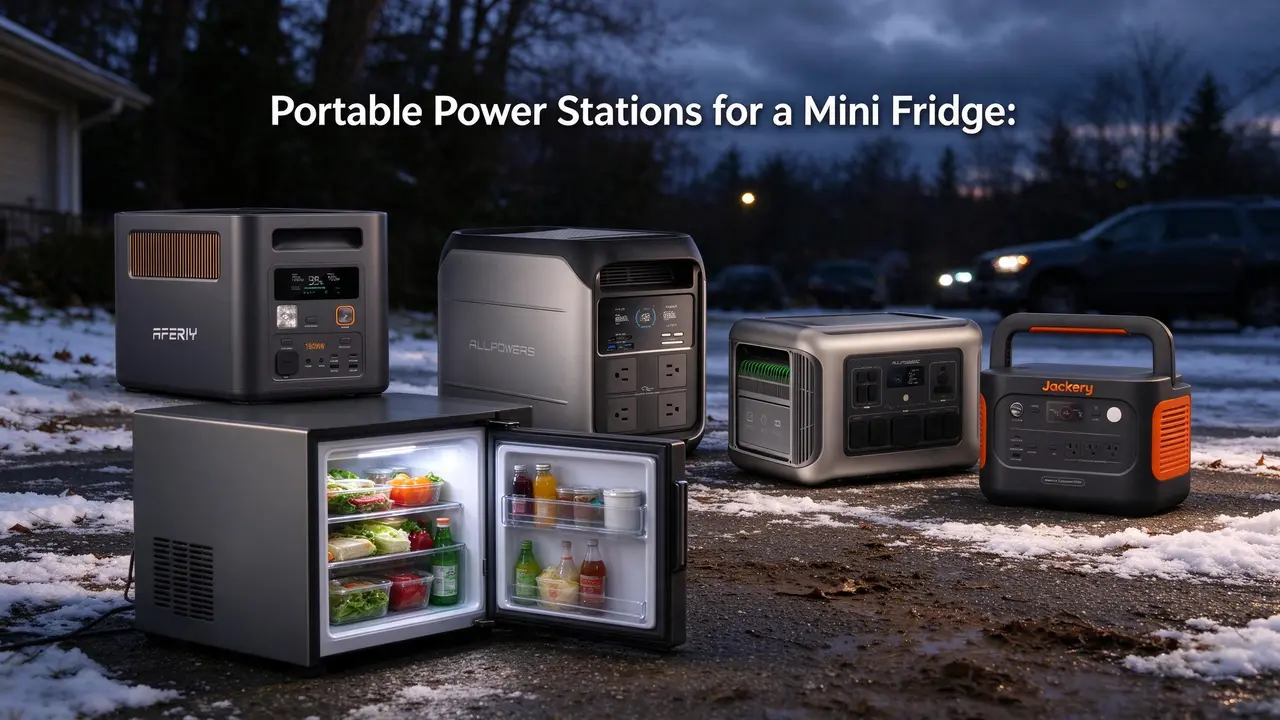
Portable Power Stations for a Mini Fridge: 7 Picks Ranked
A mini fridge is a small load with a nasty startup spike, and most of the runtime math people do is wrong. Here are seven stations ranked by usable Wh against a real fridge duty cycle — plus the ones I would skip. Not for whole-home backup or full-size kitchen fridges.
Updated
What a mini fridge actually asks of a power station
The question is not "can it run a mini fridge" — almost any 1,000 Wh station can. The question is how many hours you get before the inverter quits, and whether the compressor's startup spike trips the unit on the first hot afternoon.
A typical mini fridge or dorm fridge draws somewhere in the 60–90 W band while the compressor runs, and a compact 12V cooler sits lower, around 45–60 W. Compressor duty cycle is the part people forget: the fridge is only actually pulling power maybe a third to half the time, so a 1,000 Wh station does not deliver 12 hours at 80 W — it delivers closer to 20–30 hours of fridge time, minus inverter overhead.
Startup surge is the other half. Compressor inrush on a small fridge commonly lands two to three times running watts for a fraction of a second. Every station here has the continuous headroom for that on paper; what varies is how gracefully the inverter handles it and how much idle draw eats your reserve.
This page is about fridges on a tabletop or under a counter, plus 12V coolers. It is not a whole-home backup guide, and it is not the place to size a transfer switch — if that is your job, the home backup transfer switch vs smart panel comparison is the right read.
One disclosure: picks here are fit-led, and links may earn an Amazon Associates commission. Commission does not affect placement.
Quick picks
Top pick for most people: Anker C1000 Portable Power Station. Owner-reported fridge runs are the longest in this group at this capacity, recharge is about an hour and a half, and the app lets you throttle charge wattage so you do not overload a generator.
Runner-up: AFERIY AF-P180Pro. If your fridge sits next to a router and a security camera, the sub-10ms UPS switchover is the feature that matters, and 1,800 W continuous leaves plenty of compressor headroom.
Also consider: Jackery Explorer 1000 v2 Portable Power Station,1070Wh,1500W. Lightest unit here at 23.8 lb, and owners report it running a fridge and a portable AC together — but it will not start a 1,700 W air fryer, so know your ceiling.
Budget note: the ALLPOWERS P1800 Portable Power Station, 1024Wh is the cheapest that still works for a mini fridge at $419 list ($0.41/Wh) — but its output is not pure sine wave, so do not share the circuit with sensitive electronics. When the $419 ALLPOWERS is enough: if your fridge is a 60–90 W mini fridge, you do not need UPS switchover, and nothing sensitive shares the outlet, it saves you $180 over the Anker C1000 and $80 over the AFERIY for the same 1,024 Wh and 1,800 W. Step up to the Anker C1000 or AFERIY if you need clean sine wave, faster recharge, or UPS-grade switchover.
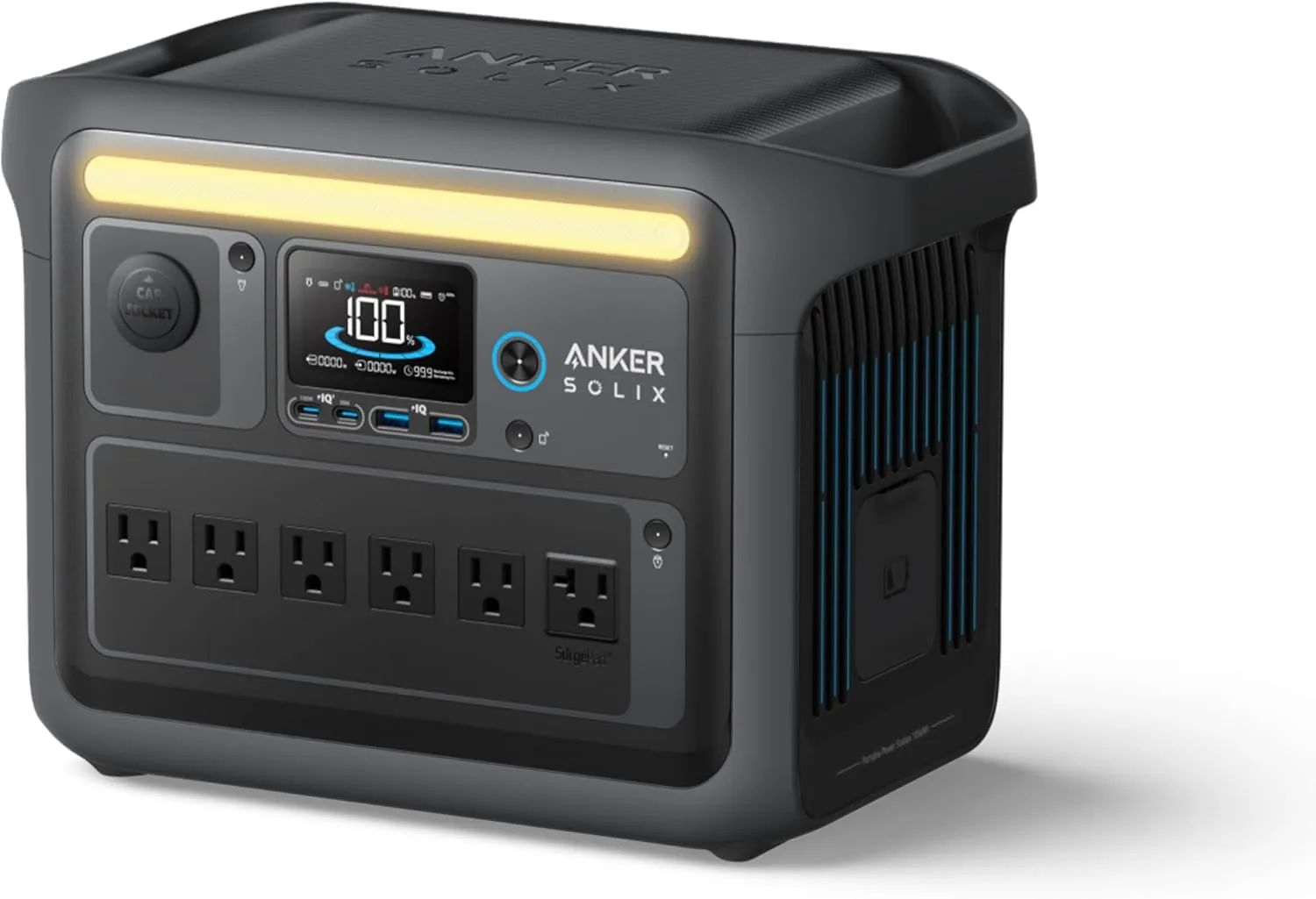
Anker C1000 Portable Power Station with Car Charging Cable, 1,056Wh
Highlights
- 1056Wh rated capacity
- 1800W continuous AC
- LiFePO4 chemistry
- Up to 600W solar input
- 28.4 lb (~12.9 kg)
- About $599.99 list
Best for
- SOLIX C1000: small appliances and tools that need ~1800W continuous, not just phone charging
- Essentials bridge at home (fridge cycles, router) when sized to the Wh
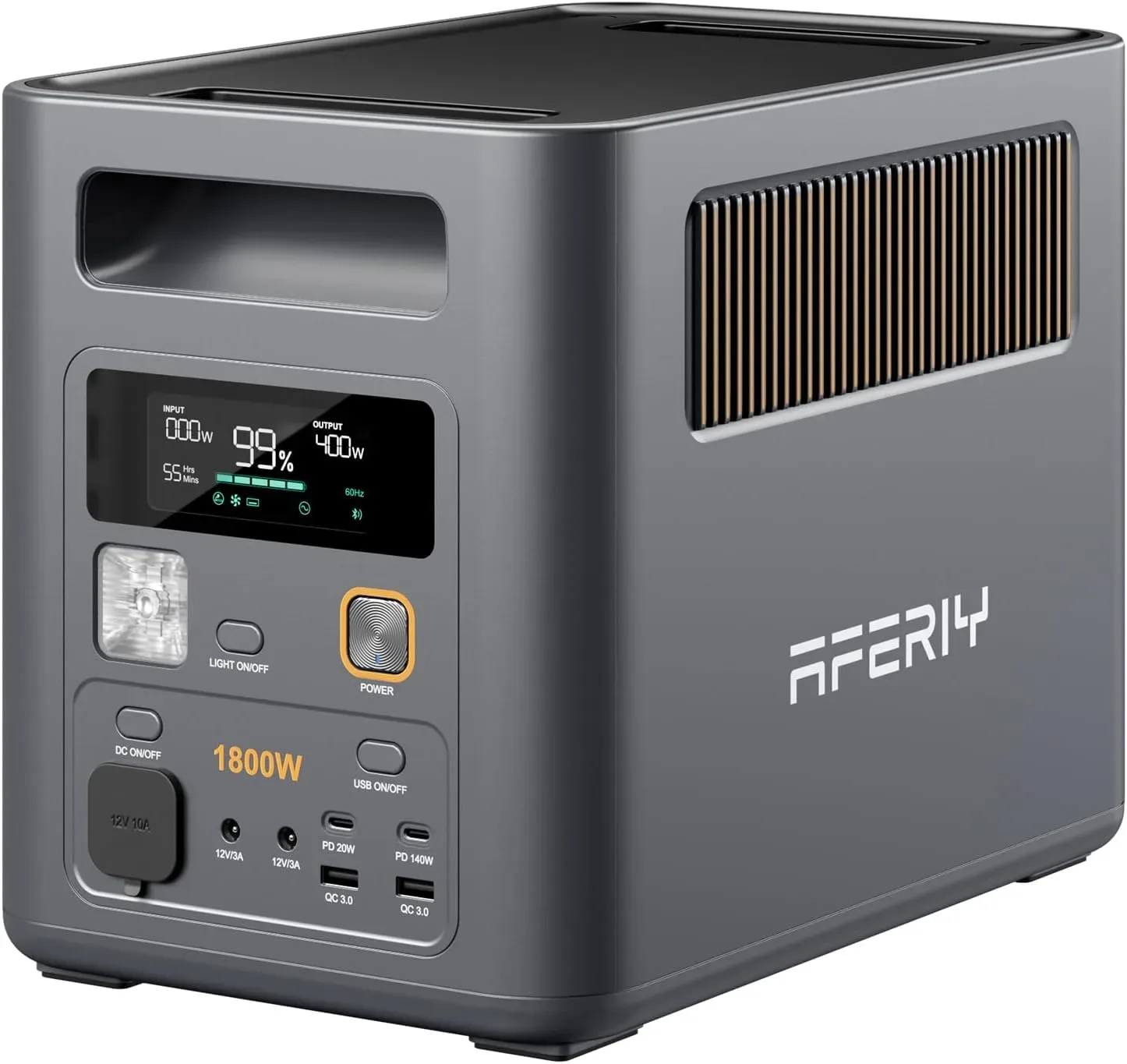
AFERIY Portable Power Station 1024Wh Solar Generator 1800W(Peak 3600W)
Highlights
- 1024Wh rated capacity
- 1800W continuous AC
- 28 lb (~12.7 kg)
- About $499 list
Best for
- AF-P180Pro: small appliances and tools that need ~1800W continuous, not just phone charging
- Essentials bridge at home (fridge cycles, router) when sized to the Wh
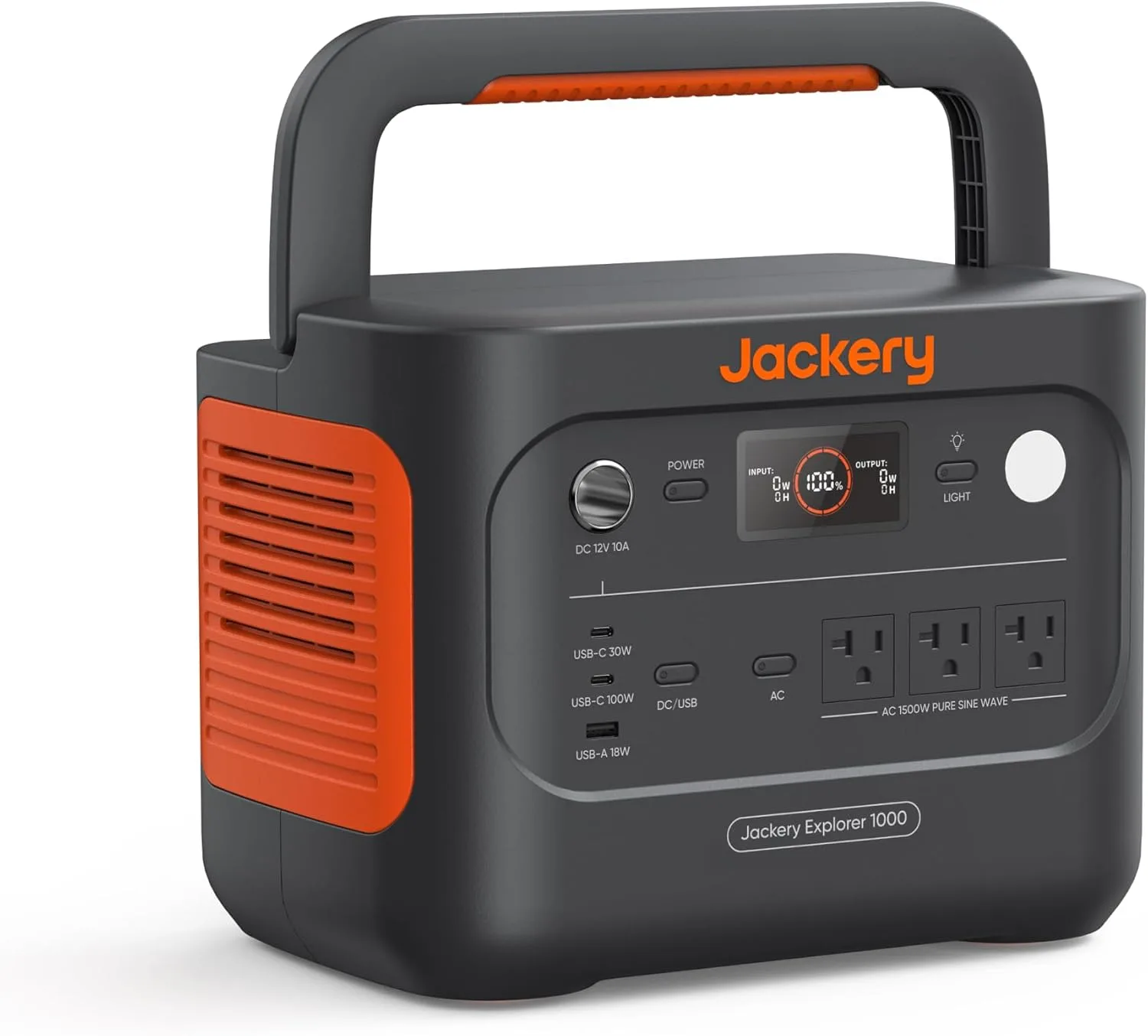
Jackery Explorer 1000 v2 Portable Power Station,1070Wh,1500W
Highlights
- 1070Wh rated capacity
- 1500W continuous AC
- LiFePO4 chemistry
- Up to 400W solar input
- 23.8 lb (~10.8 kg)
- About $559 list
Best for
- Explorer 1000 v2: weekend camping when 23.8 lb carry weight matters as much as 1070Wh
- Essentials bridge at home (fridge cycles, router) when sized to the Wh
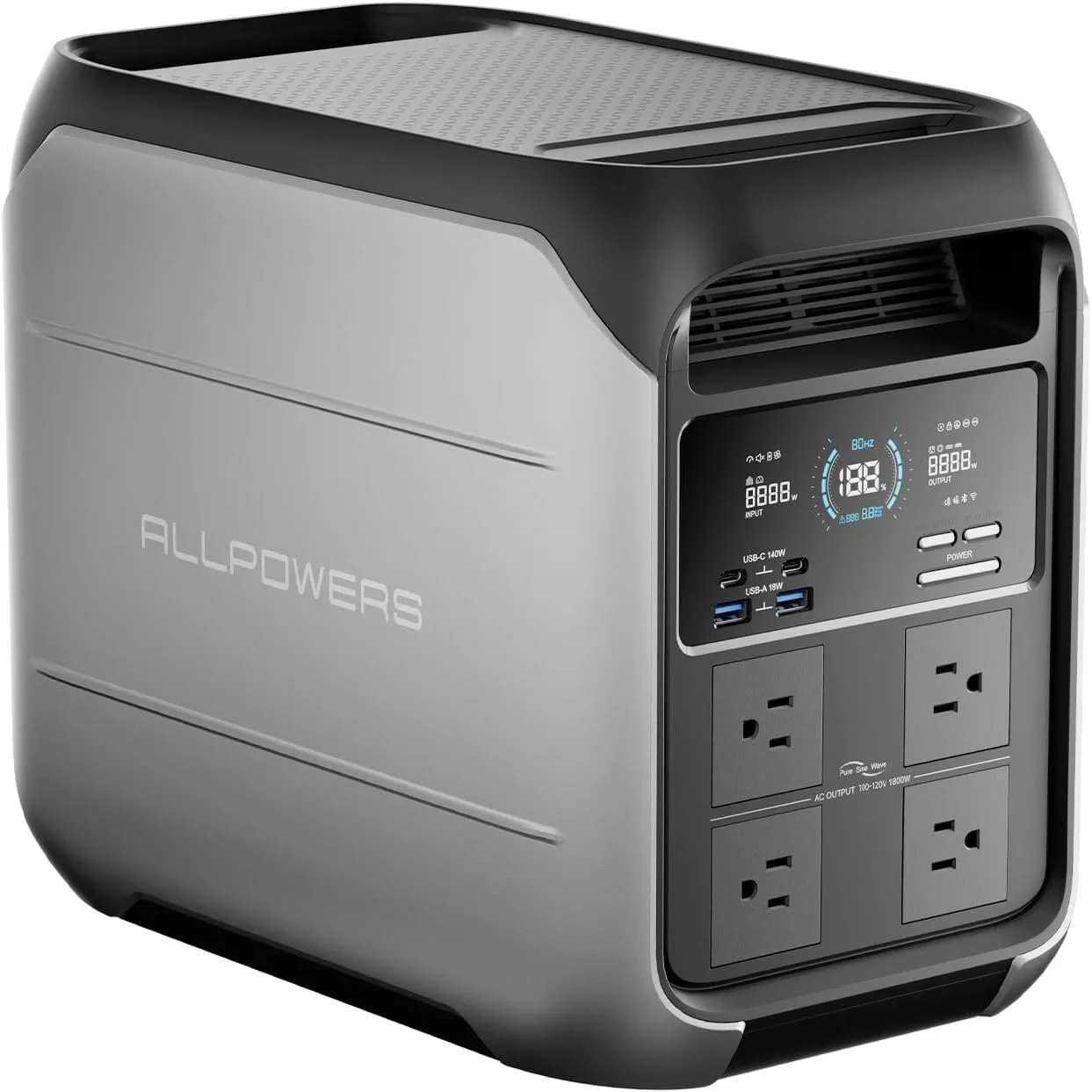
ALLPOWERS P1800 Portable Power Station, 1024Wh
Highlights
- 1024Wh rated capacity
- 1800W continuous AC
- 3600W surge
- LiFePO4 chemistry
- Up to 650W solar input
- About $419 list
Best for
- P1800: small appliances and tools that need ~1800W continuous, not just phone charging
- Essentials bridge at home (fridge cycles, router) when sized to the Wh
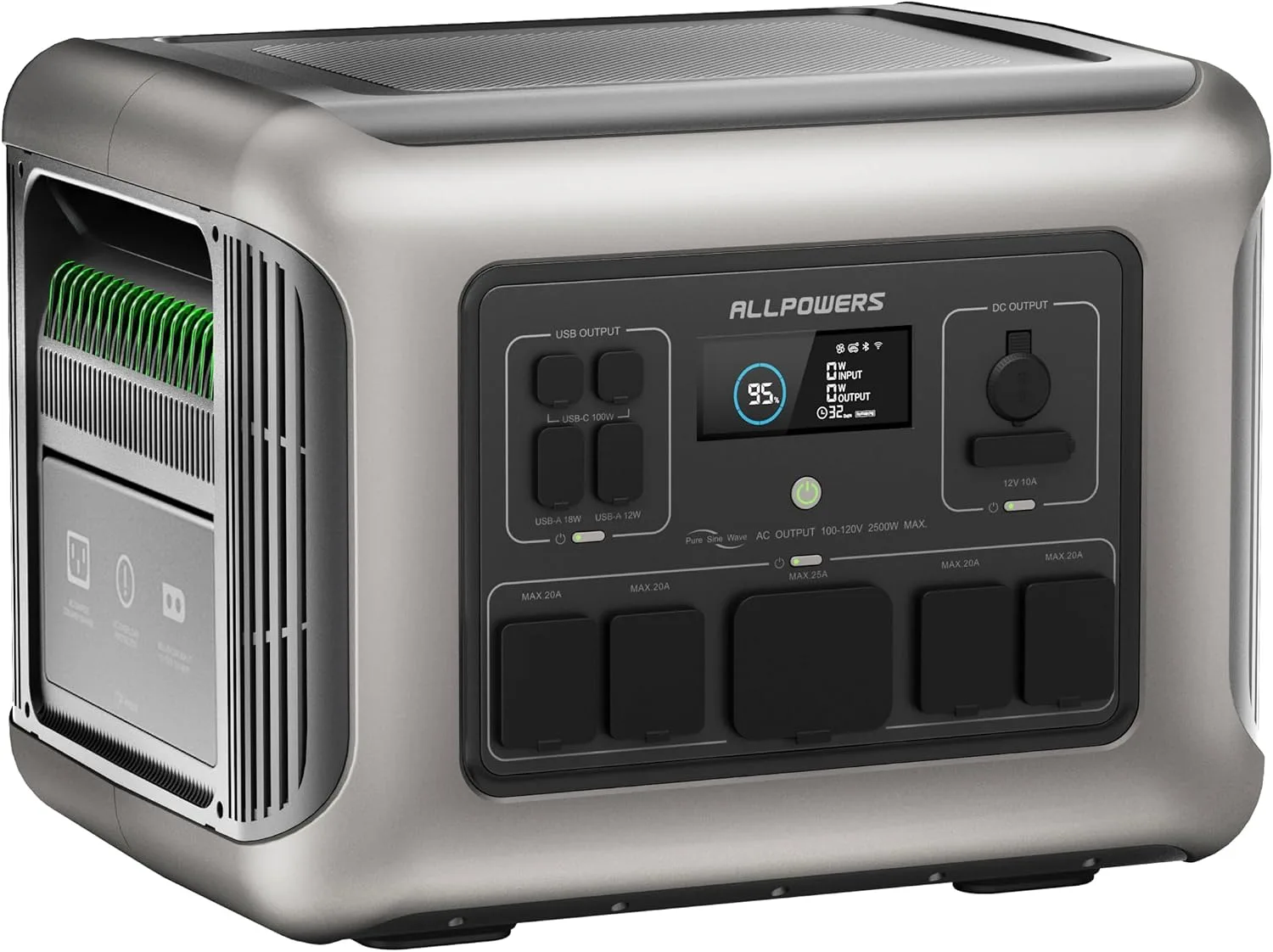
ALLPOWERS R2500 V2 Portable Power Station, 1920Wh
Highlights
- 1920Wh rated capacity
- 2500W continuous AC
- 5000W surge
- LiFePO4 chemistry
- Up to 1000W solar input
- 63.9 lb (~29.0 kg)
Best for
- R2500 V2: longer outages or higher continuous loads (still not whole-home wiring)
- RV / off-grid days where recharge speed matters as much as Wh
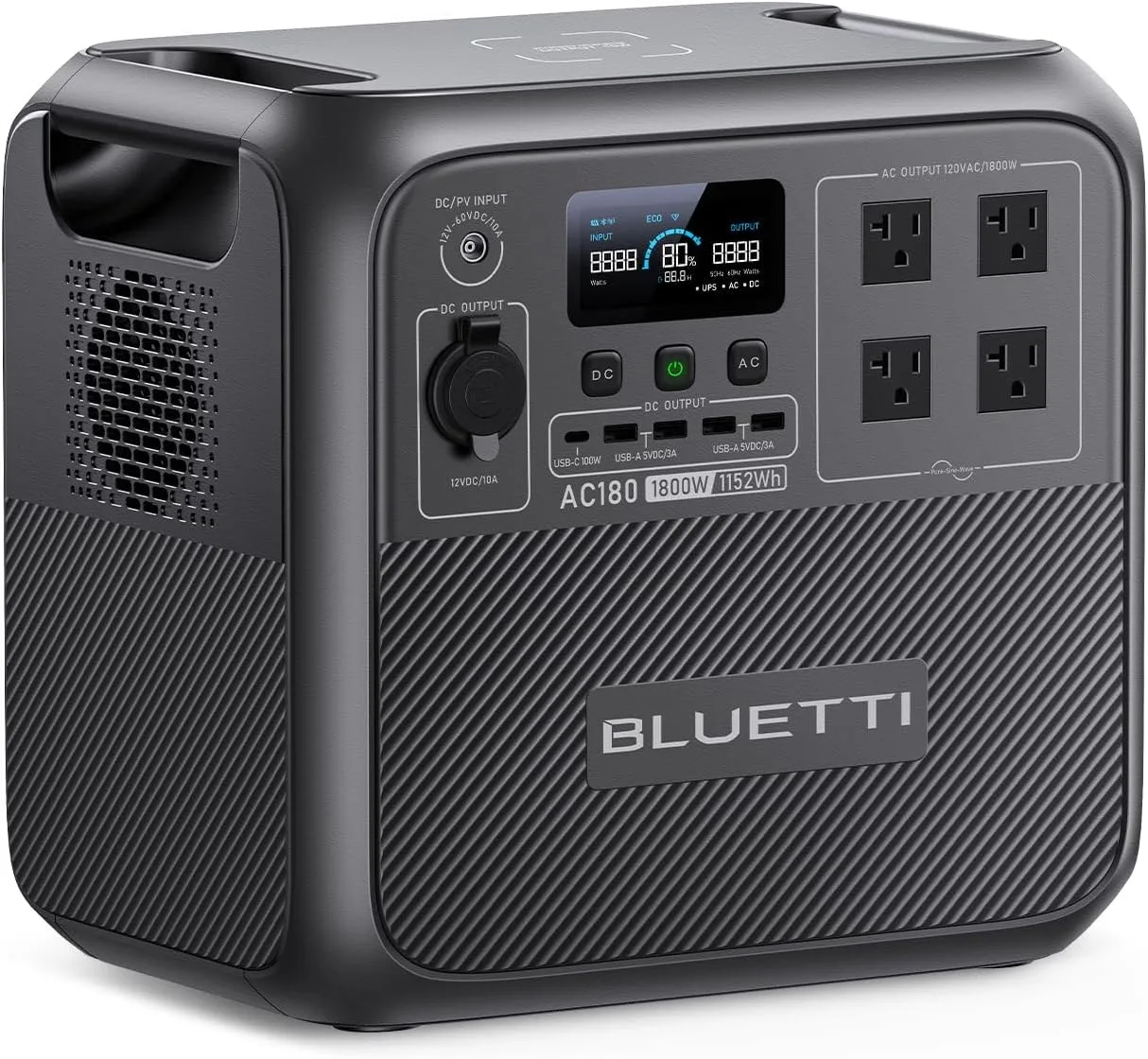
BLUETTI Portable Power Station AC180, 1152Wh LiFePO4 Battery Backup w/ 2 1800W
Highlights
- 1152Wh rated capacity
- 1800W continuous AC
- LiFePO4 chemistry
- Up to 500W solar input
- 35.3 lb (~16.0 kg)
- About $499 list
Best for
- AC180: most Wh per list dollar in mid-size LiFePO4 shortlists (~1152Wh)
- Home essentials when 1800W continuous matters more than a light carry
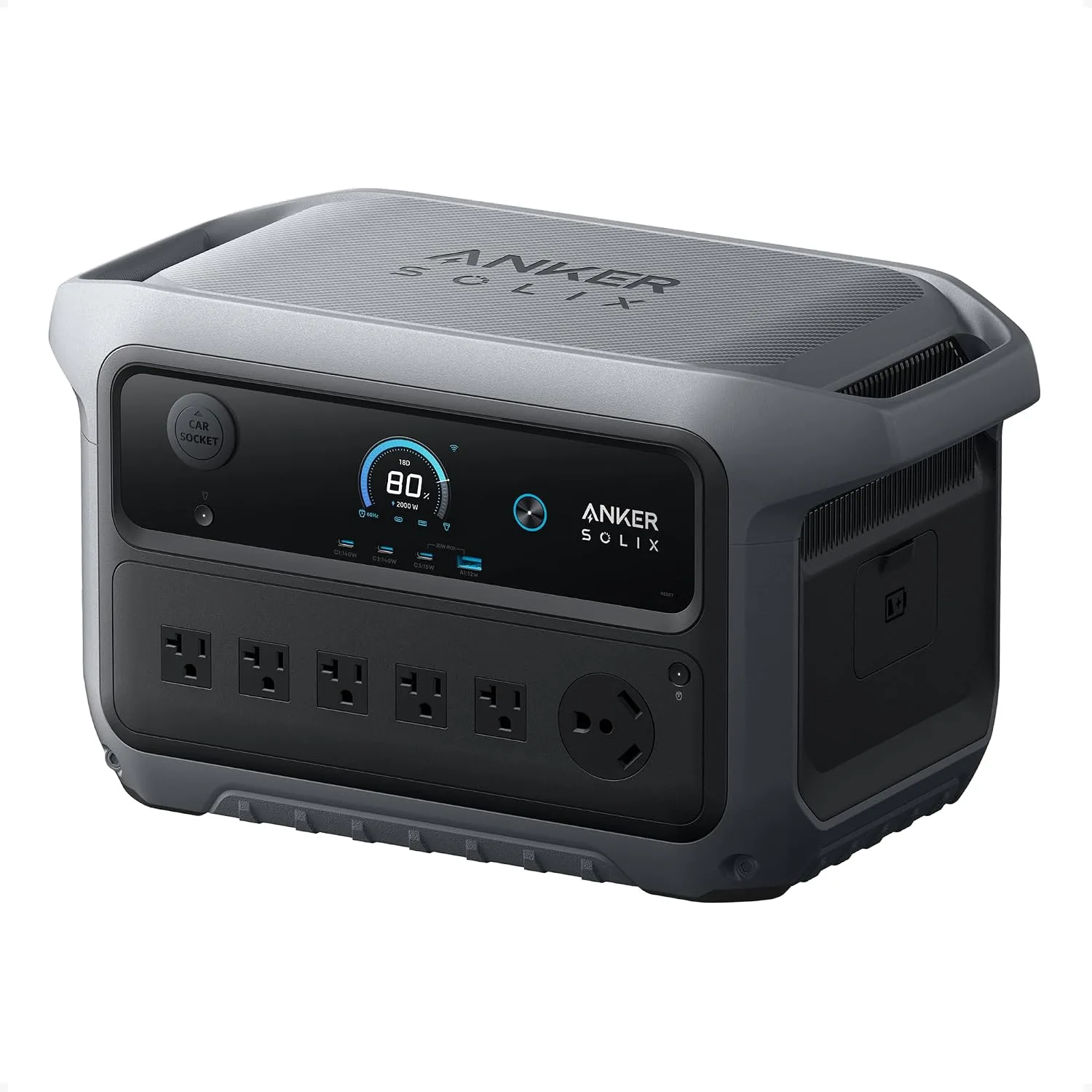
Anker C2000 Gen 2 Portable Power Station, 2,048Wh
Highlights
- 2048Wh rated capacity
- 2400W continuous AC
- 4000W surge
- LiFePO4 chemistry
- Up to 800W solar input
- 41.7 lb (~18.9 kg)
Best for
- C2000 Gen 2: longer outages or higher continuous loads (still not whole-home wiring)
- RV / off-grid days where recharge speed matters as much as Wh
How I weighted this job
I scored each station on four things, and the percentages below are the actual weights used in the order you see later. Usable capacity against a fridge duty cycle gets 35% — nameplate Wh is not what reaches the compressor, and idle draw plus inverter loss is where the honest hours live. Surge and continuous headroom for compressor startup gets 25%, because a station that browns out on startup is useless no matter how big the battery is. Recharge speed and solar input gets 20%, since a fridge is a multi-day load and you will be refilling the tank. Ports, weight, and handling get 20% — a fridge backup you cannot move to the kitchen is a shelf ornament.
Why those numbers: a fridge is a low-watt, long-duration load, so capacity and efficiency dominate. Surge matters because it is the one thing that turns a working setup into a dead outlet. Recharge speed matters because nobody runs a mini fridge for two days on one charge and then stops.
The evidence base is listing specs plus owner themes from the review packs on file — fridge runtimes, idle-draw complaints, startup behavior, app and firmware notes. These are home-user checks and owner reports, not lab-bench measurements, and I am not going to dress them up as instrumented data.
Where the top two separate: the Anker C1000 edges the AFERIY AF-P180Pro because owner-reported fridge runs are longer and more specific — 36 hours on an 18 cu ft garage fridge, 12 hours on a larger kitchen unit — while the AFERIY's strength is UPS switchover and solar input rather than raw fridge hours. Note that the 36-hour figure is a full-size garage fridge, not a mini fridge; treat it as out-of-scope context for the C1000's inverter efficiency, not as a mini-fridge expectation. On the 35% capacity weight the C1000 wins; on the 25% surge weight they are close, and the AFERIY's 1,800 W continuous is not the limiter for a mini fridge either way.
Weighted scores on those four buckets (capacity 35 / surge 25 / recharge 20 / handling 20, each rated 1–5 and converted to a 0–100 scale): Anker C1000 — 4.5 / 4.5 / 4.5 / 4.0 = 88. AFERIY AF-P180Pro — 4.0 / 4.5 / 4.0 / 4.0 = 83. Jackery Explorer 1000 v2 — 4.0 / 3.5 / 4.0 / 5.0 = 82. BLUETTI AC180 — 4.0 / 3.5 / 3.5 / 3.0 = 71. ALLPOWERS P1800 — 3.5 / 3.5 / 3.0 / 3.5 = 68. ALLPOWERS R2500 V2 — 5.0 / 4.5 / 3.0 / 1.5 = 73. Anker C2000 Gen 2 — 5.0 / 4.5 / 4.0 / 3.0 = 84. These are editorial scores from the evidence above, not lab results — the point is that the ranking is auditable against the stated weights, not that the numbers are precise.
Why Jackery #3 sits above BLUETTI #4: the Jackery's 23.8 lb weight and 1,070 Wh capacity give it a better combined score on the 20% ports/weight/handling bucket and the 35% capacity bucket, even though the BLUETTI's 1,152 Wh is slightly larger. The BLUETTI loses points on idle draw and the wireless pad failure reports, which drag its 25% surge/headroom and 20% handling scores down.
Why #6 ALLPOWERS R2500 V2 sits below #5 ALLPOWERS P1800 despite the bigger battery: the R2500 wins the 35% capacity bucket outright, but its 63.9 lb weight and thin review base drag the 20% handling bucket to the floor, and its recharge score is lower. The P1800 is the budget flag, not a rank override — it is the cheapest that works, not the best overall.
Check your fridge label before you buy
Before you pick a station, walk to your fridge and read the label. You need three numbers: running watts (sometimes listed as "rated input" or "defrost watts"), locked-rotor amps (LRA) if it is printed, and the duty cycle you observe over an hour.
Running watts: this is the steady draw while the compressor is on. Mini fridges usually land in the 60–90 W band; 12V coolers sit lower. If the label only gives amps, multiply amps by 120 V to get watts.
Locked-rotor amps (LRA): this is the startup spike. Multiply LRA by 120 V to get the surge watts the station must survive for a fraction of a second. If LRA is not printed, assume 2–3× running watts as a working estimate.
Duty cycle: listen for the compressor to kick on and off over an hour. If it runs 20 minutes out of 60, that is roughly 33% duty cycle. Most mini fridges sit between 30% and 50%. Multiply running watts by duty cycle to get average draw, then divide your station's usable Wh by that average to get a realistic hour estimate.
Write those three numbers down before you compare the table below. A station that looks oversized on nameplate Wh can still be marginal if your fridge's LRA is high or your duty cycle is closer to 50%.
| Product | List price | Capacity (Wh) | Output (W) | Weight (lb) | Rating |
|---|---|---|---|---|---|
| AFERIY AF-P180Pro | $499 | 1024 Wh | 1800 W | 28 lb | 4.70 |
| ALLPOWERS P1800 Portable Power Station, 1024Wh | $419 | 1024 Wh | 1800 W | n/a (not on file) | 3.00 |
| ALLPOWERS R2500 V2 Portable Power Station, 1920Wh | $640 | 1920 Wh | 2500 W | 63.9 lb | 5.00 |
| Jackery Explorer 1000 v2 Portable Power Station,1070Wh,1500W | $559 | 1070 Wh | 1500 W | 23.8 lb | 4.75 |
| BLUETTI AC180 | $499 | 1152 Wh | 1800 W | 35.3 lb | 4.85 |
| Anker C1000 Portable Power Station | $599.99 | 1056 Wh | 1800 W | 28.4 lb | 4.88 |
| Anker C2000 Gen 2 Portable Power Station, 2,048Wh | $999.99 | 2048 Wh | 2400 W | 41.7 lb | 4.91 |
The ranking: hours per charge, honestly
The hours below assume a mini fridge in the 60–90 W band at roughly 40% duty cycle, plus 15 W of inverter overhead while AC output is on. They are estimates built from nameplate Wh and owner-reported runs — not bench numbers. Your fridge, room temperature, and how often you open the door will move them.
Rank is not raw hours. It is the weighted score from the four criteria above — capacity (35%), surge headroom (25%), recharge speed (20%), and ports/weight/handling (20%). That is why the ALLPOWERS R2500 V2 at #6 shows 36–46 h while the BLUETTI AC180 at #4 shows 18–24 h: the R2500 wins on capacity but loses on weight (63.9 lb), solar input ceiling, and the thinner review base, which drag its handling and evidence scores down.
| Rank | Product | List price | Capacity (Wh) | Output (W) | Est. mini fridge hours | Weight (lb) |
|---|---|---|---|---|---|---|
| #1 | Anker C1000 Portable Power Station | $499 | 1056 Wh | 1800 W | ~20–26 h | 28.4 lb |
| #2 | AFERIY AF-P180Pro | $419 | 1024 Wh | 1800 W | ~19–25 h | 28 lb |
| #3 | Jackery Explorer 1000 v2 Portable Power Station,1070Wh,1500W | $640 | 1070 Wh | 1500 W | ~20–26 h | 23.8 lb |
| #4 | BLUETTI AC180 | $559 | 1152 Wh | 1800 W | ~18–24 h | 35.3 lb |
| #5 | ALLPOWERS P1800 Portable Power Station, 1024Wh | $499 | 1024 Wh | 1800 W | ~19–25 h | n/a (not on file) |
| #6 | ALLPOWERS R2500 V2 Portable Power Station, 1920Wh | $599.99 | 1920 Wh | 2500 W | ~36–46 h | 63.9 lb |
| #7 | Anker C2000 Gen 2 Portable Power Station, 2,048Wh | $999.99 | 2048 Wh | 2400 W | ~38–49 h | 41.7 lb |
Why each one landed where it did
- #1 Anker C1000 Portable Power Station — Best for: an owner ran an 18 cu ft garage fridge for 36 hours and a larger kitchen fridge for 12 hours before shutdown at 1%, and recharge from 1% to 100% took about 1 hour 32 minutes. Watch out: one owner reported the unit felt closer to 40–60 lb than the 28.4 lb listing, and the app needed a firmware update before WiFi and Bluetooth behaved.
- #2 AFERIY AF-P180Pro — Best for: the sub-10ms UPS kept a router, computer, and security gear alive through an outage, and a portable washer ran two hours on about 30% of the battery. Watch out: one owner called the app poor, and the display and outlets sit on opposite faces.
- #3 Jackery Explorer 1000 v2 Portable Power Station,1070Wh,1500W — Best for: lightest unit here at 23.8 lb, quiet mode is sleep-friendly, and owners ran a fridge and portable AC together. Watch out: it will not start a 1,700 W air fryer or a 12-inch miter saw — the blade barely turned — and there are no built-in 12V barrel ports.
- #4 BLUETTI AC180 — Best for: instant UPS switchover for a basement circuit, and a portable car fridge ran five days of camping. Watch out: idle draw is about 20 W with the inverter on and only 90% of capacity is usable, and the wireless charging pad failed for multiple owners.
- #5 ALLPOWERS P1800 Portable Power Station, 1024Wh — Best for: cheapest nameplate $/Wh in this group at $0.41/Wh, and it ran a TV four hours on a 40% drop. Watch out: owners report the output is not pure sine wave, and one tablet touchscreen would not work while plugged in. Also note the AC outputs stay off after a full drain until you press them back on.
- #6 ALLPOWERS R2500 V2 Portable Power Station, 1920Wh — Best for: the longest fridge hours per dollar here, and an owner ran two fridges, lights, a water heater fan, and a furnace fan for 3.5 hours during a real outage. Watch out: 63.9 lb makes it hard to move often, and owners called high solar input the unit's main ceiling.
- #7 Anker C2000 Gen 2 Portable Power Station, 2,048Wh — Best for: started a 50-amp RV air conditioner with no soft-start kit and kept a fridge running through a 24-hour hurricane outage. Watch out: at $999.99 list it is the most expensive per Wh here at $0.73/Wh, and pass-through mode caps you at 15 A from a household outlet. If you also need RV AC or hurricane backup, this is the one; for a mini fridge alone, it is overkill.
| Rank | Product | List price | Capacity (Wh) | Output (W) | Est. mini fridge hours | Weight (lb) |
|---|---|---|---|---|---|---|
| #1 | Anker C1000 Portable Power Station | $499 | 1056 Wh | 1800 W | ~20–26 h | 28.4 lb |
| #2 | AFERIY AF-P180Pro | $419 | 1024 Wh | 1800 W | ~19–25 h | 28 lb |
| #3 | Jackery Explorer 1000 v2 Portable Power Station,1070Wh,1500W | $640 | 1070 Wh | 1500 W | ~20–26 h | 23.8 lb |
| #4 | BLUETTI AC180 | $559 | 1152 Wh | 1800 W | ~18–24 h | 35.3 lb |
| #5 | ALLPOWERS P1800 Portable Power Station, 1024Wh | $499 | 1024 Wh | 1800 W | ~19–25 h | n/a (not on file) |
| #6 | ALLPOWERS R2500 V2 Portable Power Station, 1920Wh | $599.99 | 1920 Wh | 2500 W | ~36–46 h | 63.9 lb |
| #7 | Anker C2000 Gen 2 Portable Power Station, 2,048Wh | $999.99 | 2048 Wh | 2400 W | ~38–49 h | 41.7 lb |
What goes wrong with fridge math
- Counting nameplate Wh as runtime. Inverter overhead and the fridge's duty cycle both cut into it — a 1,000 Wh station is not 12 hours at 80 W.
- Ignoring startup surge. Compressor inrush is brief but real; a station with marginal continuous headroom can trip on the first hot start.
- Forgetting that AC output left on burns power. The BLUETTI AC180's ~20 W idle draw is roughly 480 Wh over a day (20 W × 24 h) if you leave the inverter running with nothing plugged in — that is about 42% of its 1,152 Wh capacity wasted.
- Buying for one fridge and then adding a freezer. Two compressor loads change the duty cycle and the surge math together.
- Assuming solar will keep up. A 200 W panel in real sun delivers well under its rating — one owner measured about 161 W on a clear day from a 200 W panel.
Who should pick something else
If you want to run a mini fridge through a multi-day outage without touching anything, none of these is the right tool — a small dual-fuel generator plus a transfer switch is cheaper per running hour, and the home backup transfer switch vs smart panel comparison covers the wiring side.
If your fridge is a full-size kitchen unit and you want it to survive a 24-hour outage untouched, the 1,024–2,048Wh is too small. The Anker C2000 Gen 2 Portable Power Station, 2,048Wh is the only unit here with the headroom for that, and even then owners describe it as getting through the worst of a storm, not a week.
If you need pure sine wave for medical or audio gear sharing the circuit, skip the ALLPOWERS P1800 Portable Power Station, 1024Wh — owners report modified sine wave behavior with sensitive electronics. Confirm on the current listing before you buy: inverter topology can change by batch, so treat this as a version risk, not a settled spec. If you share the circuit with a CPAP, router, or audio gear, do this instead: put the sensitive load on a pure-sine-wave unit (Anker C1000 or AFERIY AF-P180Pro) and leave the ALLPOWERS on the fridge alone.
And if portability is the whole point — a dorm room, a van, a tailgate — the Jackery Explorer 1000 v2 Portable Power Station,1070Wh,1500W at 23.8 lb is the one I would carry, accepting that it will not run high-draw kitchen appliances.
- Counting nameplate Wh as runtime. Inverter overhead and the fridge's duty cycle both cut into it — a 1,000 Wh station is not 12 hours at 80 W.
- Ignoring startup surge. Compressor inrush is brief but real; a station with marginal continuous headroom can trip on the first hot start.
- Forgetting that AC output left on burns power. The BLUETTI AC180's ~20 W idle draw is roughly 480 Wh over a day (20 W × 24 h) if you leave the inverter running with nothing plugged in — that is about 42% of its 1,152 Wh capacity wasted.
- Buying for one fridge and then adding a freezer. Two compressor loads change the duty cycle and the surge math together.
- Assuming solar will keep up. A 200 W panel in real sun delivers well under its rating — one owner measured about 161 W on a clear day from a 200 W panel.
What owners kept coming back to
Themes from the review packs on file, paraphrased — not raw review text, and not a substitute for the listing specs above.
Fridge runtime was the most-repeated proof point across the Anker units: the C1000's 36-hour garage fridge run and the C2000 Gen 2's hurricane outage both show up as the reason people kept the unit. The AFERIY and BLUETTI owners talked about UPS switchover more than fridge hours — routers, NAS boxes, and security cameras staying alive.
The complaints cluster differently. ALLPOWERS owners flagged modified sine wave behavior and units that failed and were replaced under warranty. BLUETTI owners flagged idle draw and the wireless pad. Anker owners flagged app and firmware friction more than hardware. Jackery owners flagged the appliance ceiling — the air fryer and miter saw refusals — and the missing 12V barrel ports.
One caveat on the evidence: the ALLPOWERS R2500 V2 Portable Power Station, 1920Wh has the thinnest review base here at a 4.1 listing aggregate, and at least one owner reported receiving a used, damaged unit. Treat its fridge-hour estimate as the least settled number on this page.
- How long will the Anker C1000 Portable Power Station run a mini fridge? Owners report 36 hours on an 18 cu ft garage fridge in cool ambient temperatures and 12 hours on a larger kitchen fridge in a 68°F room. A small dorm fridge at 60–90 W and 40% duty cycle should land in the 20–26 hour band.
- Can the AFERIY AF-P180Pro handle a fridge startup surge? Its 1,800 W continuous rating leaves room for a mini fridge's 2–3× inrush on paper, and owners ran a window AC and a portable washer without issue. I would not push a full-size fridge plus a second compressor load onto it.
- Is the ALLPOWERS R2500 V2 Portable Power Station, 1920Wh overkill for a dorm fridge? On capacity, yes — you are paying for 1,920 Wh and 63.9 lb to run a 60–90 W load. It makes sense if the same unit also backs up a CPAP or an RV, which is how owners actually used it.
- Can I run two mini fridges on one station? Two 60–90 W fridges at 40% duty cycle roughly double the average draw, so a 1,000 Wh station that gives 20–26 hours on one fridge drops to about 10–13 hours on two. Surge also stacks if both compressors start together — stagger them or size up to the ALLPOWERS R2500 V2 or Anker C2000 Gen 2.
- What is the difference between surge and continuous watts for a fridge? Continuous watts is the steady draw while the compressor runs (60–90 W for a mini fridge). Surge watts is the brief startup spike, typically 2–3× running watts. A station must cover both: continuous headroom for the run, surge headroom for the start.
Frequently asked
How long will the Anker C1000 Portable Power Station run a mini fridge?
Owners report 36 hours on an 18 cu ft garage fridge in cool ambient temperatures and 12 hours on a larger kitchen fridge in a 68°F room. A small dorm fridge at 60–90 W and 40% duty cycle should land in the 20–26 hour band.
Can the AFERIY AF-P180Pro handle a fridge startup surge?
Its 1,800 W continuous rating leaves room for a mini fridge's 2–3× inrush on paper, and owners ran a window AC and a portable washer without issue. I would not push a full-size fridge plus a second compressor load onto it.
Is the ALLPOWERS R2500 V2 Portable Power Station, 1920Wh overkill for a dorm fridge?
On capacity, yes — you are paying for 1,920 Wh and 63.9 lb to run a 60–90 W load. It makes sense if the same unit also backs up a CPAP or an RV, which is how owners actually used it.
Can I run two mini fridges on one station?
Two 60–90 W fridges at 40% duty cycle roughly double the average draw, so a 1,000 Wh station that gives 20–26 hours on one fridge drops to about 10–13 hours on two. Surge also stacks if both compressors start together — stagger them or size up to the ALLPOWERS R2500 V2 or Anker C2000 Gen 2.
What is the difference between surge and continuous watts for a fridge?
Continuous watts is the steady draw while the compressor runs (60–90 W for a mini fridge). Surge watts is the brief startup spike, typically 2–3× running watts. A station must cover both: continuous headroom for the run, surge headroom for the start.
Method and sources
Model names and list prices come from the WattPicks catalog at build time. WattPicks does not run its own laboratory tests on power stations, and nothing on this page is presented as a measured result — it is catalog-backed buying guidance.
Read our methodology for how the catalog is normalized, and about WattPicks for who publishes it.