
Best Jackery Explorer 300 alternatives
A capacity-first shortlist for camping and small backup, ranked by usable Wh per dollar and continuous watts — not brand hype. The Anker SOLIX C1000 leads for home-adjacent loads; the Jackery Explorer 300 is the light-trip pick.
Updated
What actually matters when you compare these
As an Amazon Associate I earn from qualifying purchases. Recommendations here are based on fit and the evidence below — not commission size.
The buying question here is simple: how much usable energy do you get per dollar, and can the inverter actually run the thing you plug in? A 268Wh station and a 1056Wh station are not competitors — they serve different trips. This shortlist covers the 250–1100Wh band, which is the sweet spot for car camping, CPAP, and short outages.
One boundary up front: none of these are whole-home backup. They are portable stations with continuous AC output between 300W and 1800W. If you need to run a fridge, furnace, or well pump through a multi-day outage, you want a transfer switch and a much larger system — not a 27-pound box.
The other thing to know before the numbers: LiFePO4 chemistry is now standard in this class, and it matters. It typically means 3,000–4,000 published cycles instead of the 500–800 you'd see on older NMC packs. That's the difference between a five-year tool and a fifteen-year one.
- Usable Wh is lower than rated Wh — inverter losses typically eat 10–15%.
- Continuous watts (not surge) determines what actually runs.
- LiFePO4 = more published cycles; NMC = lighter but shorter-lived.
- Weight scales with capacity — there is no 1000Wh pack that's truly backpackable.
Quick picks
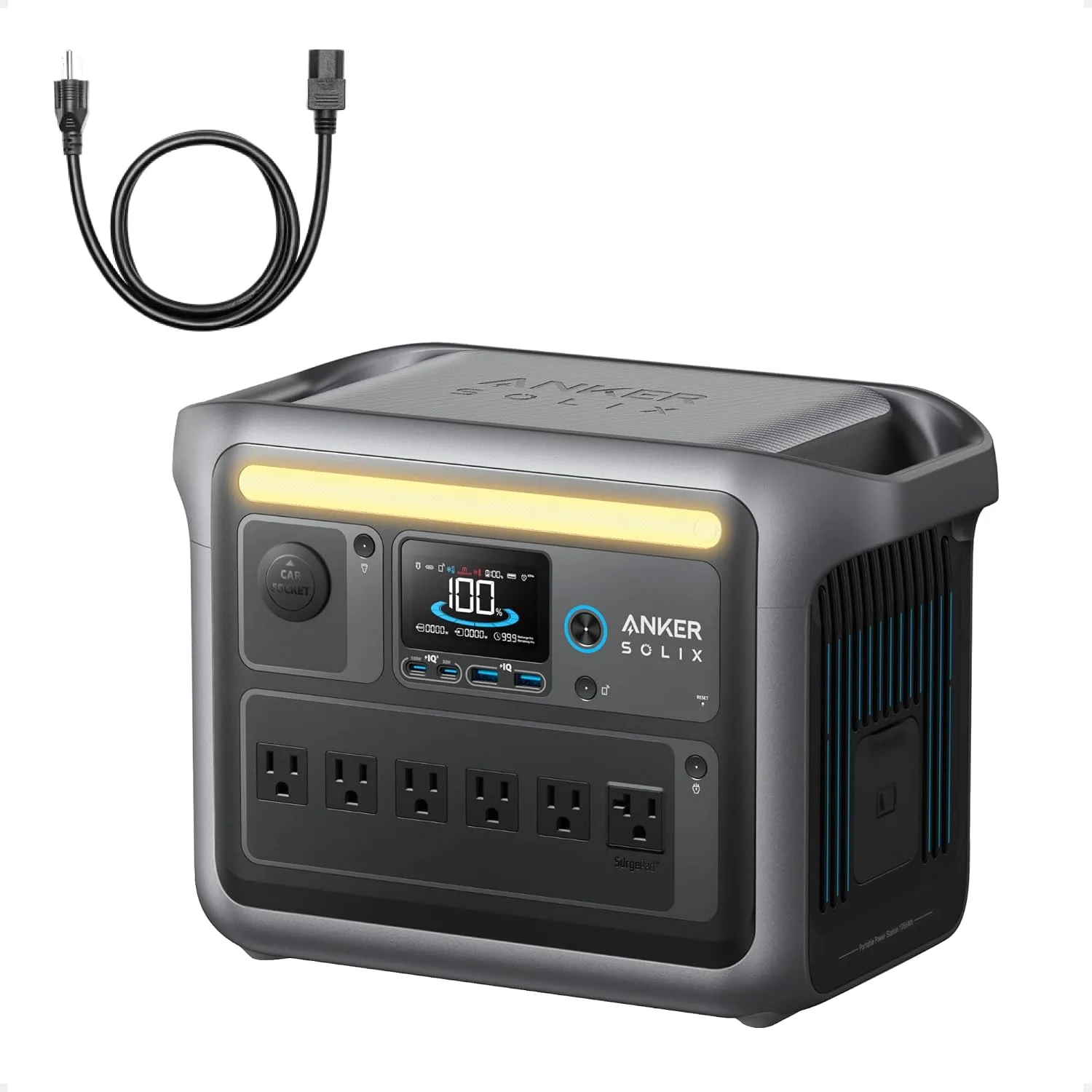
Top pick for home-adjacent loads: Anker SOLIX C1000. It's the only unit here with enough continuous watts (1800W) to run a microwave or coffee maker, and the 1056Wh capacity gives real runtime.
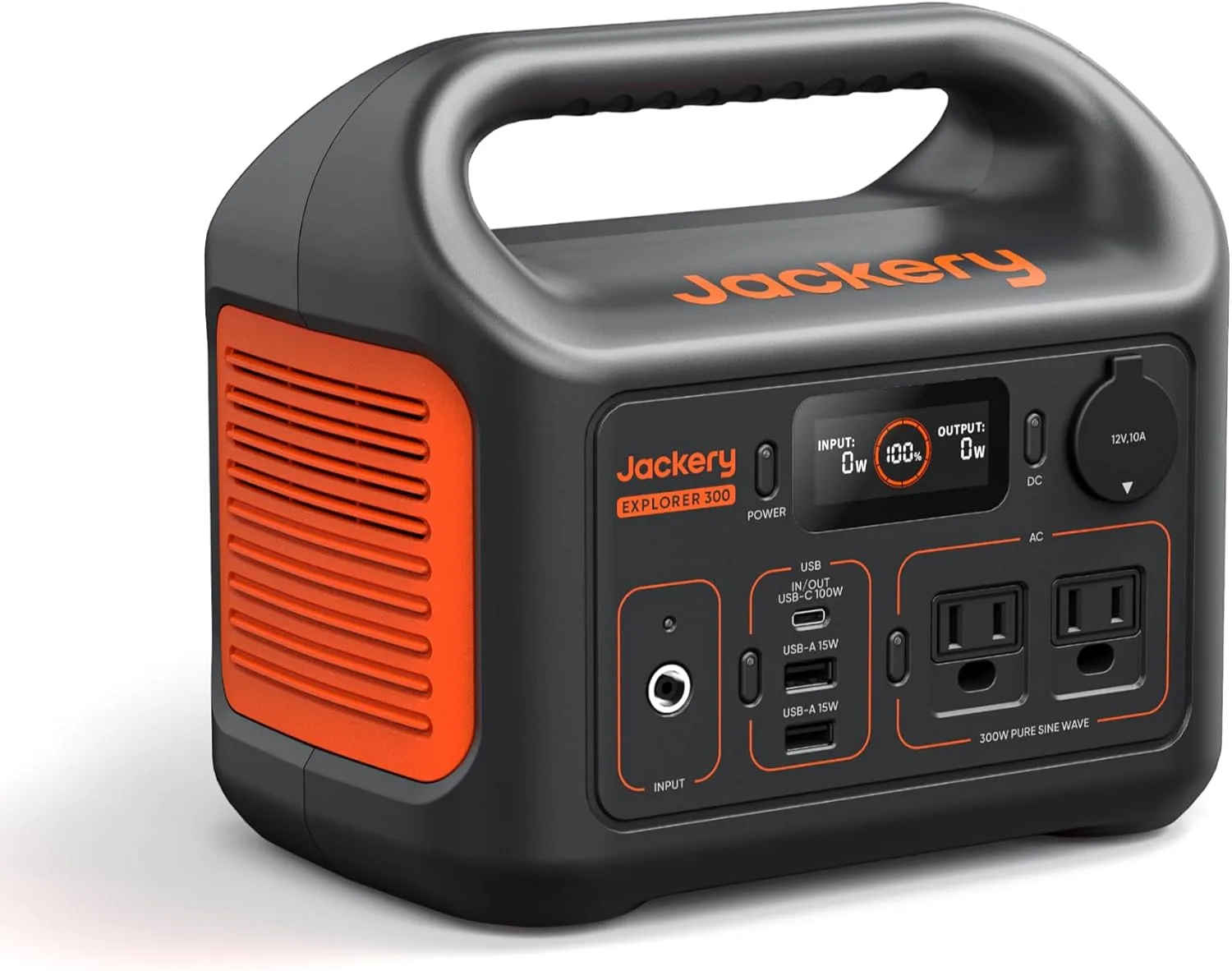
Runner-up for light trips: Jackery Explorer 300. At 8.2 lb and 288Wh, it's the best balance of weight and capacity for a weekend car camp or CPAP use.
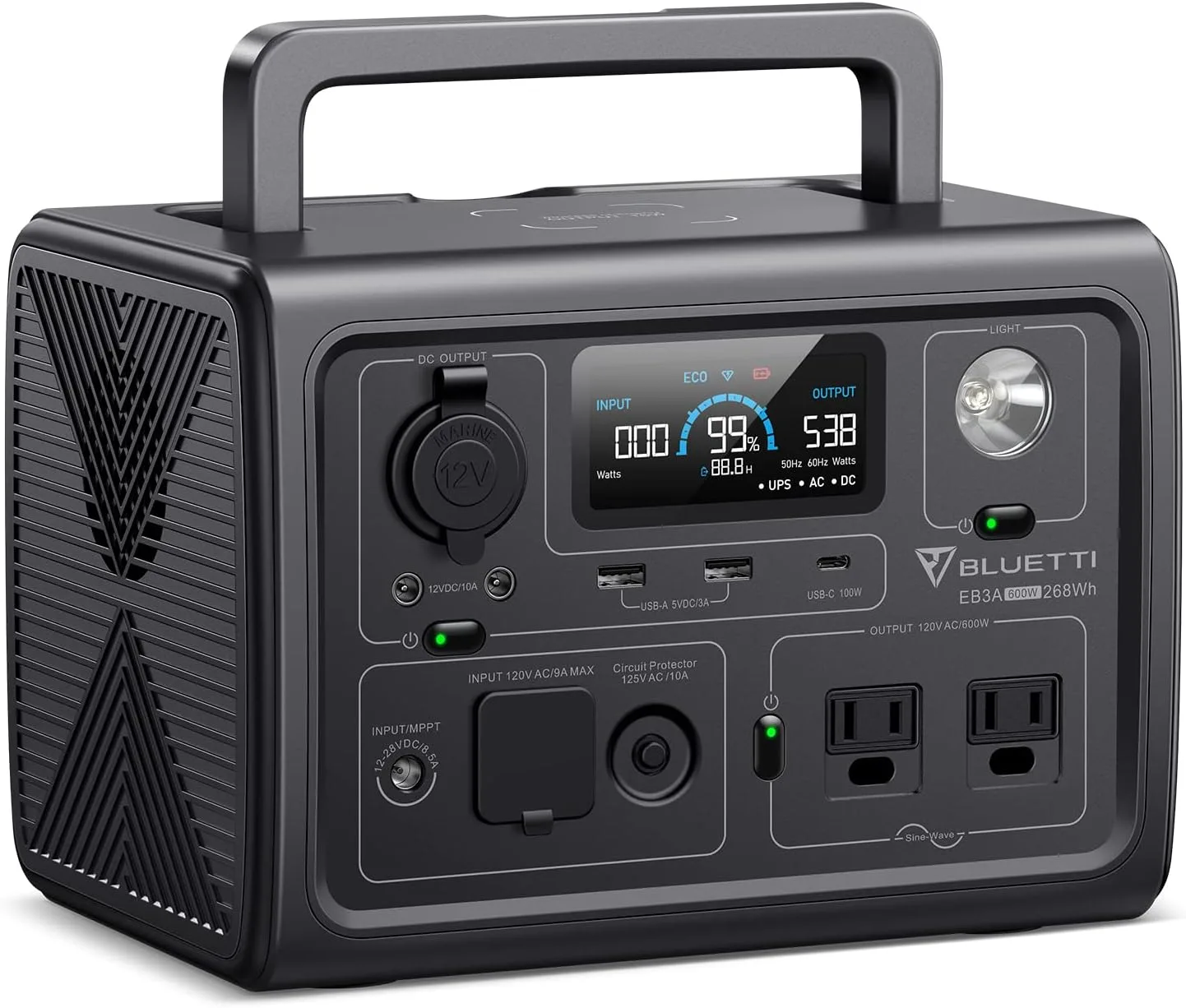
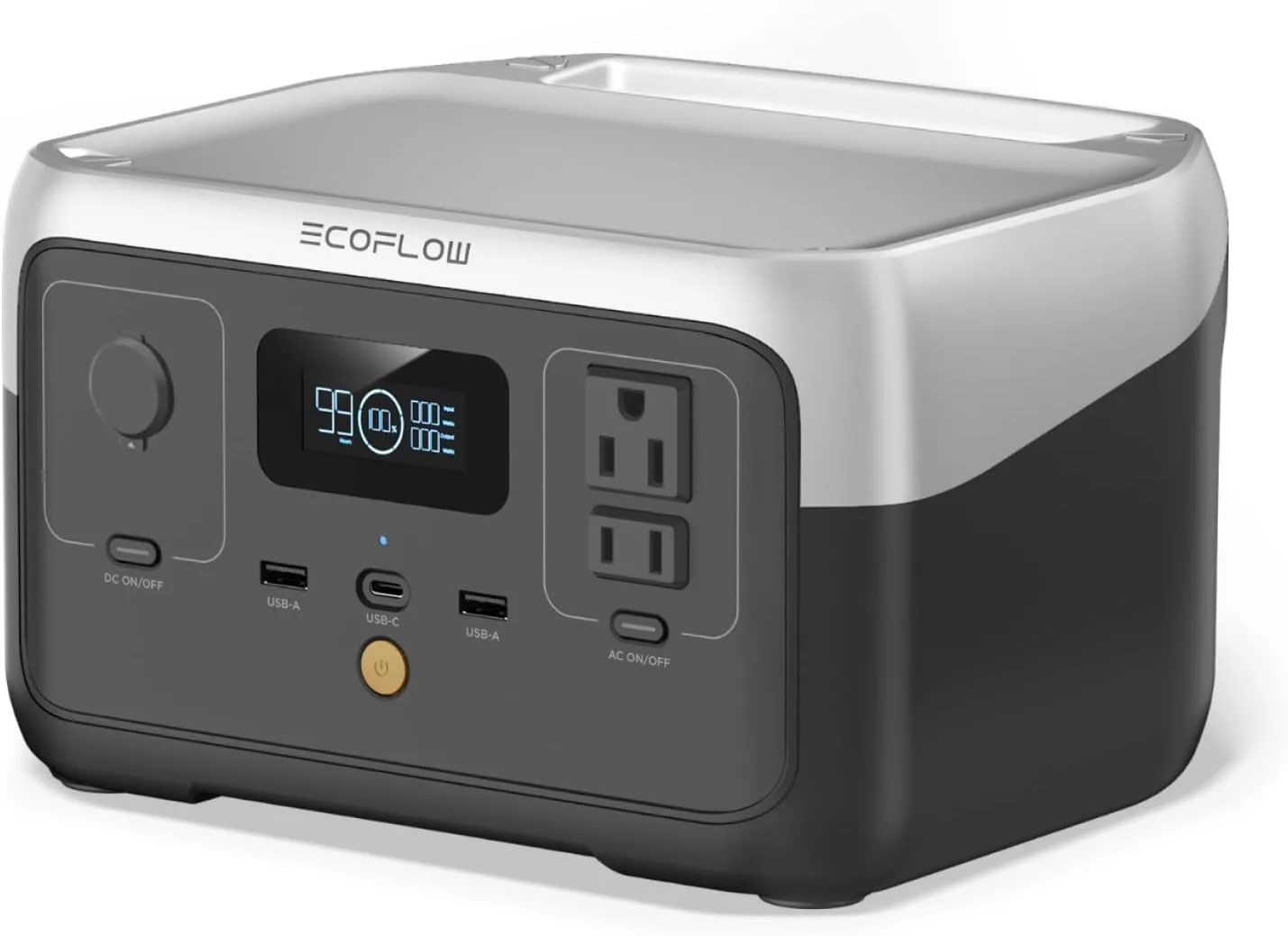
Also consider: BLUETTI EB3A if you want the most watts per dollar — 600W continuous for under $115 is hard to beat, though the 268Wh capacity limits runtime. EcoFlow RIVER 2 is the lightest at 7.7 lb but has the smallest capacity here (243Wh) and the highest list price of the small units.
Anker Full Charge in 58 Min
Highlights
- 56Wh rated capacity
- 1800W continuous AC
- LiFePO4 chemistry
- 27.6 lb (~12.5 kg)
- About $599.99 list
Best for
- SOLIX C1000: phones, cameras and a laptop on short trips
- Travel kits when you need quiet pack power, not appliance runtime
Jackery Explorer 300 Portable Power Station,292Wh
Highlights
- 288Wh rated capacity
- 300W continuous AC
- 600W surge
- LiFePO4 chemistry
- 8.2 lb (~3.7 kg)
- About $289 list
Best for
- Explorer 300 v2: phones, cameras and a laptop on short trips
- Travel kits when you need quiet pack power, not appliance runtime
BLUETTI EB3A Portable Power Station
Highlights
- 268Wh rated capacity
- 600W continuous AC
- 1200W surge
- LiFePO4 chemistry
- Up to 200W solar input
- 10.1 lb (~4.6 kg)
Best for
- bluetti-eb3a: phones, cameras and a laptop on short trips
- Travel kits when you need quiet pack power, not appliance runtime
EcoFlow RIVER 2
Highlights
- 243Wh rated capacity
- 300W continuous AC
- 600W surge
- LiFePO4 chemistry
- Up to 110W solar input
- 7.7 lb (~3.5 kg)
Best for
- RIVER 2: phones, cameras and a laptop on short trips
- Travel kits when you need quiet pack power, not appliance runtime
How we weight this shortlist
Default weights unless the title forces a tilt: value (list $/Wh) 35%, continuous output per dollar 25%, portability (Wh/lb) 20%, published warranty 20%. Specs and ratings are from listings and owner themes on file — not lab measurements. Gaps stay n/a (not on file). I edit portable-power roundups with a checklist approach against the catalogue.
I cover capacity and comparison math as an editor — Wh class, chemistry trade-offs, and cost-per-Wh from published catalogues. Everything below comes from vendor listings and owner review themes, and I've labeled which is which.
The candidate pool started with portable stations in the 250–1100Wh range that publish a continuous AC output figure. I dropped solar-panel-only kits and any unit without a listed wattage. Four made the cut.
Ranking weights: cost-per-Wh 35%, continuous output per dollar 25%, portability (weight) 20%, warranty and published cycle life 20%. A quick scoreboard: Anker wins on output and capacity but loses on portability; Jackery wins on weight-to-capacity ratio; BLUETTI wins on watts-per-dollar; EcoFlow is the lightest but the weakest on cost-per-Wh.
Cost-per-Wh 35% — list price divided by rated capacity.
Output per dollar 25% — continuous watts divided by list price.
Portability 20% — weight in pounds, lower is better.
Warranty and cycles 20% — published cycle life and warranty terms.
Scoreboard on those weights — Jackery Explorer 300 (list $289): High where list price and published capacity match the job, Med on continuous watts; BLUETTI EB3A Portable Power Station (list $159.99): High on continuous watts and ports, Med on price. That is why the pick splits by job rather than one universal winner.
Spec snapshot
All figures from vendor listings. Weight in pounds. Prices are list price, not current sale price.
| Product | Price | Capacity (Wh) | Output (W) | Weight (lb) | Rating |
|---|---|---|---|---|---|
| Jackery Explorer 300 | $289 | 288 Wh | 300 W | 8.2 lb | 4.6 |
| BLUETTI EB3A Portable Power Station | $159.99 | 268 Wh | 600 W | 10.1 lb | 4.1 |
| EcoFlow RIVER 2 | $299 | 243 Wh | 300 W | 7.7 lb | 4.3 |
| Anker SOLIX C1000 Portable Power Station with Car Charging Cable, | $599.99 | 1056 Wh | 1800 W | 27.6 lb | 4.7 |
Why each one is here
Anker SOLIX C1000 (#1) — The only unit in this shortlist with enough continuous watts to run high-draw appliances. At 1800W continuous and 1056Wh, it can handle a microwave or coffee maker, and owners report using it for exactly that. One owner with a truck camper said it powered everything except the rooftop AC, and another noted the usable capacity lands around 1 kWh after inverter losses — which matches the math. At $599.99 list, it's the most expensive here, but the cost-per-Wh is $0.57, the best in the group. Suits: home-adjacent backup, RV use, running appliances. Skip if: you need something you can carry in one hand — 27.6 lb is a two-hand lift.
Jackery Explorer 300 (#2) — The best weight-to-capacity ratio here. At 8.2 lb and 288Wh, it's lighter than the BLUETTI despite having more capacity, and the 300W continuous output is enough for laptops, drones, and a CPAP. The 4,000-cycle LiFePO4 rating is the highest published figure in this group. At $289 list, cost-per-Wh is $1.00 — mid-pack. Suits: weekend car camping, CPAP, charging small electronics. Skip if: you need to run anything with a heating element — 300W won't do it.
BLUETTI EB3A (#3) — The watts-per-dollar winner. 600W continuous for $159.99 list is the best output-per-dollar ratio here, and the 268Wh capacity is close to the Jackery's. The trade-off is weight: 10.1 lb is the heaviest of the small units, and the 4.1 rating is the lowest in the group. Owner themes include fast charging and astrophotography use, but also a recurring theme of units dying or shutting off randomly — one owner reported two units failing within months. Suits: budget buyers who need 600W for a small appliance. Skip if: you want the most reliable small unit — the review pattern here is more mixed than the others.
EcoFlow RIVER 2 (#4) — The lightest at 7.7 lb, with a 1-hour AC recharge and 3000-cycle LFP rating. But 243Wh is the smallest capacity here, and at $308.99 list it has the worst cost-per-Wh in the group at $1.27. The 300W continuous output matches the Jackery. Suits: buyers who prioritize weight above all else and don't need much runtime. Skip if: you're comparing on capacity per dollar — the Jackery gives you 45 more Wh for $20 less.
What goes wrong with this class
The most common failure mode is overestimating runtime. A 288Wh station running a 60W load gives you roughly 4.5 hours of usable time after inverter losses — not the 5 hours the listing implies. If you're powering a CPAP at 30W, that's closer to 9 hours. The math depends entirely on the load, and most listings don't make that clear.
The second issue is surge vs. continuous. A station rated at 300W continuous might handle a 600W surge for a few seconds, but a device that pulls 400W steadily will trip the inverter. Always compare continuous watts to the device's running watts, not its startup watts.
The third is chemistry confusion. LiFePO4 is now common in this class, but some older or cheaper units still use NMC. The buyer impact is real: NMC packs typically publish 500–800 cycles, while LiFePO4 publishes 3,000–4,000. If you plan to use the station regularly, that's the difference between replacing it in a few years and keeping it for a decade.
- Inverter losses: expect 10–15% less usable Wh than rated.
- Surge ratings are not continuous — check the running watts of your device.
- NMC vs LiFePO4: fewer published cycles means shorter service life.
- Solar recharge times assume ideal sun — real-world is often 20–30% slower.
Who should pick something else
If you need to run a fridge, furnace, or well pump through a multi-day outage, skip all of these. You want a home battery system with a transfer switch, not a portable station. The Anker SOLIX C1000 can run a fridge for a few hours, but not for days.
If you need to power a device that draws more than 1800W continuous — a space heater, a large microwave, a table saw — none of these will do it. You need a unit with a higher continuous rating or a generator.
If portability is your top priority and you're only charging phones and a laptop, a smaller 200–300Wh unit at a lower price might serve you better. The EcoFlow RIVER 2 is the lightest here, but there are lighter options if you don't need 300W output.
What owners report
Owner themes are drawn from review highlights where available. Jackery Explorer 300 and EcoFlow RIVER 2 have no owner reviews on file, so feedback is thin for those two.
- Anker SOLIX C1000: Truck camper owners report it powers everything except the rooftop AC; one noted usable capacity lands near 1 kWh after inverter losses, matching the math.
- Anker SOLIX C1000: A home user running a TV, Roku, and hotpad at about 120W total said the station's runtime estimate was accurate.
- BLUETTI EB3A: Owners mention fast charging and use for astrophotography, but a recurring theme is units shutting off randomly or dying — one owner reported two failures within months.
- BLUETTI EB3A: A long-term owner used it for a shed fan and drone charging on solar for three years before it failed completely.
Frequently asked
How long will a 288Wh station run a CPAP?
A typical CPAP draws 30–60W. At 50W, a 288Wh station gives roughly 5 hours of usable runtime after inverter losses. If your CPAP runs on DC, you can skip the inverter and get closer to 6 hours.
Can I charge these with solar panels?
Yes, all four support solar input, but panels are not included. The Anker accepts up to 600W solar, the BLUETTI up to 200W, and the Jackery and EcoFlow accept smaller inputs. Check the listing for the exact solar input rating before buying panels.
What's the difference between rated and usable capacity?
Rated capacity is the battery's total energy. Usable capacity is what you actually get after inverter losses, which typically run 10–15%. A 1000Wh station usually delivers around 850–900Wh of AC power.
Do these work as UPS units?
The BLUETTI EB3A lists UPS functionality with a transfer time, but the others may not switch fast enough to keep a desktop PC running without a hiccup. If UPS is your main need, check the published transfer time — and note that most portable stations are not designed as full-time UPS replacements.
Method and sources
Model names and list prices come from the WattPicks catalog at build time. WattPicks does not run its own laboratory tests on power stations, and nothing on this page is presented as a measured result — it is catalog-backed buying guidance.
Read our methodology for how the catalog is normalized, and about WattPicks for who publishes it.