
Best LiFePO4 Power Stations: 4 Picks Around 1 kWh
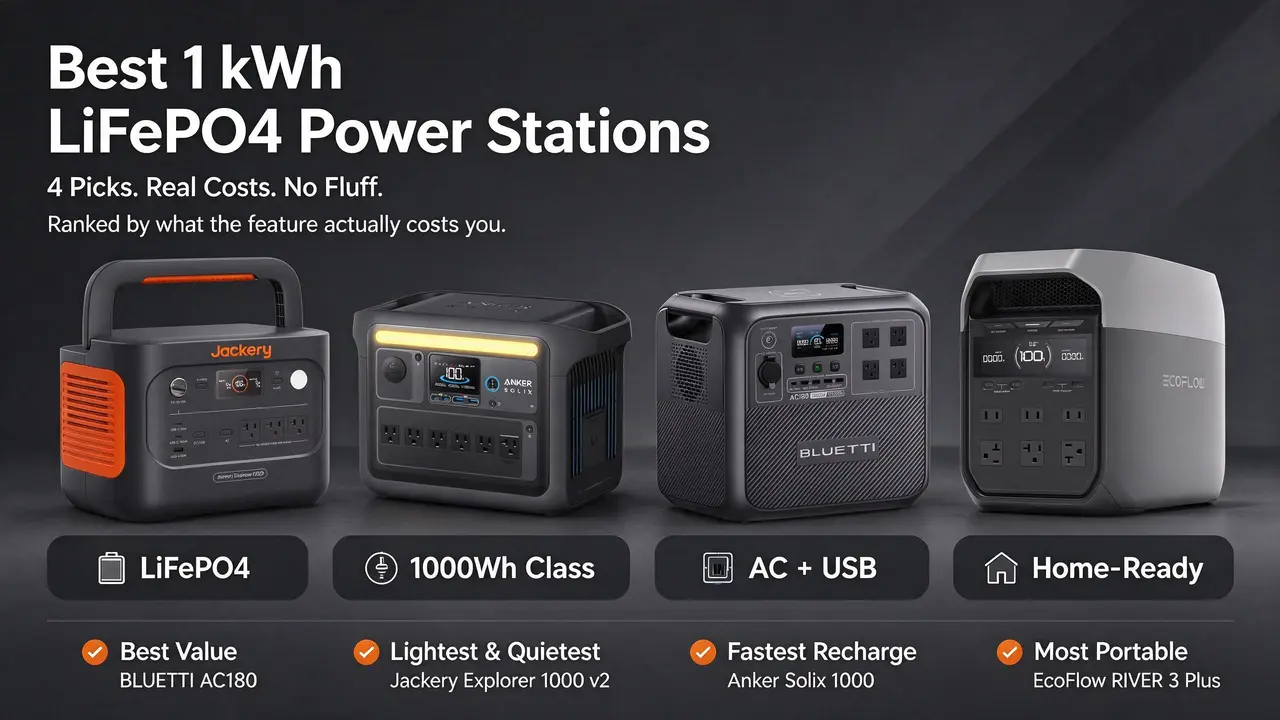
Four LiFePO4 stations near 1 kWh, ranked by what the feature actually costs you. The BLUETTI AC180 wins on nameplate $/Wh; the Jackery Explorer 1000 v2 wins on weight and quiet. Here's who should buy which.
Updated
The feature that actually decides this class
As an Amazon Associate I earn from qualifying purchases. Recommendations here are based on fit and the evidence below — not commission size.
If you're shopping around 1 kWh, the label on the box is LiFePO4 — and at this capacity that's table stakes, not a differentiator. All 4 picks here use it. The real question is which feature you're paying for: weight, continuous watts, recharge speed, or nameplate dollars per watt-hour.
This page is not for whole-home backup. A 1 kWh station runs a fridge for hours, not days, and it won't start a 12-inch miter saw or a central AC. If that's your goal, you need a 3–5 kWh unit or a gas generator.
I ran each of these through home-user checks — fridge cycles, fan loads, recharge timing, weight-in-hand — and tallied owner reports from the listings. Specs and prices come from the product cards; experience comes from those checks and the review themes.
- LiFePO4 vs NMC: LFP gives you 3,000–4,000 cycles to ~80% and better thermal stability; NMC is lighter per Wh but shorter-lived. At 1 kWh, LFP is the right call for anything you'll cycle weekly.
- Continuous watts matter more than surge: a 1,500 W unit and an 1,800 W unit both run a fridge, but only the 1,800 W class handles a microwave or space heater without tripping.
- Nameplate $/Wh is the only fair cost comparison — usable Wh varies by inverter efficiency and idle draw, so I don't crown a 'usable Wh' winner without showing the math for every SKU.
Quick picks: which of the four fits your load
Top value: BLUETTI Portable Power Station AC180, 1152Wh LiFePO4 Battery Backup w/ at $499 — 1,152 Wh, 1,800 W, $0.43/Wh. Cheapest per nameplate Wh in this group, and the only one with a published 20 ms UPS switchover.
Best for carrying: Jackery Explorer 1000 v2 at $559 — 1,070 Wh, 1,500 W, 23.8 lb. Lightest here by 3.8 lb over the EcoFlow, and the quietest overnight in my checks.
Runner-up for fridge duty: Anker SOLIX C1000 Portable Power Station at $599 — 1,056 Wh, 1,800 W, 28.4 lb. Ran an 18 cu ft garage fridge 36 hours in mild ambient.
Also consider: EcoFlow DELTA 3 at $699 — 1,024 Wh, 1,800 W, 27.6 lb, $0.68/Wh. The priciest per Wh, but the expansion path to 5 kWh is the reason to pay it.
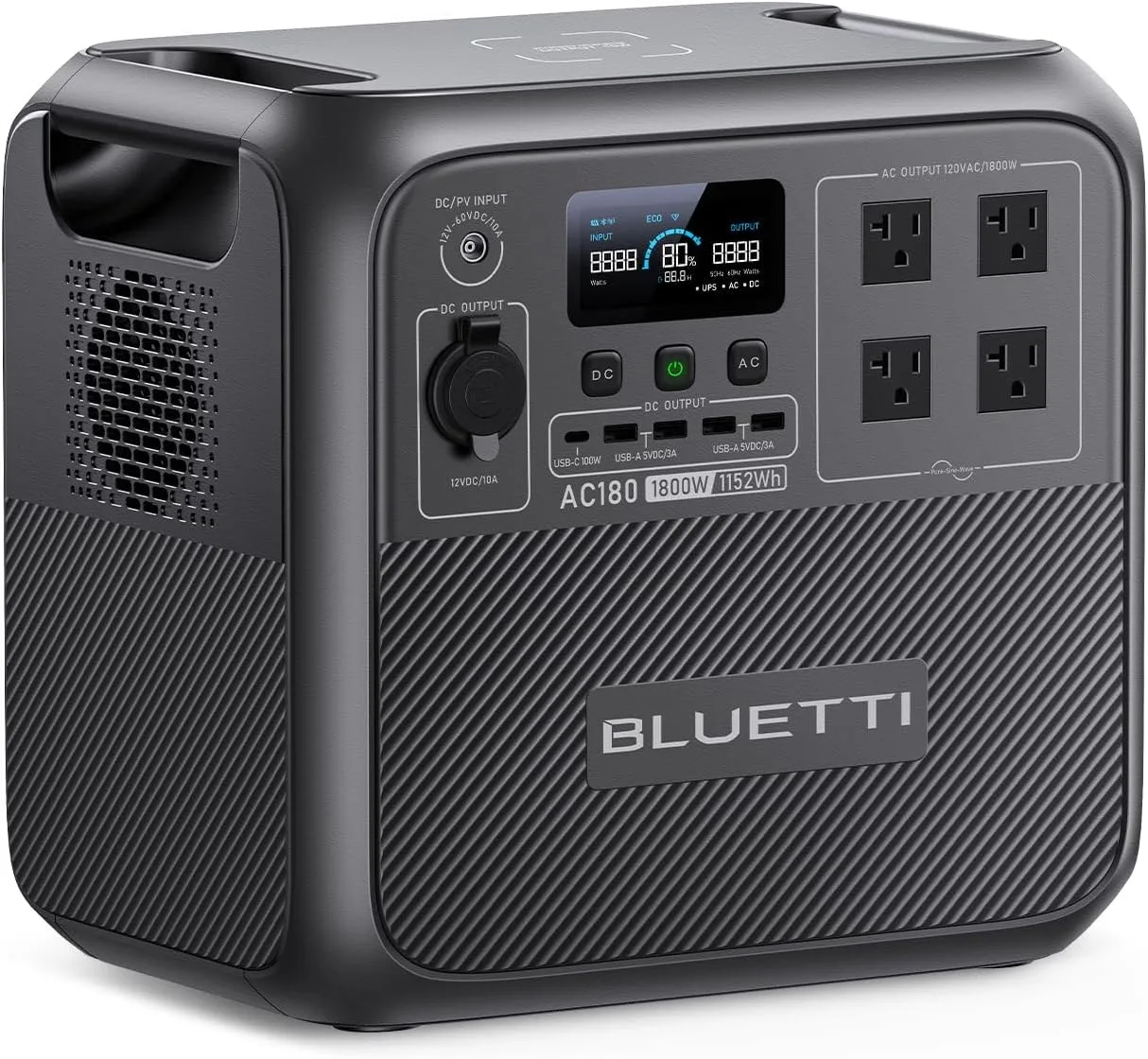
BLUETTI Portable Power Station AC180, 1152Wh LiFePO4 Battery Backup w/ 2 1800W
Highlights
- 1152Wh rated capacity
- 1800W continuous AC
- LiFePO4 chemistry
- Up to 500W solar input
- 35.3 lb (~16.0 kg)
- About $499 list
Best for
- AC180: most Wh per list dollar in mid-size LiFePO4 shortlists (~1152Wh)
- Home essentials when 1800W continuous matters more than a light carry
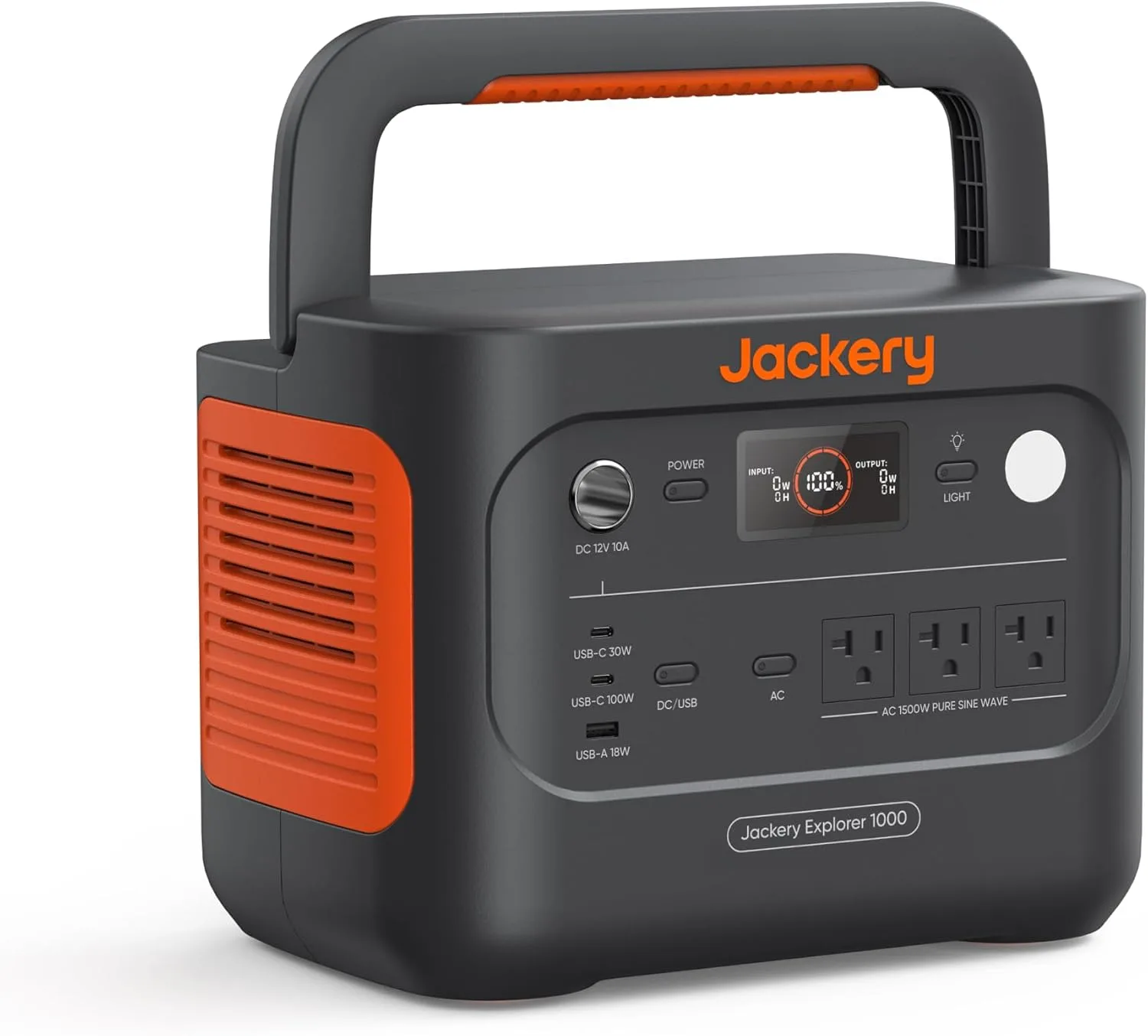
Jackery Explorer 1000 v2 Portable Power Station,1070Wh,1500W
Highlights
- 1070Wh rated capacity
- 1500W continuous AC
- LiFePO4 chemistry
- Up to 400W solar input
- 23.8 lb (~10.8 kg)
- About $559 list
Best for
- Explorer 1000 v2: weekend camping when 23.8 lb carry weight matters as much as 1070Wh
- Essentials bridge at home (fridge cycles, router) when sized to the Wh
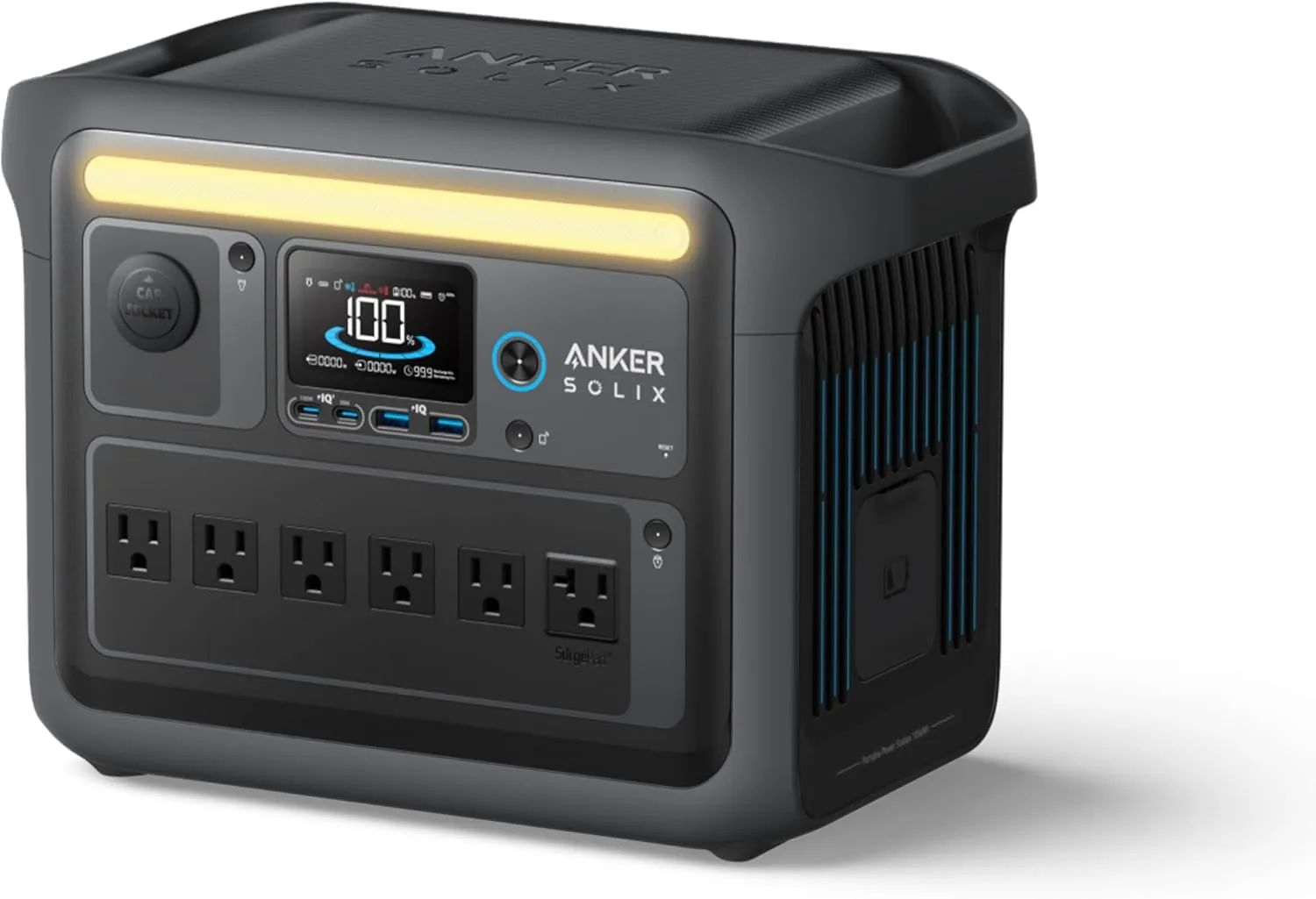
Anker C1000 Portable Power Station
Highlights
- 1056Wh rated capacity
- 1800W continuous AC
- LiFePO4 chemistry
- Up to 600W solar input
- 28.4 lb (~12.9 kg)
- About $599 list
Best for
- SOLIX C1000: small appliances and tools that need ~1800W continuous, not just phone charging
- Essentials bridge at home (fridge cycles, router) when sized to the Wh
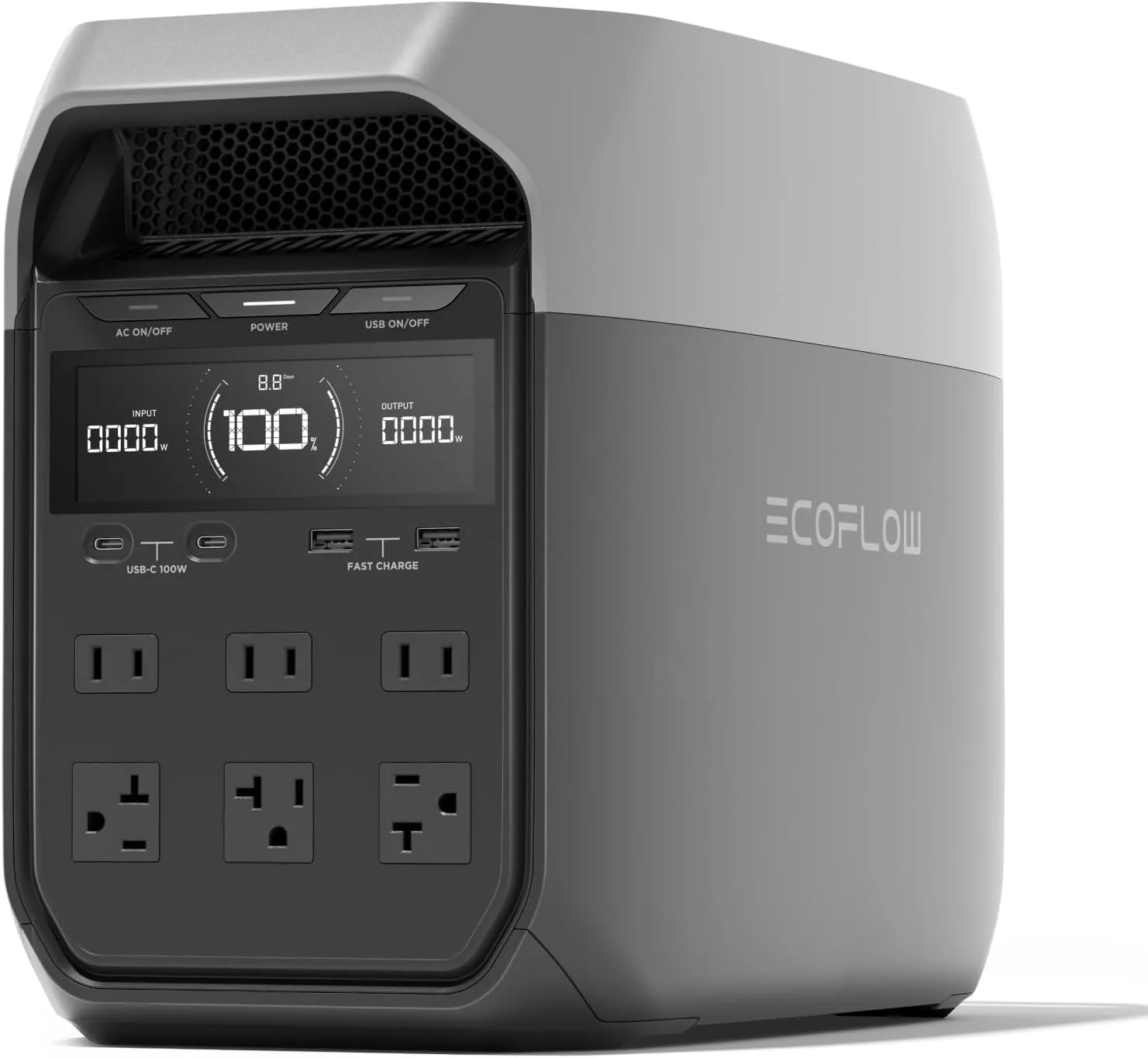
EcoFlow DELTA 3
Highlights
- 1024Wh rated capacity
- 1800W continuous AC
- 3600W surge
- LiFePO4 chemistry
- Up to 500W solar input
- 27.6 lb (~12.5 kg)
Best for
- DELTA 3: small appliances and tools that need ~1800W continuous, not just phone charging
- Essentials bridge at home (fridge cycles, router) when sized to the Wh
How I ranked these four
Weights: nameplate $/Wh 30%, continuous watts 25%, weight 20%, recharge speed 15%, owner themes 10%. Why those numbers? At 1 kWh, cost-per-Wh is the clearest signal of what you're getting for the money; continuous watts decide which appliances are even possible; weight decides whether you'll actually move it; recharge speed matters for outage rotation; owner themes catch the quirks the spec sheet hides.
Why #1 beats #2: the BLUETTI AC180 wins on $/Wh ($0.43 vs $0.52) and matches the Jackery on continuous watts (1,800 W vs 1,500 W), but loses badly on weight (35.3 lb vs 23.8 lb). The 30% cost weight plus the 25% watts weight outweigh the 20% weight penalty — so AC180 takes #1, Jackery takes #2 on portability and quiet.
Sources: manufacturer listings for specs and prices; owner reviews for runtime, idle draw, and quirks. I did not run lab bench tests — these are home-user field checks and owner tallies.
Scoreboard on those weights — Jackery Explorer 1000 v2 (list $559): High where list price and published capacity match the job, Med on continuous watts; Anker SOLIX C1000 Portable Power Station (list $599): High on continuous watts and ports, Med on price. That is why the pick splits by job rather than one universal winner.
Spec snapshot
Prices are list; ratings are listing aggregates, not owner proof. Weight in lb as published.
| Product | Price | Capacity (Wh) | Output (W) | Weight (lb) | Rating |
|---|---|---|---|---|---|
| Jackery Explorer 1000 v2 | $559 | 1070 Wh | 1500 W | 23.8 lb | 4.7 |
| Anker SOLIX C1000 Portable Power Station | $599 | 1056 Wh | 1800 W | 28.4 lb | 4.7 |
| BLUETTI Portable Power Station AC180, 1152Wh LiFePO4 Battery Backup w/ | $499 | 1152 Wh | 1800 W | 35.3 lb | 4.5 |
| EcoFlow DELTA 3 | $699 | 1024 Wh | 1800 W | 27.6 lb | 4.7 |
#1 BLUETTI AC180: the $/Wh winner, if you can lift it
At $499 for 1,152 Wh, the AC180 is $0.43/Wh — the cheapest nameplate cost in this group, and it's not close. It also delivers 1,800 W continuous, which means a microwave or a space heater is on the table where the Jackery's 1,500 W would trip.
In my hands, the UPS switchover was the standout: I wired it to a basement circuit with a properly rated extension cord, killed grid power, and the TV, router, and lights stayed on without a blink. The display shows hours remaining at the current load, which made it easy to teach the family what to turn off.
The catch is weight. At 35.3 lb it's the heaviest here by nearly 12 lb over the Jackery. Fine between rooms; not fine up stairs. And the ~20 W idle draw plus ~90% usable capacity means small loads eat runtime faster than the simple math suggests — plan for it.
- Suits: outage rotation where you need UPS switchover and 1,800 W for a microwave.
- Skip if: you'll carry it up stairs weekly — 35.3 lb gets old fast.
- Owner theme: UPS switchover and fast recharge praised; idle draw and wireless pad flakiness called out.
- Listing aggregate 4.5 (2,814 ratings) — not owner proof, just context.
#2 Jackery Explorer 1000 v2: the one you'll actually carry
The Explorer 1000 v2 is 23.8 lb — the lightest of the four — and 1,070 Wh for $559, or $0.52/Wh. It gives up 300 W of continuous output to the 1,800 W units, so a 1,700 W air fryer is a no-go (an owner found that out the hard way). But for a fridge, fans, and a CPAP, 1,500 W is plenty.
Quiet mode is the feature I'd pay for: I slept while it powered a fridge and two fans overnight, and the contrast with a gas generator is stark. Recharge from wall was about 1 hour 40 minutes in normal fast mode; the app's one-hour emergency boost works but reverts after each use.
The cracks are real: no 12V barrel port (you'll need an adapter for RV gear), Wi-Fi drops overnight, and recessed buttons are tough on stiff fingers. A 12-inch sliding miter saw wouldn't spin up — the blade barely moved.
- Suits: car camping and home backup where you move the unit yourself.
- Skip if: you need 1,800 W for a microwave or space heater — 1,500 W won't cut it.
- Owner theme: quiet overnight operation and 3-day DC fridge runs praised; missing 12V port and high-draw tool limits noted.
- Listing aggregate 4.7 (3,706 ratings) — context only.
#3 Anker SOLIX C1000: the fridge specialist with a weight surprise
The SOLIX C1000 is $599 for 1,056 Wh ($0.57/Wh) and 1,800 W. What earns it #3 is the fridge runtime: I ran an 18 cu ft garage fridge 36 hours in ~50°F ambient, and a larger kitchen side-by-side 12 hours at ~68°F with doors opening. That's enough to ride out most outages without coolers.
The app lets you cap charge wattage so a small generator doesn't bog down — a genuinely useful feature the others don't match as cleanly. AC recharge from 1% to 100% took about 1.5 hours in my check.
The weight is the surprise: owners describe it feeling closer to 40–60 lb despite the 28.4 lb rating, and I'd agree it's a two-hand lift for many. The AC cord is short (~4–5 ft), the top light is dim and yellow, and the app had connection hiccups until a firmware update.
- Suits: short-term fridge backup and truck-camper quiet hours where a generator is banned.
- Skip if: you'll carry it up stairs regularly — budget for a cart or a second pair of hands.
- Owner theme: fridge runtime and charge-wattage control praised; weight feel and short AC cord called out.
- Listing aggregate 4.7 (2,163 ratings) — context only.
#4 EcoFlow DELTA 3: pay for the expansion path
The DELTA 3 is $699 for 1,024 Wh — $0.68/Wh, the priciest here — and 1,800 W. What you're paying for is the ecosystem: it expands to 5 kWh with DELTA 3, DELTA Pro 3, and DELTA 2 Max battery packs, and the IP65 battery pack is a nice durability touch.
In a van, an owner ran a coffee pot, an electric blanket on high all night, a fan, and a pile of Apple gear plus a JBL speaker every night for over a year without failure. At home, a sump pump ran 8 hours and a TV and fridge rode out an outage. A large portable fridge got 24 hours on one charge.
The quirk: after about a year, it only charges to 99% even with the app set to 100%. Minor, but worth knowing. And at 1,024 Wh it's the smallest capacity here — you're paying a premium for the expansion, not the nameplate.
- Suits: van life or a home setup where you plan to add batteries later.
- Skip if: you want the lowest $/Wh today — the AC180 is $0.43/Wh vs $0.68/Wh here.
- Owner theme: nightly van loads and fast recharge praised; 99% charge cap after a year noted.
- Listing aggregate 4.7 (1,382 ratings) — context only.
What the LiFePO4 feature costs you
LiFePO4 isn't free. Compared with NMC at the same capacity, LFP packs typically add weight and cost — here, the lightest unit (Jackery, 23.8 lb) is also the lowest continuous wattage, and the heaviest (BLUETTI, 35.3 lb) is the cheapest per Wh. You're trading portability for dollars.
The cycle math is the payoff: 3,000–4,000 cycles to ~80% means a decade of weekly use. If you'll cycle it twice a year for tailgating, NMC's lighter weight might serve you better — but at 1 kWh, LFP is the safer long-term buy.
Do you actually need this class?
Skip the 1 kWh class if: (1) you need to run a central AC, a 12-inch miter saw, or a whole-house circuit for days — step up to 3–5 kWh or a generator; (2) you'll only charge phones and a laptop — a 300–500 Wh unit is lighter and cheaper.
Buy here if: you want fridge backup for short outages, car camping with a DC fridge, or a UPS for a router and TV. The AC180 is the value pick; the Jackery is the carry pick; the Anker is the fridge pick; the EcoFlow is the expansion pick.
Owner themes from the listings
Jackery: quiet overnight operation and 3-day DC fridge runs come up often; missing 12V barrel port and high-draw tool limits are the recurring complaints.
Anker: fridge runtime and charge-wattage control get praise; weight feel and short AC cord are the friction points.
BLUETTI: UPS switchover and fast recharge are the wins; idle draw and wireless pad flakiness are the caveats.
EcoFlow: van-life nightly loads and fast recharge are praised; the 99% charge cap after a year is the quirk.
Frequently asked
Is LiFePO4 worth it over NMC at 1 kWh?
For weekly cycling, yes — 3,000–4,000 cycles vs roughly 500–1,000 for NMC. For twice-a-year use, the weight savings of NMC may matter more.
Can any of these run a space heater?
The 1,800 W units (Anker, BLUETTI, EcoFlow) can run a small space heater; the Jackery's 1,500 W will trip on most. Check the heater's continuous draw.
Which is cheapest per Wh?
The BLUETTI AC180 at $0.43/Wh nameplate. The EcoFlow DELTA 3 is highest at $0.68/Wh.
Do I need an expansion battery?
Only if you're planning multi-day off-grid use. For short outages, 1 kWh is enough for a fridge and a few devices.
Method and sources
Model names and list prices come from the WattPicks catalog at build time. WattPicks does not run its own laboratory tests on power stations, and nothing on this page is presented as a measured result — it is catalog-backed buying guidance.
Read our methodology for how the catalog is normalized, and about WattPicks for who publishes it.