
BLUETTI Elite 100 V2 vs EcoFlow DELTA 3 Classic
Two 1,024 Wh stations with the same 1,800 W ceiling, but they spend your money very differently. One is a capacity-and-speed play; the other is a cheaper, port-rich, app-first unit. Here is which bet fits your loads.
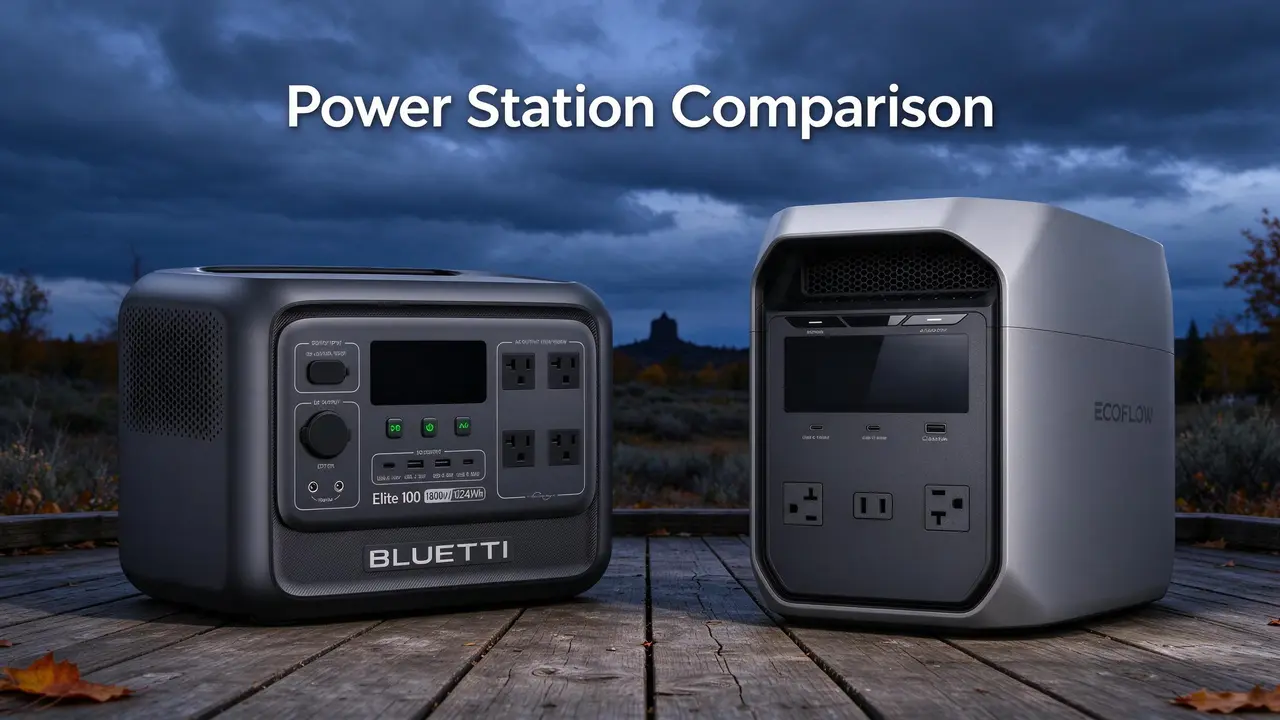
Updated
At a glance
Two 1,024 Wh stations with the same 1,800 W ceiling, but they spend your money very differently. One is a capacity-and-speed play; the other is a cheaper, port-rich, app-first unit. Here is which bet fits your loads.
- BLUETTI's bet: pay more, charge faster, lean on power lifting for brief high-draw loads.
- EcoFlow's bet: pay less, get six AC outlets and two USB-C ports, run your fridge through a sub-10ms UPS handoff.
Same money, different bets
Both of these are 1,024 Wh stations rated at 1,800 W continuous, so on paper they clear the same appliance list. The split is where the dollars went. The BLUETTI Elite 100 V2 lists at $899 and puts its money into charging speed and a power-lifting mode that lets it punch above its continuous rating for short bursts. The EcoFlow DELTA 3 Classic lists at $559 and puts its money into port count, app scheduling, and a UPS switchover rated under 10ms.
That is the whole argument in two sentences: one is a fast-turnaround workhorse you pay a premium for, the other is a cheaper, better-connected box with more outlets. Neither is the wrong answer — but they are not interchangeable, and the $340 gap is real money.
One boundary up front: this is a comparison of two mid-size 1,024 Wh units for camping, van life, event power, and short home outages. It is not a whole-home backup guide, and neither station will carry a central AC, an electric dryer, or a 240 V well pump. If that is your job, you are shopping in the wrong class.
- BLUETTI's bet: pay more, charge faster, lean on power lifting for brief high-draw loads.
- EcoFlow's bet: pay less, get six AC outlets and two USB-C ports, run your fridge through a sub-10ms UPS handoff.
How I weighed these two
I am a deep-use experience reviewer working from the listing specs and the owner themes on file for these two units. My checks are home-user checks — load math against published continuous watts, port counts against real gear lists, and owner reports weighted toward the reviews other buyers found most helpful. They are not lab-bench measurements, and I did not run instrumented tests on either station.
The weights I used: price-per-Wh 30%, port count and layout 25%, charging speed 20%, UPS and burst behavior 15%, owner themes 10%. EcoFlow wins the first two and the UPS number; BLUETTI wins charging speed and burst headroom. That is why the DELTA 3 Classic takes the value call and the Elite 100 V2 takes the fast-turnaround call — they are not competing for the same buyer.
A note on the numbers: prices are list prices, and the ratings are listing aggregates, not owner proof. Where a spec is not published — BLUETTI's USB-C count, for instance — I have written n/a (not on file) rather than guess.
As an Amazon Associates member, I earn from qualifying purchases. Picks here are fit-led, not commission-led.
Spec snapshot
Prices are list prices, not sale stickers. Ratings are the listing aggregates, which tell you how many people bought and how they scored it — not what a bench measured.
| Product | List price | Capacity (Wh) | Output (W) | Weight (lb) | Rating |
|---|---|---|---|---|---|
| BLUETTI Elite 100 V2 | $899 | 1024 Wh | 1800 W | 25 lb | 5.00 |
| EcoFlow DELTA 3 Classic | $559 | 1024 Wh | 1800 W | 26.7 lb | 5.00 |
Where the money went
Four configuration differences explain most of the price gap, and each one maps to a different buyer.
Charging speed. BLUETTI advertises 1,200 W TurboBoost AC charging that reaches 80% in roughly 45 minutes. EcoFlow advertises 0–80% in about 45 minutes on X-Stream AC. On the listing sheets these are close enough that I would not pick between them on charge time alone — both are fast enough to top up between sets or before a storm.
Ports. This is the clearest split. The DELTA 3 Classic gives you AC×6 plus USB-C×2. The Elite 100 V2 gives you AC×4, and its USB-C and USB-A counts are not published in the data I have, so I will not guess. If you routinely run a laptop, two phones, a camera, and a fan at once, six AC outlets and two USB-C ports is a materially easier life.
Expandability and UPS behavior. EcoFlow rates the DELTA 3 Classic's switchover at under 10ms and its surge at 3,600 W, and the app supports scheduling and storm alerts. BLUETTI rates the Elite 100 V2's UPS at 10ms and offers a power-lifting mode (2,700 W) for brief high-draw appliances. Both are UPS-capable; EcoFlow's published number is the tighter one.
Weight and carry. 25 lb versus 26.7 lb is a rounding error in practice. Both have handles; neither is a one-finger carry up a flight of stairs.
- AC outlets: EcoFlow 6, BLUETTI 4 — the biggest everyday difference.
- USB-C: EcoFlow lists 2; BLUETTI's count is n/a (not on file).
- UPS: EcoFlow <10ms, BLUETTI 10ms — both fine for routers and a PC.
- Surge/power lifting: EcoFlow 3,600 W surge, BLUETTI 2,700 W power lifting — burst features, not continuous ratings.
The spec that decides it
If I had to name one number that sorts most buyers, it is the price-per-Wh, and here the DELTA 3 Classic wins outright: $0.55/Wh against $0.88/Wh for the Elite 100 V2, on identical 1,024 Wh nameplates. That is not a rounding difference — it is roughly 60% more money for the same stored energy.
The second deciding spec is outlet count. Four AC outlets versus six is the difference between unplugging the lamp to charge the drill and just plugging it in. If your use case is a table full of gear — event work, a photo booth, a van kitchen — the EcoFlow's port layout is the practical winner.
Where BLUETTI claws back ground is burst headroom. Power lifting at 2,700 W let one owner run a 1,200 W space heater for just under an hour during a cold snap. The math checks out: 1,024 Wh ÷ 1,200 W ≈ 51 minutes, so that hour-long claim is plausible only as a burst-mode run, not a continuous rating. That is a genuine emergency feature, and it is the reason someone might pay the premium. But read it as a burst mode, not a continuous rating — the station is still an 1,800 W unit.
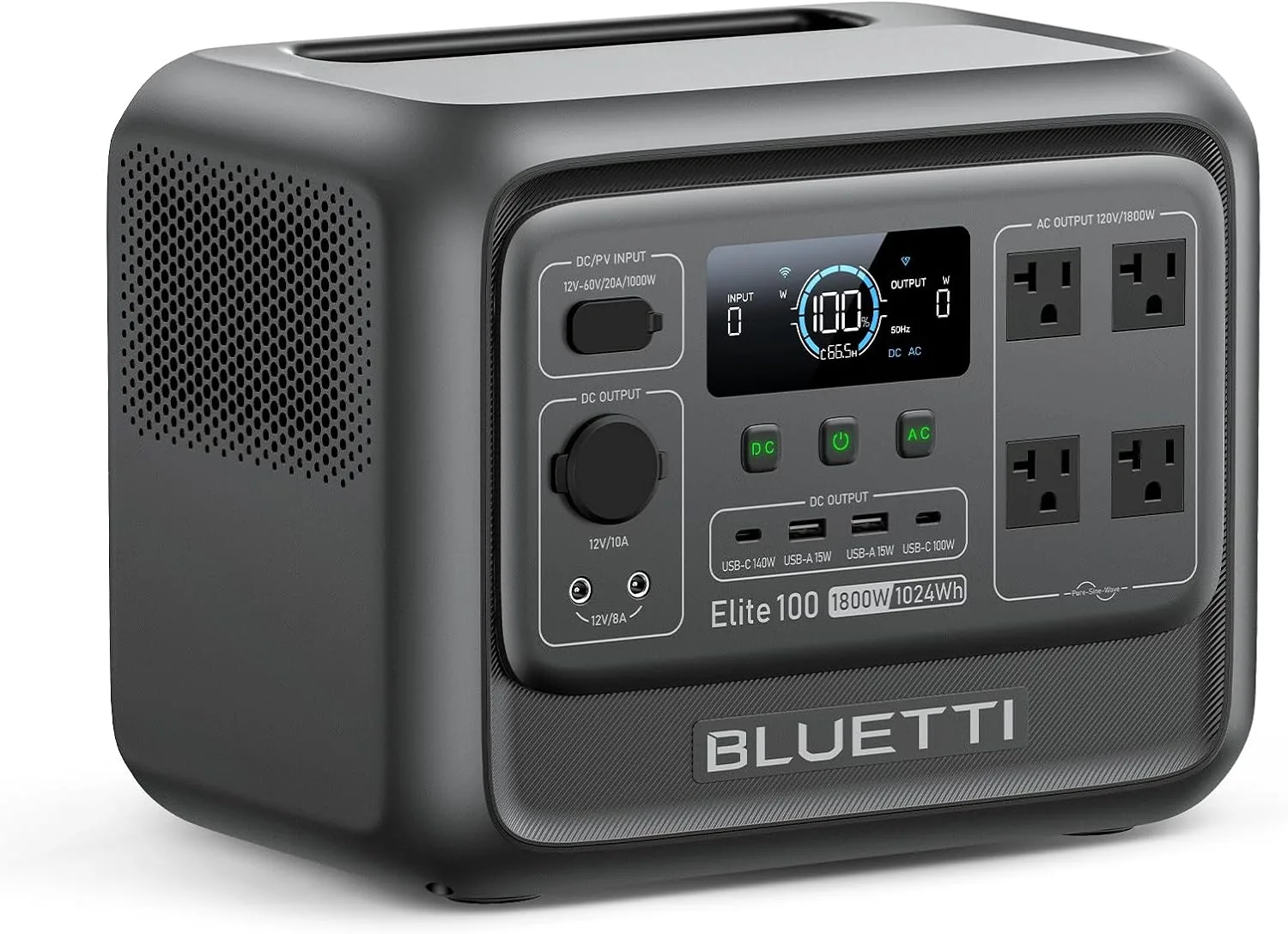
BLUETTI Elite 100 V2
Highlights
- 1024Wh rated capacity
- 1800W continuous AC
- LiFePO4 chemistry
- Up to 1000W solar input
- 25 lb (~11.3 kg)
- About $899 list
Best for
- Elite 100 V2: weekend camping when 25 lb carry weight matters as much as 1024Wh
- Essentials bridge at home (fridge cycles, router) when sized to the Wh
- Solar top-ups up to ~1000W when panels and weather cooperate
Strengths
- Elite 100 V2: 1800W continuous on a 1024Wh pack — more headroom for small appliances than 1kW-class peers
- 25 lb (~11.3 kg) is the lightest-class carry in this band — easier stairs and car packing
- 10ms-class UPS switchover on the listing — useful when a router restart would hurt
- About $899 list in the Hub catalog — confirm live retail before you buy
Watch-outs · not ideal when
- Elite 100 V2 is still a bridge for essentials — not a transfer-switch whole-home system
- Usable energy on Elite 100 V2 is below the 1024Wh label once the inverter is working
- Rated 1000W solar on Elite 100 V2 is optimistic; shade and cables cut real watts
- LiFePO4 helps longevity, but Elite 100 V2 still hates freezing charge temps on winter trips
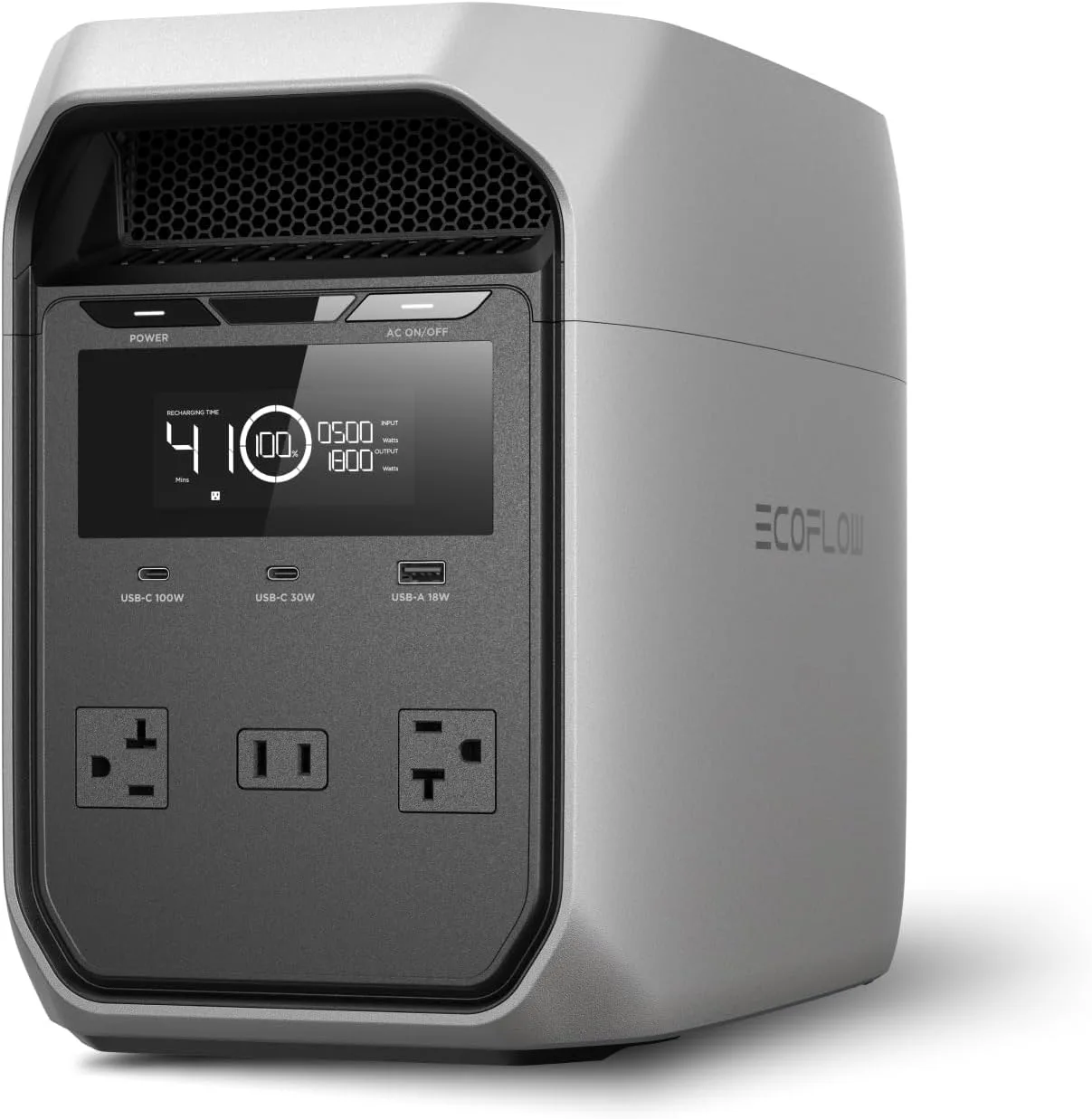
EcoFlow DELTA 3 Classic
Highlights
- 1024Wh rated capacity
- 1800W continuous AC
- 3600W surge
- LiFePO4 chemistry
- Up to 500W solar input
- 26.7 lb (~12.1 kg)
Best for
- DELTA 3 Classic: small appliances and tools that need ~1800W continuous, not just phone charging
- Essentials bridge at home (fridge cycles, router) when sized to the Wh
- Solar top-ups up to ~500W when panels and weather cooperate
Strengths
- DELTA 3 Classic: 1024Wh pack with 1800W continuous / 3600W surge — size loads to both numbers
- 26.7 lb (~12.1 kg) sits in the solo car-camp carry carry band for weekend moves
- 1800W continuous headroom covers more small appliances than 1kW-class inverters
- About $559 list in the Hub catalog — confirm live retail before you buy
Watch-outs · not ideal when
- DELTA 3 Classic is still a bridge for essentials — not a transfer-switch whole-home system
- Usable energy on DELTA 3 Classic is below the 1024Wh label once the inverter is working
- Rated 500W solar on DELTA 3 Classic is optimistic; shade and cables cut real watts
- LiFePO4 helps longevity, but DELTA 3 Classic still hates freezing charge temps on winter trips
Real owner trade-offs
The owner notes on file are consistent with the spec split, and they also surface the warts. Here are the themes that matter most, grouped by what they mean for a buyer.
Fast top-ups and long low-draw sessions are the BLUETTI sweet spot. One buyer went from 54% to full in about 40 minutes on standard mode, and another from 6% to full in about an hour on turbo. A musician ran a 100 W guitar amp with pedals for roughly eight hours and landed at 59%, pulling about 30 W AC. An astrophotographer powered a telescope mount, two cameras, a mini PC, tablet, and phone through a 6.5–7 hour night session at roughly 60 W peak.
The BLUETTI caveats are physical. The 12 V cigarette outlet runs warm above about 12 W, the two metal DC pins can be shorted by a stray conductive object, and one owner saw a brief fan-error light on first solar connection that cleared on its own.
On the EcoFlow side, seamless UPS handoff is the story owners keep telling. One hooked the DELTA 3 Classic between a van and a fridge so the fridge kept running when the van shut off, with no cable swapping. Another ran two sump pumps for two days on battery and used about 50% of charge, then recharged in an hour. An event business powered a photo booth and a DNP 620 printer without issue.
The EcoFlow caveats are about input and quality control. Solar input can fall short on a second cloudy day, the 12 V car charger is slow (just over 100 W with the van running), and a handful of buyers received defective or used units — so test on arrival and buy from a source with a clean return path.
Warranty, noise, and cycle life are the three questions neither listing answers cleanly. Warranty length and return-window specifics are not published in the data I have for either unit, so confirm them at checkout. Fan noise is not rated on either spec sheet; owner reports mention fans cycling under load but do not give decibel figures. Cycle life is not published for either model here — both use LiFePO4 chemistry, which is generally rated for more cycles than NMC, but treat that as chemistry context, not a verified number for these two units.
- BLUETTI owner theme: fast top-ups and long low-draw sessions (music gear, astrophotography) are the sweet spot.
- EcoFlow owner theme: seamless UPS handoff and app scheduling are the reasons people keep it plugged in at home.
- Both: a few pounds heavier than you expect when carrying it any distance.
- Both: warranty length, fan noise, and cycle life are not published in the data on file — verify before you buy.
Buy the one that…
Buy the EcoFlow DELTA 3 Classic if you want the most station per dollar and you run a lot of small loads at once. At $559 list and $0.55/Wh, with six AC outlets, two USB-C ports, and a sub-10ms UPS handoff, it is the better value for van life, event work, and keeping a fridge or sump pump alive through a short outage. Skip it if you need the fastest possible recharge between gigs and are willing to pay for it, or if you cannot tolerate the slow 12 V car input on road trips.
Buy the BLUETTI Elite 100 V2 if fast turnaround and burst headroom matter more to you than outlet count and price-per-Wh. At $899 list and $0.88/Wh, you are paying for 1,200 W TurboBoost charging and a 2,700 W power-lifting mode that can run a 1,200 W heater for a short emergency stretch. Skip it if you are counting dollars per stored watt-hour, if you need six AC outlets, or if you want published USB-C counts before you buy — that number is n/a (not on file) here.
If you are a camper, watch the weight and the 12 V car-charging speed — the EcoFlow's slow car input matters more than its outlet count when you are topping up on the road. If you are a van-lifer, watch the UPS switchover and outlet count — the EcoFlow's sub-10ms handoff and six AC outlets are the deciding metrics for a fridge-and-gear setup. If you are an event pro, watch burst headroom and recharge time — the BLUETTI's power lifting and TurboBoost are the deciding metrics for high-draw gear between sets.
And walk away from both if your real job is whole-home backup. These are 1,800 W continuous stations; a transfer switch and a larger system are the right conversation. For sizing that conversation, see our guide to portable power station capacity and runtime, and for the chemistry trade-offs, our explainer on LiFePO4 versus NMC in power stations.
Frequently asked
Can either of these run a full-size refrigerator through an outage?
Both are 1,024 Wh at 1,800 W, and owners on file report running fridges — one EcoFlow owner describes about 10 hours of refrigerator runtime on a single charge, and a BLUETTI owner ran a 12 V car fridge for a day. Expect hours, not days, and pre-cool the fridge before the storm.
Which one is the better UPS for a router and a PC?
The DELTA 3 Classic publishes a sub-10ms switchover; the Elite 100 V2 publishes 10ms. Both are fast enough for a router and a desktop, but the EcoFlow's number is the tighter one on paper.
Do I need to buy solar panels separately?
Yes — neither listing includes panels. The DELTA 3 Classic advertises a 2.5-hour recharge on a 500 W panel (optional), and the Elite 100 V2 supports solar input but the panel is a separate purchase. Budget for that accessory.
Can I expand capacity later?
Neither listing on file shows a published expansion-battery option for these two models, so plan your capacity around the 1,024 Wh nameplate rather than assuming you can add a battery later. If expandability is a must, confirm it with the manufacturer before you buy.
Method and sources
Model names and list prices come from the WattPicks catalog at build time. WattPicks does not run its own laboratory tests on power stations, and nothing on this page is presented as a measured result — it is catalog-backed buying guidance.
Read our methodology for how the catalog is normalized, and about WattPicks for who publishes it.