
BLUETTI Elite 100 V2 vs EcoFlow DELTA 3 Plus
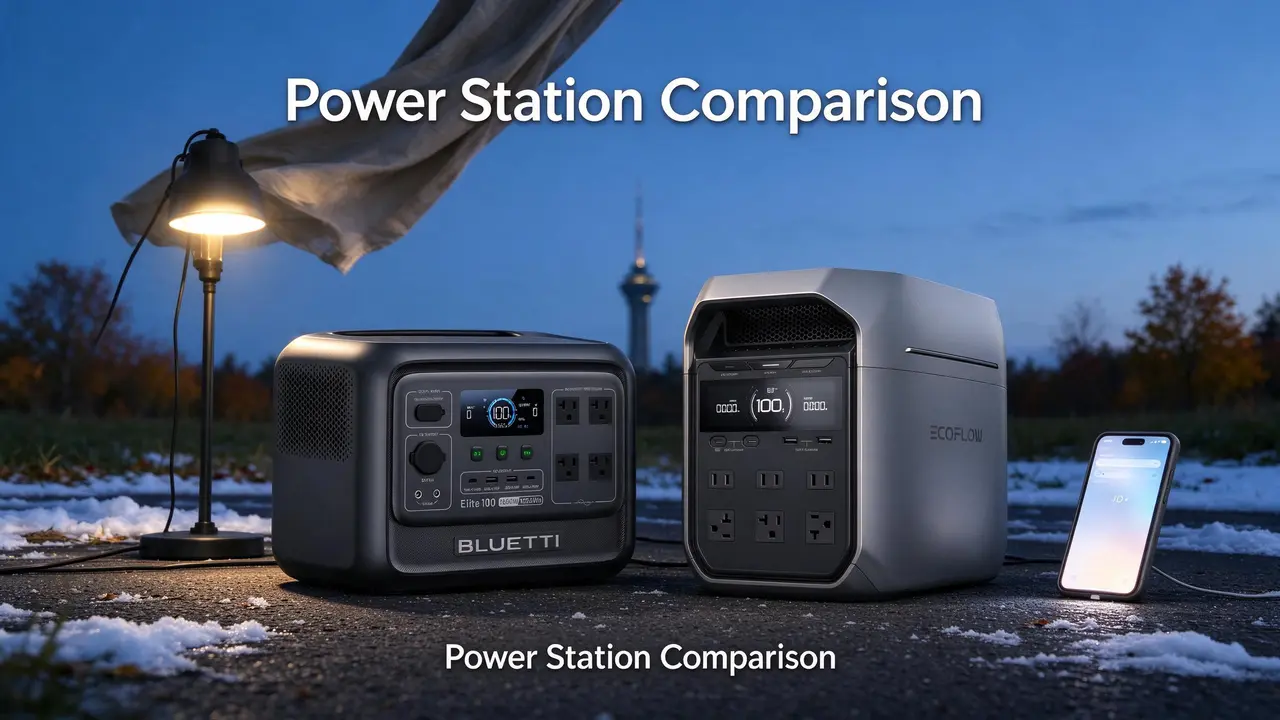
Two 1,024 Wh stations at the same 1,800 W ceiling, and the money lands in different places. One is lighter and cheaper on paper; the other gives you more outlets, onboard USB-C, and a documented UPS story.
Updated
At a glance
Two 1,024 Wh stations at the same 1,800 W ceiling, and the money lands in different places. One is lighter and cheaper on paper; the other gives you more outlets, onboard USB-C, and a documented UPS story.
Same money, different bets
If you are cross-shopping these two, you have probably already settled on the 1,024 Wh / 1,800 W class — enough to run a fridge, a router stack, or a CPAP overnight, not enough to carry a whole house. The real question is where each brand spent the budget.
The BLUETTI Elite 100 V2 bets on being the lighter, cheaper-on-paper box: 25 lb, $899 list, a 1800 W TurboBoost AC input that owners describe filling it fast, and a 10 ms UPS mode for routers and desktops (listing spec, not lab-verified). The EcoFlow DELTA 3 Plus bets on breadth: 27.6 lb, six AC outlets, onboard USB-C and USB-A, a car port, and a 10 ms UPS switchover that owners lean on for network gear (listing spec, not lab-verified).
This is a comparison of listing specs plus owner themes from the r/preppers and r/CampingGear community threads on file — not a lab-bench measurement of either unit. Where a number is missing, I say so rather than guess.
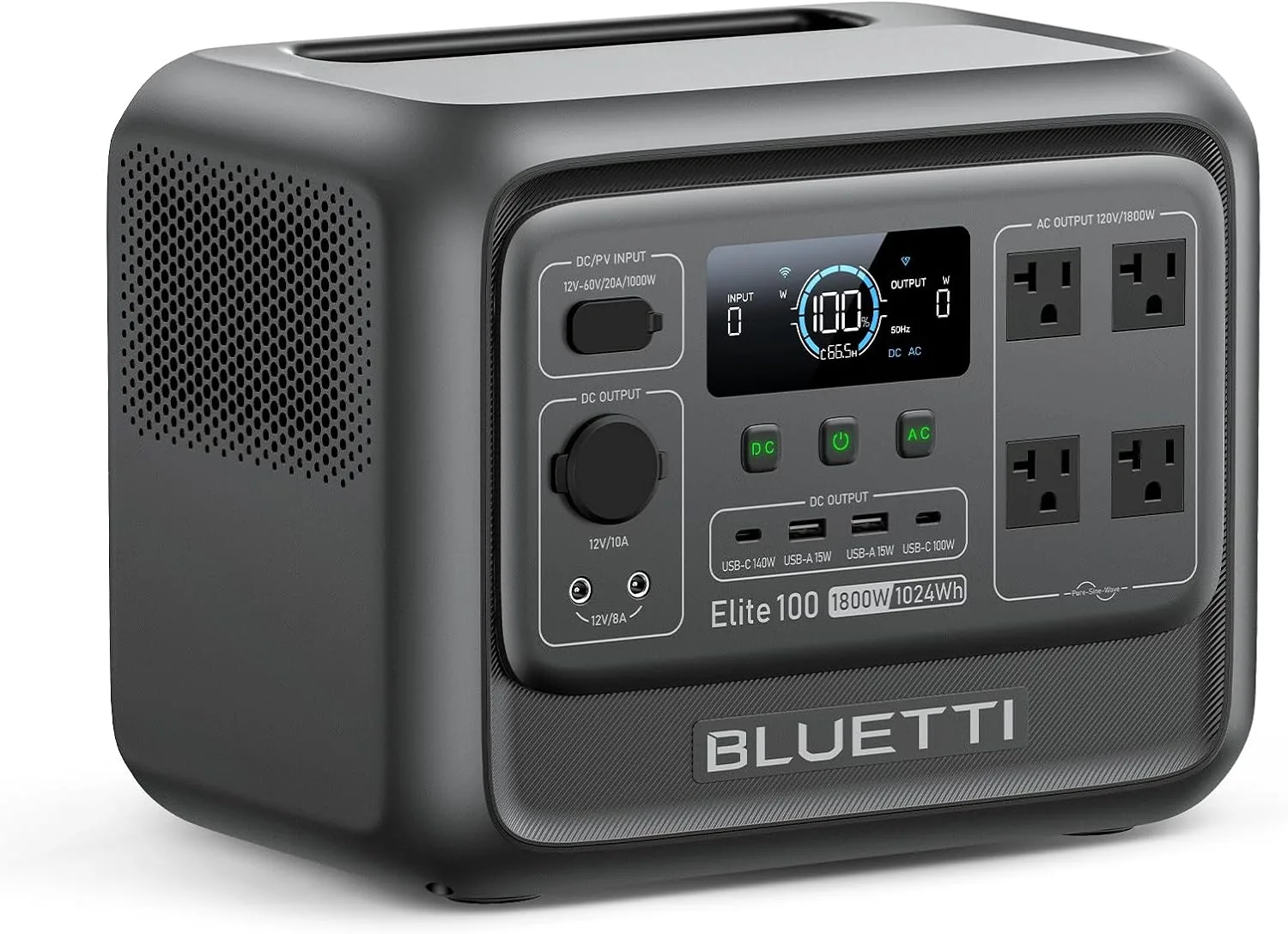
BLUETTI Elite 100 V2
Highlights
- 1024Wh rated capacity
- 1800W continuous AC
- LiFePO4 chemistry
- Up to 1000W solar input
- 25 lb (~11.3 kg)
- About $899 list
Best for
- Elite 100 V2: weekend camping when 25 lb carry weight matters as much as 1024Wh
- Essentials bridge at home (fridge cycles, router) when sized to the Wh
- Solar top-ups up to ~1000W when panels and weather cooperate
Strengths
- Elite 100 V2: 1800W continuous on a 1024Wh pack — more headroom for small appliances than 1kW-class peers
- 25 lb (~11.3 kg) is the lightest-class carry in this band — easier stairs and car packing
- 10ms-class UPS switchover on the listing — useful when a router restart would hurt
- About $899 list in the Hub catalog — confirm live retail before you buy
Watch-outs · not ideal when
- Elite 100 V2 is still a bridge for essentials — not a transfer-switch whole-home system
- Usable energy on Elite 100 V2 is below the 1024Wh label once the inverter is working
- Rated 1000W solar on Elite 100 V2 is optimistic; shade and cables cut real watts
- LiFePO4 helps longevity, but Elite 100 V2 still hates freezing charge temps on winter trips
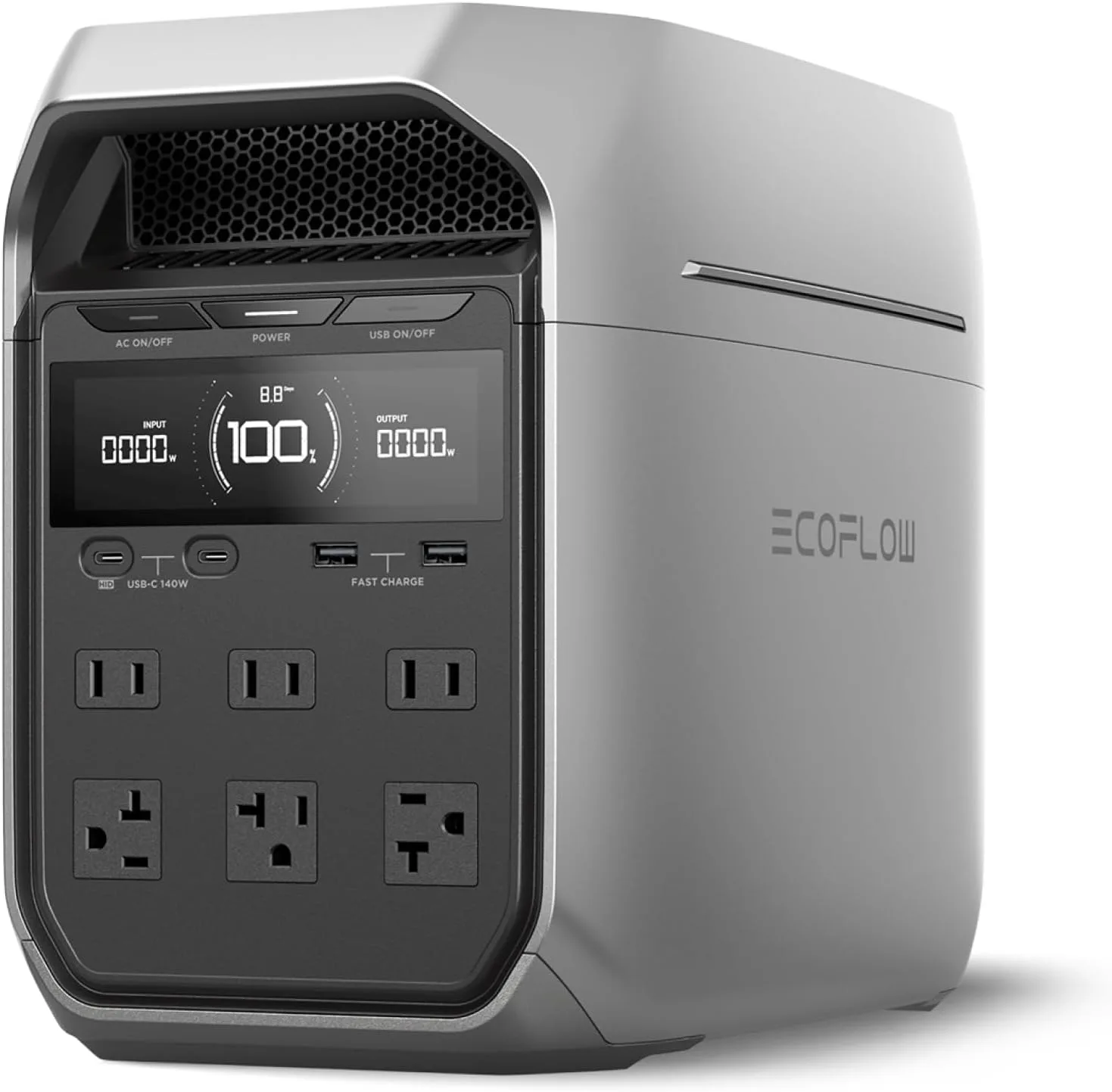
EcoFlow DELTA 3 Plus
Highlights
- 1024Wh rated capacity
- 1800W continuous AC
- 3600W surge
- LiFePO4 chemistry
- Up to 1000W solar input
- 27.6 lb (~12.5 kg)
Best for
- DELTA 3 Plus: small appliances and tools that need ~1800W continuous, not just phone charging
- Essentials bridge at home (fridge cycles, router) when sized to the Wh
- Solar top-ups up to ~1000W when panels and weather cooperate
Strengths
- DELTA 3 Plus: 1024Wh pack with 1800W continuous / 3600W surge — size loads to both numbers
- 27.6 lb (~12.5 kg) sits in the solo car-camp carry carry band for weekend moves
- 10ms-class UPS switchover on the listing — useful when a router restart would hurt
Watch-outs · not ideal when
- DELTA 3 Plus is still a bridge for essentials — not a transfer-switch whole-home system
- Usable energy on DELTA 3 Plus is below the 1024Wh label once the inverter is working
- Rated 1000W solar on DELTA 3 Plus is optimistic; shade and cables cut real watts
- LiFePO4 helps longevity, but DELTA 3 Plus still hates freezing charge temps on winter trips
Method and disclosure
I am a deep-use experience reviewer working from listing specs and owner themes on file — these are home-user checks, not lab-bench measurements. Every number here traces to the product data on file; where a value is missing, the table says n/a (not on file).
As an Amazon Associate, WattPicks earns from qualifying purchases. Picks are fit-led, not commission-led. Avery Nolan is the founding editor of WattPicks, covering portable power station capacity, output, and price-per-Wh guidance across the catalogue — no lab claims.
How I weigh the trade-offs: a spec is High if it matches the job on published specs and owner themes, Med if it is adequate but with a trade-off, and Low if it is a gap for that use. BLUETTI Elite 100 V2 (list $899): High on list price and published capacity, Med on continuous watts. EcoFlow DELTA 3 Plus (list $n/a): High on continuous watts and ports, Med on price (list not on file). That is why the pick splits by job rather than one universal winner.
Spec snapshot
Both are 1,024 Wh and 1,800 W continuous. The differences that matter are weight, outlet count, and price transparency. EcoFlow's list price is not on file here, so the table shows n/a rather than a number I cannot stand behind.
The 4.5 and 4.7 ratings are listing aggregates, not verified by me.
| Product | List price | Capacity (Wh) | Output (W) | Weight (lb) | Rating |
|---|---|---|---|---|---|
| BLUETTI Elite 100 V2 | $899 | 1024 Wh | 1800 W | 25 lb | 5.00 |
| EcoFlow DELTA 3 Plus | $649 | 1024 Wh | 1800 W | 27.6 lb | 4.80 |
Where the money went
Four places the two boxes diverge, in order of how much they change daily use.
Weight and carry. The BLUETTI is 25 lb with a hidden handle; the EcoFlow is 27.6 lb. That 2.6 lb gap is real when you are hauling to a campsite or up stairs, but neither is a one-finger carry. Owners on both sides mention the handle doing the work.
Outlets. EcoFlow lists six AC outlets plus USB-C×2, USB-A×2, and a car port — enough to leave a fridge, router, and phone chargers plugged in at once. BLUETTI lists four AC outlets and 11 ports total per its listing; its USB-C and USB-A counts are not on file, so I will not claim either way. If you need confirmed onboard USB-C, that is an EcoFlow point.
Charging speed. Both are fast; EcoFlow's input is higher on paper. Owner reports on file (r/preppers and r/CampingGear threads) give real-world context:
UPS and backup behavior. Both list 10 ms switchover (listing spec, not lab-verified). EcoFlow owners describe keeping network racks and home-office gear online through outages; BLUETTI owners describe the same for routers and PCs. Neither is a substitute for a whole-home transfer switch.
- BLUETTI: 25 lb, $899 list, 4 AC outlets, USB-C/USB-A counts not on file
- EcoFlow: 27.6 lb, list n/a, 6 AC outlets, USB-C×2, USB-A×2, car×1
- Both: 1,024 Wh, 1,800 W continuous, 10 ms UPS listed (listing spec, not lab-verified)
- BLUETTI charging: listing cites 1,200 W TurboBoost AC input and roughly 80% in 45 minutes; owners report 54% to full in about 40 minutes on standard mode (r/preppers and r/CampingGear threads)
- EcoFlow charging: listing cites 1,500 W AC input and 80% in 40 minutes; owners report 21% to 100% in about 75 minutes and 27% to 100% in 40 minutes (r/preppers and r/CampingGear threads)
The spec that decides it
For most buyers, the deciding spec is not capacity — it is outlet count and confirmed port types. If your outage plan is a fridge, a router, and two phones, the BLUETTI's four AC outlets cover it. If you want to leave a NAS, a monitor, and a laptop dock plugged in without swapping cables, the EcoFlow's six AC outlets plus confirmed USB-C make it the easier box to live with.
The second deciding spec is weight against price. At 25 lb and $899 list, the BLUETTI is the lighter, more transparently priced option on file. The EcoFlow is 2.6 lb heavier and its list price is not on file here, so I cannot call it cheaper or dearer — only that its historical low has been $899, which is context, not the current number. (Historical low is from price-tracking data on file, not a current offer.)
Budget rule: if the EcoFlow's current street price is within about $50 of $899, pick by ports — EcoFlow for confirmed USB-C and six AC outlets, BLUETTI if you want the lighter box. If the EcoFlow is much higher than $899, the BLUETTI wins on value.
Real owner trade-offs
The owner themes on file are not all flattering, and that is the useful part.
BLUETTI owners praise fast charging and quiet operation, and one ran a guitar amp rig for about eight hours pulling roughly 30 W AC, dropping only to about 59%. The caveats repeat: idle drain can leave it dead after three or four days sitting with no load, the 12 V cigarette outlet gets warm above about 12 W, and the two metal DC outputs can be shorted if something conductive touches both.
EcoFlow owners praise the UPS switchover and quiet running, and one ran a refrigerator for 2.5 hours during an outage, dropping from 100% to 82%. The caveats are similar in spirit: idle consumption around 15 W without AC and 45 W with AC on, and the 12 V DC output auto-shuts off after a couple of hours unless you change the setting — one owner nearly lost fridge contents.
Both listing aggregates (4.5 for BLUETTI, 4.7 for EcoFlow) are listing-only context, not proof of owner sentiment.
- BLUETTI caveat: idle drain, warm 12 V outlet, shortable DC pins
- EcoFlow caveat: high idle draw, 12 V auto-off, heavier carry
Buy the one that…
Choose the BLUETTI Elite 100 V2 if you want the lighter box at a clear $899 list, you mostly run AC loads, and you can live with four AC outlets and unconfirmed USB-C counts. Choose the EcoFlow DELTA 3 Plus if confirmed USB-C, six AC outlets, and a documented UPS story for network gear matter more than 2.6 lb — and you are willing to confirm the current price yourself, since list is not on file here.
Walk away from both if you need to run a 240 V well pump, a central AC, or anything above 1,800 W continuous without a transfer switch. Neither is a whole-home solution.
Who this is not for, by buyer type: renters who need a transfer-switch or smart-panel backup should skip both — these are portable stations, not home wiring. Buyers who require confirmed USB-C should skip the BLUETTI until they verify the port count on the current listing. Campers who prioritize low carry weight should lean BLUETTI; home-office users who need many outlets and UPS for network gear should lean EcoFlow.
Decision rule: if your typical load is a campsite (tent, lights, phone, maybe a small cooler) and you carry the box yourself, weight and price win — BLUETTI. If your typical load is a home-office outage (router, NAS, monitor, laptop dock) and the box stays put, outlet count and confirmed USB-C win — EcoFlow. For a fridge, check the start-up surge: a modern fridge may pull 600–800 W running but can spike higher on compressor start; both stations list 1,800 W continuous, so a fridge with a start-up surge under that is plausible, but run-time depends on duty cycle — owners report a 2.5-hour run dropping 18% on EcoFlow, which suggests a ballpark of 10–14 hours of fridge time per full charge, duty-cycle dependent, not a guaranteed overnight for an old unit.
What we don't know
Fridge duty cycle and old-compressor surge are the two biggest unknowns. A modern fridge may cycle on and off, so run-time varies; an old fridge can spike higher on start-up. The owner-reported 2.5-hour run dropping 18% on EcoFlow gives a ballpark of 10–14 hours per full charge, but that is an estimate, not a guarantee.
USB-C port counts on the BLUETTI are not on file, so verify on the current listing before you buy if that matters to you.
The EcoFlow list price is not on file; the historical low of $899 is context, not a current offer.
Frequently asked
Can either run a full-size refrigerator overnight?
Owners report a fridge running 2.5 hours on the EcoFlow for an 18% drop, and BLUETTI owners report multi-hour fridge runs. Overnight is plausible for a modern fridge, not guaranteed for an old one. Run-time depends on duty cycle; a ballpark from the owner data is 10–14 hours per full charge, but that is an estimate.
Which is lighter?
BLUETTI at 25 lb vs. EcoFlow at 27.6 lb.
Is either a whole-home backup?
No. Both are 1,800 W continuous portable stations, not transfer-switch or smart-panel replacements.
How fast do these charge in real use?
Listings cite 80% in 45 minutes for BLUETTI (1,200 W TurboBoost) and 80% in 40 minutes for EcoFlow (1,500 W AC). Owner reports on file: BLUETTI 54% to full in about 40 minutes on standard mode; EcoFlow 21% to 100% in about 75 minutes and 27% to 100% in 40 minutes. These are owner themes, not lab measurements.
Does the UPS mode actually keep a router online?
Both list 10 ms switchover (listing spec, not lab-verified). EcoFlow owners describe keeping network racks and home-office gear online through outages; BLUETTI owners describe the same for routers and PCs. That is owner-reported behavior, not a lab test — and neither replaces a transfer switch.
Method and sources
Model names and list prices come from the WattPicks catalog at build time. WattPicks does not run its own laboratory tests on power stations, and nothing on this page is presented as a measured result — it is catalog-backed buying guidance.
Read our methodology for how the catalog is normalized, and about WattPicks for who publishes it.