
EcoFlow DELTA 3 Classic vs Jackery Explorer 1000 v2
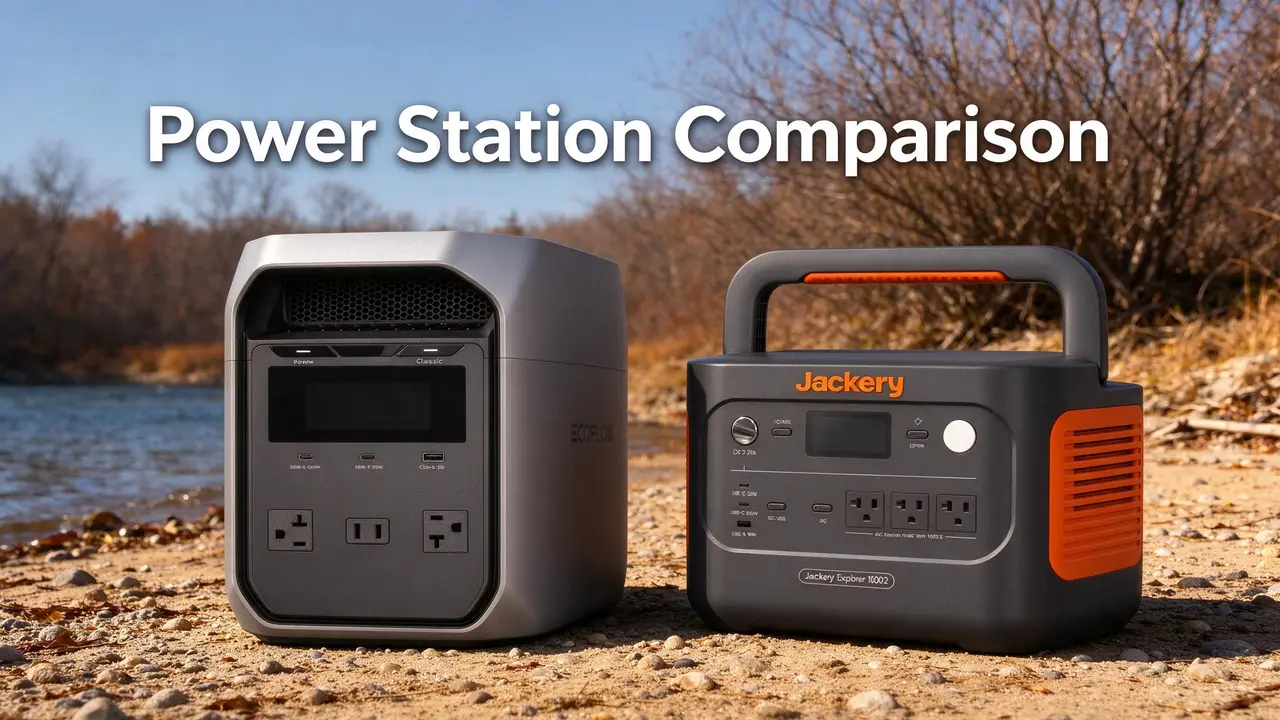
Two 1,000Wh-class stations at the same $559 list price, betting on different things: EcoFlow on output and UPS switchover, Jackery on lighter weight and a bigger battery. Here is how to pick when the money is identical.
Updated
At a glance
Two 1,000Wh-class stations at the same $559 list price, betting on different things: EcoFlow on output and UPS switchover, Jackery on lighter weight and a bigger battery. Here is how to pick when the money is identical.
Same money, different bets
Both of these land at a $559 list price, and both sit in the 1,000Wh class. So the usual tiebreaker — price — is gone. What you are actually choosing between is a station that pushes more watts into a heavy load (EcoFlow DELTA 3 Classic, 1800 W continuous) and one that carries a little more energy in a lighter body (Jackery Explorer 1000 v2, 1,070 Wh at 23.8 lb).
That is the whole argument in one line: EcoFlow bets on headroom and automatic switchover, Jackery bets on watt-hours per pound. Neither is the wrong answer — they are answers to different questions.
To be clear about scope: this is a two-way comparison for people deciding between these exact units. It is not a roundup of every 1,000Wh station, and it is not a whole-home backup plan — neither of these is a transfer-switch install. If you need to run a furnace blower or a well pump through a multi-day outage, you are shopping in the wrong class.
One disclosure up front: this page uses Amazon Associates links, and if you buy through them we may earn a commission. The pick logic below is fit-led — the two units cost the same, so there is no commission reason to steer you either way.
My checks here are home-user checks grounded in the owner themes on file plus the listing specs; they are not lab-bench measurements, and the star figures are listing aggregates, not proof of anything.
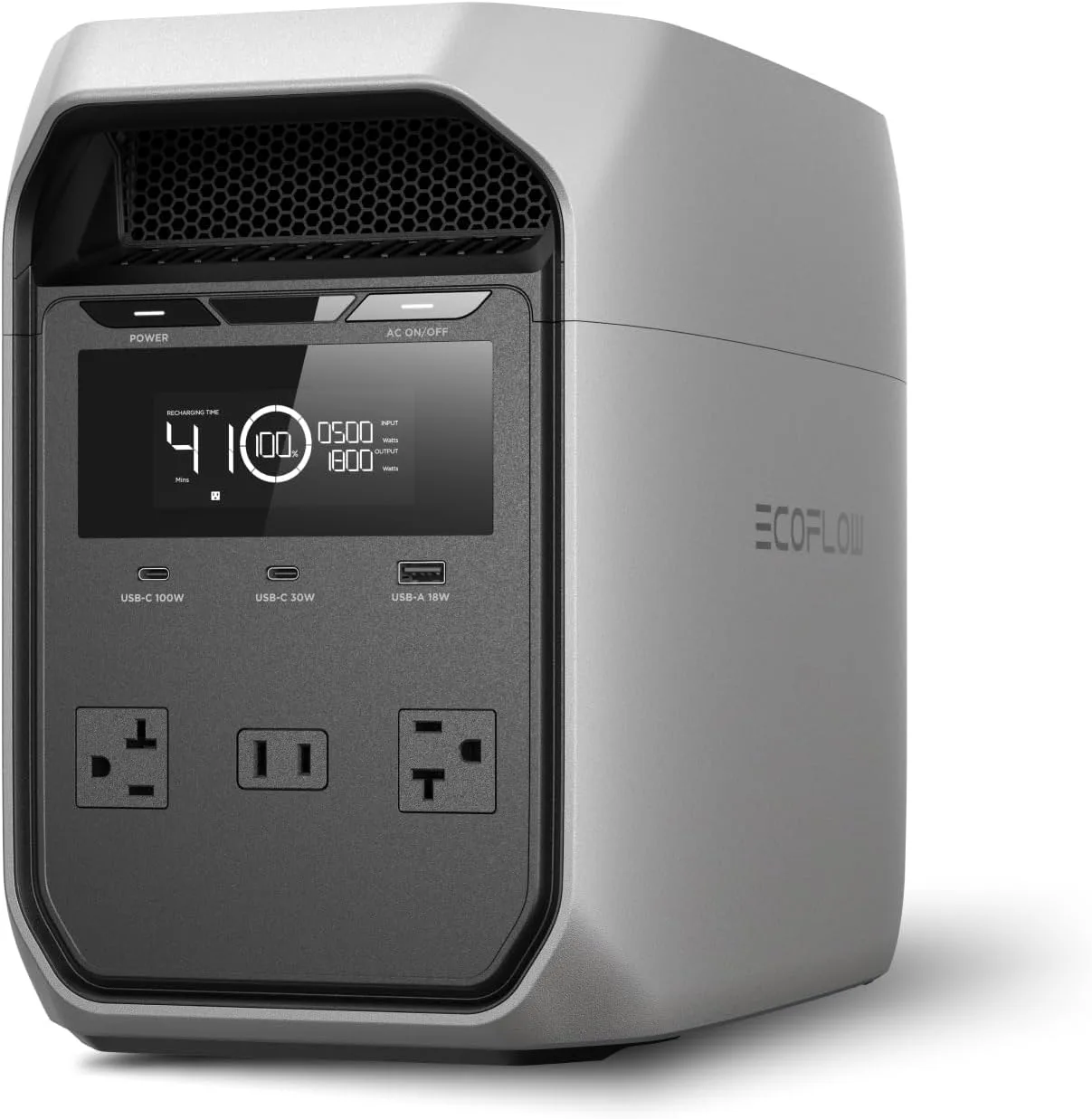
EcoFlow DELTA 3 Classic
Highlights
- 1024Wh rated capacity
- 1800W continuous AC
- 3600W surge
- LiFePO4 chemistry
- Up to 500W solar input
- 26.7 lb (~12.1 kg)
Best for
- DELTA 3 Classic: small appliances and tools that need ~1800W continuous, not just phone charging
- Essentials bridge at home (fridge cycles, router) when sized to the Wh
- Solar top-ups up to ~500W when panels and weather cooperate
Strengths
- DELTA 3 Classic: 1024Wh pack with 1800W continuous / 3600W surge — size loads to both numbers
- 26.7 lb (~12.1 kg) sits in the solo car-camp carry carry band for weekend moves
- 1800W continuous headroom covers more small appliances than 1kW-class inverters
- About $559 list in the Hub catalog — confirm live retail before you buy
Watch-outs · not ideal when
- DELTA 3 Classic is still a bridge for essentials — not a transfer-switch whole-home system
- Usable energy on DELTA 3 Classic is below the 1024Wh label once the inverter is working
- Rated 500W solar on DELTA 3 Classic is optimistic; shade and cables cut real watts
- LiFePO4 helps longevity, but DELTA 3 Classic still hates freezing charge temps on winter trips
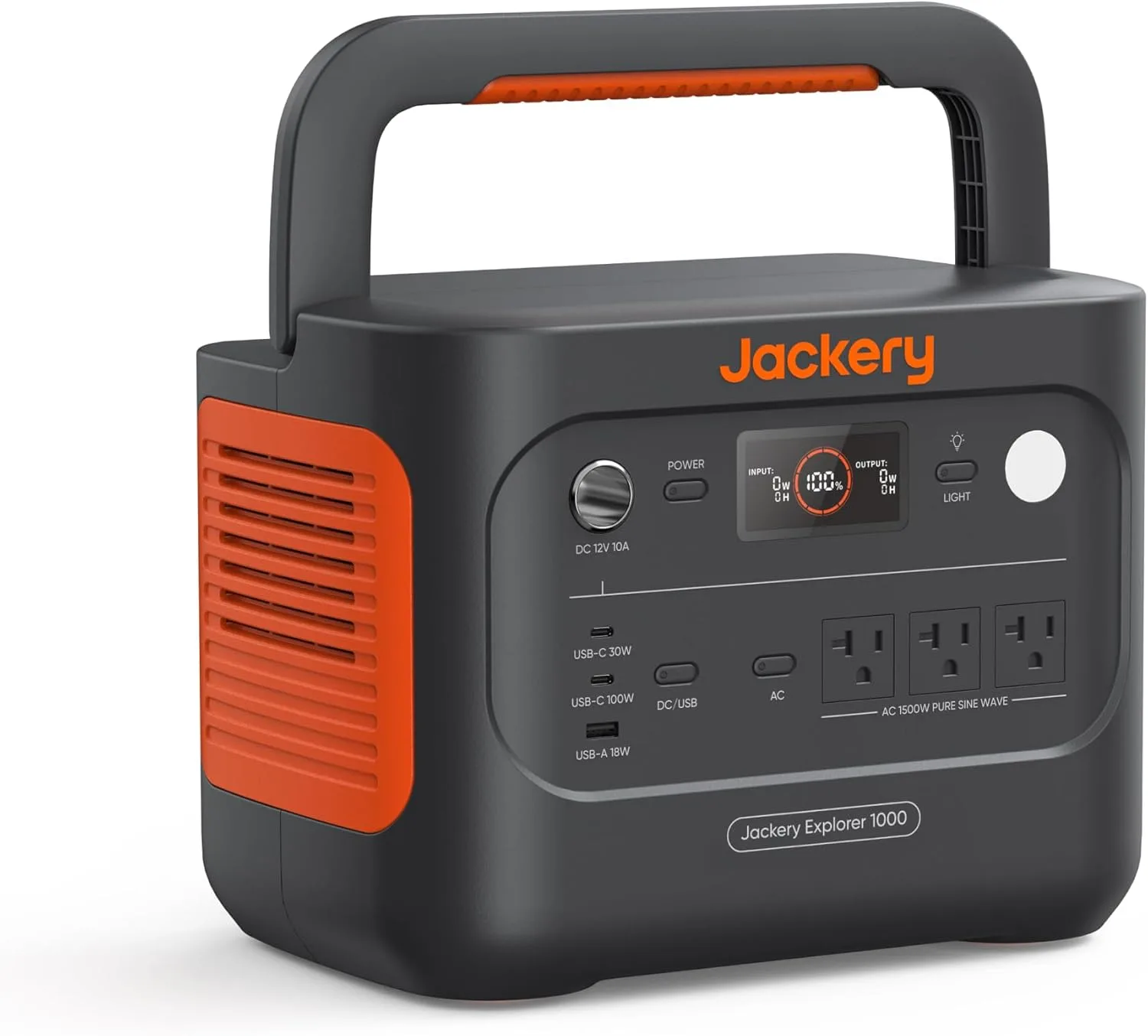
Jackery Explorer 1000 v2 Portable Power Station,1070Wh,1500W
Highlights
- 1070Wh rated capacity
- 1500W continuous AC
- LiFePO4 chemistry
- Up to 400W solar input
- 23.8 lb (~10.8 kg)
- About $559 list
Best for
- Explorer 1000 v2: weekend camping when 23.8 lb carry weight matters as much as 1070Wh
- Essentials bridge at home (fridge cycles, router) when sized to the Wh
- Solar top-ups up to ~400W when panels and weather cooperate
Strengths
- Explorer 1000 v2: 1070Wh with 1500W continuous — enough for fridge cycles if surge on the listing clears the start
- 23.8 lb (~10.8 kg) is the lightest-class carry in this band — easier stairs and car packing
- Explorer 1000 v2 uses LiFePO4 — cycle-life claims usually beat older NMC marketing lines
- Owners on file: Updated to add that customer service contacted me and offered a partial refund so i added 2 more stars. It do…
Watch-outs · not ideal when
- Explorer 1000 v2 is still a bridge for essentials — not a transfer-switch whole-home system
- Usable energy on Explorer 1000 v2 is below the 1070Wh label once the inverter is working
- Rated 400W solar on Explorer 1000 v2 is optimistic; shade and cables cut real watts
- LiFePO4 helps longevity, but Explorer 1000 v2 still hates freezing charge temps on winter trips
How this comparison was built
I am Avery Nolan, WattPicks founding editor. For this head-to-head I scored the two units on four things that actually change the ownership experience: output headroom (30%), capacity and weight (25%), recharge and switchover behavior (25%), and owner themes (20%). Every score traces to a spec or an owner report on file — no lab-bench claims.
On that weighting, EcoFlow wins output and switchover, Jackery wins capacity, weight, and nameplate $/Wh ($0.52/Wh vs $0.55/Wh). The final pick splits by job rather than declaring one universal winner.
For related reading, see our guides on sizing a power station to your loads and on LiFePO4 versus NMC chemistry before you commit.
Spec snapshot
Prices are list price, not the current deal sticker — both have run at $499 historically, and I am ignoring that here so the comparison stays apples to apples. Weight is in pounds. Where a spec is not on file, it says so.
| Product | List price | Capacity (Wh) | Output (W) | Weight (lb) | Recharge time (wall) | Rating |
|---|---|---|---|---|---|---|
| EcoFlow DELTA 3 Classic | $559 | 1024 Wh | 1800 W | 26.7 lb | Not on file | 5.00 |
| Jackery Explorer 1000 v2 | $559 | 1070 Wh | 1500 W | 23.8 lb | Not on file | 4.75 |
Where the money went
Four configuration choices separate these two, and each one tells you what the maker thought you would pay for.
- Output headroom: EcoFlow spends on a 1800 W inverter (3600 W surge per the listing, not independently verified) versus Jackery's 1500 W (3000 W surge, also a listing claim). That extra 300 W is the difference between a space heater or a big kitchen appliance starting and not starting.
- Battery and weight: Jackery puts 1,070 Wh into 23.8 lb; EcoFlow puts 1,024 Wh into 26.7 lb. Jackery wins both the capacity and the weight column — 46 more Wh and nearly 3 lb lighter.
- Switchover and app: EcoFlow's listing claims a sub-10ms UPS switchover plus app scheduling (peak-rate windows, storm alerts) — that switchover figure is a listing claim, not independently verified. Jackery's app is real too — charging modes, quiet mode, battery level — but the listing does not claim a UPS-grade transfer time, so treat that as n/a (not on file).
- Ports and extras: EcoFlow lists AC×6 and USB-C×2 (USB-A count not on file). Jackery's listing shows front-facing AC outlets plus a built-in two-level LED light; the raw USB port counts on that listing look inflated by a scrape, so I would not lean on them. Neither ships with a solar panel; both are optional add-ons.
The spec that decides it
Two numbers do most of the work. The first is continuous output: 1800 W versus 1500 W. If your outage plan includes a microwave, a space heater, or a big power tool, the EcoFlow clears the bar and the Jackery does not — owners on the Jackery side report a 1700 W air fryer and a large sliding miter saw both refusing to start. That is not a defect; it is a 1500 W box doing 1500 W things.
The second is weight against capacity. At 23.8 lb the Jackery is the one you will actually carry to a campsite or a job site; at 26.7 lb the EcoFlow is semi-permanent gear in my book. The 46 Wh gap is small — call it a rounding error in real runtime — but the 2.9 lb gap is the one your back notices.
If you want the honest tiebreak: pick on output first, weight second. Capacity is close enough that it should not decide anything.
Real owner trade-offs
The review pools agree on more than they disagree. Both units recharge fast from a wall outlet, both are quiet enough to sleep near, and both draw the same 4.7 listing aggregate. The split shows up in what people use them for. These owner themes are drawn from the review pools on file for each unit; they are paraphrased patterns, not individually traceable quotes, and the pool size and date are not on file.
- EcoFlow owners lean on the switchover: one describes wiring a fridge through the unit so it takes over the moment source power drops and hands back when it returns — no cable swapping. Another ran two sump pumps for two days on battery and used about half the charge.
- EcoFlow's weak spot is solar-only stretches: on a second straight cloudy day, one owner could not gather enough sun to run a fridge overnight and had to find a wall outlet. A minority also report units arriving dead or visibly used — check it powers on the day it lands.
- Jackery owners lean on fridge duty: one ran a 12V cooler overnight at roughly a quarter of the battery per night, good for multiple nights off-grid. Quiet mode came up repeatedly as the reason people could sleep next to it.
- Jackery's weak spot is the high-wattage ceiling and accessories: no car charger in the box, solar input slow and angle-sensitive, and a few owners noted the Wi-Fi/app link dropping overnight so they had to wake the unit to check level.
Buy the one that…
If you mostly camp, the Jackery's 23.8 lb and 1,070 Wh are the better fit; if you mostly backup, the EcoFlow's 1800 W and switchover are the better fit.
Buy the EcoFlow DELTA 3 Classic if you want a station that can sit between the wall and a fridge or a sump pump and switch over on its own, and you need the 1800 W to start a heavier appliance. Skip it if you plan to carry it by hand any distance or run purely off solar through bad weather — the weight and the cloudy-day shortfall are real.
Buy the Jackery Explorer 1000 v2 if portability and fridge/fan/phone duty matter more than peak watts, and you want the lighter box with the front outlets and built-in light. Skip it if your outage plan includes a 1700 W-class appliance or a big saw — it will not start them, and no amount of app modes changes that.
Walk away from both if you are sizing for a whole-home transfer switch or multi-day furnace backup; that is a different product class and a different budget.
Frequently asked
Can either run a fridge overnight?
Yes — EcoFlow owners report fridge duty with automatic switchover, and Jackery owners report a 12V cooler sipping about a quarter of the battery per night. Runtime depends on the fridge, so treat those as owner reports, not guarantees.
Will the Jackery run a 1700 W air fryer?
No. Its continuous output is 1500 W, and owners report exactly that appliance failing to start. The EcoFlow's 1800 W clears it on paper.
Do either include solar panels?
No. Panels are optional add-ons for both; the Jackery listing states the panel is not included, and EcoFlow's 500 W solar recharge figure (a listing claim, not independently verified) assumes a panel you buy separately.
Which is lighter to carry?
The Jackery at 23.8 lb versus the EcoFlow at 26.7 lb — about 3 lb, which matters more than the 46 Wh capacity gap.
Method and sources
Model names and list prices come from the WattPicks catalog at build time. WattPicks does not run its own laboratory tests on power stations, and nothing on this page is presented as a measured result — it is catalog-backed buying guidance.
Read our methodology for how the catalog is normalized, and about WattPicks for who publishes it.