
EcoFlow DELTA 2 Max vs Jackery Explorer 2000 v2: Which Bet Fits?
Two 2kWh stations, $400 apart, betting on different things: EcoFlow on output and expandability, Jackery on weight and price. Here is how to pick without overpaying for headroom you will never use.
Updated
At a glance
Two 2kWh stations, $400 apart, betting on different things: EcoFlow on output and expandability, Jackery on weight and price. Here is how to pick without overpaying for headroom you will never use.
Same money class, two different bets
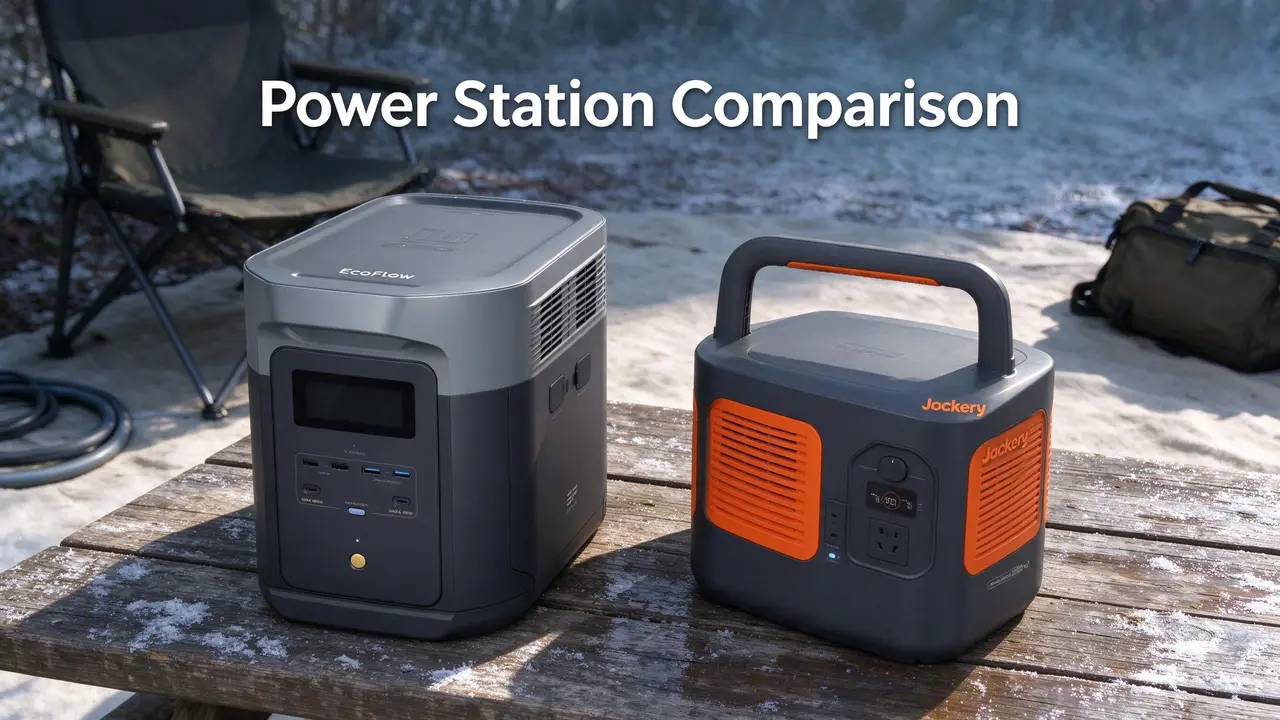
You are shopping in the 2kWh band, and these two land close enough on capacity that the decision is not about watt-hours. It is about what each brand spent the budget on. The EcoFlow DELTA 2 Max bets on headroom: 2400 W continuous, six AC outlets, and a path to expand capacity later. The Jackery Explorer 2000 v2 bets on portability and price: 39.5 lb and a $999 list against $1399.
Neither is a whole-home solution. If you are sizing a transfer switch or trying to run a central AC, stop here — this is fridge, furnace blower, router, and CPAP territory, not a service-panel replacement. For that job, read our home backup sizing guide before you spend anything.
One disclosure up front: picks here are fit-led, and links may earn an Amazon Associates commission. Numbers come from the listings and the owner themes on file — home-user checks, not lab-bench measurements. Where a figure is owner-reported rather than listing-backed, we say so.
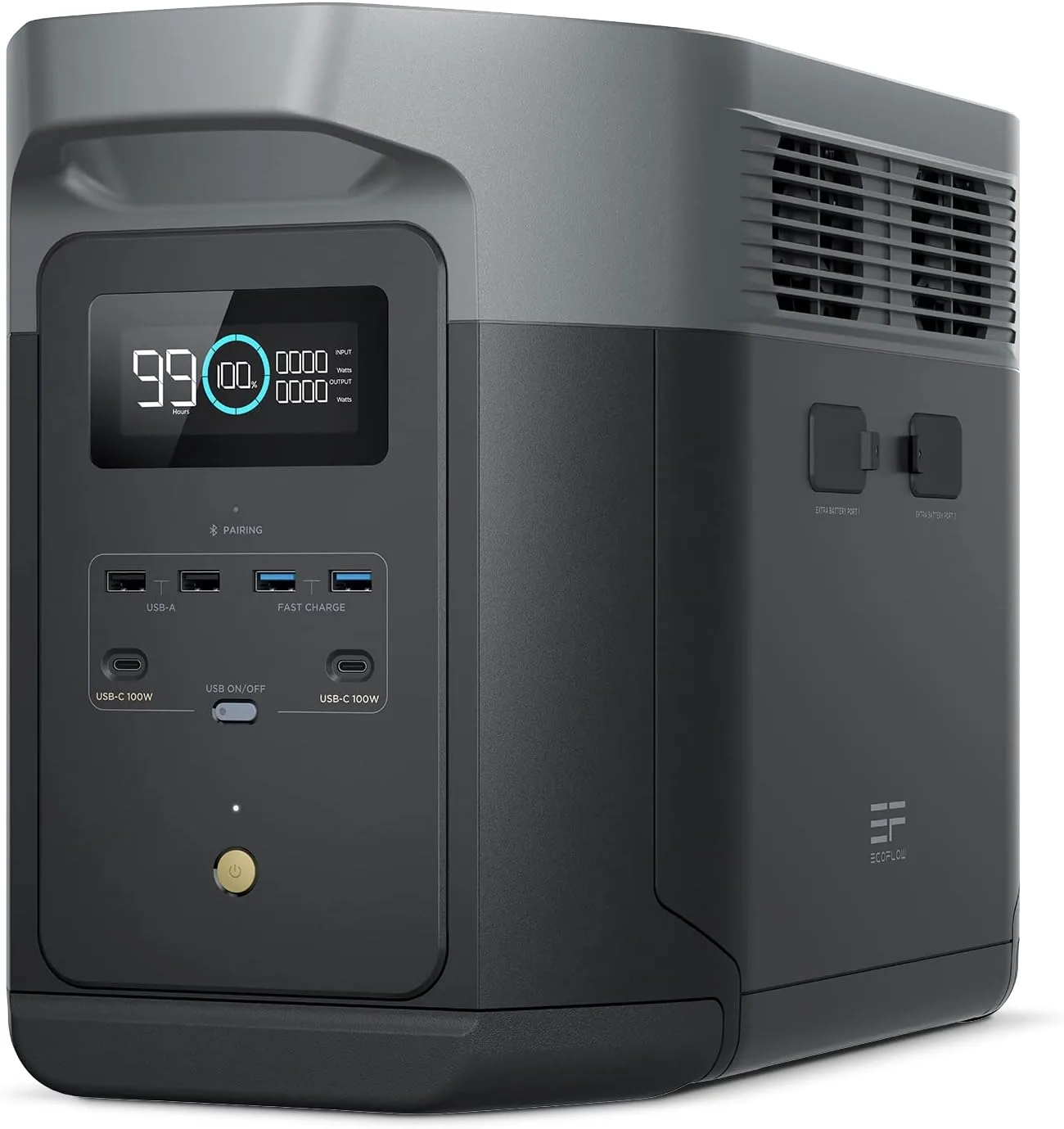
EcoFlow DELTA 2 Max
Highlights
- 2048Wh rated capacity
- 2400W continuous AC
- 4800W surge
- LiFePO4 chemistry
- Up to 1000W solar input
- 50 lb (~22.7 kg)
Best for
- DELTA 2 Max: longer outages or higher continuous loads (still not whole-home wiring)
- RV / off-grid days where recharge speed matters as much as Wh
- Best parked near the vehicle or cabin — not a long carry to a tent
Strengths
- DELTA 2 Max: 2048Wh pack with 2400W continuous / 4800W surge — size loads to both numbers
- 50 lb (~22.7 kg) is a park-and-use chassis — plan a short path, not a trail hike
- 2400W continuous headroom covers more small appliances than 1kW-class inverters
- About $1399 list in the Hub catalog — confirm live retail before you buy
Watch-outs · not ideal when
- At 50 lb (~22.7 kg), DELTA 2 Max is a poor tent-hike companion — plan a cart or leave it in the vehicle
- High continuous output on DELTA 2 Max tempts big loads — Wh still runs out on kettles and A/C
- Rated 1000W solar on DELTA 2 Max is optimistic; shade and cables cut real watts
- LiFePO4 helps longevity, but DELTA 2 Max still hates freezing charge temps on winter trips
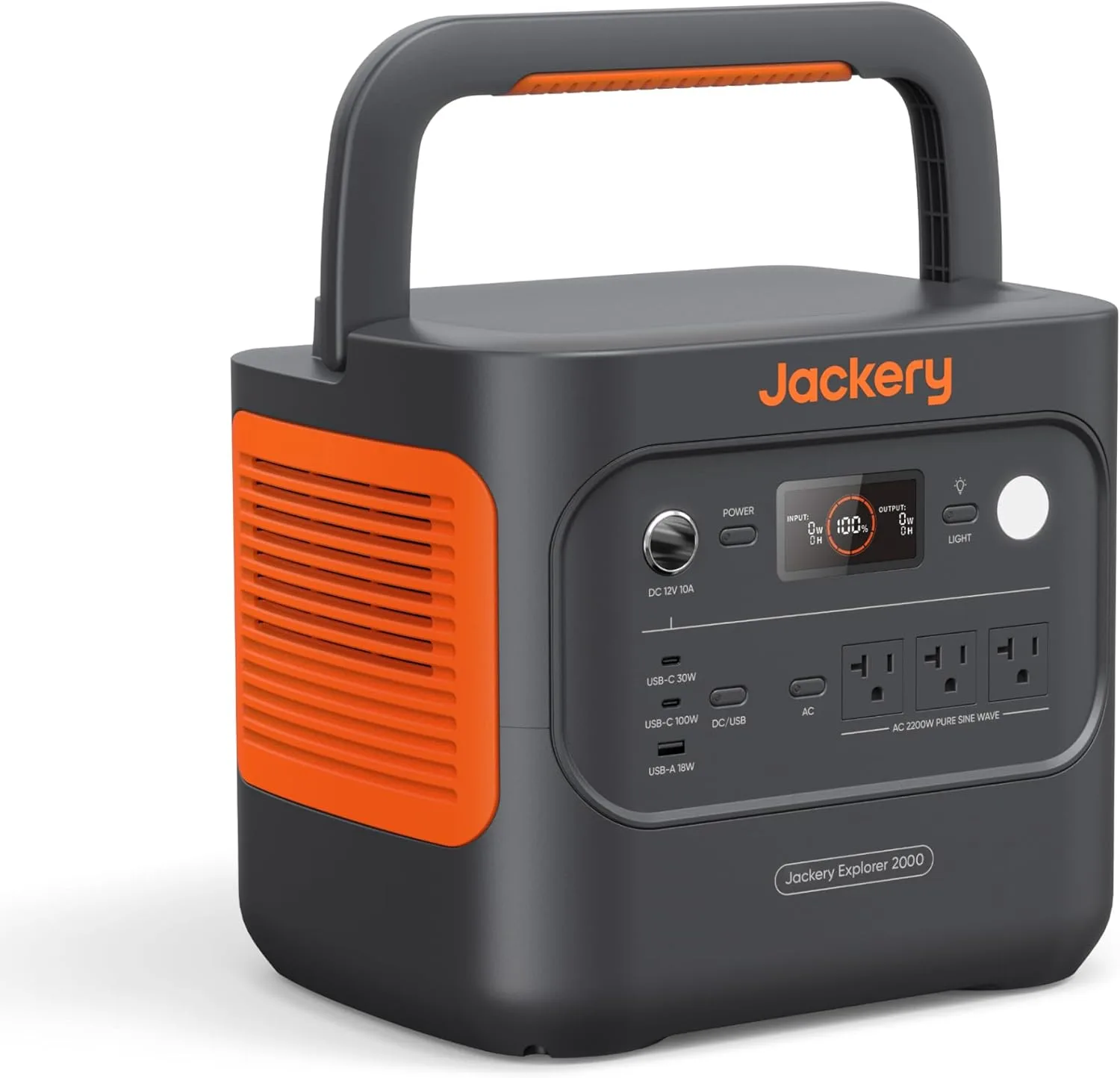
Jackery Explorer 2000 v2 Portable Power Station, 2042Wh
Highlights
- 2042Wh rated capacity
- 2200W continuous AC
- LiFePO4 chemistry
- 39.5 lb (~17.9 kg)
- About $999 list
Best for
- Explorer 2000 v2: longer outages or higher continuous loads (still not whole-home wiring)
- RV / off-grid days where recharge speed matters as much as Wh
- Users who will pair solar or expand rather than buy a second small pack
Strengths
- Explorer 2000 v2: 2200W continuous on a 2042Wh pack — more headroom for small appliances than 1kW-class peers
- 39.5 lb (~17.9 kg) is a park-and-use chassis — plan a short path, not a trail hike
- 20ms-class UPS switchover on the listing — useful when a router restart would hurt
- Owners on file: Replaces a Jackery Explorer as power for my cabin. This is the perfect all-weekend solution for a cabin, camp…
Watch-outs · not ideal when
- 39.5 lb (~17.9 kg) is a two-hand lift; skip it if you walk more than a short path to camp
- High continuous output on Explorer 2000 v2 tempts big loads — Wh still runs out on kettles and A/C
- Solar input unpublished for Explorer 2000 v2 — do not assume a same-day off-grid refill
- LiFePO4 helps longevity, but Explorer 2000 v2 still hates freezing charge temps on winter trips
Owner voices
Short takes from public retail reviews — paraphrased or translated when long or non-English; meaning kept close to the original.
“Replaces a Jackery Explorer as power for my cabin. This is the perfect all-weekend solution for a cabin, camper or RV. Ditto, certainly will get used for large group cookouts and campouts. We have a plug-in generator…”
“Tested unit on a iceco VL60ProD, unit ran perfectly for days. 2000v will be mainly used as a backup power supply for our travel trailer and occasionally for intermittent power outages at home.”
“Great customer service and fast response.”
Spec snapshot
List prices only — ignore the sale stickers you will see on the product pages, since they move weekly and would distort the comparison. Ratings are listing aggregates, not proof of owner satisfaction.
| Product | List price | Capacity (Wh) | Output (W) | Weight (lb) | Rating |
|---|---|---|---|---|---|
| EcoFlow DELTA 2 Max | $1,399 | 2048 Wh | 2400 W | 50 lb | 4.80 |
| Jackery Explorer 2000 v2 Portable Power Station, 2042Wh | $999 | 2042 Wh | 2200 W | 39.5 lb | 4.80 |
Where the money went
Four configuration differences explain most of the $400 gap, and only some of them will matter to you.
Output and outlets. The DELTA 2 Max gives you 2400 W continuous across six AC outlets; the Explorer 2000 v2 gives 2200 W across three. That 200 W gap is not huge, but the outlet count is — six versus three changes how you run a kitchen counter or a desk full of gear without a power strip.
Weight. This is the Jackery's clearest win. At 39.5 lb it is roughly 10 lb lighter than the 50 lb EcoFlow, and owners on both sides flag the difference when carrying a unit up stairs or into an RV. If you move it weekly, that matters more than 200 W.
Expandability. EcoFlow sells add-on batteries that take the DELTA 2 Max from 2048 Wh up toward 6 kWh (owner-reported expansion path; check current listing for available add-on models). The Jackery's listing does not offer the same expansion path. If you want a system that grows, that is a real reason to pay more.
Recharge and UPS behavior. Both recharge fast on AC — owners report roughly an hour to an hour and fifteen minutes to full on each (owner-reported, not a listing spec). The Jackery listing calls out a 20 ms UPS switchover; the EcoFlow has an EPS mode owners use for furnace and fridge pass-through. Treat both as battery-backed pass-through, not a substitute for a wired transfer switch.
- AC outlets: EcoFlow 6 vs Jackery 3 — the bigger practical gap
- Continuous output: 2400 W vs 2200 W
- Weight: 50 lb vs 39.5 lb — Jackery carries easier
- Expansion: EcoFlow add-on batteries; Jackery listing shows none
The spec that decides it
For most buyers, weight decides this, not wattage. A 2kWh station that lives in a garage and gets wheeled out twice a year can be 50 lb without complaint. One that goes upstairs, into a camper, or onto a boat every weekend should be the lighter unit — and that is the Jackery.
The second deciding number is outlet count. If your outage plan is fridge plus router plus a couple of chargers, three AC outlets on the Jackery is enough. If you picture a power strip daisy-chain across the kitchen, the DELTA 2 Max's six outlets and 2400 W continuous give you more room before you start unplugging things. Neither unit should be asked to run loads above its continuous rating — 2400 W and 2200 W respectively — and surge or boost modes do not change that.
A quick rubric for your job: if you move the unit weekly, weight wins; if it lives on a kitchen counter, outlets win; if you plan to grow capacity later, expansion wins.
What owners actually report
Themes, not quotes. On the EcoFlow side, the recurring positives are fast grid charging, fridge and freezer runtime that beats the on-screen estimate because compressors cycle, and a furnace EPS setup that switched over cleanly during winter outages. The app — real-time wattage, runtime estimates, remote output toggles — comes up often. The caveats are weight at around 50 lb, slow technical support during an outage, and Smart Generator pairing errors that one owner hit repeatedly over a multi-day blackout (owner-reported). That last one is an ecosystem headache, not a battery flaw, but it matters if you plan to pair the two.
On the Jackery side, owners describe a full-size fridge running about 21 hours on one charge with pass-through switching that did not flicker the fridge lights. That 21-hour figure is owner-reported and assumes rated capacity; if your unit underperforms like the capacity complaint below, expect closer to 15–18 hours. Fast AC recharge and the lighter carry weight come up repeatedly. The caveats are more pointed: one electrical engineer measured effective capacity well below the rated 2042 Wh on a small AC load and traced it to idle drain and conversion overhead — a replacement unit behaved closer to expected, so test yours early. Separately, solar charging can pulse on and off until a free software update (v1.1) is pushed to the unit (owner-reported), and support quality ranges from fast replacement to generic troubleshooting.
Both listings carry star aggregates — 4.7 for the EcoFlow, 4.4 for the Jackery — but those are listing numbers, not a substitute for reading the critical reviews on the unit you actually order.
- EcoFlow strength: fast recharge, strong fridge/freezer runtime, useful app
- EcoFlow caveat: ~50 lb, support delays, Smart Generator pairing issues (owner-reported)
- Jackery strength: ~40 lb carry, seamless pass-through fridge backup
- Jackery caveat: one capacity complaint, solar software bug (owner-reported), uneven support
Buy the one that…
Buy the EcoFlow DELTA 2 Max if you want more outlets and continuous output now, and a path to expand capacity later — and you can live with 50 lb and a support line that may be slow in a crisis. It is the better bet for a garage-based home backup that stays put.
Buy the Jackery Explorer 2000 v2 Portable Power Station, 2042Wh if you move the unit — upstairs, into an RV, onto a boat — and want the lightest 2kWh carry at the lower list price. Test capacity and confirm the solar software version in your first week, and keep the return window open.
Skip both if you need whole-home coverage, a hardwired transfer switch, or anything above 2400 W continuous. That is a different product class, and our transfer switch vs smart panel guide is the right next read.
Don't buy either if: your total budget is under $700 (neither fits), you won't run a first-week capacity test (you lose the return-window safety net), or you need a hardwired UPS for critical medical or server gear (these are battery-backed pass-through, not a wired UPS).
Frequently asked
Can either run a full-size fridge through an outage?
Yes, on the owner reports on file — roughly 21 hours for the Jackery (owner-reported, assumes rated capacity; expect 15–18 hours if your unit underperforms) and comparable or better for the EcoFlow, depending on how often the compressor cycles. Runtime figures are owner-reported, not guaranteed. Neither will run a fridge plus a space heater plus a microwave at once.
Is the $400 gap worth it?
Only if you need the extra AC outlets, the 200 W of continuous headroom, or the expansion path. If you just want fridge and router backup and you carry the unit often, the Jackery's lower price and lighter weight win.
Which is easier to move?
The Jackery at 39.5 lb, by about 10 lb. Owners on both sides flag weight as the main day-to-day friction.
Can I expand capacity later?
The EcoFlow DELTA 2 Max supports add-on batteries (owner-reported path up toward 6 kWh; check the current listing for available add-on models). The Jackery Explorer 2000 v2 listing does not show an expansion path, so plan its 2042 Wh as a fixed ceiling.
Method and sources
Model names and list prices come from the WattPicks catalog at build time. WattPicks does not run its own laboratory tests on power stations, and nothing on this page is presented as a measured result — it is catalog-backed buying guidance.
Read our methodology for how the catalog is normalized, and about WattPicks for who publishes it.