
Anker SOLIX C300 vs Goal Zero Yeti 300: Which Bet Fits?
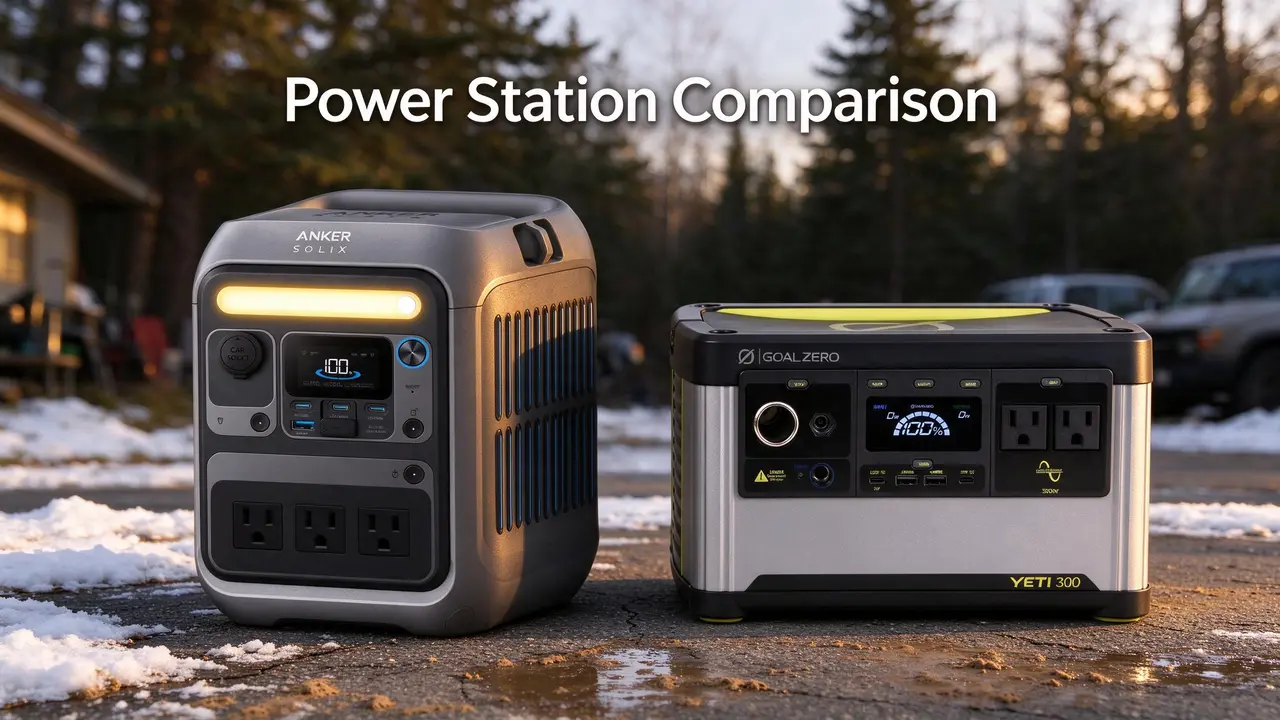
Two 300Wh-class stations, $20 apart, built for different owners. The Anker C300 wins on portability and AC outlets; the Yeti 300 asks a premium for slightly more output and a tougher shell. Here's how to pick.
Updated
At a glance
Two 300Wh-class stations, $20 apart, built for different owners. The Anker C300 wins on portability and AC outlets; the Yeti 300 asks a premium for slightly more output and a tougher shell. Here's how to pick.
- Anker C300: 288 Wh, 300 W continuous, 9.1 lb, $329.99 list, 8 AC outlets, 3 USB-C.
- Goal Zero Yeti 300: 297 Wh, 350 W continuous, 13.7 lb, $349.95 list, 1 AC outlet, 3 USB-C, 2 USB-A, 1 car port.
Same money, different bets
At $329.99 for the Anker C300 Portable Power Station, 288Wh Solar Generator and $349.95 for the Goal Zero Yeti 300 Portable Power Station, you are paying nearly the same money for two different design bets. The Anker bets on being the lightest, most outlet-rich 300Wh-class box you can carry with one hand. The Yeti bets on a slightly bigger reserve, a bit more AC headroom, and a tougher exterior.
This is not a whole-home backup comparison. Both units are 300Wh-class portables for camping, short outages, and charging small electronics. If you need to run a fridge for a day or a space heater overnight, neither is the right tool — look at 1,000Wh-and-up stations instead. The question here is which small bet fits your week.
- Anker C300: 288 Wh, 300 W continuous, 9.1 lb, $329.99 list, 8 AC outlets, 3 USB-C.
- Goal Zero Yeti 300: 297 Wh, 350 W continuous, 13.7 lb, $349.95 list, 1 AC outlet, 3 USB-C, 2 USB-A, 1 car port.
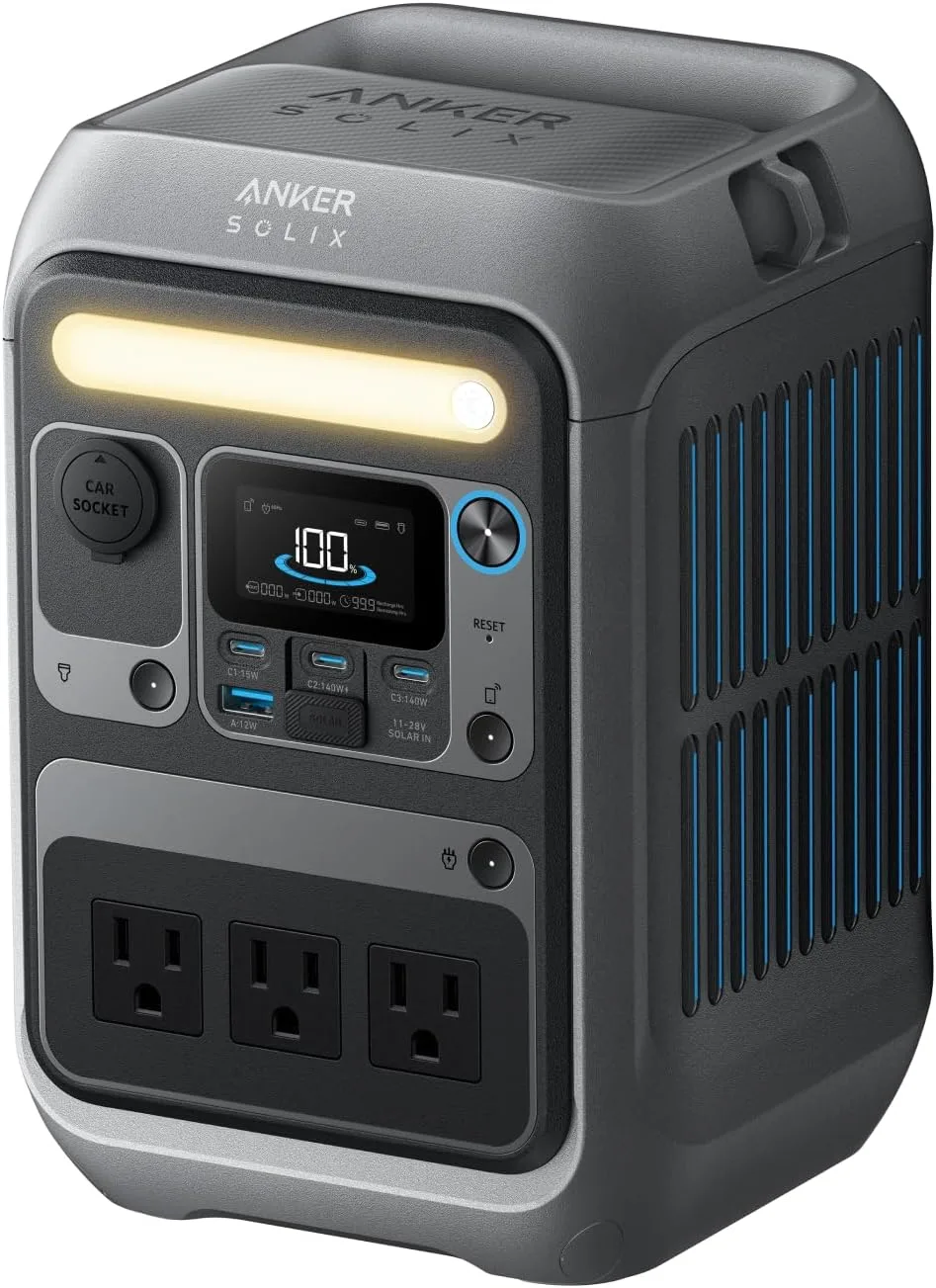
Anker C300 Portable Power Station, 288Wh Solar Generator
Highlights
- 288Wh rated capacity
- 300W continuous AC
- 600W surge
- LiFePO4 chemistry
- 9.1 lb (~4.1 kg)
- About $329.99 list
Best for
- SOLIX C300: phones, cameras and a laptop on short trips
- Travel kits when you need quiet pack power, not appliance runtime
- Brief desk backup for router and lights — not a fridge for days
Strengths
- SOLIX C300: 288Wh pack with 300W continuous / 600W surge — size loads to both numbers
- 9.1 lb (~4.1 kg) is the lightest-class carry in this band — easier stairs and car packing
- SOLIX C300 uses LiFePO4 — cycle-life claims usually beat older NMC marketing lines
- Owners on file: Theme: Customers find the power station performs well as an uninterruptible power supply and appreciate its f…
Watch-outs · not ideal when
- SOLIX C300's small Wh class empties fast with a kettle, hair dryer or space heater
- 300W continuous will not hold heating elements or many compressor surges for long
- Solar input unpublished for SOLIX C300 — do not assume a same-day off-grid refill
- Airline and pack limits may still block SOLIX C300 even when the weight looks friendly
Owner voices
Short takes from public retail reviews — paraphrased or translated when long or non-English; meaning kept close to the original.
“Theme: Customers find the power station performs well as an uninterruptible power supply and appreciate its fast charging capability, reaching 80% in about 50-55 minutes. They praise its power delivery, with one custo…”
“Theme: Charging Devices (64)”
“Theme: Outdoor Electronics (25)”
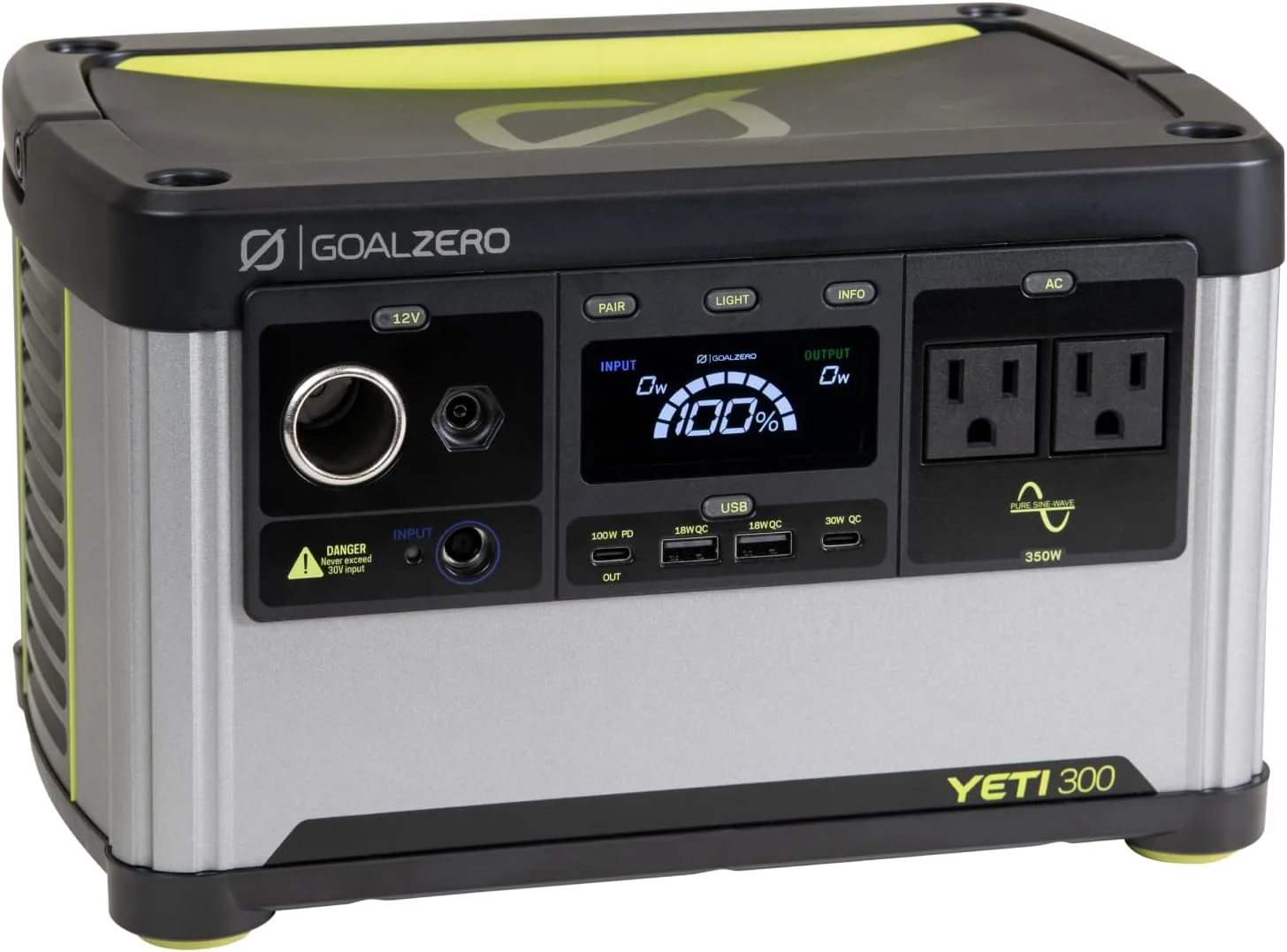
Goal Zero Yeti 300 Portable Power Station
Highlights
- 297Wh rated capacity
- 350W continuous AC
- 600W surge
- LiFePO4 chemistry
- Up to 200W solar input
- 13.7 lb (~6.2 kg)
Best for
- Yeti 300: phones, cameras and a laptop on short trips
- Travel kits when you need quiet pack power, not appliance runtime
- Brief desk backup for router and lights — not a fridge for days
Strengths
- Yeti 300: 297Wh pack with 350W continuous / 600W surge — size loads to both numbers
- 13.7 lb (~6.2 kg) is the lightest-class carry in this band — easier stairs and car packing
- Yeti 300 uses LiFePO4 — cycle-life claims usually beat older NMC marketing lines
- Owners on file: Theme: Customers report that the portable power station works well and can recharge to 100% in less than an h…
Watch-outs · not ideal when
- Yeti 300's small Wh class empties fast with a kettle, hair dryer or space heater
- 350W continuous will not hold heating elements or many compressor surges for long
- Rated 200W solar on Yeti 300 is optimistic; shade and cables cut real watts
- Airline and pack limits may still block Yeti 300 even when the weight looks friendly
Owner voices
Short takes from public retail reviews — paraphrased or translated when long or non-English; meaning kept close to the original.
“Theme: Customers report that the portable power station works well and can recharge to 100% in less than an hour, though some mention it loses power quickly. The product receives mixed feedback about its power quality…”
“Theme: Power quality (15)”
“Theme: Battery life (11)”
Methodology
I am Avery Nolan, WattPicks founding editor. My checks here are home-user comparisons grounded in owner themes on file and listing specs — not lab-bench measurements. I weigh four things: portability and weight (30%), outlet and output fit for small loads (30%), owner-reported reliability and caveats (25%), and list price per Wh (15%). On those weights, the Anker C300 edges the Yeti 300 because its 9.1 lb carry weight and 8 AC outlets fit the small-load job better, and its owner themes are more consistent; the Yeti's 50W output advantage is real but narrow for a 300Wh-class station, and its thinner, lower listing aggregate keeps it second.
Prices are list prices from the WattPicks catalogue. Ratings are listing aggregates, not owner proof. As an Amazon Associate, WattPicks earns from qualifying purchases; picks are fit-led, not commission-led.
Weighted sub-scores (out of 10) on those four criteria: Anker C300 — portability 9.5, outlet/output fit 9.0, owner reliability 8.5, price per Wh 8.0; Yeti 300 — portability 6.0, outlet/output fit 7.5, owner reliability 6.5, price per Wh 7.5. Applying the weights gives Anker 8.9 and Yeti 7.0. That is why the pick splits by job rather than one universal winner.
Spec snapshot
All numbers below come from the product listings and the WattPicks catalogue. Ratings are listing aggregates, not owner proof. Where a spec is not published, the cell says n/a (not on file).
Port counts and the IPX4 / 4,000-cycle claims are manufacturer listing details, not independently measured. Confirm them on the current product page before you buy.
| Product | Price | Capacity (Wh) | Output (W) | Weight (lb) | Rating (listing aggregate) |
|---|---|---|---|---|---|
| Anker C300 Portable Power Station, 288Wh Solar Generator | $329.99 | 288 Wh | 300 W | 9.1 lb | 4.6 |
| Goal Zero Yeti 300 Portable Power Station | $349.95 | 297 Wh | 350 W | 13.7 lb | 4.0 |
Where the money went
Four configuration choices explain most of the price gap — and the gap is small, so the trade-offs are sharp.
Capacity and output. The Yeti 300 lists 297 Wh and 350 W continuous; the Anker C300 lists 288 Wh and 300 W. That is a 9Wh and 50W difference on paper. In practice, 50W of extra AC headroom matters if you want to run a small fan, a projector, or a mini fridge right at the edge of the Anker's ceiling. For phones, laptops, lights, and a router, both are comfortably inside their continuous ratings.
Weight and footprint. The Anker is 9.1 lb; the Yeti is 13.7 lb. That 4.6 lb spread is the difference between one-hand carry and a two-hand lug. If the station lives in a car or a tent, the Anker's lighter shell is a daily win. If it lives on a shelf and only comes out during outages, the Yeti's extra heft is less of a tax.
Outlets. The Anker lists 8 AC outlets, 3 USB-C, and USB-A. The Yeti lists 1 AC outlet, 3 USB-C, 2 USB-A, and a car port. Eight AC outlets on a 300W box is unusual — it means you can leave several small adapters plugged in without a power strip. The Yeti's single AC outlet forces you to choose one AC device at a time, though the car port and USB bank cover the rest.
Recharge and extras. Both listings claim roughly 50-minute AC recharges to full — a manufacturer claim, not measured. The Anker adds app monitoring and a built-in light bar; the Yeti adds an IPX4 water-resistance rating and a LiFePO4 pack rated for 4,000+ cycles on the listing — both listing claims, not independently verified. Neither listing publishes a full charge-time curve, so treat the 50-minute figure as a manufacturer claim, not a measured result.
- Capacity: 288 Wh (Anker) vs 297 Wh (Yeti) — 9 Wh apart on paper.
- Continuous output: 300 W (Anker) vs 350 W (Yeti) — 50 W more AC headroom on the Yeti.
- Weight: 9.1 lb (Anker) vs 13.7 lb (Yeti) — 4.6 lb lighter Anker.
- AC outlets: 8 (Anker) vs 1 (Yeti) — the Anker is the better multi-device hub.
Runtime self-check: will it last the night?
Runtime is the anxiety point for most buyers. The table below converts common device wattages into rough hours, assuming about 85% inverter efficiency and a usable capacity of roughly 85% of the listed Wh (to protect battery health). These are estimates, not measured results — your device's actual draw and the station's cutoff behavior will change the numbers.
Use it as a self-check: find your device, multiply its real wattage by the hours you need, and compare that to the usable Wh. If your total load exceeds the usable capacity, size up.
| Device (typical draw) | Anker C300 est. hours (288Wh) | Yeti 300 est. hours (297Wh) |
|---|---|---|
| Laptop (~50W) | ~4.2 h | ~4.3 h |
| WiFi router (~10W) | ~20.8 h | ~21.5 h |
| Fan (~40W) | ~5.2 h | ~5.4 h |
| CPAP (~30W avg) | ~7.0 h | ~7.2 h |
| Phone (~10W) | ~20.8 h | ~21.5 h |
The spec that decides it
For most buyers, weight decides this matchup before capacity does. The Anker C300 is 9.1 lb and has a built-in handle; the Yeti 300 is 13.7 lb. If you are carrying the station from car to campsite, or moving it between rooms during an outage, that 4.6 lb difference is the spec you will feel every time.
The second deciding spec is AC outlet count. Eight AC outlets on the Anker means you can run a laptop charger, a lamp, a fan, and a phone brick without a strip. The Yeti's single AC outlet is the bigger practical limitation for desk or outage use — you will be swapping plugs. The Yeti's 50W output advantage only matters if you have a device that draws between 300W and 350W, which is a narrow band for a 300Wh-class station.
- Anker C300: owners like the sub-hour AC recharge and one-hand carry; caveats include limited capacity, a solar resume quirk, and no true UPS behavior.
- Yeti 300: owners like the fast recharge and multi-device charging; caveats include limited runtime, a high-helpful reliability complaint, and a car-charging fuse issue at high rates.
Real owner trade-offs
Owner themes on file point to different frustrations on each side. These are paraphrases of review themes, not lab results.
Anker C300 owners consistently praise the fast AC recharge — one reported 3% to 100% in under an hour — and the light, compact carry. The recurring caveats are capacity limits (fine for laptops and routers, not for big appliances), a solar resume quirk where the unit may not restart charging after sunrise without unplugging and replugging the panel, and a warning that it is not a true UPS for sensitive electronics. A default car-socket power-saving mode also cut off charging before a phone was full until it was disabled in settings.
Yeti 300 owners also report fast recharge and easy carry, and several say it handled a fan, TV, and WiFi for a couple of hours during an outage. But the review pack includes a high-helpful critical report of the unit dying overnight while charging a single phone on two separate camping trips, plus a laptop-and-WiFi user who got about four hours before hitting 10%. A car-charging fuse issue also appears when the charge rate is set too high. The listing aggregate is 4.0 from 107 ratings — thinner and lower than the Anker's 4.6 from 1,949 ratings, so treat the Yeti's feedback as less settled. (Rating counts are listing aggregates, not independently verified.)
- Anker C300: owners like the sub-hour AC recharge and one-hand carry; caveats include limited capacity, a solar resume quirk, and no true UPS behavior.
- Yeti 300: owners like the fast recharge and multi-device charging; caveats include limited runtime, a high-helpful reliability complaint, and a car-charging fuse issue at high rates.
If you camp off-grid: panel wattage vs recharge time
Solar recharge is where the two units diverge in practice. Neither includes a panel. The Anker listing recommends a 100W or 60W Anker panel and notes incompatibility with some smaller panels; the Yeti listing pairs with a solar panel sold separately.
As a rough guide, a 100W panel in good sun can replace roughly 60–80Wh per hour after losses, so a full recharge of a ~290Wh pack takes several hours of decent sun — not the 50-minute AC figure. A 60W panel roughly halves that hourly input. If you plan to camp off-grid for multiple days, budget for a 100W-or-larger panel and expect to top up during the day rather than rely on a single hour of sun.
- Anker C300: 100W or 60W Anker panel recommended; some smaller panels incompatible.
- Yeti 300: solar panel sold separately; check panel compatibility before buying.
- Rule of thumb: 100W panel ≈ 60–80Wh per hour in good sun; a full ~290Wh recharge takes several hours.
Buy the one that…
Buy the Anker C300 Portable Power Station, 288Wh Solar Generator if you want the lightest 300Wh-class box with the most AC outlets, and you mostly run laptops, routers, lights, and phones. It is the better camping and desk-side pick, and the lower list price ($329.99 vs $349.95) makes the weight and outlet advantages easier to justify.
Buy the Goal Zero Yeti 300 Portable Power Station if you need the extra 50W of AC headroom, the IPX4 rating, or the car port, and you are willing to carry 4.6 lb more for it. Skip it if you need a full day of laptop-and-WiFi runtime or if the high-helpful reliability complaint gives you pause — in that case, size up to a 500Wh-or-higher station or keep a backup plan.
- Pick Anker C300 if: portability and outlet count matter more than 50W of extra output.
- Pick Yeti 300 if: you need the higher continuous rating, IPX4, or a car port, and 13.7 lb is acceptable.
- Walk away from both if: you need to run a fridge, space heater, or whole-home circuits — these are 300Wh-class portables, not backup power for large loads.
Frequently asked
Can the Anker C300 run a CPAP overnight?
The listing does not publish a CPAP runtime, and owner notes on file do not include a CPAP test. A 288Wh pack can run a low-draw CPAP for a night only if the machine's average draw is well under 30W and you account for inverter losses; check your CPAP's wattage before assuming. The Yeti 300's 297Wh is only 9Wh more, so the same caution applies.
Which one charges faster from the wall?
Both listings claim about 50 minutes to full from AC. Neither listing publishes a full charge curve, so treat those as manufacturer claims, not measured results. Owner notes on file for both units describe sub-hour recharges, but not instrumented measurements.
Can I use either as a UPS for my router?
The Anker owner notes on file explicitly warn against using the C300 as a UPS for sensitive electronics — one owner saw another UPS register many more outages when the C300 was in the chain. The Yeti 300 listing does not publish UPS transfer time, so n/a (not on file). For router backup, a dedicated UPS is the safer choice.
Do I need to buy solar panels separately?
Yes — neither listing includes a solar panel in the box. The Anker listing recommends a 100W or 60W Anker panel and notes incompatibility with some smaller panels; the Yeti listing pairs with a solar panel sold separately. Budget for the panel if off-grid recharge matters.
Method and sources
Model names and list prices come from the WattPicks catalog at build time. WattPicks does not run its own laboratory tests on power stations, and nothing on this page is presented as a measured result — it is catalog-backed buying guidance.
Read our methodology for how the catalog is normalized, and about WattPicks for who publishes it.