
EcoFlow DELTA 3 Max vs Jackery Explorer 2000 v2: Which Bet Fits?
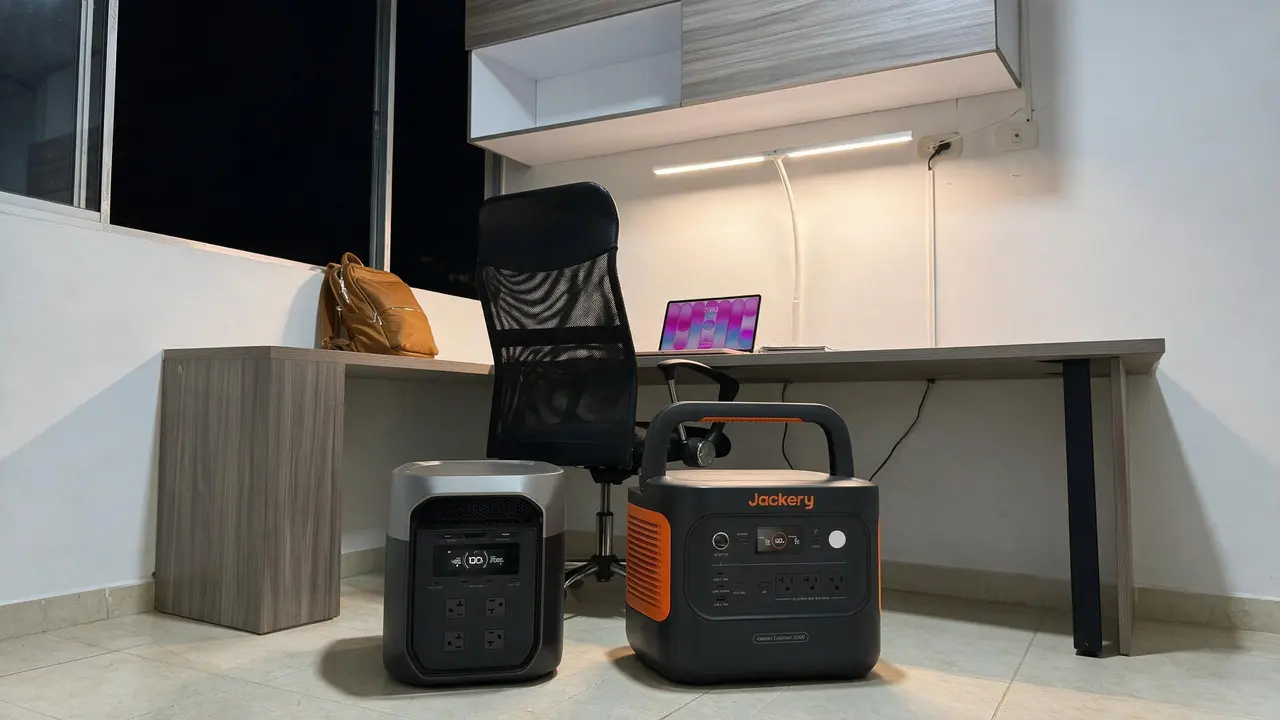
Two mid-size power stations, roughly $200 apart, betting on different things: EcoFlow on expandable capacity and output headroom, Jackery on a lighter, simpler box with fast AC charging. Here is where the money actually went, and which one to buy.
Updated
At a glance
Two mid-size power stations, roughly $200 apart, betting on different things: EcoFlow on expandable capacity and output headroom, Jackery on a lighter, simpler box with fast AC charging. Here is where the money actually went, and which one to buy.
- EcoFlow DELTA 3 Max — $1,199 current, $1199 historical low; bets on capacity expansion and output headroom.
- Jackery Explorer 2000 v2 — $999 current, $999.00 historical low; bets on lighter weight and fast AC recharge.
Same money, different bets
As an Amazon Associate I earn from qualifying purchases. Recommendations here are based on fit and the evidence below — not commission size.
At current list, the EcoFlow DELTA 3 Max runs $1,199 and the Jackery Explorer 2000 v2 runs $999 — a $200 gap that puts them in the same shopping tier, not different ones. EcoFlow's historical low has dipped to $1199; Jackery's has touched $999.00. So on a good sale day the two can land within about $20 of each other.
That is the whole problem with this matchup. You are not choosing between cheap and premium. You are choosing between two philosophies: EcoFlow bets on expandable capacity and higher continuous output, Jackery bets on a lighter, simpler unit that charges fast from a wall outlet. One of those bets will matter more to you, and the rest of this piece is about figuring out which.
A note on method: everything below comes from the two product listings and platform reviews. This is not an independent bench test, and no lab scores are claimed.
- EcoFlow DELTA 3 Max — $1,199 current, $1199 historical low; bets on capacity expansion and output headroom.
- Jackery Explorer 2000 v2 — $999 current, $999.00 historical low; bets on lighter weight and fast AC recharge.
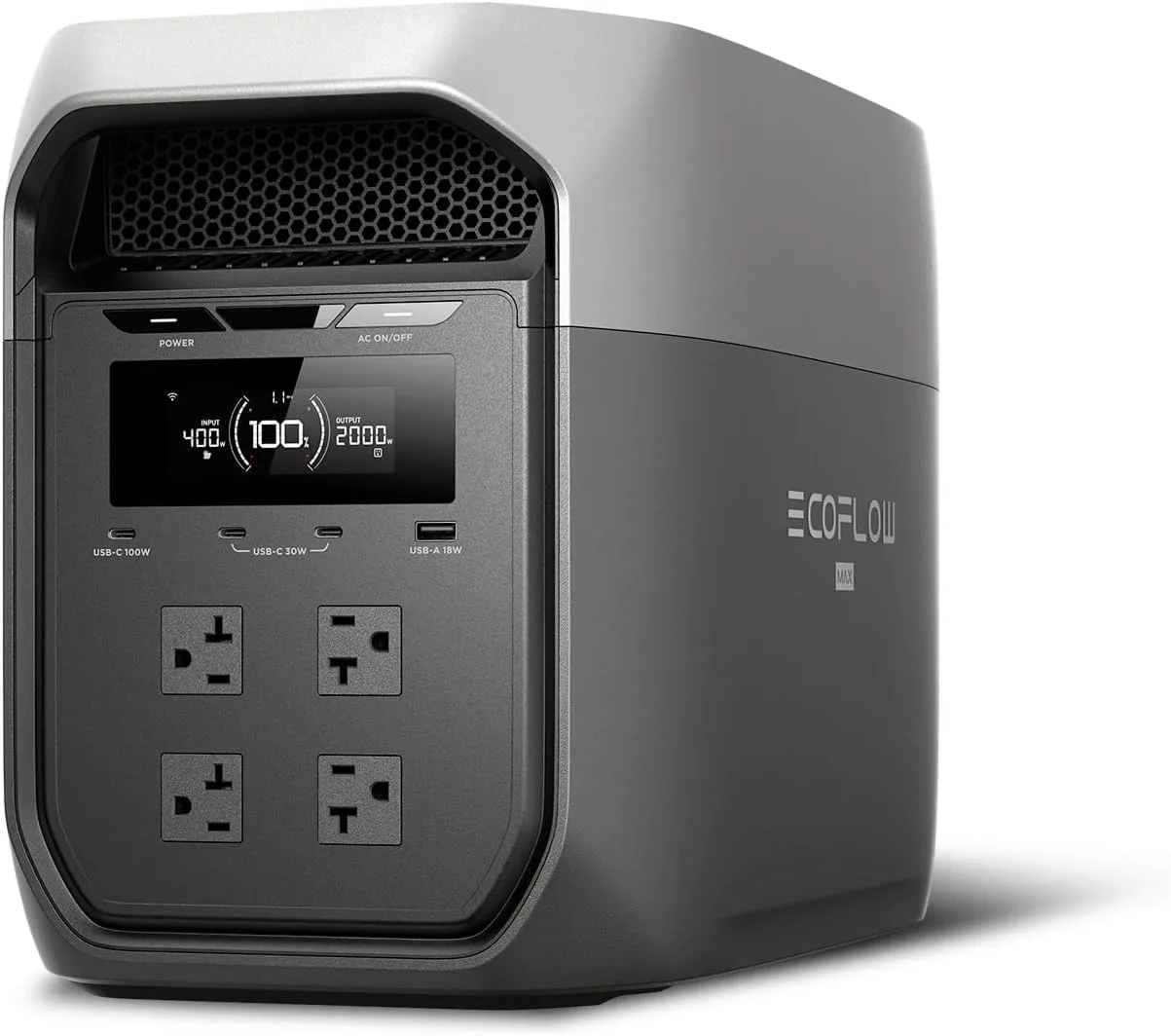
EcoFlow DELTA 3 Max Portable Power Station, 2048Wh LFP Battery
Highlights
- 2048Wh rated capacity
- 2400W continuous AC
- 4800W surge
- LiFePO4 chemistry
- Up to 500W solar input
- 44.8 lb (~20.3 kg)
Best for
- DELTA 3 Max: longer outages or higher continuous loads (still not whole-home wiring)
- RV / off-grid days where recharge speed matters as much as Wh
- Best parked near the vehicle or cabin — not a long carry to a tent
Strengths
- DELTA 3 Max: 2048Wh pack with 2400W continuous / 4800W surge — size loads to both numbers
- 44.8 lb (~20.3 kg) is a park-and-use chassis — plan a short path, not a trail hike
- 10ms-class UPS switchover on the listing — useful when a router restart would hurt
- About $1199 list in the Hub catalog — confirm live retail before you buy
Watch-outs · not ideal when
- At 44.8 lb (~20.3 kg), DELTA 3 Max is a poor tent-hike companion — plan a cart or leave it in the vehicle
- High continuous output on DELTA 3 Max tempts big loads — Wh still runs out on kettles and A/C
- Rated 500W solar on DELTA 3 Max is optimistic; shade and cables cut real watts
- LiFePO4 helps longevity, but DELTA 3 Max still hates freezing charge temps on winter trips
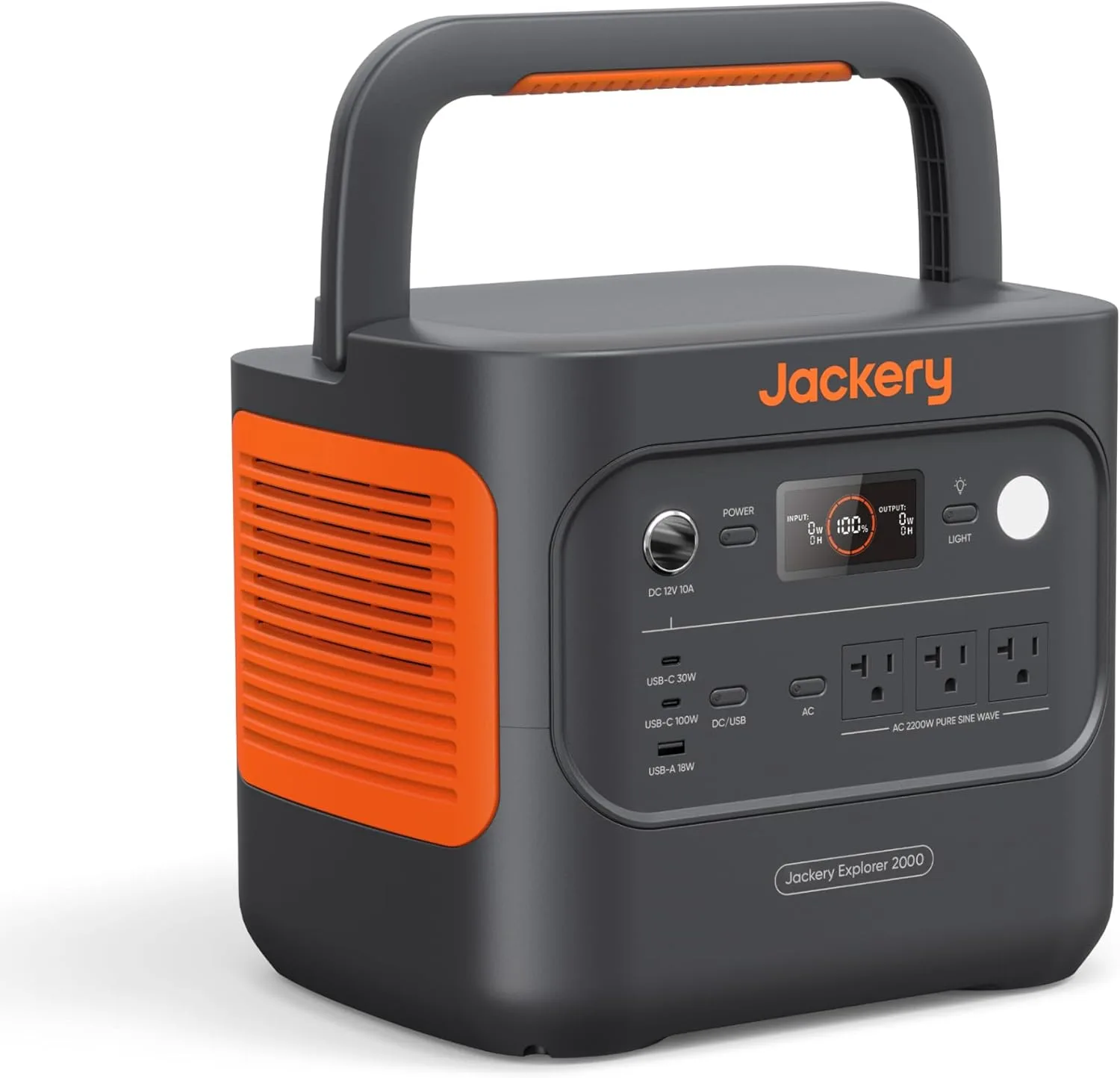
Jackery Explorer 2000 v2 Portable Power Station, 2042Wh
Highlights
- 2042Wh rated capacity
- 2200W continuous AC
- LiFePO4 chemistry
- 39.5 lb (~17.9 kg)
- About $999 list
Best for
- Explorer 2000 v2: longer outages or higher continuous loads (still not whole-home wiring)
- RV / off-grid days where recharge speed matters as much as Wh
- Users who will pair solar or expand rather than buy a second small pack
Strengths
- Explorer 2000 v2: 2200W continuous on a 2042Wh pack — more headroom for small appliances than 1kW-class peers
- 39.5 lb (~17.9 kg) is a park-and-use chassis — plan a short path, not a trail hike
- 20ms-class UPS switchover on the listing — useful when a router restart would hurt
- Owners on file: Replaces a Jackery Explorer as power for my cabin. This is the perfect all-weekend solution for a cabin, camp…
Watch-outs · not ideal when
- 39.5 lb (~17.9 kg) is a two-hand lift; skip it if you walk more than a short path to camp
- High continuous output on Explorer 2000 v2 tempts big loads — Wh still runs out on kettles and A/C
- Solar input unpublished for Explorer 2000 v2 — do not assume a same-day off-grid refill
- LiFePO4 helps longevity, but Explorer 2000 v2 still hates freezing charge temps on winter trips
Owner voices
Short takes from public retail reviews — paraphrased or translated when long or non-English; meaning kept close to the original.
“Replaces a Jackery Explorer as power for my cabin. This is the perfect all-weekend solution for a cabin, camper or RV. Ditto, certainly will get used for large group cookouts and campouts. We have a plug-in generator…”
“Tested unit on a iceco VL60ProD, unit ran perfectly for days. 2000v will be mainly used as a backup power supply for our travel trailer and occasionally for intermittent power outages at home.”
“Great customer service and fast response.”
Spec snapshot
Listing figures only. Weight in lb; missing cells are n/a (not on file) — not guesses.
| Product | List price | Capacity (Wh) | Output (W) | Weight (lb) | Rating |
|---|---|---|---|---|---|
| EcoFlow DELTA 3 Max Portable Power Station, 2048Wh LFP Battery | $1,199 | 2048 Wh | 2400 W | 44.8 lb | 5.00 |
| Jackery Explorer 2000 v2 Portable Power Station, 2042Wh | $999 | 2042 Wh | 2200 W | 39.5 lb | 4.80 |
Where the money went
Strip the branding and the two boxes allocate their budget differently. EcoFlow spends on the battery architecture and inverter; Jackery spends on portability and charge speed. Here is the line-by-line, all figures as listed by the manufacturer.
The capacity story is the clearest split. EcoFlow's headline number is larger and, more importantly, expandable — you can add battery modules later. Jackery's 2000 v2 is a fixed-capacity unit; what you buy is what you get. If you have ever wished a power station had just a bit more room after a two-day outage, that difference is the one you will feel.
Output is the second split. EcoFlow lists a higher continuous AC output, which matters for anything with a motor or a heating element. Jackery's output is respectable for its class but sits below EcoFlow's ceiling.
Ports and charging are where Jackery claws back. Its AC recharge time is the standout spec — the listing claims a full charge in about an hour from a wall outlet, which is genuinely useful when a storm is inbound and you have a narrow window. EcoFlow's recharge is fast too, but Jackery's is the number the listing leads with.
Weight and form factor favor Jackery. It is the easier box to carry up stairs or load into a car trunk, and for a lot of buyers that is not a minor detail — it is the difference between using the thing and leaving it in the garage.
- Capacity: EcoFlow lists a larger base capacity and supports expansion; Jackery is fixed-capacity.
- Continuous AC output: EcoFlow lists the higher ceiling; Jackery sits lower in the same class.
- AC recharge speed: Jackery's listing claims roughly a one-hour full charge; EcoFlow is fast but not the headline.
- Weight and portability: Jackery is the lighter, easier-to-move unit.
- Expansion: EcoFlow only — Jackery does not offer add-on battery modules for this model.
- Price: EcoFlow $1,199 vs Jackery $999 today; $1199 vs $999.00 at historical lows.
The spec that decides it
For most buyers, two numbers settle this: expandable capacity and continuous output. If you are sizing for a multi-day outage and you want the option to grow the system without replacing it, EcoFlow is the only one of the two that lets you do that. That is the single biggest structural difference between these products.
If instead your use case is a weekend cabin, a tailgate, or a one-night outage where you want to top up fast and carry the box yourself, Jackery's recharge speed and lighter weight win the day. The capacity ceiling matters less when you are never running the thing for 48 hours straight.
Everything else — port count, app features, solar input — is close enough that it should not override those two questions.
- Decisive for EcoFlow: expandable capacity plus higher continuous output.
- Decisive for Jackery: roughly one-hour AC recharge and lighter carry weight.
Real owner trade-offs
Jackery has the review history here; EcoFlow's listing has no owner reviews on file, so its trade-offs are inferred from specs alone. That asymmetry is worth naming — you are buying EcoFlow partly on faith in the spec sheet.
The Jackery reviews that are on file lean heavily on off-grid reliability. One 5-star reviewer living off grid in Belize described the unit as a lifesaver for keeping Wi-Fi and internet running during remote work, and noted that multi-day rain can outlast the solar input — a candid admission that capacity, not output, is the real limit in sustained bad weather. That is exactly the scenario where EcoFlow's expansion option would help.
A second 5-star reviewer focused on arrival condition and packaging, noting the unit showed up in perfect condition at around 30% charge. Useful for expectations, less useful for judging long-term durability.
The takeaway from the reviews is not that Jackery is better or worse — it is that the failure mode owners describe is running out of stored energy, not running out of ports. Buy capacity accordingly.
- Jackery, 5-star: off-grid remote worker called it a lifesaver for Wi-Fi during outages; noted multi-day rain can exhaust solar input.
- Jackery, 5-star: praised packaging and arrival at ~30% charge.
- EcoFlow: no owner reviews on file — spec-based assessment only.
Buy the one that…
Buy the EcoFlow DELTA 3 Max if you want a system you can grow — larger base capacity, higher continuous output, and the option to add battery modules later. It is the better long-term bet for a house that loses power for days at a time, and the $200 premium over Jackery buys you headroom you cannot retrofit into the other unit.
Buy the Jackery Explorer 2000 v2 if you want a lighter, simpler box that charges fully in about an hour and costs less today. It is the better fit for cabin weekends, tailgates, and short outages where portability and fast recharge beat raw capacity.
Skip both if you need to run a well pump, a central AC, or a whole-house transfer switch setup — neither of these is sized for that, and you should be looking at a permanently installed system instead.
- Buy EcoFlow if: you want expandable capacity and higher output, and you are planning for multi-day outages.
- Buy Jackery if: you want lighter weight, roughly one-hour AC recharge, and a lower price today.
- Skip both if: you need whole-house backup or high-surge motor loads.
Frequently asked
Which is better for most buyers, the EcoFlow DELTA 3 Max or the Jackery Explorer 2000 v2?
The Explorer 2000 v2 leads 4–3 on shared published metrics. That edge matters when weight, list price, cost per watt-hour match what you need; otherwise take the DELTA 3 Max.
I care most about carry / camping — which should I buy?
Choose Explorer 2000 v2 when you will move the unit often — it leads on weight and watt-hours per pound.
Method and sources
Model names and list prices come from the WattPicks catalog at build time. WattPicks does not run its own laboratory tests on power stations, and nothing on this page is presented as a measured result — it is catalog-backed buying guidance.
Read our methodology for how the catalog is normalized, and about WattPicks for who publishes it.