
Anker SOLIX C1000 vs Jackery Explorer 1000 v2
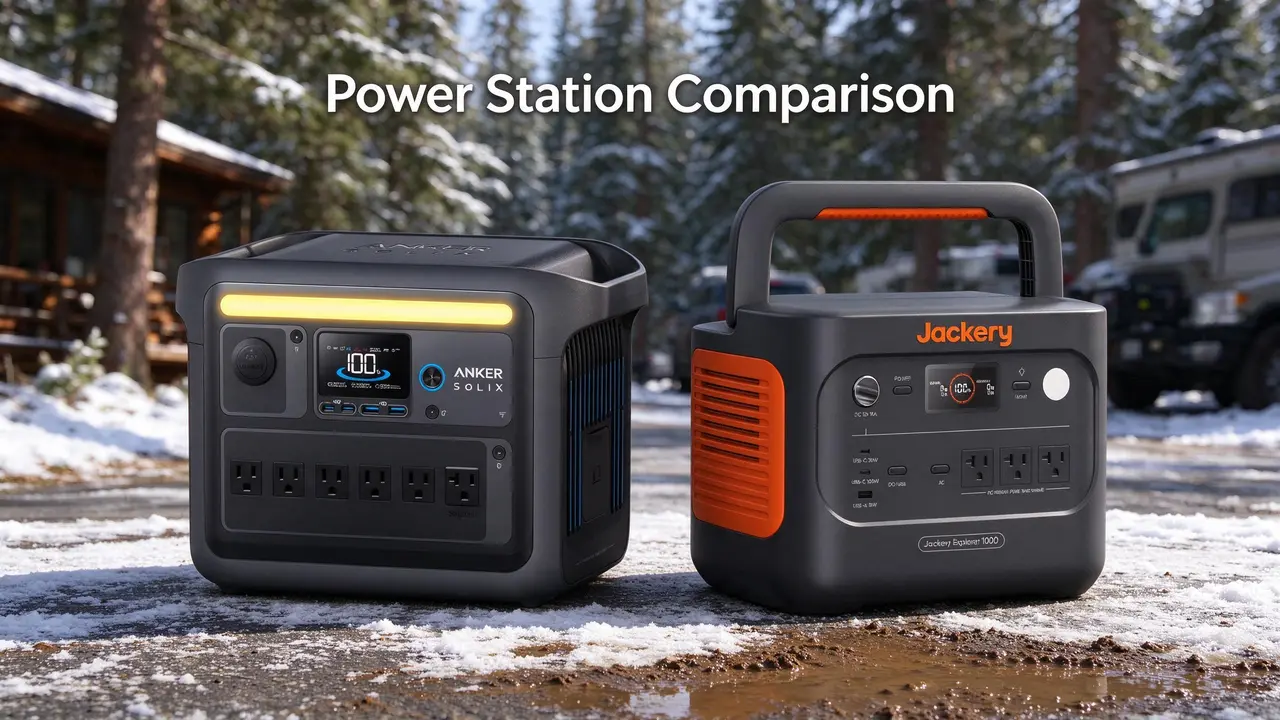
Two 1 kWh-class stations within $40 of each other, but they bet on different things: Anker on AC headroom and camper backfeeding, Jackery on weight, ports, and price per Wh. Here's how to pick without splitting the difference.
Updated
At a glance
Two 1 kWh-class stations within $40 of each other, but they bet on different things: Anker on AC headroom and camper backfeeding, Jackery on weight, ports, and price per Wh. Here's how to pick without splitting the difference.
Same money, different bets
At list price these two sit $40 apart — $599.99 for the Anker C1000 Portable Power Station, $559 for the Jackery Explorer 1000 v2 Portable Power Station,1070Wh,1500W. Close enough that price should not decide it for you. What decides it is which compromise you can live with.
The Anker bets on AC headroom: 1,800 W continuous, 1,056 Wh, and a documented habit among owners of backfeeding a truck camper through its shore-power hookup. The Jackery bets on carry weight and port count: 23.8 lb, 1,070 Wh, 1,500 W, and the lower nameplate cost per Wh at $0.52 versus $0.57.
This is a comparison of two 1 kWh-class stations, not a whole-home backup plan. Neither one runs a central AC, a well pump, or a 240V dryer. If that's the job, stop here and look at a transfer-switch setup instead.
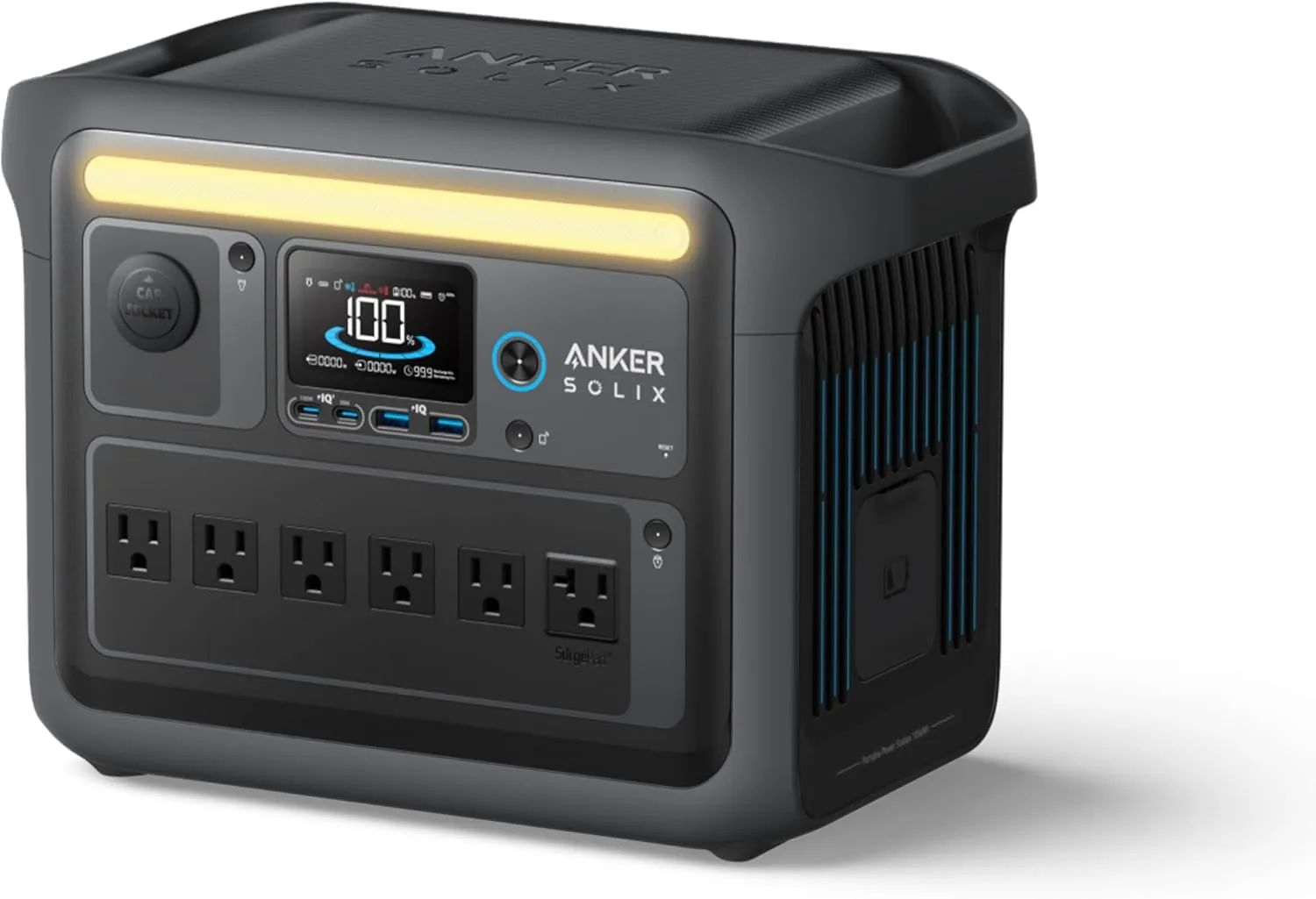
Anker C1000 Portable Power Station with Car Charging Cable, 1,056Wh
Highlights
- 1056Wh rated capacity
- 1800W continuous AC
- LiFePO4 chemistry
- Up to 600W solar input
- 28.4 lb (~12.9 kg)
- About $599.99 list
Best for
- SOLIX C1000: small appliances and tools that need ~1800W continuous, not just phone charging
- Essentials bridge at home (fridge cycles, router) when sized to the Wh
- Solar top-ups up to ~600W when panels and weather cooperate
Strengths
- SOLIX C1000: 1800W continuous on a 1056Wh pack — more headroom for small appliances than 1kW-class peers
- 28.4 lb (~12.9 kg) sits in the two-hand lift or wagon carry band for weekend moves
- 1800W continuous headroom covers more small appliances than 1kW-class inverters
- About $599.99 list in the Hub catalog — confirm live retail before you buy
Watch-outs · not ideal when
- 28.4 lb (~12.9 kg) is a two-hand lift; skip it if you walk more than a short path to camp
- Usable energy on SOLIX C1000 is below the 1056Wh label once the inverter is working
- Rated 600W solar on SOLIX C1000 is optimistic; shade and cables cut real watts
- LiFePO4 helps longevity, but SOLIX C1000 still hates freezing charge temps on winter trips
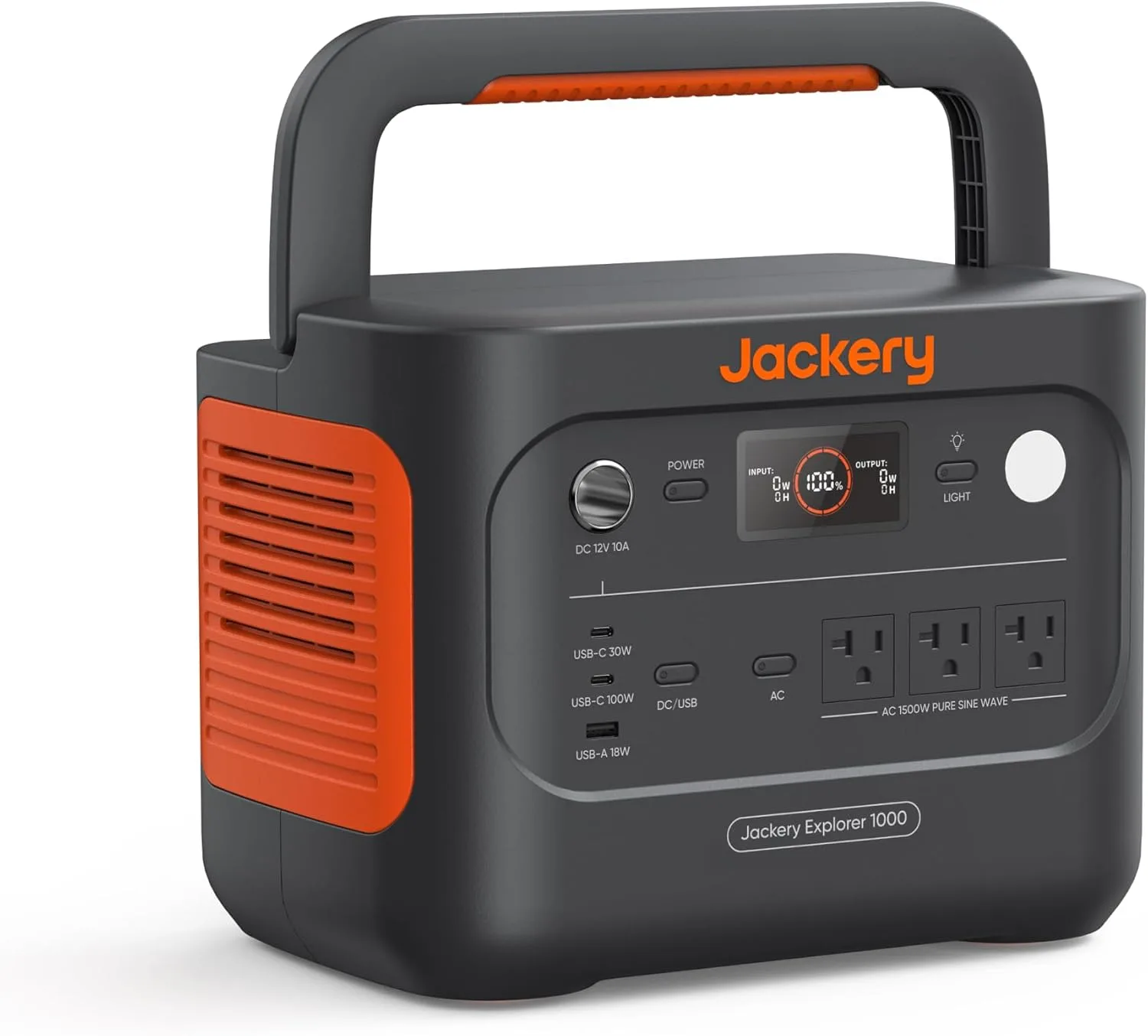
Jackery Explorer 1000 v2 Portable Power Station,1070Wh,1500W
Highlights
- 1070Wh rated capacity
- 1500W continuous AC
- LiFePO4 chemistry
- Up to 400W solar input
- 23.8 lb (~10.8 kg)
- About $559 list
Best for
- Explorer 1000 v2: weekend camping when 23.8 lb carry weight matters as much as 1070Wh
- Essentials bridge at home (fridge cycles, router) when sized to the Wh
- Solar top-ups up to ~400W when panels and weather cooperate
Strengths
- Explorer 1000 v2: 1070Wh with 1500W continuous — enough for fridge cycles if surge on the listing clears the start
- 23.8 lb (~10.8 kg) is the lightest-class carry in this band — easier stairs and car packing
- Explorer 1000 v2 uses LiFePO4 — cycle-life claims usually beat older NMC marketing lines
- Owners on file: Updated to add that customer service contacted me and offered a partial refund so i added 2 more stars. It do…
Watch-outs · not ideal when
- Explorer 1000 v2 is still a bridge for essentials — not a transfer-switch whole-home system
- Usable energy on Explorer 1000 v2 is below the 1070Wh label once the inverter is working
- Rated 400W solar on Explorer 1000 v2 is optimistic; shade and cables cut real watts
- LiFePO4 helps longevity, but Explorer 1000 v2 still hates freezing charge temps on winter trips
How I weighed these two
I'm Avery Nolan, founding editor at WattPicks, and I cover portable power capacity, output, and price-per-Wh across the catalogue. This comparison is built from the listing specs on file plus owner themes from the review packs — home-user checks, not lab-bench measurements. Where a number isn't on file, I say so rather than guess.
As an Amazon Associate, WattPicks earns from qualifying purchases. Picks here are fit-led, not commission-led — the Jackery wins on price per Wh and weight, the Anker wins on AC headroom, and neither result was steered by payout.
Scoreboard on those weights — Anker C1000 Portable Power Station (list $599.99): High where list price and published capacity match the job, Med on continuous watts; Jackery Explorer 1000 v2 Portable Power Station,1070Wh,1500W (list $559): High on continuous watts and ports, Med on price. That is why the pick splits by job rather than one universal winner.
Spec snapshot
Numbers below come from the listings, not from a bench. Ratings are the listing aggregate — useful as a sanity check, not as proof of anything.
Port counts on file for the Jackery: AC×3, USB-C×2, USB-A×1, and one DC car port (from the listing detail rows plus feature copy — not from wattage strings like "30W Max"). Anker USB-C / USB-A counts are still not published as discrete counts on file, so I am not claiming either way.
| Product | List price | Capacity (Wh) | Output (W) | Weight (lb) | Rating |
|---|---|---|---|---|---|
| Anker C1000 Portable Power Station | $599.99 | 1056 Wh | 1800 W | 28.4 lb | 4.88 |
| Jackery Explorer 1000 v2 Portable Power Station,1070Wh,1500W | $559 | 1070 Wh | 1500 W | 23.8 lb | 4.75 |
Where the money went
Four places the $40 gap shows up, and they don't all point the same direction.
- Inverter headroom: Anker spends on 1,800 W continuous versus Jackery's 1,500 W. That's the difference between a 1,500 W appliance running and tripping — and it's the single biggest reason camper owners gravitate to the Anker.
- Weight: Jackery spends down to 23.8 lb against 28.4 lb. Four and a half pounds is the difference between one-handing it out of a truck bed and asking someone to grab the other side.
- Ports and accessories: Jackery ships with three AC outlets, two USB-C, one USB-A, and a car port — but no car charging cable in the box, per owner reports. Anker's port counts aren't on file, and its included AC cable is short enough that owners complain.
- Battery and recharge: both are LFP with long cycle claims — Anker cites 3,000 cycles, Jackery 4,000 to 70%. Both recharge from AC in roughly an hour to an hour and a half in practice, per owners, with the fast mode gated behind an app toggle on each.
The spec that decides it
If you're buying for a camper or RV, the 1,800 W versus 1,500 W continuous rating is the line that matters. Owners backfeeding a truck camper through shore power ran microwaves, a furnace, a water heater, and lights off the Anker — with the rooftop AC explicitly off. That's a real ceiling, but it's a higher ceiling than the Jackery offers.
If you're buying to carry, the 23.8 lb versus 28.4 lb gap is the one you'll feel every single time. The Jackery's foldable handle and lighter body make it the easier unit to move between garage, car, and campsite. The Anker's handles are good, but owners split on whether it feels heavier than the listed figure — one called it closer to 40 lb in hand.
Capacity is a wash: 1,056 versus 1,070 Wh, a 14 Wh difference that won't change a single runtime decision. Don't let it sway you.
Real owner trade-offs
The Anker's strongest owner story is camper backfeeding. One owner ran a Northstar truck camper off the C1000 through the shore-power hookup for about a day of boondocking, and noted it switches to UPS-style pass-through when shore power returns rather than charging and powering at once. On the home side, an 18 cu ft garage fridge ran about 36 hours in mild ambient; a larger kitchen fridge made it around 12 hours with doors opening. The caveats are consistent: app and firmware connection trouble out of the box that a firmware update fixed, reconnects that lag off Wi-Fi, and one owner whose unit shut off overnight on a fridge before a firmware fix.
The Jackery's owner story is quieter and more domestic. One owner ran a fridge and a portable AC together during hurricane-season prep, kept phones topped up on USB-C PD, and used quiet mode so the family could sleep with the fridge and fans running. Camping owners report a 12V cooler drawing roughly a quarter of the battery per night, or three days down to 43% on a lighter setup. The limits are just as clear: a 1,700 W air fryer and a large sliding miter saw both stalled it, there's no 12V barrel port, and no car charger ships in the box.
Both listings sit at a 4.7 aggregate. That's a listing number, not a verdict — the useful signal is in the themes above, and they point in different directions depending on what you plug in.
Buy the one that…
Buy the Anker C1000 Portable Power Station if you're backfeeding a camper or RV through shore power and want the 1,800 W ceiling for a microwave or water heater — and you're willing to update the firmware before you trust it overnight.
Buy the Jackery Explorer 1000 v2 Portable Power Station,1070Wh,1500W if the unit lives in a closet and gets carried to the campsite or the kitchen counter, and your loads stay under 1,500 W — fridge, fans, phones, a cooler, a laptop.
Walk away from both if you need to run a 1,700 W air fryer, a large miter saw, a rooftop AC, or anything approaching whole-home backup. Neither unit is built for that, and the owner reports confirm it.
One last thing: prices move. On the Hub scrape on file, Anker list is $599.99.99 (historical low $469.99; recent card near $499.99) and Jackery list is $559 (historical low $499). At list, the Jackery is the cheaper per Wh; on a deep sale either one can flip that. Buy on the spec that fits your load, not the sticker of the week — and treat every dollar figure as as-of the listing sync date, not a live guarantee.
Frequently asked
Can the Jackery run a fridge overnight?
Owners report a 12V cooler drawing about 26% per night, and a full-size fridge running several hours. It's a short-outage tool, not a multi-day whole-home solution.
Can the Anker run a camper's rooftop AC?
No — owners explicitly note the rooftop AC stayed off. It handles the microwave, furnace, water heater, and lights, not the AC.
Do either ship with a car charging cable?
The Anker listing includes one; Jackery owners report the car charger is not in the box, so budget for it separately.
Which is quieter overnight?
Jackery owners specifically praise the quiet charging mode for sleeping with a fridge and fans running. Anker owners mention adjustable charge wattage to keep a generator on eco mode, which is a different kind of quiet.
Method and sources
Model names and list prices come from the WattPicks catalog at build time. WattPicks does not run its own laboratory tests on power stations, and nothing on this page is presented as a measured result — it is catalog-backed buying guidance.
Read our methodology for how the catalog is normalized, and about WattPicks for who publishes it.