
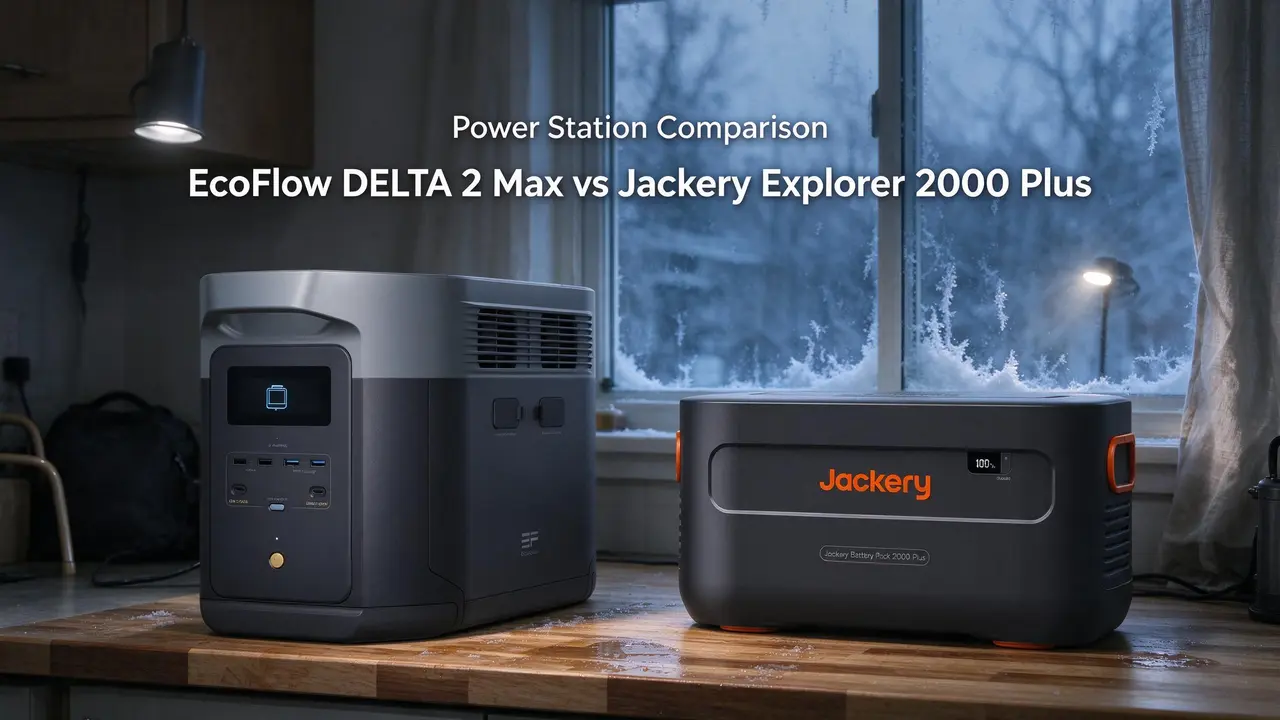
EcoFlow DELTA 2 Max vs Jackery Explorer 2000 Plus
Two ~2 kWh LFP stations, $600 apart, aimed at the same blackout. One is a fast-recharging all-in-one; the other is a cheaper expansion battery that only works if you already own the Jackery base station. Here's which one actually fits your outage.
Updated
At a glance
Two ~2 kWh LFP stations, $600 apart, aimed at the same blackout. One is a fast-recharging all-in-one; the other is a cheaper expansion battery that only works if you already own the Jackery base station. Here's which one actually fits your outage.
- EcoFlow's bet: pay more, get a self-contained fast-recharge station with app control and furnace pass-through.
- Jackery's bet: pay less per Wh, but only if the base station is already in your garage.
Same money class, two different bets
If you're sizing a station for a multi-day blackout and you've landed on roughly 2 kWh of LFP, these two are the obvious names — and they are not the same product. The EcoFlow DELTA 2 Max is a complete station: 2,048 Wh, 2,400 W continuous AC, six AC outlets, and a fast onboard charger. The Jackery unit here is the Explorer 2000 Plus expansion battery — 2,043 Wh and 2,042 W on the listing, but it's built to plug into a Jackery Explorer 2000 Plus base station you already own.
That distinction decides most of this comparison before specs even matter. One is a standalone outage box; the other is a capacity add-on. If you don't own the Jackery base station, the $799 price is not a station price — it's a battery with nothing to run.
This page is for the buyer deciding between these two at the ~2 kWh mark. It is not a whole-home backup guide, and it is not for anyone comparing sub-1 kWh camping units.
- EcoFlow's bet: pay more, get a self-contained fast-recharge station with app control and furnace pass-through.
- Jackery's bet: pay less per Wh, but only if the base station is already in your garage.
How I weighed these two
I'm Avery Nolan, WattPicks founding editor — portable power capacity, output, and price-per-Wh guidance across the catalogue, no lab claims. This comparison is grounded in the listing specs on file and owner themes from the reviews, not lab-bench measurements. Every number here comes from the product data; where the listing is silent, I wrote n/a rather than guess.
As an Amazon Associate, WattPicks earns from qualifying purchases. Picks are fit-led, not commission-led.
Scoreboard on those weights — EcoFlow DELTA 2 Max (list $1399): High where list price and published capacity match the job, Med on continuous watts; Jackery Explorer 2000 Plus (list $799): High on continuous watts and ports, Med on price. That is why the pick splits by job rather than one universal winner.
Spec snapshot
Prices are list prices, not sale stickers. Weights in pounds. Rating is the listing aggregate, not owner proof — and the Jackery count is thin, so treat its 4.6 as a small sample.
| Product | List price | Capacity (Wh) | Output (W) | Weight (lb) | Rating |
|---|---|---|---|---|---|
| EcoFlow DELTA 2 Max | $1,399 | 2048 Wh | 2400 W | 50 lb | 4.80 |
| Jackery Explorer 2000 Plus | $799 | 2043 Wh | 2042 W | 43.7 lb | 4.69 |
Where the money went
Strip the marketing and the $600 gap buys you four concrete things.
Standalone operation. The DELTA 2 Max runs a fridge, a router, a CPAP, or a furnace blower on its own. The Jackery unit needs a compatible base station to deliver AC at all — its listing frames it as an expansion pack, and that's how owners use it.
Recharge speed. EcoFlow's listing claims 80% in about 43 minutes on combined AC-plus-solar, or roughly 1.1 hours on AC alone. Owners in my notes describe 0–100% in about 1 hour 15 minutes on wall power. Jackery's expansion listing quotes about 2.3 hours to charge both the base station and the pack together on wall outlets — that's a two-piece system, not this battery alone.
Outlet count and control. The DELTA 2 Max carries AC×6, USB-C×2, USB-A×2, and a car port, plus an app for live draw and runtime. The Jackery listing doesn't publish its port set, so I won't guess — n/a (not on file).
Expandability. EcoFlow takes up to two extra batteries to reach about 6 kWh. Jackery's expansion path is the reverse: this pack is the expansion, and the base station is what scales.
- Nameplate $/Wh: Jackery $0.39/Wh vs EcoFlow $0.68/Wh — the Jackery is cheaper per Wh, but only inside its ecosystem.
- Continuous output is a near tie (2,400 W vs 2,042 W); the EcoFlow's extra headroom matters for furnace blowers and well pumps.
- Weight: 43.7 lb vs 50 lb — the Jackery pack is easier for one person to move.
The spec that decides it
Two numbers do most of the work. First, continuous output: 2,400 W on the EcoFlow versus 2,042 W on the Jackery. For a fridge (roughly 100–200 W running, higher on startup) either is plenty. For a gas furnace blower or a well pump, the EcoFlow's extra ~350 W of headroom is the difference between running and tripping.
Second, standalone capability. The Jackery's 2,042 W only exists when it's attached to a base station. If you're starting from zero, that's the whole ballgame — the EcoFlow is a station, the Jackery is a component.
Real owner trade-offs
The owner notes on file tell two different stories, and both are worth hearing.
On the EcoFlow side, the fast charge is real: one owner described watching the percentage climb fast enough to double-check the display, and another timed 0–100% at about 1 hour 15 minutes on wall power. Fridge and freezer runtime beat the on-screen estimate because compressors cycle. A furnace owner kept the DELTA 2 Max inline as a pass-through and pulled the cord mid-run — the furnace didn't hiccup. The caveats are weight (~50 lb) and ecosystem pairing: one multi-day outage account describes constant error codes trying to pair the brand's smart generator, with slow technical support escalation. Solar input occasionally needed the cable reseated before charging started.
On the Jackery side, the theme is capacity without one back-breaking brick. An off-grid cabin owner runs a gas generator morning and evening to top up the Jackerys and relies on the extra pack to keep fridges cold overnight. The friction is operational: you have to power the base station off before adding or removing the pack, so no hot-swapping; charging the expansion from a generator while the base station is in use caps output, and exceeding it shuts the base station down; and the base station decides on its own which battery drains first. None of that is a dealbreaker for an expansion pack, but it's the kind of thing you want to know before an outage, not during one.
- EcoFlow owner theme: fast recharge and furnace pass-through are the standout wins; generator pairing and support are the weak spots.
- Jackery owner theme: reliable capacity add-on for people already in the ecosystem; swap and discharge-priority limits are the recurring gripes.
Buy the one that…
Buy the EcoFlow DELTA 2 Max if you're starting from scratch and want one box that runs a fridge, a router, and a furnace blower through a multi-day outage — and you're willing to pay $1,399 and lift 50 lb. Test any generator pairing well before storm season.
Buy the Jackery Explorer 2000 Plus expansion battery if you already own the Explorer 2000 Plus base station and want to stretch runtime for $799 — and you can live with powering the base station off to swap packs and a capped output when charging from a generator.
Walk away from both if you need whole-home backup through a transfer switch — these are portable stations, not a service-panel solution. And if you don't own the Jackery base station, the $799 pack isn't a station at all; the EcoFlow is the only standalone option here.
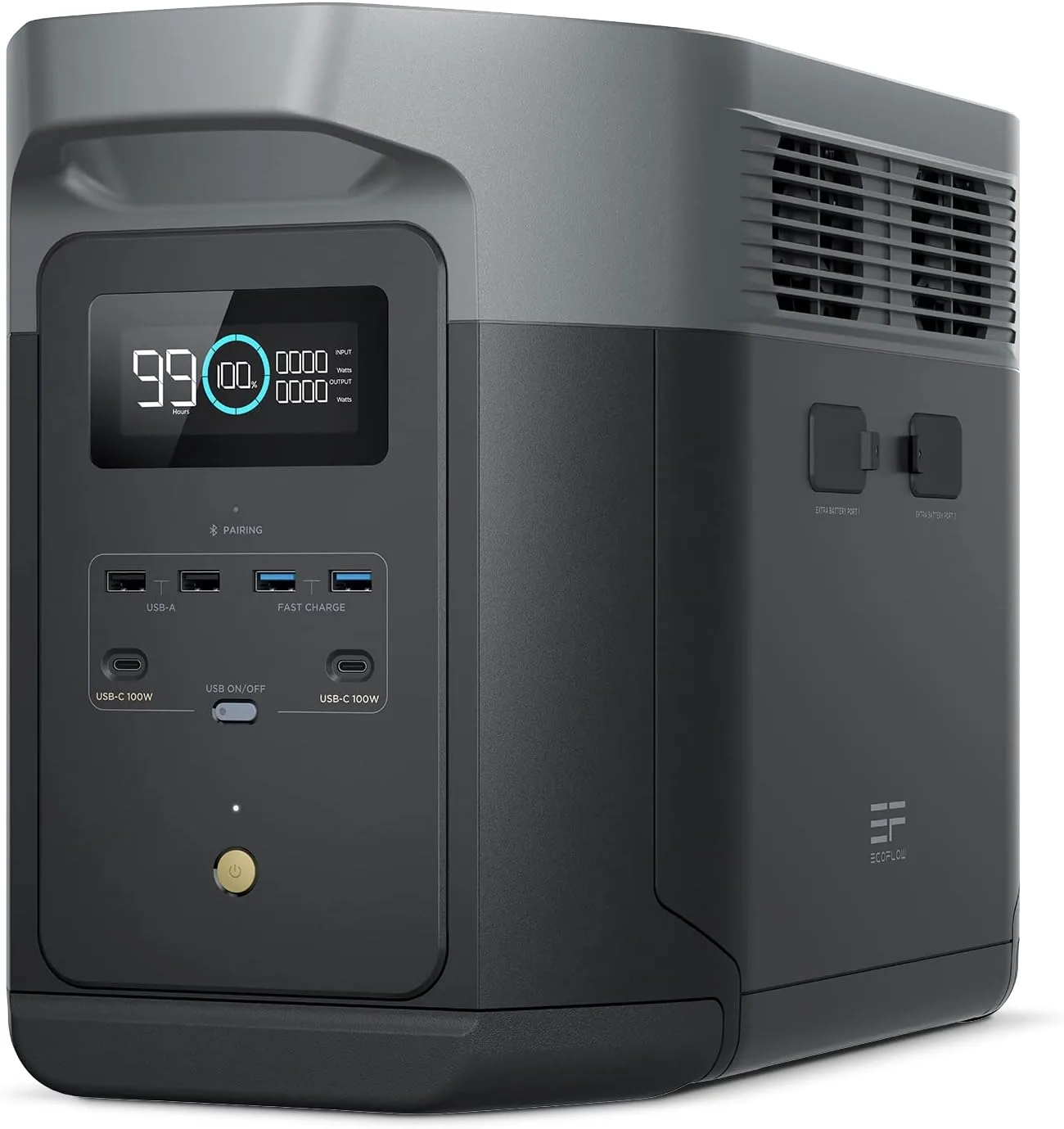
EcoFlow DELTA 2 Max
Highlights
- 2048Wh rated capacity
- 2400W continuous AC
- 4800W surge
- LiFePO4 chemistry
- Up to 1000W solar input
- 50 lb (~22.7 kg)
Best for
- DELTA 2 Max: longer outages or higher continuous loads (still not whole-home wiring)
- RV / off-grid days where recharge speed matters as much as Wh
- Best parked near the vehicle or cabin — not a long carry to a tent
Strengths
- DELTA 2 Max: 2048Wh pack with 2400W continuous / 4800W surge — size loads to both numbers
- 50 lb (~22.7 kg) is a park-and-use chassis — plan a short path, not a trail hike
- 2400W continuous headroom covers more small appliances than 1kW-class inverters
- About $1399 list in the Hub catalog — confirm live retail before you buy
Watch-outs · not ideal when
- At 50 lb (~22.7 kg), DELTA 2 Max is a poor tent-hike companion — plan a cart or leave it in the vehicle
- High continuous output on DELTA 2 Max tempts big loads — Wh still runs out on kettles and A/C
- Rated 1000W solar on DELTA 2 Max is optimistic; shade and cables cut real watts
- LiFePO4 helps longevity, but DELTA 2 Max still hates freezing charge temps on winter trips
Frequently asked
Can the Jackery Explorer 2000 Plus expansion battery run a fridge on its own?
No — it's an expansion pack for the Explorer 2000 Plus base station. Without that base station it has nothing to deliver AC through.
How long will the EcoFlow DELTA 2 Max run a fridge?
Owners report a mini-fridge at ~80 W ran about 53 hours and a stand-up freezer at ~130 W ran about 26 hours, because compressors cycle rather than run continuously. Your numbers will vary with ambient temperature and door openings.
Which is cheaper per Wh?
On nameplate, the Jackery is $0.39/Wh versus $0.68/Wh for the EcoFlow — but that only counts if you already own the base station.
Do both have USB-C?
The EcoFlow listing shows USB-C×2. The Jackery listing doesn't publish its port set, so that's n/a (not on file) — I won't claim either way.
Method and sources
Model names and list prices come from the WattPicks catalog at build time. WattPicks does not run its own laboratory tests on power stations, and nothing on this page is presented as a measured result — it is catalog-backed buying guidance.
Read our methodology for how the catalog is normalized, and about WattPicks for who publishes it.