
EcoFlow DELTA 3 Max Plus vs Jackery Explorer 2000 Plus
Two stations land near 2,000 Wh, but they bet your money very differently: EcoFlow sells output and fast charging, Jackery sells capacity per dollar. Here is who should buy which — and who should walk away from both.
Updated
At a glance
Two stations land near 2,000 Wh, but they bet your money very differently: EcoFlow sells output and fast charging, Jackery sells capacity per dollar. Here is who should buy which — and who should walk away from both.
- EcoFlow buys you headroom: 3,000 W continuous and fast recharge
- Jackery buys you watt-hours cheap: 2,043 Wh at $0.39/Wh nameplate
- Both sit in the same weight class — 48.7 lb vs 43.7 lb
Same money class, two different bets
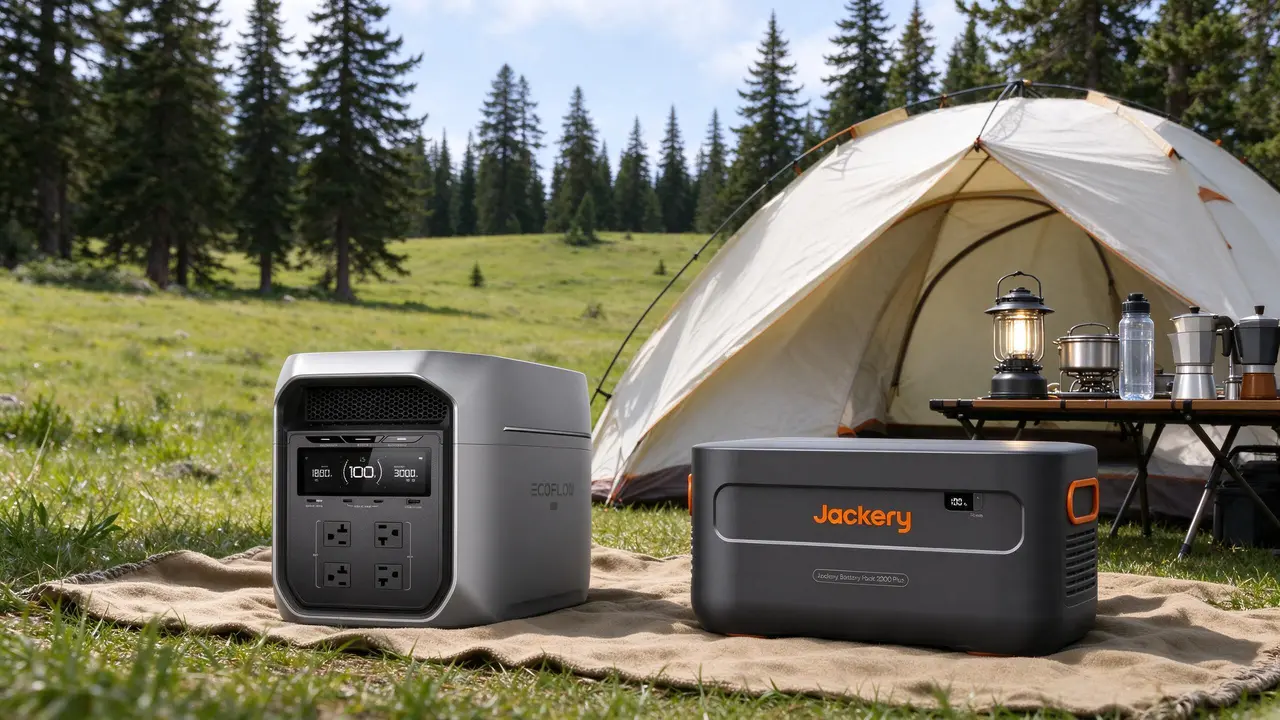
If you are shopping the 2,000 Wh class for home backup or a camper, these two show up in the same search and then split hard. The EcoFlow DELTA 3 Max Plus bets on output and speed: 3,000 W continuous, a 10 ms transfer claim from the listing, and a fast wall-charge cycle. The Jackery Explorer 2000 Plus bets on capacity per dollar — 2,043 Wh for $799 against $1,899 for the EcoFlow.
That price gap is the whole article. One of these is roughly 2.4 times the money for the same nominal capacity, and the question is whether the extra watts and charging speed are worth it for the loads you actually run.
One boundary up front: this is a two-way pick between these stations, not a whole-home backup plan. Neither replaces a transfer switch and an electrician, and neither is a generator substitute for multi-day outages at full house load.
Disclosure: as an Amazon Associate, WattPicks earns from qualifying purchases. Picks here are fit-led, not commission-led.
- EcoFlow buys you headroom: 3,000 W continuous and fast recharge
- Jackery buys you watt-hours cheap: 2,043 Wh at $0.39/Wh nameplate
- Both sit in the same weight class — 48.7 lb vs 43.7 lb
Spec snapshot
Everything below comes from the listings and the WattPicks catalogue. Where a spec is not published, it says so rather than guessing. Ratings are the listing aggregate, not an owner-verified score.
| Product | List price | Capacity (Wh) | Output (W) | Weight (lb) | Rating |
|---|---|---|---|---|---|
| EcoFlow DELTA 3 Max Plus | $1,899 | 2048 Wh | 3000 W | 48.7 lb | 5.00 |
| Jackery Explorer 2000 Plus | $799 | 2043 Wh | 2042 W | 43.7 lb | 4.60 |
Where the money went
Four configuration differences explain most of the $1,100 gap, and none of them is cosmetic.
Output headroom. The EcoFlow lists 3,000 W continuous, with a 3,800 W X-Boost mode the listing describes for appliances that spike above their steady draw. The Jackery lists 2,042 W. For a fridge, a fan, lights, and a router, both are overkill. For a microwave plus a coffee maker plus a space heater on one circuit, the EcoFlow's extra watts are the difference between running and tripping.
Charging speed. EcoFlow's listing claims 80% in about 43 minutes on AC and five charging paths including solar, car, and a smart generator. Jackery's expansion-battery listing describes roughly 2.3 hours to charge a base station plus one battery on wall power, and about 2 hours for the battery alone on six 200 W solar panels. If you recharge between outages rather than during them, this matters less than it sounds.
Expansion path. EcoFlow scales from 2 kWh to a listed 10 kWh with add-on batteries. Jackery's listing describes going from 2 kWh to 12 kWh with up to five expansion packs, or 24 kWh and 6,000 W by paralleling two base stations. Both are real ecosystems; Jackery's ceiling is higher on paper.
Ports and control. EcoFlow's port lock shows AC×4, USB-C×1, USB-A×1, plus app monitoring and scheduling. Jackery's listing does not publish a port set on file, so treat port count as a check-it-yourself item on the Jackery.
- Output: 3,000 W vs 2,042 W — the EcoFlow's clearest win
- Recharge: fast AC on EcoFlow; Jackery's numbers are for the battery pack, not a full station cycle
- Expansion: 10 kWh listed for EcoFlow, 12–24 kWh described for Jackery
- Ports: EcoFlow AC×4 / USB-C×1 / USB-A×1; Jackery port set not published on file
The spec that decides it
Two numbers do most of the work here, and they point in opposite directions.
The first is nameplate dollars per watt-hour: $0.39/Wh for the Jackery against $0.93/Wh for the EcoFlow. If your job is keeping a fridge, a CPAP, lights, and a router alive through an evening outage, the Jackery delivers the same 2,000 Wh class for less than half the money. That is the single strongest argument on this page, and it is not close.
The second is continuous output: 3,000 W versus 2,042 W. If your outage plan includes a space heater, a microwave, or power tools — or you want to run a camper's AC — the EcoFlow's headroom is the reason to pay. The Jackery's 2,042 W is plenty for essentials and thin for anything with a heating element.
For the camper-AC scenario specifically, surge or startup watts is the deciding metric, not continuous watts. Neither listing publishes a surge figure on file, so ask the seller or check the manual before you buy on that basis. As a fallback rule, plan for continuous headroom of at least 1.25× the steady load — so a 1,500 W AC needs a station rated near 1,875 W continuous, and startup surge on top of that.
Everything else is secondary. Weight differs by 5 lb, which is not a carrying decision at this size — both are two-hand, roll-it-or-leave-it units.
What owners actually report
Method note: owner themes below are paraphrased from Amazon review notes on file, read in the last review cycle; they are not independently auditable here and should be treated as directional, not verified.
Owner themes on file line up with the spec split, and they also flag the same annoyances on both sides.
EcoFlow owners describe camper and RV use where solar input kept both the camper and the station climbing toward full in one afternoon, and one ran a cooler, a large fan, and an air purifier for a long stretch with the battery barely moving. The clever one: using the station as a buffer between an EV's limited outlets and a camper, with a charge limit set so the truck never overloads. The recurring complaints are weight — one owner put it on rolling platforms — only four front AC outlets, and a power-down required before adding an expansion battery.
Jackery owners skew toward off-grid cabins and storm prep. One cut generator runtime to a couple of hours morning and evening while fridges and lights ran all night. Others like that each pack stays movable, so capacity grows in affordable increments. The caveats are consistent: no hot-swap (the base station powers down to add or remove a battery), output caps when charging from a generator while running loads, and no control over whether the battery or the base drains first.
Note the angle skew: EcoFlow reviews lean camper and home-backup, Jackery reviews lean cabin and expansion-battery add-on. Neither listing's 4.6 aggregate is owner proof — it is a listing figure.
- EcoFlow: solar top-up while running loads, EV-buffer trick, heavy, four outlets
- Jackery: generator-runtime cut at a cabin, movable increments, no hot-swap, discharge-order gap
Buy the one that…
Buy the EcoFlow DELTA 3 Max Plus if your outage or trip plan includes loads approaching 2,000 W with surge — a space heater, a microwave, a camper AC — or if fast AC recharge between storms is worth real money to you. It is also the pick if you want app scheduling and a documented port set you can plan around.
Buy the Jackery Explorer 2000 Plus if the job is essentials: fridge, lights, router, CPAP, fans. At $799 for 2,043 Wh it is the value play in this class, and the expansion path lets you add runtime later without buying a second station.
Walk away from both if you need whole-home backup through a multi-day outage, or if you expect to carry either unit up stairs regularly — 43.7 lb and 48.7 lb are furniture, not luggage. And skip the EcoFlow if you will never use more than 2,000 W; you would be paying $1,100 for headroom you do not draw.
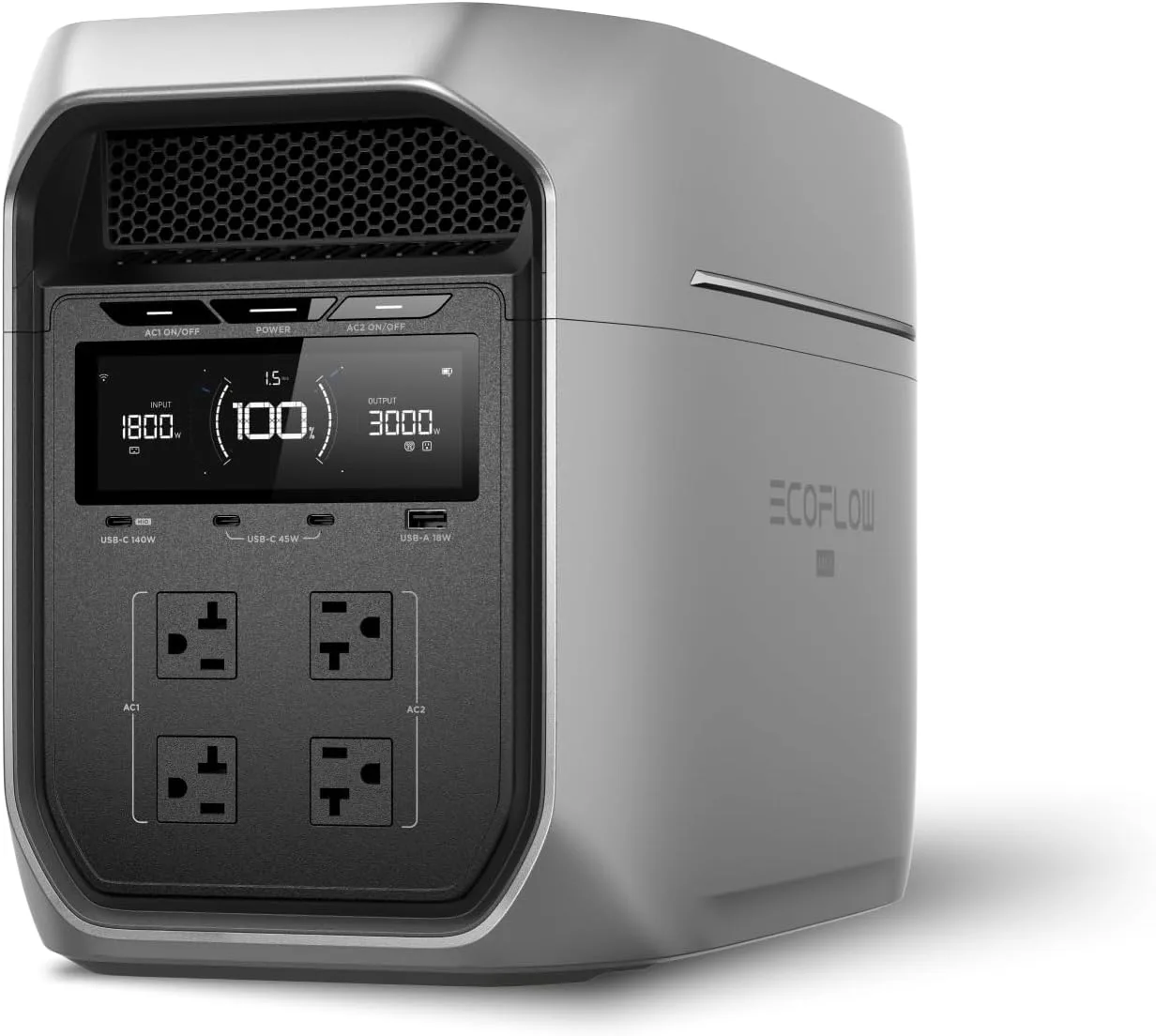
EcoFlow DELTA 3 Max Plus
Highlights
- 2048Wh rated capacity
- 3000W continuous AC
- 6000W surge
- LiFePO4 chemistry
- 48.7 lb (~22.1 kg)
- About $1899 list
Best for
- DELTA 3 Max Plus: longer outages or higher continuous loads (still not whole-home wiring)
- RV / off-grid days where recharge speed matters as much as Wh
- Best parked near the vehicle or cabin — not a long carry to a tent
Strengths
- DELTA 3 Max Plus: 2048Wh pack with 3000W continuous / 6000W surge — size loads to both numbers
- 48.7 lb (~22.1 kg) is a park-and-use chassis — plan a short path, not a trail hike
- 3000W continuous headroom covers more small appliances than 1kW-class inverters
- Owners on file: 5/5 · 6 helpful — I waited a while to leave this review. I bought this power station for one reason which was…
Watch-outs · not ideal when
- At 48.7 lb (~22.1 kg), DELTA 3 Max Plus is a poor tent-hike companion — plan a cart or leave it in the vehicle
- High continuous output on DELTA 3 Max Plus tempts big loads — Wh still runs out on kettles and A/C
- Solar input unpublished for DELTA 3 Max Plus — do not assume a same-day off-grid refill
- LiFePO4 helps longevity, but DELTA 3 Max Plus still hates freezing charge temps on winter trips
Quick questions before you pick
A few things buyers of these two specific stations tend to ask.
Can the Jackery run a space heater? At 2,042 W continuous, a typical 1,500 W heater fits, but little else at the same time. The EcoFlow's 3,000 W leaves room for a second load.
How long will either run a fridge? Runtime depends on duty cycle, not just capacity. Worked example with a stated assumption: a fridge averaging 100 W draw at a 33% duty cycle uses about 33 W continuous-equivalent, so roughly 2,000 Wh ÷ 33 W ≈ 60 hours on either unit — before inverter losses and other loads. Apply the same assumption to both; the Jackery and EcoFlow land in the same ballpark because their capacities are within 5 Wh.
Do I need the expansion battery on day one? No. Both stations work standalone at roughly 2,000 Wh; expansion is a later decision, and on the Jackery it requires the matching base station.
Which is easier to move? The Jackery, marginally, at 43.7 lb versus 48.7 lb — but plan on a cart for either.
Frequently asked
How long does each take to recharge on solar?
EcoFlow's listing claims five charging paths including solar but does not publish a solar recharge time on file. Jackery's listing describes about 2 hours for the expansion battery alone on six 200 W panels; a full base-station cycle will be longer. Treat both as listing claims and confirm panel compatibility before buying.
Can I parallel two units for more power?
Jackery's listing describes paralleling two base stations to reach 24 kWh and 6,000 W. EcoFlow's listing on file describes expansion batteries up to 10 kWh but does not mention paralleling two DELTA 3 Max Plus units, so do not count on it without confirmation.
Is the 10 ms transfer time verified?
No — the 10 ms transfer claim comes from EcoFlow's listing and is not independently verified here. If you need seamless backup for sensitive equipment, confirm the spec and your configuration with the seller.
Method and sources
Model names and list prices come from the WattPicks catalog at build time. WattPicks does not run its own laboratory tests on power stations, and nothing on this page is presented as a measured result — it is catalog-backed buying guidance.
Read our methodology for how the catalog is normalized, and about WattPicks for who publishes it.