
Portable Power Stations Ranked by Weight and Size
Weight is the first spec you feel, not the one on the box. Here's how six stations from 7.7 to 27.6 lb split into carry tiers — and where capacity starts costing you your shoulders.
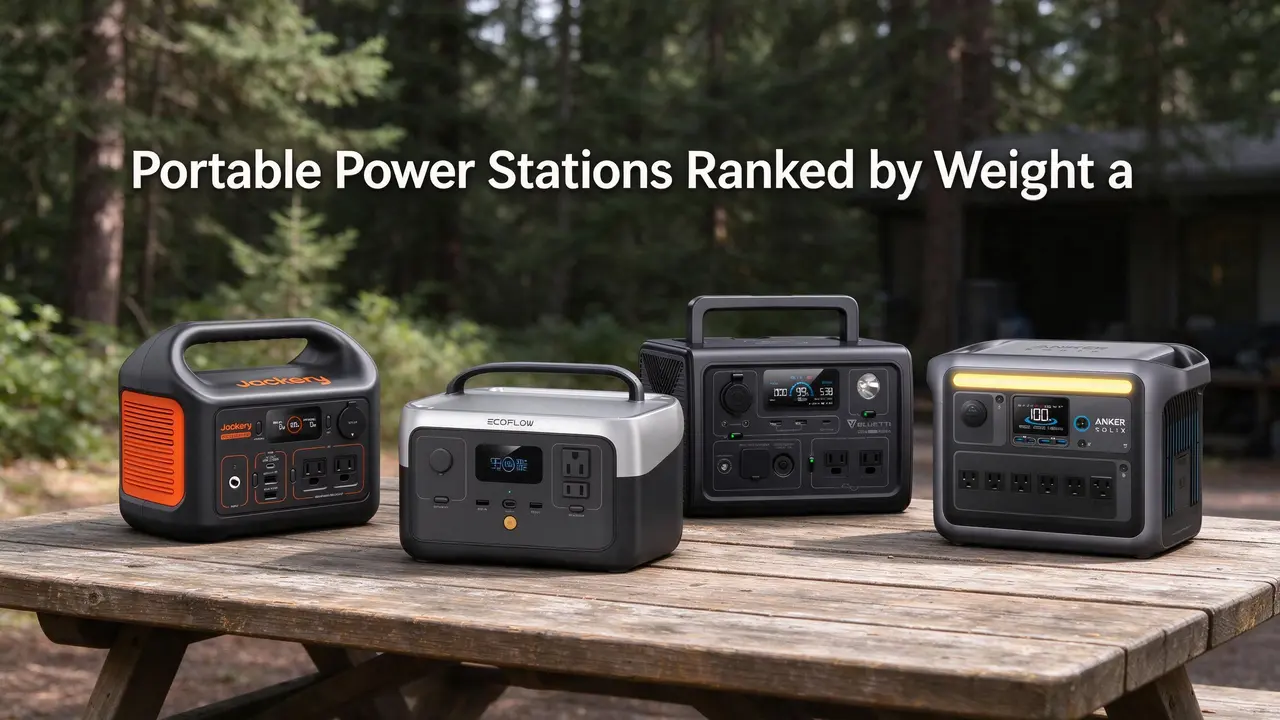
Updated
The short answer: weight tracks Wh, but not linearly
As an Amazon Associate I earn from qualifying purchases. Recommendations here are based on fit and the evidence below — not commission size.
If you're shopping by weight, start with the ratio: every station in this group carries roughly 25–40 Wh per pound, and that ratio gets worse as capacity climbs. The lightest unit here, EcoFlow RIVER 2 at 7.7 lb, packs 243 Wh — about 31.6 Wh/lb. The heaviest, Anker C1000 at 27.6 lb, is a different animal entirely, and its catalogue capacity figure (56 Wh) doesn't fit the pattern, so treat that number as unverified until you confirm it on the listing.
What that means in practice: under 10 lb is a one-hand carry you'll actually bring. Ten to 15 lb is a two-hand lift you'll bring if you planned for it. Past 20 lb, you're moving a station around the house or loading it into a vehicle — not hiking with it.
This page is a weight-and-size guide, not a runtime calculator. If you need to size a station against a specific load — a fridge, a CPAP, a furnace blower — start with our guide to sizing a power station for home backup, then come back here to pick the body you can actually lift.
Plain verdicts on the two lightest picks: Jackery Explorer 300 Portable Power Station,292Wh (list $289) is a solid buy if you want a proven camping/CPAP unit and don't mind $1.00/Wh; its 300 W continuous output is the limit. EcoFlow RIVER 2 (list $177.65) is the better value for phones, laptops, and fans — 300 W continuous and a lower price — but it won't run a compressor or heating element.
All figures from the catalogue. Prices are list, not sale. Ratings are listing aggregates, not owner proof.
This ranking is built from catalogue specs (weight, Wh, W, list price, ports) and owner themes on file for each SKU. I'm a deep-use experience reviewer working from listings and owner notes — these are not lab-bench measurements, and I haven't run instrumented tests on any of these units. Where I say 'owners report,' I'm paraphrasing review themes on file, not reporting my own field tests.
Weight and capacity carry the most weight here because that's the page job. Price per Wh is calculated from list price, not sale price. Where the catalogue has no price (BLUETTI EB3A) or a capacity figure that conflicts with the product name (Anker C1000), I've flagged it rather than guessed.
Avery Nolan is the founding editor of WattPicks, covering portable power station capacity, output, and price-per-Wh across the catalogue — no lab claims.
- Under 10 lb: EcoFlow RIVER 2 (7.7 lb), Jackery Explorer 300 v2 (8.2 lb), Anker C300 (9.1 lb)
- 10–15 lb: BLUETTI EB3A (10.1 lb)
- 20 lb and up: Jackery Explorer 1000 v2 (23.8 lb), Anker C1000 (27.6 lb)
Spec snapshot
Listing list prices (same figure as product cards). Weight in lb; missing cells are n/a (not on file). Dimensions are not on file for any of these SKUs — check each listing if footprint matters. Historical lows on cards are separate — do not mix them into this table.
| Product | Price | Capacity (Wh) | Output (W) | Weight (lb) | Rating |
|---|---|---|---|---|---|
| Jackery Explorer 300 Portable Power Station,292Wh | $289 | 288 Wh | 300 W | 8.2 lb | 4.6 |
| EcoFlow RIVER 2 | $177.65 | 243 Wh | 300 W | 7.7 lb | 4.3 |
| BLUETTI EB3A Portable Power Station | n/a (not on file) | 268 Wh | 600 W | 10.1 lb | 4.1 |
| Anker C1000 Portable Power Station with Car Charging Cable, 1,056Wh | $599.99 | n/a — unverified (catalogue says 56 Wh; product name says 1,056 Wh; do not rely on either figure until confirmed on listing) | 1800 W | 27.6 lb | 4.7 |
| Jackery Explorer 1000 v2 Portable Power Station,1070Wh,1500W | $559 | 1070 Wh | 1500 W | 23.8 lb | 4.7 |
| Anker C300 Portable Power Station, 288Wh Solar Generator | $329.99 | 288 Wh | 300 W | 9.1 lb | 4.6 |
Ultralight tier: under 10 lb, one-hand carry
Three stations sit in the true grab-and-go band, and they're close enough on weight that the decision comes down to capacity and price per Wh rather than pounds.
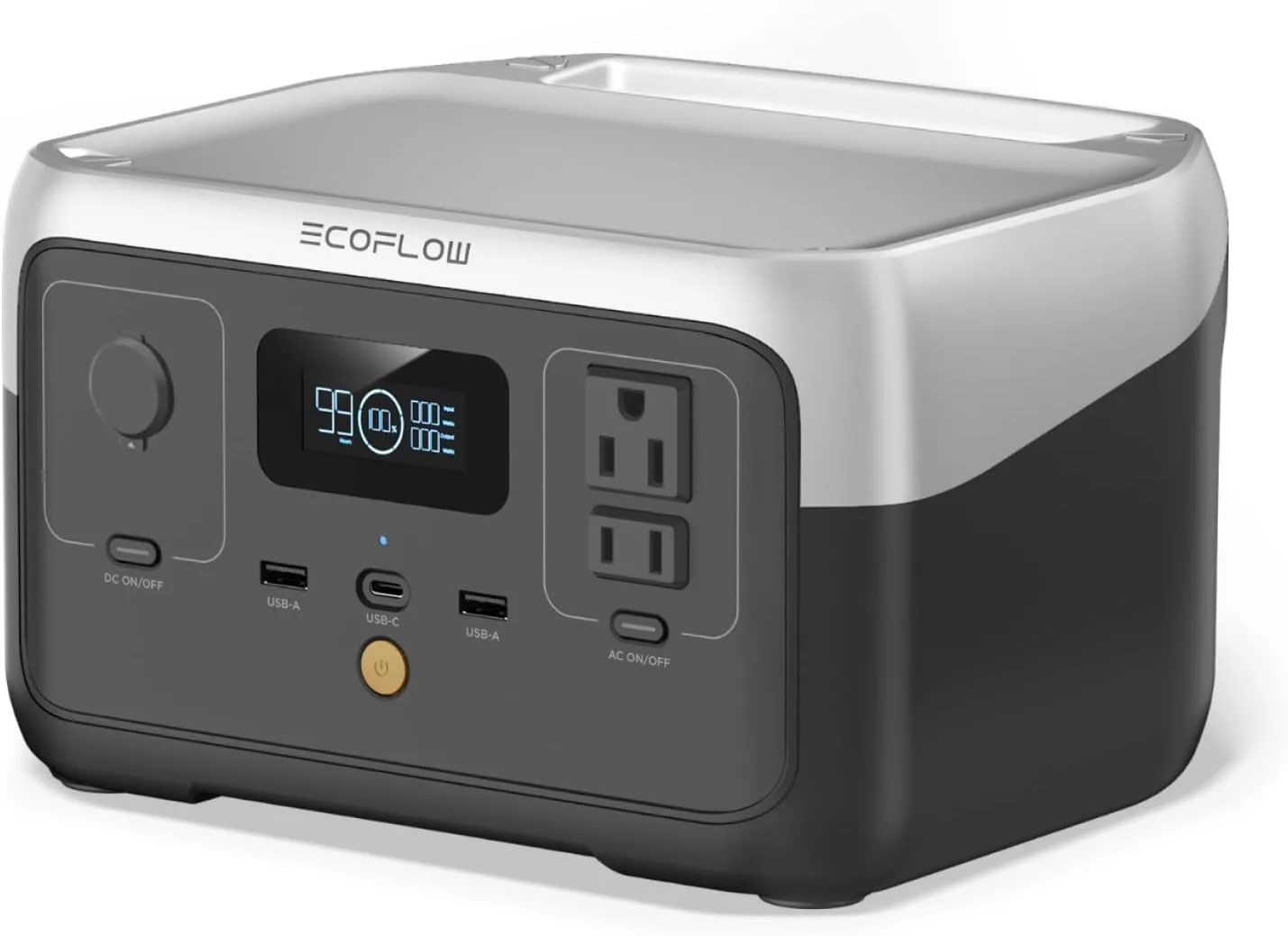
EcoFlow RIVER 2 is the lightest at 7.7 lb with 243 Wh and 300 W continuous. At $177.65 list, that's $0.73/Wh — the second-cheapest per Wh in this group. Owners on file lean on it for phone charging, camping, and short backup runs; several mention using it as a small UPS for a router or network gear. If your load is a laptop, a fan, and a couple of phones, this is enough. It is not enough for a fridge or anything with a heating element.
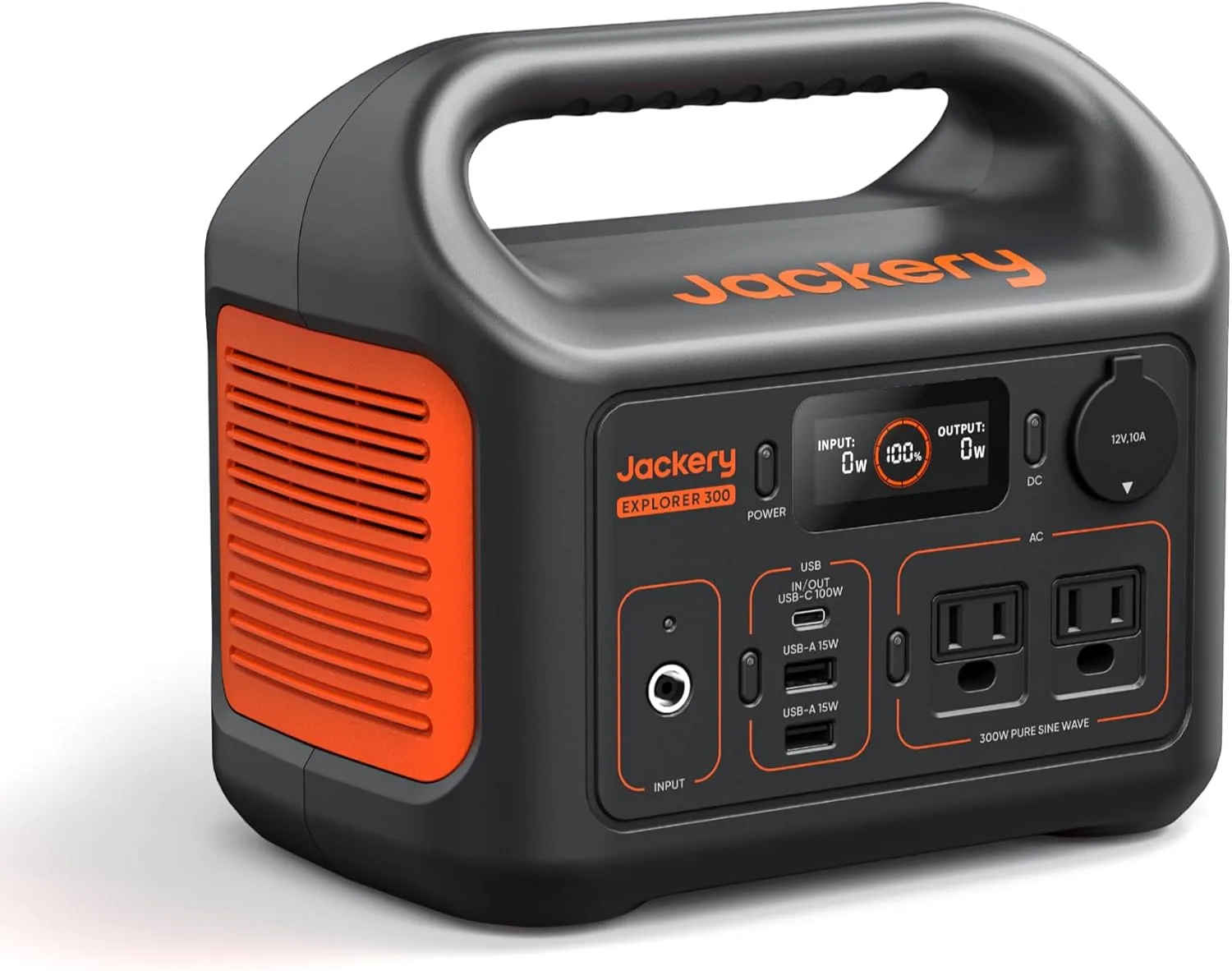
Jackery Explorer 300 Portable Power Station,292Wh is 8.2 lb with 288 Wh and 300 W. At $289 list, that's $1.00/Wh. The extra 45 Wh over the RIVER 2 costs you about $111 and half a pound. Owner themes skew toward camping, CPAP use, and outage backup — one reviewer notes running a CPAP on DC rather than AC roughly halves the overnight draw, which is a useful trick if that's your load.
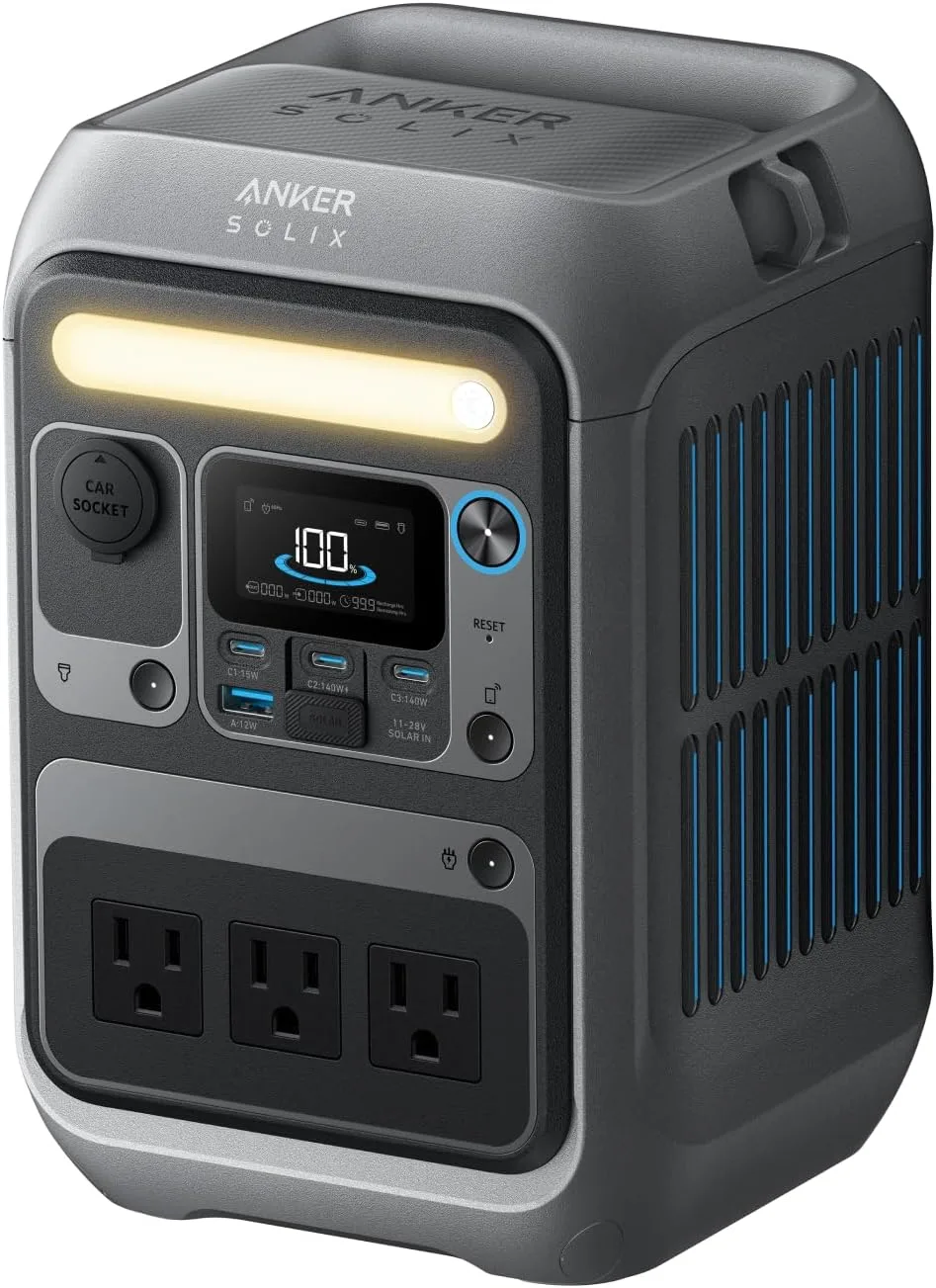
Anker C300 Portable Power Station, 288Wh Solar Generator matches the Jackery on capacity (288 Wh) and output (300 W) at 9.1 lb, but lists at $329.99 — $1.15/Wh, the priciest per Wh here. What you're paying for is port selection: AC×8 and USB-C×3 per the catalogue. If you're charging a lot of USB-C devices at once, that's the trade; if you're not, the Jackery is cheaper for the same capacity.
EcoFlow RIVER 2
Highlights
- 243Wh rated capacity
- 300W continuous AC
- 600W surge
- LiFePO4 chemistry
- Up to 110W solar input
- 7.7 lb (~3.5 kg)
Best for
- RIVER 2: phones, cameras and a laptop on short trips
- Travel kits when you need quiet pack power, not appliance runtime
Jackery Explorer 300 Portable Power Station,292Wh
Highlights
- 288Wh rated capacity
- 300W continuous AC
- 600W surge
- LiFePO4 chemistry
- 8.2 lb (~3.7 kg)
- About $289 list
Best for
- Explorer 300 v2: phones, cameras and a laptop on short trips
- Travel kits when you need quiet pack power, not appliance runtime
Anker C300 Portable Power Station, 288Wh Solar Generator
Highlights
- 288Wh rated capacity
- 300W continuous AC
- 600W surge
- LiFePO4 chemistry
- 9.1 lb (~4.1 kg)
- About $329.99 list
Best for
- SOLIX C300: phones, cameras and a laptop on short trips
- Travel kits when you need quiet pack power, not appliance runtime
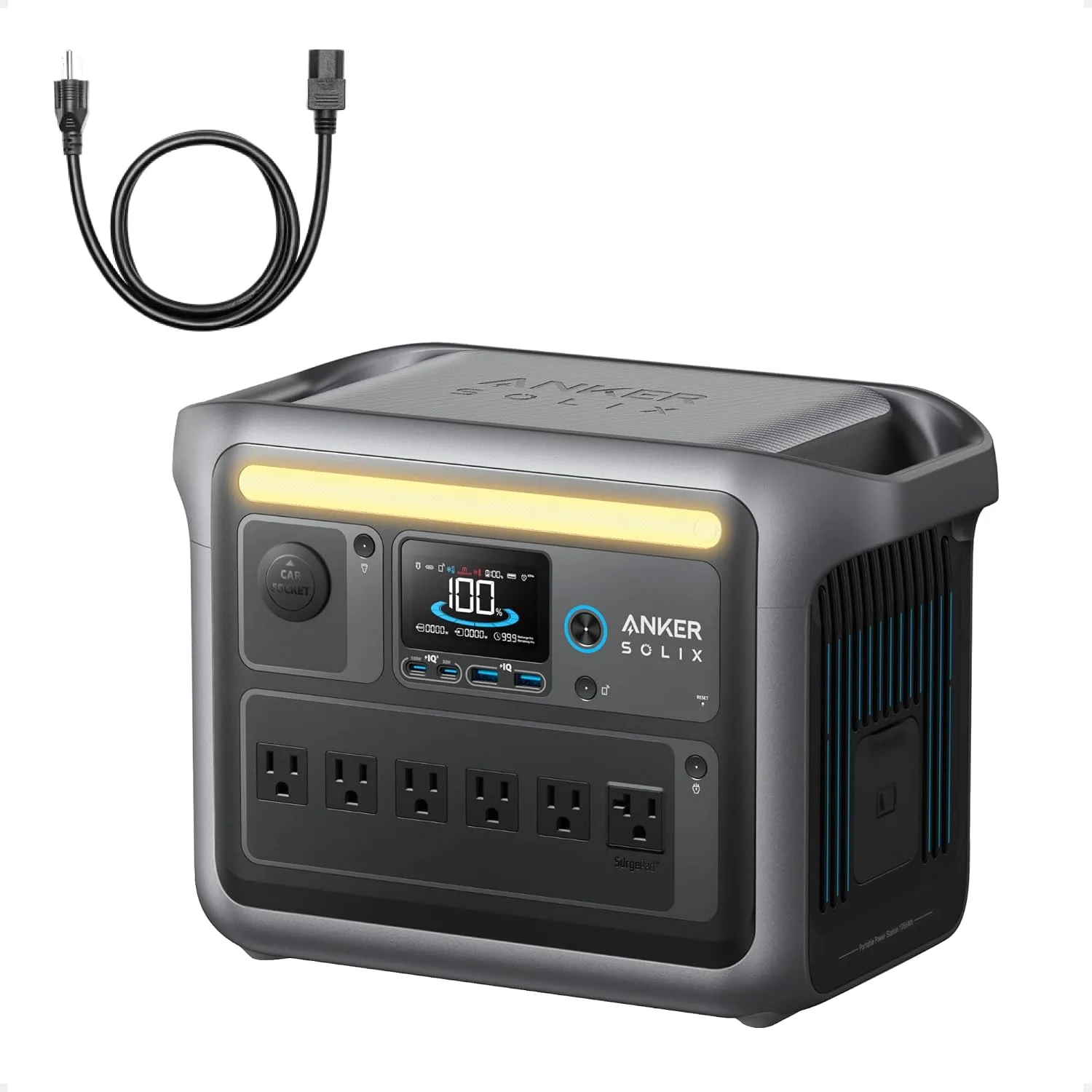
Anker Full Charge in 58 Min
Highlights
- 56Wh rated capacity
- 1800W continuous AC
- LiFePO4 chemistry
- 27.6 lb (~12.5 kg)
- About $599.99 list
Best for
- SOLIX C1000: phones, cameras and a laptop on short trips
- Travel kits when you need quiet pack power, not appliance runtime
Compact mid-size: 10–15 lb, the awkward middle
BLUETTI EB3A Portable Power Station is the only station in this band at 10.1 lb, and it's the odd one out in a useful way: 268 Wh but 600 W continuous output. That's double the AC headroom of the three ultralights, which matters if you want to run a small appliance — a blender, a shop vac, a space heater on low — that would trip a 300 W inverter.
The catch is price transparency. The catalogue lists no price for the EB3A (n/a, not on file), so I can't give you a $/Wh figure or rank it on value. On paper it's the most capable small unit here; on price, you'll need to check the current listing yourself.
Owner themes on file mention camping, powering appliances, CPAP, and UPS mode — and also a recurring thread of units shutting down or failing, which is worth weighing against the spec sheet. If you buy one, test it under load inside the return window: run your heaviest planned appliance for at least 20–30 minutes, confirm it doesn't trip or shut down, and check the unit's display for error codes before the return period ends.
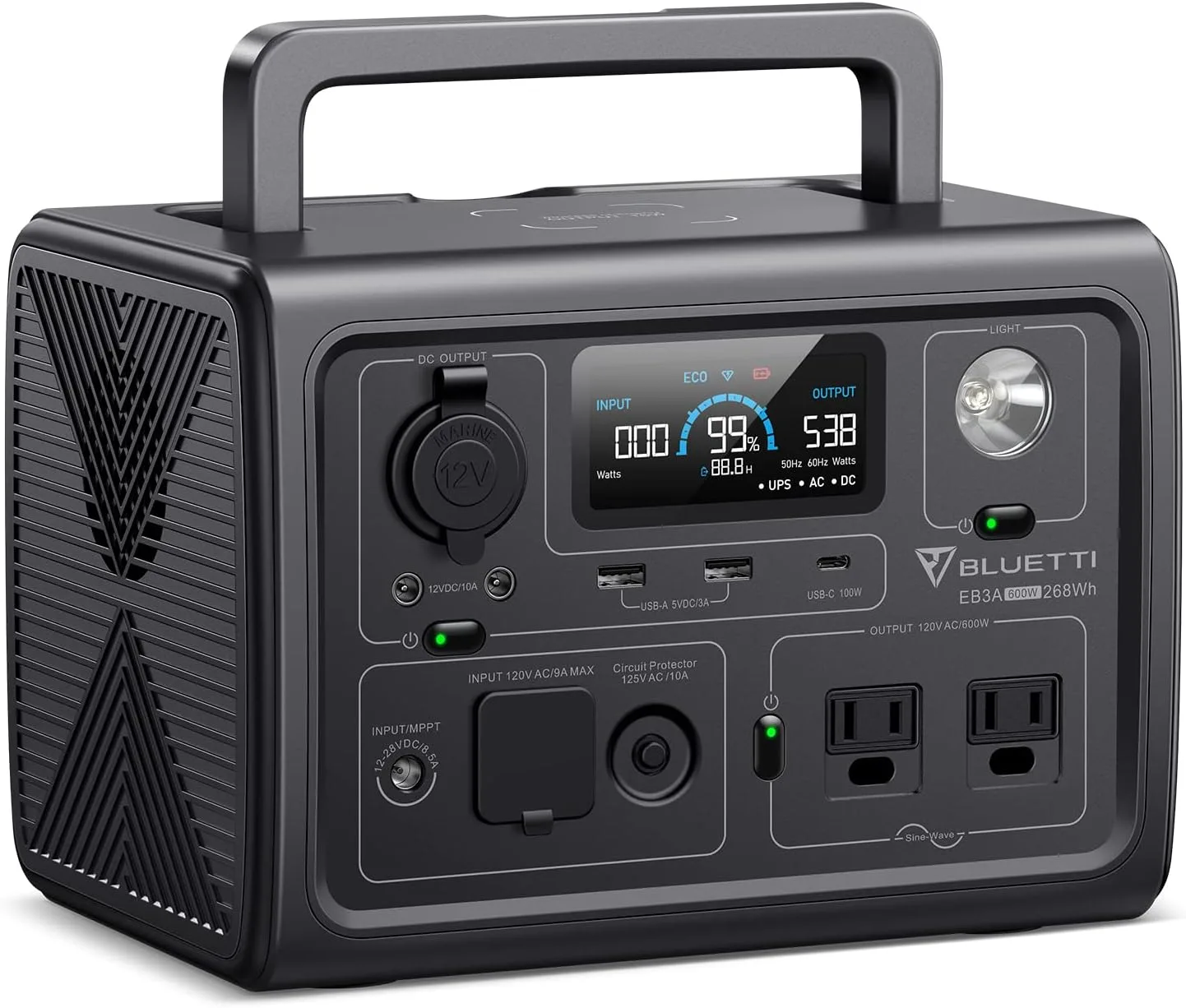
BLUETTI EB3A Portable Power Station
Highlights
- 268Wh rated capacity
- 600W continuous AC
- 1200W surge
- LiFePO4 chemistry
- Up to 200W solar input
- 10.1 lb (~4.6 kg)
Best for
- EB3A: phones, cameras and a laptop on short trips
- Travel kits when you need quiet pack power, not appliance runtime
Larger but still portable: 20 lb and up
Two stations cross the 20 lb line, and both are vehicle-and-home units rather than backpack units. The weight difference between them — 3.8 lb — is the difference between a two-hand lift and a two-hand lift you plan around.
Jackery Explorer 1000 v2 Portable Power Station,1070Wh,1500W is 23.8 lb with 1,070 Wh and 1,500 W continuous. At $559 list, that's $0.52/Wh — the cheapest per Wh in this group by a wide margin. Owner themes center on camping, kitchen appliances, and power tools; one reviewer notes a 12-inch sliding miter saw stalled it, which is a fair reminder that 1,500 W continuous is not the same as unlimited surge. For a fridge, a CPAP, and a few lights during an outage, this is enough. For a whole-home panel, it is not.
Anker C1000 Portable Power Station with Car Charging Cable, 1,056Wh is 27.6 lb with 1,800 W continuous. The catalogue capacity reads 56 Wh, which does not match the 1,056 Wh in the product name — treat that figure as unverified until you confirm it on the listing. At $599.99 list, the $/Wh math is meaningless until the capacity is confirmed. Owner themes lean toward refrigeration, RVs, and home power; several mention running a full-size fridge for hours, which is consistent with a ~1 kWh unit but not with a 56 Wh one. Because the capacity is unresolved, I'm not recommending the C1000 for purchase until you verify it on the listing.
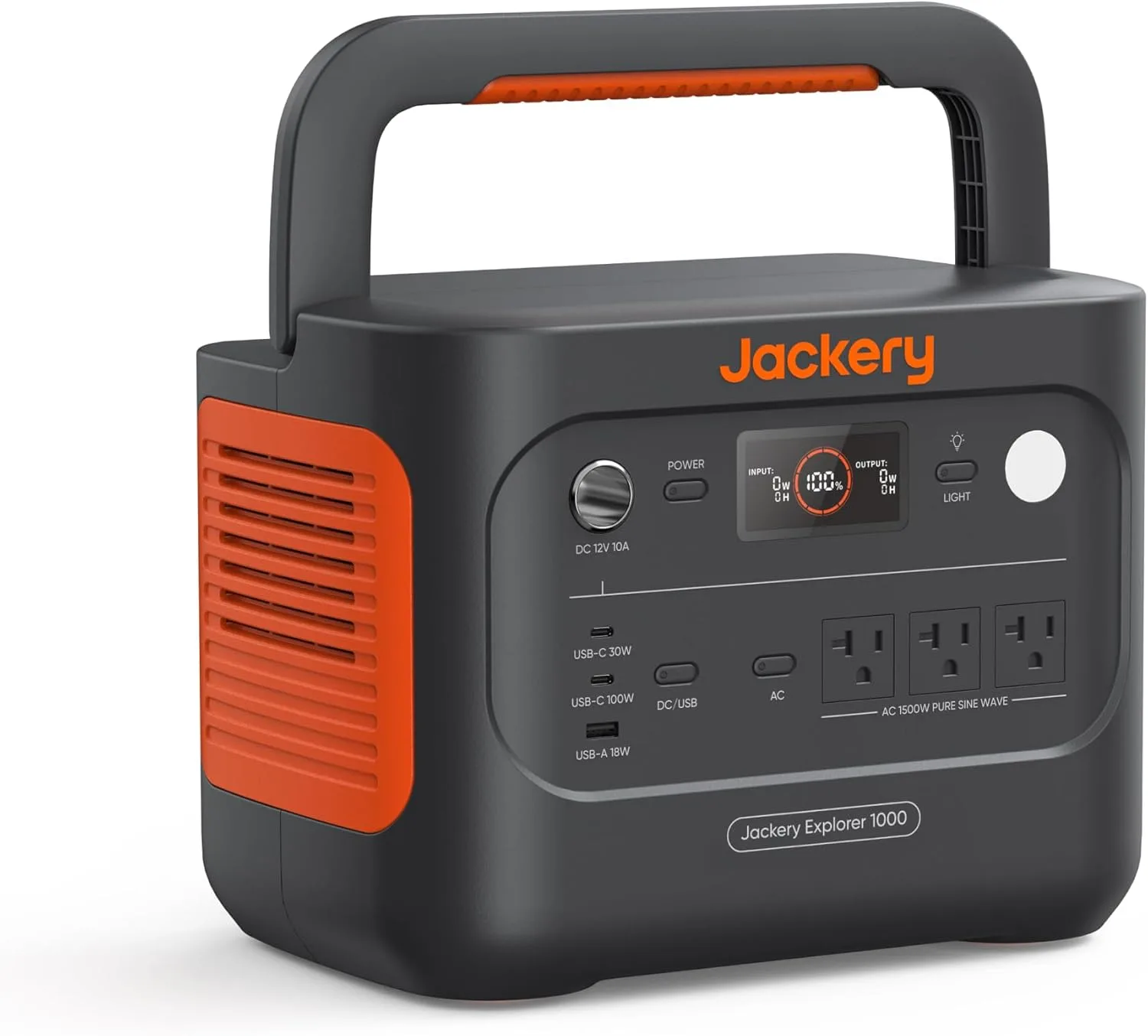
Jackery Explorer 1000 v2
Highlights
- 1070Wh rated capacity
- 1500W continuous AC
- LiFePO4 chemistry
- Up to 400W solar input
- 23.8 lb (~10.8 kg)
- About $559 list
Best for
- Explorer 1000 v2: weekend camping when 23.8 lb carry weight matters as much as 1070Wh
- Essentials bridge at home (fridge cycles, router) when sized to the Wh
How to trade capacity for portability
The math is simple enough to do in your head: divide Wh by pounds and you get a rough portability score. The RIVER 2 comes in at about 31.6 Wh/lb; the Jackery 300 v2 at 35.1 Wh/lb; the Anker C300 at 31.6 Wh/lb; the Jackery 1000 v2 at 45.0 Wh/lb. The bigger unit wins on density — but density isn't the same as carryability. A 23.8 lb box is still 23.8 lb.
The decision rule I'd use: if the station lives in a bag or a backpack, stay under 10 lb and accept 243–288 Wh. If it lives in a car or on a shelf and gets carried to the campsite or the kitchen, 20–28 lb is fine and you get 3–4× the capacity. The 10–15 lb band is the awkward middle — you pay a weight penalty without a big capacity jump, unless you specifically need the higher continuous output of the EB3A.
One more thing: weight scales with chemistry and inverter size, not just Wh. A 600 W inverter (EB3A) adds pounds over a 300 W one at similar capacity. If you don't need the output, you're carrying it for nothing.
- Backpack or day bag: under 10 lb, 243–288 Wh
- Car camping or tailgating: 20–28 lb, 1,000+ Wh
- Need 600 W continuous in a small body: EB3A is the only option here, at 10.1 lb
- Need the cheapest per Wh: Jackery 1000 v2 at $0.52/Wh, but it's 23.8 lb
Who should buy which — and who should walk away
Buy the EcoFlow RIVER 2 if you want the lightest possible station for phones, a laptop, and a fan, and you're price-sensitive at $177.65. Skip it if you need to run anything with a heating element or a compressor.
Buy the Jackery Explorer 300 v2 if you want a proven camping/CPAP unit at 8.2 lb and don't mind paying $1.00/Wh. Skip it if the Anker C300's extra USB-C ports matter more to you than the $41 price difference.
Buy the Anker C300 if you're charging a lot of USB-C devices simultaneously and want 288 Wh in a 9.1 lb body. Skip it if you're optimizing purely on $/Wh — it's the priciest here at $1.15/Wh.
Buy the BLUETTI EB3A if you need 600 W continuous in a 10.1 lb package and can confirm the price on the listing. Skip it if you want a transparent $/Wh comparison — the catalogue has no list price on file.
Buy the Jackery Explorer 1000 v2 if you need 1,070 Wh and 1,500 W and can handle 23.8 lb. It's the value pick at $0.52/Wh. Skip it if you need to carry the station more than a few hundred feet.
Hold off on the Anker C1000 until you confirm its actual capacity on the listing. The catalogue's 56 Wh figure doesn't match the 1,056 Wh product name, and at $599.99 you shouldn't buy on an unverified spec. If the listing confirms ~1 kWh, it's a 27.6 lb, 1,800 W unit for home and RV use — but not a backpack unit.
Walk away from all of these if you need whole-home backup. None of them is a transfer-switch or smart-panel solution; for that, see our guide to home backup with a transfer switch.
What owners report
These are paraphrased review themes from listings on file, not my own field tests. Where a theme is thin or truncated in the source, I've said so rather than filling in.
- Jackery Explorer 300 Portable Power Station,292Wh: Owners describe it as reliable for outages and say it provides more than enough power for small loads; the source theme is truncated, so treat the detail as partial.
- EcoFlow RIVER 2: The dominant owner theme is phone charging — many buyers use it as a phone-and-small-device station rather than for appliances.
- BLUETTI EB3A Portable Power Station: Phone charging is the most common theme, alongside camping and UPS use; a separate thread of shutdown/failure reports is worth testing under load in the return window.
- Jackery Explorer 1000 v2 Portable Power Station,1070Wh,1500W: Owners report fast charging (to 100% within about 3 hours) and running a side-by-side fridge/freezer for up to about 9 hours.
- Anker C300 Portable Power Station, 288Wh Solar Generator: Owners highlight UPS performance and fast charging (to 80% quickly); the source theme is truncated, so confirm charge times on the listing.
- Anker C1000 Portable Power Station with Car Charging Cable, 1,056Wh: Owners report fast charging (0–100% in about an hour) and enough power for several small appliances; capacity remains unverified in the catalogue, so confirm on the listing.
Frequently asked
What's the lightest station here?
EcoFlow RIVER 2 at 7.7 lb, with 243 Wh and 300 W.
Can the Jackery 1000 v2 run a fridge overnight?
Owners on file report running a side-by-side fridge/freezer for up to about 9 hours; your runtime depends on the fridge's draw and ambient temperature.
Why is the Anker C1000's capacity listed as unverified?
The catalogue figure (56 Wh) doesn't match the 1,056 Wh in the product name. Treat it as unverified and confirm on the listing before buying.
Do any of these include solar panels?
No — none of the six lists a solar panel as included. Check each listing for panel compatibility; the Jackery 1000 v2, for example, is listed as compatible only with Jackery panels.
Are dimensions available for these stations?
Not on file in the catalogue for any of the six. If footprint matters — for a shelf, a cabinet, or a vehicle compartment — check the listing's dimension spec before you buy.
Method and sources
Model names and list prices come from the WattPicks catalog at build time. WattPicks does not run its own laboratory tests on power stations, and nothing on this page is presented as a measured result — it is catalog-backed buying guidance.
Read our methodology for how the catalog is normalized, and about WattPicks for who publishes it.