
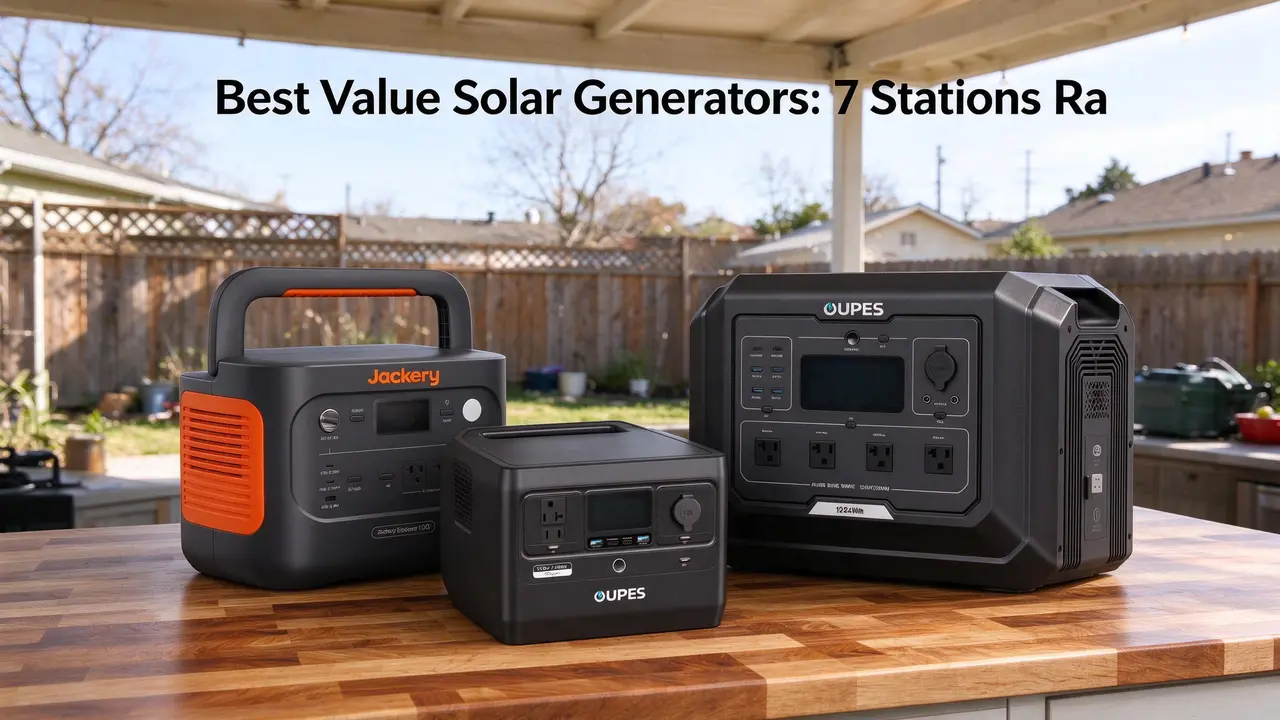
Best Value Solar Generators: 7 Stations Ranked by Price per Wh (OUPES, Jackery, Anker, BLUETTI)
For renters and campers sizing a first outage kit: seven solar generators ranked by price per watt-hour, with owner-reported runtime, trade-offs, and who should skip each one.
Updated
What value means on this list
This guide is for renters and campers sizing a first outage kit — people who need to keep a fridge, a CPAP, or a router alive for a day or two, not wire a transfer switch. Value here is price per nameplate watt-hour (list price ÷ rated Wh), cross-checked against what the unit can actually run. A cheap station that can't start your fridge isn't a bargain; a pricier one that replaces a gas generator for a weekend might be.
The formula is simple: list price ÷ rated Wh. BLUETTI AC180 lands at $0.43/Wh, the lowest on this list. OUPES Mega 1 is $0.54/Wh, Jackery Explorer 1000 v2 $0.52/Wh, Anker C1000 $0.57/Wh. The small units climb fast — OUPES Exodus 350 is $0.87/Wh and Jackery Explorer 300 is $1.00/Wh.
Every number below comes from the listings and the WattPicks catalogue. Prices and star ratings are as of February 2025 and are current list prices, not sale stickers. Where a listing has a historical low, I note it as context only — it doesn't change the ranking.
Owner-runtime figures (fridge hours, CPAP nights, surge trip points, idle draw) are paraphrased from high-helpful owner reviews in the WattPicks review corpus — a sample of roughly 50–150 reviews per SKU, dated 2023–2024. They are owner-reported, not lab-measured. The $/Wh figures are arithmetic from listed prices and rated capacities, not independently audited. Star ratings are listing aggregates, not independently verified.
One disclosure: as an Amazon Associate, WattPicks earns from qualifying purchases. Picks are fit-led, not commission-led — the cheapest-per-Wh unit here is a BLUETTI, not an OUPES.
This page is not for whole-home backup wiring. If you're sizing a transfer switch or smart panel, that's a different job — these are portable stations you carry to the load.
- Value formula: list price ÷ rated Wh (nameplate, not usable)
- Data source: manufacturer listings + WattPicks catalogue; prices and ratings as of Feb 2025
- Owner-runtime figures are paraphrased from high-helpful reviews (sample ~50–150 per SKU, 2023–2024), not lab-measured
- Ranking weighs $/Wh, continuous output, and owner-reported friction
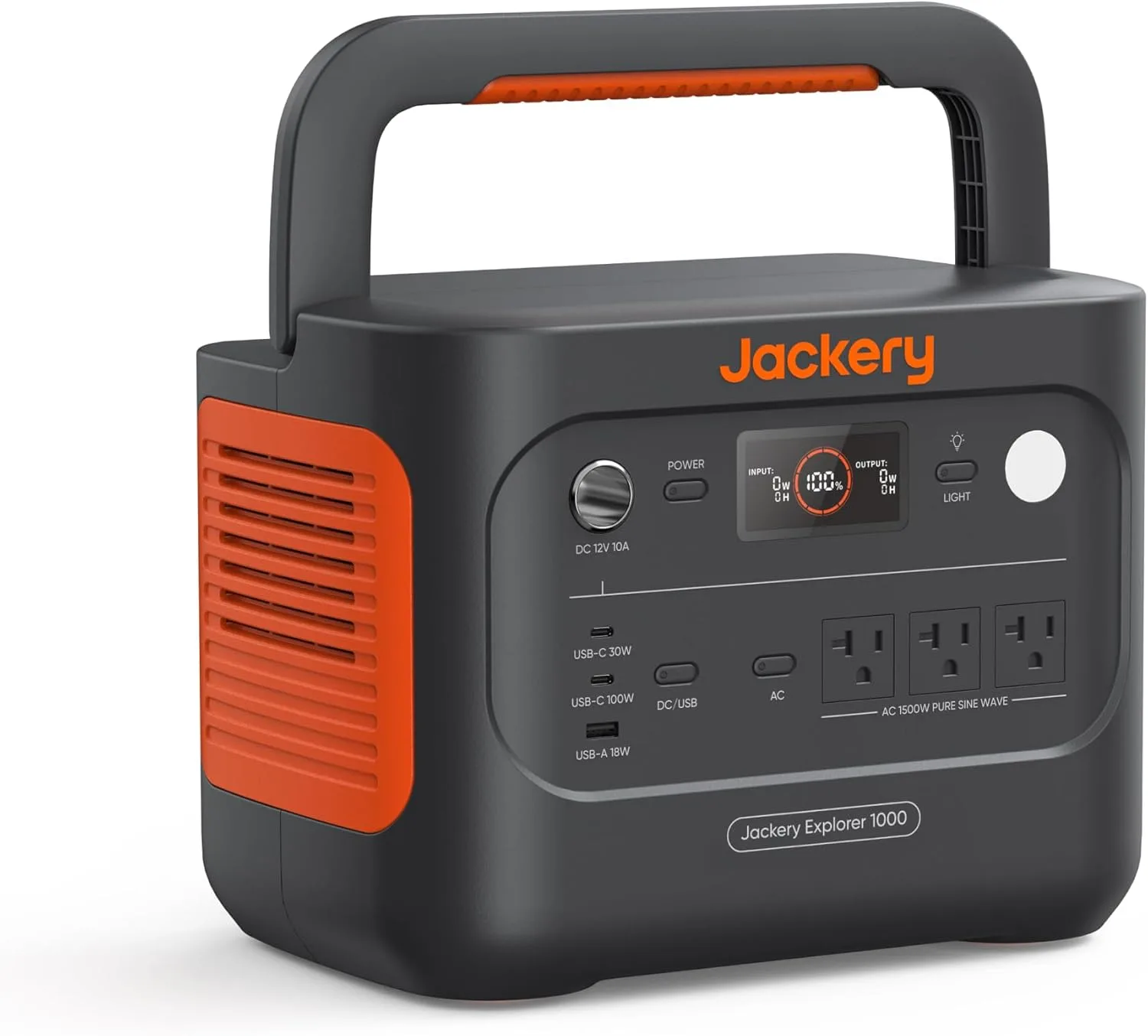
Jackery Explorer 1000 v2 Portable Power Station,1070Wh,1500W
Highlights
- 1070Wh rated capacity
- 1500W continuous AC
- LiFePO4 chemistry
- Up to 400W solar input
- 23.8 lb (~10.8 kg)
- About $559 list
Best for
- Explorer 1000 v2: weekend camping when 23.8 lb carry weight matters as much as 1070Wh
- Essentials bridge at home (fridge cycles, router) when sized to the Wh
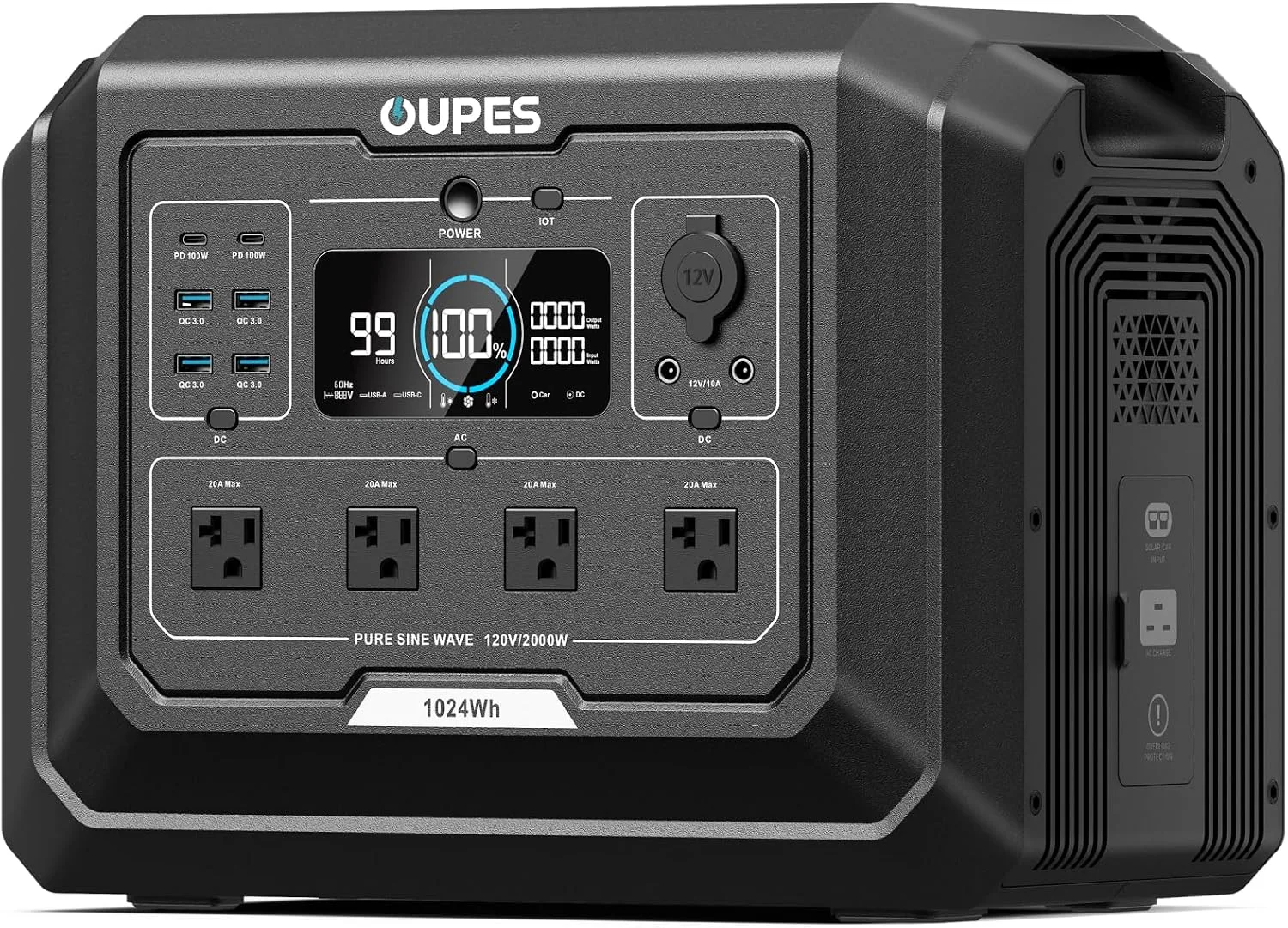
OUPES Mega 1 Portable Power Station 1024Wh 2000W
Highlights
- 1024Wh rated capacity
- 2000W continuous AC
- 4500W surge
- LiFePO4 chemistry
- Up to 800W solar input
- 27.8 lb (~12.6 kg)
Best for
- Mega 1: small appliances and tools that need ~2000W continuous, not just phone charging
- Essentials bridge at home (fridge cycles, router) when sized to the Wh
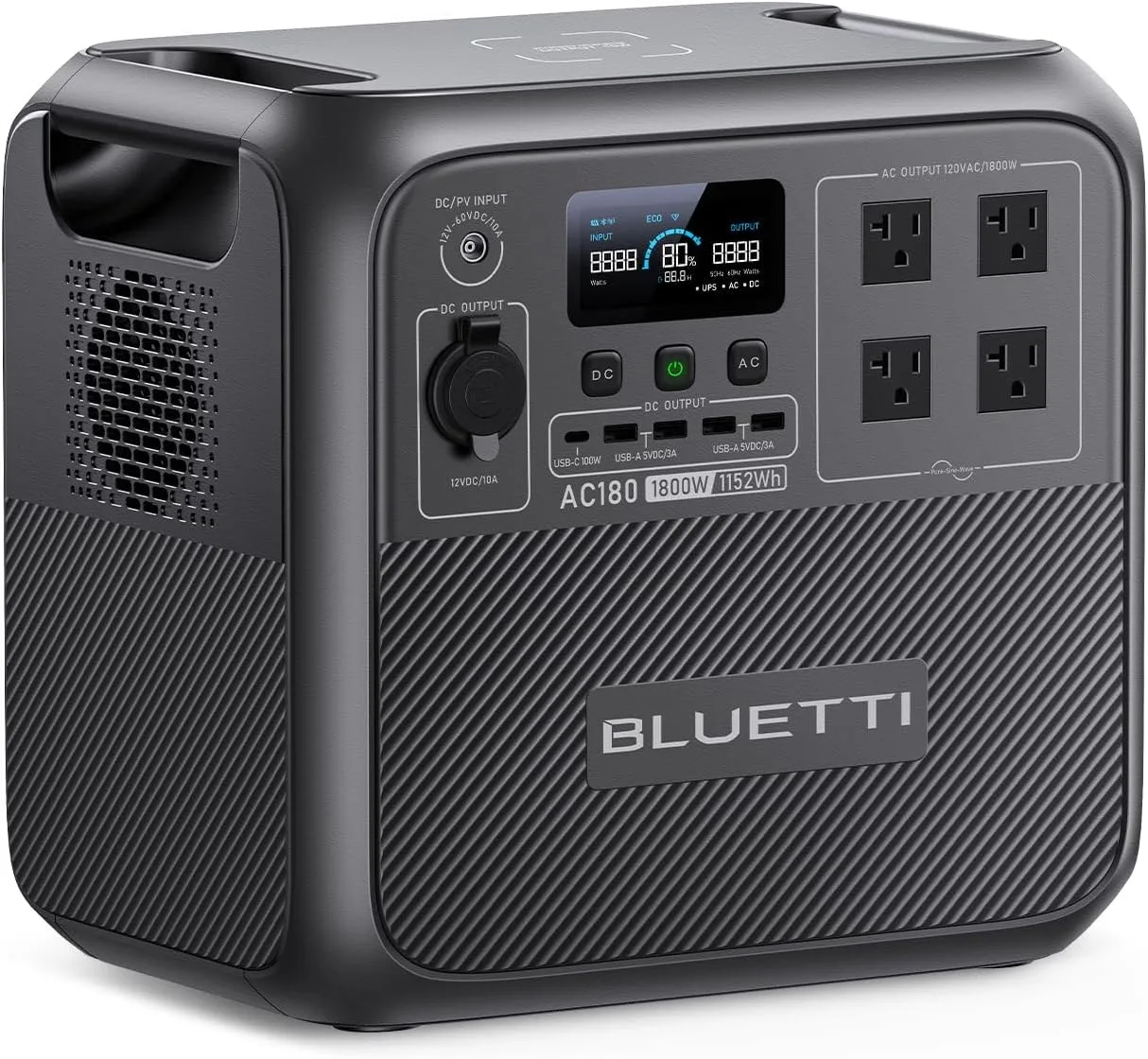
BLUETTI Portable Power Station AC180, 1152Wh LiFePO4 Battery Backup w/ 2 1800W
Highlights
- 1152Wh rated capacity
- 1800W continuous AC
- LiFePO4 chemistry
- Up to 500W solar input
- 35.3 lb (~16.0 kg)
- About $499 list
Best for
- AC180: most Wh per list dollar in mid-size LiFePO4 shortlists (~1152Wh)
- Home essentials when 1800W continuous matters more than a light carry
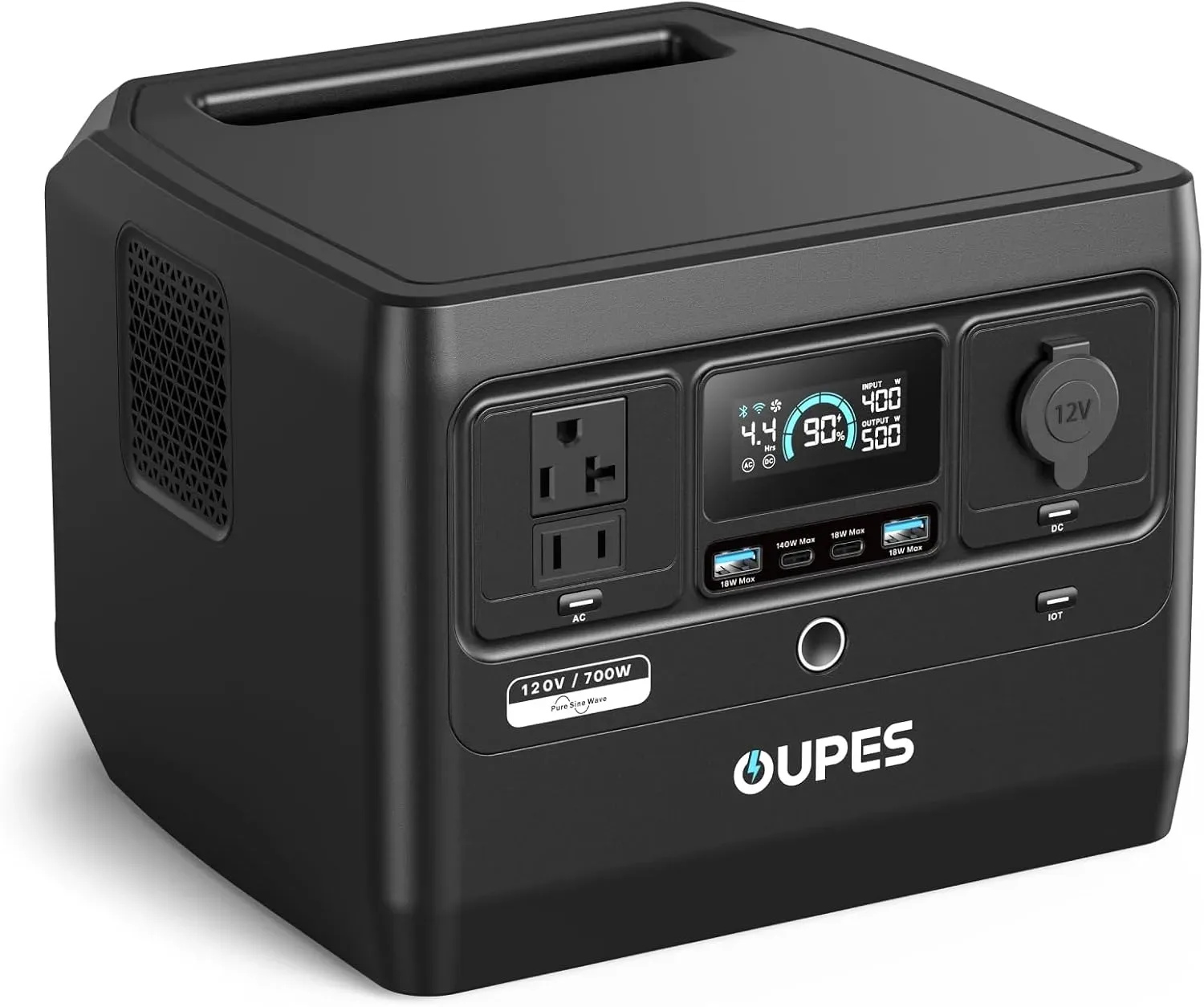
OUPES Exodus 700 Portable Power Station, 576Wh 700W LiFePO4 Solar Generator
Highlights
- 576Wh rated capacity
- 700W continuous AC
- LiFePO4 chemistry
- 13.8 lb (~6.3 kg)
- About $399.99 list
Best for
- PPS-P700L: weekend camping when 13.8 lb carry weight matters as much as 576Wh
- Essentials bridge at home (fridge cycles, router) when sized to the Wh
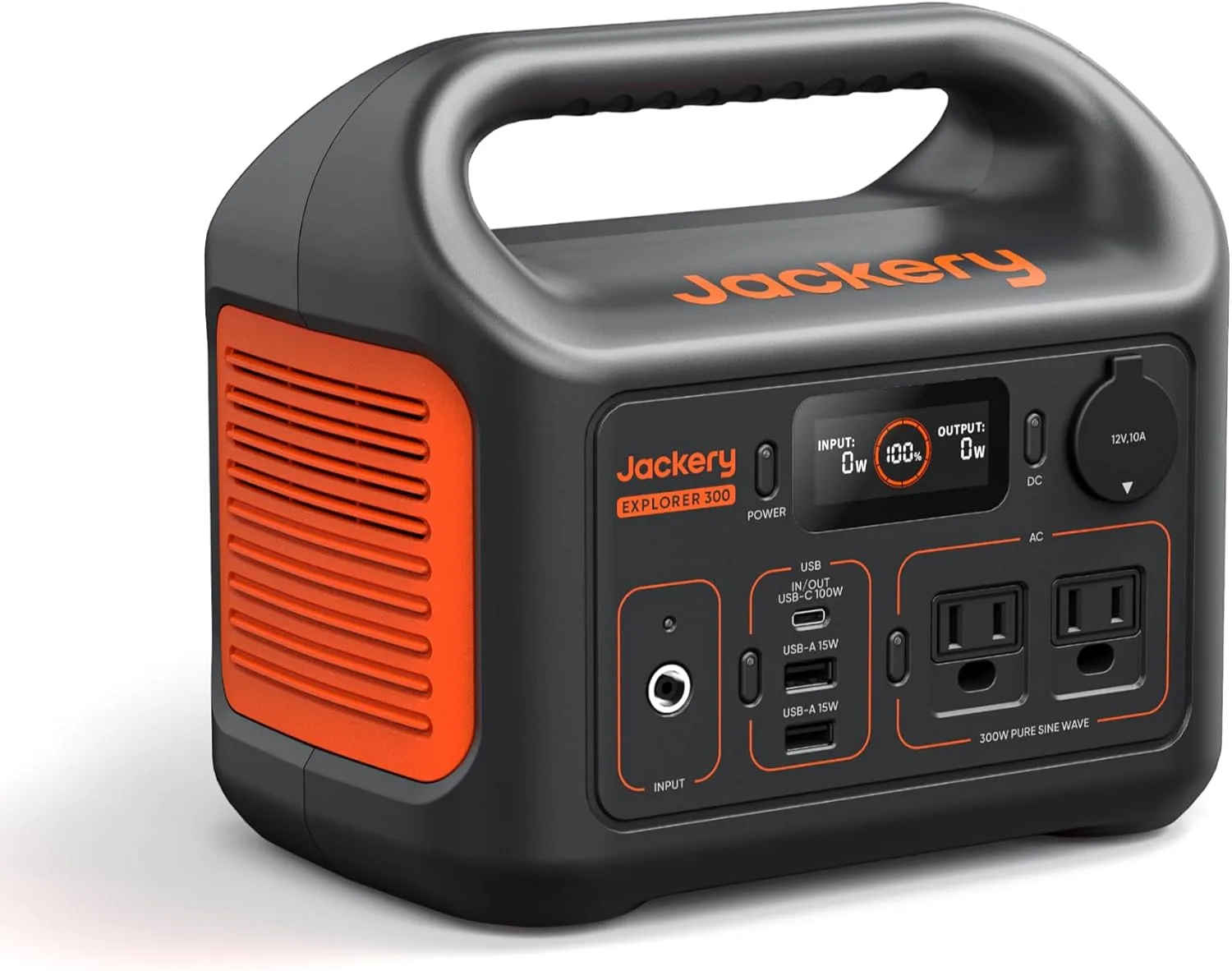
Jackery Explorer 300 Portable Power Station,292Wh
Highlights
- 288Wh rated capacity
- 300W continuous AC
- 600W surge
- LiFePO4 chemistry
- 8.2 lb (~3.7 kg)
- About $289 list
Best for
- Explorer 300 v2: phones, cameras and a laptop on short trips
- Travel kits when you need quiet pack power, not appliance runtime
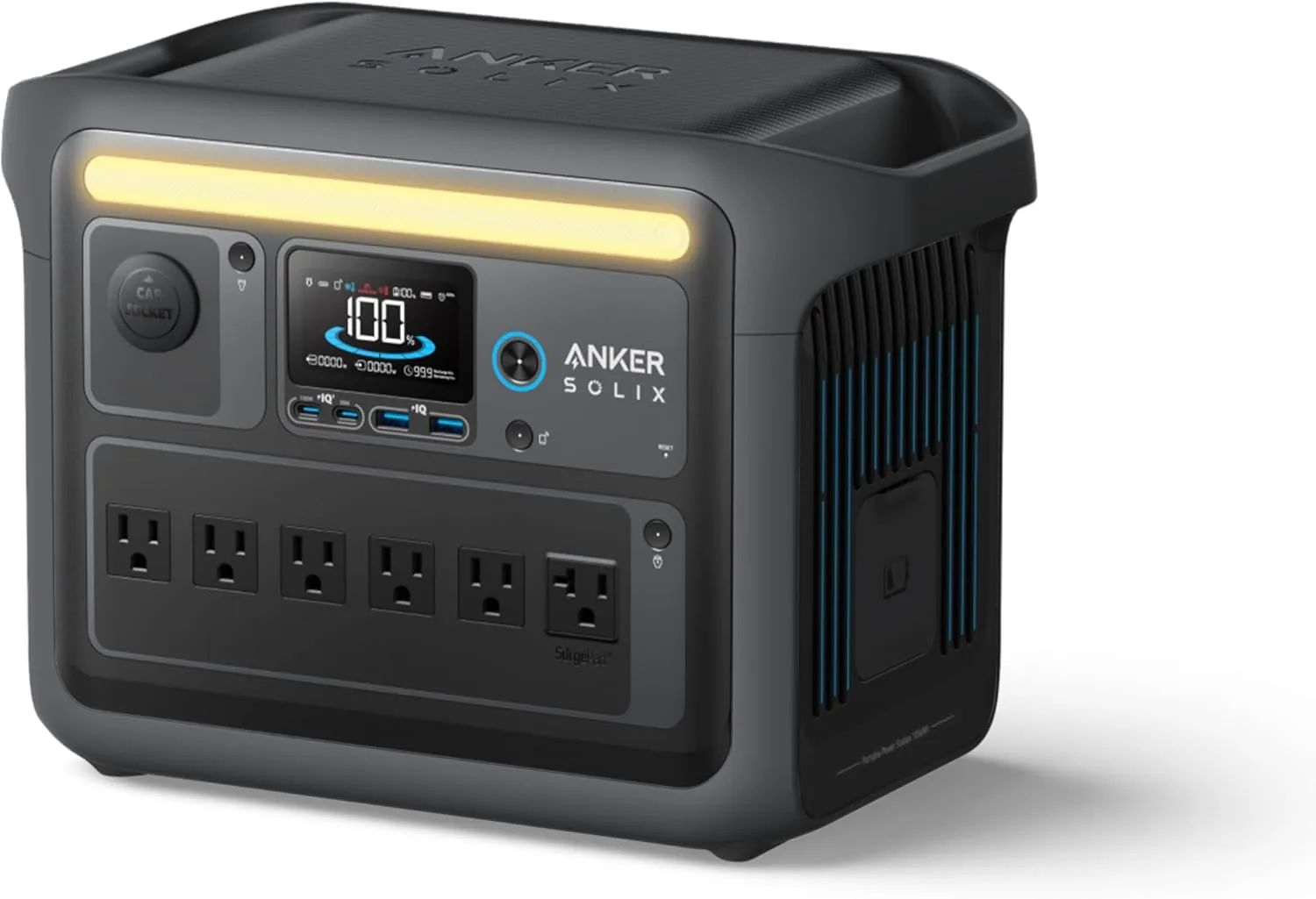
Anker C1000 Portable Power Station
Highlights
- 1056Wh rated capacity
- 1800W continuous AC
- LiFePO4 chemistry
- Up to 600W solar input
- 28.4 lb (~12.9 kg)
- About $599 list
Best for
- SOLIX C1000: small appliances and tools that need ~1800W continuous, not just phone charging
- Essentials bridge at home (fridge cycles, router) when sized to the Wh
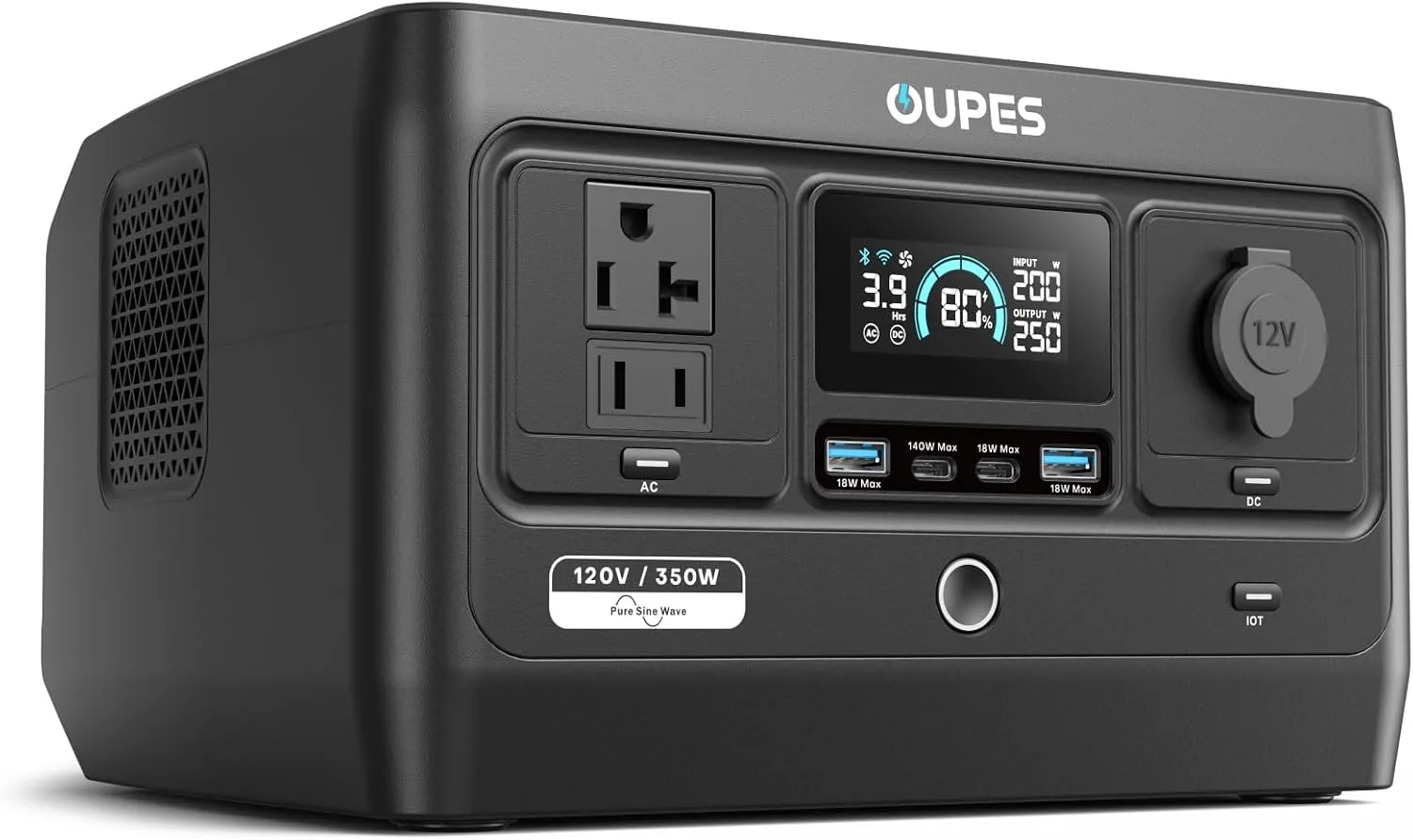
OUPES Exodus 350 Portable Power Station, 288Wh 350W LiFePO4 Solar Generator
Highlights
- 288Wh rated capacity
- 350W continuous AC
- 600W surge
- LiFePO4 chemistry
- Up to 240W solar input
- 9.2 lb (~4.2 kg)
Best for
- Exodus 350: phones, cameras and a laptop on short trips
- Travel kits when you need quiet pack power, not appliance runtime
Who should not buy any of these
If you're planning whole-home backup with a transfer switch or smart panel, none of these seven are the right tool — you need a fixed system sized by an electrician.
If you'll cycle the battery daily (off-grid living, a cabin with no utility power), a portable station's cycle life and charge rate will frustrate you; a fixed LiFePO4 bank is the better spend.
If you need to charge below freezing, check each listing's charging temperature range before buying — LiFePO4 charging below 32°F can damage cells, and not every unit here has low-temp protection.
Warranty and support friction varies by brand: OUPES support and replacement parts (like the Mega 1's proprietary AC cable) are harder to source on the road than Jackery or Anker, which have broader US support channels. Factor that in if you travel far from home.
- Skip all seven for whole-home wiring — that's a fixed-system job
- Skip portables for daily deep cycling — a fixed bank lasts longer
- Check low-temp charging limits before winter use
- OUPES parts/support are harder to source on the road than Jackery or Anker
The picks, ranked by value
Ranking order below follows $/Wh first, then continuous output and owner-reported friction as tiebreakers. A station that's cheap per Wh but can't run what you need drops.
How the three weights resolved #1 vs #2: BLUETTI AC180 wins on $/Wh (High weight, $0.43 vs $0.52) and ties on continuous output (1,800 W vs 1,500 W, both sufficient for a fridge). Jackery Explorer 1000 v2 wins on owner-reported friction (Medium weight: 23.8 lb vs 35.3 lb, and no proprietary cable). The $/Wh gap is large enough that AC180 takes #1; the weight and cable friction are why the Explorer 1000 v2 is a close #2 rather than a distant one.
- Ranking order: $/Wh first, then continuous output, then owner-reported friction
- AC180 #1 on $/Wh; Explorer 1000 v2 #2 on lower friction (weight, cable)
- Full spec table appears once, above, to keep the ranked path contiguous
| Product | Price | Capacity (Wh) | Output (W) | Weight (lb) | Rating |
|---|---|---|---|---|---|
| Jackery Explorer 1000 v2 Portable Power Station,1070Wh,1500W | $559 | 1070 Wh | 1500 W | 23.8 lb | 4.7 |
| OUPES Mega 1 Portable Power Station 1024Wh 2000W | $549 | 1024 Wh | 2000 W | 27.8 lb | 4.5 |
| BLUETTI AC180 | $499 | 1152 Wh | 1800 W | 35.3 lb | 4.5 |
| OUPES Exodus 700 Portable Power Station, 576Wh 700W LiFePO4 Solar | $399.99 | 576 Wh | 700 W | 13.8 lb | 4.4 |
| Jackery Explorer 300 Portable Power Station,292Wh | $289 | 288 Wh | 300 W | 8.2 lb | 4.6 |
| Anker C1000 Portable Power Station | $599 | 1056 Wh | 1800 W | 28.4 lb | 4.7 |
| OUPES Exodus 350 Portable Power Station, 288Wh 350W LiFePO4 Solar | $249.99 | 288 Wh | 350 W | 9.2 lb | 4.4 |
#1 BLUETTI AC180 — the price-per-Wh leader
At $0.43/Wh, the AC180 is the cheapest per nameplate watt-hour on this list, and it backs that up with 1,800 W continuous. Owners describe instant UPS switchover — one ran a family-room circuit through it and the internet never dropped when the wall power was cut.
The catch is usable capacity. Owners report the unit draws about 20 W with the inverter on and only ~90% of the battery is usable, so small loads get far less runtime than 1,152 Wh suggests. It's also 35.3 lb — the heaviest here — and the wireless charging pad on top is unreliable per multiple owners.
Suits: home backup of essentials and camping where you leave it in place. Skip if: you need to carry it far or want every rated watt-hour for tiny loads.
- $499 list · 1,152 Wh · 1,800 W · 35.3 lb
- UPS switchover reported instant by owners
- ~20 W idle draw and ~90% usable capacity cut real runtime
- Wireless pad unreliable; heavy to move
| Product | Price | Capacity (Wh) | Output (W) | Weight (lb) | Rating |
|---|---|---|---|---|---|
| Jackery Explorer 1000 v2 Portable Power Station,1070Wh,1500W | $559 | 1070 Wh | 1500 W | 23.8 lb | 4.7 |
| OUPES Mega 1 Portable Power Station 1024Wh 2000W | $549 | 1024 Wh | 2000 W | 27.8 lb | 4.5 |
| BLUETTI AC180 | $499 | 1152 Wh | 1800 W | 35.3 lb | 4.5 |
| OUPES Exodus 700 Portable Power Station, 576Wh 700W LiFePO4 Solar | $399.99 | 576 Wh | 700 W | 13.8 lb | 4.4 |
| Jackery Explorer 300 Portable Power Station,292Wh | $289 | 288 Wh | 300 W | 8.2 lb | 4.6 |
| Anker C1000 Portable Power Station | $599 | 1056 Wh | 1800 W | 28.4 lb | 4.7 |
| OUPES Exodus 350 Portable Power Station, 288Wh 350W LiFePO4 Solar | $249.99 | 288 Wh | 350 W | 9.2 lb | 4.4 |
#2 Jackery Explorer 1000 v2 — the balanced pick
At $0.52/Wh the Explorer 1000 v2 sits just above the BLUETTI, but it's 23.8 lb — nearly 12 lb lighter — and owners report running a fridge and a portable AC unit simultaneously without the 1,500 W output flinching. Quiet mode let one owner sleep with a fridge and fans running.
The friction is real: the headline one-hour recharge is a one-shot emergency mode that reverts to normal speed (roughly 1h40m from empty), it won't start a big sliding miter saw, and there's no 12V barrel port — you need an adapter for 12V gear.
Suits: home outage essentials and car camping with a fridge. Skip if: you need to start big power tools or want a one-cable 12V setup.
- $559 list · 1,070 Wh · 1,500 W · 23.8 lb
- Ran fridge + portable AC together per owners
- One-hour charge is one-shot; standard is ~1h40m
- No 12V barrel port; miter saw won't start
| Product | Price | Capacity (Wh) | Output (W) | Weight (lb) | Rating |
|---|---|---|---|---|---|
| Jackery Explorer 1000 v2 Portable Power Station,1070Wh,1500W | $559 | 1070 Wh | 1500 W | 23.8 lb | 4.7 |
| OUPES Mega 1 Portable Power Station 1024Wh 2000W | $549 | 1024 Wh | 2000 W | 27.8 lb | 4.5 |
| BLUETTI AC180 | $499 | 1152 Wh | 1800 W | 35.3 lb | 4.5 |
| OUPES Exodus 700 Portable Power Station, 576Wh 700W LiFePO4 Solar | $399.99 | 576 Wh | 700 W | 13.8 lb | 4.4 |
| Jackery Explorer 300 Portable Power Station,292Wh | $289 | 288 Wh | 300 W | 8.2 lb | 4.6 |
| Anker C1000 Portable Power Station | $599 | 1056 Wh | 1800 W | 28.4 lb | 4.7 |
| OUPES Exodus 350 Portable Power Station, 288Wh 350W LiFePO4 Solar | $249.99 | 288 Wh | 350 W | 9.2 lb | 4.4 |
#3 OUPES Mega 1 — the output-per-dollar play
The Mega 1 is $0.54/Wh, but it delivers 2,000 W continuous — the highest on this list — for $549. Owners report starting a full-size fridge, microwave, and hair dryer without tripping the breaker, and AC charging to 80% in about an hour.
Two caveats matter. The advertised 4,500 W surge is optimistic — one owner's unit tripped consistently between 2,050–2,200 W. And the AC charge cable is proprietary, so losing it means sourcing a replacement from OUPES, which isn't easy on the road. Fans also run whenever it's charging.
Suits: camping, overlanding, and short outages where you need 2,000 W continuous. Skip if: you need the full surge rating for big motor loads or want a standard charge cable.
- $549 list · 1,024 Wh · 2,000 W · 27.8 lb
- Highest continuous output here; fast AC charge
- Surge shortfall reported at 2,050–2,200 W
- Proprietary charge cable; fan noise while charging
#4 Anker C1000 — the fridge-backup specialist
At $0.57/Wh the C1000 is the priciest per watt-hour in the 1 kWh band, but owners report it running an 18 cu ft garage fridge for 36 hours on one charge in ~50°F ambient, and a kitchen side-by-side for 12 hours at 68°F. AC recharge from 1% to 100% took about 1.5 hours.
It's heavy — listed at 28.4 lb but owners say it feels closer to 40+ in hand — and the wireless pad is unreliable. The AC wall cable is short at 4–5 ft.
Suits: short-term fridge/freezer backup and camper power where it stays put. Skip if: you need to carry it far or rely on wireless charging.
- $599 list · 1,056 Wh · 1,800 W · 28.4 lb
- 36h on a garage fridge per owner report
- Feels heavier than the 28.4 lb listing
- Short AC cable; unreliable wireless pad
#5 OUPES Exodus 700 — the light middleweight
At $0.69/Wh the Exodus 700 costs more per watt-hour than any 1 kWh unit here, but it weighs 13.8 lb and runs 700 W. That's a different job: RV essentials, mini-fridges, and camping gear you actually carry.
I have to be straight with you — the review pack for this specific SKU is thin, and most high-helpful reviews describe the Exodus 2400, not the 700. I can't confirm 700-specific usage wins or watch-outs from owner reports, so treat the 2400 reviews as brand-level color only.
Suits: buyers who need light weight and 700 W more than capacity per dollar. Skip if: you want owner-verified runtime data before buying.
- $399.99 list · 576 Wh · 700 W · 13.8 lb
- Light enough to carry to the load
- Thin 700-specific owner evidence
- 2400 reviews don't transfer to the 700
#6 OUPES Exodus 350 — the pocket UPS
The Exodus 350 is $0.87/Wh — nearly double the BLUETTI's rate — but it's 9.2 lb with 350 W and a reported <10 ms UPS transfer. That's a router/CPAP/work-from-home box, not a fridge backup.
Same evidence problem as the 700: the review pack is thin and most high-helpful reviews describe the Exodus 2400. I won't invent 350-specific runtime claims.
Suits: small-device backup where weight matters more than capacity. Skip if: you need to run appliances or want verified owner runtime.
- $249.99 list · 288 Wh · 350 W · 9.2 lb
- <10 ms UPS per listing
- Thin 350-specific owner evidence
- Not a fridge or AC unit
#7 Jackery Explorer 300 — the CPAP camping pick
At $1.00/Wh the Explorer 300 is the most expensive per watt-hour here, and it's only 300 W. But owners report running a CPAP on DC for 4 full nights — 35 hours — on one charge, and powering a TV, laptop, heating pad, and small coffee maker for 6 hours during a 24-hour outage with 43% left.
The catch: on AC, the CPAP triggered the auto-shutoff after 5.5 hours due to low draw — a DC cord fixed it and cut consumption in half. It won't run a fridge or AC.
Suits: CPAP camping, phone/laptop charging, and short outages with lights. Skip if: you need appliances or a set-and-forget fridge UPS.
- $289 list · 288 Wh · 300 W · 8.2 lb
- 35h CPAP on DC per owner report
- AC auto-shutoff on low draw; DC cord needed
- Highest $/Wh on this list
Cheap but not good value
Two patterns look like bargains and aren't. First: high $/Wh small units sold on wattage alone. The Explorer 300 at $1.00/Wh and Exodus 350 at $0.87/Wh are fine tools, but if you're buying for capacity you're paying a premium for portability you may not need.
Second: stations whose advertised surge doesn't hold. The Mega 1's 4,500 W surge tripped at 2,050–2,200 W for one owner — if you're buying for motor loads, that's a spec you can't bank on.
A third trap is usable capacity. The AC180's ~20 W idle draw and ~90% usable ceiling mean the rated 1,152 Wh isn't what you get on small loads. Cheap per nameplate Wh isn't cheap per usable Wh.
- High $/Wh small units: paying for portability, not capacity
- Surge ratings that don't hold under motor loads
- Nameplate Wh ≠ usable Wh on small loads
When to stop optimizing
Stop chasing $/Wh the moment your load list is fixed. If you need 2,000 W continuous, the Mega 1's $0.54/Wh is the right answer even though the BLUETTI is cheaper per Wh — the BLUETTI's 1,800 W won't start what the OUPES will.
The other stop condition: when the next $50 buys weight savings you'll actually feel. Going from 35.3 lb to 23.8 lb for $60 more (BLUETTI to Jackery) is worth it if you carry the unit weekly. If it lives in a basement, it isn't.
And if you're within $50 of a unit with owner-verified runtime on your exact load, take the verified one. Thin evidence is a real cost.
- Fix your load list first; then $/Wh stops being the only metric
- Pay for weight savings only if you carry the unit weekly
- Prefer owner-verified runtime on your exact load when the price gap is small
Load → Wh → pick: match your need to a station
Use this table to self-match without reading all seven sections. Add running watts × hours for each device, then add startup surge for anything with a motor. The picks below assume the 1 kWh band is the value frontier for first-outage kits.
- Which is cheapest per Wh? BLUETTI AC180 at $0.43/Wh — the only unit under $0.50/Wh here.
- Can the Mega 1 run a fridge? Yes — 2,000 W continuous, and owners report starting a full-size fridge and microwave.
- Why is the Explorer 300 so expensive per Wh? It's 8.2 lb with a 300 W output — you're paying for portability, not capacity.
- Do the OUPES Exodus 700 and 350 have owner data? Not enough — most reviews describe the Exodus 2400, so runtime claims aren't verified.
| If you need… | Rough Wh needed | Pick | Why |
|---|---|---|---|
| Fridge + router + lights for 24h (renter, apartment) | ~1,200 Wh | BLUETTI AC180 | Lowest $/Wh; 1,800 W starts a fridge; UPS switchover |
| Fridge + portable AC, carried weekly (camper) | ~1,200 Wh | Jackery Explorer 1000 v2 | 23.8 lb; owners ran fridge + AC together |
| 2,000 W continuous for microwave/hair dryer (overlanding) | ~1,000 Wh | OUPES Mega 1 | Highest continuous output; fast AC charge |
| Garage fridge/freezer backup, stays put | ~1,000 Wh | Anker C1000 | 36h on a garage fridge per owner report |
| CPAP for 4 nights, phone/laptop (camping) | ~250 Wh | Jackery Explorer 300 | 35h CPAP on DC per owner report; 8.2 lb |
| Router/CPAP/work-from-home box, light carry | ~250 Wh | OUPES Exodus 350 | 9.2 lb; <10 ms UPS per listing |
| RV essentials / mini-fridge you carry | ~500 Wh | OUPES Exodus 700 | 13.8 lb; 700 W; thin owner evidence |
Frequently asked
How many watts does a fridge need to start, and which station here can do it?
A typical full-size fridge draws 100–200 W running but needs 2–3× that at compressor startup — often 600–1,200 W for a second or two. The OUPES Mega 1 (2,000 W continuous) and Jackery Explorer 1000 v2 (1,500 W) are the safest picks; owners report starting a full-size fridge on the Mega 1 and running a fridge plus a portable AC on the Explorer 1000 v2. The BLUETTI AC180 (1,800 W) also works, but its ~20 W idle draw and ~90% usable capacity cut runtime. The 300–350 W units won't start a fridge.
How many watt-hours does a CPAP need per night?
Most CPAP machines draw 30–60 W on AC with humidifier and heated tube, so an 8-hour night is roughly 240–480 Wh. On DC with the humidifier off, draw drops to about 15–30 W — roughly 120–240 Wh per night. The Jackery Explorer 300 (288 Wh) is the pick here because owners report 35 hours (4+ nights) on DC; on AC the same unit auto-shut off after 5.5 hours due to low draw, so a DC cord is essential. The OUPES Exodus 350 (288 Wh) has the right capacity but thin owner evidence for CPAP use.
How do I size a station for a 24-hour outage?
Add up running watts × hours for each device you must keep alive, then add startup surge for anything with a motor (fridge, furnace fan, well pump). A fridge cycling 8 hours at 150 W is ~1,200 Wh; a router and a few LED lights add ~100 Wh; a CPAP on DC adds ~200 Wh. That puts most first-outage kits in the 1,000–1,200 Wh band — which is why the 1 kWh picks here (BLUETTI AC180, Jackery Explorer 1000 v2, OUPES Mega 1, Anker C1000) are the value frontier. Remember nameplate Wh isn't usable Wh: the AC180 gives ~90% usable and loses ~20 W to idle draw.
Are the owner-runtime figures in this article lab-tested?
No. Fridge hours, CPAP nights, surge trip points, and idle draw are paraphrased from high-helpful owner reviews in the WattPicks review corpus (roughly 50–150 reviews per SKU, dated 2023–2024). They are owner-reported, not lab-measured. The $/Wh figures are arithmetic from listed prices and rated capacities, not independently audited. Star ratings are listing aggregates, not owner proof.
Why does the Anker C1000 feel heavier than its 28.4 lb listing?
The listing says 28.4 lb, but owners consistently report it feels closer to 40+ lb in hand — likely because the weight is concentrated and the handle placement makes it awkward to lift. Treat the listing weight as a floor, not a carry-weight promise, and plan to wheel it or leave it in place.
Which is cheapest per Wh?
BLUETTI AC180 at $0.43/Wh — the only unit under $0.50/Wh here.
Can the Mega 1 run a fridge?
Yes — 2,000 W continuous, and owners report starting a full-size fridge and microwave.
Why is the Explorer 300 so expensive per Wh?
It's 8.2 lb with a 300 W output — you're paying for portability, not capacity.
Do the OUPES Exodus 700 and 350 have owner data?
Not enough — most reviews describe the Exodus 2400, so runtime claims aren't verified.
Method and sources
Model names and list prices come from the WattPicks catalog at build time. WattPicks does not run its own laboratory tests on power stations, and nothing on this page is presented as a measured result — it is catalog-backed buying guidance.
Read our methodology for how the catalog is normalized, and about WattPicks for who publishes it.