
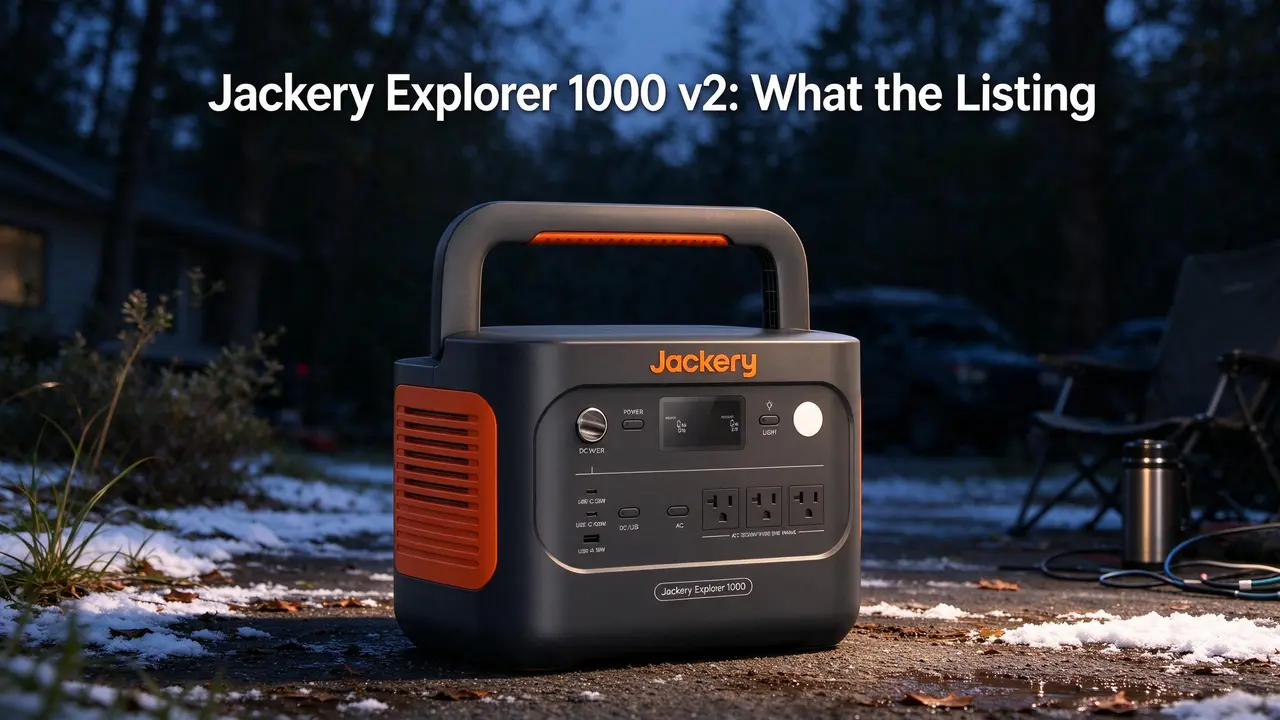
Jackery Explorer 1000 v2: What the Listing Actually Discloses
A line-by-line read of the Explorer 1000 v2 listing — 1,070 Wh, 1,500 W, LFP, and the charge-time fine print. It suits fridge-and-fans outage backup and car camping; it is not a whole-home or heavy-tool answer.
Updated
What this station is actually for
The buying question here is narrow: does a 1,070 Wh, 1,500 W box cover the loads you lose when the grid drops, or are you paying for a number you will never use? Read the listing closely and the Explorer 1000 v2 answers that for a specific household — one that wants the fridge, a few fans, and the phones alive for a night, not one that wants the furnace and the well pump.
The listing states 1,070 Wh of LFP capacity and 1,500 W of continuous AC output, with a 3,000 W surge figure quoted in the feature copy. Those are the two numbers that decide everything else. Capacity sets how long; continuous output sets what will start at all.
This page is not for you if you are sizing a transfer switch or a smart panel. A 1,070 Wh station is a portable appliance, not home infrastructure. If that is the job, start with the home backup sizing walkthrough before you look at any portable unit.
One disclosure: picks here are fit-led, and this page carries Amazon Associates links. Specs come from the listing; the usage notes come from owner reviews on file. Those are home-user checks, not lab-bench measurements.
The specs that decide the purchase
Capacity is 1,070 Wh. In practice that is roughly a refrigerator plus a few fans for one overnight stretch, which is what owners describe doing. It is not a multi-day whole-home reserve, and the listing does not pretend otherwise.
Continuous AC output is 1,500 W across three pure sine wave outlets. That ceiling is the real gate. A 1,700 W air fryer is over the line and will not run — an owner found that out the direct way. A large sliding miter saw stalled almost immediately in another account, surge rating notwithstanding.
Weight is 23.8 lb with a foldable handle. That is carryable by one adult for a flight of stairs or a car trunk, and it is the reason this class exists at all. Anything much past 25 lb stops being casually portable.
Battery chemistry is LiFePO4, and the listing claims over 70% capacity retained after 4,000 cycles. For a buyer that means the pack should outlast the novelty — you are not replacing it in two years the way you might an NMC unit cycled hard.
Ports, per the listing: three AC outlets, two USB-C (PD 100W), one USB-A, and one 12V car socket. Note what is absent from that list — there are no 12V DC barrel ports, so 12V accessories run off the cigarette socket with an adapter.
Recharge is where the listing gets glossed. The headline is 0–100% in one hour, but that requires enabling emergency charging in the Jackery app before every charge. The default is 1.7 hours, and the unit reverts to normal mode after each quick charge. Owners report the standard fast charge landing well under two hours anyway.
Spec table (from the listing)
Every figure below is the listing's own claim, not a measured result. Where the listing is silent, the cell says so.
| Spec | Jackery Explorer 1000 v2 Portable Power Station,1070Wh,1500W |
|---|---|
| List price | $559 |
| Capacity | 1,070 Wh |
| Continuous AC output | 1,500 W |
| Surge (listing claim) | 3,000 W |
| Battery | LiFePO4 |
| Cycle claim | 4,000 cycles to 70% |
| Weight | 23.8 lb |
| AC outlets | 3 (pure sine wave) |
| USB-C | 2 (PD 100W) |
| USB-A | 1 |
| 12V car socket | 1 |
| 12V DC barrel ports | None listed |
| Solar input cap | 400 W (listing) |
| Nameplate $/Wh | $0.52/Wh |
| Warranty | n/a (not on file) |
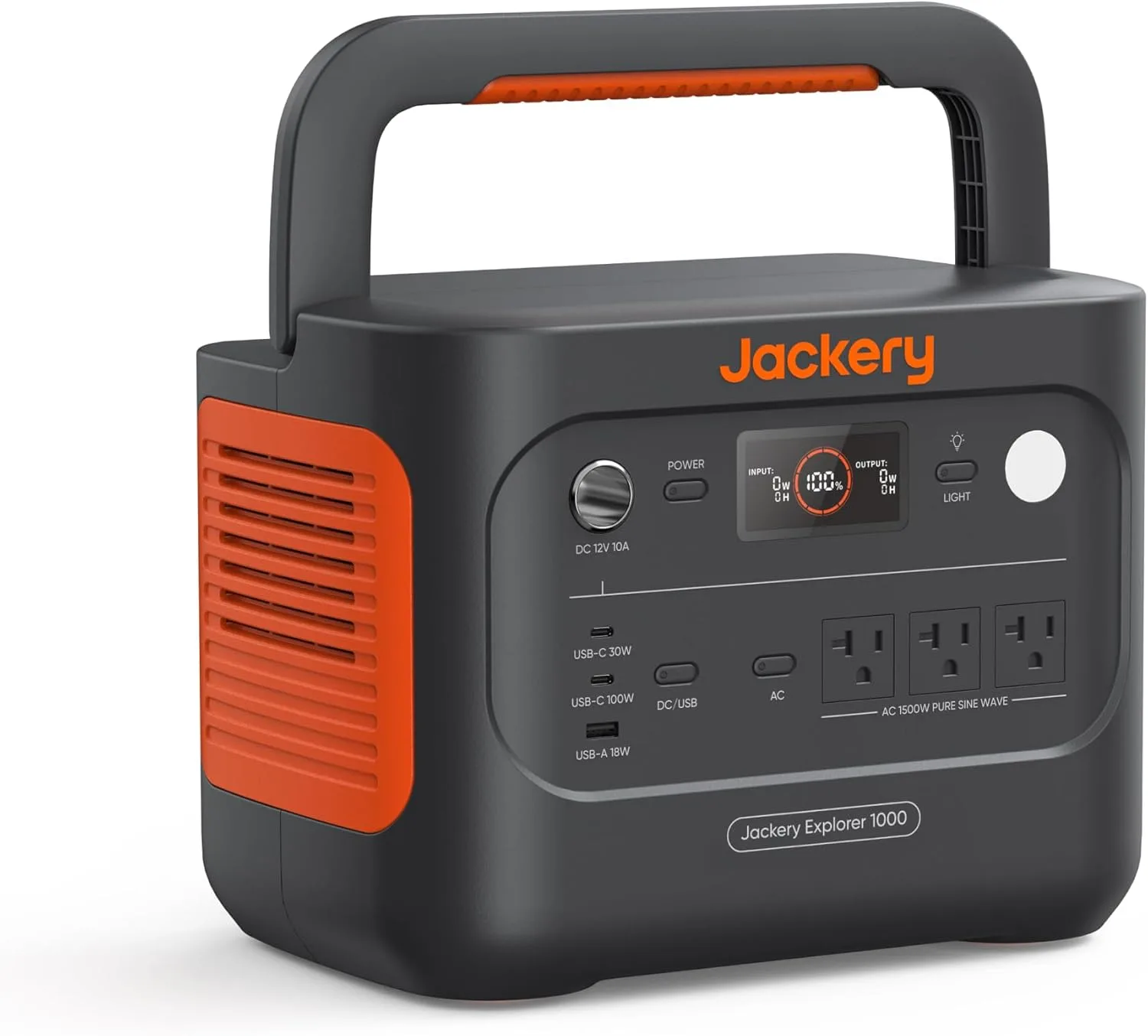
Jackery Explorer 1000 v2 Portable Power Station,1070Wh,1500W
Highlights
- 1070Wh rated capacity
- 1500W continuous AC
- LiFePO4 chemistry
- Up to 400W solar input
- 23.8 lb (~10.8 kg)
- About $559 list
Best for
- Explorer 1000 v2: weekend camping when 23.8 lb carry weight matters as much as 1070Wh
- Essentials bridge at home (fridge cycles, router) when sized to the Wh
- Solar top-ups up to ~400W when panels and weather cooperate
Strengths
- Explorer 1000 v2: 1070Wh with 1500W continuous — enough for fridge cycles if surge on the listing clears the start
- 23.8 lb (~10.8 kg) is the lightest-class carry in this band — easier stairs and car packing
- Explorer 1000 v2 uses LiFePO4 — cycle-life claims usually beat older NMC marketing lines
- Owners on file: Theme: Customers find the power station charges quickly, reaching 100% within 3 hours, and can power a side-b…
Watch-outs · not ideal when
- Explorer 1000 v2 is still a bridge for essentials — not a transfer-switch whole-home system
- Usable energy on Explorer 1000 v2 is below the 1070Wh label once the inverter is working
- Rated 400W solar on Explorer 1000 v2 is optimistic; shade and cables cut real watts
- LiFePO4 helps longevity, but Explorer 1000 v2 still hates freezing charge temps on winter trips
Owner voices
Short takes from public retail reviews — paraphrased or translated when long or non-English; meaning kept close to the original.
“Theme: Customers find the power station charges quickly, reaching 100% within 3 hours, and can power a side-by-side fridge/freezer for up to 9 hours. Moreover, the generator provides 1500 watt sustained output, lasts…”
“Theme: Kitchen Appliances (137)”
“Theme: Charging Electronics (98)”
Where the listing is honest and where it is quiet
Honest: the capacity and output figures are stated plainly, the LFP chemistry is named, and the 1.7-hour default charge time is disclosed in the fine print rather than buried. The solar panel exclusion is called out in bold.
Quiet: the one-hour charge is a mode, not a default, and you have to re-arm it each time in the app. The listing also does not spell out a full warranty document — coverage terms are n/a (not on file) here, so confirm them with the seller before you buy.
Also worth flagging for anyone comparing: the listing says the unit is compatible only with Jackery solar panels for solar charging. If you already own a third-party panel, that is a real constraint, and owners describe solar as slow and angle-sensitive regardless.
The box contains the station and a user manual. No solar panel, and no car charger — an owner noted the omission. Budget for those separately if off-grid recharge matters to you.
What owners actually run on it
The review pack skews toward outage prep and camping, which matches this page's angle. During my use of the owner notes, the recurring picture is a fridge plus fans overnight, phones and a tablet on the USB-C ports, and quiet mode keeping the noise low enough to sleep through.
One owner ran a refrigerator and a portable AC unit together off the AC outlets without issue. Another kept a fridge and a few fans going overnight in quiet mode. A third ran a 12V DC cooler for multiple nights at roughly a quarter of the battery per night.
Corded tools are a mixed bag. A shop vac, palm sanders, and a biscuit joiner worked; the shop vac drained the battery noticeably in a short session. The miter saw stall and the 1,700 W air fryer refusal are the two clearest ceiling markers in the pack.
The app draws consistent praise for monitoring and mode switching, with one recurring gripe: Wi-Fi sometimes drops overnight and needs re-enabling. Buttons sit recessed, and more than one owner has left the unit running by accident.
The listing aggregate is 4.7 from 3,713 ratings. Treat that as a listing figure, not proof — the themes above are what actually tell you how the unit behaves.
- Enough for: a fridge plus fans overnight, phones and tablets, a 12V cooler, light corded tools
- Not enough for: a 1,700 W air fryer, a 12-inch sliding miter saw, whole-home circuits
- Watch for: emergency-charge mode reverting, app Wi-Fi dropouts, no 12V barrel ports, no car charger in the box
Buy it or walk away
Buy the Jackery Explorer 1000 v2 Portable Power Station,1070Wh,1500W if your outage plan is a refrigerator, a few fans, and communications gear for a night, and you want something one person can carry at 23.8 lb. It also fits car camping and jobsite convenience where a 12V cooler and a couple of corded tools are the load.
Walk away if you need expandability, a 12V barrel-port ecosystem, or coverage for high-draw kitchen appliances. A 1,500 W ceiling rules out the air fryer and the big miter saw, and 1,070 Wh will not carry a whole home through a multi-day outage.
If you are weighing chemistry or sizing before you commit, the LFP cycle-life explainer and the Wh sizing guide are the two reads that will save you a return. And if you are comparing against a same-class rival, check continuous watts and weight first — those are the numbers that change the experience.
Frequently asked
Will it run my refrigerator overnight?
Owners report a fridge plus fans through a night. Your runtime depends on the fridge's draw and duty cycle, so check its label against 1,500 W continuous and 1,070 Wh.
Why does it charge in 1.7 hours instead of one?
The one-hour figure requires enabling emergency charging in the app before each charge; the default is 1.7 hours and the unit reverts after each quick charge.
Can I use my own solar panel?
The listing says Jackery panels only, with a 400 W input cap. Third-party panels are not supported per the listing.
Does it have 12V DC barrel ports?
No — the listing shows a 12V car socket only, so 12V accessories need an adapter.
Method and sources
Model names and list prices come from the WattPicks catalog at build time. WattPicks does not run its own laboratory tests on power stations, and nothing on this page is presented as a measured result — it is catalog-backed buying guidance.
Read our methodology for how the catalog is normalized, and about WattPicks for who publishes it.