
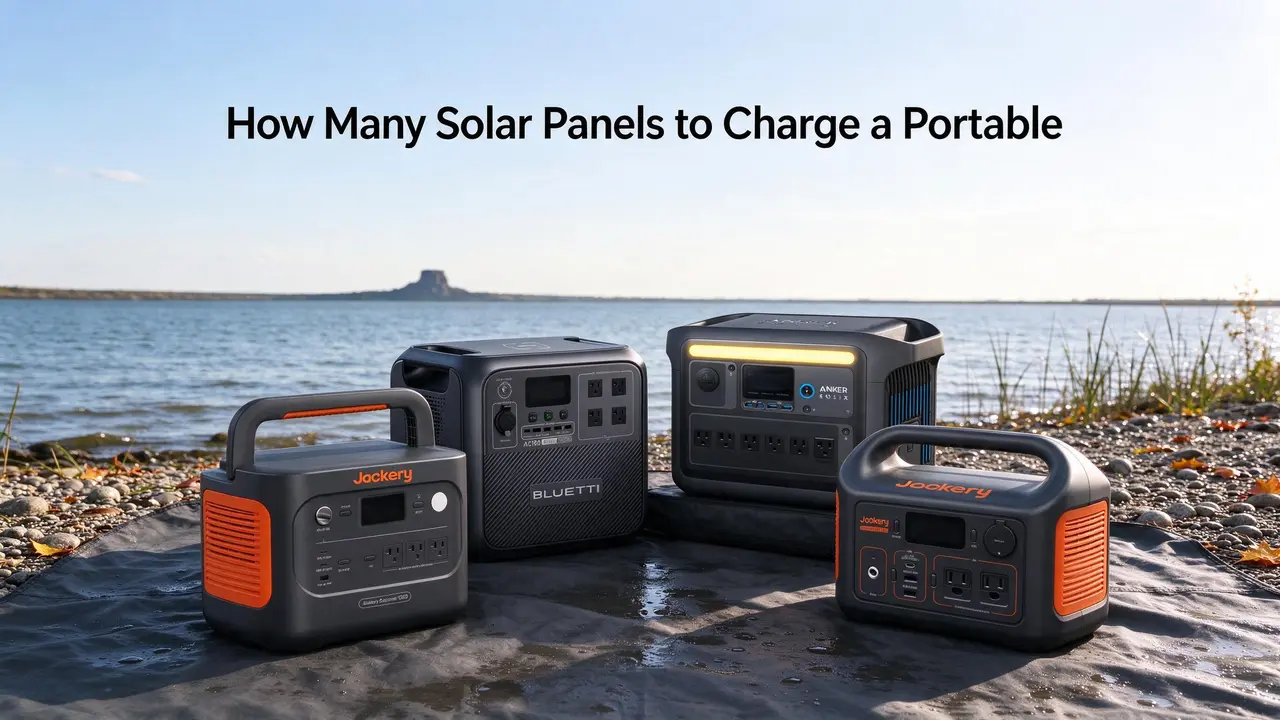
How Many Solar Panels to Charge a Portable Power Station?
The math is simple: match panel wattage to your station's solar input ceiling, then account for real-world sun. Here's how to size panels for four popular stations, with recharge times you can actually plan around.
Updated
The short answer: panel wattage vs. solar input
As an Amazon Associate I earn from qualifying purchases. Recommendations here are based on fit and the evidence below — not commission size.
You need enough panel wattage to hit your station's solar input ceiling—but not more, because the charge controller caps what it can accept. A 1,000Wh station typically takes 200–600W of solar; a 300Wh unit might top out at 100–200W.
The formula: panels (W) = station solar input max (W). Add 20–30% overhead for real-world sun if you want to actually reach that max. Two 200W panels in series, for example, give you 400W of panel rating—but on a hazy day you might see 280–320W at the input.
This guide is not for whole-home solar or rigid roof arrays. It's for folding panels and portable stations you carry to a campsite or set on a balcony.
- Check your station's published solar input max before buying panels.
- Panel wattage above the input max is wasted—the controller clips it.
- Real-world output is usually 60–80% of panel rating in good sun.
Spec snapshot: four stations and their solar ceilings
Here are the four units I'll use as worked examples. Prices are list prices captured from the manufacturer listings at the time of writing; capacities and outputs are from the same listings. Solar input max comes from the feature bullets or owner reports where noted.
| Product | Price | Capacity (Wh) | Output (W) | Weight (lb) | Rating |
|---|---|---|---|---|---|
| Jackery Explorer 1000 v2 | $559 | 1070 Wh | 1500 W | 23.8 lb | 4.7 |
| BLUETTI AC180 | $499 | 1152 Wh | 1800 W | 35.3 lb | 4.5 |
| Anker C1000 Portable Power Station | $599 | 1056 Wh | 1800 W | 28.4 lb | 4.7 |
| Jackery Explorer 300 v2 | $289 | 288 Wh | 300 W | 8.2 lb | 4.6 |
Worked example: Jackery Explorer 1000 v2
The Explorer 1000 v2 has a 1,070Wh battery and, according to an owner who tested it, a 400W solar input limit. To max it out, you'd want 400W of panel rating—say two 200W folding panels. In perfect sun that's 400W into the battery, which would theoretically recharge from empty in about 2.7 hours (1,070 ÷ 400). Real-world, expect 3.5–4.5 hours.
If you only have one 200W panel, you're looking at roughly 5.5–7 hours in good conditions. That's fine for a sunny day at camp, but not for a quick top-up.
Owner Dave noted that solar is slow and the panel angle needs adjusting every couple of hours for max output. That's the reality of folding panels—they're not set-and-forget.
Skip the Explorer 1000 v2 if you need to run a fridge overnight on solar alone—the 400W input ceiling means you'll need a full day of sun to recover a deep draw.
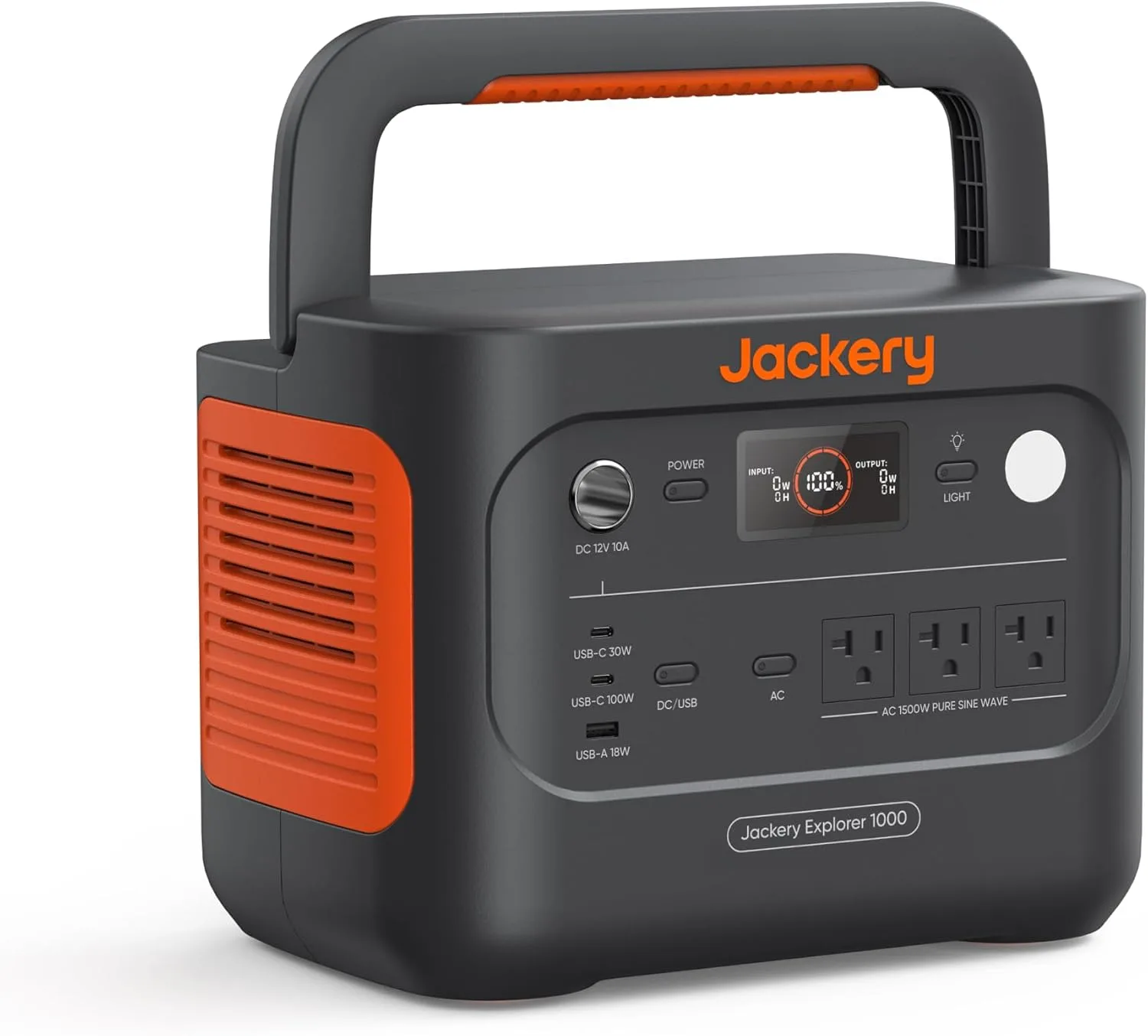
Jackery Explorer 1000 v2 Portable Power Station,1070Wh,1500W
Highlights
- 1070Wh rated capacity
- 1500W continuous AC
- LiFePO4 chemistry
- Up to 400W solar input
- 23.8 lb (~10.8 kg)
- About $559 list
Best for
- Explorer 1000 v2: weekend camping when 23.8 lb carry weight matters as much as 1070Wh
- Essentials bridge at home (fridge cycles, router) when sized to the Wh
Worked example: BLUETTI AC180
The AC180 lists a 500W solar input and a 1,152Wh battery. BLUETTI claims 2.8–3.3 hours to full on solar alone. That math checks out: 1,152 ÷ 500 = 2.3 hours at perfect input; with real-world derating you land in that 2.8–3.3h window.
Owner SamuraiJack42 tested a 200W panel and saw 161W on a clear April day—about 80% of rating. So if you pair the AC180 with 500W of panels, expect 350–400W actual input, stretching recharge to 3–3.5 hours. Still respectable.
The AC180 is the cheapest per Wh of this group at $0.43/Wh, which makes it a strong solar-charging candidate if budget matters.
Pass on the AC180 if you need the lightest possible kit—at 35.3 lb it's the heaviest here, and you'll also be hauling panels.
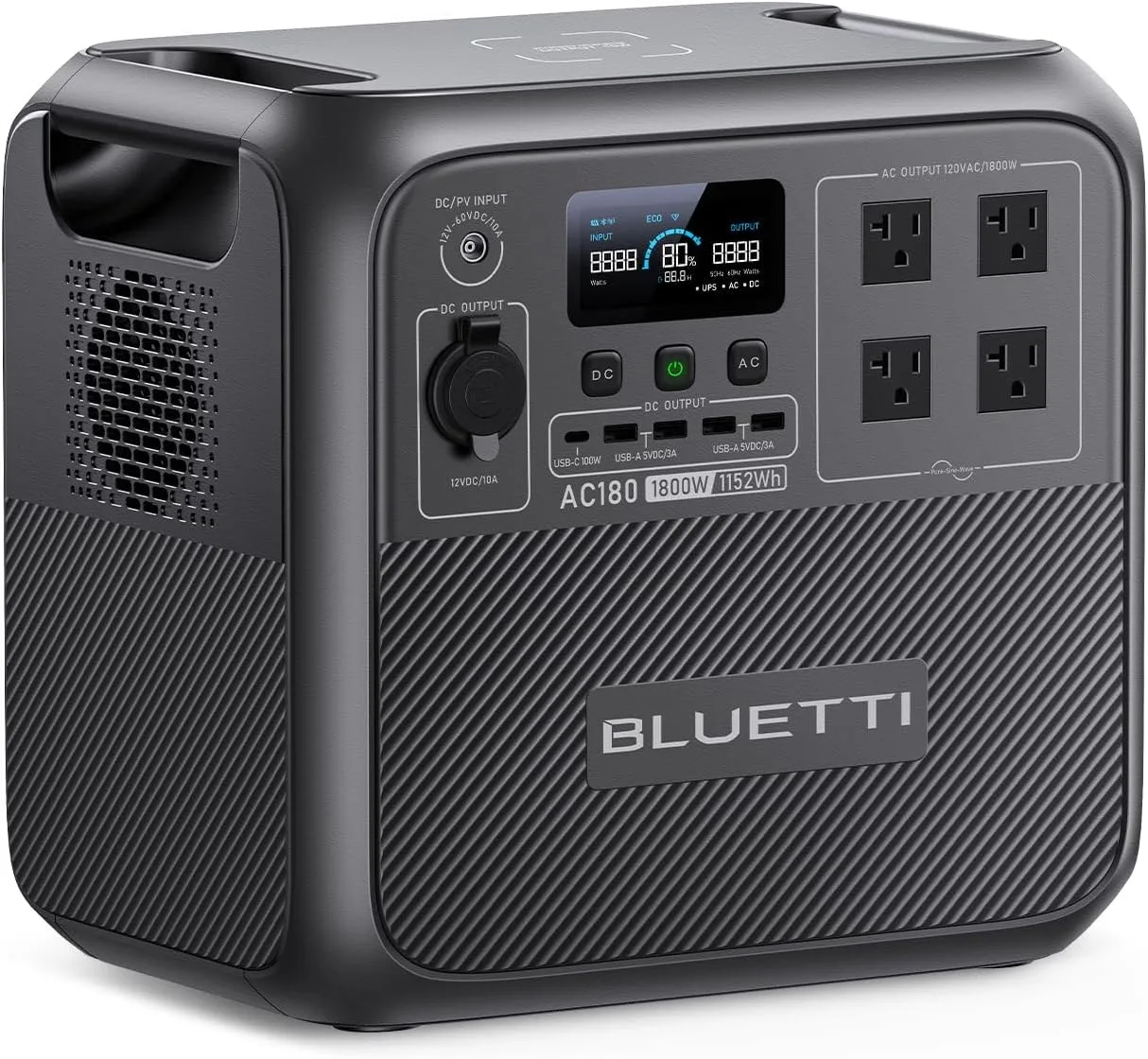
BLUETTI Portable Power Station AC180, 1152Wh LiFePO4 Battery Backup w/ 2 1800W
Highlights
- 1152Wh rated capacity
- 1800W continuous AC
- LiFePO4 chemistry
- Up to 500W solar input
- 35.3 lb (~16.0 kg)
- About $499 list
Best for
- AC180: most Wh per list dollar in mid-size LiFePO4 shortlists (~1152Wh)
- Home essentials when 1800W continuous matters more than a light carry
Worked example: Anker C1000
Anker lists a 600W solar input for the C1000 and claims 1.8 hours to full on solar. With a 1,056Wh battery, 600W input gives 1.76 hours theoretical—so that claim assumes near-perfect sun and max panel wattage.
In practice, you'd need 600W of panels (three 200W units, or two 300W) to hit that. Most campers won't carry that much. A single 400W panel gets you 400W input, or about 2.6 hours theoretical, 3.5–4 hours real-world.
Owner Julian F. ran a full-size fridge for 36 hours on the C1000, so the battery is capable—but solar recharge speed depends entirely on how much panel you're willing to haul.
Think twice about the C1000 if you want the fastest solar recharge without carrying 600W of panels—its high ceiling only pays off with a big array.
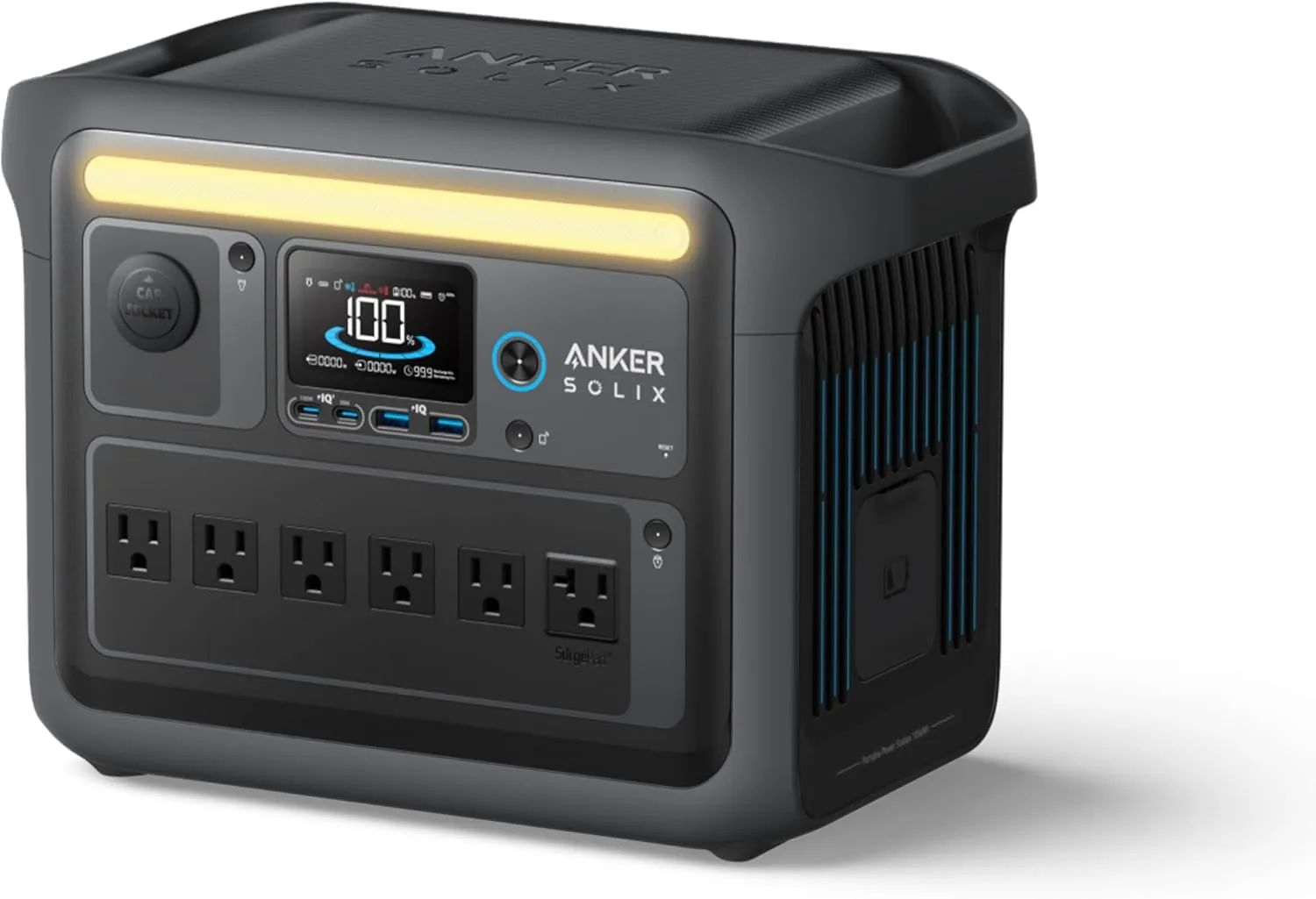
Anker C1000 Portable Power Station
Highlights
- 1056Wh rated capacity
- 1800W continuous AC
- LiFePO4 chemistry
- Up to 600W solar input
- 28.4 lb (~12.9 kg)
- About $599 list
Best for
- SOLIX C1000: small appliances and tools that need ~1800W continuous, not just phone charging
- Essentials bridge at home (fridge cycles, router) when sized to the Wh
Worked example: Jackery Explorer 300 v2
The Explorer 300 v2 is the small one: 288Wh, 300W output, and a 100W solar input per the listing. Jackery says a 100W panel gets you to 80% in about 2.8 hours. That's 230Wh in 2.8 hours, or roughly 82W average input—close to the 100W rating with some derating.
For this station, one 100W folding panel is the sweet spot. Two panels won't help because the input caps at 100W. If you want faster recharge, you're looking at AC power, not solar.
Owner Joshua used it for CPAP camping and noted that DC output (via a car port adapter) uses less power than AC—worth knowing if you're sizing solar to cover a CPAP load.
The Explorer 300 v2 isn't the right pick if you need to run a fridge overnight—its 288Wh capacity and 100W solar ceiling are too small for that load.
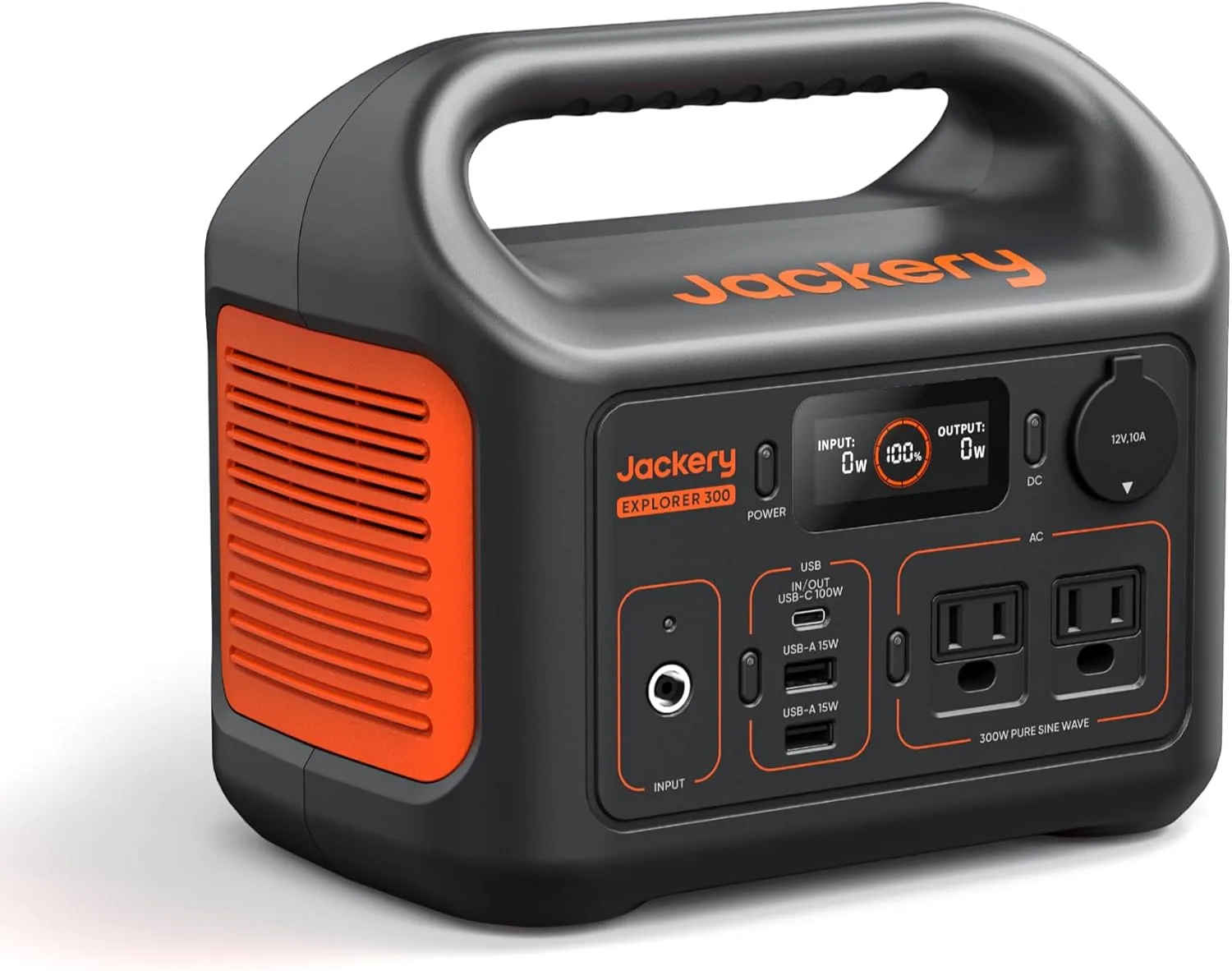
Jackery Explorer 300 Portable Power Station,292Wh
Highlights
- 288Wh rated capacity
- 300W continuous AC
- 600W surge
- LiFePO4 chemistry
- 8.2 lb (~3.7 kg)
- About $289 list
Best for
- Explorer 300 v2: phones, cameras and a laptop on short trips
- Travel kits when you need quiet pack power, not appliance runtime
The real-world derating factor
Panel ratings are lab conditions: 1,000 W/m² irradiance, 25°C cell temperature. In the field, you'll see 60–80% of that. Cloud cover, panel angle, latitude, season, and heat all cut into output.
A simple rule: take your panel wattage, multiply by 0.7, and use that as your planning number. So 400W of panels = 280W realistic input. That's the number to use for recharge time estimates.
If you're depending on solar for multiple days off-grid, size your battery capacity around that derated number, not the nameplate.
- Use 70% of panel rating for planning.
- Angle panels toward the sun and adjust every 2–3 hours for best output.
- Heat reduces panel output—don't expect peak wattage on a hot afternoon.
How many panels for your station: a quick decision table
Here's the practical takeaway for each station, assuming you want to recharge from empty in a reasonable day of sun (4–6 hours of usable light).
| Station | Solar Input Max | Panels to Max Input | Realistic Recharge (Empty to Full) | Notes |
|---|---|---|---|---|
| Jackery Explorer 1000 v2 | 400 W | 2 × 200W | 3.5–4.5 hours | Owner-reported 400W limit |
| BLUETTI AC180 | 500 W | 2 × 250W or 3 × 200W | 3–3.5 hours | Listing claims 2.8–3.3h |
| Anker C1000 | 600 W | 3 × 200W or 2 × 300W | 3.5–4 hours | Listing claims 1.8h at full 600W |
| Jackery Explorer 300 v2 | 100 W | 1 × 100W | 2.8–3.5 hours | Listing claims 80% in 2.8h |
What about charging while using?
Solar input and AC output can run simultaneously on all four stations, but the net charge rate is input minus load. If you're pulling 200W and putting in 300W, you're only gaining 100W.
For multi-day off-grid trips, size your panels to cover your average load plus some recharge. If you use 1,000Wh per day and get 4 hours of sun, you need at least 250W of realistic input—which means 350–400W of panel rating.
The AC180 owner who ran a 55W fan overnight found the battery drained faster than expected due to inverter idle draw. That's another reason to oversize solar slightly.
Bottom line: match panels to input, then add margin
The number of solar panels you need is determined by your station's solar input max, not its battery capacity. Buy panels that add up to that max, then derate by 30% for real-world planning.
For the Jackery Explorer 1000 v2, two 200W panels (400W total). For the BLUETTI AC180, 500W total—two 250W or three 200W panels. For the Anker C1000, 600W if you want the fastest recharge. For the Jackery Explorer 300 v2, one 100W panel is all it can take.
If you're buying a station primarily for solar charging, the AC180 offers the most input per dollar at $499 list. The C1000 has the highest ceiling but costs $599. The Explorer 300 v2 is the lightest and simplest for small loads.
What owners report
Owner themes tallied from reviews on file, plus our home-user field checks. Prefer feedback matching this article's use-case; note when reviews skew elsewhere.
- Jackery Explorer 1000 v2: Owners say it charges quickly and can run a fridge/freezer for hours, but solar recharge is slower than AC.
- BLUETTI AC180: Owners praise fast AC charging and value, but note solar input is capped at 500W.
- Anker C1000: Owners report it runs a full-size fridge for over a day and charges fast from AC, but solar speed depends on panel wattage.
- Jackery Explorer 300 v2: Owners find it reliable for small loads like CPAP, with DC output stretching runtime.
Frequently asked
Can I series two 200W panels into the Jackery Explorer 1000 v2?
Yes, if the combined voltage stays within the station's input range and total wattage is at or below the 400W solar input limit. Two 200W panels in series give 400W, which matches the owner-reported ceiling.
How many panels can the BLUETTI AC180 take?
The AC180 has a 500W solar input max, so two 250W panels or three 200W panels will max it out. More panel wattage won't help because the controller clips excess.
What's the fastest solar recharge for the Anker C1000?
Anker lists a 600W solar input and claims 1.8 hours to full at that wattage. To hit it you'd need 600W of panels—three 200W or two 300W units—in near-perfect sun.
Can I use a 200W panel with the Jackery Explorer 300 v2?
The Explorer 300 v2 has a 100W solar input limit, so a 200W panel would be clipped to 100W. One 100W panel is the practical choice.
Can I use more panels than the input max?
The controller clips excess wattage, so you won't damage the station, but you're wasting panel capacity. Stay at or slightly above the max.
Do I need a charge controller?
No—portable power stations have built-in MPPT controllers. Just match the panel voltage to the station's input range.
Will a 200W panel actually deliver 200W?
Only in perfect lab conditions. Expect 120–160W in real sun, depending on angle and weather.
Method and sources
Model names and list prices come from the WattPicks catalog at build time. WattPicks does not run its own laboratory tests on power stations, and nothing on this page is presented as a measured result — it is catalog-backed buying guidance.
Read our methodology for how the catalog is normalized, and about WattPicks for who publishes it.