
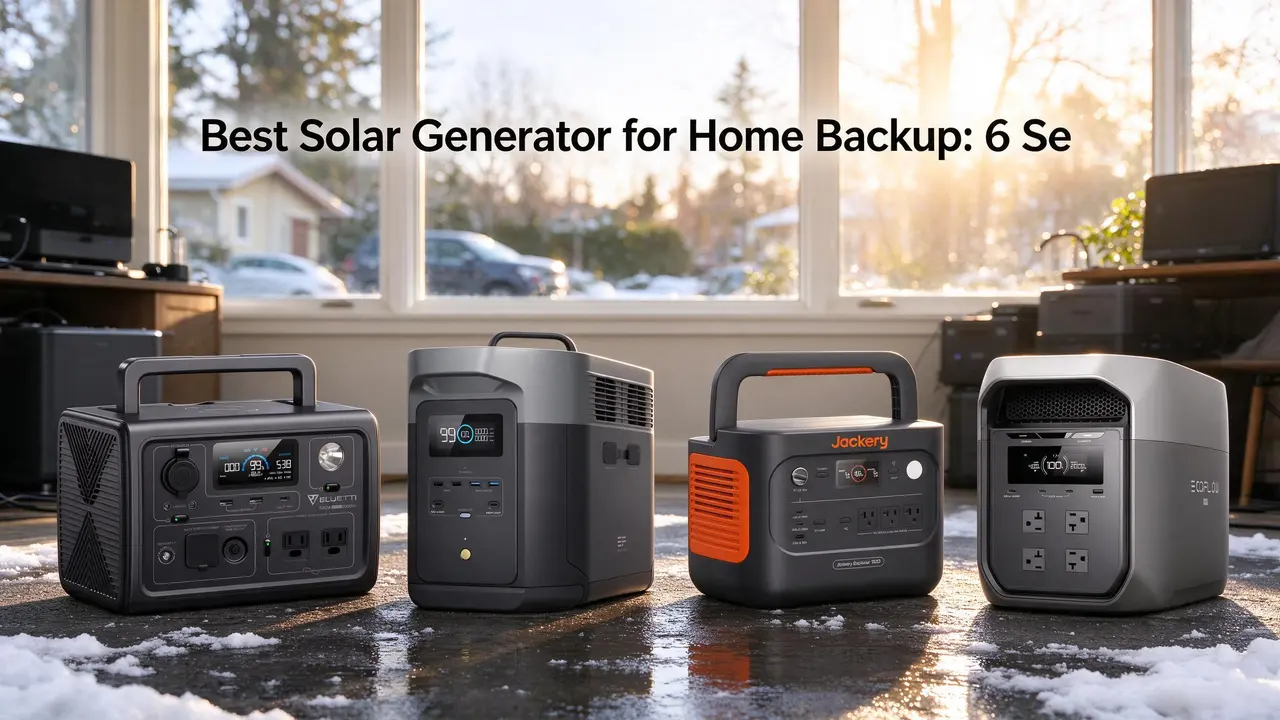
Best Solar Generator for Home Backup: 6 Self-Reliant Picks
You want the fridge and router to survive a 2–3 day outage without dragging out a generator. This ranking follows usable capacity, surge headroom, solar recharge speed, and battery chemistry — not marketing names — with the trade-offs spelled out.
Updated
What 'patriot' should mean for a power station
If you're shopping for a 'patriot solar generator,' the useful question isn't which brand waves the flag hardest. It's which station keeps your refrigerator, Wi-Fi, and a few lights running when the grid goes down — and can be refilled by the sun when the outage stretches past a day. That's the self-reliance test I used here.
This list is not for whole-home backup. None of these six units will run a central AC, an electric furnace, or a 240V well pump without a transfer switch and a much larger system. Think of them as targeted backup: the fridge, the router, medical devices, phones, and a fan. If you need to power a whole panel, you're shopping in a different category.
One disclosure: as an Amazon Associate, WattPicks earns from qualifying purchases. The ranking below is fit-led — the order follows the weights I explain in the method section, not commission rates.
- Boundary: these are portable stations, not standby generators or home battery systems.
- Boundary: solar panels are sold separately on every SKU here unless a bundle says otherwise.
- Boundary: runtime estimates assume you're not running every outlet at once.
Quick picks: the shortlist at a glance
Six stations, six different jobs. The order below reflects the weighted method further down — usable capacity and surge headroom carry the most weight for outage duty, followed by solar recharge speed and LiFePO4 longevity.
Budget rule: if budget is the constraint, pick the BLUETTI AC180 over the DELTA 2 Max because it delivers 1,152 Wh and 1,800 W for $499 — less than half the price — and still covers a fridge, router, and lights for a short outage. You give up capacity and surge headroom, but you keep the essentials.
- #1 EcoFlow DELTA 2 Max — the expandable anchor for multi-day outages; 2,048 Wh and 2,400 W, but 50 lb and $1399.
- #2 EcoFlow DELTA 3 Max Portable Power Station, 2048Wh LFP Battery — same capacity class, lighter at 44.8 lb, faster UPS transfer, $1199.
- #3 BLUETTI AC180 — the value pick at $499, 1,152 Wh and 1,800 W, with a real UPS mode.
- #4 Jackery Explorer 1000 v2 Portable Power Station,1070Wh,1500W — the lightweight 1,070 Wh option at 23.8 lb and $559.
- #5 Anker C1000 Portable Power Station — 1,056 Wh and 1,800 W in a 28.4 lb frame, $599.
- #6 BLUETTI EB3A Portable Power Station — the small 268 Wh / 600 W unit for lights, phones, and a CPAP; list price n/a (not on file). Check current price on Amazon.
How I ranked these six
I'm a deep-use experience reviewer working from owner themes on file plus listing specs. Those checks are not lab-bench measurements, and I don't present them as such. The weights below are what actually moved the order — every percentage is scored.
Usable capacity and surge headroom (30%) matter most because an outage is a marathon, not a sprint. A 2,048 Wh station with a 2,400 W inverter can carry a fridge and a few essentials overnight; a 268 Wh unit cannot. Solar recharge speed (20%) is the self-reliance multiplier — if you can't refill from the sun, you're just delaying the outage. LiFePO4 longevity and cycle life (20%) decides whether the station is still useful in year eight. UPS transfer and outlet layout (15%) matters if you're using it as a bridge for electronics. Portability and weight (10%) is the tiebreaker for people who actually move the thing. Owner-reported reliability themes (5%) get the smallest weight because the sample is self-selected; a 5% weight means a single bad report can't sink a station, but a pattern of complaints can nudge it down.
The tiebreak between #1 and #2: both have 2,048 Wh and 2,400 W, so they tie on the 30% capacity/surge weight. The DELTA 2 Max wins on the 20% solar recharge weight because its larger solar input lets it refill faster from panels, while the DELTA 3 Max wins on the 10% portability weight (44.8 lb vs. 50 lb) and the 15% UPS weight (10ms transfer). The 20% solar weight outweighs the combined 25% of portability and UPS, so the DELTA 2 Max takes #1 — but if you value lighter weight and faster UPS transfer more than solar speed, the DELTA 3 Max is the better buy for you.
How to check your own load: runtime (hours) = (station Wh × 0.9 usable) ÷ (appliance running watts × duty cycle). Most fridges cycle on and off, so their duty cycle is roughly 0.3–0.5 — meaning they draw their rated watts only part of the time. Example: a 2,048 Wh station with a 150W fridge at a 0.4 duty cycle gives (2048 × 0.9) ÷ (150 × 0.4) ≈ 30.7 hours. Owner-reported numbers like 53 hours for an 80W mini-fridge imply a low duty cycle or partial cycling, not continuous draw. Always check your appliance's actual wattage before relying on any estimate.
- 30% — usable capacity and surge headroom
- 20% — solar recharge speed
- 20% — LiFePO4 longevity and cycle life
- 15% — UPS transfer and outlet layout
- 10% — portability and weight
- 5% — owner-reported reliability themes
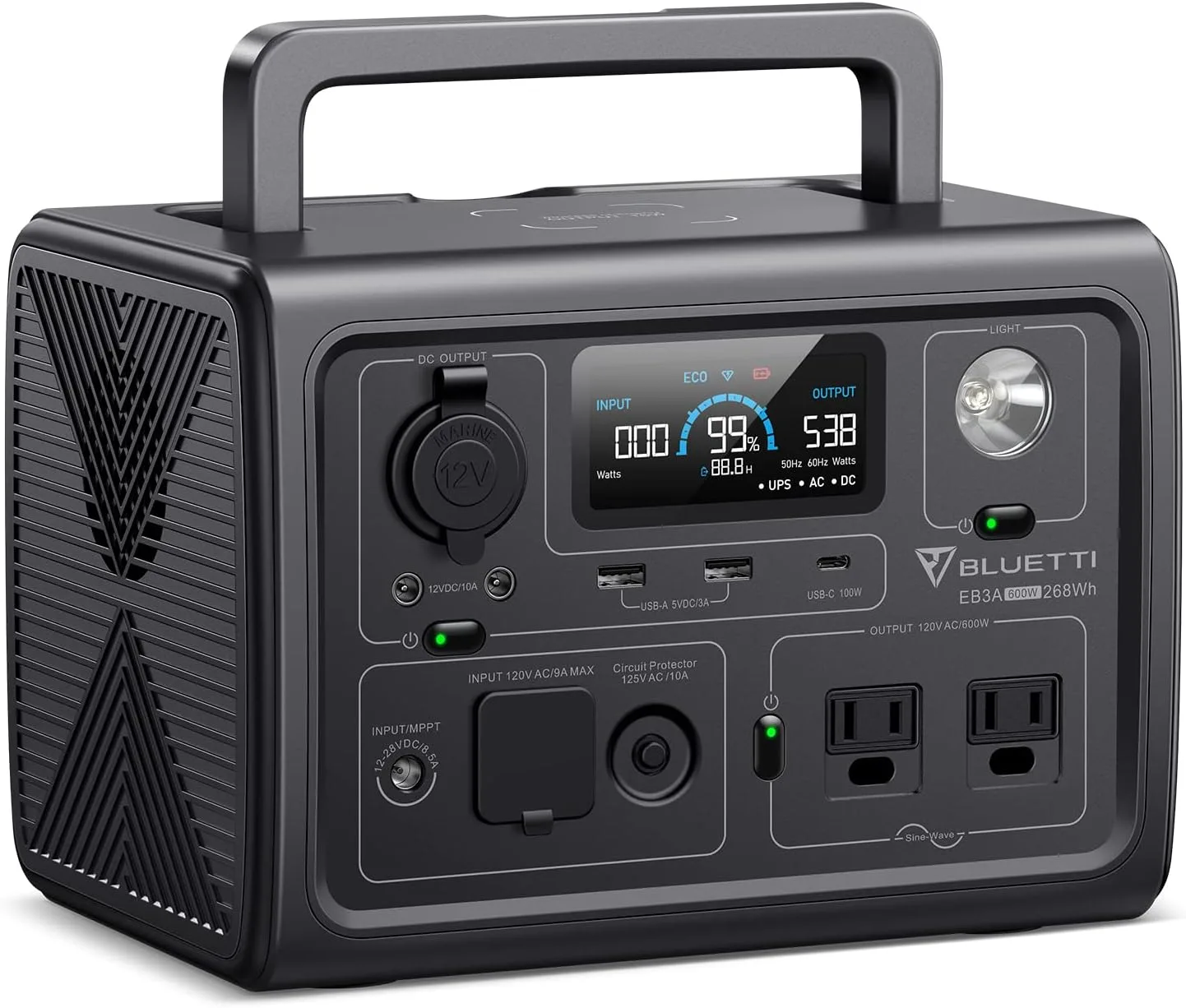
BLUETTI EB3A Portable Power Station
Highlights
- 268Wh rated capacity
- 600W continuous AC
- 1200W surge
- LiFePO4 chemistry
- Up to 200W solar input
- 10.1 lb (~4.6 kg)
Best for
- bluetti-eb3a: phones, cameras and a laptop on short trips
- Travel kits when you need quiet pack power, not appliance runtime
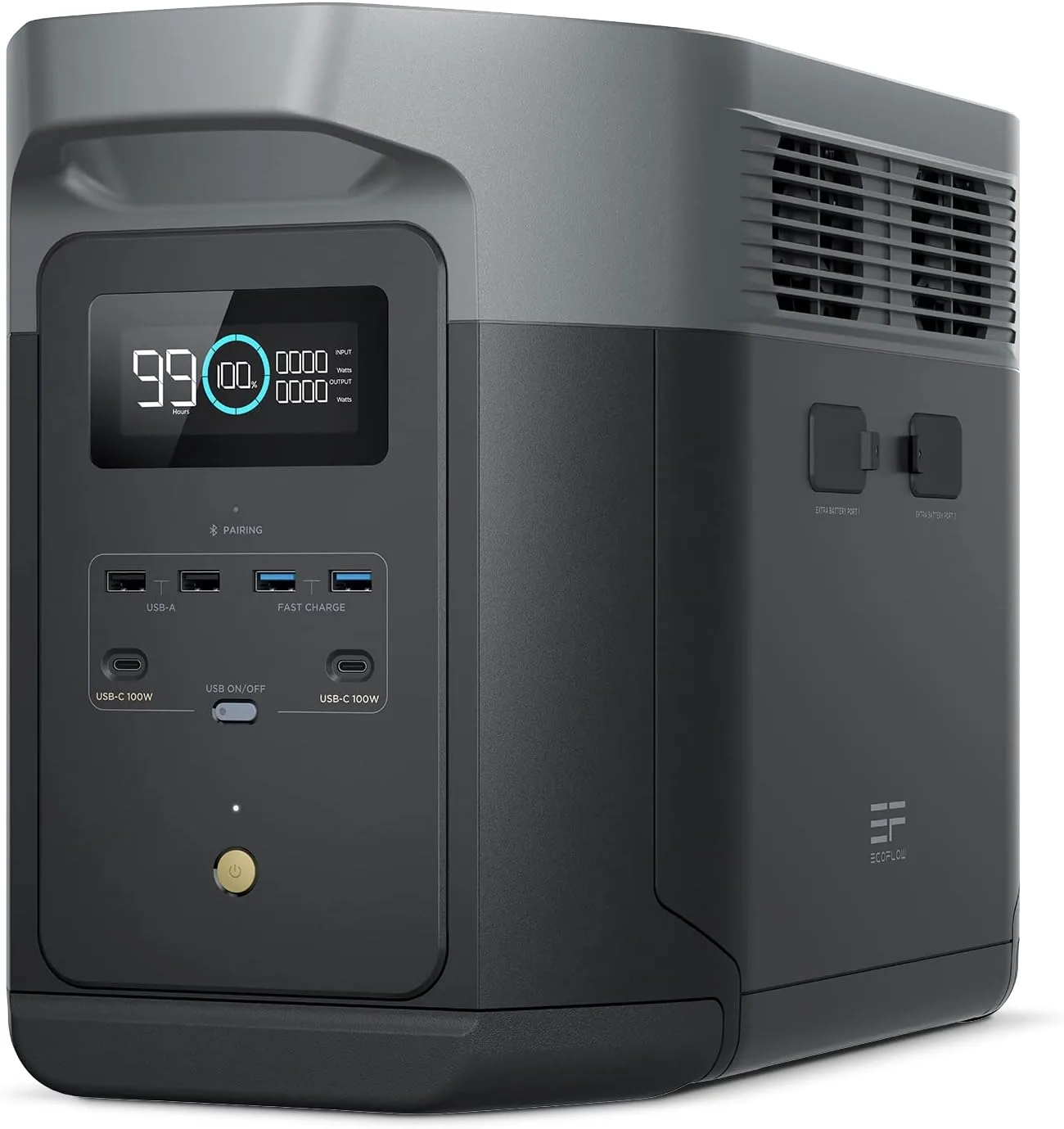
EcoFlow DELTA 2 Max
Highlights
- 2048Wh rated capacity
- 2400W continuous AC
- 4800W surge
- LiFePO4 chemistry
- Up to 1000W solar input
- 50 lb (~22.7 kg)
Best for
- DELTA 2 Max: longer outages or higher continuous loads (still not whole-home wiring)
- RV / off-grid days where recharge speed matters as much as Wh
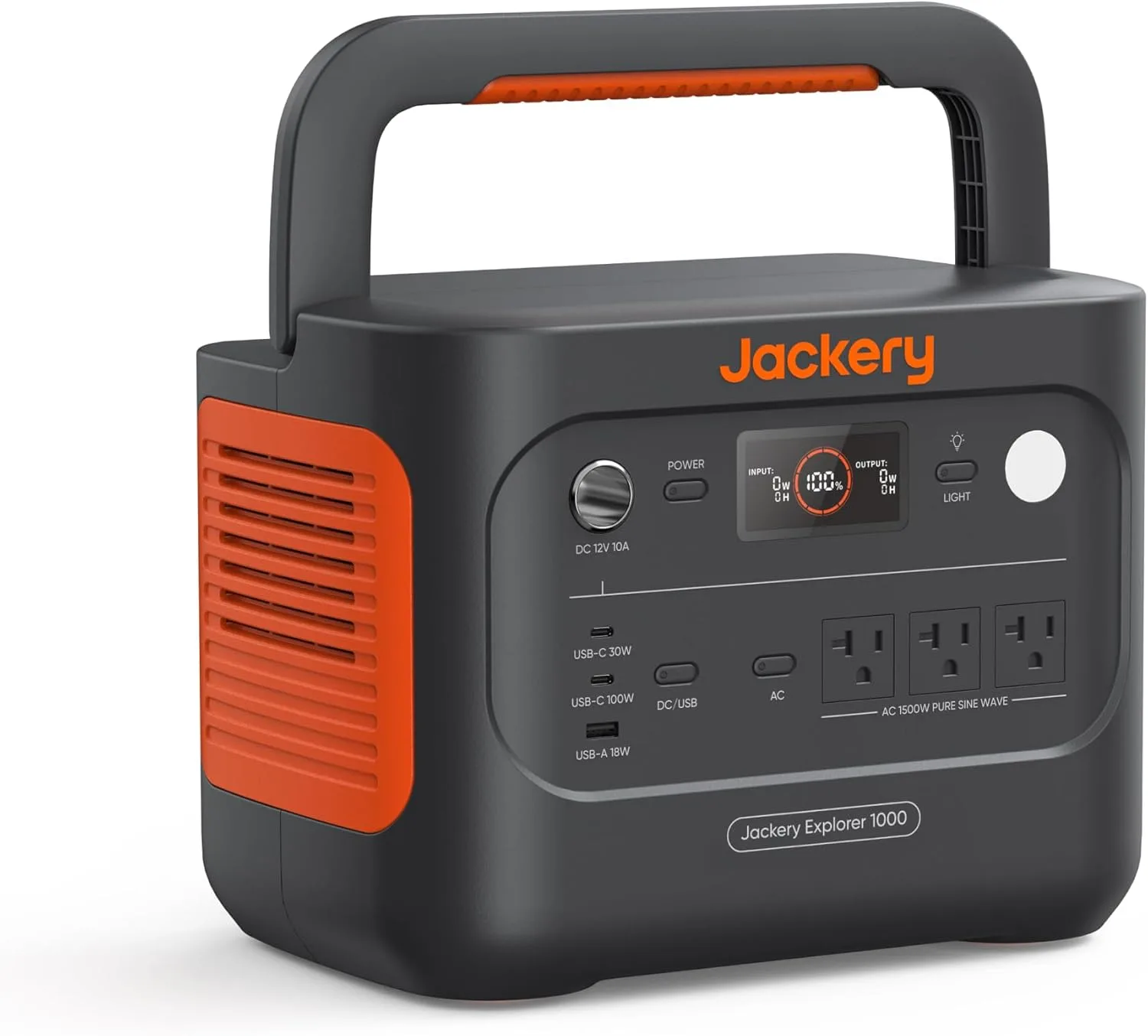
Jackery Explorer 1000 v2 Portable Power Station,1070Wh,1500W
Highlights
- 1070Wh rated capacity
- 1500W continuous AC
- LiFePO4 chemistry
- Up to 400W solar input
- 23.8 lb (~10.8 kg)
- About $559 list
Best for
- Explorer 1000 v2: weekend camping when 23.8 lb carry weight matters as much as 1070Wh
- Essentials bridge at home (fridge cycles, router) when sized to the Wh
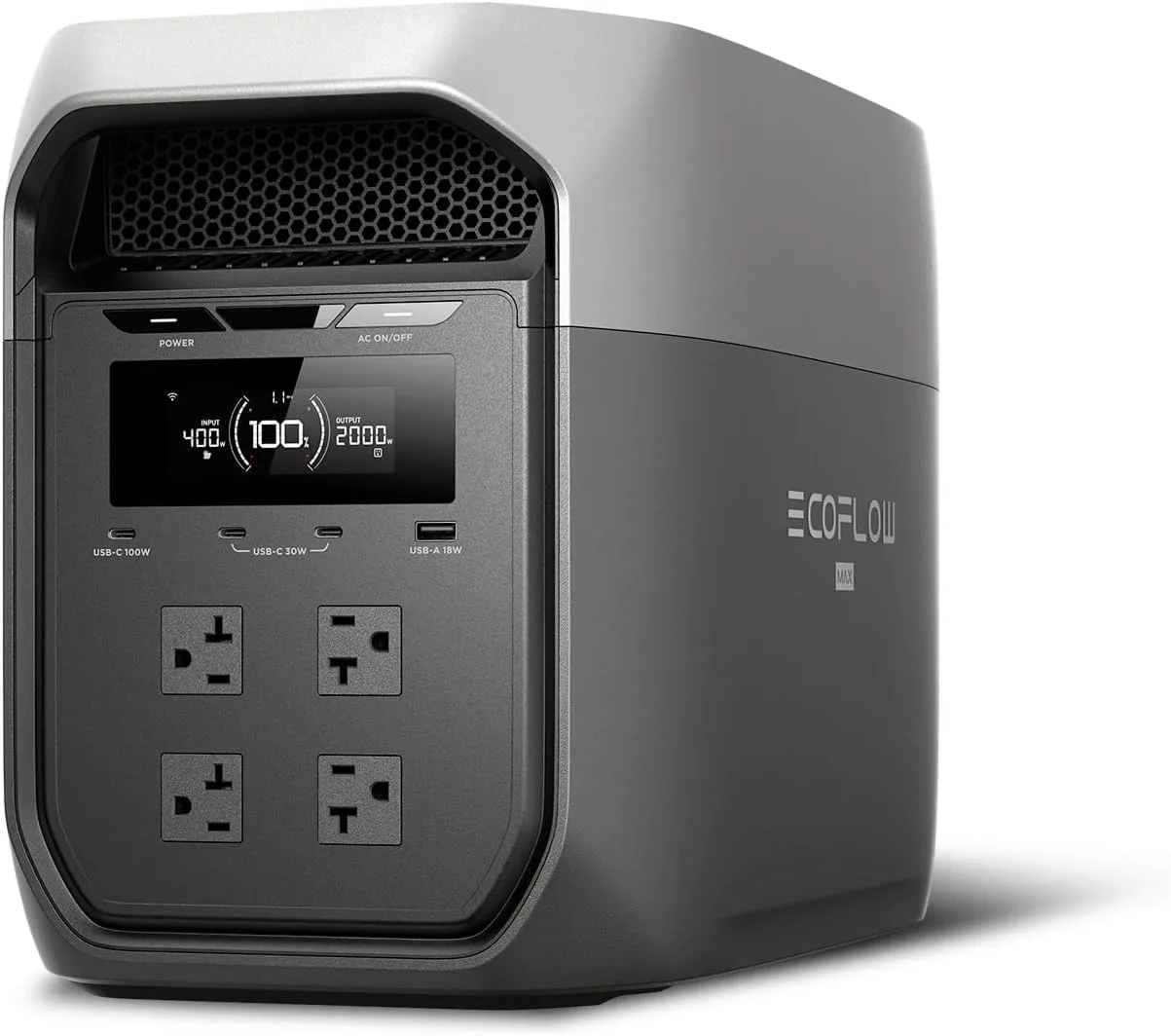
EcoFlow DELTA 3 Max Portable Power Station, 2048Wh LFP Battery
Highlights
- 2048Wh rated capacity
- 2400W continuous AC
- 4800W surge
- LiFePO4 chemistry
- Up to 500W solar input
- 44.8 lb (~20.3 kg)
Best for
- DELTA 3 Max: longer outages or higher continuous loads (still not whole-home wiring)
- RV / off-grid days where recharge speed matters as much as Wh
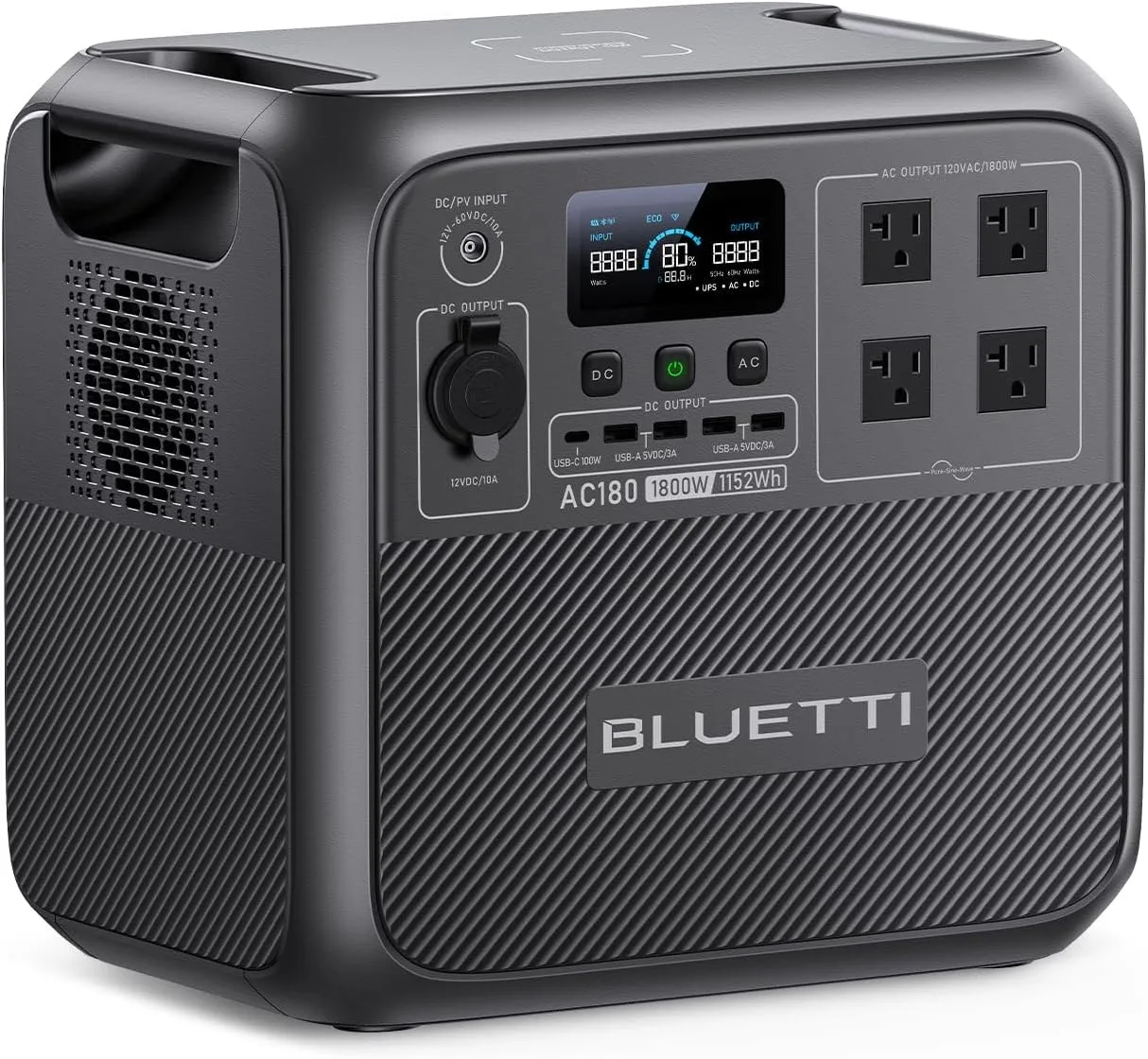
BLUETTI Portable Power Station AC180, 1152Wh LiFePO4 Battery Backup w/ 2 1800W
Highlights
- 1152Wh rated capacity
- 1800W continuous AC
- LiFePO4 chemistry
- Up to 500W solar input
- 35.3 lb (~16.0 kg)
- About $499 list
Best for
- AC180: most Wh per list dollar in mid-size LiFePO4 shortlists (~1152Wh)
- Home essentials when 1800W continuous matters more than a light carry
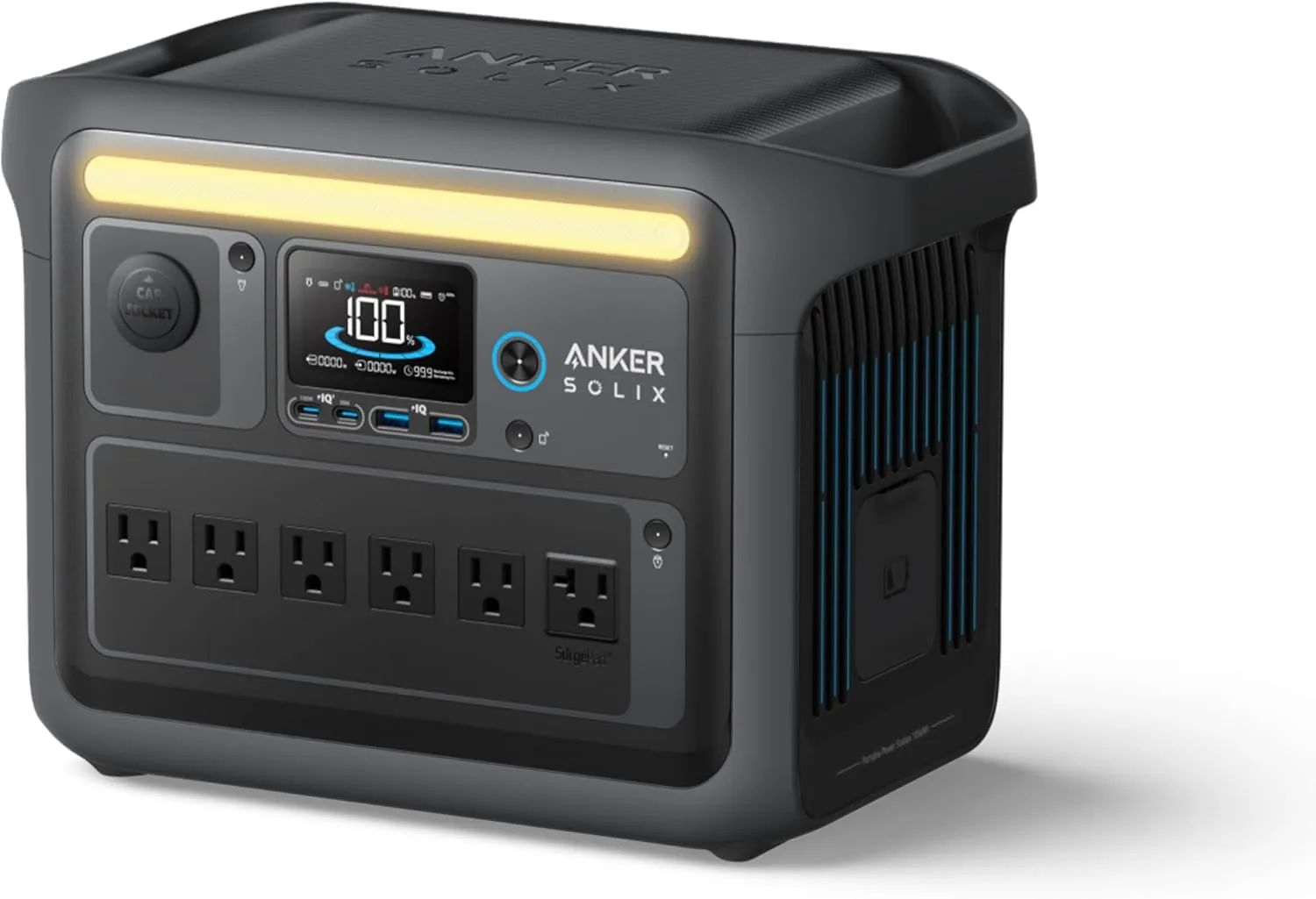
Anker C1000 Portable Power Station
Highlights
- 1056Wh rated capacity
- 1800W continuous AC
- LiFePO4 chemistry
- Up to 600W solar input
- 28.4 lb (~12.9 kg)
- About $599 list
Best for
- SOLIX C1000: small appliances and tools that need ~1800W continuous, not just phone charging
- Essentials bridge at home (fridge cycles, router) when sized to the Wh
Scoreboard: how each pick scored on the weights
Each station is rated High, Med, or Low on the six weighted criteria. This is the trace behind the order — not a lab score, but a fit score against the weights above.
- EcoFlow DELTA 2 Max — Capacity/surge: High (2,048 Wh, 2,400 W); Solar recharge: High; LiFePO4: High; UPS/outlets: Med; Portability: Low (50 lb); Owner reliability: Med. Overall: #1.
- EcoFlow DELTA 3 Max — Capacity/surge: High (2,048 Wh, 2,400 W); Solar recharge: Med; LiFePO4: High; UPS/outlets: High (10ms transfer); Portability: Med (44.8 lb); Owner reliability: High. Overall: #2.
- BLUETTI AC180 — Capacity/surge: Med (1,152 Wh, 1,800 W); Solar recharge: Med; LiFePO4: High; UPS/outlets: High (UPS mode); Portability: Med (35.3 lb); Owner reliability: Med. Overall: #3.
- Jackery Explorer 1000 v2 — Capacity/surge: Med (1,070 Wh, 1,500 W); Solar recharge: High (fast recharge); LiFePO4: High; UPS/outlets: Med; Portability: High (23.8 lb); Owner reliability: Med. Overall: #4.
- Anker C1000 — Capacity/surge: Med (1,056 Wh, 1,800 W); Solar recharge: High (fast recharge); LiFePO4: High; UPS/outlets: Med; Portability: High (28.4 lb); Owner reliability: Med. Overall: #5.
- BLUETTI EB3A — Capacity/surge: Low (268 Wh, 600 W); Solar recharge: Med; LiFePO4: High; UPS/outlets: Low (brief interruptions reported); Portability: High (10.1 lb); Owner reliability: Low (shutdowns reported). Overall: #6.
| Product | Price | Capacity (Wh) | Output (W) | Weight (lb) | Rating |
|---|---|---|---|---|---|
| BLUETTI EB3A Portable Power Station | n/a (not on file) | 268 Wh | 600 W | 10.1 lb | 4.1 |
| EcoFlow DELTA 2 Max | $1399 | 2048 Wh | 2400 W | 50 lb | 4.7 |
| Jackery Explorer 1000 v2 Portable Power Station,1070Wh,1500W | $559 | 1070 Wh | 1500 W | 23.8 lb | 4.7 |
| EcoFlow DELTA 3 Max Portable Power Station, 2048Wh LFP Battery | $1199 | 2048 Wh | 2400 W | 44.8 lb | 4.7 |
| BLUETTI AC180 | $499 | 1152 Wh | 1800 W | 35.3 lb | 4.5 |
| Anker C1000 Portable Power Station | $599 | 1056 Wh | 1800 W | 28.4 lb | 4.7 |
Spec snapshot
Prices are list prices from the catalogue; sale stickers are ignored. Ratings are listing aggregates, not owner proof. Where a spec is missing, it's marked n/a. Note: the EB3A's list price is not on file, so it is excluded from any price or $/Wh comparison below.
Owner-reported runtimes below are self-reported and vary with load, temperature, and battery age — treat them as directional, not guaranteed.
- #1 EcoFlow DELTA 2 Max — 2,048 Wh and 2,400 W, expandable to 6 kWh with add-on batteries. Owners report running a mini-fridge (80W) for 53 hours and a stand-up freezer (130W) for 26 hours. Suits: multi-day outages where you can leave it in one place. Skip if: you need to carry it up stairs regularly — it's 50 lb.
- #2 EcoFlow DELTA 3 Max Portable Power Station, 2048Wh LFP Battery — same 2,048 Wh and 2,400 W as the #1, but 44.8 lb and a 10ms UPS transfer. Owners report keeping Wi-Fi and a PC running through outages and running an Iceco VL45Pro fridge for over five days. Suits: UPS-style backup for electronics plus fridge duty. Skip if: you need more than 100W USB output — one owner wished for 140W.
- #3 BLUETTI AC180 — 1,152 Wh and 1,800 W for $499, the lowest nameplate $/Wh here at $0.43. Owners report instant UPS switchover for a basement circuit and a box fan running 7 hours with 22% left. Suits: budget-conscious backup where you can keep it plugged in. Skip if: you need every watt-hour — idle draw is about 20W/hour with the inverter on, and only 90% of capacity is usable.
- #4 Jackery Explorer 1000 v2 Portable Power Station,1070Wh,1500W — 1,070 Wh and 1,500 W at 23.8 lb. Owners report running a 12V car fridge for three days (100% to 43%) and recharging 0–100% in about 1 hour 40 minutes. Suits: camping and short outages where you move the station. Skip if: you need to run a 1,700W air fryer or a 12-inch miter saw — owners report both tripping it.
- #5 Anker C1000 Portable Power Station — 1,056 Wh and 1,800 W at 28.4 lb. Owners report an 18 cu ft fridge running 36 hours in a 50°F garage and a 1%–100% recharge in about 1 hour 32 minutes. Suits: short-term fridge backup and camping. Skip if: you need a long AC charging cable — the included one is about 4–5 ft.
- #6 BLUETTI EB3A Portable Power Station — 268 Wh and 600 W at 10.1 lb. Owners report a CPAP running about 10.5 hours with the heater off and a 400W chainsaw charger working fine. Suits: lights, phones, and a CPAP for one night. Skip if: you need rock-solid UPS behavior — owners report brief interruptions and random shutdowns from 50–70% charge.
| Product | Price | Capacity (Wh) | Output (W) | Weight (lb) | Rating |
|---|---|---|---|---|---|
| BLUETTI EB3A Portable Power Station | n/a (not on file) | 268 Wh | 600 W | 10.1 lb | 4.1 |
| EcoFlow DELTA 2 Max | $1399 | 2048 Wh | 2400 W | 50 lb | 4.7 |
| Jackery Explorer 1000 v2 Portable Power Station,1070Wh,1500W | $559 | 1070 Wh | 1500 W | 23.8 lb | 4.7 |
| EcoFlow DELTA 3 Max Portable Power Station, 2048Wh LFP Battery | $1199 | 2048 Wh | 2400 W | 44.8 lb | 4.7 |
| BLUETTI AC180 | $499 | 1152 Wh | 1800 W | 35.3 lb | 4.5 |
| Anker C1000 Portable Power Station | $599 | 1056 Wh | 1800 W | 28.4 lb | 4.7 |
Why each one made the list
The order below follows the weights above. Each entry gets a suits line and a skip line tied to its own specs — no copy-paste trade-offs.
- #1 EcoFlow DELTA 2 Max — 2,048 Wh and 2,400 W. Owners report running a mini-fridge (80W) for 53 hours and a stand-up freezer (130W) for 26 hours. Suits: multi-day outages where you can leave it in one place. Skip if: you need to carry it up stairs regularly — it's 50 lb.
- #2 EcoFlow DELTA 3 Max Portable Power Station, 2048Wh LFP Battery — same 2,048 Wh and 2,400 W as the #1, but 44.8 lb and a 10ms UPS transfer. Owners report keeping Wi-Fi and a PC running through outages and running an Iceco VL45Pro fridge for over five days. Suits: UPS-style backup for electronics plus fridge duty. Skip if: you need more than 100W USB output — one owner wished for 140W.
- #3 BLUETTI AC180 — 1,152 Wh and 1,800 W for $499. Owners report instant UPS switchover for a basement circuit and a box fan running 7 hours with 22% left. Suits: budget-conscious backup where you can keep it plugged in. Skip if: you need every watt-hour — idle draw is about 20W/hour with the inverter on, and only 90% of capacity is usable.
- #4 Jackery Explorer 1000 v2 Portable Power Station,1070Wh,1500W — 1,070 Wh and 1,500 W at 23.8 lb. Owners report running a 12V car fridge for three days (100% to 43%) and recharging 0–100% in about 1 hour 40 minutes. Suits: camping and short outages where you move the station. Skip if: you need to run a 1,700W air fryer or a 12-inch miter saw — owners report both tripping it.
- #5 Anker C1000 Portable Power Station — 1,056 Wh and 1,800 W at 28.4 lb. Owners report an 18 cu ft fridge running 36 hours in a 50°F garage and a 1%–100% recharge in about 1 hour 32 minutes. Suits: short-term fridge backup and camping. Skip if: you need a long AC charging cable — the included one is about 4–5 ft.
- #6 BLUETTI EB3A Portable Power Station — 268 Wh and 600 W at 10.1 lb. Owners report a CPAP running about 10.5 hours with the heater off and a 400W chainsaw charger working fine. Suits: lights, phones, and a CPAP for one night. Skip if: you need rock-solid UPS behavior — owners report brief interruptions and random shutdowns from 50–70% charge.
Who should not buy the top pick
The DELTA 2 Max is #1 because it has the most usable capacity and the highest continuous output in this group. But it's the wrong buy for two clear profiles.
First, anyone who needs to move the station regularly. At 50 lb, it's a two-hand lift and not something you'll carry to a campsite. If portability is the priority, the Jackery Explorer 1000 v2 at 23.8 lb or the Anker C1000 at 28.4 lb makes more sense.
Second, anyone who needs responsive customer support during an outage. One owner reported no technical help during a multi-day hurricane outage and a six-day wait for an email response. If support response time is a dealbreaker, weigh that against the capacity advantage.
- Skip the DELTA 2 Max if you need to carry it up stairs or to a campsite regularly.
- Skip it if you need fast, technical support during an active outage.
- Skip it if you need more than 100W USB-C output — the DELTA 3 Max has the same limit.
If none of these fit
Two alternative directions. If you need whole-home backup — a furnace, a well pump, or a central AC — none of these six will do it. You're shopping for a standby generator or a home battery system with a transfer switch, not a portable station.
If you need a smaller, lighter station for camping only, the EB3A at 10.1 lb is the lightest here, but its 268 Wh capacity won't carry a fridge overnight. For a camping-first station with more capacity, the Jackery Explorer 1000 v2 at 23.8 lb is the better balance.
- Whole-home backup: look at standby generators or home battery systems with a transfer switch.
- Camping-first: the Jackery Explorer 1000 v2 at 23.8 lb is the lightest option with enough capacity to run a 12V car fridge for three days — the EB3A is lighter but won't carry a fridge overnight.
Owner themes worth knowing
These are paraphrases of owner themes from the evidence pack, not raw review dumps. They're here to show where the real-world experience diverges from the spec sheet.
- DELTA 2 Max: fast AC charging and quiet operation are consistent themes; weight and slow support are the recurring complaints.
- DELTA 3 Max: the 10ms UPS transfer and app-based storm guard get praise; the 100W USB limit and bulk are the trade-offs.
- AC180: UPS switchover and fast charging are strengths; idle draw and unreliable wireless charging are the caveats.
- Jackery Explorer 1000 v2: light weight and fast recharge are the wins; high-wattage appliances trip it, and there are no 12V barrel ports.
- Anker C1000: fridge runtime and fast recharge are the highlights; app connection issues and a short AC cable are the friction points.
- EB3A: small size and solar flexibility are the strengths; fan noise and random shutdowns are the risks.
Frequently asked
How do I estimate runtime for my own fridge?
Use this formula: runtime (hours) = (station Wh × 0.9 usable) ÷ (appliance running watts × duty cycle). Most fridges cycle on and off, so their duty cycle is roughly 0.3–0.5 — meaning they draw their rated watts only part of the time. Example: a 2,048 Wh station with a 150W fridge at a 0.4 duty cycle gives (2048 × 0.9) ÷ (150 × 0.4) ≈ 30.7 hours. Owner-reported numbers like 53 hours for an 80W mini-fridge imply a low duty cycle or partial cycling, not continuous draw. Always check your appliance's actual wattage before relying on any estimate.
Can the DELTA 2 Max run a refrigerator overnight?
Owners report a mini-fridge (80W) running 53 hours and a stand-up freezer (130W) running 26 hours. A full-size fridge will draw more, so plan on a shorter window.
Does the AC180 really have a UPS mode?
Yes — owners report instant switchover for a basement circuit. But idle draw is about 20W/hour with the inverter on, so don't leave it on for days without a plan to recharge.
Can the Jackery Explorer 1000 v2 run a CPAP?
Owners report it can, but the 1,070 Wh capacity means you should check your CPAP's watt draw and plan for one night, not two.
Is the EB3A enough for a power outage?
For lights, phones, and a CPAP for one night, yes. For a fridge or a space heater, no — 268 Wh and 600 W won't carry those loads.
Method and sources
Model names and list prices come from the WattPicks catalog at build time. WattPicks does not run its own laboratory tests on power stations, and nothing on this page is presented as a measured result — it is catalog-backed buying guidance.
Read our methodology for how the catalog is normalized, and about WattPicks for who publishes it.