
How Many Solar Watts a 1kWh Power Station Really Needs
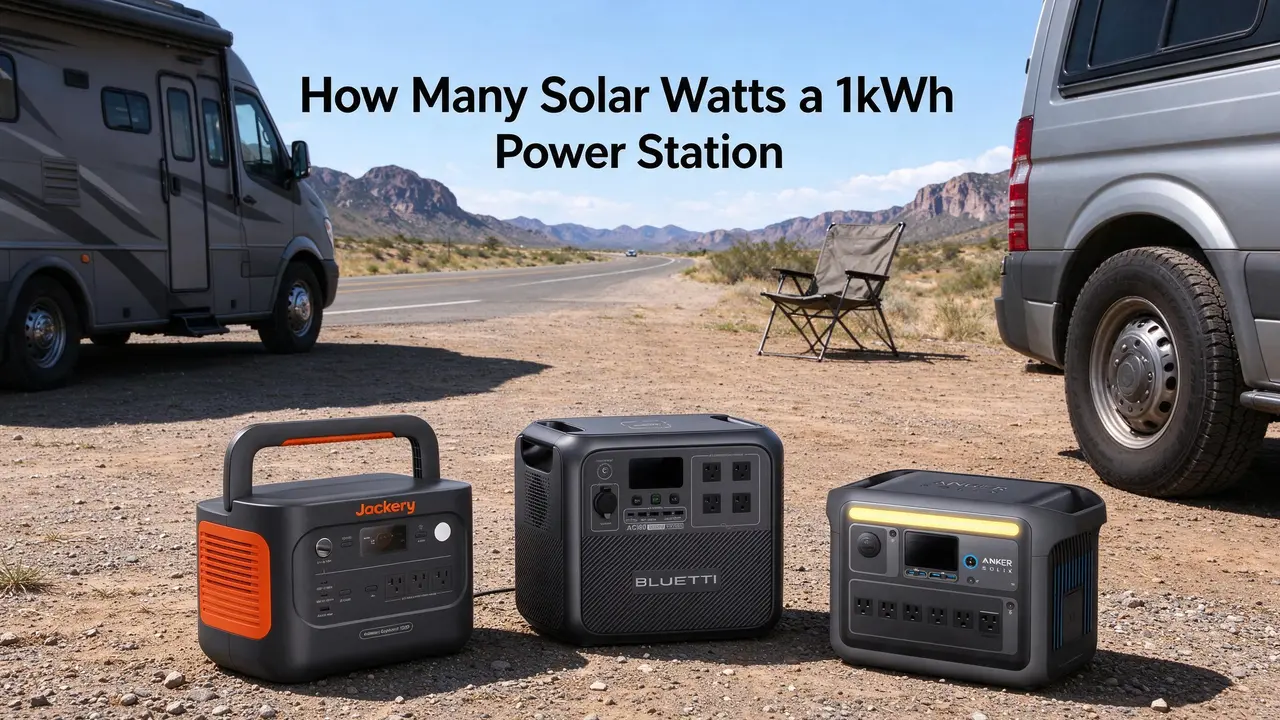
The honest answer is more panel than the marketing math suggests — roughly 300–600 W of solar to refill a 1kWh station in a useful day. Here's the derating math, plus which of five 1kWh-class stations actually has the solar input headroom to use it.
Updated
The short answer: plan on 300–600 W of panel
For a 1kWh-class station, a 400 W panel array is the sane default. That's not the number on the box — it's the number that survives a partly cloudy afternoon.
Here's the math. A 1,024 Wh battery needs roughly 1,150–1,250 Wh of panel harvest to refill from empty, because charging losses and the inverter's idle draw eat the difference. A 400 W panel rated under perfect sun delivers maybe 280–320 W in real conditions, so a full recharge lands around 4–5 hours of good sun. A 200 W panel doubles that to 8–10 hours — a whole day of chasing the sun for one fill.
So: 200 W is a trickle that keeps a working station topped up. 400 W is a real daily recharge. 600–800 W is what you want if you're off-grid and running loads while charging.
The station ranking later in this article is a secondary decision aid — the primary job here is sizing your panel array correctly.
- 200 W panel → ~8–10 sun hours for a full 1kWh fill (top-up duty)
- 400 W panel → ~4–5 sun hours (the practical default)
- 600–800 W panel → recharge plus run a load in the same day
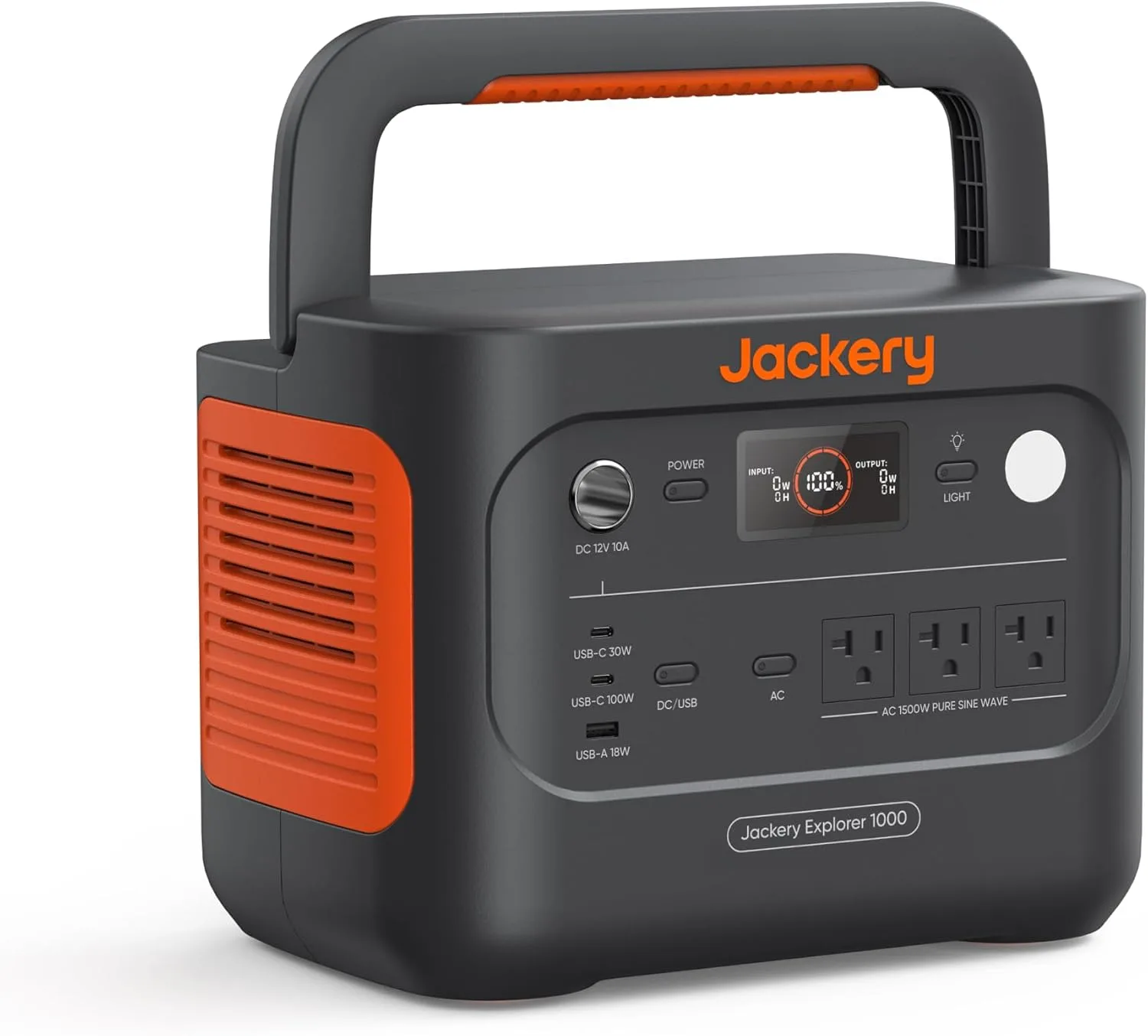
Jackery Explorer 1000 v2 Portable Power Station,1070Wh,1500W
Highlights
- 1070Wh rated capacity
- 1500W continuous AC
- LiFePO4 chemistry
- Up to 400W solar input
- 23.8 lb (~10.8 kg)
- About $559 list
Best for
- Explorer 1000 v2: weekend camping when 23.8 lb carry weight matters as much as 1070Wh
- Essentials bridge at home (fridge cycles, router) when sized to the Wh
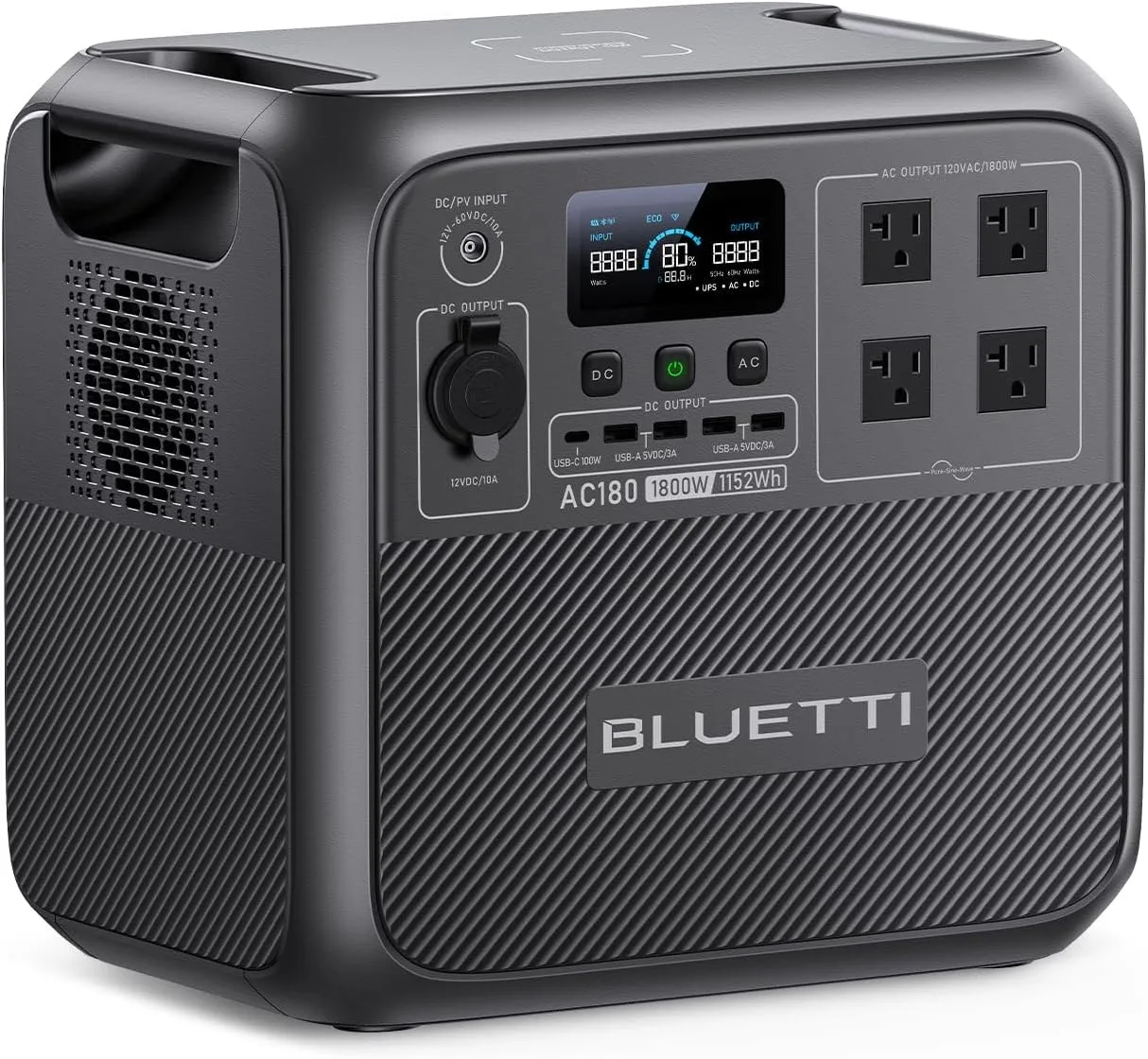
BLUETTI Portable Power Station AC180, 1152Wh LiFePO4 Battery Backup w/ 2 1800W
Highlights
- 1152Wh rated capacity
- 1800W continuous AC
- LiFePO4 chemistry
- Up to 500W solar input
- 35.3 lb (~16.0 kg)
- About $499 list
Best for
- AC180: most Wh per list dollar in mid-size LiFePO4 shortlists (~1152Wh)
- Home essentials when 1800W continuous matters more than a light carry
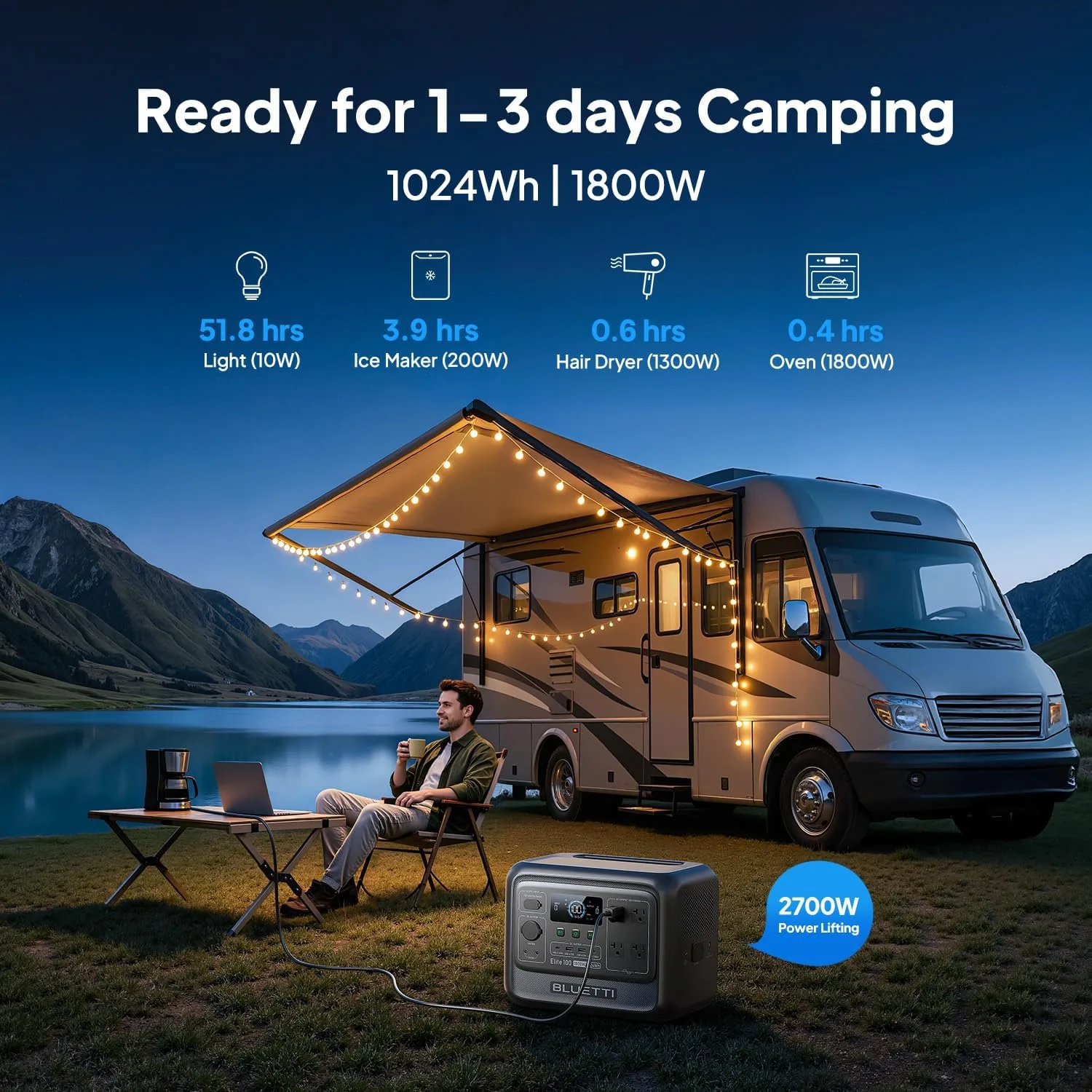
BLUETTI Solar Generator Elite 100 V2 with 200W Solar Panel Included, 1024Wh
Highlights
- About $699 list
- BLUETTI catalog listing
- Specs from manufacturer listings
Best for
- BLUETTI Solar Generator Elite 100 V2 with 200W Solar Panel Included, 1024Wh: longer outages or higher continuous loads (still not whole-home wiring)
- RV / off-grid days where recharge speed matters as much as Wh
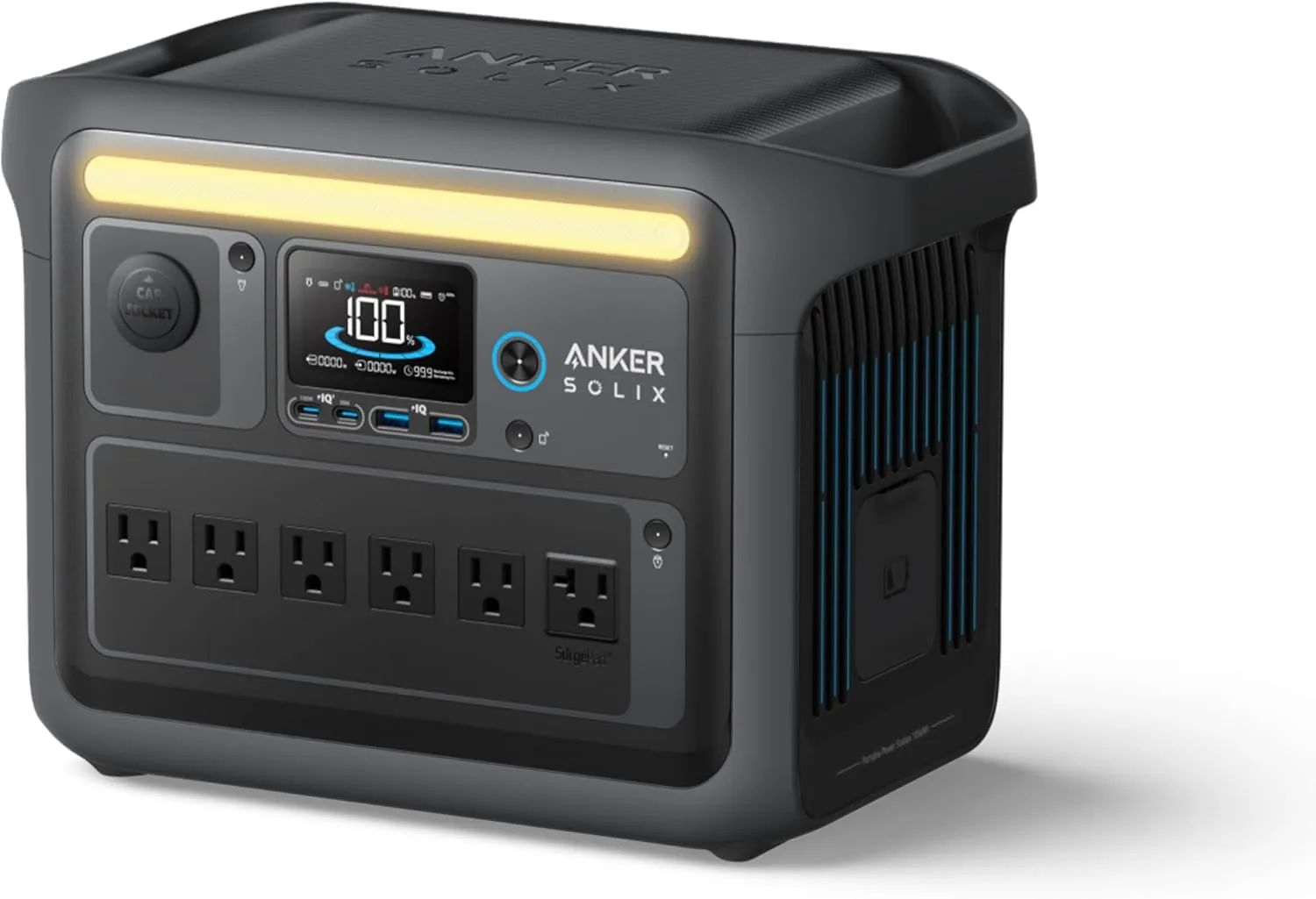
Anker C1000 Portable Power Station
Highlights
- 1056Wh rated capacity
- 1800W continuous AC
- LiFePO4 chemistry
- Up to 600W solar input
- 28.4 lb (~12.9 kg)
- About $599 list
Best for
- SOLIX C1000: small appliances and tools that need ~1800W continuous, not just phone charging
- Essentials bridge at home (fridge cycles, router) when sized to the Wh
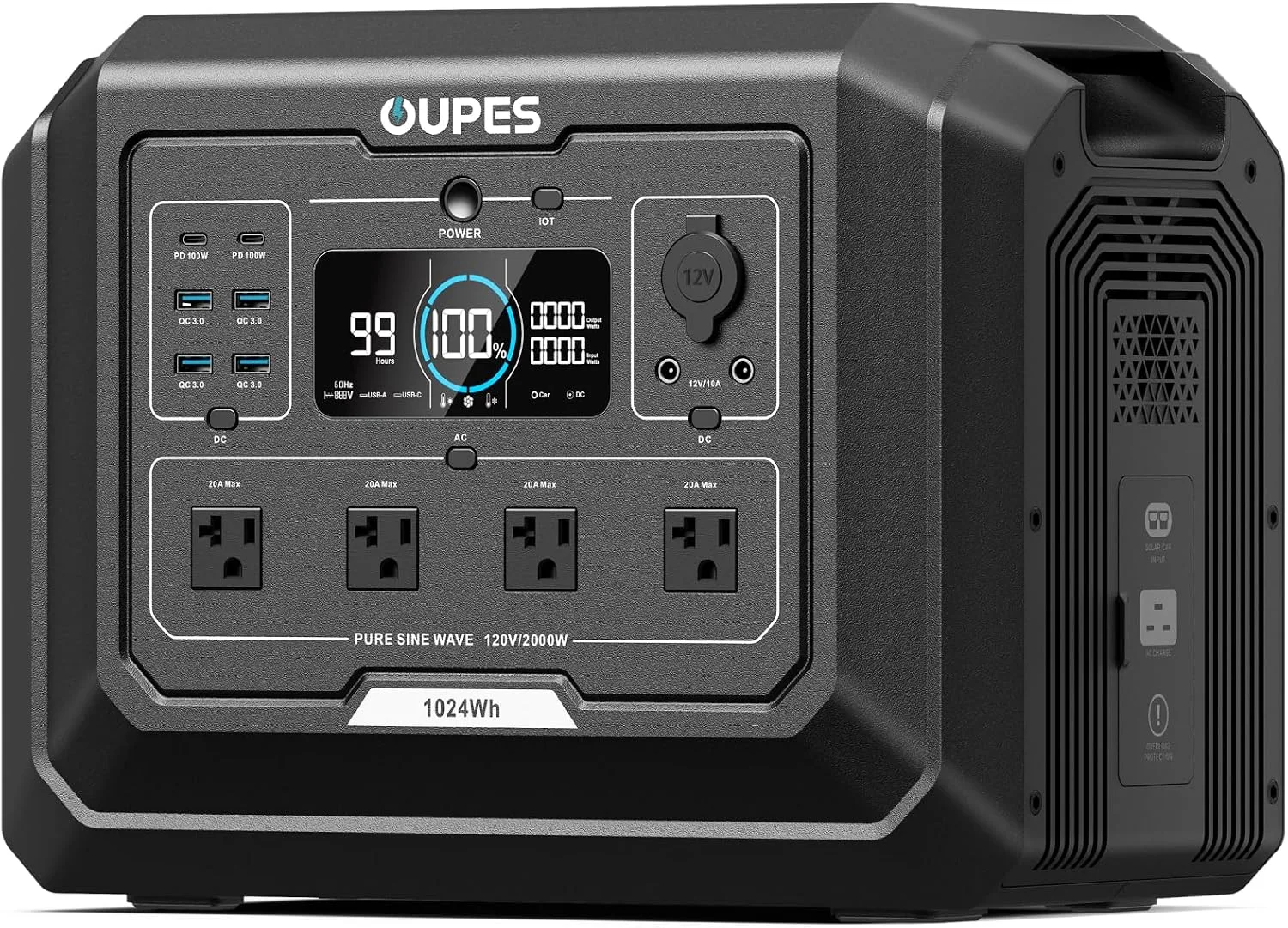
OUPES Mega 1 Portable Power Station 1024Wh 2000W
Highlights
- 1024Wh rated capacity
- 2000W continuous AC
- 4500W surge
- LiFePO4 chemistry
- Up to 800W solar input
- 27.8 lb (~12.6 kg)
Best for
- Mega 1: small appliances and tools that need ~2000W continuous, not just phone charging
- Essentials bridge at home (fridge cycles, router) when sized to the Wh
Why the panel number on the box is optimistic
Panel wattage is a lab rating at 25°C and 1,000 W/m² of irradiance. Nobody camps at those numbers. Heat, haze, latitude, season, and panel angle all shave output, and flat-mounted panels on a roof or truck bed lose more.
Owner reports on file (not lab-tested) suggest budgeting 70–80% of nameplate on a good day and 25–30% under heavy cloud. That's the range to plan against, not the sticker.
The station's own overhead matters too. The AC180's inverter pulls around 20 W just sitting there with AC on, which is 480 Wh over a 24-hour day — nearly half the battery. Turn outputs off when you're not using them and the solar math gets much kinder.
Match panel watts to the station's solar input ceiling
Every station caps how much solar it will accept. Buy a 600 W array for a unit that only takes 400 W and you've paid for panels the charge controller will never use.
The five stations below are all in the 1,024–1,152 Wh class, but their solar ceilings differ by 2×. That gap is the single most useful spec on this page for anyone buying panels.
Solar input figures below are listing claims unless noted as owner-verified. Where an owner test exists, it's cited inline.
| Product | Price | Capacity (Wh) | AC Output (W) | Solar Input (W) | Weight (lb) | Owner Rating |
|---|---|---|---|---|---|---|
| Jackery Explorer 1000 v2 | $559 | 1070 Wh | 1500 W | 400 W (claimed) | 23.8 lb | 4.7 |
| BLUETTI AC180 | $499 | 1152 Wh | 1800 W | 500 W (claimed) | 35.3 lb | 4.5 |
| BLUETTI Elite 100 V2 with 200W panel | $699 | 1024 Wh | 1800 W | 1,000 W (claimed) | 25 lb | 4.5 |
| Anker SOLIX C1000 | $599 | 1056 Wh | 1800 W | 600 W (claimed) | 28.4 lb | 4.7 |
| OUPES Mega 1 | $549 | 1024 Wh | 2000 W | 800 W (claimed) | 27.8 lb | 4.5 |
How we ranked these five stations
We weighted three criteria: solar input headroom (High), price per nameplate Wh (Medium), and weight (Low). Solar headroom matters most because it's the spec that determines whether your panel array can actually be used. Price per Wh is a tiebreaker; weight matters only if you'll carry the unit.
Here's the scoreboard:
- OUPES Mega 1: Solar headroom High (800 W claimed), Price/Wh High ($0.54), Weight Medium (27.8 lb) — top overall
- Anker SOLIX C1000: Solar headroom High (600 W claimed), Price/Wh Medium ($0.57), Weight Medium (28.4 lb) — strong middle ground
- BLUETTI AC180: Solar headroom Medium (500 W claimed), Price/Wh High ($0.43), Weight Low (35.3 lb) — value pick if solar is secondary
- BLUETTI Elite 100 V2: Solar headroom High (1,000 W claimed), Price/Wh Low ($0.68), Weight High (25 lb) — kit convenience, no owner data
- Jackery Explorer 1000 v2: Solar headroom Low (400 W claimed, Jackery panels only), Price/Wh Medium ($0.52), Weight High (23.8 lb) — skip for solar-first use
Solar headroom, station by station
Start with the OUPES Mega 1 Portable Power Station 1024Wh 2000W. On paper it takes up to 800 W of solar — the highest ceiling here — and at $549 it's the second-cheapest per nameplate Wh at $0.54. An owner testing 400 W of panels saw the station pull the charge immediately and refill the main battery in a couple of hours. The catch is fan noise under heavy charge and a 27.8 lb body; it's a truck-camping unit, not a backpack one. Owners also note the 1400 W AC input recharges quickly, under two hours.
The Anker SOLIX C1000 Portable Power Station sits at 600 W solar input (listing claim), and owners describe running it off 200–400 W of panel as the sensible setup. At $599 and 28.4 lb it's the middle of this pack on price and weight, and its 1,056 Wh is the second-largest capacity here. If you already own a 400 W folding array, this is the cleanest pairing. Owners report charging from 0–100% in about an hour on AC and plenty of power for several small devices.
BLUETTI AC180 is the price leader at $499, or $0.43 per nameplate Wh — cheapest of the five. Its 500 W solar ceiling (claimed) is real but modest, and the owner reports above show what a 200 W panel actually delivers. Buy it for the AC recharge speed and the price; buy panels knowing 400 W is your practical cap. Owners praise fast charging (100% in about an hour) and value.
The Jackery Explorer 1000 v2 Portable Power Station is the lightest at 23.8 lb and the largest capacity at 1,070 Wh, but its solar ceiling is the tightest of the group at 400 W (claimed). One owner report on file suggests the unit may only accept Jackery panels — treat that as a single owner observation, not a spec, and verify the connector type before you buy. That's a real lock-in cost if you already own generic MC4 panels. Owners find it charges quickly (100% within 3 hours on AC) and can power a side-by-side fridge/freezer for up to 9 hours.
Then there's the BLUETTI Solar Generator Elite 100 V2 with 200W Solar Panel Included — the only kit here with a panel in the box. The listing claims up to 1,000 W solar input and a 200 W panel good for 0–80% in about 4 hours. I'd treat those as listing claims: there are no owner reviews on file for this one, so the real-world panel output is unverified. At $699 it's the most expensive per Wh at $0.68, and you're paying for convenience, not headroom.
- Highest solar ceiling: OUPES Mega 1 (800 W claimed)
- Best panel pairing if you own 400 W already: Anker SOLIX C1000 (600 W claimed)
- Cheapest per nameplate Wh: BLUETTI AC180 ($0.43/Wh)
- Lightest, biggest battery, tightest solar cap: Jackery Explorer 1000 v2 (400 W claimed, Jackery panels only)
- Only kit with a panel included: BLUETTI Elite 100 V2 — but no owner data on file
If you already own a panel, pick this station
A quick one-line matrix for the most common panel sizes:
- 200 W panel → Anker SOLIX C1000 (600 W input) or OUPES Mega 1 (800 W input) — both leave room to add panels later
- 400 W panel → Anker SOLIX C1000 (600 W input) is the cleanest pairing; BLUETTI AC180 (500 W input) is the value alternative
- 600 W panel → OUPES Mega 1 (800 W input) uses the full array; Anker SOLIX C1000 (600 W input) maxes out exactly
- 800 W+ panel → OUPES Mega 1 (800 W input) is the only one here that can absorb it; the Elite 100 V2 claims 1,000 W but has no owner data on file
- Jackery panels only → Jackery Explorer 1000 v2 (400 W input) — but verify connector compatibility first
Recharge time: solar vs. the wall
Solar is the slow, free path. AC is the fast one, and every station here is quick on the wall — the AC180 claims a 1-hour charge at 1,440 W input, the Anker C1000 claims 80% in 43 minutes, and the Mega 1 claims 0–80% in 36 minutes. Those are listing figures, not something I've timed.
The practical rule: size your panel for the daily energy you actually use, not for a full recharge. If you burn 400 Wh a day running a fridge and charging devices, a 200 W panel in decent sun covers it. If you drain the thing to zero every day, you need the 400–600 W array.
And keep the AC cord. A 1-hour wall charge before a storm beats any panel math.
Before you buy, check these three things
1. Your existing panel's connector type. MC4, Anderson, or a proprietary plug — if your panels don't match the station's input, you'll need an adapter or different panels. The Jackery owner report above is a reminder that lock-in is real.
2. The station's solar ceiling vs. your array. A 600 W array on a 400 W-input station wastes half your panel budget. Match the array to the ceiling, not the other way around.
3. Low-temp cutoff. LiFePO4 cells shouldn't charge below 0°C (32°F). Some stations have built-in cutoff, some don't. If you camp in shoulder seasons, check the manual before you buy.
What buyers worry about most
Cycle life: most LiFePO4 stations in this class are rated for 3,000–5,000 cycles to 80% capacity, but check the listing for the exact figure — it's not always stated. A station cycled daily will last years; one cycled weekly will outlast its warranty.
Warranty: coverage varies from 2 to 5 years. Jackery and BLUETTI typically offer 2–3 years; Anker often 5. Confirm before buying, because a solar-first user will cycle the battery more.
Cold charging: LiFePO4 cells should not be charged below 0°C (32°F). Some stations have built-in low-temp cutoff, some don't. If you camp in shoulder seasons, check the manual — charging a cold battery can permanently reduce capacity.
Panel shortfall: if your panel output falls below the load, the station drains slowly rather than charging. Size the array for your average daily load, not your peak.
- Jackery Explorer 1000 v2 Portable Power Station,1070Wh,1500W: Theme: Customers find the power station charges quickly, reaching 100% within 3 hours, and can power a side-by-side fridge/freezer for up to 9 hours.…
- BLUETTI Portable Power Station AC180, 1152Wh LiFePO4 Battery Backup w/ 2 1800W: Theme: Customers find this power station to be the best they've used, praising its fast charging capability (reaching 100% in about an hour) and valu…
- BLUETTI Solar Generator Elite 100 V2 with 200W Solar Panel Included, 1024Wh: thin owner feedback on file — no star/quote invented.
- Anker C1000 Portable Power Station: Theme: Customers find the power station to be an excellent unit that charges from 0-100% in about an hour, with plenty of power to run several small…
- OUPES Mega 1 Portable Power Station 1024Wh 2000W: Theme: Customers find this power station to be one of the best on the market, with a 1400W AC input that recharges quickly and takes under two hours…
Who this sizing advice is for — and who it isn't
This page is for the person who has decided on a ~1kWh station and is now staring at panel listings, trying to work out whether 200 W is enough. It's also for the buyer choosing between these five units who wants solar headroom to be part of the decision.
It is not for whole-home backup. A 1kWh station runs a fridge for hours, not days, and none of these replaces a transfer switch and a generator. If that's your goal, this is the wrong class of product entirely.
And it's not for someone who'll never unplug the panel. If the station lives in a garage and charges from the wall, buy on price and capacity — the AC180 at $499 is the value pick — and skip the solar premium.
The bottom line
For a 1kWh power station, buy 400 W of solar as your default and accept that a full recharge takes most of a good day. Step up to 600–800 W only if the station will accept it and you're genuinely off-grid.
Among these five, the OUPES Mega 1 Portable Power Station 1024Wh 2000W gives you the most solar headroom for $549, and the Anker SOLIX C1000 Portable Power Station is the better-built middle ground at 600 W solar input. The BLUETTI AC180 wins on price at $499 if solar is secondary. Skip the Jackery Explorer 1000 v2 for solar-first use — its 400 W solar ceiling and reported Jackery-only panel compatibility will frustrate you.
Amazon Associates disclosure: as an Amazon Associate, WattPicks earns from qualifying purchases. Picks here are fit-led, not commission-led.
Methodology: home-user checks grounded in owner themes on file plus listing specs; these are not lab-bench measurements. Avery Nolan is WattPicks' founding editor, covering portable power capacity, output, and price-per-Wh across the catalogue.
Frequently asked
Can a 200 W panel fully charge a 1kWh station in a day?
Usually not from empty. Budget 8–10 hours of good sun, and less if it's hazy. It's a top-up panel, not a daily refill.
Will a 600 W panel damage a station rated for 400 W solar input?
No — the charge controller caps intake. You just waste money on panel you can't use. Match the array to the ceiling.
Which of these five recharges fastest from solar?
The OUPES Mega 1 at up to 800 W input is the verified pick. The BLUETTI Elite 100 V2 claims up to 1,000 W, but that figure is unverified — there are no owner reports on file for it.
Do I need an MPPT charge controller?
No. These stations have one built in. Adding a second controller between panel and station is a common mistake — one OUPES owner was advised against it.
Method and sources
Model names and list prices come from the WattPicks catalog at build time. WattPicks does not run its own laboratory tests on power stations, and nothing on this page is presented as a measured result — it is catalog-backed buying guidance.
Read our methodology for how the catalog is normalized, and about WattPicks for who publishes it.