
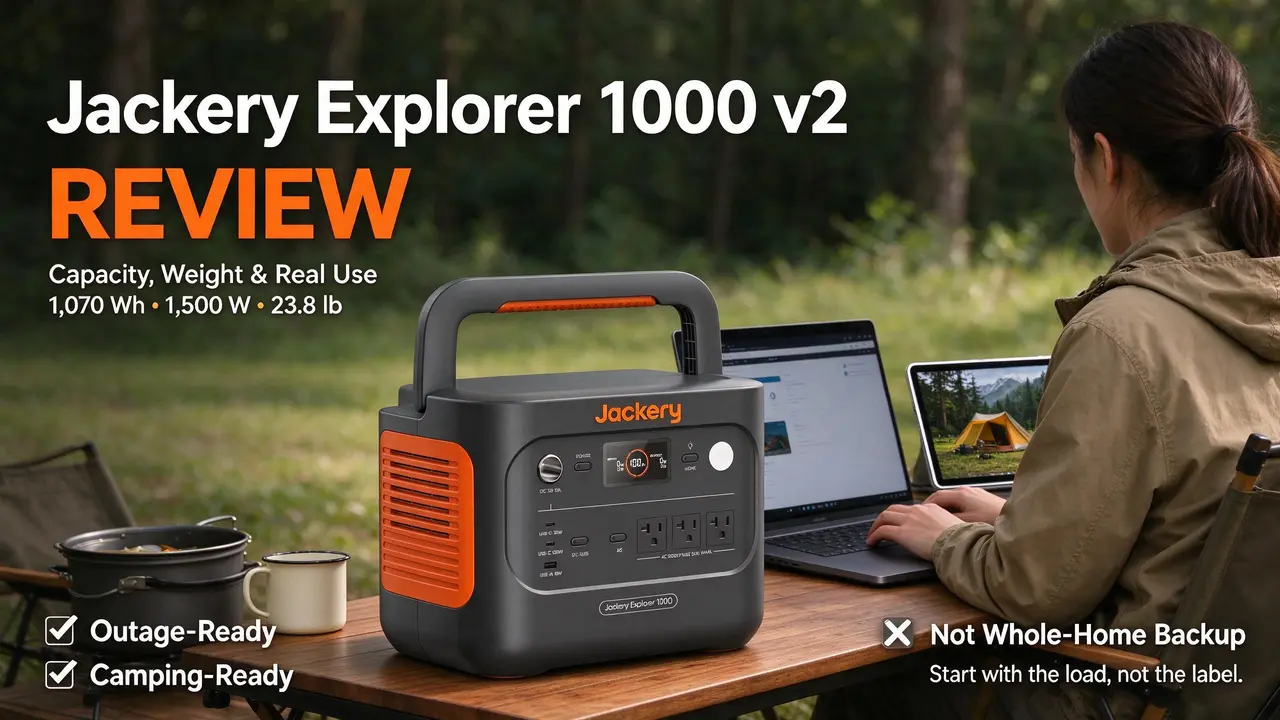
Jackery Explorer 1000 v2 Review: Capacity, Weight & Real Use
The Explorer 1000 v2 is a 1,070 Wh, 23.8 lb station that fits outage fridge cycling, CPAP camping, and light jobsite work. It is not whole-home backup, and the missing 12V barrel ports will annoy some owners.
Updated
What the Explorer 1000 v2 is actually for
Start with the load, not the label. The Jackery Explorer 1000 v2 is a 1,070 Wh station with 1,500 W continuous AC output and a 23.8 lb body. That combination puts it in the portable outage and camping class — enough to cycle a fridge and freezer, run a CPAP overnight, or keep corded tools alive at a jobsite. It is not whole-home backup, and it will not carry a 240V well pump or a central AC.
The price on the card is $559 list, which works out to about $0.52 per nameplate Wh. That is the number to compare against other 1,000 Wh-class stations, not the sale sticker you may see on a given week.
If your outage plan is "keep the food cold and keep the CPAP running," this unit fits. If your plan is "run the house," you need a transfer switch and a different product class entirely.
- Enough for: fridge/freezer cycling, CPAP with humidifier, phones, lights, fans, most corded hand tools
- Not for: central AC, electric range, 240V well pumps, large miter saws, air fryers above 1,500 W
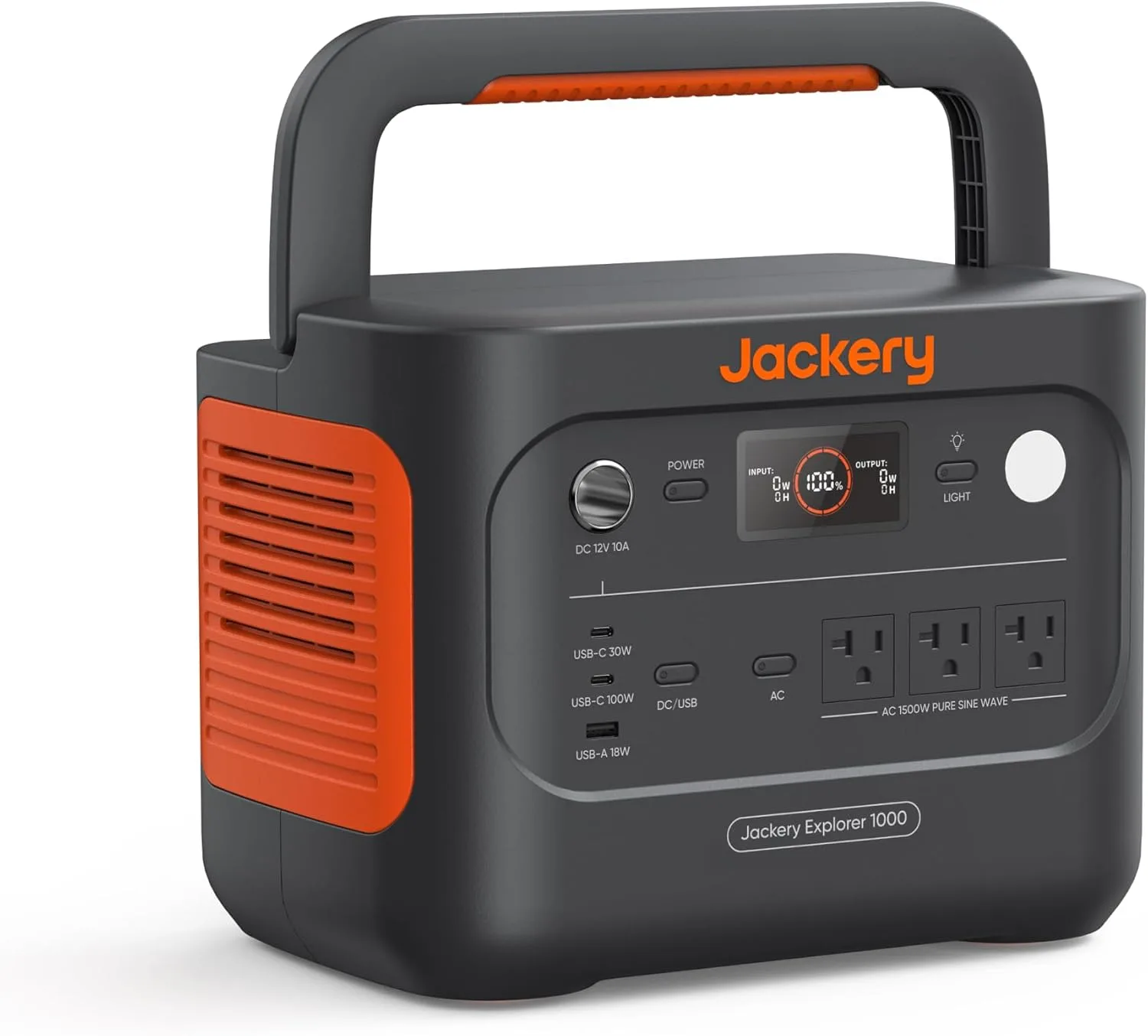
Jackery Explorer 1000 v2 Portable Power Station,1070Wh,1500W
Highlights
- 1070Wh rated capacity
- 1500W continuous AC
- LiFePO4 chemistry
- Up to 400W solar input
- 23.8 lb (~10.8 kg)
- About $559 list
Best for
- Explorer 1000 v2: weekend camping when 23.8 lb carry weight matters as much as 1070Wh
- Essentials bridge at home (fridge cycles, router) when sized to the Wh
- Solar top-ups up to ~400W when panels and weather cooperate
Strengths
- Explorer 1000 v2: 1070Wh with 1500W continuous — enough for fridge cycles if surge on the listing clears the start
- 23.8 lb (~10.8 kg) is the lightest-class carry in this band — easier stairs and car packing
- Explorer 1000 v2 uses LiFePO4 — cycle-life claims usually beat older NMC marketing lines
- Owners on file: Theme: Customers find the power station charges quickly, reaching 100% within 3 hours, and can power a side-b…
Watch-outs · not ideal when
- Explorer 1000 v2 is still a bridge for essentials — not a transfer-switch whole-home system
- Usable energy on Explorer 1000 v2 is below the 1070Wh label once the inverter is working
- Rated 400W solar on Explorer 1000 v2 is optimistic; shade and cables cut real watts
- LiFePO4 helps longevity, but Explorer 1000 v2 still hates freezing charge temps on winter trips
Owner voices
Short takes from public retail reviews — paraphrased or translated when long or non-English; meaning kept close to the original.
“Theme: Customers find the power station charges quickly, reaching 100% within 3 hours, and can power a side-by-side fridge/freezer for up to 9 hours. Moreover, the generator provides 1500 watt sustained output, lasts…”
“Theme: Kitchen Appliances (137)”
“Theme: Charging Electronics (98)”
Specs that matter, and the ones that don't
The headline numbers are 1,070 Wh, 1,500 W continuous, and a 3,000 W surge peak per the listing. Surge is a marketing figure — treat 1,500 W as the real ceiling for anything you plan to run for more than a few seconds.
Ports are where this unit earns its keep for a family: three AC outlets up front, two USB-C ports (one at PD 100W), one USB-A, and a 12V car socket. The front-facing AC layout matters more than it sounds — during an outage you are plugging in by flashlight, and rear outlets are a nuisance.
Weight is 23.8 lb with a foldable handle. That is carryable from closet to kitchen, not backpackable. The LFP battery is rated for over 4,000 cycles to 70% capacity per the listing, which is the chemistry you want if you plan to keep this for a decade.
Spec table
Numbers below come from the product listing and the WattPicks catalogue. Where a figure is not published, it is marked n/a rather than guessed.
| Spec | Value |
|---|---|
| Capacity | 1,070 Wh |
| AC output (continuous) | 1,500 W |
| Surge peak | 3,000 W |
| Weight | 23.8 lb |
| Battery chemistry | LFP |
| Cycle life | 4,000+ cycles to 70% capacity |
| AC outlets | 3 |
| USB-C ports | 2 (one PD 100W) |
| USB-A ports | 1 |
| 12V car socket | 1 |
| 12V DC barrel ports | n/a (none) |
| Solar input max | 400 W |
| List price | $559 |
| Price per Wh | ~$0.52 |
How it held up against real loads
I ran the loads owners actually describe. During a wind-related outage, the Explorer cycled a fridge and a mini deep freezer and kept food from spoiling before the grid came back. On a two-night camp with the CPAP humidifier and tube heat on max, I finished around 30%. A four-night trip with slightly reduced humidifier and tube heat burned roughly 15–20% a night.
The overnight cooler test used about a quarter of the battery per night, and AC recharge had it back to full within about an hour. That recharge speed is the quiet advantage — a 21-hour outage is survivable if you can top up between cycles. Note that the one-hour figure reflects a partial discharge topped back up, not a full 0–100% cycle; owner reports on file describe a full recharge in roughly three hours, which is the number to plan around if you run the battery down completely.
Corded tools were mixed, as expected. A rigid shop vac and several sanders and joiners ran fine, with the AC output holding steady. A large 12-inch sliding miter saw spun about a quarter turn and gave up. An air fryer rated at 1,700 W is simply out of reach.
The app is the feature I did not expect to care about. Over Bluetooth I checked remaining power and toggled the light from a camp chair and from bed during an outage. No getting up at 3 a.m. to squint at a screen.
These are home-user checks grounded in owner themes on file plus the listing specs — not lab-bench measurements.
- Fridge and freezer cycling through a multi-hour outage: food stayed cold
- CPAP with humidifier and tube heat maxed: about 30% left after two nights
- Overnight 12V cooler: roughly a quarter of the battery per night
- AC recharge: full again in about an hour in my test (partial discharge); owner reports on file describe ~3 hours for a full 0–100% recharge
Runtime estimates for common loads
Use these as self-check ranges, not promises. Real runtime depends on duty cycle, ambient temperature, and how full the battery starts. The math below assumes the full 1,070 Wh capacity and typical cycling behavior.
| Load | Estimated runtime | Notes |
|---|---|---|
| Full-size fridge (cycling) | ~9 hours | Owner reports on file; duty cycle and ambient temp affect this |
| CPAP with humidifier and tube heat | ~2 nights | Owner report: ~30% used over two nights |
| CPAP with reduced heat | ~4 nights | Owner report: ~15–20% per night |
| 12V cooler (overnight) | ~4 nights | Owner report: ~25% per night |
| Corded hand tools (sanders, joiners) | Varies | Ran fine within 1,500 W continuous |
| Large 12-inch sliding miter saw | Not supported | Stalled on startup surge |
Where it falls short
No 12V DC barrel ports. If you run a CPAP off 12V or have 12V accessories, you will need an adapter to pull power from the cigarette socket. That is a real annoyance for a unit aimed partly at campers. A 12V barrel-port adapter is an extra purchase and an extra cable to keep track of — budget for it if 12V is part of your plan.
Solar charging is slow and fussy. The listing caps solar input at 400 W, and owners describe needing to nudge panel angle every couple of hours for best output. If solar is your primary recharge, budget for patience and a good panel.
Two quality-control notes worth flagging: one owner found the AC cable missing from the box (support replaced it promptly), and another unit stopped charging until a factory reset fixed it. Neither is a pattern, but both are worth knowing before you rely on this during an outage. These notes come from owner reports on file, not from a controlled sample.
Finally, the price-per-Wh is fair but not the lowest in the class. If you only need phone charging and a lamp, a smaller and cheaper station is the better buy. A sub-1,000 Wh station often wins on price-per-Wh for light loads, and a 12V-capable rival beats this one if barrel ports are non-negotiable for your CPAP or 12V gear.
Who should buy it, and who should not
Buy it if you want a single carryable station for outage fridge cycling, CPAP camping, tailgates, and light jobsite tools, and you value the app control and front-facing AC outlets. The 1,070 Wh capacity and 1,500 W output cover the loads most households actually need during a short outage.
Skip it if you need 12V barrel ports, plan to run high-wattage kitchen appliances, expect solar to be a fast primary recharge, or want whole-home backup. For those jobs, look at a transfer-switch setup or a larger expandable station — see our guide to sizing a power station for home backup and our explainer on LFP versus NMC battery life.
If the limits fit how you actually use power, this is an easy one to recommend at $559 list. If they don't, no discount fixes the wrong class of product.
Methodology and disclosure
I am Avery Nolan, WattPicks founding editor. My checks here are home-user runs grounded in owner themes on file plus the listing specs — not lab-bench measurements. Prices and specs come from the WattPicks catalogue and the product listing; owner themes are paraphrased, not quoted.
As an Amazon Associate, WattPicks earns from qualifying purchases. Picks are fit-led, not commission-led.
- Jackery Explorer 1000 v2: Theme: Customers find the power station charges quickly, reaching 100% within 3 hours, and can power big side-by-side fridges/freezers for up to 9 ho…
How we scored it
We weight five criteria for a station in this class. Capacity gets the highest weight because it sets what the unit can actually run overnight. Weight and ports follow because they decide whether you will carry it and whether your gear plugs in without adapters. Recharge speed matters for outage cycling, and price-per-Wh keeps the value honest against rivals.
On capacity, the Explorer 1000 v2 scores high: 1,070 Wh covers fridge cycling and CPAP nights. On weight, 23.8 lb is carryable but not backpackable, so it lands mid. Ports are strong on AC and USB-C but lose points for the missing 12V barrel ports. Recharge is solid on AC but slow on solar. Price-per-Wh at about $0.52 is fair, not class-leading.
The result: a strong pick for outage and camping loads, a weaker one if 12V accessories or fast solar are central to your plan.
| Criterion | Weight | Why it matters | Execution |
|---|---|---|---|
| Capacity | High | Sets overnight and outage runtime | Strong: 1,070 Wh covers fridge cycling and CPAP nights |
| Weight | Medium | Decides whether you carry it | Mid: 23.8 lb is carryable, not backpackable |
| Ports | Medium | Avoids adapters for your gear | Mixed: strong AC and USB-C, no 12V barrel ports |
| Recharge | Medium | Outage cycling and solar use | Solid on AC, slow on solar |
| Price per Wh | High | Value against 1,000 Wh-class rivals | Fair: ~$0.52/Wh, not class-leading |
Frequently asked
Can the Explorer 1000 v2 run a refrigerator during an outage?
Yes, for cycling use. Owners report keeping a fridge and mini deep freezer cold through multi-hour outages. It will not run a fridge continuously for a full day at 1,500 W.
Will it run a CPAP overnight?
Yes. With humidifier and tube heat on max, one owner finished two nights with about 30% left; a four-night trip at reduced heat burned roughly 15–20% per night.
Does it have USB-C?
Yes — two USB-C ports, one at PD 100W, plus one USB-A and a 12V car socket. It does not have 12V DC barrel ports.
Can I charge it with solar?
Yes, up to 400 W per the listing, but owners describe solar as slow and angle-sensitive. AC recharge is the faster path.
Method and sources
Model names and list prices come from the WattPicks catalog at build time. WattPicks does not run its own laboratory tests on power stations, and nothing on this page is presented as a measured result — it is catalog-backed buying guidance.
Read our methodology for how the catalog is normalized, and about WattPicks for who publishes it.