
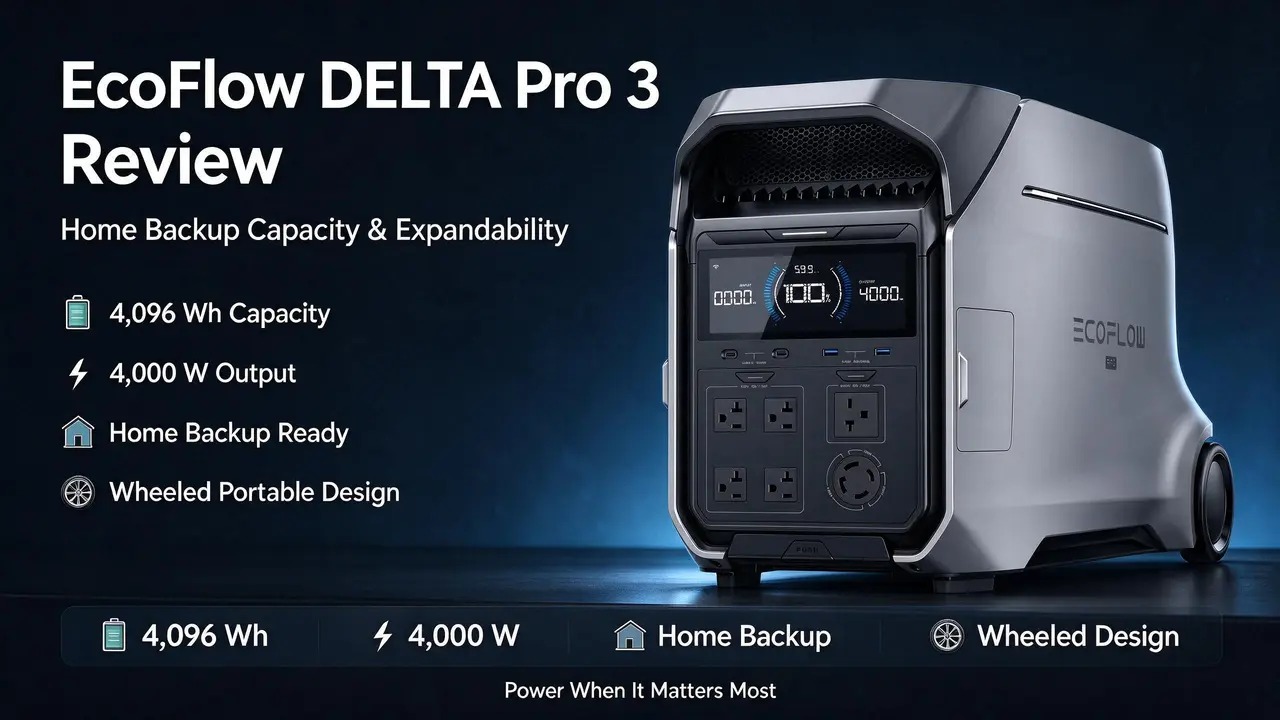
EcoFlow DELTA Pro 3 Review: Home Backup Capacity & Expandability
The EcoFlow DELTA Pro 3 packs 4,096 Wh and 4,000 W of split-phase output into a wheeled case, enough to carry a fridge, lights, and a 240V well pump through a short outage. It's a serious home-backup buffer for people who will use the app and can live with the weight — not a grab-and-go camping unit.
Updated
What an outage actually needs
Before you look at watt-hours, list the loads you refuse to lose. For most homes that's the refrigerator (about 150–300W running, with a defrost spike), a few LED lights and phone chargers (under 100W combined), the modem and router (15–30W), and — if you're on a well — the pump. A 1 HP well pump can pull 1,000–1,500W continuous and needs a surge allowance on startup.
The EcoFlow DELTA Pro 3 Portable Power Station, 4096Wh is built for that list and a bit more. Its 4,000W continuous AC output (6,000W with X-Boost, per the listing) and 120/240V split-phase capability mean it can run a 240V well pump or a small central AC, not just 120V gadgets. That's the headline: this is a home-backup buffer, not a tailgate toy.
What it is not: a whole-home solution on its own. The listing claims 2–4 days of whole-home backup, but that assumes extra batteries or a smart generator and a carefully managed load. Out of the box, 4,096Wh is enough for essentials for a day or so, not for running the dryer and the oven.
- Refrigerator: 150–300W running, ~1–2 kWh/day with normal cycling
- LED lights + chargers: under 100W
- Modem/router: 15–30W
- 1 HP well pump: 1,000–1,500W continuous, higher surge
- Sump pump: 800–1,200W intermittent
Spec snapshot
All figures below are from the EcoFlow listing at the time of writing; verify current firmware and configuration before you buy.
- Nameplate capacity: 4,096Wh
- Usable estimate: ~3,480Wh (85%)
- Continuous AC output: 4,000W
- Surge (X-Boost, per listing): 6,000W
- Runtime at 200W mixed load: ~17 hours
- Runtime at 600W mixed load: ~5.8 hours
| Spec | Figure | Source |
|---|---|---|
| Capacity | 4,096Wh | Listing |
| Chemistry | LFP | Listing |
| Continuous AC output | 4,000W | Listing |
| Surge (X-Boost) | 6,000W | Listing |
| Output voltage | 120/240V split-phase | Listing |
| Switchover time | 10 ms | Listing |
| Solar input | Up to 2,600W combined, two ports | Listing |
| Weight | 113.5 lb | Listing |
| Warranty | 5 years | Listing |
| Rating | 4.3/5 from 721 ratings | Listing aggregate |
Sizing against those loads
The math is straightforward. Take the DELTA Pro 3's 4,096Wh nameplate capacity and assume you use about 85% of it before the unit shuts down — that's roughly 3,480Wh of usable energy. That 85% figure is an editorial estimate, not a spec: it accounts for inverter losses and the reserve the BMS keeps to protect the cells. A fridge averaging 200W over a day draws 4.8 kWh, so the station alone won't carry it for 24 hours. But a fridge doesn't run continuously; it cycles. A high-helpful owner review reports running a fridge, AC, and misc charging for about five hours in 97-degree heat on one charge, which lines up with a realistic mixed load of 600–800W.
For a tighter essentials list — fridge cycling at ~150W average, lights and router at ~50W — you're looking at roughly 200W continuous, or about 17 hours from 3,480Wh usable. That's a solid overnight buffer. Add a 1,000W well pump run for 30 minutes and you spend another 500Wh, dropping runtime to about 14 hours.
The 4,000W continuous rating matters more than capacity for surge loads. A fridge compressor startup can spike to 1,200W for a second; the DELTA Pro 3 handles that without strain. The listing's 6,000W X-Boost figure is a surge mode, not continuous — don't plan to run a 5,000W load indefinitely.
- Nameplate capacity: 4,096Wh
- Usable estimate: ~3,480Wh (85%, editorial estimate)
- Continuous AC output: 4,000W
- Surge (X-Boost, per listing): 6,000W
- Runtime at 200W mixed load: ~17 hours
- Runtime at 600W mixed load: ~5.8 hours
Switchover and wiring
The DELTA Pro 3 has a 10 ms switchover time, per the listing. That's fast enough for most home electronics — your desktop, NAS, or router won't reboot during a brief outage. It is not a whole-home automatic transfer switch; you're plugging loads into the unit or using an extension cord, not wiring it into your breaker panel without an electrician.
The 30A outlet is the feature that separates this from smaller stations. A high-helpful owner review describes moving the house cord from a gas generator to the DELTA Pro 3's 30A outlet and running the whole house — including a 240V well pump — for the remainder of the day. That's a manual switchover, not automatic, but it works.
What you cannot connect: a central AC system that draws more than 4,000W continuous, an electric dryer or oven (typically 5,000W+), or anything requiring a hardwired transfer switch without a licensed electrician. The listing mentions a 3-ton central AC, but that's a best-case scenario with soft-start hardware; most 3-ton units pull 3,500–4,000W running and much more on startup. Buy rule: do not buy this to run a central AC unless you have a soft-start kit installed and have measured the locked-rotor current.
- Switchover: 10 ms (listing)
- Outlet: 30A locking, 120/240V split-phase
- Not for: central AC without soft-start, electric dryer, oven
- Wiring: manual cord swap, not automatic transfer
Keeping it ready
A backup battery is only useful if it's charged when the grid drops. The DELTA Pro 3 uses LFP cells, which tolerate partial state-of-charge better than NMC. EcoFlow's listing doesn't publish a specific recharge interval, but the general guidance for LFP home backup is to top it off every 3–6 months and store it between 40% and 80% if it's sitting idle. Keep it above 30°F and below 115°F — a high-helpful owner review notes the manual's temperature warnings, and LFP does not like charging below freezing.
The app is effectively mandatory for managing this. Charge rate, neutral-ground bonding toggle, and firmware updates all live there. A high-helpful owner review says plainly: don't buy this unless you're willing to download the app. The on-unit labeling is sparse, and the online manual is thin on detail — several owners flagged that plugs and switches aren't labeled on the machine itself.
Charging from a wall outlet is fast — a high-helpful owner review reports 15% to 90% in under 8 hours on AC. Solar input is also strong, with two ports and up to 2,600W combined per the listing, though you'll need panels and cables sold separately.
- Chemistry: LFP (lithium iron phosphate)
- Storage: 40–80% charge, 30–115°F
- Recharge reminder: every 3–6 months
- App required for charge rate and bonding toggle
- Solar panels sold separately
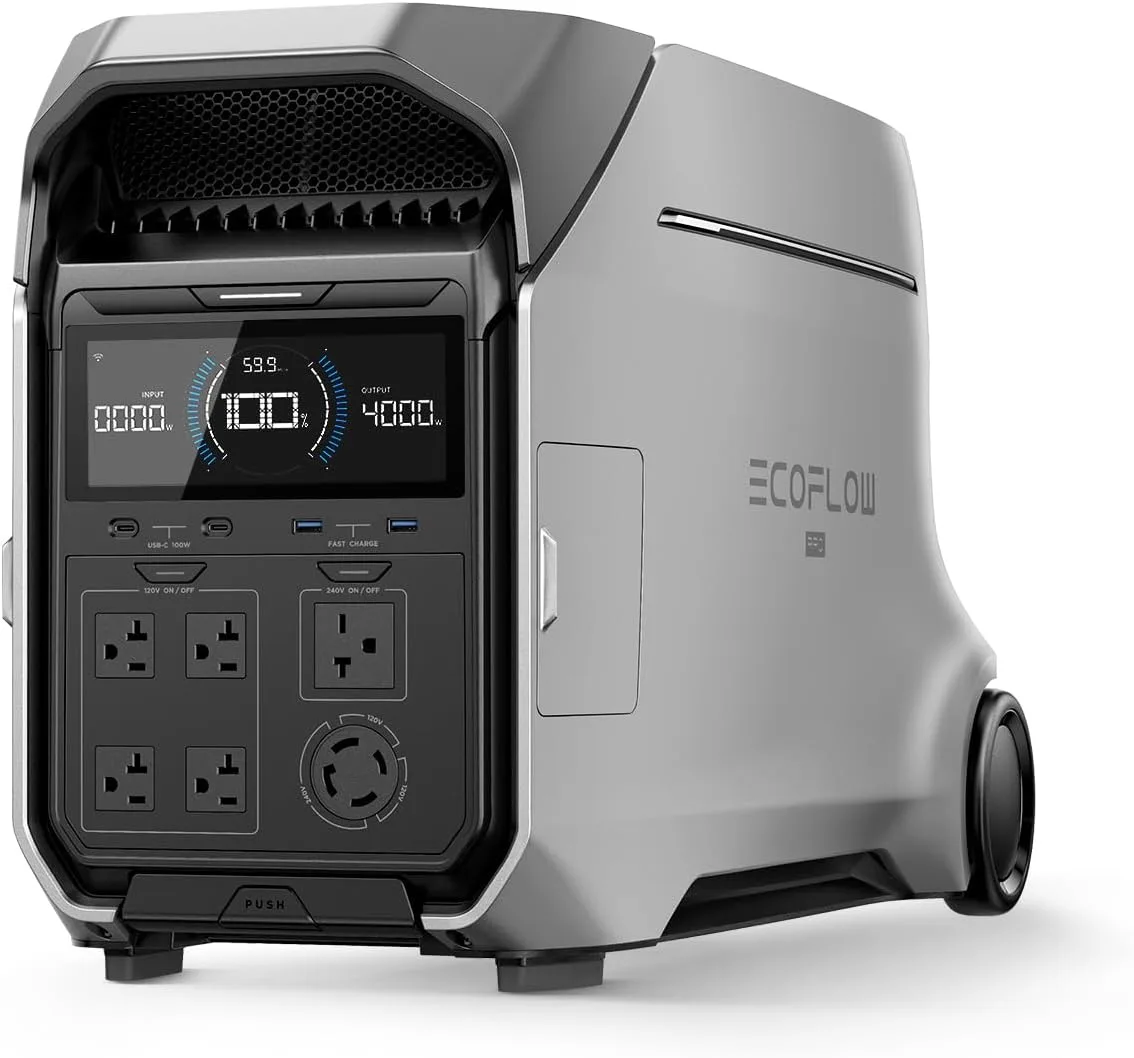
EcoFlow DELTA Pro 3 Portable Power Station, 4096Wh
Highlights
- 4096Wh rated capacity
- 4000W continuous AC
- 8000W surge
- LiFePO4 chemistry
- Up to 2600W solar input
- 113.5 lb (~51.5 kg)
Best for
- DELTA Pro 3: longer outages or higher continuous loads (still not whole-home wiring)
- RV / off-grid days where recharge speed matters as much as Wh
- Best parked near the vehicle or cabin — not a long carry to a tent
Strengths
- DELTA Pro 3: 4096Wh pack with 4000W continuous / 8000W surge — size loads to both numbers
- 113.5 lb (~51.5 kg) is a park-and-use chassis — plan a short path, not a trail hike
- 10ms-class UPS switchover on the listing — useful when a router restart would hurt
- Owners on file: Theme: Powering Appliances (11)
Watch-outs · not ideal when
- At 113.5 lb (~51.5 kg), DELTA Pro 3 is a poor tent-hike companion — plan a cart or leave it in the vehicle
- High continuous output on DELTA Pro 3 tempts big loads — Wh still runs out on kettles and A/C
- Rated 2600W solar on DELTA Pro 3 is optimistic; shade and cables cut real watts
- LiFePO4 helps longevity, but DELTA Pro 3 still hates freezing charge temps on winter trips
Owner voices
Short takes from public retail reviews — paraphrased or translated when long or non-English; meaning kept close to the original.
“Theme: Refrigeration (15)”
“Theme: Powering Appliances (11)”
“Theme: Backup Power (10)”
Is it the right backup for you
The DELTA Pro 3 is a strong fit if you want a quiet, high-output battery buffer that can run a fridge, lights, router, and a 240V well pump through a short outage — and you're willing to manage it through the app. It's also a reasonable middle ground between a gas generator and a whole-home battery: a high-helpful owner review describes using it to cut generator runtime to a couple of hours a day, recharging the station while the generator ran the house.
The trade-offs are real. It weighs 113.5 lb, so treat it as semi-stationary; the wheels and telescoping handle help, but this isn't a unit you carry up stairs. The app dependency is a genuine friction point if you want simple on-unit controls. And the worst-case risk — a BMS failure that locks the unit and turns a warranty claim into a hazardous-materials shipping fight — is documented in at least one high-helpful review. That's not a reason to avoid the category, but it is a reason to keep your receipt and register the warranty.
Skip it if you need automatic whole-home switchover (that's a smart panel and electrician territory), if you want to run a central AC without a soft-start kit, or if you're not willing to use the app. For everyone else, it's a capable, quiet home-backup buffer with enough capacity to matter and enough output to run the loads that count.
- Buy if: you want 240V-capable home backup for essentials and will use the app
- Skip if: you need automatic transfer, plan to run a central AC without soft-start, or want on-unit controls
- Warranty: 5 years (listing); keep receipt and register
What owners say
The listing aggregate is 4.3 out of 5 from 721 ratings — that's a listing figure, not an owner-verified score. The high-helpful reviews cluster around performance and home backup, with refrigeration and RV use also common.
Owners consistently praise the quiet cooling and the 120/240V flexibility. A high-helpful owner review describes running the whole house off the 30A outlet during a one-day outage, including a 240V well pump. Another highlights the built-in neutral-ground bonding toggle as a fix for the grounding-adapter hassle on the previous model.
The critical themes are worth weighing. A high-helpful one-star review details a BMS lockup (Error 71) and a weeks-long warranty fight over hazardous-materials shipping — a worst-case scenario, but one that matters for emergency gear. Others note that charge-rate control isn't absolute (the unit can pass through whatever the source supplies once full), the manual is thin, and the unit is heavier than it looks.
- Quiet operation: repeatedly praised, even under load
- 240V output: enables well pumps and EV charging
- App dependency: several owners say it's mandatory
- Weight: 113.5 lb, best treated as semi-stationary
- Warranty friction: one high-helpful BMS failure report
How I evaluated it
I'm Avery Nolan, WattPicks founding editor. My checks here are home-user load math and owner-theme review, grounded in the listing specs and the high-helpful owner notes on file — not lab-bench measurements. I did not run independent capacity or output tests.
As an Amazon Associate, WattPicks earns from qualifying purchases. Picks are fit-led, not commission-led.
Frequently asked
Can the DELTA Pro 3 run a 1 HP well pump?
Yes — the 4,000W continuous output and 240V split-phase capability cover a 1 HP pump (roughly 1,000–1,500W running). A high-helpful owner review reports running a 240V well pump during an outage.
How long will it run a refrigerator?
A typical fridge cycling at ~150W average draws about 3.6 kWh per day. From ~3,480Wh usable, expect roughly 23 hours of fridge-only runtime, less if you add lights and router.
Does it need the app?
For charge-rate adjustment, neutral-ground bonding, and firmware updates, yes. The on-unit controls are limited, and the manual is thin.
Method and sources
Model names and list prices come from the WattPicks catalog at build time. WattPicks does not run its own laboratory tests on power stations, and nothing on this page is presented as a measured result — it is catalog-backed buying guidance.
Read our methodology for how the catalog is normalized, and about WattPicks for who publishes it.