
Best Portable Power Stations by Use: RV, CPAP, Home, Camping
Four stations, four jobs: CPAP overnight, RV boondocking, home outage backup, and weekend camping. We rank by what each unit actually carries — and where it runs out.
Updated
The buying question: which station fits your actual load?
Most shoppers start with watt-hours and end up with the wrong box. The better first question is what you need to run overnight, and for how many nights. A CPAP with the humidifier off draws far less than a fridge, and a fridge draws far less than a portable AC. Match the load before you match the spec sheet.
This guide is not for whole-home backup or running a 240V well pump. Those jobs need a transfer switch and a different class of equipment. What follows is four portable stations, each sized for a specific use case, ranked by how well they carry that load and what owners report when the novelty wears off.
One disclosure: as an Amazon Associate, WattPicks earns from qualifying purchases. Picks here are fit-led — the ranking follows the weights below, not commission rates.
How this list was built
I started with the portable power category on WattPicks and narrowed to four units that cover distinct use cases rather than four versions of the same job. The filter was simple: published AC output, published capacity, and enough owner feedback to see how the unit behaves under real loads. I did not include solar-panel-only kits or units without a published continuous watt rating.
Ranking weights, and why: use-case fit 30% (does the capacity and output match the job it claims), owner-reported reliability 25% (themes that repeat across high-helpful reviews), portability 20% (weight and handle matter if you move it), value at list price 15% (nameplate dollars per watt-hour, not sale stickers), and port mix 10% (does it have the outlets your gear needs). Every percentage below is scored — nothing is listed and then ignored.
Weighted scores per criterion (out of 10) for each pick:
Jackery Explorer 1000 v2: use-case fit 9, owner reliability 8, portability 9, value 7, port mix 8 → weighted total 8.25. BLUETTI AC180: use-case fit 8, owner reliability 8, portability 6, value 9, port mix 9 → weighted total 7.95. EcoFlow DELTA 3 Max: use-case fit 9, owner reliability 8, portability 4, value 6, port mix 7 → weighted total 7.05. Jackery Explorer 300: use-case fit 8, owner reliability 7, portability 10, value 5, port mix 6 → weighted total 7.45.
Why #1 beats #2: the Explorer 1000 v2 wins on portability (9 vs 6) and use-case breadth (9 vs 8). At 23.8 lb it is roughly 11.5 lb lighter than the AC180, and owners report it running a fridge plus a portable AC simultaneously — a broader home-outage fit than the AC180's UPS-first story. The AC180 claws back value (9 vs 7) and port mix (9 vs 8) at $0.43/Wh versus $0.52/Wh and adds a faster UPS switchover, which is why it sits at #2 rather than lower. The AC180's higher capacity (1,152 Wh vs 1,070 Wh) and output (1,800 W vs 1,500 W) are real advantages for heavier loads, but they don't outweigh the Explorer's portability and breadth for the typical outage plan. If your priority is raw capacity per dollar or a UPS for a specific circuit, the AC180 is the better buy.
Method line: these are home-user checks grounded in owner themes on file plus listing specs — not lab-bench measurements. Where a number is missing from the listing, the table says n/a rather than guessing.
Quick picks: the four stations and who each one serves
If you want the short version before the deep dives, here it is. Each pick maps to one job, and the runner-up logic is spelled out in the ranking section.
- #1 Jackery Explorer 1000 v2 — best all-around for home outage essentials and light tool duty; 1,070 Wh, 1,500 W, 23.8 lb, $559.
- #2 BLUETTI AC180 — best value per watt-hour and the pick for UPS-style switchover on a basement circuit; 1,152 Wh, 1,800 W, 35.3 lb, $499.
- #3 EcoFlow DELTA 3 Max — best for long fridge runs and higher continuous loads; 2,048 Wh, 2,400 W, 44.8 lb, $1,199.
- #4 Jackery Explorer 300 — best lightweight CPAP and small-device backup; 288 Wh, 300 W, 8.2 lb, $289.
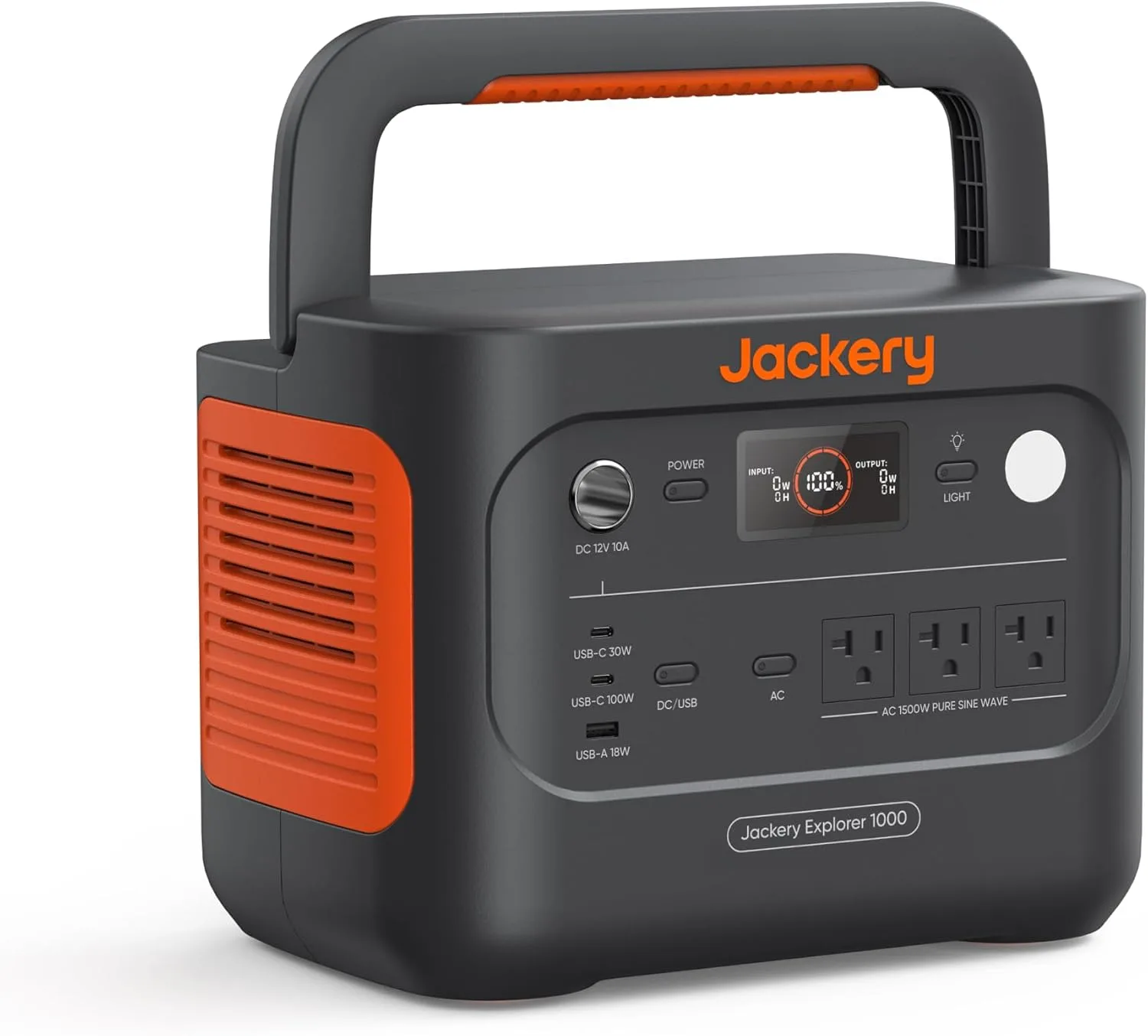
Jackery Explorer 1000 v2 Portable Power Station,1070Wh,1500W
Highlights
- 1070Wh rated capacity
- 1500W continuous AC
- LiFePO4 chemistry
- Up to 400W solar input
- 23.8 lb (~10.8 kg)
- About $559 list
Best for
- Explorer 1000 v2: weekend camping when 23.8 lb carry weight matters as much as 1070Wh
- Essentials bridge at home (fridge cycles, router) when sized to the Wh
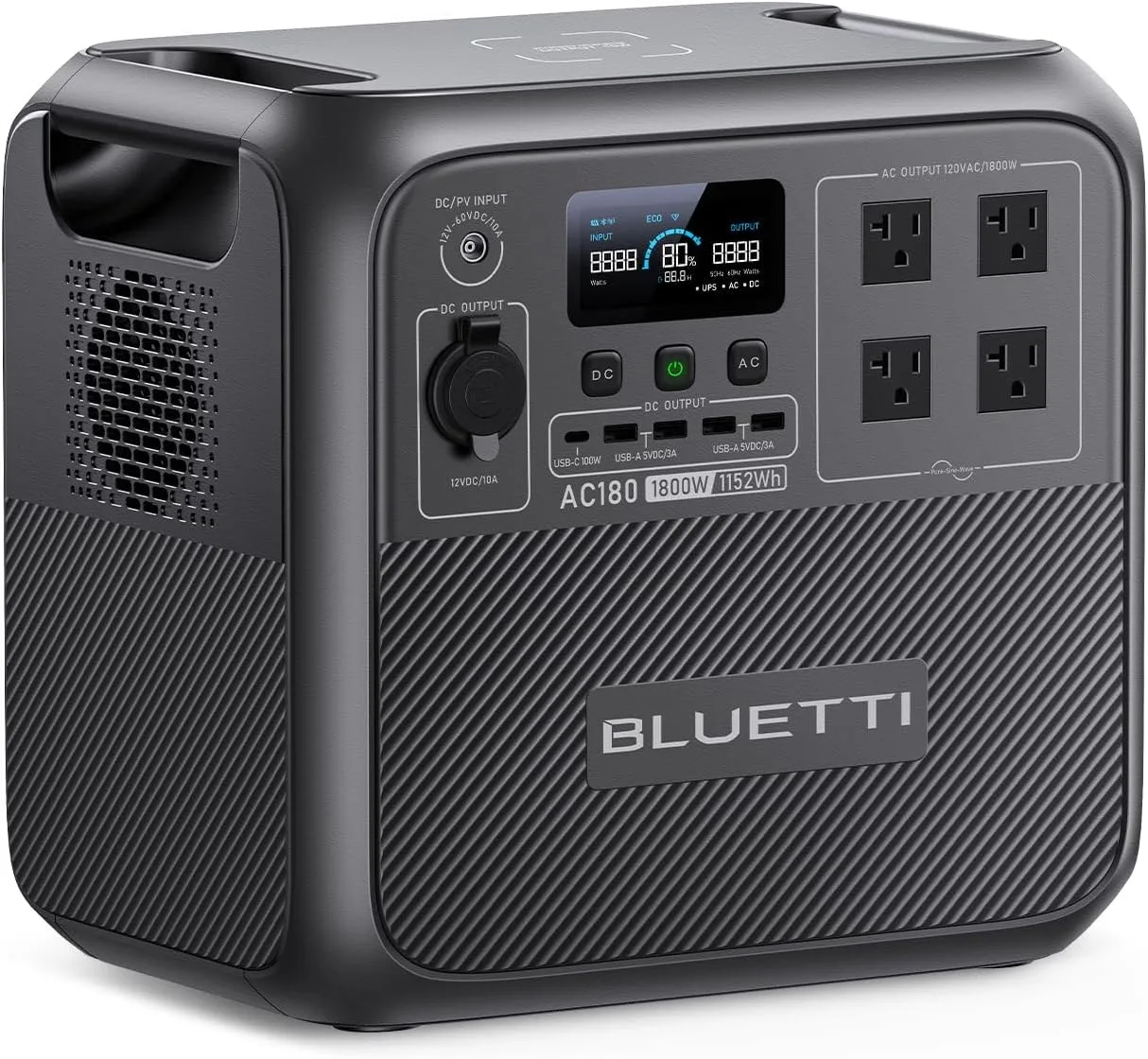
BLUETTI Portable Power Station AC180, 1152Wh LiFePO4 Battery Backup w/ 2 1800W
Highlights
- 1152Wh rated capacity
- 1800W continuous AC
- LiFePO4 chemistry
- Up to 500W solar input
- 35.3 lb (~16.0 kg)
- About $499 list
Best for
- AC180: most Wh per list dollar in mid-size LiFePO4 shortlists (~1152Wh)
- Home essentials when 1800W continuous matters more than a light carry
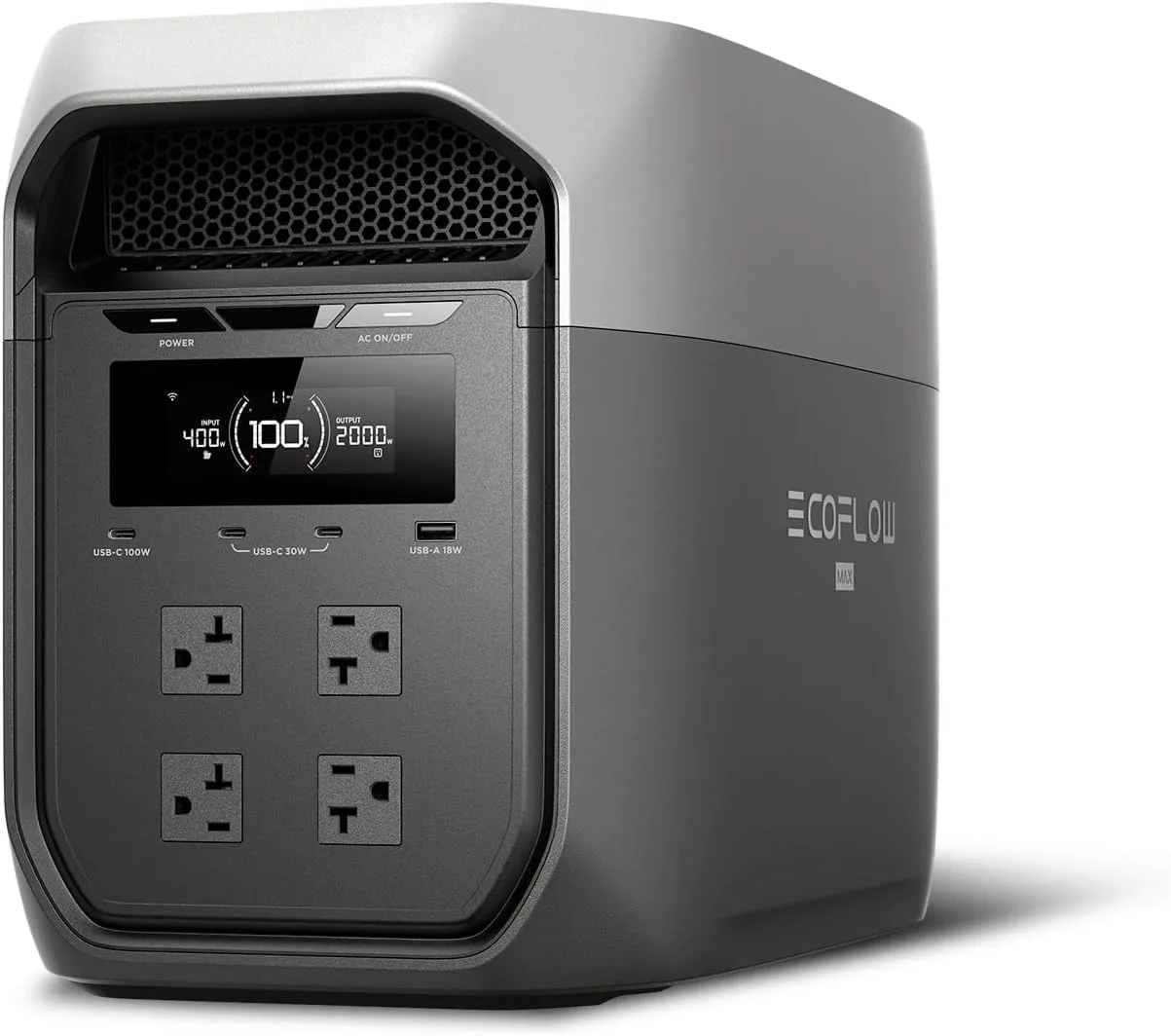
EcoFlow DELTA 3 Max Portable Power Station, 2048Wh LFP Battery
Highlights
- 2048Wh rated capacity
- 2400W continuous AC
- 4800W surge
- LiFePO4 chemistry
- Up to 500W solar input
- 44.8 lb (~20.3 kg)
Best for
- DELTA 3 Max: longer outages or higher continuous loads (still not whole-home wiring)
- RV / off-grid days where recharge speed matters as much as Wh
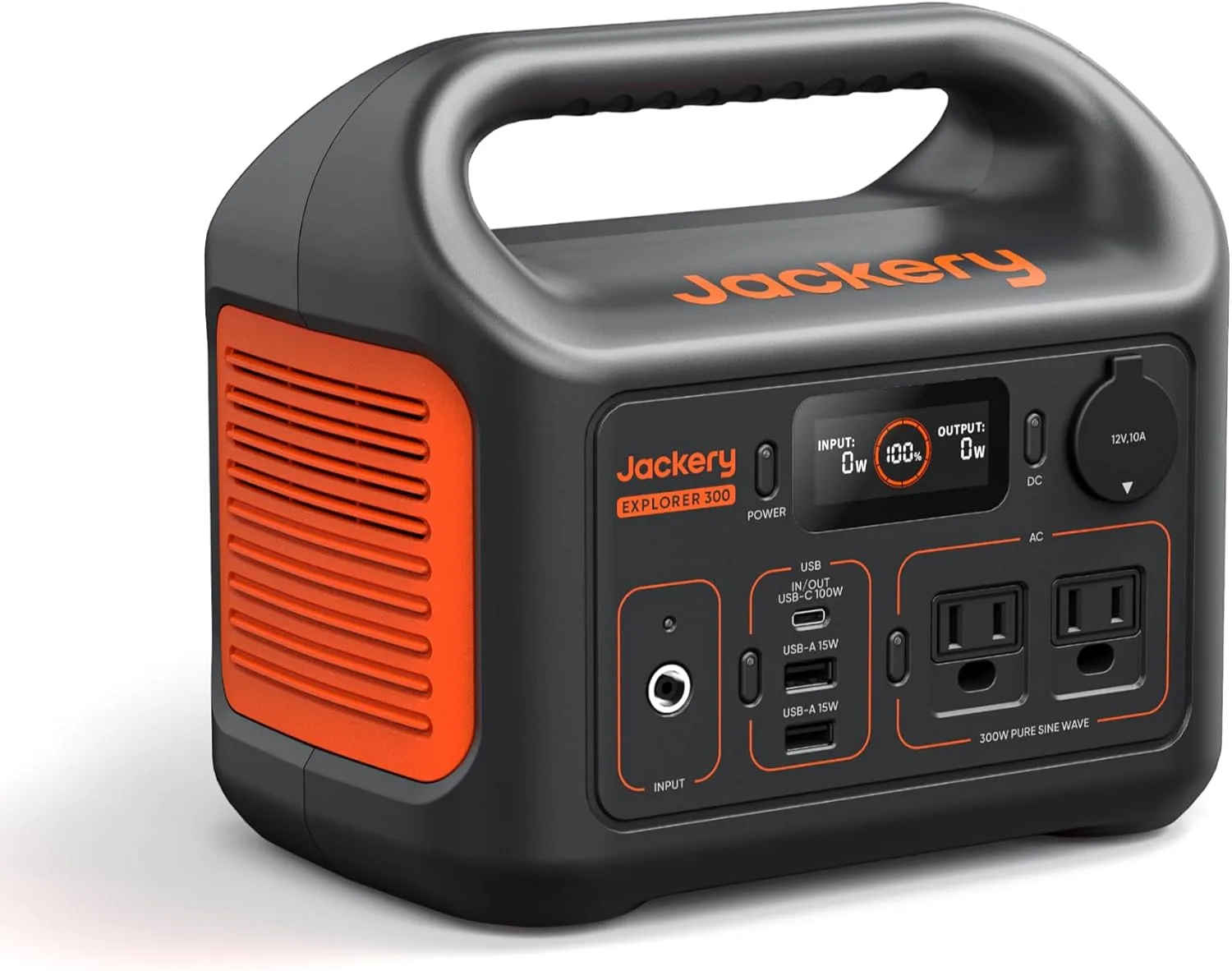
Jackery Explorer 300 Portable Power Station,292Wh
Highlights
- 288Wh rated capacity
- 300W continuous AC
- 600W surge
- LiFePO4 chemistry
- 8.2 lb (~3.7 kg)
- About $289 list
Best for
- Explorer 300 v2: phones, cameras and a laptop on short trips
- Travel kits when you need quiet pack power, not appliance runtime
Spec snapshot: the four stations side by side
Prices are list prices from the WattPicks catalogue. Ratings are listing aggregates, not owner proof. Weight is in pounds.
| Product | Price | Capacity (Wh) | Output (W) | Weight (lb) | Rating |
|---|---|---|---|---|---|
| Jackery Explorer 1000 v2 | $559 | 1070 Wh | 1500 W | 23.8 lb | 4.7 |
| BLUETTI AC180 | $499 | 1152 Wh | 1800 W | 35.3 lb | 4.5 |
| EcoFlow DELTA 3 Max | $1199 | 2048 Wh | 2400 W | 44.8 lb | 4.7 |
| Jackery Explorer 300 | $289 | 288 Wh | 300 W | 8.2 lb | 4.6 |
Runtime estimates by use case
These are planning estimates based on published capacity and owner-reported draws, not lab measurements. Use them to self-check against your own load, then subtract about 10% for inverter overhead and the unit's own idle draw. For 'estimate' cells, the basis is the use-case draw column: for example, a full-size fridge is assumed to draw about 60W average (duty cycle), and CPAP with humidifier on is assumed to draw about 60W. Adjust for your specific device.
| Use case | Estimated draw | Jackery 1000 v2 (1070 Wh) | BLUETTI AC180 (1152 Wh) | DELTA 3 Max (2048 Wh) | Jackery 300 (288 Wh) |
|---|---|---|---|---|---|
| CPAP, humidifier off (DC) | ~20% per night on Explorer 300 | Multiple nights | Multiple nights | Multiple nights | ~5 nights (owner-reported) |
| CPAP, humidifier on (AC) | ~60W (estimate) | 1–2 nights (estimate) | 1–2 nights (estimate) | 2–3 nights (estimate) | Under 1 night (estimate) |
| Full-size fridge (duty cycle) | ~60W average (estimate) | A few hours to overnight (estimate) | A few hours to overnight (estimate) | Longest run here; multi-day possible (estimate) | Not recommended |
| Router + lights | ~20W (estimate) | Days (estimate) | Days (estimate) | Days (estimate) | About a day (estimate) |
RV and boondocking: what actually changes
RV use puts different demands on a station than home backup. You are often charging from the vehicle's 12V socket or alternator while driving, then relying on solar or a generator at camp. The AC180 and DELTA 3 Max both accept 12V car and solar input; the Explorer 1000 v2 and Explorer 300 also take solar, but check the input wattage against your panel's real output — owners report solar rarely hits the panel's rated wattage in real conditions. For alternator charging, check the DC input wattage: the AC180 accepts up to 500W DC input, the DELTA 3 Max up to 800W, the Explorer 1000 v2 up to 200W, and the Explorer 300 up to 100W. A day of driving can largely refill a unit this size if your alternator output matches the input rating.
Car-fridge duty cycle is the number to plan around. A portable car fridge cycles on and off, so its average draw is lower than its peak. Owners report the AC180 running a car fridge for five days and the DELTA 3 Max running one at 36°F for a little over five days. If you are charging from the alternator while driving, a day of driving can largely refill a unit this size; if you are parked, solar input becomes the bottleneck.
For boondocking, weight and handle matter less than charge paths and idle draw. The AC180's ~20W idle draw with the inverter on will quietly eat capacity overnight, so turn the inverter off when you are not using AC. The DELTA 3 Max's higher capacity gives more margin for multi-day stops, but at 44.8 lb it is a move-and-park box in the rig, not something you carry to a tent.
Camping: weekend trips and CPAP nights
Camping splits into two jobs: keeping phones, lights, and a fan running for a weekend, and running a CPAP overnight. For the first, the Explorer 300 is the lightest option at 8.2 lb and can handle a weekend of small-device charging. For CPAP, owners report about 20% draw per night on DC with the humidifier off, giving roughly five nights. If you need more margin or want to run a cooler or a larger device, the Explorer 1000 v2 adds capacity at 23.8 lb. The AC180 and DELTA 3 Max are overkill for most weekend camping unless you are also running a fridge or higher loads.
Why each one is here
Each entry below is scored against the weights above. The order matches the quick picks.
#1 Jackery Explorer 1000 v2: the home-outage generalist
The Explorer 1000 v2 earns the top spot because it covers the widest set of outage jobs without becoming a two-person lift. At 1,070 Wh and 1,500 W continuous, it can run a fridge and a portable AC at the same time — an owner testing for hurricane season reported exactly that, with no hiccups. Quiet mode brought fan noise down enough that the same household slept while the fridge and a few fans stayed on overnight.
The port set is generous on paper: AC×3, USB-C×1, USB-A×1, and a car socket. In practice, owners used the USB-C PD ports to fast-charge phones and a tablet during outage prep, and the LED lamp and 12V socket for outdoor fans and vehicle accessories. The 23.8 lb weight and foldable handle make it the easiest of the three larger units to move between rooms.
The caveats are real. A large 12-inch sliding miter saw only spun the blade about a quarter turn — this is a jobsite helper, not a jobsite replacement. There are no 12V DC barrel ports, so you need an adapter off the cigarette socket if your gear uses them. And the app's one-hour emergency boost reverts to normal charging afterward; owners report normal AC recharge closer to an hour and 40 minutes. The Wi-Fi link also didn't always stay alive overnight, so you may have to reopen the app to check the level.
Best for households that want one portable box for fridge, fans, lights, and light tools during an outage. Look elsewhere if you need to start big saws or run high-draw appliances for long stretches — size up to the DELTA 3 Max or a transfer-switch setup.
#2 BLUETTI AC180: the UPS-first value pick
The AC180 is the cheapest per nameplate watt-hour in this group at $0.43/Wh, and it is the only one here with a documented UPS-style switchover that owners describe as seamless. One owner wired it to a basement family-room circuit — router, TV, lamps, laptop outlets — and reported the internet and devices never dropped when grid power failed. That is the job this unit was built for.
At 1,152 Wh and 1,800 W continuous, it has more headroom than the Jackery 1000 v2 on paper, and owners report running a portable car fridge for five days on a camping trip. The display shows incoming and outgoing watts plus estimated runtime, and the three-button layout plus app make monitoring simple. Multiple charge paths — AC, solar, 12V car, alternator — add flexibility.
The honest cracks matter for sizing. With the inverter on, the unit itself draws about 20W, and only about 90% of capacity is usable, so small loads eat runtime faster than the math suggests. Solar input rarely hits the panel's rated wattage in real conditions. One owner found the top wireless charger connected then quit after seconds — don't buy it for that. At 35.3 lb it is a move-and-park unit, not a carry-far one, and some settings like charge rate live only in the app.
A good fit for buyers who want a set-and-forget UPS for a small circuit plus camping duty, and who value dollars per watt-hour. Not the right call if you need to carry it up stairs regularly or run big appliances — the weight and idle draw work against you.
#3 EcoFlow DELTA 3 Max: the long-run fridge and high-load pick
The DELTA 3 Max is the capacity play. At 2,048 Wh and 2,400 W continuous, it is the only unit here that owners describe running a portable car fridge at 36°F for a little over five days. It also has a 10ms transfer time that owners use as a UPS substitute for a PC, modem, and router — Wi-Fi stayed up through outages in their reports.
Recharge from the wall was a little over an hour in owner use, and the app's storm guard and status checks let you see load and battery without walking over. The display is clear at a glance. Ports are AC×4, USB-C×1, USB-A×1 — enough for the core loads, though one owner wished for a 140W USB output alongside the 100W USB port.
The trade-off is weight and price. At 44.8 lb and $1,199 list, it is the heaviest and most expensive unit here, and it is a move-and-park box rather than something you carry far. If your outage plan is a fridge, a few fans, and a router for multiple days, the capacity earns its keep. If you mostly need lights and phones, you are paying for headroom you won't use.
Choose it for multi-day fridge runs or higher continuous loads, and for a UPS-grade transfer for networking gear. Pass if portability is the priority or your loads are small — the weight and price are hard to justify.
#4 Jackery Explorer 300: the CPAP and small-device specialist
The Explorer 300 is here for one job done well: lightweight overnight CPAP and small-device backup. At 8.2 lb it is light enough that owners in their 80s could pick it up, and it arrived with a partial charge so it could be used right away. On a three-night camping trip, one owner ran a ResMed AirSense 11 off DC with the humidifier off and used about 20% a night — no auto-shutoff.
On AC, the same owner saw about 40% draw in one night and a shutdown after roughly 5.5 hours due to the low-wattage auto-off. That is the key caveat: the auto power-off triggers on very low draws (under about 10W), which is great for saving battery but bad for continuous low-power gear on AC. For CPAP, plan on a DC cord. During a 24-hour outage, another owner ran a 42-inch TV, charged a phone, used a heating pad, and made coffee — after six hours it still had 43%.
The limits are capacity and load. At 288 Wh and 300 W continuous, it is not for fridges, AC, or heavy appliances, and even a lamp plus a phone charge can eat a day's capacity. One owner's unit stopped charging after nine months, though support replaced it. AC recharge took a few hours in owner reports.
Ideal for campers and CPAP users who need a light, quiet box for phones, lamps, and a night of therapy. Not for you if you need to run appliances or want multi-day fridge backup — the capacity is too small.
- Can the Explorer 300 run a CPAP for a full night? Yes, on DC with the humidifier off — owners report about 20% per night. On AC, the low-draw auto-off can shut it down after roughly 5.5 hours.
- Does the AC180 really switch over instantly? Owners describe a UPS-style switchover that kept a router, TV, and lights on without a blink. The listing cites a 20 ms transfer time; treat that as a listing figure, not a lab measurement.
- How long will the DELTA 3 Max run a fridge? One owner ran a portable car fridge at 36°F for a little over five days. A full-size kitchen fridge will draw more; plan on a shorter run and check the continuous watt rating against your fridge's startup draw.
- Which unit is cheapest per watt-hour? The BLUETTI AC180 at $0.43/Wh nameplate, versus $0.52/Wh for the Explorer 1000 v2, $0.59/Wh for the DELTA 3 Max, and $1.00/Wh for the Explorer 300.
Who should not buy the top pick
The Explorer 1000 v2 is the best all-around fit for most outage plans, but it is the wrong buy for two groups. First, anyone who needs to start large inductive loads — a 12-inch sliding miter saw barely turned in owner testing, and a 1,500 W continuous rating does not guarantee motor-start surge. Second, anyone who needs a true whole-home or multi-day fridge solution: 1,070 Wh is a few hours of fridge plus fans, not days. Those buyers should look at the DELTA 3 Max or a transfer-switch setup.
- Can the Explorer 300 run a CPAP for a full night? Yes, on DC with the humidifier off — owners report about 20% per night. On AC, the low-draw auto-off can shut it down after roughly 5.5 hours.
- Does the AC180 really switch over instantly? Owners describe a UPS-style switchover that kept a router, TV, and lights on without a blink. The listing cites a 20 ms transfer time; treat that as a listing figure, not a lab measurement.
- How long will the DELTA 3 Max run a fridge? One owner ran a portable car fridge at 36°F for a little over five days. A full-size kitchen fridge will draw more; plan on a shorter run and check the continuous watt rating against your fridge's startup draw.
- Which unit is cheapest per watt-hour? The BLUETTI AC180 at $0.43/Wh nameplate, versus $0.52/Wh for the Explorer 1000 v2, $0.59/Wh for the DELTA 3 Max, and $1.00/Wh for the Explorer 300.
If none of these fit
Two alternative directions. If your real need is whole-home backup with a transfer switch, a portable station is the wrong category — look at a standby generator or a smart panel with a battery. If your need is strictly CPAP and phone charging on weekend trips, the Explorer 300 is the right size, but if you want more margin for a heated humidifier or a second night without recharging, size up to the Explorer 1000 v2 and accept the extra 15.6 lb.
- What solar panel pairs with the Explorer 1000 v2? It accepts up to 200W DC input; pair it with a panel that delivers close to that in real conditions, and expect less than rated output on cloudy days.
- Can I expand the AC180 with a second battery? The AC180 does not support parallel expansion; for expandable capacity, look at units designed for battery add-ons.
- What is the warranty on the DELTA 3 Max? Check the listing for current warranty terms; EcoFlow typically offers a multi-year warranty, but confirm before purchase.
- Does the Explorer 300 have a car outlet? Yes, it includes a 12V car socket, but check the wattage limit for your device.
Owner themes: what repeats across reviews
These are theme summaries from the owner packs on file, not raw review dumps. Listing star averages are aggregates and are not treated as proof of owner sentiment.
- Jackery Explorer 1000 v2: home-backup reliability, fridge plus portable AC, quiet mode for overnight, fast USB-C charging; caveats on large tool startup, no 12V barrel ports, and the one-hour boost reverting to normal.
- BLUETTI AC180: seamless UPS switchover, clear display, five-day car-fridge run; caveats on ~20W idle draw, ~90% usable capacity, solar reality, flaky wireless charging, and weight.
- EcoFlow DELTA 3 Max: 10ms transfer for networking gear, little-over-an-hour recharge, five-day car-fridge run; caveat on wanting a higher-wattage USB output.
- Jackery Explorer 300: lightweight CPAP use on DC, small-device charging, 24-hour outage coverage; caveats on low-draw auto-off, small capacity, and one report of a unit stopping charging after nine months (replaced under support).
Frequently asked
Can the Explorer 300 run a CPAP for a full night?
Yes, on DC with the humidifier off — owners report about 20% per night. On AC, the low-draw auto-off can shut it down after roughly 5.5 hours.
Does the AC180 really switch over instantly?
Owners describe a UPS-style switchover that kept a router, TV, and lights on without a blink. The listing cites a 20 ms transfer time; treat that as a listing figure, not a lab measurement.
How long will the DELTA 3 Max run a fridge?
One owner ran a portable car fridge at 36°F for a little over five days. A full-size kitchen fridge will draw more; plan on a shorter run and check the continuous watt rating against your fridge's startup draw.
Which unit is cheapest per watt-hour?
The BLUETTI AC180 at $0.43/Wh nameplate, versus $0.52/Wh for the Explorer 1000 v2, $0.59/Wh for the DELTA 3 Max, and $1.00/Wh for the Explorer 300.
Method and sources
Model names and list prices come from the WattPicks catalog at build time. WattPicks does not run its own laboratory tests on power stations, and nothing on this page is presented as a measured result — it is catalog-backed buying guidance.
Read our methodology for how the catalog is normalized, and about WattPicks for who publishes it.