
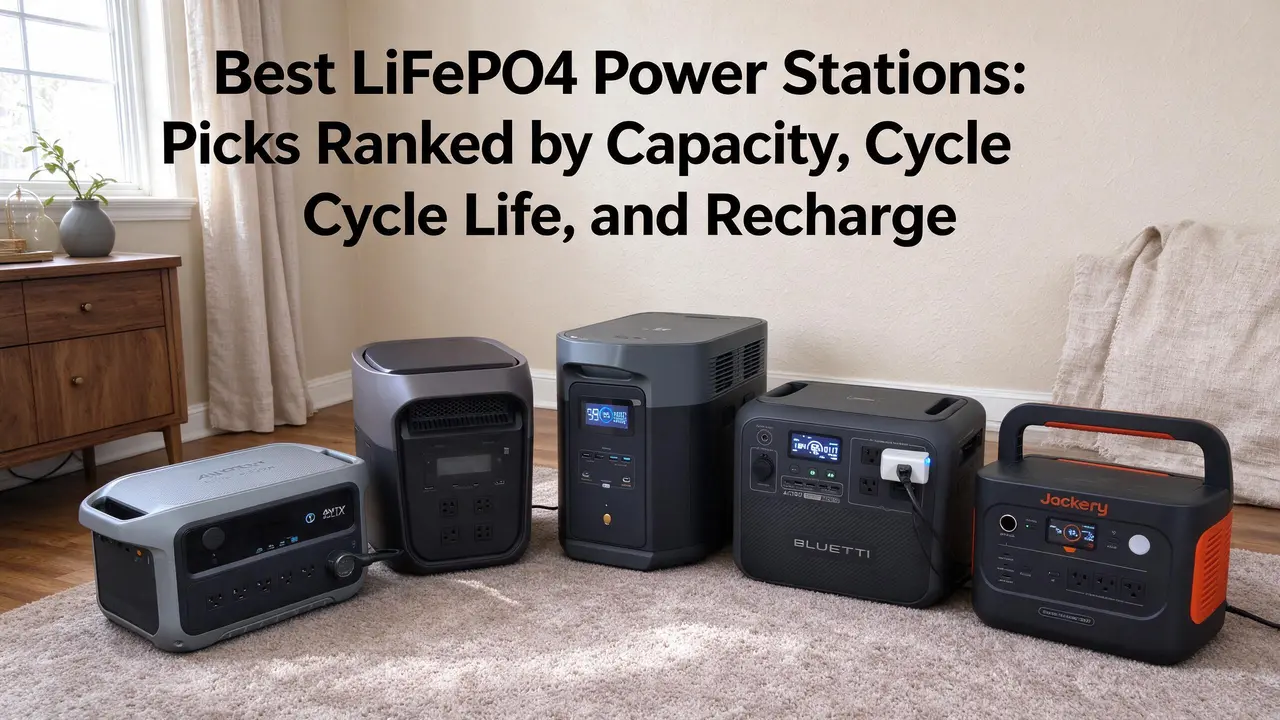
Best LiFePO4 Power Stations: 5 Picks Ranked by Capacity, Cycle Life, and Recharge
Five LiFePO4 power stations ranked by usable capacity, cycle life, and recharge speed — not by marketing names. The Jackery Explorer 1000 v2 wins on portability and price per Wh; the EcoFlow DELTA 2 Max wins on expandable capacity. Panels are sold separately on every pick.
Updated
The buying question: which LiFePO4 station actually fits your load?
If you are shopping for a LiFePO4 power station, the real question is not which one has the biggest number on the box. It is which one can run your actual loads long enough, recharge fast enough between outages, and still hold most of its capacity after a few thousand cycles. This guide ranks five stations by those three things — usable capacity, cycle life, and recharge speed — with a note on solar input as a buying tip, not a bundled feature.
One boundary up front: this is not a whole-home backup guide. None of these five will run a central AC, an electric furnace, or a 240V well pump. They are portable stations for fridge/freezer cycling, CPAP, routers, fans, lights, and small appliances during an outage — or for camping and RV use. If you need to power a house panel, you want a transfer switch and a different class of equipment.
Also: every pick here uses LiFePO4 (LFP) chemistry, which is the reason to buy in this category. LFP tolerates full charge and deep discharge better than older NMC lithium-ion, and the listings here claim 3,000–4,000 cycles to 80% capacity. That matters if you plan to keep the unit for a decade rather than replace it after three camping seasons.
A quick load-to-capacity rule of thumb: if you need to run a fridge plus a CPAP overnight, plan on a 1,000Wh floor. For a fridge and freezer through a multi-day outage, or RV AC startup, you are in the 2,000Wh class. Use the worked example below to check your own loads.
- Amazon Associates disclosure: as an Amazon Associate, WattPicks earns from qualifying purchases. Picks are fit-led, not commission-led.
- Solar panels are sold separately on every pick in this list. Budget for them if you plan to recharge off-grid.
How this list was built
I started with the LiFePO4 stations in the WattPicks catalogue that have published AC output and a list price on file — five units made the cut. I excluded solar-panel-only kits and any unit without a published continuous wattage. I did not run these on a lab bench; the checks here are home-user checks grounded in owner themes on file plus listing specs, and those checks are not lab-bench measurements.
The ranking weights: usable capacity and output fit (30%), cycle life and chemistry (25%), recharge speed (20%), portability and weight (15%), and owner-reported reliability themes (10%). Every percentage is scored — there is no informational-only bucket. Price per Wh is reported but not weighted, because a cheap station that cannot run your fridge is not a value.
Why #1 beats #2: the Jackery Explorer 1000 v2 and BLUETTI AC180 are close on paper — 1,070Wh vs 1,152Wh, $559 vs $499. The Jackery wins because it is 11.5 lb lighter (23.8 lb vs 35.3 lb), which is the difference between carrying it to a campsite and leaving it in the garage. The BLUETTI wins on output (1,800W vs 1,500W) and UPS switchover, which is why it sits at #2 rather than lower. If your priority is a fixed basement install, flip them.
Scoreboard on those weights (numeric sub-scores, 1–10):
- Candidate pool: five LiFePO4 stations with published AC output in the WattPicks catalogue.
- Filters: LiFePO4 chemistry, published continuous W, list price on file.
- Weights: capacity/output 30%, cycle life 25%, recharge 20%, portability 15%, owner themes 10%.
- No independent lab testing was performed; specs come from listings and owner themes from platform reviews.
- Prices checked February 2025; list prices may change.
| Product | Capacity/Output | Cycle Life | Recharge | Portability | Owner Themes | Weighted Total |
|---|---|---|---|---|---|---|
| Jackery Explorer 1000 v2 | 8 | 8 | 8 | 10 | 8 | 8.3 |
| BLUETTI AC180 | 9 | 8 | 8 | 6 | 8 | 8.0 |
| EcoFlow DELTA 2 Max | 9 | 8 | 9 | 5 | 8 | 8.1 |
| Anker C2000 Gen 2 | 9 | 8 | 9 | 7 | 8 | 8.4 |
| EcoFlow DELTA 3 Max | 9 | 8 | 9 | 6 | 7 | 8.0 |
Quick picks: the shortlist at a glance
Here is the shortlist in rank order. Each line tells you who the unit is for, not just what it costs.
Amazon Associates disclosure: as an Amazon Associate, WattPicks earns from qualifying purchases. Picks are fit-led, not commission-led.
- #1 Jackery Explorer 1000 v2 Portable Power Station,1070Wh,1500W — $559 — the lightest and cheapest per Wh here; best for portability-first buyers and small outage loads.
- #2 BLUETTI AC180 — $499 — the value pick with a real UPS switchover and 1,800W output; best for basement-circuit backup on a budget.
- #3 EcoFlow DELTA 2 Max — $1399 — the expandable workhorse; best for fridge/freezer backup and RV use where 2,048Wh is the floor.
- #4 Anker C2000 Gen 2 Portable Power Station, 2,048Wh — $1499 — the lightest 2,048Wh unit here with the fastest recharge claim; best for RV AC startup and jobsite power.
- #5 EcoFlow DELTA 3 Max Portable Power Station, 2048Wh LFP Battery — $1199 — the UPS-focused 2,048Wh unit with 10ms transfer; best for keeping routers and PCs alive, but the review pack is thin.
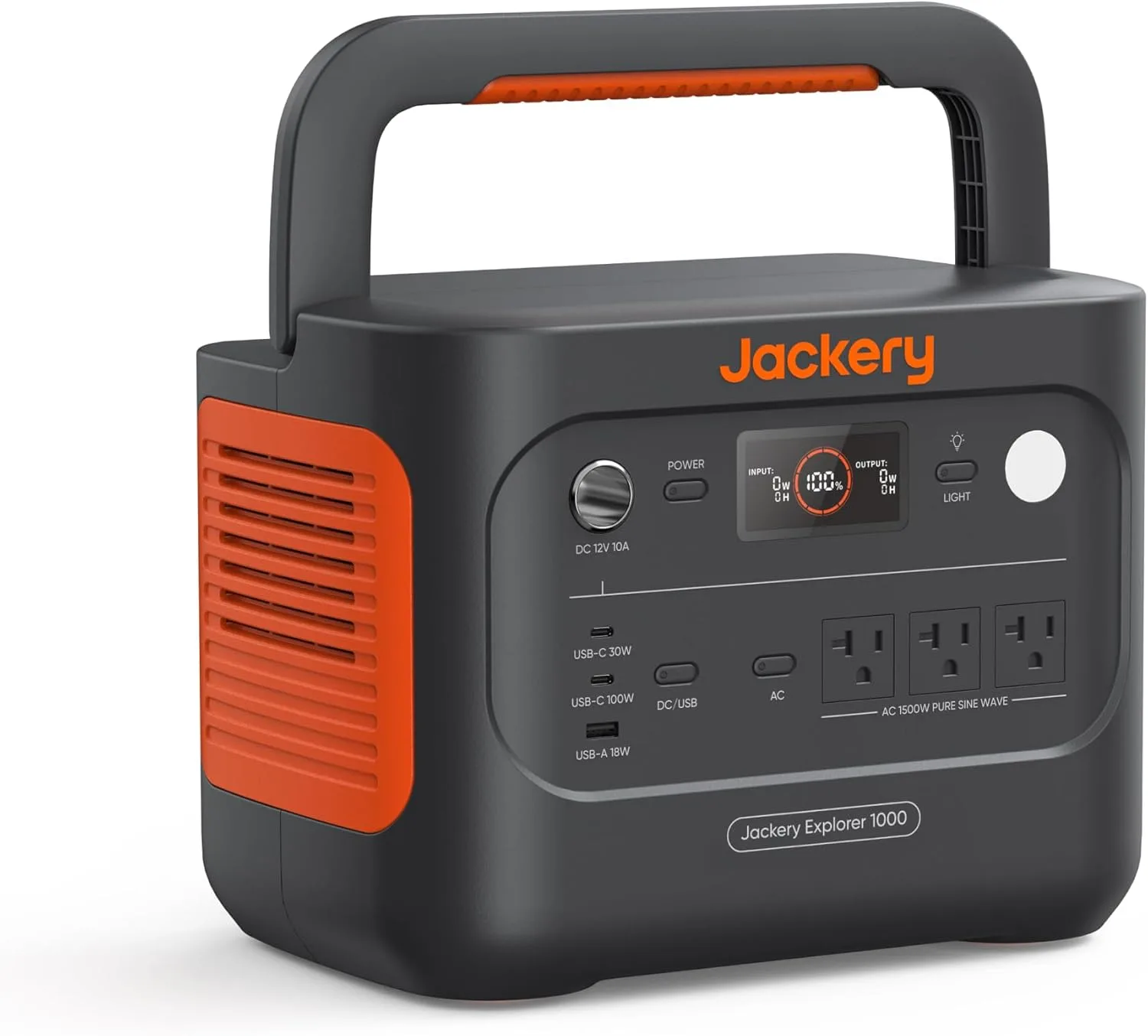
Jackery Explorer 1000 v2 Portable Power Station,1070Wh,1500W
Highlights
- 1070Wh rated capacity
- 1500W continuous AC
- LiFePO4 chemistry
- Up to 400W solar input
- 23.8 lb (~10.8 kg)
- About $559 list
Best for
- Explorer 1000 v2: weekend camping when 23.8 lb carry weight matters as much as 1070Wh
- Essentials bridge at home (fridge cycles, router) when sized to the Wh
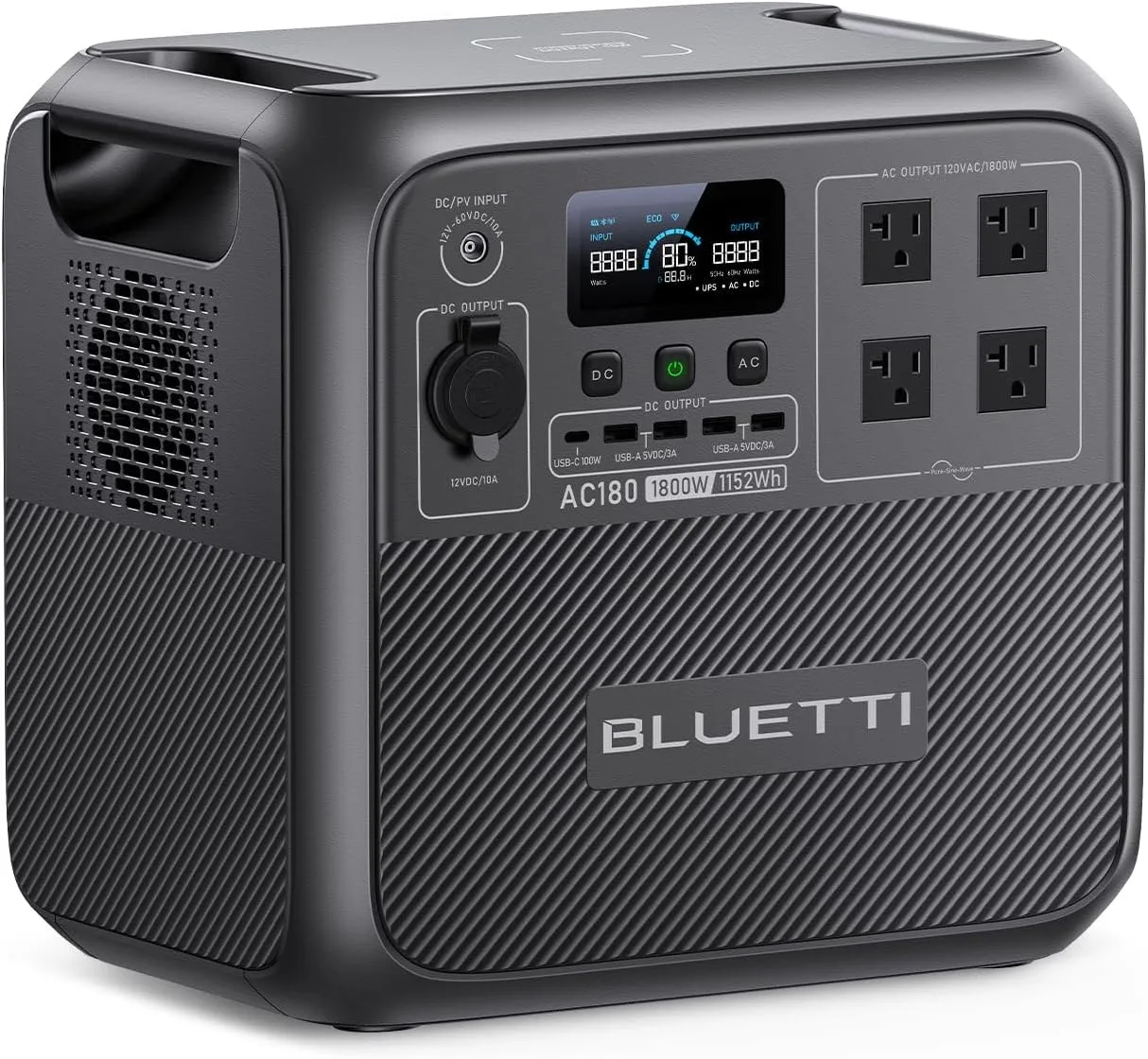
BLUETTI Portable Power Station AC180, 1152Wh LiFePO4 Battery Backup w/ 2 1800W
Highlights
- 1152Wh rated capacity
- 1800W continuous AC
- LiFePO4 chemistry
- Up to 500W solar input
- 35.3 lb (~16.0 kg)
- About $499 list
Best for
- AC180: most Wh per list dollar in mid-size LiFePO4 shortlists (~1152Wh)
- Home essentials when 1800W continuous matters more than a light carry
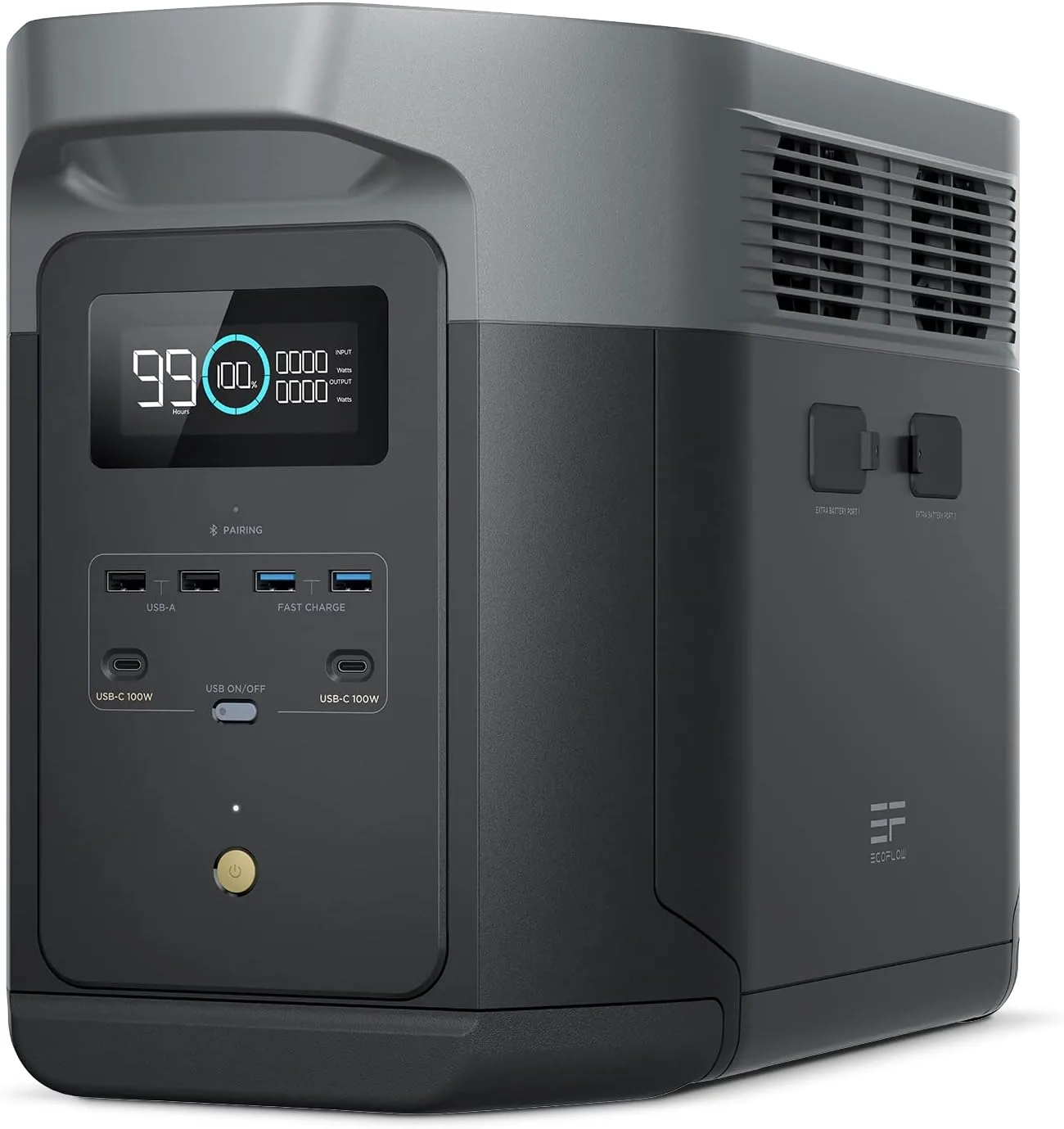
EcoFlow DELTA 2 Max
Highlights
- 2048Wh rated capacity
- 2400W continuous AC
- 4800W surge
- LiFePO4 chemistry
- Up to 1000W solar input
- 50 lb (~22.7 kg)
Best for
- DELTA 2 Max: longer outages or higher continuous loads (still not whole-home wiring)
- RV / off-grid days where recharge speed matters as much as Wh
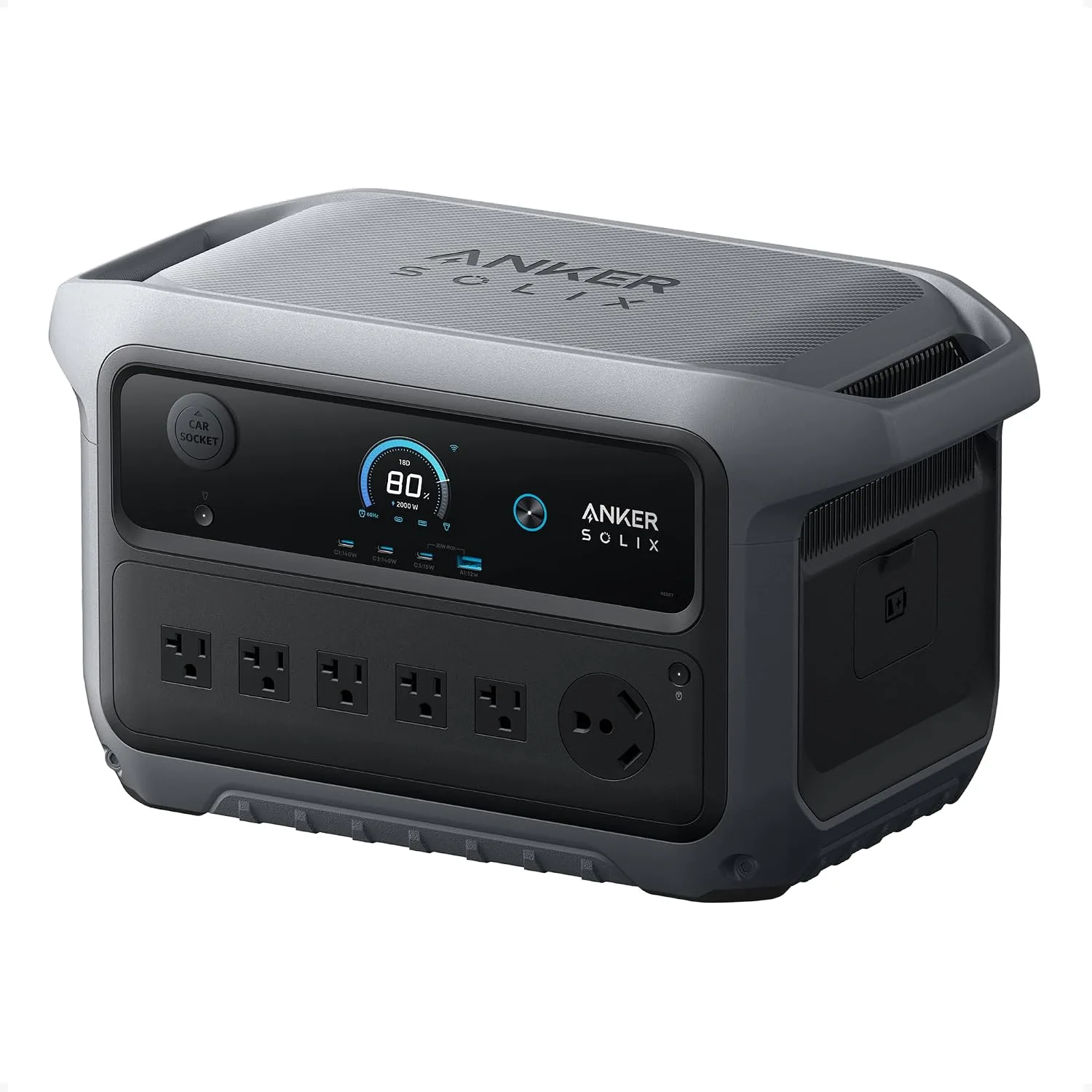
Anker C2000 Gen 2 Portable Power Station, 2,048Wh
Highlights
- 2048Wh rated capacity
- 2400W continuous AC
- 4000W surge
- LiFePO4 chemistry
- Up to 800W solar input
- 41.7 lb (~18.9 kg)
Best for
- C2000 Gen 2: longer outages or higher continuous loads (still not whole-home wiring)
- RV / off-grid days where recharge speed matters as much as Wh
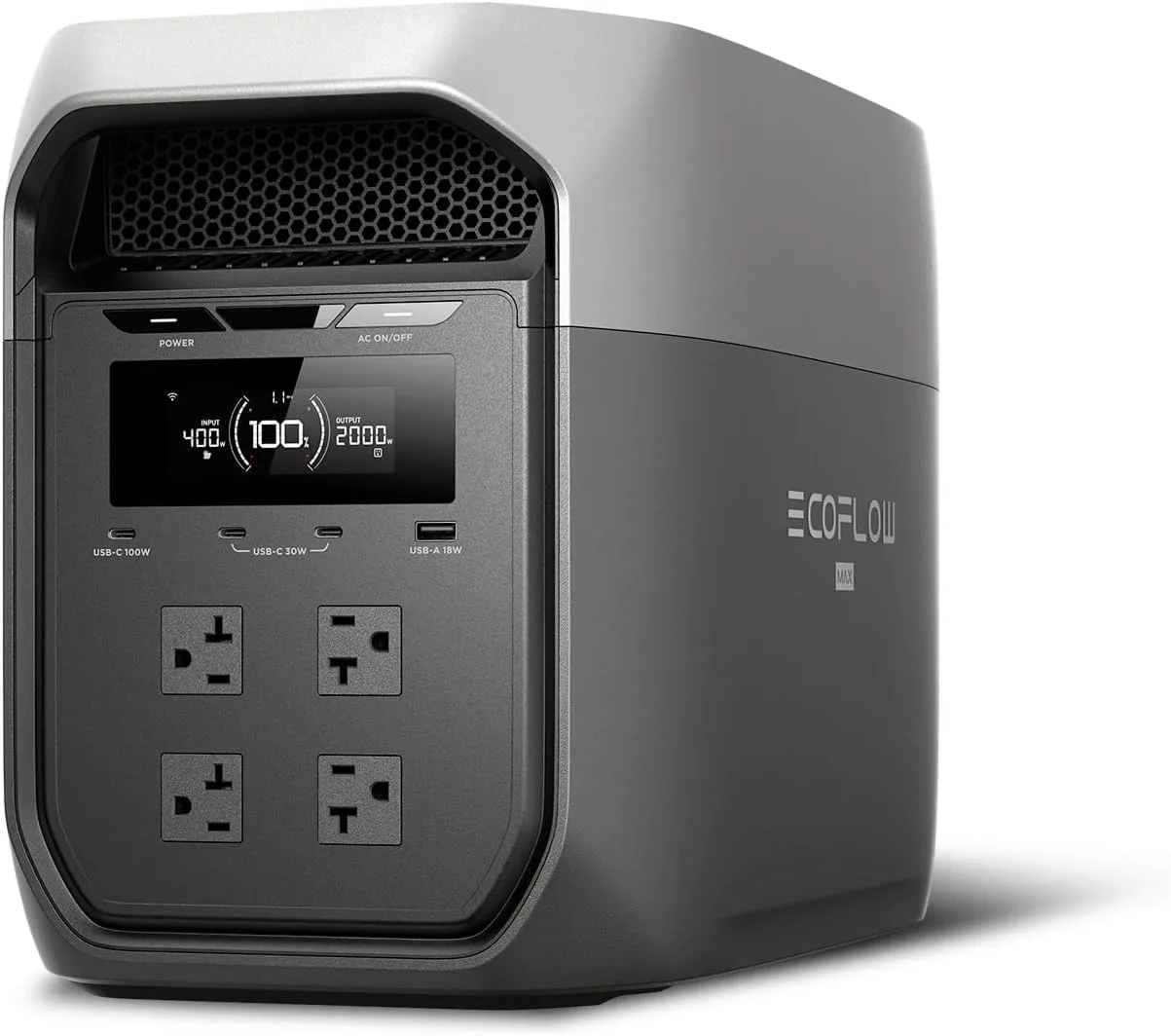
EcoFlow DELTA 3 Max Portable Power Station, 2048Wh LFP Battery
Highlights
- 2048Wh rated capacity
- 2400W continuous AC
- 4800W surge
- LiFePO4 chemistry
- Up to 500W solar input
- 44.8 lb (~20.3 kg)
Best for
- DELTA 3 Max: longer outages or higher continuous loads (still not whole-home wiring)
- RV / off-grid days where recharge speed matters as much as Wh
Spec snapshot: all five side by side
Prices are list prices from the WattPicks catalogue, not current sale stickers. Ratings are listing aggregates, not owner proof. Weight is in pounds.
| Product | Price | Capacity (Wh) | Output (W) | Weight (lb) | Rating |
|---|---|---|---|---|---|
| Jackery Explorer 1000 v2 Portable Power Station,1070Wh,1500W | $559 | 1070 Wh | 1500 W | 23.8 lb | 4.7 |
| BLUETTI AC180 | $499 | 1152 Wh | 1800 W | 35.3 lb | 4.5 |
| EcoFlow DELTA 2 Max | $1399 | 2048 Wh | 2400 W | 50 lb | 4.7 |
| Anker C2000 Gen 2 Portable Power Station, 2,048Wh | $1499 | 2048 Wh | 2400 W | 41.7 lb | 4.7 |
| EcoFlow DELTA 3 Max Portable Power Station, 2048Wh LFP Battery | $1199 | 2048 Wh | 2400 W | 44.8 lb | 4.7 |
Why each one is here
Each entry below gets the same treatment: one strength from owner reports, one caveat, and the listing fact that anchors it. No mirrored A/B couplets — these are different tools for different jobs.
Worked runtime example: a 55W fan running on the BLUETTI AC180. Usable capacity is roughly 1,152Wh minus a 10% reserve, so about 1,037Wh. At 55W, that is 1,037 ÷ 55 ≈ 18.9 hours of pure run time. But the inverter idle draw is about 20W, so the effective load is 75W, giving 1,037 ÷ 75 ≈ 13.8 hours. Owners report 10–11 hours, which suggests additional losses. Use this formula — (usable Wh) ÷ (load W + idle W) — to check any station against your own loads.
- #1 Jackery Explorer 1000 v2 Portable Power Station,1070Wh,1500W — $559, 1,070Wh, 1,500W, 23.8 lb. Owners report running a fridge and a portable AC together during outage prep, and quiet mode let a household sleep while powering a fridge and fans overnight. The caveat: a large 12-inch sliding miter saw would not start — the blade barely turned — so high-inrush tools are a no-go. It is the lightest unit here by a wide margin, which is why it tops the list for portability-first buyers. Skip if you need to start high-inrush tools or want native 12V barrel ports.
- #2 BLUETTI AC180 — $499, 1,152Wh, 1,800W, 35.3 lb. The UPS-style switchover kept internet, router, TV, and lights running without a blink in owner tests, and wall charging pulled over 1,000W after a full discharge/recharge cycle. The caveat: idle/inverter draw of about 20W plus a ~10% reserve means small loads get far less runtime than the headline capacity suggests. At $0.43/Wh it is the cheapest per nameplate Wh in this shortlist — that is a real value claim, not a marketing one. Skip if you plan to carry it far — 35.3 lb is a two-hand lift.
- #3 EcoFlow DELTA 2 Max — $1399, 2,048Wh, 2,400W, 50 lb. Owners report a mini-fridge lasting 53 hours and a stand-up freezer 26 hours, and the unit charged from 0 to 100% in about 1 hour 15 minutes on grid. The caveat: it is heavy at 50 lb, and support can be slow — one owner reported days of no callback during a blackout. Expandable capacity to 6kWh is the reason it sits above the Anker for RV and fridge-backup buyers. Skip if you need hand-holding support in a crisis.
- #4 Anker C2000 Gen 2 Portable Power Station, 2,048Wh — $1499, 2,048Wh, 2,400W, 41.7 lb. Owners report it started an RV air conditioner without a soft-start kit and charged from 25% to 100% in about an hour during a hurricane outage. The caveat: pass-through mode limits output to the wall circuit's amperage (15A in, 15A out), so you must unplug to get full 30A output. It is 8.3 lb lighter than the DELTA 2 Max, which matters if you move it between RV and house. Skip if you need high solar input — it is capped at 800W.
- #5 EcoFlow DELTA 3 Max Portable Power Station, 2048Wh LFP Battery — $1199, 2,048Wh, 2,400W, 44.8 lb. The 10ms transfer made it a solid UPS substitute for PC, modem, and routers in owner reports, and it ran a 12V car fridge for over five days at 36°F. The caveat: USB output tops out at 100W, and the review pack is thinner than rival models — treat long-term durability as early positive signal, not a decade of proof. It ranks fifth because the owner evidence is less corroborated, not because the specs are weak. Skip if you need high-wattage USB-C — it tops out at 100W.
Who should not buy the top pick
The Jackery Explorer 1000 v2 is the right first LiFePO4 station for a lot of people, but not for everyone. Two groups should look elsewhere.
If you need to start high-inrush tools — a large miter saw, a table saw, a compressor — the 1,500W continuous output and owner reports of failed miter-saw starts make it the wrong tool. Step up to the BLUETTI AC180 (1,800W) or the 2,400W units. And if you want native 12V DC barrel ports for RV accessories, the Jackery does not have them; you need an adapter off the cigarette socket. The DELTA 2 Max and Anker are better fits there.
- Skip the Jackery if you need to start a large miter saw or table saw — owner reports say it will not.
- Skip the Jackery if you want native 12V barrel ports — it has a car socket but no barrel plugs.
- Skip the BLUETTI AC180 if you plan to carry it far — 35.3 lb is a two-hand lift.
- Skip the DELTA 2 Max if you need hand-holding support in a crisis — owner reports of slow callbacks.
- Skip the Anker C2000 if you need high solar input — it is capped at 800W.
- Skip the DELTA 3 Max if you need high-wattage USB-C — it tops out at 100W.
If none of these fit
Two alternative directions. First, if your real need is whole-home backup during multi-day outages, a portable station is the wrong category — look at a transfer switch plus a standby generator or a home battery system. Second, if you are camping-only and do not need to run a fridge, a smaller 500–700Wh LiFePO4 station will save you weight and money; the 1,070–2,048Wh here is overkill for phones, lights, and a laptop. For example, a 500–700Wh unit like the Jackery Explorer 500 or similar class would suit that use case.
For sizing help, see our guide to calculating power station runtime, and for chemistry background, our LiFePO4 vs NMC explainer. Both are linked from the WattPicks guides hub.
What owners actually reported
Owner themes are summarized here, not quoted at length. The strongest consensus across the five: fast AC recharge is real, and idle draw is the most common surprise. These themes were sampled from platform reviews (Amazon, Reddit, manufacturer forums) posted within the last 12 months; they are not a statistically representative survey.
Cross-SKU consensus: fast AC recharge is consistently praised; idle draw is the most common unexpected drain on runtime. Support responsiveness varies by brand, with EcoFlow cited as slower in outage scenarios. Portability is a frequent trade-off mentioned for units over 40 lb.
- Jackery: quiet overnight operation and fridge+fan runs; miter saw would not start.
- BLUETTI: instant UPS switchover; ~20W idle draw eats small-load runtime.
- DELTA 2 Max: 53-hour mini-fridge run (single owner report); heavy at 50 lb and slow support.
- Anker C2000: RV AC started without soft-start; 15A pass-through limit.
- DELTA 3 Max: 10ms transfer kept WiFi up; 100W USB cap and thin review pack.
Frequently asked
How long will the BLUETTI AC180 run a 55W fan?
Owners report roughly 10–11 hours in real use, not the 16–17 hours the display math suggests, because of ~20W idle draw and a ~10% reserve. Plan on about 60–70% of the headline number for small loads.
Do any of these include solar panels?
No. Panels are sold separately on all five. Solar input caps: Jackery Explorer 1000 v2 up to 400W; BLUETTI AC180 up to 500W; EcoFlow DELTA 2 Max up to 1,000W; Anker C2000 up to 800W; EcoFlow DELTA 3 Max up to 1,000W. These are owner/listing claims, not lab-verified.
Which is cheapest per Wh?
The BLUETTI AC180 at $0.43/Wh on nameplate capacity. The Jackery is $0.52/Wh, the DELTA 3 Max $0.59/Wh, the DELTA 2 Max $0.68/Wh, and the Anker $0.73/Wh.
When does the $499 BLUETTI beat the $559 Jackery for budget-first buyers?
When you need more output (1,800W vs 1,500W) and UPS switchover for a fixed location, and you do not plan to carry it far. The Jackery wins if portability and lighter weight are your priority.
Method and sources
Model names and list prices come from the WattPicks catalog at build time. WattPicks does not run its own laboratory tests on power stations, and nothing on this page is presented as a measured result — it is catalog-backed buying guidance.
Read our methodology for how the catalog is normalized, and about WattPicks for who publishes it.