
Portable Power Picks: BLUETTI, Jackery, EcoFlow Ranked
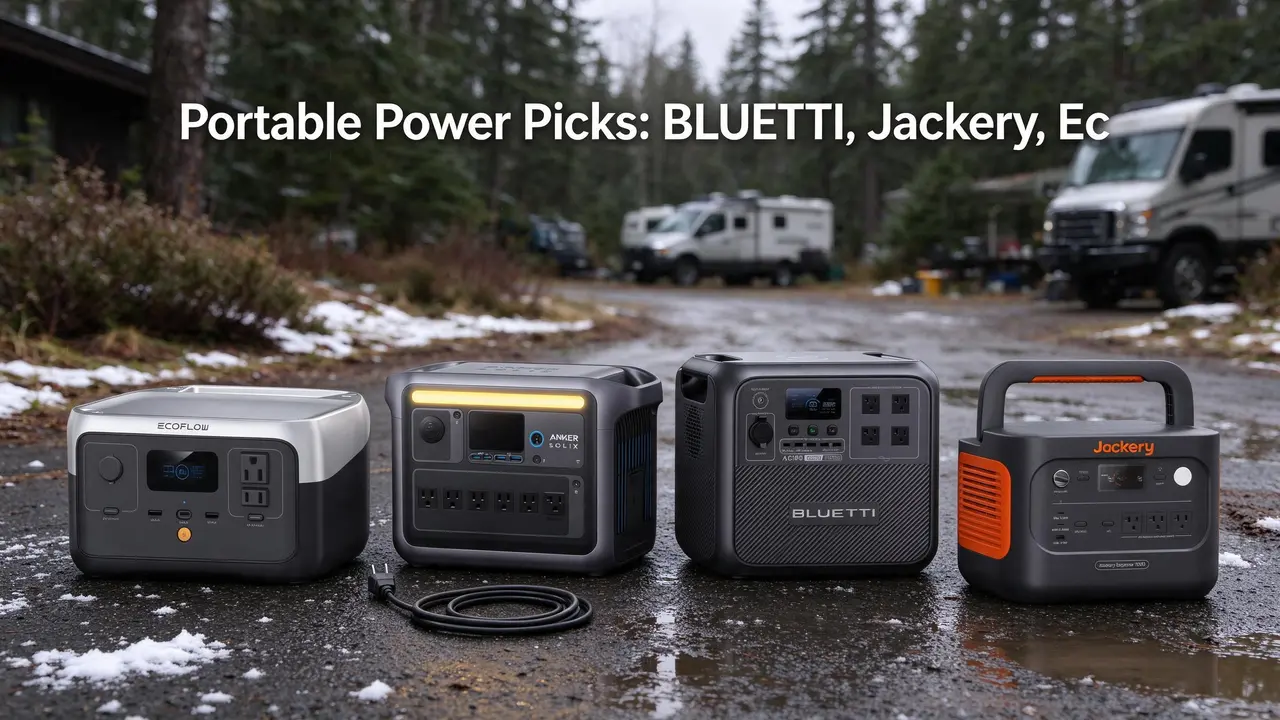
Six portable power stations across three capacity tiers, ranked by what they actually run — not by badge. The BLUETTI AC180 wins on watts per dollar; the DELTA 3 Max wins when the load is a whole room.
Updated
What a power station actually has to run before you pick one
Start with the load, not the badge. A fridge that cycles at 100–150 W average, a router and modem at 10–20 W, a CPAP at 30–60 W, a box fan at 55 W — that's the real shortlist for most outages and most campsites. Anything with a heating element is a different purchase entirely.
So here's the boundary up front: this is a comparison of six portable stations from 243 Wh to 2,048 Wh. It is not a whole-home backup guide, and none of these replaces a transfer switch and a standby generator. If you want to run a well pump, a central AC, or an electric range, close this tab and read about home backup sizing instead.
Quick scenario split: camping and tailgating usually means light loads and carrying weight matters most; home outages usually mean a fridge and router and runtime matters most. The picks below are sorted with that split in mind. For camping specifically, the decision line is simple: if you're carrying the station any distance, weight and quiet operation outrank capacity — which is why the 23.8 lb Explorer 1000 v2 and the 7.7 lb RIVER 2 punch above their tier for tent and tailgate duty.
One disclosure: as an Amazon Associate, WattPicks earns from qualifying purchases. The order below follows the numbers, not the commission.
The other thing worth saying plainly — these are home-user checks grounded in owner themes on file plus the listing specs. They are not lab-bench measurements, and I'm not going to dress them up as such.
How I ordered these six
Four weights, applied to every unit: usable capacity and continuous output for the money (35%), fit to a named load — fridge, CPAP, router, tools (30%), portability and weight in hand (20%), and owner-reported reliability themes including charging quirks and support outcomes (15%).
Why those numbers? Because capacity without continuous watts is a paper spec — a 2,000 W inverter on a 1,024 Wh battery runs a microwave for minutes, not hours. And because the most common owner complaint across all six isn't failure, it's surprise: surprise at idle draw, at usable capacity below nameplate, at a fan that kicks on at 2 a.m.
Tracing #1 over #2: the AC180 beats the Explorer 1000 v2 on nameplate $/Wh ($0.43 vs $0.52) and on continuous output (1,800 W vs 1,500 W), and it carries a documented 5-year warranty term in its listing. The Jackery wins back on weight (23.8 lb vs 35.3 lb) and on quiet operation, which is why it's #2 and not #6. If you carry the thing up stairs, flip them.
A note on the Anker C1000's placement: its owner themes are genuinely strong — a full truck camper backcharged for a day, an 18 cu ft fridge carried overnight. It ranks sixth here because the capacity figure on file doesn't hold together (see the spec-snapshot note), and I'd rather flag that than quietly round it.
Scoreboard on those weights, all six units:
• BLUETTI AC180 — High on $/Wh and continuous watts; Med on weight; High on owner reliability. Lands #1.
• Jackery Explorer 1000 v2 — High on weight and quiet operation; Med on $/Wh; High on owner reliability. Lands #2.
• EcoFlow DELTA 3 Max — High on capacity and continuous watts; Low on $/Wh; High on owner reliability. Lands #3.
• OUPES Mega 1 — High on continuous watts per dollar; Low on portability (proprietary cable, surge tripping); Med on owner reliability. Lands #4.
• EcoFlow RIVER 2 — High on portability and price; Low on continuous watts; High on owner reliability. Lands #5.
• Anker C1000 — High on continuous watts and ports; Med on price; Low on data confidence (capacity figure unresolved). Lands #6.
That is why the pick splits by job rather than one universal winner.
One cross-SKU rule worth carrying into any shortlist: set a ceiling of about $0.50 per nameplate Wh for the 1 kWh class. Above that, you're paying for weight savings, portability, or a brand premium — which can be fair, but should be a conscious trade, not an accident. The AC180 at $0.43 and the Mega 1 at $0.54 bracket that line; the DELTA 3 Max at $0.59 is above it because 2 kWh in one box is a different product.
Who should not buy the top pick
The AC180 is #1 on this list, and it's still the wrong purchase for two kinds of buyer.
If you move your power station between rooms, floors, or a vehicle, 35.3 lb is a two-hand carry with a stop to set it down. The Explorer 1000 v2 does the same fridge-and-fan job at 23.8 lb for $60 more. That's a fair trade for a lot of people.
If your loads are small and constant — a router, a CPAP, a couple of lamps — the AC180's ~20 W idle draw with the inverter on eats a meaningful slice of a 1,152 Wh battery over a long night. Owners flag this directly. The RIVER 2 at $177.65 handles that job with less waste and a fraction of the weight.
And if you need to run a 240 V well pump or a central air conditioner, none of these six is your answer. That's a transfer switch and a different budget.
Two more skip scenarios worth naming. If you plan to charge below freezing, check the chemistry and charging temperature range on the product page — LiFePO4 units generally restrict charging at sub-zero temps, and none of these listings promises cold-weather charging. And if you're buying for true UPS duty on a desktop or NAS, confirm the transfer time on the product page; the DELTA 3 Max's 10 ms figure comes from its listing, not from an independent test, so verify it before you rely on it for sensitive gear.
The shortlist, ranked
#1 BLUETTI AC180 — best overall on watts per dollar. #2 Jackery Explorer 1000 v2 — best for quiet, light-footed backup. #3 EcoFlow DELTA 3 Max — best heavy-duty pick. #4 OUPES Mega 1 — best value on continuous output. #5 EcoFlow RIVER 2 — best small essentials unit. #6 Anker C1000 — best camper backcharger, but ranked sixth on data confidence, not capability.
The AC180 leads because it pairs 1,152 Wh and 1,800 W continuous with the lowest nameplate cost per watt-hour in this group at $0.43/Wh. The Jackery takes second on a different axis: 1,070 Wh at 23.8 lb is the lightest way to get past a kilowatt-hour here, and owners consistently describe it as the quiet one. The DELTA 3 Max is third only because $1,199 buys capacity you may not need — if you do need it, nothing else here competes.
The OUPES Mega 1 sits fourth despite the highest continuous output per dollar in the 1 kWh class, because owner reports of surge tripping and a proprietary charge cable are real ownership taxes. The RIVER 2 is fifth on capability and first on portability — 7.7 lb is a different product category. The Anker C1000 lands last on this particular list for one reason only: its listed capacity figure on file is 56 Wh, which does not reconcile with a 1,056 Wh nameplate, and I won't rank a number I can't stand behind.
Tier-to-scenario mapping, so the split drives the table: 243 Wh (RIVER 2) covers a CPAP night, a router, and phone charging; 1,024–1,152 Wh (Mega 1, AC180, Explorer 1000 v2) covers a fridge overnight plus a few small loads; 2,048 Wh (DELTA 3 Max) covers a multi-day fridge run or a job site. Match the tier to the job before you match the brand.
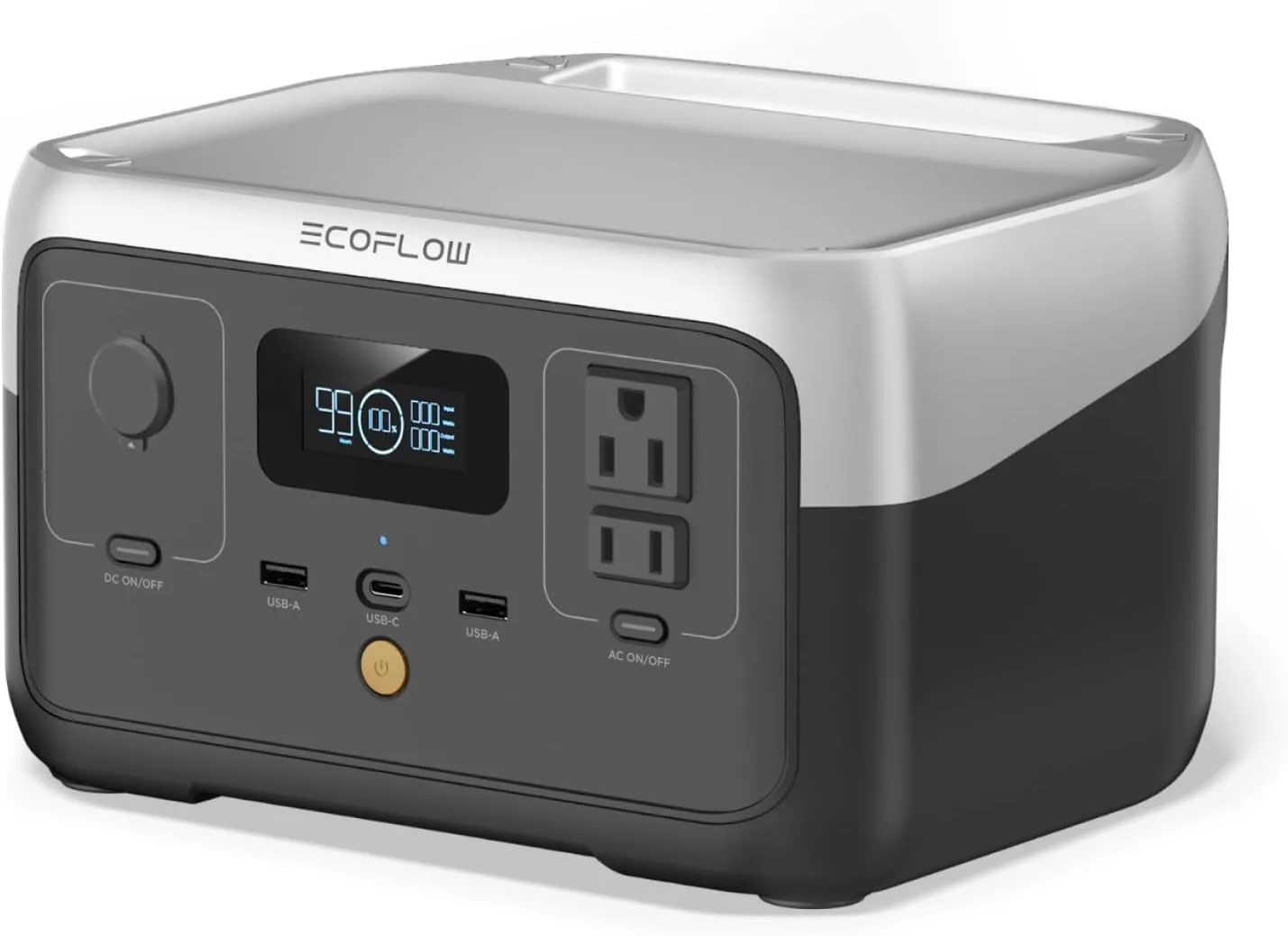
EcoFlow RIVER 2
Highlights
- 243Wh rated capacity
- 300W continuous AC
- 600W surge
- LiFePO4 chemistry
- Up to 110W solar input
- 7.7 lb (~3.5 kg)
Best for
- RIVER 2: phones, cameras and a laptop on short trips
- Travel kits when you need quiet pack power, not appliance runtime
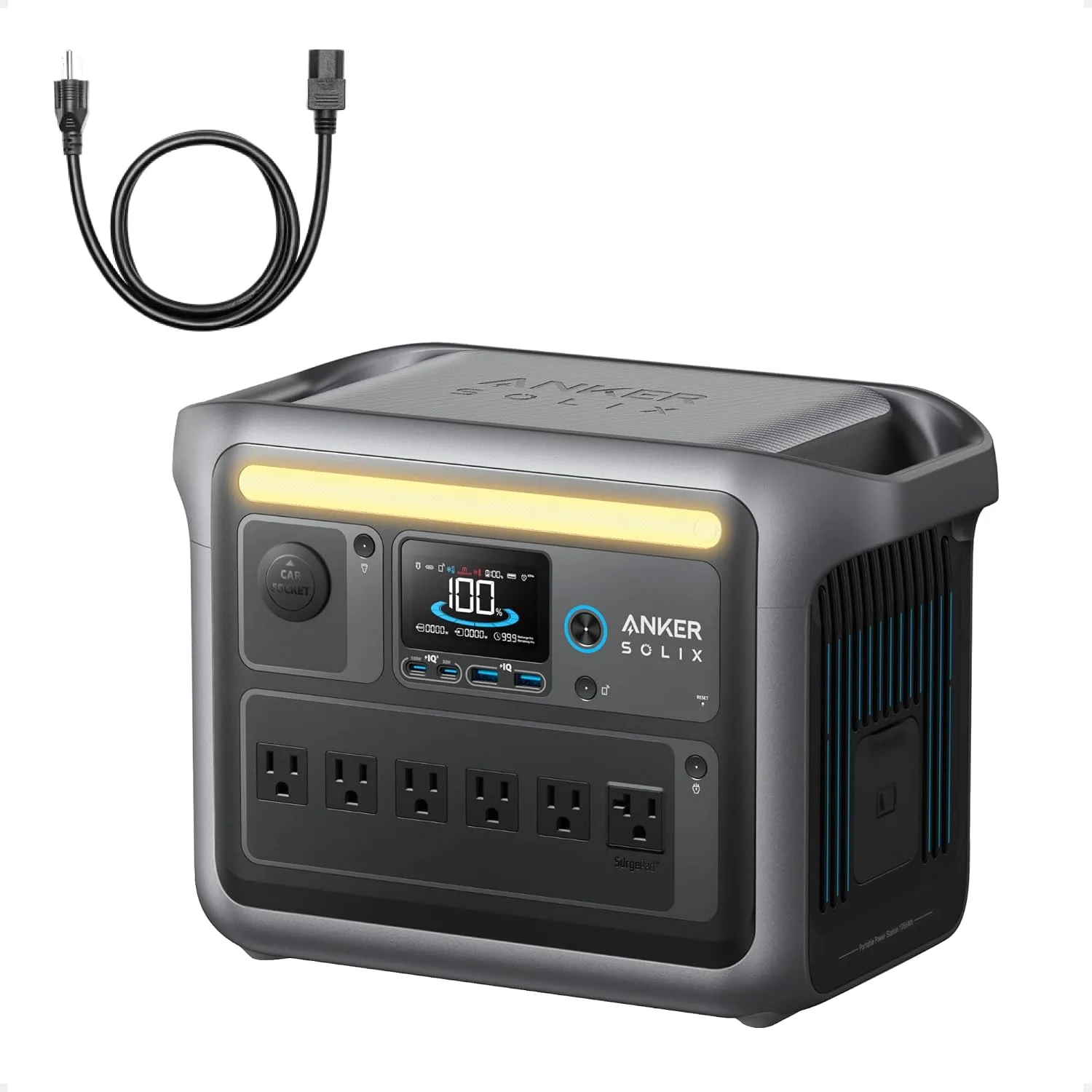
Anker Full Charge in 58 Min
Highlights
- 56Wh rated capacity
- 1800W continuous AC
- LiFePO4 chemistry
- 27.6 lb (~12.5 kg)
- About $599.99 list
Best for
- SOLIX C1000: phones, cameras and a laptop on short trips
- Travel kits when you need quiet pack power, not appliance runtime
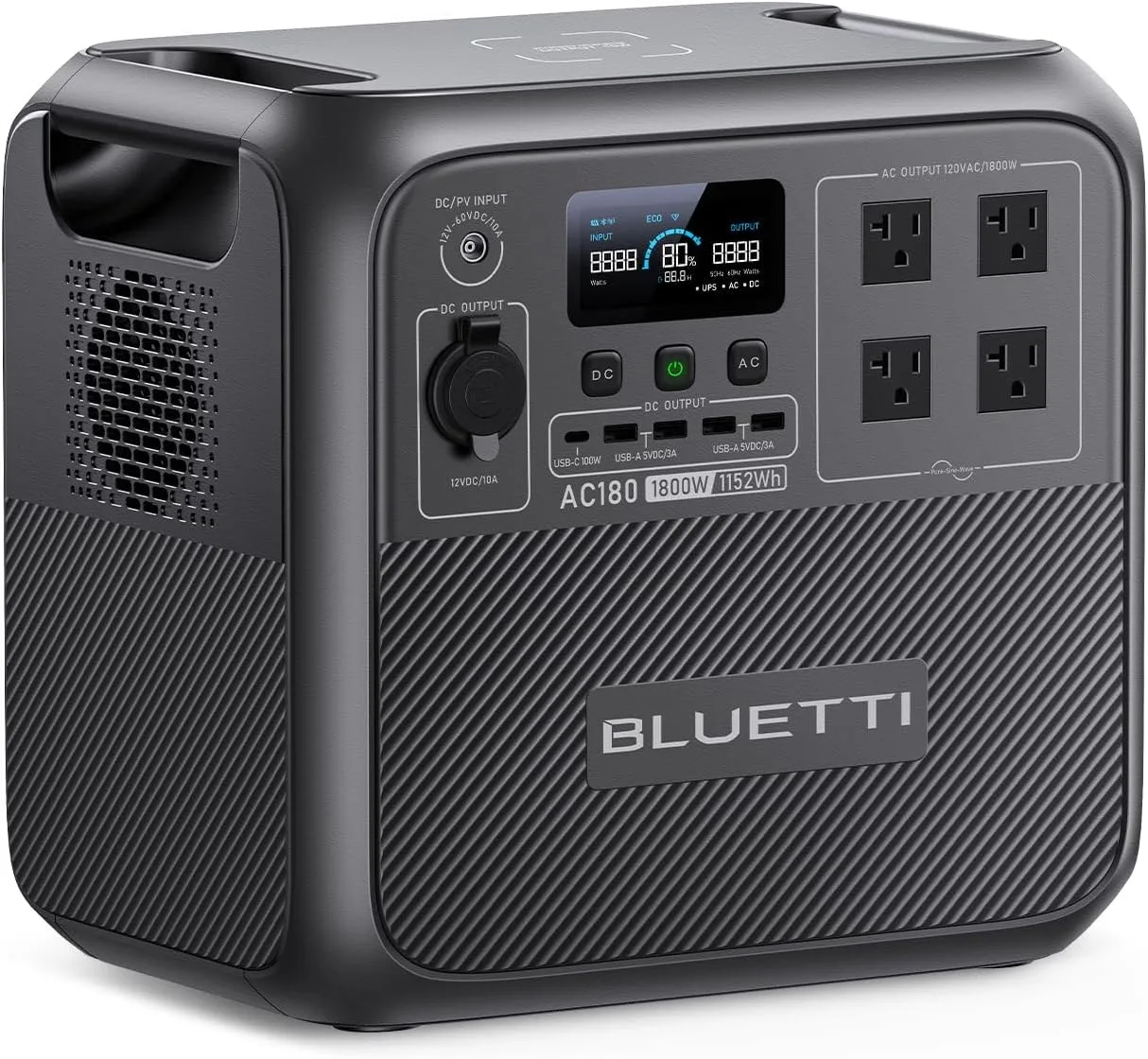
BLUETTI Portable Power Station AC180, 1152Wh LiFePO4 Battery Backup w/ 2 1800W
Highlights
- 1152Wh rated capacity
- 1800W continuous AC
- LiFePO4 chemistry
- Up to 500W solar input
- 35.3 lb (~16.0 kg)
- About $499 list
Best for
- AC180: most Wh per list dollar in mid-size LiFePO4 shortlists (~1152Wh)
- Home essentials when 1800W continuous matters more than a light carry
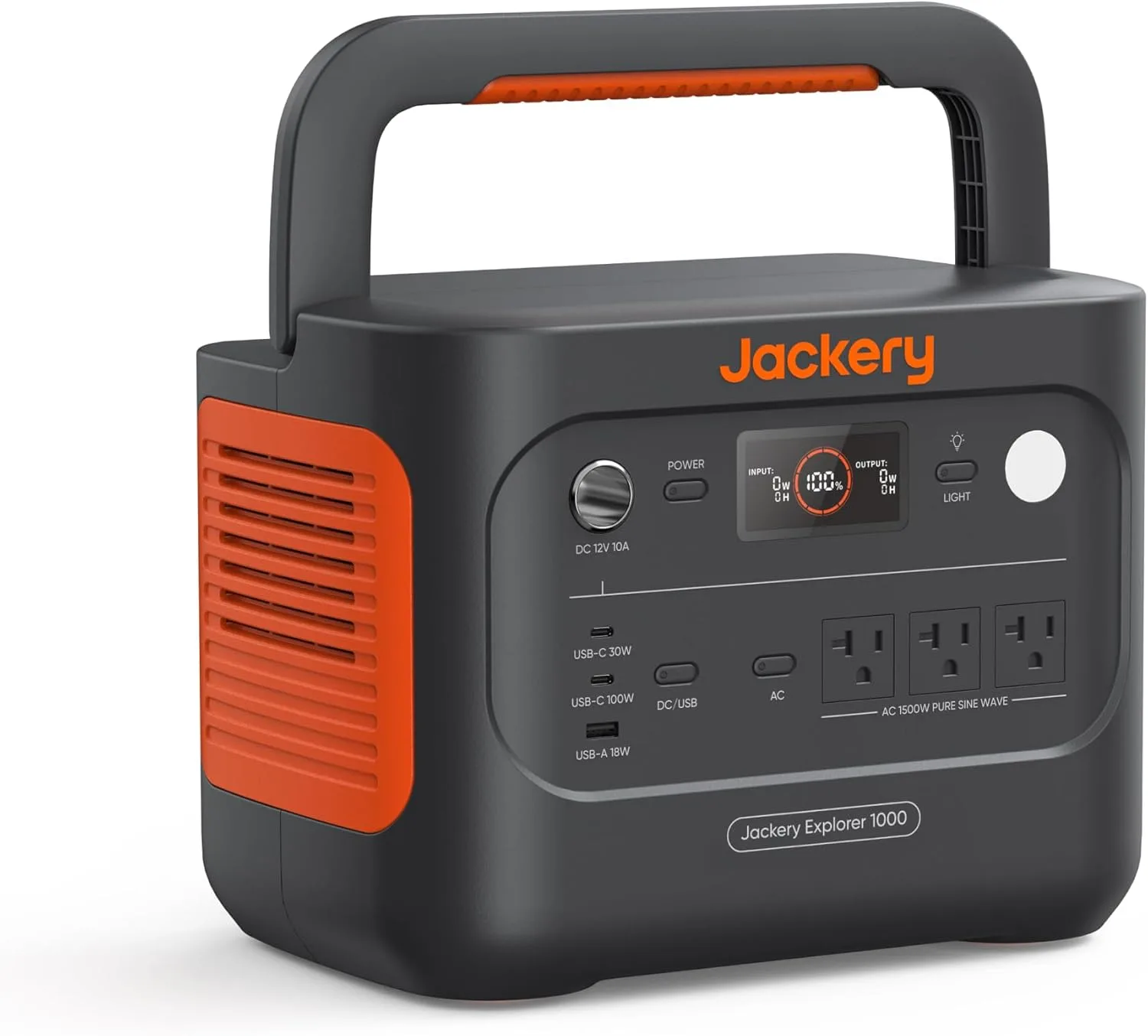
Jackery Explorer 1000 v2
Highlights
- 1070Wh rated capacity
- 1500W continuous AC
- LiFePO4 chemistry
- Up to 400W solar input
- 23.8 lb (~10.8 kg)
- About $559 list
Best for
- Explorer 1000 v2: weekend camping when 23.8 lb carry weight matters as much as 1070Wh
- Essentials bridge at home (fridge cycles, router) when sized to the Wh
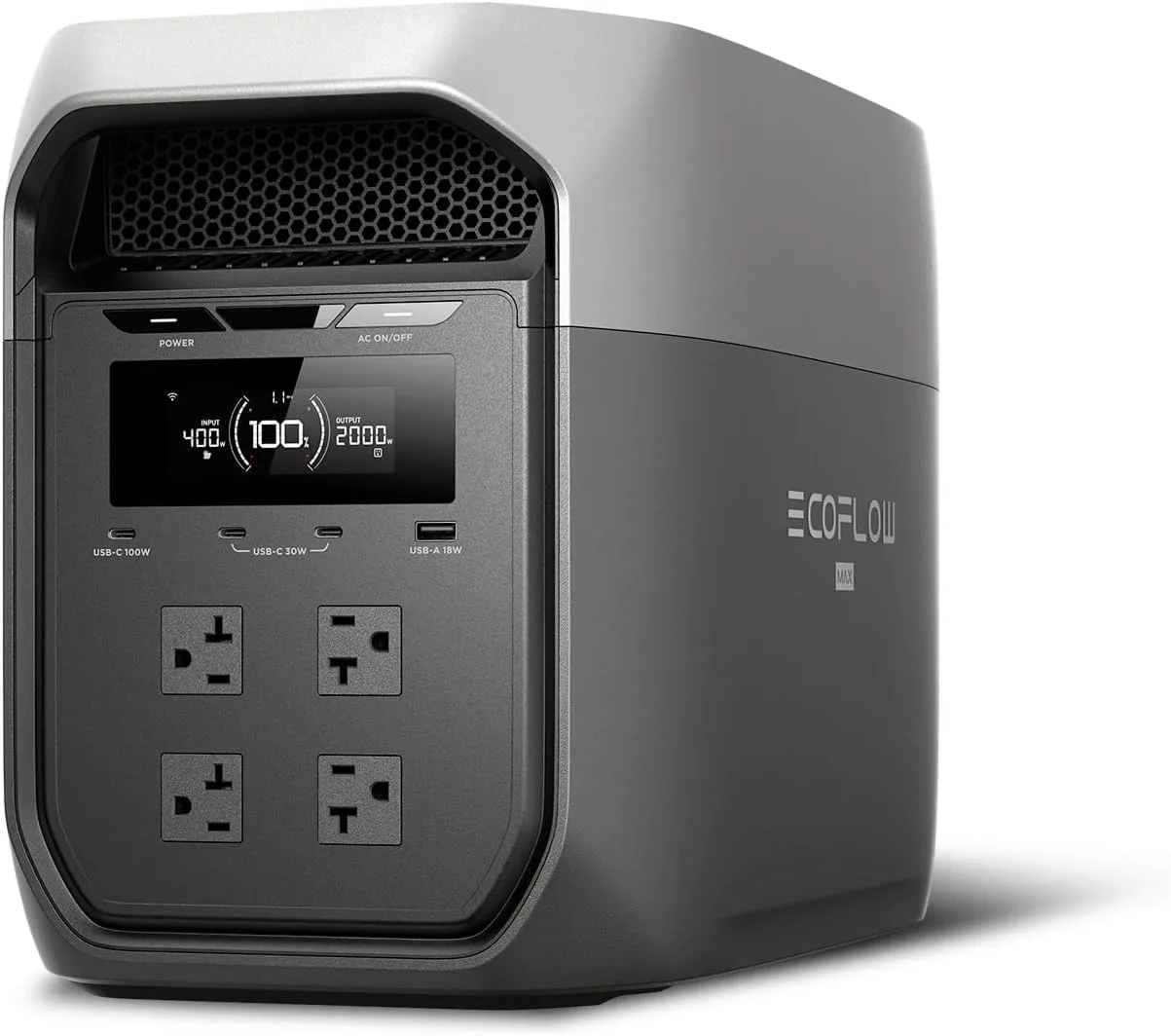
EcoFlow DELTA 3 Max Portable Power Station, 2048Wh LFP Battery
Highlights
- 2048Wh rated capacity
- 2400W continuous AC
- 4800W surge
- LiFePO4 chemistry
- Up to 500W solar input
- 44.8 lb (~20.3 kg)
Best for
- DELTA 3 Max: longer outages or higher continuous loads (still not whole-home wiring)
- RV / off-grid days where recharge speed matters as much as Wh
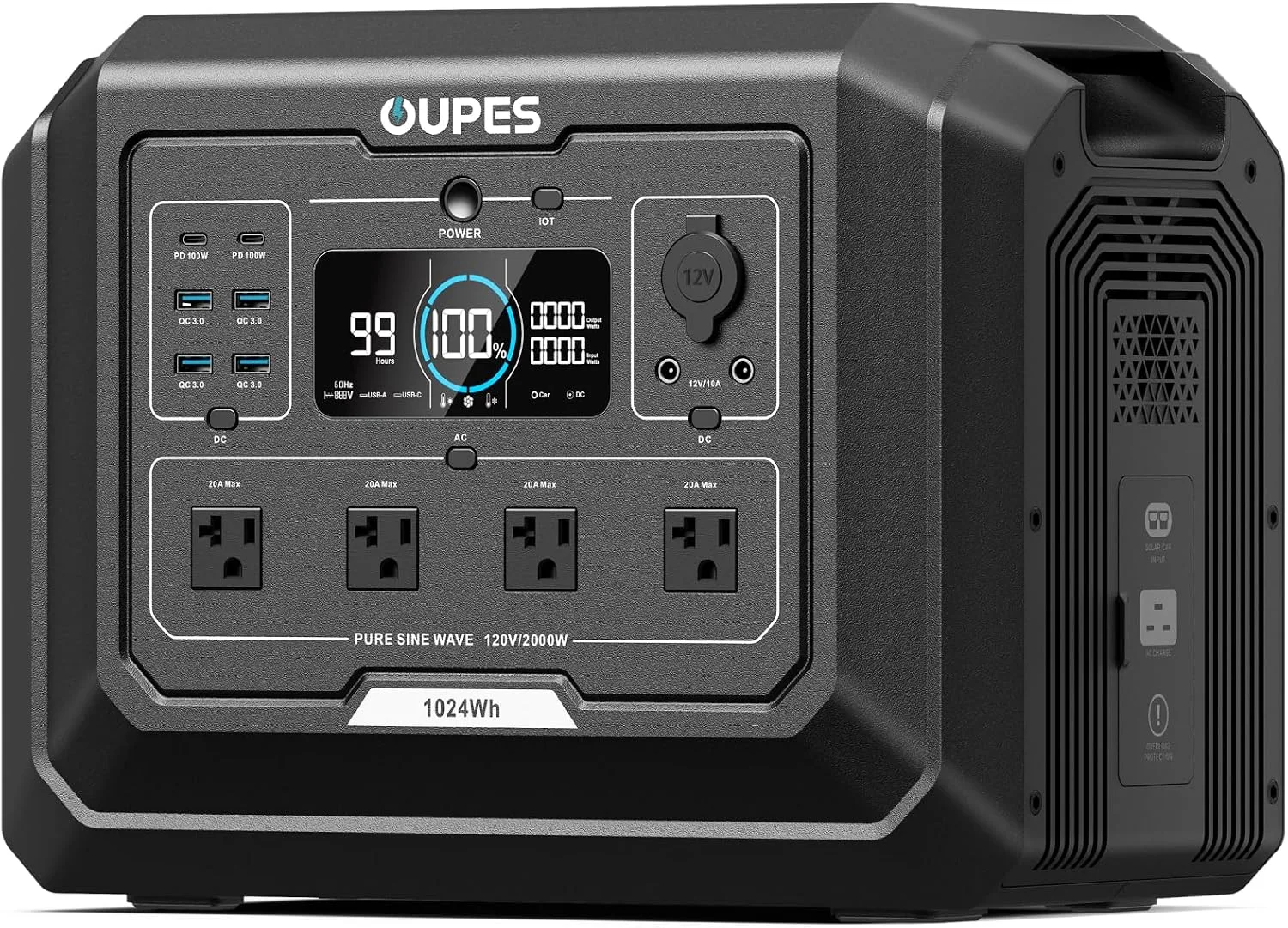
OUPES Mega 1 Portable Power Station 1024Wh 2000W
Highlights
- 1024Wh rated capacity
- 2000W continuous AC
- 4500W surge
- LiFePO4 chemistry
- Up to 800W solar input
- 27.8 lb (~12.6 kg)
Best for
- Mega 1: small appliances and tools that need ~2000W continuous, not just phone charging
- Essentials bridge at home (fridge cycles, router) when sized to the Wh
Spec snapshot
Prices are list prices, not sale stickers. Ratings are listing aggregates, not owner proof.
Note: The Anker C1000 capacity is listed as 56 Wh in the source data, which conflicts with its 1,056 Wh nameplate. Treat this as a listing error and verify the capacity on the product page before purchase.
| Product | Price | Capacity (Wh) | Output (W) | Weight (lb) | Rating |
|---|---|---|---|---|---|
| EcoFlow RIVER 2 | $177.65 | 243 Wh | 300 W | 7.7 lb | 4.3 |
| Anker C1000 Portable Power Station with Car Charging Cable, 1,056Wh | $599.99 | 56 Wh (see note) | 1800 W | 27.6 lb | 4.7 |
| BLUETTI AC180 | $499 | 1152 Wh | 1800 W | 35.3 lb | 4.5 |
| Jackery Explorer 1000 v2 Portable Power Station,1070Wh,1500W | $559 | 1070 Wh | 1500 W | 23.8 lb | 4.7 |
| EcoFlow DELTA 3 Max Portable Power Station, 2048Wh LFP Battery | $1199 | 2048 Wh | 2400 W | 44.8 lb | 4.7 |
| OUPES Mega 1 Portable Power Station 1024Wh 2000W | $549 | 1024 Wh | 2000 W | 27.8 lb | 4.5 |
Why each one earned its slot
- BLUETTI AC180 — $499, 1,152 Wh, 1,800 W, 35.3 lb. Cheapest nameplate $/Wh here at $0.43. Owners describe wiring a basement circuit through it and never seeing the internet blink; another ran a garage fridge 36 hours. Suits: short outages, fridge duty, a stationary UPS. Skip if: you'll carry it far, or you expect the full 1,152 Wh at the outlet — owners report ~20 W idle draw and roughly 90% usable capacity.
- Jackery Explorer 1000 v2 — $559, 1,070 Wh, 1,500 W, 23.8 lb. The lightest kilowatt-hour in the group, and owners repeatedly call out quiet mode. One ran a fridge and a portable AC together during storm prep. Suits: bedroom and living-room backup, tent camping with a fridge. Skip if: your load includes a 1,700 W air fryer or a big miter saw — owners report it refuses both.
- EcoFlow DELTA 3 Max — $1,199, 2,048 Wh, 2,400 W, 44.8 lb. The only unit here that owners describe running a 12 V compressor fridge for five days straight. Its listing cites a 10 ms transfer time, which would make it a credible UPS for a desktop — verify that figure on the product page before relying on it. Suits: multi-day outages, job sites, anyone whose essentials include a full-size fridge. Skip if: $1,199 is more than your outage history justifies, or you need more than 100 W USB out.
- OUPES Mega 1 — $549, 1,024 Wh, 2,000 W, 27.8 lb. Highest continuous output per dollar in the 1 kWh tier, and owners report 0–100% AC charging in about 35 minutes. Suits: tool-heavy camping, truck builds, buyers who want watts over brand. Skip if: you need the advertised 4,500 W surge — one owner's unit tripped between 2,050 and 2,200 W — or you lose cables easily, since the charge cable is proprietary.
- EcoFlow RIVER 2 — $177.65, 243 Wh, 300 W, 7.7 lb. Owners report a full night on a CPAP (seven and a half hours) and steady shed duty with a 110 W panel. Suits: CPAP backup, router UPS, phone and laptop charging off-grid. Skip if: anything with a heating element is on your list — a coffee maker is out of reach at 300 W continuous.
- Anker C1000 Portable Power Station with Car Charging Cable, 1,056Wh — $599.99, 1,800 W, 27.6 lb. Owner themes are strong: a camper backcharged for a day, an 18 cu ft fridge carried eight hours with 38% left. Suits: RV and camper owners who want one box to run quiet-hour appliances. Skip if: you need the listed capacity to be verifiable — the 56 Wh figure on file doesn't reconcile with the 1,056 Wh nameplate, and I'd want that resolved before spending $599.99.
Where these six fall short
Three recurring traps show up across the owner notes, and they're worth knowing before you buy any of them.
Usable capacity is not nameplate capacity. Inverter idle draw, the reserve the BMS holds back, and conversion losses all take a bite. Owners of the AC180 and the Mega 1 both report real runtime landing below the arithmetic. Plan for roughly 80–90% of the rated watt-hours at the outlet, and size up if you're close to the line.
Surge ratings are marketing. The Mega 1's 4,500 W surge claim didn't survive one owner's testing. Treat surge as a maybe and continuous watts as the contract.
Solar is an add-on, not a feature. None of these six ships with a panel, and the Jackery listing states plainly that it's compatible only with Jackery panels. Budget for the panel separately, and expect real-world input well under the rated wattage on anything but a clear, perpendicular, mid-day sun. For solar sizing: a 200 W panel in good sun realistically delivers well under its rating through these charge controllers, so plan on two panels or a larger single panel if you want to refill a 1 kWh battery in a day. Match panel voltage and connector to the station's input spec before you buy.
If none of these fit
Two directions worth considering instead.
If your real need is a fridge and a few circuits for a multi-day outage, skip the portable category and look at a home backup battery paired with a transfer switch — the sizing math is different and the runtime is measured in days, not hours.
If your need is a laptop and a phone at a campsite, a 243 Wh unit like the RIVER 2 is already more than you need, and a smaller 100–200 Wh bank will save you weight and money. Match the box to the load, not to the tier above it.
And a rule for the sub-$500 tier: cheaper is better when your load is small and constant — a router, a CPAP, a few lamps — and you're not chasing a fridge overnight. Above that load, the extra capacity is buying runtime you'll actually use, not just a bigger number on the box.
What owners keep coming back to
Across the notes, the pattern isn't brand loyalty — it's the moment the thing saved something. A fridge that stayed cold. A router that never dropped. A CPAP that ran until morning.
The RIVER 2 owners talk about sheds and CPAPs and the hour-long recharge. AC180 owners talk about UPS switchover and fridge hours. Explorer 1000 v2 owners talk about quiet. DELTA 3 Max owners talk about five-day fridge runs. Mega 1 owners talk about charging speed and then, honestly, about fan noise and a cable they can't replace at a hardware store. Anker C1000 owners talk about camper life and a unit that feels heavier than its listed 27.6 lb.
The one signal that isn't in the anecdotes: support and warranty outcomes. The AC180's listing documents a 5-year warranty term; the others vary, so check the warranty page for each before you buy. A strong warranty is often the difference between a station that lasts and one that becomes e-waste after a bad BMS.
That's the useful signal: not which one wins a spec sheet, but which one's compromises you can live with. Buy the one whose weaknesses match your patience.
Frequently asked
Will the BLUETTI AC180 run my refrigerator overnight?
Owners report a full-size garage fridge for 36 hours and a kitchen side-by-side for 12, both from 100% to 1%. A modern fridge cycling at 100–150 W average is comfortably inside that. A chest freezer plus a space heater is not.
Can the EcoFlow RIVER 2 run a CPAP all night?
One owner reports seven and a half hours on a single charge with a CPAP. Check your machine's draw — most sit in the 30–60 W range, which fits inside the 300 W continuous rating with room to spare.
Why is the Anker C1000 ranked last when its owners like it?
Because the capacity figure on file (56 Wh) doesn't reconcile with the 1,056 Wh nameplate, and I won't rank a number I can't verify. The owner themes are strong; the spec sheet needs a second look.
Do any of these include solar panels?
No. All six are stations only. The Jackery listing notes compatibility with Jackery panels specifically, so check panel compatibility before you buy a third-party panel for any of them.
Method and sources
Model names and list prices come from the WattPicks catalog at build time. WattPicks does not run its own laboratory tests on power stations, and nothing on this page is presented as a measured result — it is catalog-backed buying guidance.
Read our methodology for how the catalog is normalized, and about WattPicks for who publishes it.