
Best 500Wh Portable Power Stations: 4 Picks Ranked
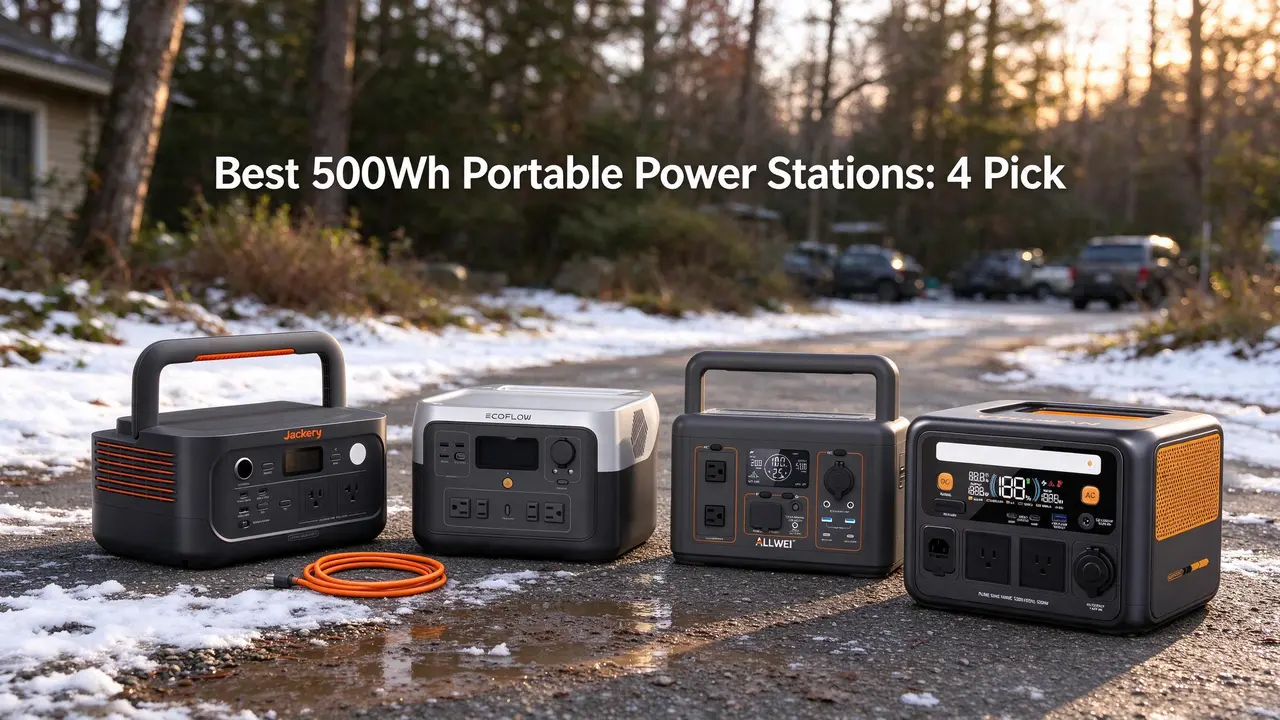
Four mid-size stations that actually land near the 500Wh class — ranked on usable capacity, chemistry, AC output, and cost per Wh. The Jackery wins on regulated 12V, but the ALLWEI is the value play.
Updated
The 500Wh question, answered
If you're shopping the 500Wh class, you want a station that runs a fridge overnight, keeps a CPAP going, or bridges a short outage without weighing like a car battery. The four here all sit near that mark — but they don't agree on chemistry, outlet count, or what "500Wh" actually means once you subtract inverter losses.
One boundary up front: this is not a whole-home backup list. None of these will run a space heater, a microwave for long, or a full-size fridge through a multi-day outage. If that's the job, you want 1,500Wh and up. These are camping, tailgate, CPAP, and short-outage tools.
A note on the numbers: prices and specs come from the listings and our catalogue, and the owner themes come from reviews on file. My checks are home-user checks, not lab-bench measurements.
Affiliate disclosure: As an Amazon Associate I earn from qualifying purchases. Picks are fit-led, not commission-led. No commission differences influenced the ranking; if they had, I'd say so here.
How this list was built
I started with the mid-size portable power pool — stations advertised around 500Wh with a published AC output — and narrowed to four that owners actually use for camping, CPAP, and short outages. Solar-panel-only kits were excluded; every unit here has a real AC inverter.
The ranking weights: usable-capacity confidence 30% (nameplate Wh plus how owners describe real runtime), chemistry and cycle life 25% (LiFePO4 vs NMC and what that means for years of use), AC output and ports 20%, recharge speed 15%, and owner-theme consistency 10%. Every percentage is scored — nothing is listed and then ignored.
Why #1 beats #2: the Jackery and the ALLWEI are close on paper — both 512Wh, both 500W, both LiFePO4. The Jackery wins on the 30% usable-capacity weight because owners consistently describe multi-hour fridge runs and a regulated 12V output that doesn't sag, and on the 10% owner-theme weight because those reports are detailed and repeated. The ALLWEI takes the value crown on $/Wh, but its sleep-timer lockout is a real usability ding that shows up in owner notes.
I did not run these on a bench. What I did was read the owner reports on file, cross-check them against the listing specs, and weigh the themes that repeat across high-helpful reviews. Where a spec is missing — the VTOMAN's capacity, for instance — I say so rather than guess.
Scoreboard on those weights: Jackery Explorer 500 v2 — High on usable-capacity confidence (owner-reported fridge runs, regulated 12V), High on chemistry (LiFePO4), Med on AC output and ports (single AC outlet, no USB-C), Med on recharge speed, High on owner-theme consistency. ALLWEI PPS600-1 — High on usable-capacity confidence (512Wh nameplate, one capacity complaint), High on chemistry (LiFePO4), High on AC output and ports (fast USB-C, multiple outlets), High on recharge speed, Med on owner-theme consistency (sleep-timer lockout). EcoFlow RIVER 2 Max — High on usable-capacity confidence (512Wh nameplate), High on chemistry (LiFePO4), High on AC output and ports (AC, DC, USB-A, USB-C), High on recharge speed (~1 hr AC), Med on owner-theme consistency (WiFi drain, firmware risk). VTOMAN Jump 600X — Low on usable-capacity confidence (capacity n/a), Med on chemistry (not confirmed), High on AC output and ports (1,200W continuous, 9 ports), High on recharge speed, Med on owner-theme consistency (support inconsistency, tight input port). That is why the pick splits by job rather than one universal winner.
Quick picks: which one, and why
The Jackery Explorer 500 v2 takes the top spot for one reason that shows up again and again in owner notes: a regulated 12V DC output that holds steady under load. If you're running a DC fridge or sensitive radio gear, that's the feature that separates it from the pack.
The ALLWEI PPS600-1 is the value pick at $279 — the lowest nameplate cost per Wh here at $0.54/Wh — and it's the one I'd hand someone who wants a compact, backpackable backup with a genuinely fast USB-C port. The EcoFlow RIVER 2 Max is the fast-recharge specialist, with pass-through UPS behavior that owners lean on during outages. And the VTOMAN Jump 600X is the odd one out: 1,200W continuous output in a 9.9 lb body, but its capacity isn't on file, so treat it as a high-output compact rather than a true 500Wh peer.
- Best overall: Jackery Explorer 500 v2 — regulated 12V, fridge-friendly runtime, $399
- Best value: ALLWEI PPS600-1 — $279, $0.54/Wh, fast USB-C, compact
- Best fast-recharge: EcoFlow RIVER 2 Max — ~1 hr AC recharge, pass-through UPS
- Best high-output compact: VTOMAN Jump 600X — 1,200W continuous, 9.9 lb, capacity n/a
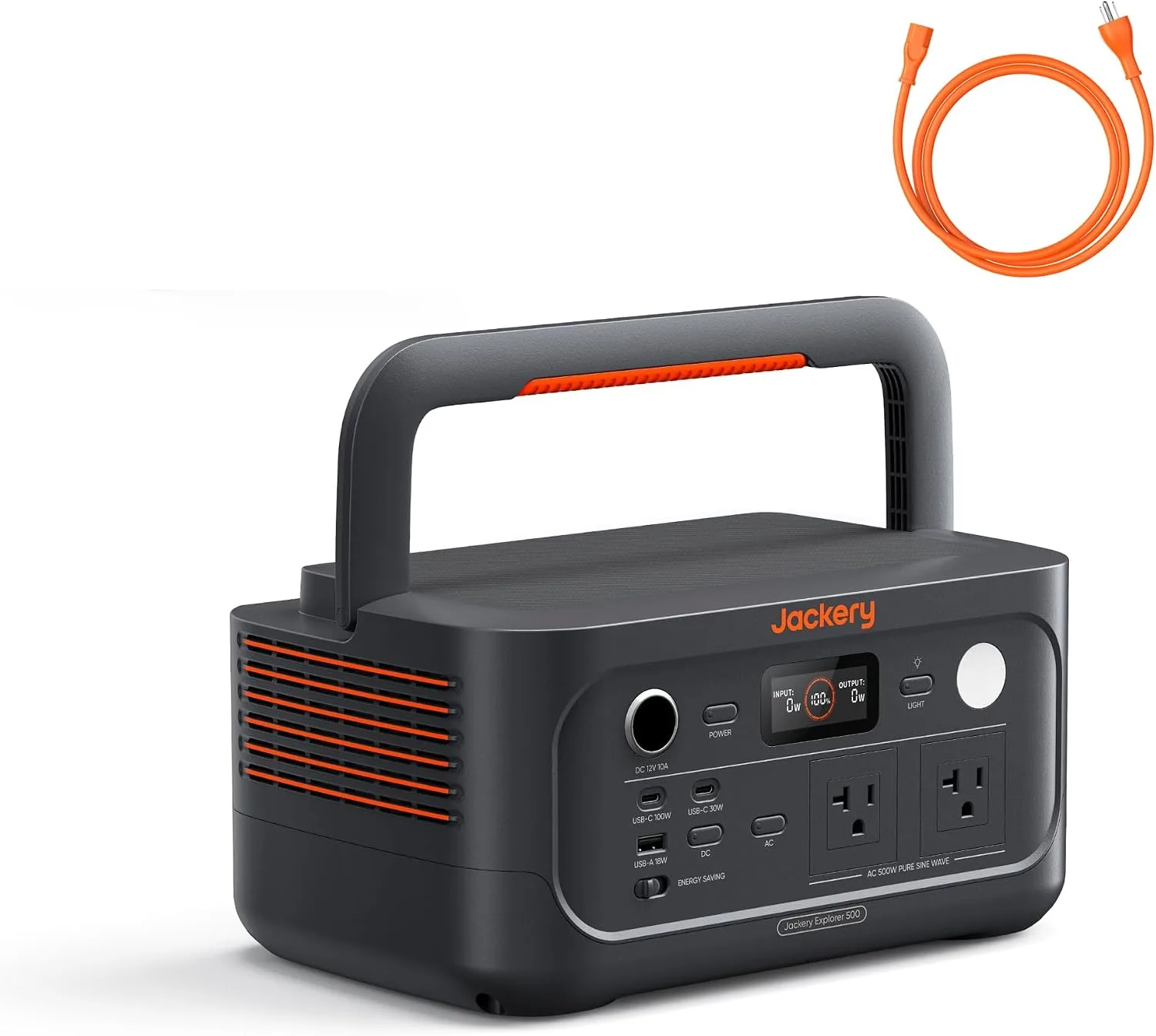
Jackery Explorer 500 v2 Power Station, 512Wh/500W, AC Cable Included
Highlights
- 640Wh rated capacity
- 500W continuous AC
- 1000W surge
- LiFePO4 chemistry
- Up to 200W solar input
- 14.1 lb (~6.4 kg)
Best for
- Explorer 600 v2: most Wh-per-dollar in this ~500Wh band for weekend fridge/CPAP math
- Car-camp carry at 14.1 lb when review depth matters as much as peak watts
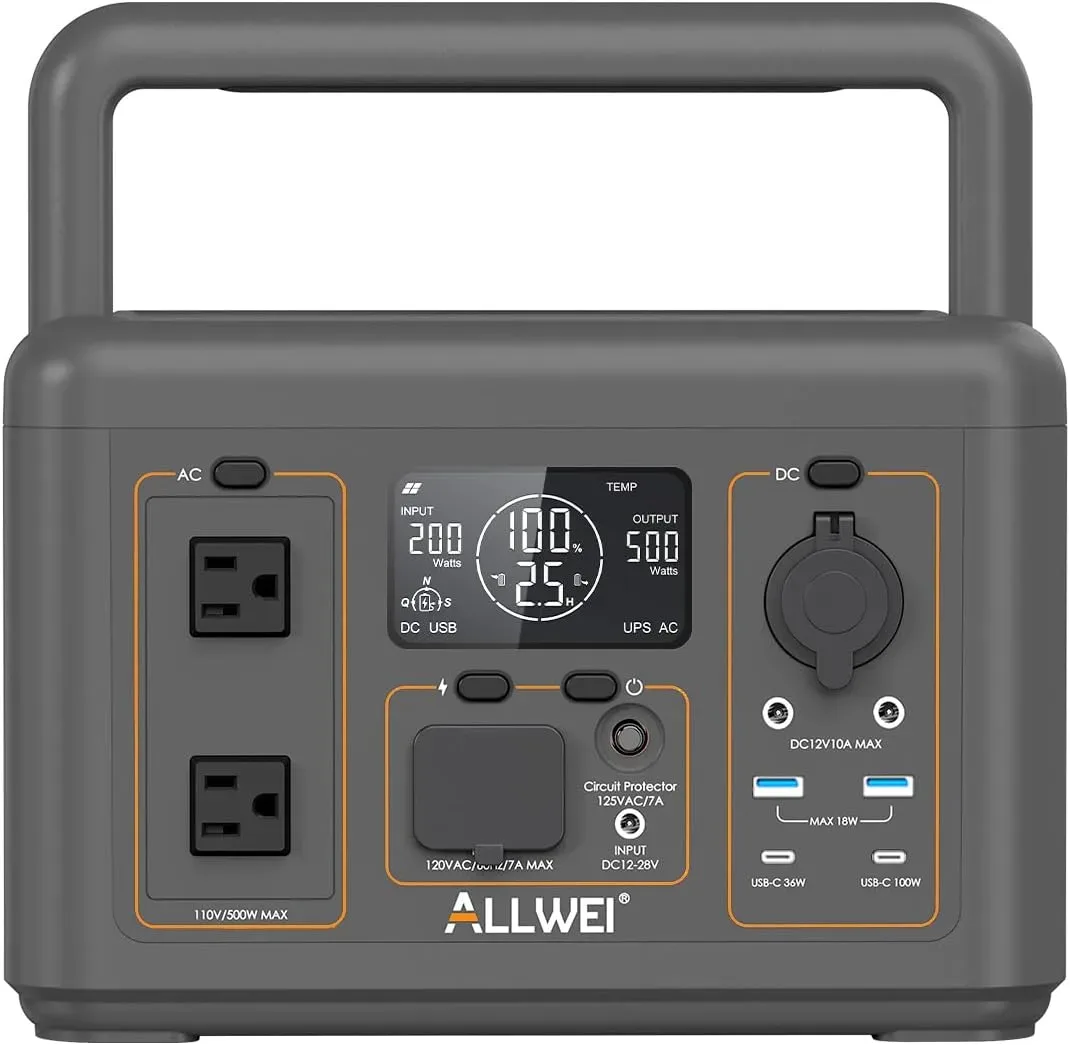
ALLWEI Portable Power Station 500W, 512Wh LiFePO4 Battery UPS Backup Power
Highlights
- 512Wh rated capacity
- 500W continuous AC
- LiFePO4 chemistry
- 13 lb (~5.9 kg)
- About $279 list
Best for
- Portable: weekend camping when 13 lb carry weight matters as much as 512Wh
- Essentials bridge at home (fridge cycles, router) when sized to the Wh
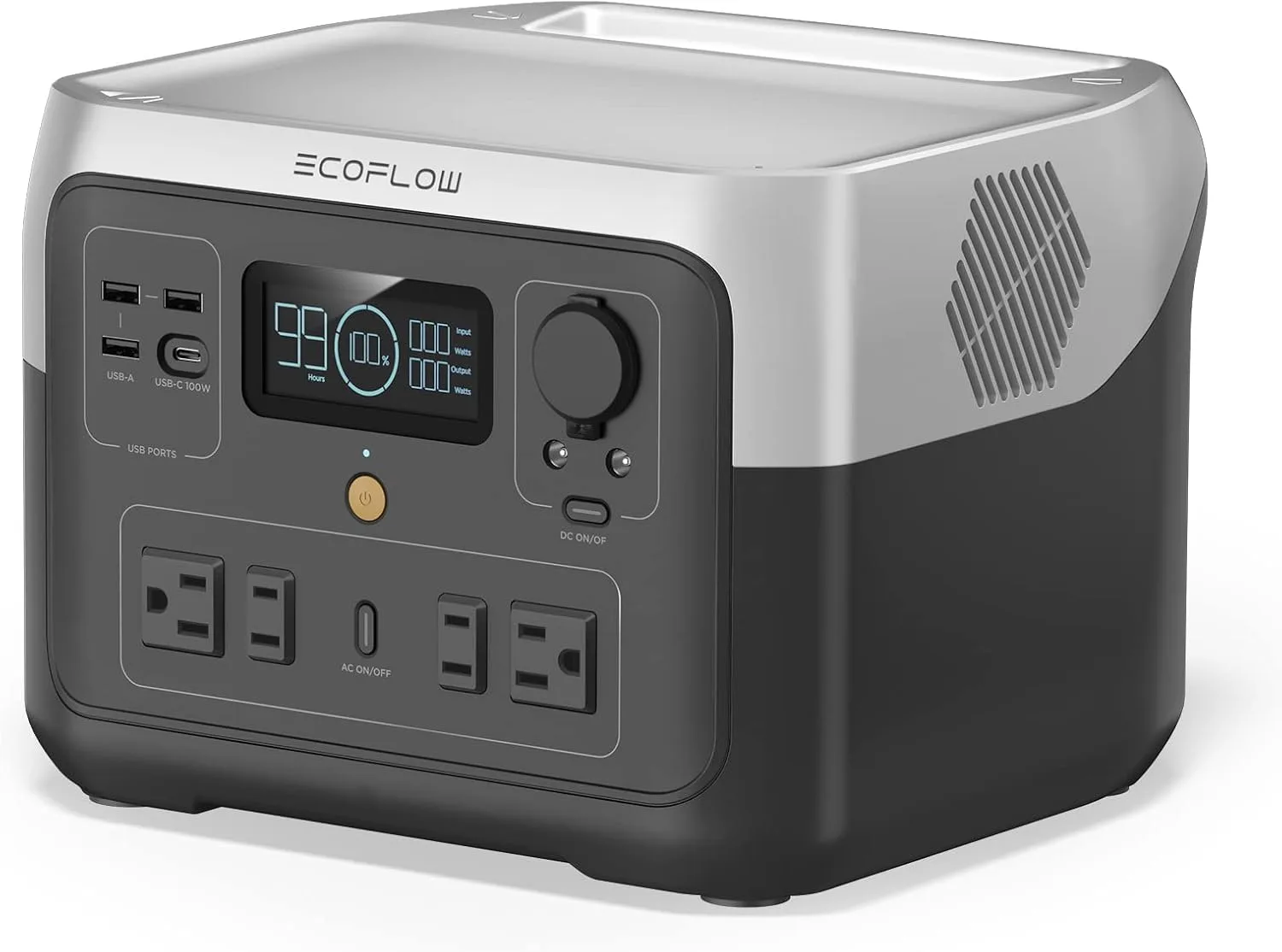
EcoFlow RIVER 2 Max
Highlights
- 512Wh rated capacity
- 500W continuous AC
- 1000W surge
- LiFePO4 chemistry
- Up to 220W solar input
- 13.4 lb (~6.1 kg)
Best for
- RIVER 2 Max: fast AC refill buyers who will pay for 1-hour recharge marketing
- Lightest chassis here (13.4 lb) when pack weight beats capacity
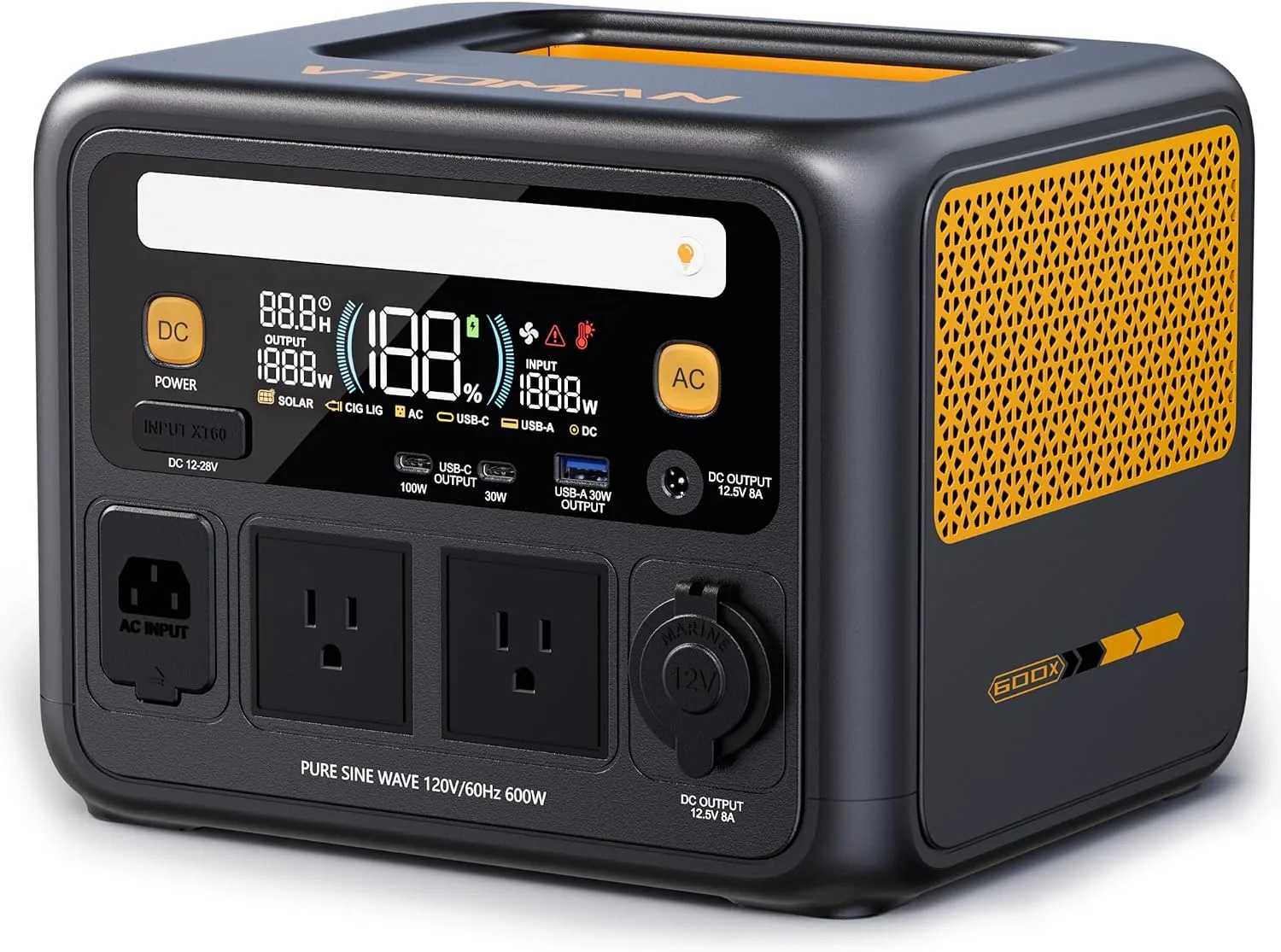
VTOMAN Jump 600X Portable Power Station 600W, 9 Ports LEP Solar Generator
Highlights
- About $299.99 list
- VTOMAN catalog listing
- Specs from manufacturer listings
Best for
- VTOMAN Jump 600X Portable Power Station 600W, 9 Ports LEP Solar Generator: longer outages or higher continuous loads (still not whole-home wiring)
- RV / off-grid days where recharge speed matters as much as Wh
Spec snapshot
Prices are list prices from our catalogue, not sale stickers. Ratings are listing aggregates, not owner proof.
| Product | Price | Capacity (Wh) | Output (W) | Weight (lb) | Rating |
|---|---|---|---|---|---|
| Jackery Explorer 500 v2 Power Station, 512Wh/500W, AC Cable Included | $399 | 512 Wh | 500 W | 14.1 lb | 4.7 |
| EcoFlow RIVER 2 Max | n/a (not on file) | 512 Wh | 500 W | 13.4 lb | 4.4 |
| ALLWEI PPS600-1 | $279 | 512 Wh | 500 W | 13 lb | 4.4 |
| VTOMAN Jump 600X Portable Power Station 600W, 9 Ports LEP Solar | $299.99 | n/a (not on file) | 1200 W | 9.9 lb | 4.4 |
Why each one is here
Jackery Explorer 500 v2 Power Station, 512Wh/500W, AC Cable Included — $399, 512 Wh, 500 W, 14.1 lb. The headline number is the 512Wh capacity, which ties the ALLWEI and EcoFlow for the largest nameplate on this list, but the reason it ranks first is the regulated 12V DC output. Owners describe running a DC fridge/freezer overnight and still having over half the charge left, with the fridge never throwing an error — that's the failure mode cheaper stations hit. It also handled a pellet stove's startup surge and ran a camping fridge for roughly two days in normal mode. The trade-offs are real: one AC outlet, no USB-C, and a solar input floor that makes a 60W panel useless — plan on 100W. Support is the wildcard; some owners got fast replacements, others described slow email and a warranty runaround. Suits: DC-fridge campers, ham radio, and anyone who wants a steady 12V rail. Skip if: you need multiple AC outlets or USB-C without a dongle.
ALLWEI PPS600-1 — $279, 512 Wh, 500 W, 13 lb. This is the value play, and the math backs it: $0.54/Wh nameplate is the lowest here. Owners praise the fast USB-C port (a power-hungry phone reported fast charging), the three-level side light, and the independent AC/USB/DC buttons that let you kill standby drain. It held a charge for months in storage, which matters for emergency kit. The caveats are specific: the sleep timer can't be disabled and shuts off the DC port after about two hours of no draw — fine for phones, fatal for a mini-fridge cycling overnight. Solar input tops out around 70–80W, so a 100W panel is the practical minimum. And one owner reported capacity falling short of the claim, so test yours in the return window. Suits: backpackable device charging, events, and budget-conscious buyers. Skip if: you need an unattended DC load to run all night.
EcoFlow RIVER 2 Max — list price n/a (not on file), 512 Wh, 500 W, 13.4 lb. The fast-recharge specialist: owners describe going from partial to full in well under an hour on AC, and solar from two 100W panels reaching full in under three hours even under load. Pass-through charging is the quiet hero — one owner ran a desktop setup through it as a UPS and the devices never blinked. The port mix (AC, DC, USB-A, USB-C) covers a lot at once. The cracks: the WiFi module drains roughly 5% per day when idle, the app wants internet for some settings, and firmware is a genuine risk — one owner's unit bricked into an overload state after an update. CPAP users need a model-specific DC converter cable; the 12V output won't feed a 24V AirSense directly. Suits: fast-recharge camping, craft shows, and short UPS duty. Skip if: you want a station that never touches an app.
VTOMAN Jump 600X Portable Power Station 600W, 9 Ports LEP Solar — $299.99, capacity n/a (not on file), 1,200 W, 9.9 lb. This one doesn't fit the 500Wh band cleanly because its capacity isn't on file — treat it as a high-output compact rather than a true peer. What it does have is 1,200W continuous output in a 9.9 lb body, which is the highest AC rating here by a wide margin. Owners describe running a mini-fridge for over five hours on roughly half a charge, charging fully from the wall in a few hours, and holding 100% after sitting boxed for nearly two years. The front light is very bright and the buttons are findable by feel in the dark. The caveats: support is a coin flip (one owner got a fast replacement, another got no response), the power input port is tight enough that one owner damaged the plug, and one unit drained from 45–75% overnight with only a small 12V fridge in eco mode. Suits: high-wattage camping loads and compact off-grid power. Skip if: you need a confirmed 500Wh capacity or predictable support.
Who should not buy the top pick
The Jackery Explorer 500 v2 is the right call for a DC-fridge camper or someone who needs a steady 12V rail. It's the wrong call for two groups.
First, anyone who needs to run several AC devices at once during an outage. One AC outlet means a power strip or a different station — the EcoFlow's port mix is the better fit there. Second, anyone who wants USB-C charging without an adapter. The Jackery's port set is one AC outlet, no USB-C, USB-A, and car port, so USB-C is not present, and the single AC outlet is the real constraint. If you're powering a family's phones, a laptop, and a lamp simultaneously, look at the ALLWEI or the EcoFlow instead.
If none of these fit
Two directions worth considering. If you need more runtime than 500Wh class offers, step up to the 1,000Wh tier — the math changes: roughly double the capacity for a higher price, but the weight climbs too, and that's the trade-off. If you need whole-home or multi-day backup, a portable station isn't the tool; a gas generator or a home battery system is.
For related reading, see our guide to portable power station sizing and our explainer on LiFePO4 vs NMC chemistry — both go deeper on the trade-offs that decide this class.
What owners keep saying
The themes that repeat across high-helpful reviews, briefly:
- Jackery: regulated 12V holds under load; fridge runs for hours; single AC outlet and no USB-C are the common complaints; support experiences split.
- ALLWEI: fast USB-C and bright side light get praise; sleep timer lockout and solar input cap are the recurring gripes; one capacity complaint.
- EcoFlow: fast AC recharge and pass-through UPS are the standouts; WiFi drain and firmware risk are the watch-outs; CPAP users need a DC cable.
- VTOMAN: compact and bright with fast recharge; support inconsistency and a tight input port show up; one overnight-drain report.
Frequently asked
How long will the Jackery Explorer 500 v2 run a DC fridge?
Owners describe roughly two days in normal fridge mode and over half a charge left after an overnight run. That's owner-reported, not a lab figure — your runtime depends on the fridge's draw and ambient temperature.
Can the EcoFlow RIVER 2 Max run a CPAP?
Yes, but plan on a model-specific DC converter cable. The 12V DC output won't feed a 24V AirSense directly, and running through the AC brick wastes energy. One owner measured 35% for a 7-hour night on AC versus 11% on DC.
Why is the VTOMAN's capacity listed as n/a?
Because it isn't on file in our catalogue. The listing advertises 600W output and a 9.9 lb weight, but the Wh figure isn't confirmed — so I don't quote one. Treat it as a high-output compact, not a confirmed 500Wh peer.
Which one is cheapest per Wh?
The ALLWEI PPS600-1 at $0.54/Wh nameplate. The Jackery is $0.78/Wh at its 512Wh nameplate, and the EcoFlow and VTOMAN don't have confirmed list prices or capacities to compute against.
Can these run a space heater or microwave?
No — not for any useful time. A 500W-class inverter can't power a space heater (typically 750–1,500W) or a microwave (often 700–1,200W) beyond a brief surge, and even the VTOMAN's 1,200W continuous output won't sustain them. For those loads, you need a 1,500Wh+ station or a gas generator.
Method and sources
Model names and list prices come from the WattPicks catalog at build time. WattPicks does not run its own laboratory tests on power stations, and nothing on this page is presented as a measured result — it is catalog-backed buying guidance.
Read our methodology for how the catalog is normalized, and about WattPicks for who publishes it.