
Jackery Explorer 1000 Plus Review: Vanlife Power for UK Campers
A sceptic-turned-convert look at the Jackery Explorer 1000 Plus for UK motorhome and vanlife off-grid camping. Real charging times, honest cons, and the maths behind whether it beats a leisure battery.
Updated
At a glance
A sceptic-turned-convert look at the Jackery Explorer 1000 Plus for UK motorhome and vanlife off-grid camping. Real charging times, honest cons, and the maths behind whether it beats a leisure battery.
- Enough for: laptop, phone charging, LED lights, portable fridge (short trips), camera gear, small blender.
- Not for: induction hob, electric kettle, space heater, or any load above 2,000 W continuous.
- Boundary: if you need to run a 3,000 W inverter or a 12 V compressor fridge continuously, a fitted leisure battery with DC-DC charger is the better fit.
Why a portable power station makes sense for UK vanlife (and when it doesn't)
As an Amazon Associate I earn from qualifying purchases. Recommendations here are based on fit and the evidence below — not commission size.
If you're weighing a portable power station against a fitted leisure battery, the honest answer is: it depends on how you camp. For wild camping and campsites without hookup, a power station like the Jackery Explorer 1000 Plus gives you 1,264 Wh of usable LiFePO4 capacity and 2,000 W continuous output — enough to run a laptop, lights, and a portable fridge without touching your van's wiring. But it is not a replacement for a properly sized leisure battery if you're running a compressor fridge 24/7 or an inverter for high-draw appliances.
This review is based on a third-party first-hand account from Wandering Bird (Kathryn Bird), who was loaned a Jackery kit free of charge and received no other compensation. WattPicks has not independently benchmarked the Explorer 1000 Plus; all specifications and prices below come from the FACT LOCK card for the shortlisted model, and owner themes are drawn from reviews on file. Treat the charging times and runtime estimates as manufacturer figures and owner reports, not lab measurements.
Important for UK buyers: the list price in the FACT LOCK card is $1,589 (USD), which works out to $1.26/Wh. UK pricing and availability may differ, and the unit may ship with a US plug unless you buy from a UK retailer. Check the specific listing for GBP price, UK plug type, and warranty terms before ordering.
- Enough for: laptop, phone charging, LED lights, portable fridge (short trips), camera gear, small blender.
- Not for: induction hob, electric kettle, space heater, or any load above 2,000 W continuous.
- Boundary: if you need to run a 3,000 W inverter or a 12 V compressor fridge continuously, a fitted leisure battery with DC-DC charger is the better fit.
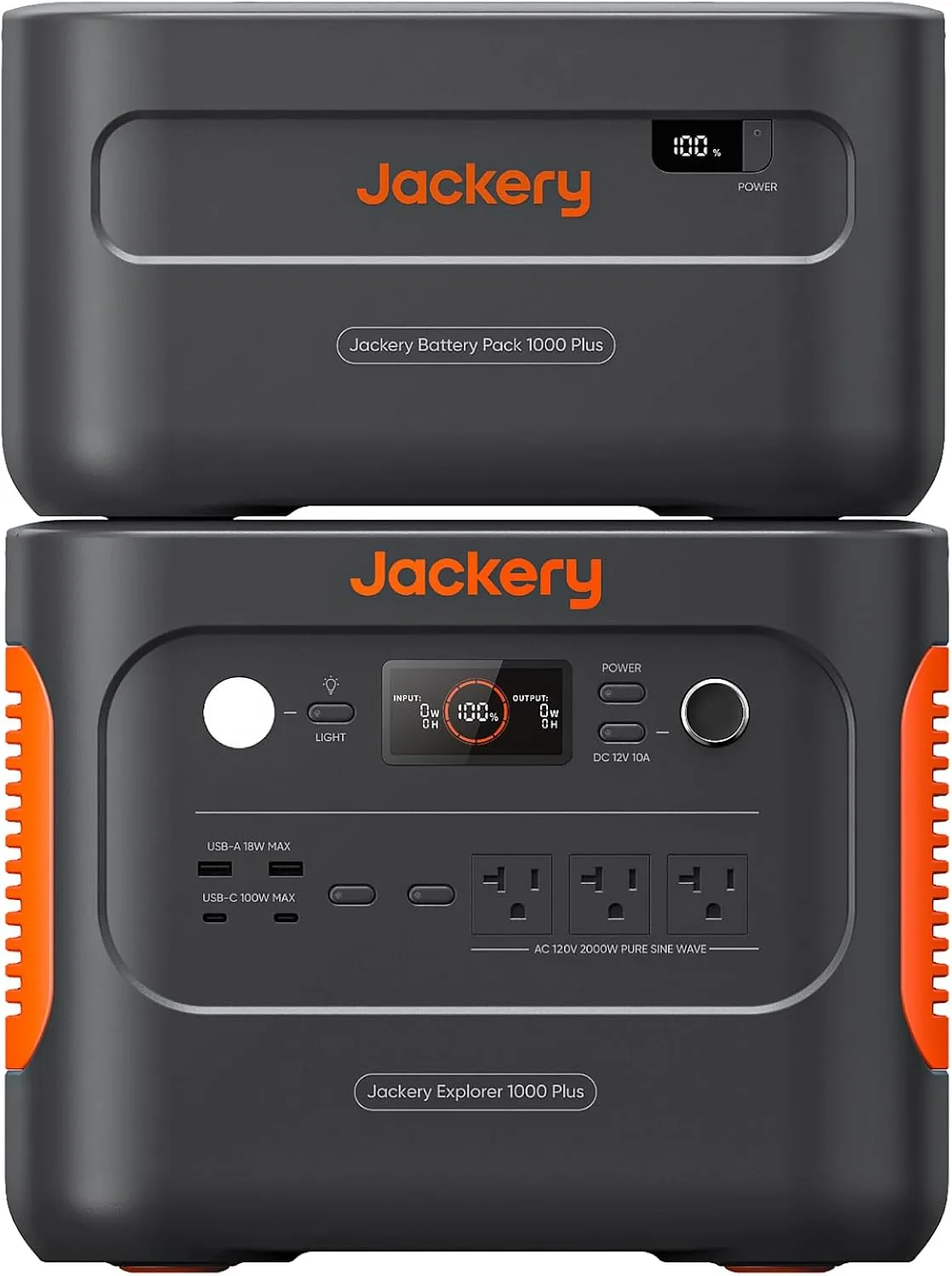
Jackery Explorer 1000 Plus Portable Power Station Kit - 2528Wh LiFePO4 Battery with
Highlights
- 1264Wh rated capacity
- 2000W continuous AC
- LiFePO4 chemistry
- 32 lb (~14.5 kg)
- About $1589 list
Best for
- Explorer 1000 Plus: small appliances and tools that need ~2000W continuous, not just phone charging
- Park-and-use backup — at 32 lb (~14.5 kg) this is a poor long hike companion
What the Jackery Explorer 1000 Plus actually is (and what's in the box)
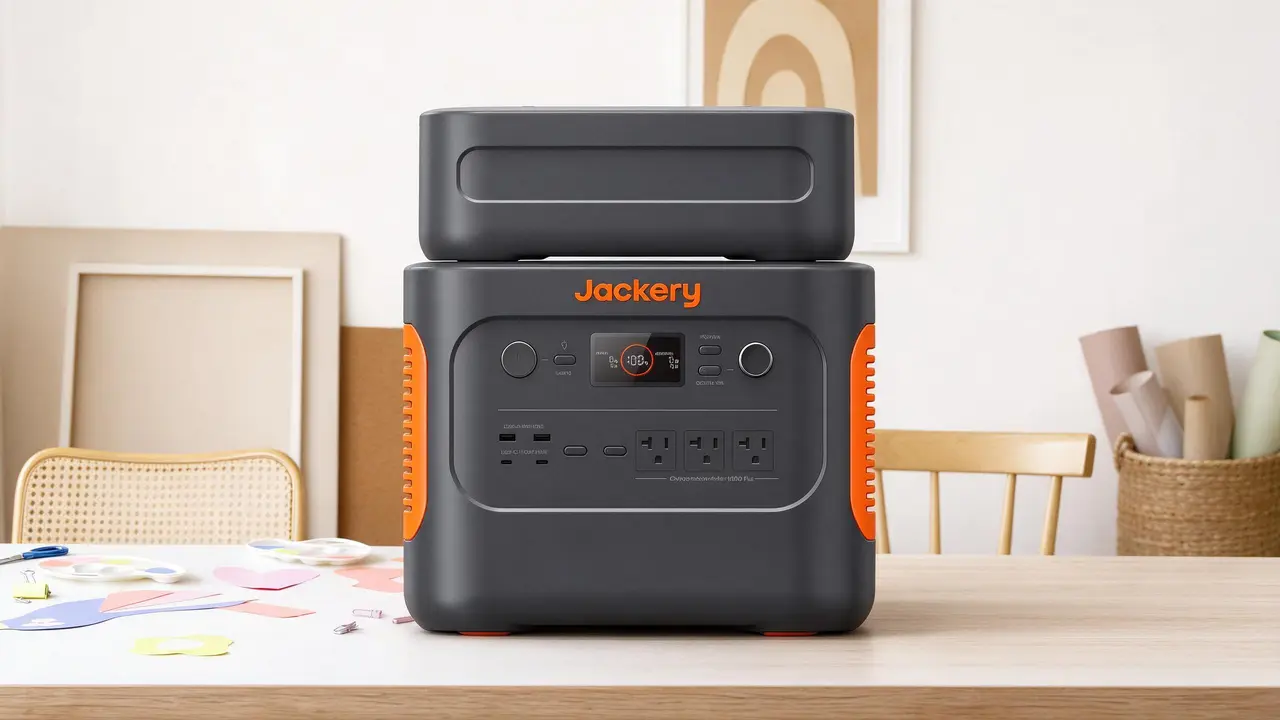
The Jackery Explorer 1000 Plus Portable Power Station Kit - 2528Wh LiFePO4 is a 1,264 Wh LiFePO4 power station with 2,000 W continuous and 4,000 W peak output. The '2528Wh' in the product name refers to the kit's expanded capacity when paired with additional battery packs — the base unit is 1,264 Wh, and you can add up to three expansion batteries to reach 5 kWh. For vanlife, the base unit alone is a sensible starting point; the expansion path is there if you later want to run more.
In the box you get the power station itself, an AC charging cable, and a car charging cable. Solar panels are not included unless you buy a bundle — check the specific kit listing. The unit weighs 32 lb (about 14.5 kg), which is manageable for one person to lift in and out of a van, but it's not something you'll want to carry on a hike.
- Capacity: 1,264 Wh (expandable to 5 kWh with add-on batteries).
- Output: 2,000 W continuous, 4,000 W peak.
- Ports: 3× AC, 2× USB-C, 2× USB-A, 1× car port.
- Weight: 32 lb (14.5 kg).
- Chemistry: LiFePO4, rated for 4,000 cycles to 70% capacity.
Jackery Explorer 1000 Plus specs: the numbers that matter for vanlife
The headline figure is 1,264 Wh. In plain terms, that's enough to charge a 60 Wh laptop battery about 21 times, or run a 45 W portable fridge for roughly 28 hours (assuming 100% depth of discharge and no inverter losses — real-world will be lower). The 2,000 W continuous output means you can run most kitchen appliances up to that limit, but not an electric kettle (typically 2,500–3,000 W) or an induction hob (often 3,000 W+).
The LiFePO4 chemistry is the big selling point over older NMC units. Jackery rates it for 4,000 cycles to 70% capacity, which at one cycle per day is over 10 years of daily use. That matters for vanlife because you're likely to cycle it hard. The trade-off is weight: LiFePO4 is heavier than NMC, and at 32 lb this unit is about 7 lb heavier than the equivalent NMC model (the Explorer 1000 Pro).
| Spec | Jackery Explorer 1000 Plus |
|---|---|
| List price | $1,589 (USD; check UK retailers for GBP) |
| Capacity | 1,264 Wh |
| Continuous output | 2,000 W |
| Peak output | 4,000 W |
| Weight | 32 lb (14.5 kg) |
| Chemistry | LiFePO4 |
| Cycle life | 4,000 cycles to 70% |
| Ports | AC×3, USB-C×2, USB-A×2, car×1 |
| Nameplate $/Wh | $1.26/Wh |
How long does the Explorer 1000 Plus take to charge?
Jackery quotes a 100-minute mains charge for the Explorer 1000 Plus, which is impressively fast for a 1,264 Wh battery. From the car's 12 V socket, expect a much slower top-up — the listing doesn't give an exact 12 V time, but based on the 800 W max solar input and typical car socket limits, a full charge from 12 V will take many hours (likely 10+). For solar, Jackery says a full recharge in about 2 hours with four 200 W SolarSaga panels (800 W total). With a single 100 W panel, you're looking at roughly 12–14 hours of good sun, so plan for a full day or more.
For UK vanlife, the practical takeaway: mains charging is fast when you have hookup, solar is viable if you invest in enough panels, and the 12 V socket is best for maintaining charge rather than bulk charging. The Wandering Bird review of the smaller Explorer 500 noted 7.5 hours from mains and 9.5 hours from a 100 W panel — the 1000 Plus is a bigger battery but charges faster from mains, so the ratio is similar.
- Mains: ~100 minutes (manufacturer figure).
- Solar: ~2 hours with 800 W of panels; ~12–14 hours with a single 100 W panel (estimate based on capacity and typical solar yield).
- 12 V car: slow — best for maintenance, not bulk charging.
What can the Explorer 1000 Plus actually power?
The 2,000 W continuous limit is the key constraint. Here's a quick load-math guide using typical wattages:
Laptop (60 W) + LED lights (10 W) + phone charging (10 W) = 80 W total, which would run for roughly 15 hours from 1,264 Wh (assuming 90% inverter efficiency). A portable compressor fridge (45 W average) would run for about 28 hours. A small blender (300 W) for 5 minutes uses about 25 Wh — negligible. But a 2,000 W kettle would drain the battery in about 34 minutes (1,264 Wh × 0.9 ÷ 2,000 W), and anything above 2,000 W will trip the inverter — so a 2,000 W kettle is right at the limit and not recommended. Stick to kettles rated under 2,000 W or use a gas stove.
The 4,000 W peak is there for motor starts and surge loads, not continuous draw. Don't plug in a 3,000 W heater and expect it to run — it won't.
- Safe continuous loads: laptops, lights, phones, cameras, small fans, portable fridge (under 200 W).
- Short-burst loads: blender, coffee grinder, small microwave (check wattage).
- Avoid: kettles, induction hobs, space heaters, hair dryers, any load over 2,000 W continuous.
Real-world performance: how long does a full charge last?
Owner reports on file suggest the Explorer 1000 Plus holds its charge well when stored. One owner (Wes M.) charged it fully and left it in the garage for six months; it was still at 100% when checked. That's a good sign for seasonal vanlife use — you can charge it before a trip and not worry about it draining while parked.
Another owner (Jkuo) uses the 1000 Plus for RV daily battery use and reports it handles a laptop, lights, portable fridge, coffee maker, and oven (presumably a small camping oven) with one expansion battery (2.5 kWh total). That aligns with the load math above: the base 1,264 Wh is enough for a day or two of light use, but heavy cooking or fridge use will need expansion or regular recharging.
Pros and cons of the Jackery Explorer 1000 Plus for UK vanlife
The pros are straightforward: LiFePO4 longevity (4,000 cycles), fast mains charging (100 minutes), a healthy 2,000 W output, and the option to expand to 5 kWh. The app control (Bluetooth/Wi-Fi) is a nice touch for monitoring from your phone.
The cons are equally real. At 32 lb it's heavy for what it is — you'll feel it lifting it in and out of a van. It's not waterproof, so you'll need to keep it dry in a damp UK climate. It has two USB-C ports, so charging modern devices is covered. The 1000 Plus does not have a built-in light, and the carrying case is sold separately. Finally, the list price of $1,589 works out to $1.26/Wh, which is mid-range for LiFePO4 — not the cheapest per Wh, but competitive given the cycle life and expansion capability. UK buyers should check for GBP pricing and a UK plug.
- Pros: LiFePO4 4,000 cycles, 2,000 W continuous, fast mains charge, expandable to 5 kWh, app monitoring.
- Cons: 32 lb, not waterproof, case extra, no built-in light, $1.26/Wh is mid-pack.
- Skip if: you need to run loads above 2,000 W continuously, or you want a lightweight unit to carry between campsites.
Explorer 1000 Plus vs a fitted leisure battery and a fuel generator
A fitted leisure battery (typically 100–200 Ah at 12 V, so 1,200–2,400 Wh) costs less per Wh but requires installation, a DC-DC charger, and wiring. It's integrated into the van, which is convenient, but you can't take it out to use at home or in a tent. The Explorer 1000 Plus is portable, needs no installation, and can be charged from mains, solar, or 12 V. For a van you're building out, a leisure battery is often the better long-term choice; for a van you're renting or want flexibility with, the power station wins.
A fuel generator (petrol or diesel) has unlimited runtime as long as you have fuel, but it's noisy, emits fumes, and many campsites ban them. For wild camping in the UK, a fuel generator is often impractical. The Explorer 1000 Plus is silent and fume-free, which matters for campsite etiquette and safety.
| Option | Pros | Cons | Best for |
|---|---|---|---|
| Jackery Explorer 1000 Plus | Portable, silent, no installation, expandable to 5 kWh | Higher $/Wh, 32 lb, not waterproof | Flexible camping, renters, occasional off-grid use |
| Fitted leisure battery | Lower $/Wh, integrated, can be charged from alternator | Requires installation and wiring, not portable | Permanent van conversions, heavy daily use |
| Fuel generator | Unlimited runtime with fuel | Noisy, fumes, campsite bans, maintenance | Extended off-grid trips where noise is acceptable |
Which Jackery model is right for you? Explorer vs Plus vs Pro
Jackery's lineup can be confusing. The Explorer series (like the 500) uses NMC chemistry and is lighter but has a shorter cycle life (typically 500–1,000 cycles). The Plus series (like the 1000 Plus) uses LiFePO4 for 4,000 cycles and adds expansion capability. The Pro series sits in between with LiFePO4 but often fewer cycles or different port layouts. For vanlife, the Plus series is the sweet spot: LiFePO4 longevity, expandability, and reasonable weight. The 1000 Plus is the middle child — the 2000 Plus is bigger and heavier, the 500 Plus is smaller and cheaper. If you need to run a 2,000 W appliance, the 1000 Plus is the minimum; if you only need laptops and lights, the 500 Plus would save weight and money.
Is the Jackery carrying case worth buying?
The carrying case is sold separately and typically costs around $50–$80. It protects the unit from scratches and makes it easier to carry, but it adds bulk. For vanlife, where space is tight, the case is useful for storing the unit safely when not in use. However, it's not waterproof, so it won't save you if you leave it out in the rain. If you're on a budget, skip the case and use a dry bag or a sturdy box instead.
Jackery Explorer 1000 Plus UK FAQs
These are the questions UK vanlife buyers ask most often about the Explorer 1000 Plus, answered with the numbers from the FACT LOCK card.
Verdict: is the Jackery Explorer 1000 Plus worth it for UK vanlife?
If you're a UK vanlifer who wants a portable, silent power source for laptops, lights, a fridge, and occasional cooking, the Jackery Explorer 1000 Plus is a solid choice. The LiFePO4 chemistry gives it a long life, the 2,000 W output covers most camping appliances, and the expansion path means you can grow the system. At $1,589 ($1.26/Wh), it's not the cheapest per Wh, but the cycle life and app control justify the premium for many buyers. UK buyers should check for GBP pricing and a UK plug.
Skip it if you need to run high-draw appliances above 2,000 W continuously, or if you're on a tight budget and only need to charge phones and a laptop — a smaller, cheaper unit like the Explorer 500 would do. And if you're building a permanent van conversion, a fitted leisure battery is likely more cost-effective. But for flexible, off-grid power you can take from van to tent to home, the Explorer 1000 Plus earns its place.
What owners report
Owner themes tallied from reviews on file. Prefer feedback matching this article's use-case; note when reviews skew elsewhere.
- One owner bought it to power fridge/freezers during storm-related outages but has not had to use it yet; it has sat in the garage after charging.
Frequently asked
Can I charge the Explorer 1000 Plus from a campsite EHU?
Yes, you can charge it from a UK campsite electric hookup using the supplied AC charging cable. The manufacturer quotes a 100-minute mains charge. Make sure you have the correct UK plug adapter if the unit ships with a US plug.
Will it run a 12V compressor fridge via AC?
Yes, a typical 12V compressor fridge draws around 45 W when running, which is well within the 2,000 W continuous output. Based on the 1,264 Wh capacity, you could expect roughly 28 hours of runtime, though real-world performance will be lower due to inverter losses and fridge duty cycles.
What plug type does the UK version come with?
The FACT LOCK card does not specify the plug type. UK buyers should check the specific retailer listing to confirm it includes a UK 3-pin plug or adapter. Some imported units may ship with a US plug.
Is the warranty valid in the UK?
The FACT LOCK card does not include warranty details. Check the retailer's terms for UK warranty coverage before purchasing.
How loud is it when running?
The Explorer 1000 Plus is silent in operation because it has no fuel engine or moving parts. The only noise is a fan that may run during heavy loads or charging.
Can I use it to power a 2,000 W kettle?
A 2,000 W kettle is right at the continuous limit and not recommended. It would drain the battery in about 34 minutes and may trip the inverter. Most kettles are 2,500–3,000 W, which exceeds the limit. Use a gas stove or a lower-wattage kettle instead.
Method and sources
Model names and list prices come from the WattPicks catalog at build time. WattPicks does not run its own laboratory tests on power stations, and nothing on this page is presented as a measured result — it is catalog-backed buying guidance.
Read our methodology for how the catalog is normalized, and about WattPicks for who publishes it.