
Jackery SolarSaga 100W Air Review: Is 23% Efficiency Worth?
The Jackery SolarSaga 100W Air is a 13.67 lb bifacial panel with a 23% efficiency claim and a $345.99 list price. Here is what the listing and owner notes actually support — and where the math gets uncomfortable.
Updated
At a glance
The Jackery SolarSaga 100W Air is a 13.67 lb bifacial panel with a 23% efficiency claim and a $345.99 list price. Here is what the listing and owner notes actually support — and where the math gets uncomfortable.
- Rated 100 W, 13.67 lb, $345.99 list — premium tier for the wattage class
- Bifacial PERC cells with a 23% efficiency claim (listing, not independently verified)
- IP68 waterproof and dust resistance per listing; -4°F to 149°F operating range
- Not compatible with Explorer 300 / 300 v2 — F7 voltage error risk per Jackery
The short answer: a premium 100W panel with a compatibility catch
As an Amazon Associate I earn from qualifying purchases. Recommendations here are based on fit and the evidence below — not commission size.
At $345.99 list, the Jackery SolarSaga 100W Air is not the cheap way to add 100 watts to a power station. It is the light, bifacial, IP68-rated way — and the listing says 13.67 lb, which is heavier than the marketing bullet's '7 lbs' claim. That discrepancy alone tells you to read the spec sheet, not the hero copy.
The bigger catch is compatibility. Jackery's own listing states this panel is not compatible with the Explorer 300 or 300 v2 series, and that pairing them can trigger an F7 input-voltage error. If you own one of those stations, stop here — the panel is the wrong voltage match regardless of price.
For everyone else, the question is whether a 100 W panel with a 23% cell-efficiency claim and a 4.6 listing aggregate justifies roughly three times the cost of a generic 100 W foldable. The answer depends on how much you value weight, bifacial gain, and weather sealing — not on lab numbers I cannot produce.
- Rated 100 W, 13.67 lb, $345.99 list — premium tier for the wattage class
- Bifacial PERC cells with a 23% efficiency claim (listing, not independently verified)
- IP68 waterproof and dust resistance per listing; -4°F to 149°F operating range
- Not compatible with Explorer 300 / 300 v2 — F7 voltage error risk per Jackery
Spec snapshot: what the listing actually locks down
The table below uses only the Hub catalogue figures. Folded size is not on file, so it reads n/a rather than a guessed dimension. The 4.6 rating is the listing aggregate across 204 ratings — useful as a smell test, not as proof of field output.
One number worth flagging: the feature bullet says 'just 7lbs,' but the normalized weight on file is 13.67 lb. I am treating 13.67 lb as the real figure because it appears in the structured product data, and I would not plan a backpacking trip around the lighter claim.
| Product | Rated (W) | Folded size | Weight (lb) | List price | Rating |
|---|---|---|---|---|---|
| Jackery SolarSaga 100W Air Solar Panel, 23% Conversion Efficiency | 100 W | n/a (not on file) | 13.67 lb | $345.99 | 4.60 |
What 23% efficiency does and does not mean for your watt-hours
Cell efficiency is not the same as system output. A 23% cell can still deliver well under 100 W at the panel's terminals once you account for angle, heat, cable loss, and the fact that bifacial gain depends on what is behind the panel. The listing claims better performance at dawn, dusk, and in clouds — plausible for bifacial, but not something I can verify from a spec sheet.
Here is the math a buyer should actually run. If your station accepts roughly 100 W of solar input and you get a realistic 70–85 W during good sun, a 100 W panel adds about 70–85 Wh per hour of peak-equivalent sun. Over a 4-hour usable solar window, that is roughly 280–340 Wh per day. At $345.99, you are paying about $3.46 per rated watt, or roughly $1.02–$1.24 per Wh added per good solar day in that window.
Compare that to a generic 100 W foldable at, say, $150–$200: the cost per rated watt drops to $1.50–$2.00. The Jackery's premium buys you the bifacial rear face, IP68 sealing, the integrated aluminum stand, and the Jackery connector ecosystem. Whether that is worth $150+ is a personal call, but the efficiency percentage alone does not close the gap.
- Rated watt is not delivered watt — expect a realistic 70–85% of rating in good sun
- Bifacial gain is real but site-dependent; do not budget it as guaranteed output
- At $345.99 for 100 W, cost per rated watt is about $3.46
- A generic 100 W foldable at $150–$200 lands near $1.50–$2.00 per rated watt
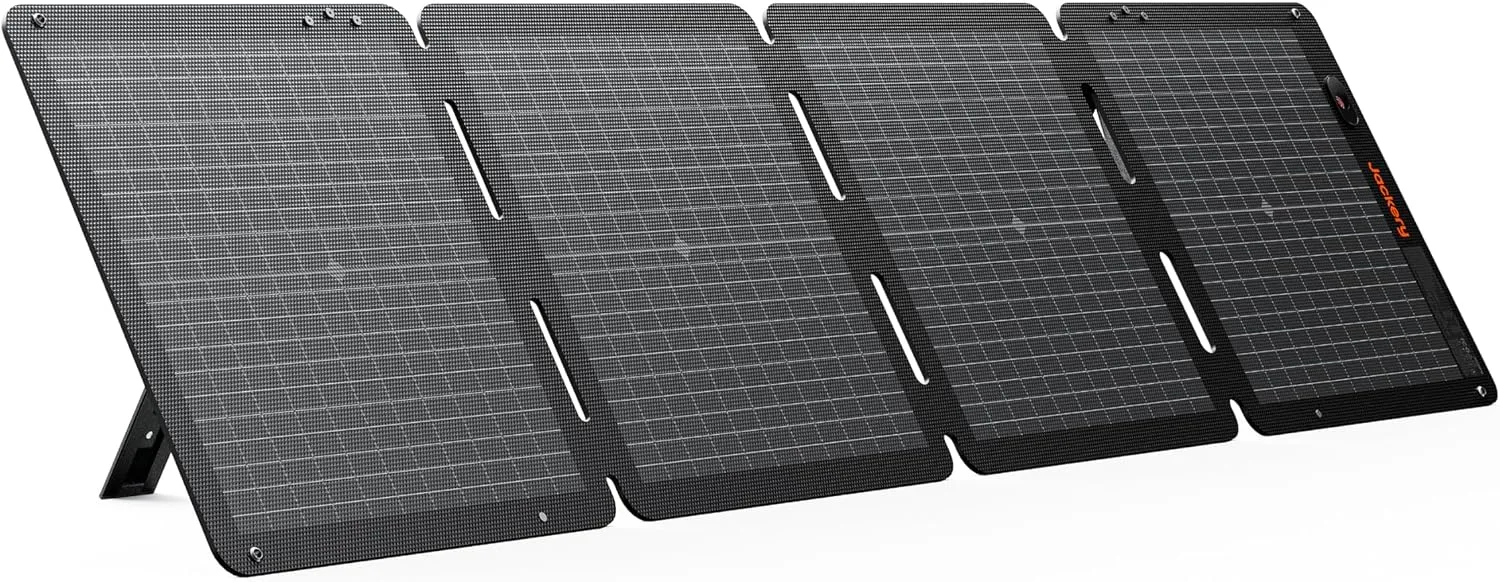
Jackery SolarSaga 100W Air Solar Panel, 23% Conversion Efficiency Bifacial Panels, IP65 Waterproof,
Highlights
- About $345.99 list
- Jackery catalog listing
- Specs from manufacturer listings
Best for
- Jackery SolarSaga 100W Air Solar Panel, 23% Conversion Efficiency Bifacial Panels, IP65 Waterproof,: longer outages or higher continuous loads (still not whole-home wiring)
- RV / off-grid days where recharge speed matters as much as Wh
Setup, ports, and the 60-second claim
The listing says setup takes about 60 seconds with the integrated aluminum stand and no tools. That matches the owner theme of easy setup — 'ease of use' shows up seven times in the review highlights, and one owner specifically called out easy folding and unfolding. I would treat 60 seconds as optimistic but not fantasy for a single panel.
Ports are where the listing gets thin. The port lock shows USB-C ×1 and USB-A ×1, with USB-C output listed at 5V-3A and USB-A at 5V-2.4A. The feature bullet claims 'dual USB ports delivering 100W of each' and charging three devices at once — that does not reconcile with the 5V-3A and 5V-2.4A figures, which are phone-charging speeds, not 100 W USB-C PD. I would not buy this panel expecting to fast-charge a laptop over USB-C.
AC output is unknown per the port lock, so I will not claim it is absent. If you need an AC outlet on the panel itself, verify that with Jackery before ordering.
- USB-C ×1 at 5V-3A and USB-A ×1 at 5V-2.4A per listing — not 100 W USB-C PD
- AC port status unknown; do not assume an outlet is present
- Integrated aluminum stand and ground stake holes for windy setups
- F7 error risk with Explorer 300 / 300 v2 — check your station first
Durability and weather: IP68, 4,000 folds, and what owners say
The listing claims IP68 waterproof and dust resistance, an operating range of -4°F to 149°F, IEC TS 63163 certification, and 4,000 fold-test cycles. Those are listing claims, not WattPicks measurements. What I can say is that durability and reliability are the two most common owner themes in the review highlights — reliability appears 20 times and durability 8 times, which is a decent signal that the build holds up in normal use.
One owner mentioned the panel feels 'very durable and seems easy to clean,' and another said it is 'a little big but manageable.' That tracks with 13.67 lb: it is portable, not backpackable. The carrying bag helps, but this is a car-camping or balcony panel, not a hike-in panel.
- IP68 and 4,000-fold claims are from the listing, not independently tested here
- Reliability (20) and durability (8) are the strongest owner themes on file
- 13.67 lb is manageable for car camping, not for long carries
- Owners describe it as easy to clean and fold
Charging speed: the split verdict owners actually report
Charging speed is the most divided theme in the owner notes. Twelve mentions, and they split: some owners say it charges efficiently, others call it slow. One owner reported two 10,000 mAh power banks going from near-dead to full in 'less than a few hours' on a partly sunny day — that is a reasonable result for 100 W of panel in less-than-ideal sun.
Another owner paired two of these panels and saw 204 W briefly before it settled to 194–200 W. That is a useful data point: two 100 W panels in good sun delivered roughly their rated combined wattage, which suggests the panels themselves are not the bottleneck. If you are seeing slow charging, check your station's input limit and your cable before blaming the panel.
The honest take: 100 W is 100 W. If you want faster charging, buy a second panel or a larger array. The Jackery's efficiency claim does not change the fundamental wattage ceiling.
- Owner reports range from 'very efficient' to 'slow charging' — station input limits likely explain the split
- Two panels in series/parallel reportedly delivered ~194–200 W combined in good sun
- One panel will not fast-charge a large power station; plan on hours, not minutes
- Check your station's solar input cap before assuming the panel is underperforming
Value: who should pay the Jackery premium, and who should not
Buy the SolarSaga 100W Air if you already own a compatible Jackery station and want a sealed, bifacial panel with an integrated stand that you can leave on a balcony or deck. The IP68 rating and the Jackery connector ecosystem are the real reasons to pay $345.99. Owners consistently rate quality and reliability highly, and the 4.6 listing aggregate over 204 ratings is not a warning sign.
Skip it if you are price-sensitive, if you need to fast-charge laptops over USB-C, or if you own an Explorer 300 / 300 v2. A generic 100 W foldable will deliver similar wattage for roughly half the cost, and the efficiency percentage will not rescue the math. Also skip if you need a backpackable panel — 13.67 lb is not that.
The middle case: if you value the bifacial rear face for dawn/dusk charging and you plan to leave the panel deployed for long stretches, the premium is easier to justify. Just do not expect the 23% cell efficiency to translate into 23% more watt-hours than a cheaper panel — the system losses dominate.
- Buy if: compatible Jackery station, want IP68 + bifacial + integrated stand, balcony/deck use
- Skip if: Explorer 300 / 300 v2 owner, budget-focused, need USB-C PD fast charging
- Skip if: backpacking or long carries — 13.67 lb is car-camping weight
- Consider a second panel before upgrading to a 'more efficient' single panel
The bottom line on the Jackery SolarSaga 100W Air
This is a well-built, weather-sealed 100 W bifacial panel with a real compatibility landmine and a price that asks you to believe in the ecosystem. The owner themes support quality and reliability; the charging-speed reports are mixed but explainable by station input limits. The 23% efficiency number is a cell-level claim, not a promise of 23% more delivered watt-hours.
If you own a compatible Jackery station and want a leave-it-outdoors panel with an integrated stand, $345.99 is defensible. If you are shopping on cost per watt or you own an Explorer 300-series station, walk away. The math does not bend, and the F7 error is not a risk worth taking.
- Fit-led pick for compatible Jackery owners who value sealing and bifacial gain
- Not a value pick at $3.46 per rated watt
- Hard skip for Explorer 300 / 300 v2 owners
- No WattPicks lab data exists for this panel — all performance figures are listing claims or owner reports
Frequently asked
Will the SolarSaga 100W Air work with my Explorer 300?
No — Jackery's listing says it is not compatible with the Explorer 300 / 300 v2 and may trigger an F7 input-voltage error.
How many watt-hours can one panel add per day?
In a 4-hour usable solar window at a realistic 70–85 W, expect roughly 280–340 Wh per day. That is an estimate from the rated wattage, not a measured result.
Can I fast-charge a laptop from the USB-C port?
The listing shows USB-C at 5V-3A, which is phone-charging speed, not USB-C PD. Do not count on laptop fast charging.
Is the 23% efficiency claim verified?
No — it is a listing claim. WattPicks has not independently measured cell or system efficiency for this panel.
Method and sources
Model names and list prices come from the WattPicks catalog at build time. WattPicks does not run its own laboratory tests on power stations, and nothing on this page is presented as a measured result — it is catalog-backed buying guidance.
Read our methodology for how the catalog is normalized, and about WattPicks for who publishes it.