
Goal Zero Yeti 1500 vs VTOMAN FlashSpeed 2400: Which Bet?
Two 1400Wh-class stations, two very different bets: Goal Zero charges a premium for build, ports, and ecosystem polish; VTOMAN undercuts it hard on price per Wh and adds a jump-starter. Here's which one fits your outage plan.
Updated
At a glance
Two 1400Wh-class stations, two very different bets: Goal Zero charges a premium for build, ports, and ecosystem polish; VTOMAN undercuts it hard on price per Wh and adds a jump-starter. Here's which one fits your outage plan.
Same money? No — same class, different bets
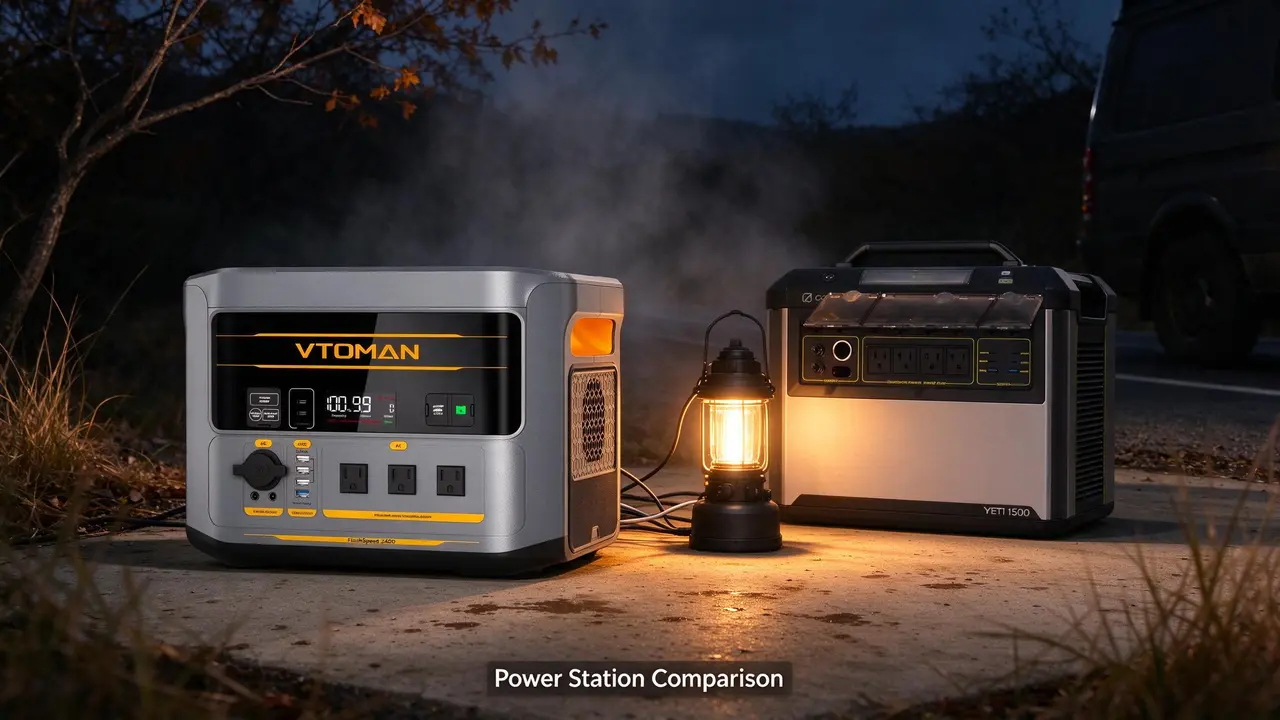
These two land in the same 1400Wh-class bucket, but they are not the same purchase. The VTOMAN FlashSpeed 2400 Portable Power Station, 1408Wh LiFePO4 bets that you want the most watts and the lowest price per Wh, and it throws in a 12V jump-starter to sweeten the deal. The Goal Zero Yeti 1500 Portable Power Station bets that you'll pay roughly double for a tougher aluminum shell, more USB-C ports, an app, and a brand ecosystem you can build on.
Neither is a whole-home solution. This is a comparison for people sizing a fridge-and-router outage plan or an off-grid camping setup — not for anyone expecting to run central AC or a well pump off either unit. If that's the job, you're shopping the wrong class entirely.
One disclosure up front: picks here are fit-led, not commission-led, and this page uses Amazon Associates links. Specs come from the listings; owner impressions come from review themes on file. Those are home-user checks, not lab-bench measurements.
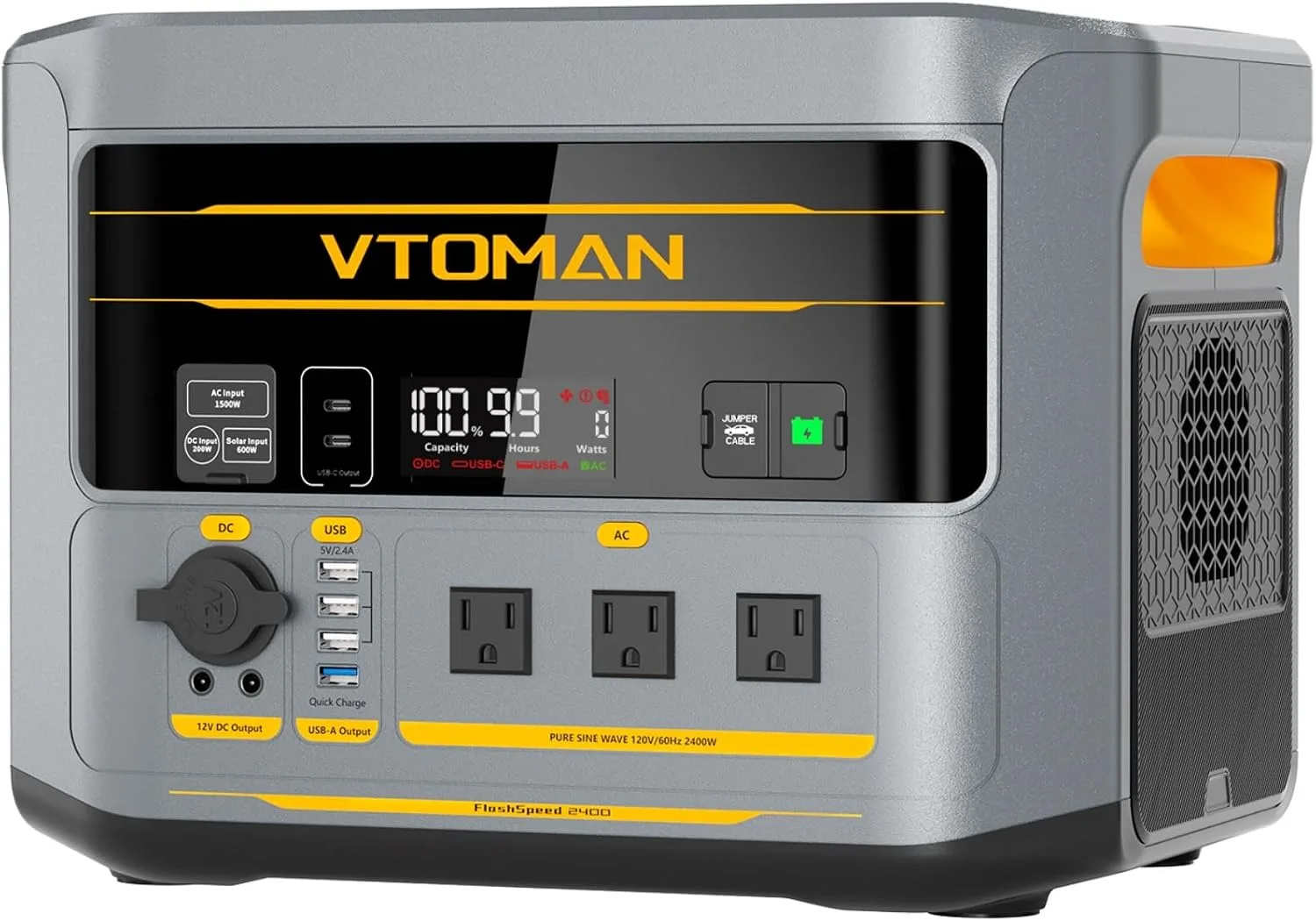
VTOMAN FlashSpeed 2400 Portable Power Station, 1408Wh LiFePO4
Highlights
- 1408Wh rated capacity
- 2400W continuous AC
- 3200W surge
- LiFePO4 chemistry
- Up to 600W solar input
- 41.9 lb (~19.0 kg)
Best for
- FlashSpeed 2400: small appliances and tools that need ~2400W continuous, not just phone charging
- Park-and-use backup — at 41.9 lb (~19.0 kg) this is a poor long hike companion
- Solar top-ups up to ~600W when panels and weather cooperate
Strengths
- FlashSpeed 2400: 1408Wh pack with 2400W continuous / 3200W surge — size loads to both numbers
- 41.9 lb (~19.0 kg) is a park-and-use chassis — plan a short path, not a trail hike
- 10ms-class UPS switchover on the listing — useful when a router restart would hurt
- About $799.99 list in the Hub catalog — confirm live retail before you buy
Watch-outs · not ideal when
- At 41.9 lb (~19.0 kg), FlashSpeed 2400 is a poor tent-hike companion — plan a cart or leave it in the vehicle
- Usable energy on FlashSpeed 2400 is below the 1408Wh label once the inverter is working
- Rated 600W solar on FlashSpeed 2400 is optimistic; shade and cables cut real watts
- LiFePO4 helps longevity, but FlashSpeed 2400 still hates freezing charge temps on winter trips
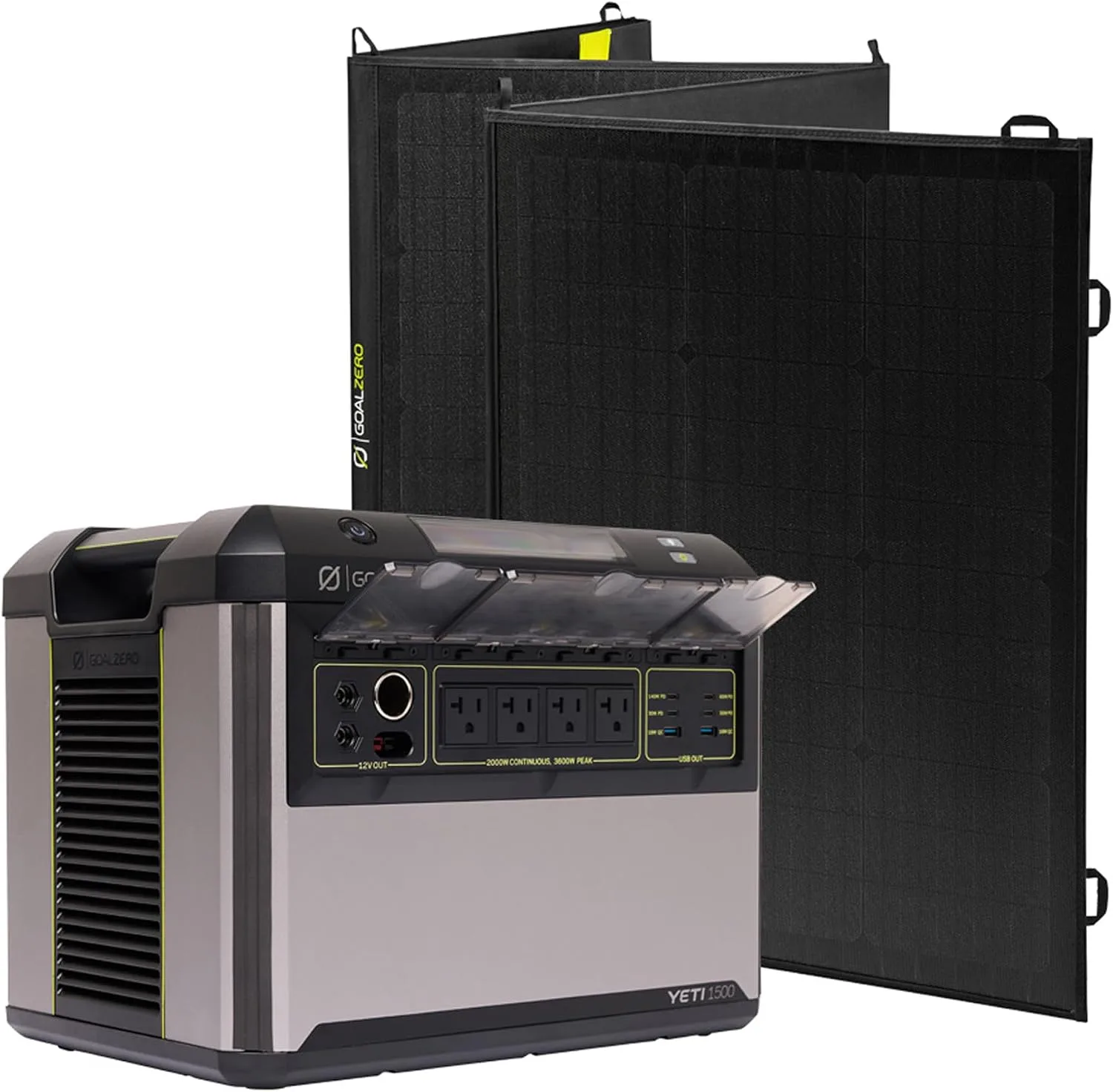
Goal Zero Yeti 1500 Portable Power Station
Highlights
- 1505Wh rated capacity
- 2000W continuous AC
- 3600W surge
- LiFePO4 chemistry
- Up to 900W solar input
- 52.8 lb (~23.9 kg)
Best for
- Yeti 1500: longer outages or higher continuous loads (still not whole-home wiring)
- RV / off-grid days where recharge speed matters as much as Wh
- Best parked near the vehicle or cabin — not a long carry to a tent
Strengths
- Yeti 1500: 1505Wh pack with 2000W continuous / 3600W surge — size loads to both numbers
- 52.8 lb (~23.9 kg) is a park-and-use chassis — plan a short path, not a trail hike
- 15ms-class UPS switchover on the listing — useful when a router restart would hurt
- Owners on file: 5/5 · 6 helpful — Without a doubt Goal Zero's best power station yet. I've been a customer for many years and…
Watch-outs · not ideal when
- At 52.8 lb (~23.9 kg), Yeti 1500 is a poor tent-hike companion — plan a cart or leave it in the vehicle
- High continuous output on Yeti 1500 tempts big loads — Wh still runs out on kettles and A/C
- Rated 900W solar on Yeti 1500 is optimistic; shade and cables cut real watts
- LiFePO4 helps longevity, but Yeti 1500 still hates freezing charge temps on winter trips
Owner voices
Short takes from public retail reviews — paraphrased or translated when long or non-English; meaning kept close to the original.
“5/5 · 6 helpful — Without a doubt Goal Zero's best power station yet. I've been a customer for many years and always find the products to be durable and reliable. Happy to report this new station continues the trend.…”
“5/5 · 5 helpful — Enjoying using my Goal Zero Yeti 1500. The unit recharges in an hour or less and provides quiet power for several days. Running power tools and various chargers works flawlessly. End result is to use…”
“5/5 · 4 helpful — We love the Yeti 1500 Portable Power Station. When the power goes out, we no longer need to fire up the gas-powered generator and run a cord from outdoors. We simply plug in an appliance, light, comp…”
Spec snapshot
List prices only — the VTOMAN's current deal price is a moving target and doesn't belong in a spec table. Ratings are the listing aggregate, not proof of owner consensus.
| Product | Price | Capacity (Wh) | Output (W) | Weight (lb) | Rating |
|---|---|---|---|---|---|
| VTOMAN FlashSpeed 2400 Portable Power Station, 1408Wh LiFePO4 | $799.99 | 1408 Wh | 2400 W | 41.9 lb | 4.4 |
| Goal Zero Yeti 1500 Portable Power Station | $1499.95 | 1505 Wh | 2000 W | 52.8 lb | 4 |
Where the money went
Run the nameplate math and the gap is stark. VTOMAN sits at $0.57 per Wh; Goal Zero at $1.00 per Wh. For about 100 Wh less capacity, you're paying $700 more. That premium has to buy you something real, so let's itemize what it actually buys.
Output favors VTOMAN, and not by a little: 2400 W continuous versus 2000 W. That's the difference between running a space heater or a decent-size microwave with headroom and doing it right at the edge. If your outage plan includes any resistive heat, this is the spec that decides it.
Weight cuts the other way from what you'd expect at this price. The Yeti is 52.8 lb; the VTOMAN is 41.9 lb. Goal Zero's aluminum chassis is the reason — owners consistently praise how solid it feels — but you carry that mass every time you haul it up from the basement.
Ports are where Goal Zero claws back ground. Four AC outlets and four USB-C ports (including a 140W USB-C) versus VTOMAN's three AC and two USB-C. If you're charging a house full of laptops and tablets at once, the Yeti's port count is a genuine convenience, not a spec-sheet nicety.
Then there's the wildcard: the VTOMAN ships with a jumper cable and can jump-start most 12V vehicles. Goal Zero doesn't offer that. It's a niche feature until the morning your truck won't crank, and then it's the whole reason you bought the thing.
- Price per Wh: VTOMAN $0.57/Wh vs Goal Zero $1.00/Wh — VTOMAN is the cheaper bet on nameplate math
- Continuous output: 2400 W (VTOMAN) vs 2000 W (Goal Zero)
- Weight: 41.9 lb vs 52.8 lb — the Yeti is the heavier haul
- Ports: VTOMAN AC×3, USB-C×2, USB-A×4, car×1; Goal Zero AC×4, USB-C×4, USB-A×2, car×1
- Extras: VTOMAN includes a 12V jump-starter cable; Goal Zero leans on its app and ecosystem
The spec that decides it
For most home-backup buyers, the deciding number is continuous output, and that's the 2400 W versus 2000 W gap. A fridge cycling on and off is easy for either. A space heater, a microwave, or a power tool is where 2000 W starts to feel tight and 2400 W gives you margin. If your outage list includes any of those, VTOMAN wins on capability per dollar by a wide margin.
The second deciding factor is port count and build, and that's where Goal Zero earns its premium — for a specific buyer. If you're running a home office with four USB-C devices and you want an app that shows live draw so you can plan the next outage better, the Yeti's four USB-C ports and monitoring are worth real money. Just be honest that you're paying for convenience and finish, not for more watts.
Real owner trade-offs
The VTOMAN review themes center on outage performance and fast charging. Owners describe it carrying a fridge, router, and fans through multi-day storm outages, and recharging from solar even in less-than-full sun. The pass-through behavior gets called out specifically — it stays inline and flips to battery automatically, so a desk setup doesn't blink. That matches the 10ms UPS claim on the listing.
The caveats are worth flagging. One owner reported the add-on top battery shutting off repeatedly while running a fridge, requiring a manual restart — they never pinned down whether it was a safety cutoff or a flaw. Another reported the unit kicking out on small voltage draws. If you plan to run low-draw devices overnight, watch for that.
Goal Zero's themes skew toward build quality and fast charging. Owners describe the aluminum case surviving being tossed in a car, port lights and flap doors paying off in the dark or rain, and the app making them smarter about what to run. One owner ran a fridge and ice chest in shifts through a multi-day outage and kept up via maxed solar input.
But the critical reviews are serious. One owner hit unexplained error codes that weren't in the manual or online, returned the unit, and ate return shipping until Amazon stepped in. Another reported the unit and charger overheating and smoking after two years of careful use, and said Amazon flagged more units as faulty. That's a safety watch-out, not a thin rant — weigh it before you spend $1,500.
- VTOMAN owners: fast recharge, pass-through UPS, real outage duty — but watch low-draw cutout and expansion-battery shutoff
- Goal Zero owners: rugged aluminum, port lights, app monitoring — but error codes and an overheating report are on record
Buy the one that…
Buy the VTOMAN FlashSpeed 2400 Portable Power Station, 1408Wh LiFePO4 if you want the most continuous watts and the lowest price per Wh in this class, and you're willing to babysit the occasional low-draw quirk. It's the better bet for budget-conscious outage backup, RV trips where you might need a jump-start, and anyone who'd rather put the $700 savings toward solar panels.
Buy the Goal Zero Yeti 1500 Portable Power Station if port count, build feel, and app monitoring matter more to you than raw watts per dollar — and you're comfortable with the premium and the documented error-code and overheating reports. It's the pick for a home office with a pile of USB-C devices and a buyer who values finish over value.
Walk away from both if you need to run central AC, a well pump, or anything above 2400 W continuous. Neither unit is built for that, and no amount of port counting changes it.
Frequently asked
Can either run a full-size fridge through a multi-day outage?
Owners on both sides report running a fridge in shifts, not continuously — plan on cycling it and recharging from solar or wall between runs.
Which is easier to haul for camping?
The VTOMAN at 41.9 lb is lighter than the Yeti at 52.8 lb, but neither is a one-hand carry; both are two-hand lifts.
Does the VTOMAN really jump-start a car?
The listing includes a jumper cable and claims most 12V vehicles, but explicitly not large-displacement gas or diesel engines — treat it as an emergency assist, not a shop tool.
Is the Goal Zero worth double the price?
Only if four USB-C ports, the aluminum build, and app monitoring are worth $700 to you. On watts per dollar, the VTOMAN wins clearly.
Method and sources
Model names and list prices come from the WattPicks catalog at build time. WattPicks does not run its own laboratory tests on power stations, and nothing on this page is presented as a measured result — it is catalog-backed buying guidance.
Read our methodology for how the catalog is normalized, and about WattPicks for who publishes it.