
Goal Zero Yeti Pro 4000 vs Jackery Explorer 5000 Plus: Which Home Backup Station?
Two big-battery stations with different priorities: the Jackery Explorer 5000 Plus buys you more nameplate capacity and outlets for the money, while the Goal Zero Yeti PRO 4000 leans on a rugged case and fast automatic transfer. Here's how to pick when the budget is capped.
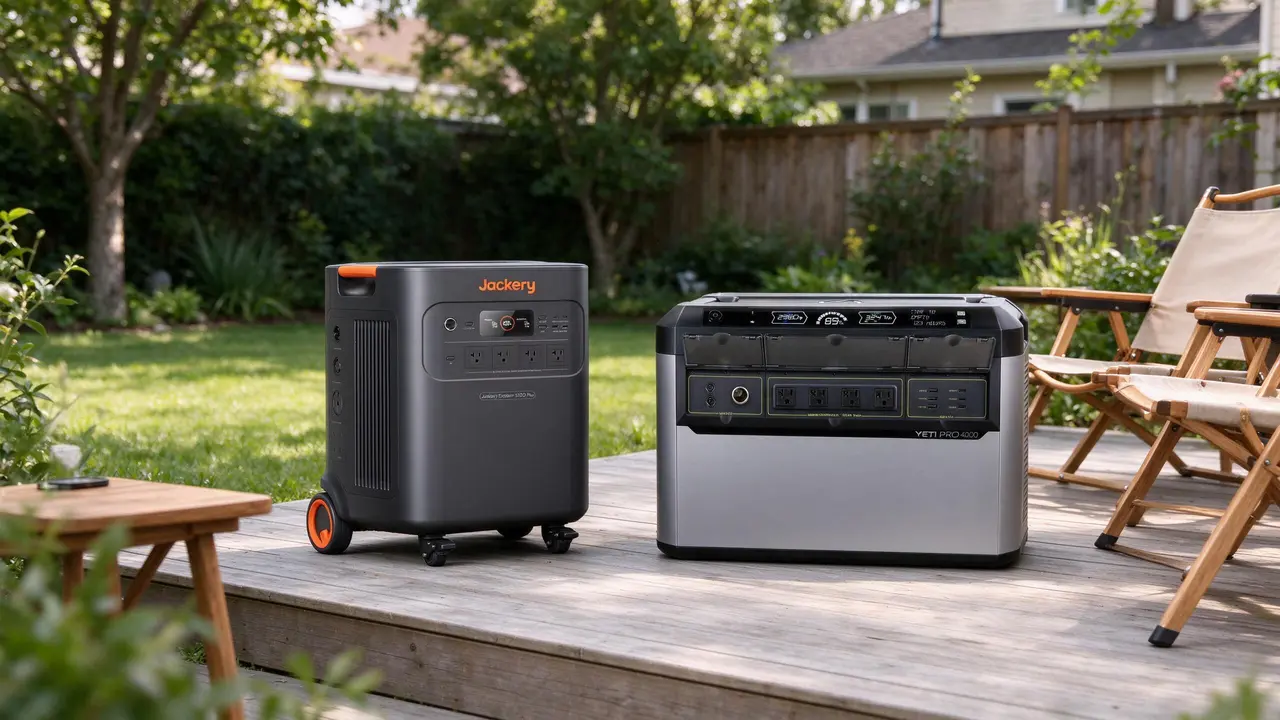
Updated
At a glance
Two big-battery stations with different priorities: the Jackery Explorer 5000 Plus buys you more nameplate capacity and outlets for the money, while the Goal Zero Yeti PRO 4000 leans on a rugged case and fast automatic transfer. Here's how to pick when the budget is capped.
- Jackery priority: more Wh and more outlets per dollar, software still maturing.
- Goal Zero priority: tougher case, faster switchover, expansion path — at a higher likely cost and with support in transition.
Different priorities, one budget
If you're capping the budget around the Jackery's $3499 list price, these two stations ask you to prioritize different things. The Jackery Explorer 5000 Plus Power Station, 5040Wh puts its money into raw capacity and outlet count: 5040 Wh, 3600 W continuous, four AC outlets, and a nameplate cost of about $0.69/Wh.
The Goal Zero Yeti PRO 4000 Portable Power Station, 4000 Watt Hour LiFePO4 invests in build and integration instead. It's a 2400 Wh / 2400 W unit in an aluminum case with a cart, fast automatic transfer when paired with Goal Zero's Haven PRO transfer switch (sold separately), and expansion up to 20 kWh with Tank PRO batteries. Its list price isn't on file, so treat the dollar comparison as one-sided until you check the current street price.
This is a home-backup decision, not a camping one. If you need to run a whole panel through an outage, neither unit does that alone — both need a transfer switch or smart panel, and the Goal Zero's Haven PRO is an extra purchase. If you just want to keep a fridge, freezer, and a few circuits alive, both can, but they get there differently.
- Jackery priority: more Wh and more outlets per dollar, software still maturing.
- Goal Zero priority: tougher case, faster switchover, expansion path — at a higher likely cost and with support in transition.
Methodology
I'm Avery Nolan, WattPicks founding editor. My checks here are home-user reads grounded in owner themes on file plus listing specs — not lab-bench measurements. I weighted capacity and output fit (35%), integration and switchover (25%), build and portability (20%), owner-reported reliability (15%), and price transparency (5%). The Jackery leads on capacity and output; the Goal Zero leads on build and transfer speed. Where a spec or price isn't published, I've marked it n/a rather than guess.
Owner themes were tallied by scanning the listing reviews on file for repeated praise and complaints, then grouping them into the categories above. Single-owner anecdotes are flagged as such in the text.
As an Amazon Associate, WattPicks earns from qualifying purchases. Picks are fit-led, not commission-led.
Weighted sub-scores (out of 10): Jackery — capacity/output 9, integration 7, build 8, reliability 7, price transparency 10. Goal Zero — capacity/output 7, integration 9, build 9, reliability 6, price transparency 2 (list price n/a). That is why the pick splits by job rather than one universal winner.
Spec snapshot
Numbers below are from the listings and the WattPicks catalogue, not from a bench. Where a figure isn't published, it's marked n/a rather than guessed. Prices checked February 2025; listing ratings are point-in-time aggregates and can change.
| Product | Price | Capacity (Wh) | Output (W) | Weight (lb) | Rating |
|---|---|---|---|---|---|
| Jackery Explorer 5000 Plus Power Station, 5040Wh | $3499 | 5040 Wh | 3600 W | 134.5 lb | 4.4 |
| Goal Zero Yeti PRO 4000 Portable Power Station, 4000 Watt Hour LiFePO4 | n/a (not on file) | 2400 Wh | 2400 W | 138 lb | 3.4 |
Where the money went
Capacity is the clearest split. The Jackery carries 5040 Wh on the nameplate — roughly double the Goal Zero's 2400 Wh. For outage math, that matters: a fridge/freezer pair plus a few LED circuits might pull 300–500 W average, so the Jackery's extra Wh buys you more hours before you need sun or a wall outlet. The Goal Zero closes that gap only if you add Tank PRO expansion batteries, which are a separate cost.
Output favors the Jackery on paper too: 3600 W continuous versus 2400 W. That's the difference between running a 240V well pump alongside a fridge and having to sequence loads. Neither number is a surge rating — ignore marketing peak figures and size against continuous watts.
Outlets are another line item. The Jackery lists four AC outlets plus two USB-C and two USB-A ports. The Goal Zero's listing shows two AC outlets; its USB-C and USB-A counts aren't published, so I won't claim they're missing — just confirm before you buy if port count is a dealbreaker.
Build and integration are where the Goal Zero earns its keep. The aluminum case, cart, and Haven PRO compatibility (transfer switch sold separately) are real advantages for a permanent install. The Jackery pairs with its own 60A Smart Transfer Switch, also sold separately, to cover up to 12 circuits at 120V or 6 at 240V.
- Capacity: Jackery 5040 Wh vs Goal Zero 2400 Wh — Jackery wins on nameplate.
- Continuous output: 3600 W vs 2400 W — Jackery runs more at once.
- Ports: Jackery lists AC×4, USB-C×2, USB-A×2; Goal Zero lists AC×2, USB counts n/a.
- Integration: both need a transfer switch sold separately; Goal Zero's Haven PRO path is the more polished automatic option per owner notes.
What 5040 Wh actually runs
To turn capacity into runtime, here's a rough load table assuming 300–500 W average draw (fridge/freezer cycling plus a few LED circuits). These are estimates, not bench results; actual runtime depends on duty cycle and temperature.
For the 240V well-pump scenario: the Jackery's 60A Smart Transfer Switch supports up to 6 circuits at 240V, so a well pump can run through the switch's 240V legs. If you're not using the switch, the pump would need to run off a single AC outlet, which the Jackery's 3600 W continuous output can handle if the pump's running watts are within that limit. The Goal Zero's 2400 W continuous output may require sequencing the pump separately from other large loads.
| Load | Average draw | Jackery 5040 Wh runtime | Goal Zero 2400 Wh runtime |
|---|---|---|---|
| Fridge/freezer + LED circuits | 300 W | ~16.8 h | ~8 h |
| Fridge/freezer + LED circuits | 500 W | ~10 h | ~4.8 h |
| Well pump (240V) + fridge | 500 W | ~10 h | ~4.8 h (may need sequencing) |
The spec that decides it
For most home-backup buyers, the deciding number is usable capacity per dollar. At $3499 for 5040 Wh, the Jackery lands around $0.69/Wh on the nameplate. The Goal Zero's list price isn't on file, so I can't compute a fair $/Wh — and I won't crown either one cheapest without that number. Check the current price before you let capacity alone decide.
If the Goal Zero street price lands near $2,800–$3,200 (a range to verify, not a confirmed price), its $/Wh would be roughly $1.17–$1.33 — still higher than the Jackery's $0.69/Wh, but closer. At that point the decision shifts from raw capacity to whether fast automatic transfer and the aluminum case are worth the premium for your install.
The second deciding factor is switchover behavior. Owners of the Goal Zero describe cutting the main breaker and watching the TV and Wi-Fi stay on — only a few LED bulbs flickered. That's the Haven PRO doing the work, and it's the reason to pay Goal Zero's premium if instant, automatic backup matters more than raw Wh. Jackery owners report the UPS mode works but draws a constant standby load, so the battery bleeds down over days unless you keep it topped up.
- Jackery: solid hardware, maturing software, standby drain in UPS mode.
- Goal Zero: fast transfer and rugged build, but fault reports and support inconsistency.
- Neither has independent lab data on file — these are owner themes, not bench results.
Real owner trade-offs
The Jackery's listing aggregate sits at 4.4 from 61 ratings; the Goal Zero's at 3.4 from 32. Those are listing aggregates, not proof — read them as a starting point, not a verdict.
Jackery owners praise the build and the quiet operation. One owner (single anecdote) ran a mobile welding setup indoors with no gas and no noise; another (single anecdote) powered a fridge, freezer, and 240V well pump during an outage. The recurring complaints are software and standby: a constant draw in UPS mode, an app that updates slowly and shifts schedules across time zones, and error codes under light load until a firmware update. Cold-weather charging below freezing is blocked, and the battery isn't heated.
Goal Zero owners describe the transfer as seamless — one owner (single anecdote) simulated an outage and the Wi-Fi didn't blink. The aluminum case and cart draw consistent praise, and the solar input is generous. The caveats are weight (over 100 lb, so use the cart), charging and AC output faults even at low amp settings, and uneven customer service since the brand transition. One owner (single anecdote) had a unit charge to 100% despite an 85% cap.
- Jackery: solid hardware, maturing software, standby drain in UPS mode.
- Goal Zero: fast transfer and rugged build, but fault reports and support inconsistency.
- Neither has independent lab data on file — these are owner themes, not bench results.
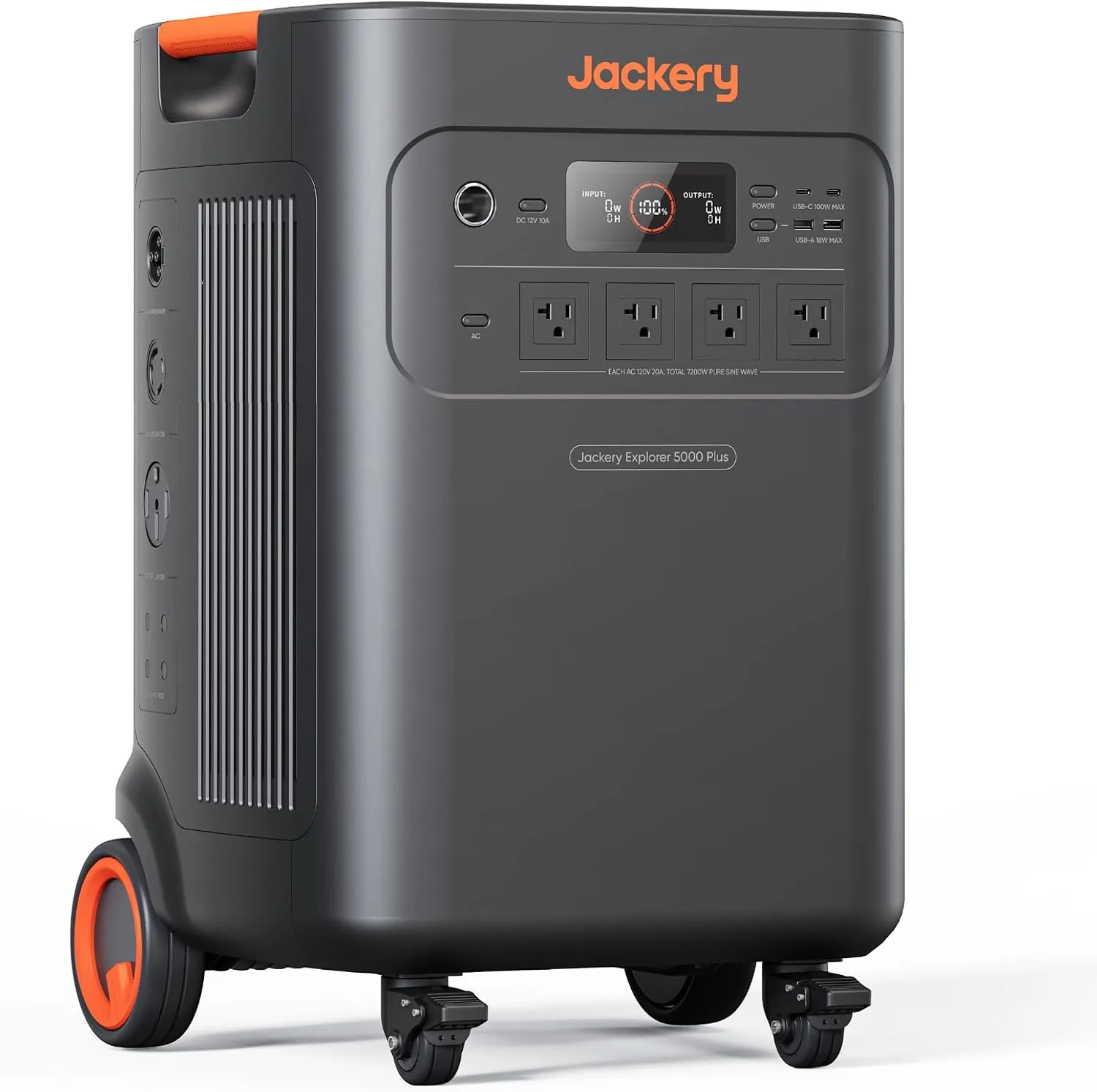
Jackery Explorer 5000 Plus Power Station, 5040Wh
Highlights
- 5040Wh rated capacity
- 3600W continuous AC
- LiFePO4 chemistry
- Up to 4000W solar input
- 134.5 lb (~61.0 kg)
- About $3499 list
Best for
- Explorer 5000 Plus: longer outages or higher continuous loads (still not whole-home wiring)
- RV / off-grid days where recharge speed matters as much as Wh
- Best parked near the vehicle or cabin — not a long carry to a tent
Strengths
- Explorer 5000 Plus: 3600W continuous on a 5040Wh pack — more headroom for small appliances than 1kW-class peers
- 134.5 lb (~61.0 kg) is a park-and-use chassis — plan a short path, not a trail hike
- 3600W continuous headroom covers more small appliances than 1kW-class inverters
- Owners on file: Theme: Customers find the power station's performance positive. However, the battery life receives mixed feed…
Watch-outs · not ideal when
- At 134.5 lb (~61.0 kg), Explorer 5000 Plus is a poor tent-hike companion — plan a cart or leave it in the vehicle
- High continuous output on Explorer 5000 Plus tempts big loads — Wh still runs out on kettles and A/C
- Rated 4000W solar on Explorer 5000 Plus is optimistic; shade and cables cut real watts
- LiFePO4 helps longevity, but Explorer 5000 Plus still hates freezing charge temps on winter trips
Owner voices
Short takes from public retail reviews — paraphrased or translated when long or non-English; meaning kept close to the original.
“Theme: Customers find the power station's performance positive. However, the battery life receives mixed feedback - while some say it holds a charge well, others report it loses over 30% of its charge per day. The rel…”
“3/5 · 129 helpful — I bought this battery and a smart transfer switch to backup my house. The battery, when not in use, loses over 30% of its charge per day. This means if I don’t constantly recharge it, it will die a…”
“5/5 · 95 helpful — I have owned 2 Jackery units for five years now. I own a Jackery 250, Jackery 1000. Both have been very reliable, I’ve had no issues with either unit in over 5 years! I recently purchased Solar Gene…”
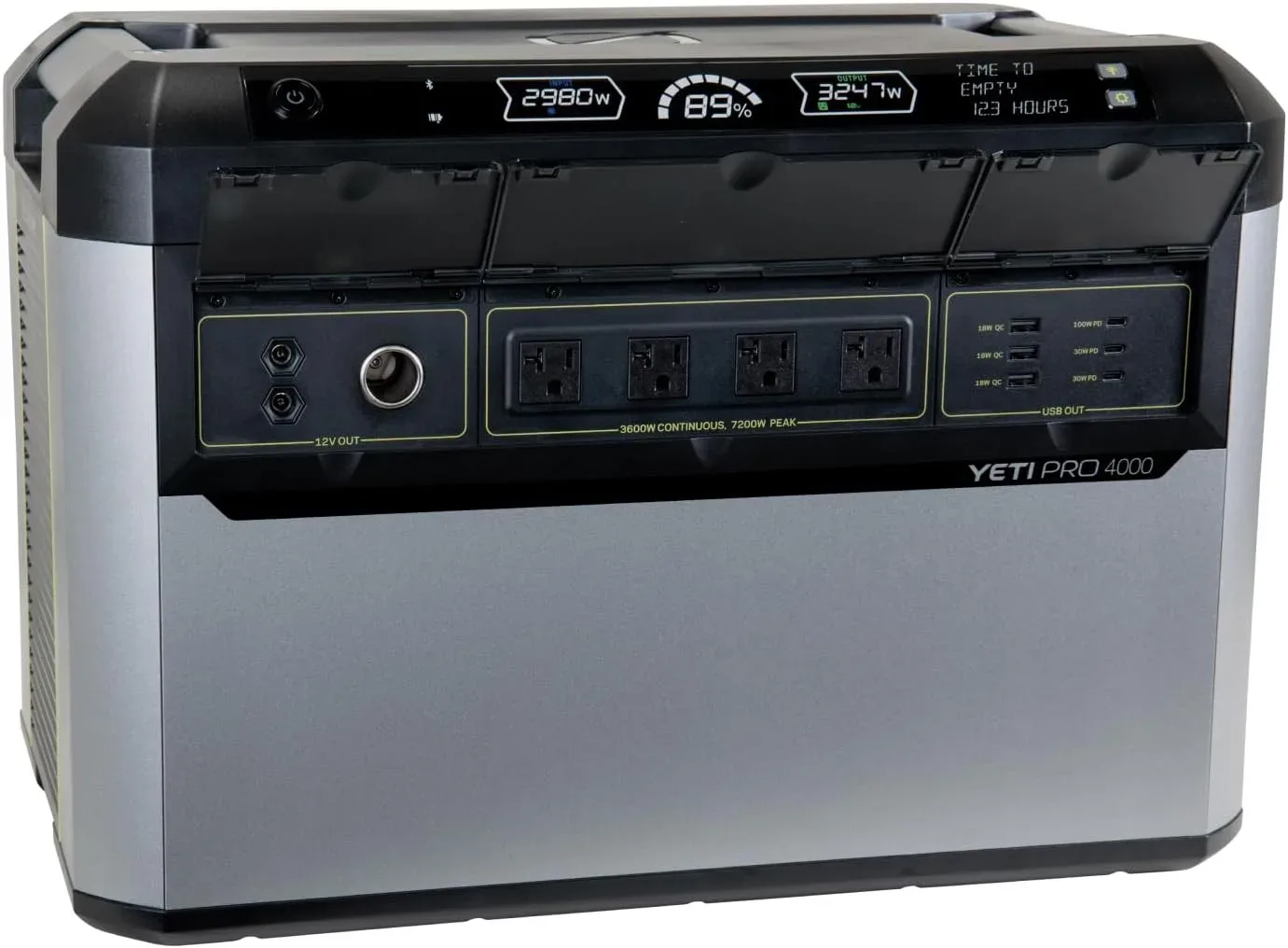
Goal Zero Yeti PRO 4000 Portable Power Station, 4000 Watt Hour LiFePO4 Battery, Expandable Solar Gen
Highlights
- LiFePO4 chemistry
- Goal Zero catalog listing
- Specs from manufacturer listings
Best for
- Goal Zero Yeti PRO 4000 Portable Power Station, 4000 Watt Hour LiFePO4 Battery, Expandable Solar Gen: longer outages or higher continuous loads (still not whole-home wiring)
- RV / off-grid days where recharge speed matters as much as Wh
- Users who will pair solar or expand rather than buy a second small pack
Strengths
- Goal Zero Yeti PRO 4000 Portable Power Station, 4000 Watt Hour LiFePO4 Battery, Expandable Solar Gen: capacity not published on file — compare only what the listing actually states
- Goal Zero Yeti PRO 4000 Portable Power Station, 4000 Watt Hour LiFePO4 Battery, Expandable Solar Gen: quiet battery output suits campsites with generator bans
- Goal Zero Yeti PRO 4000 Portable Power Station, 4000 Watt Hour LiFePO4 Battery, Expandable Solar Gen uses LiFePO4 — cycle-life claims usually beat older NMC marketing lines
- Owners on file: Theme: Customers find the power station to be an absolute beast of a product. However, the reliability receiv…
Watch-outs · not ideal when
- Goal Zero Yeti PRO 4000 Portable Power Station, 4000 Watt Hour LiFePO4 Battery, Expandable Solar Gen is still a bridge for essentials — not a transfer-switch whole-home system
- No Wh on file for Goal Zero Yeti PRO 4000 Portable Power Station, 4000 Watt Hour LiFePO4 Battery, Expandable Solar Gen — do not invent runtime math from the product name
- Solar input unpublished for Goal Zero Yeti PRO 4000 Portable Power Station, 4000 Watt Hour LiFePO4 Battery, Expandable Solar Gen — do not assume a same-day off-grid refill
- Airline and pack limits may still block Goal Zero Yeti PRO 4000 Portable Power Station, 4000 Watt Hour LiFePO4 Battery, Expandable Solar Gen even when the weight looks friendly
Owner voices
Short takes from public retail reviews — paraphrased or translated when long or non-English; meaning kept close to the original.
“Theme: Customers find the power station to be an absolute beast of a product. However, the reliability receives negative feedback, with several customers reporting immediate failures.”
“5/5 · 19 helpful — I don't write many product reviews, but the GZ Yeti PRO 4000 has really impressed me. I was looking for a power station to back my home, run my 30' travel trailer, and power the occasional backyard…”
“1/5 · 13 helpful — Why did you pick this product vs others?: DO NOT BUY!!! They do not have a customer service department anymore - Yeti Pro 4000 doesn't work. Won't hold charge no help - wasted money. Biolite purchas…”
Buy the one that…
Buy the Jackery Explorer 5000 Plus Power Station, 5040Wh if you want the most nameplate capacity and outlets for a known $3499, you're comfortable with a transfer switch sold separately, and you can live with software that's still settling. Skip it if you need flawless UPS behavior out of the box or charge in freezing conditions.
Buy the Goal Zero Yeti PRO 4000 Portable Power Station, 4000 Watt Hour LiFePO4 if fast automatic transfer and a rugged aluminum case matter more than raw Wh, and you're willing to add Haven PRO and Tank PRO expansion later. Skip it if you need the lowest $/Wh, can't confirm the current price, or want responsive support from day one — the transition period has been uneven.
Frequently asked
How much does the transfer switch install cost?
Installation cost isn't listed for either the Jackery 60A Smart Transfer Switch or the Goal Zero Haven PRO. It depends on your panel and local electrician rates — get a quote before you commit to either ecosystem.
Who should not buy either unit?
Renters and apartment dwellers who can't install a transfer switch or smart panel should skip both for whole-home backup. Without that hardware, you're limited to plugging individual devices into the outlets, and the capacity premium buys you less than you'd expect.
Can either unit back up a whole home without extra hardware?
No. Both need a transfer switch or smart panel — Jackery's 60A Smart Transfer Switch or Goal Zero's Haven PRO, each sold separately.
Which runs a fridge and freezer longer on one charge?
On nameplate capacity, the Jackery's 5040 Wh gives it more headroom than the Goal Zero's 2400 Wh, assuming similar loads. Add Tank PRO batteries to the Goal Zero to close the gap.
Do both have USB-C?
The Jackery lists USB-C×2. The Goal Zero's USB-C count isn't published, so confirm before buying if that port matters.
Which is easier to move?
The Jackery is 134.5 lb and the Goal Zero is 138 lb — both need a cart or a helper. The Goal Zero includes a cart; confirm whether the Jackery's is included.
What's the cost per added kWh for expansion?
For the Goal Zero, Tank PRO batteries add capacity at a separate cost — check current pricing per battery. For the Jackery, there's no listed expansion battery, so adding a second Jackery unit is the path to more kWh; compare that total cost against Tank PRO.
Method and sources
Model names and list prices come from the WattPicks catalog at build time. WattPicks does not run its own laboratory tests on power stations, and nothing on this page is presented as a measured result — it is catalog-backed buying guidance.
Read our methodology for how the catalog is normalized, and about WattPicks for who publishes it.