
EcoFlow RIVER 2 vs Goal Zero Yeti 700: Which Bet Fits?
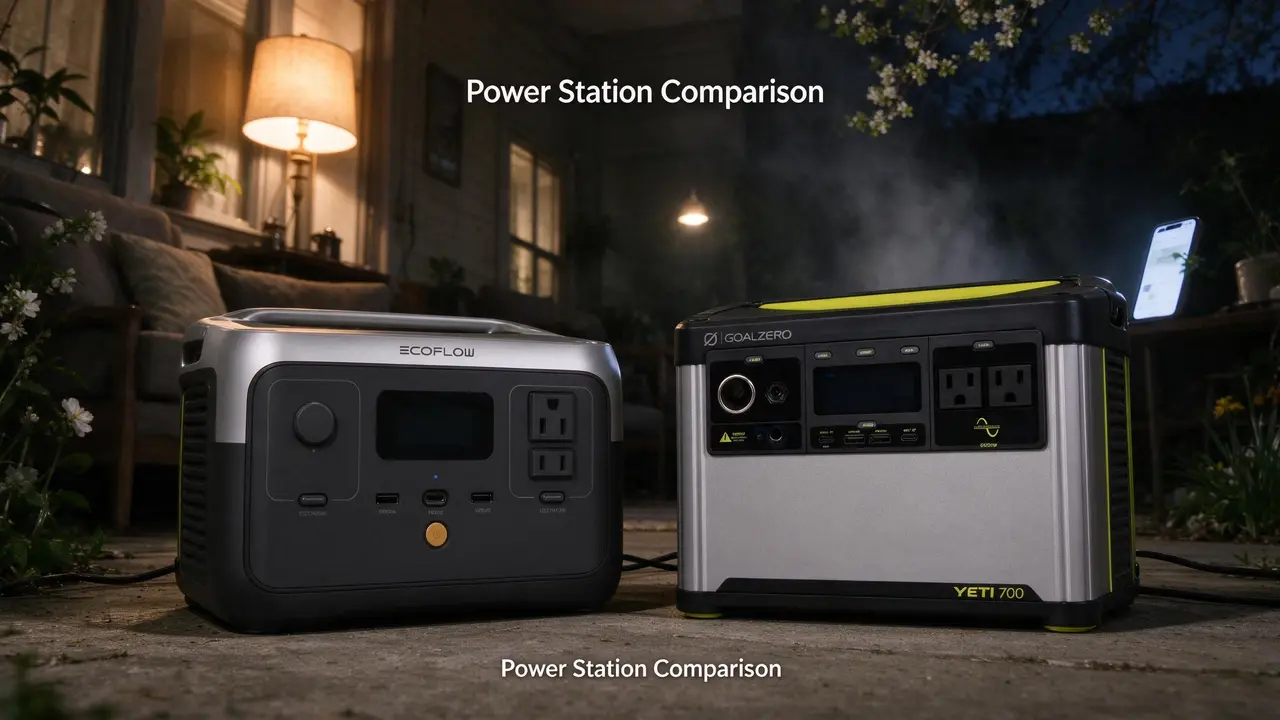
Two LiFePO4 stations that are not really rivals — one is a 7.7 lb grab-and-go, the other a 20.3 lb overnight workhorse. Here is how to tell which bet your use case actually needs.
Updated
At a glance
Two LiFePO4 stations that are not really rivals — one is a 7.7 lb grab-and-go, the other a 20.3 lb overnight workhorse. Here is how to tell which bet your use case actually needs.
Same money? No — same question, different bets
These two do not sit in the same price or capacity class, and pretending otherwise would waste your time. The honest framing is a bet on what an outage or a trip actually asks of you: a light 243 Wh pack you can carry one-handed, or a 677 Wh box that can hold a CPAP with the humidifier running until morning.
The Goal Zero Yeti 700 lists at $699.95 for 677 Wh and 600 W continuous. The EcoFlow RIVER 2 lists at $177.65 for 243 Wh and 300 W continuous. That is roughly a 4x price gap and a 2.8x capacity gap — so the real decision is capacity and weight, not brand loyalty.
This page is for campers and short-outage households choosing between a light pack and an overnight box. It is not for whole-home backup. Neither unit is wired for a transfer switch, and neither should be asked to run a fridge circuit, a sump pump, or anything above its continuous rating. If that is your job, you are shopping in the wrong category.
Disclosure: as an Amazon Associate, WattPicks earns from qualifying purchases. Picks here are fit-led — the cheaper unit is not automatically the recommendation, and the bigger one is not automatically the safe answer.
Goal Zero Yeti 700
Highlights
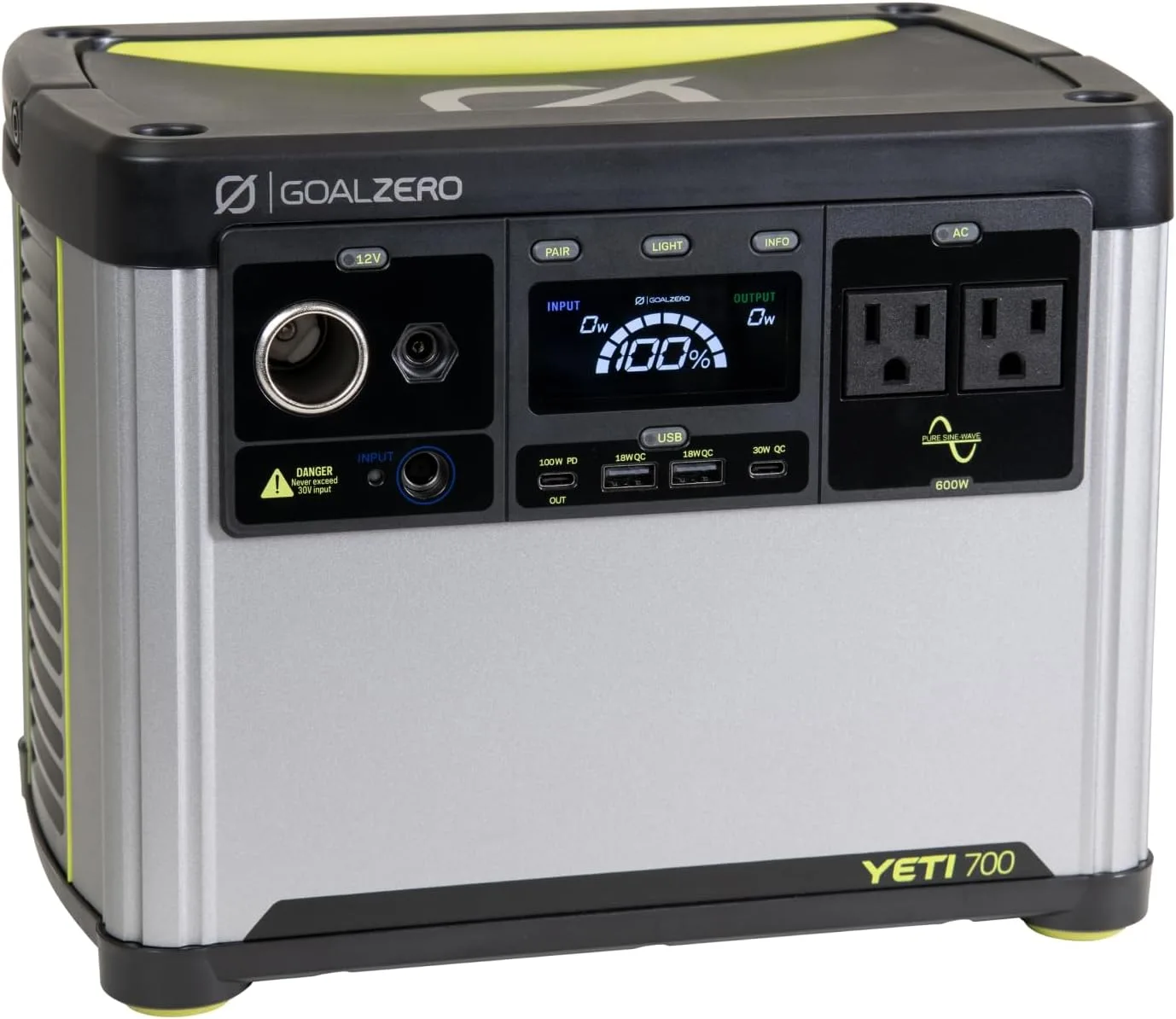
- 677Wh rated capacity
- 600W continuous AC
- 1000W surge
- LiFePO4 chemistry
- Up to 200W solar input
- 20.3 lb (~9.2 kg)
Best for
- Yeti 700: weekend camping when 20.3 lb carry weight matters as much as 677Wh
- Essentials bridge at home (fridge cycles, router) when sized to the Wh
- Solar top-ups up to ~200W when panels and weather cooperate
Strengths
- Yeti 700: 677Wh pack with 600W continuous / 1000W surge — size loads to both numbers
- 20.3 lb (~9.2 kg) is the lightest-class carry in this band — easier stairs and car packing
- Yeti 700 uses LiFePO4 — cycle-life claims usually beat older NMC marketing lines
- Owners on file: Theme: Customers find the power station reliable, with one mentioning it runs all their equipment through the…
Watch-outs · not ideal when
- Yeti 700 is still a bridge for essentials — not a transfer-switch whole-home system
- Usable energy on Yeti 700 is below the 677Wh label once the inverter is working
- Rated 200W solar on Yeti 700 is optimistic; shade and cables cut real watts
- LiFePO4 helps longevity, but Yeti 700 still hates freezing charge temps on winter trips
Owner voices
Short takes from public retail reviews — paraphrased or translated when long or non-English; meaning kept close to the original.
“Theme: Customers find the power station reliable, with one mentioning it runs all their equipment through the night. The battery life receives positive feedback, with multiple customers noting it charges quickly from…”
“Theme: Battery life (10)”
“5/5 · 19 helpful — I bought this 700 since I have a full size CPAP machine with the humidifier that I need when I go camping. Was able to charge multiple other devices over night (phone, hearing aid, watch) while I wa…”
EcoFlow RIVER 2
Highlights
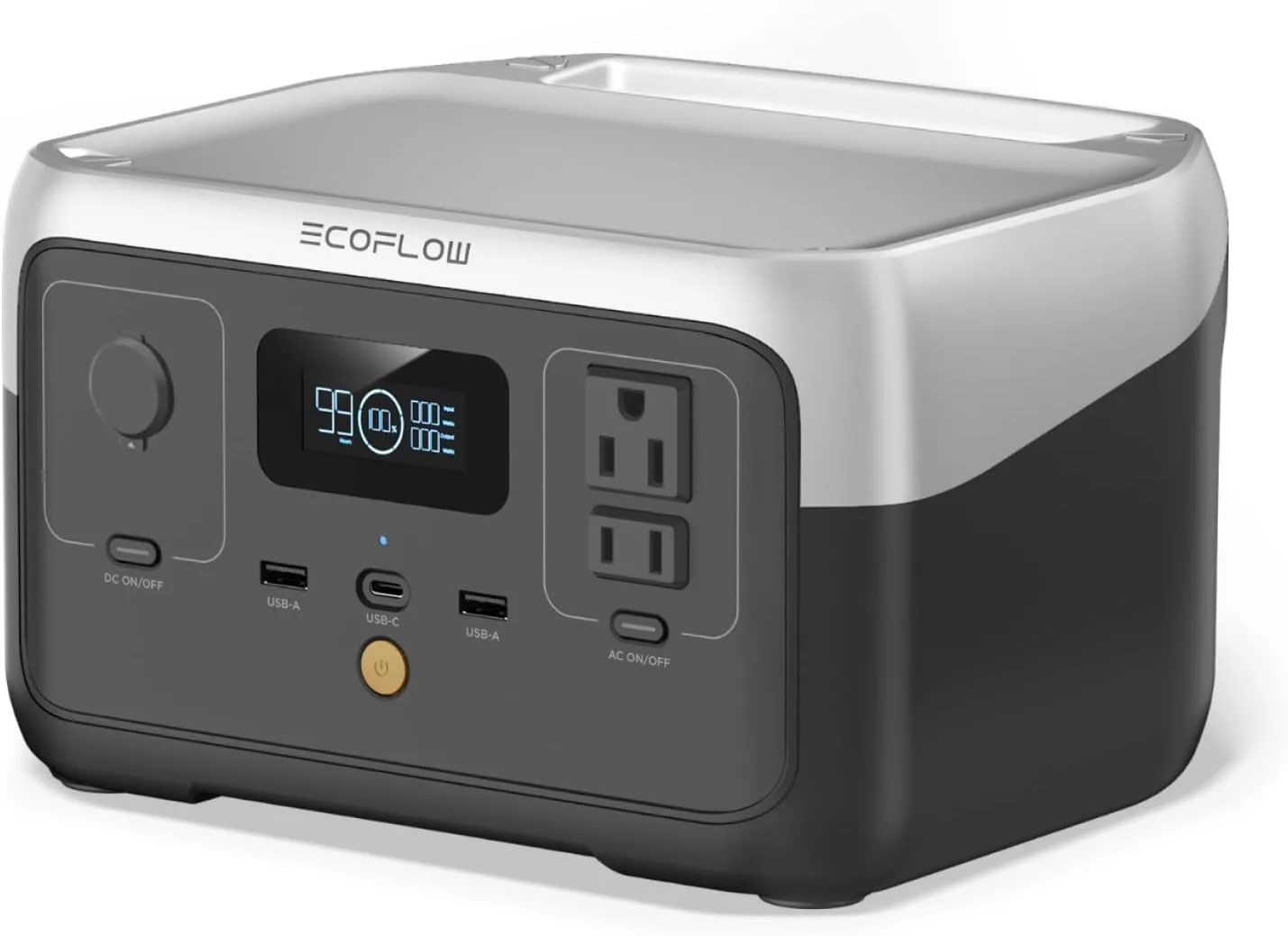
- 243Wh rated capacity
- 300W continuous AC
- 600W surge
- LiFePO4 chemistry
- Up to 110W solar input
- 7.7 lb (~3.5 kg)
Best for
- RIVER 2: phones, cameras and a laptop on short trips
- Travel kits when you need quiet pack power, not appliance runtime
- Brief desk backup for router and lights — not a fridge for days
Strengths
- RIVER 2: 243Wh pack with 300W continuous / 600W surge — size loads to both numbers
- 7.7 lb (~3.5 kg) is the lightest-class carry in this band — easier stairs and car packing
- RIVER 2 uses LiFePO4 — cycle-life claims usually beat older NMC marketing lines
- Owners on file: Theme: Small Appliances (53)
Watch-outs · not ideal when
- RIVER 2's small Wh class empties fast with a kettle, hair dryer or space heater
- 300W continuous will not hold heating elements or many compressor surges for long
- Rated 110W solar on RIVER 2 is optimistic; shade and cables cut real watts
- Airline and pack limits may still block RIVER 2 even when the weight looks friendly
Owner voices
Short takes from public retail reviews — paraphrased or translated when long or non-English; meaning kept close to the original.
“Theme: Phone Charging (126)”
“Theme: Small Appliances (53)”
“Theme: Backup Power (43)”
The spec that decides it: capacity-to-weight
If you only compare one ratio, compare Wh per pound. The Yeti 700 delivers 677 Wh at 20.3 lb — about 33 Wh/lb. The RIVER 2 delivers 243 Wh at 7.7 lb — about 32 Wh/lb. On paper they are nearly identical in density, which is the interesting part: you are not paying a weight penalty for the bigger box, you are paying a price and bulk penalty.
The second deciding spec is continuous output. 600 W versus 300 W is the line between 'small appliance capable' and 'electronics only.' If your load list includes anything with a heating element, the RIVER 2 is out before price enters the conversation.
That is why the price gap is not the story. The Yeti 700 costs more because it stores more and pushes more watts — not because it is a better-made version of the same thing.
I am a deep-use experience reviewer working from owner themes on file plus listing specs — home-user checks, not lab-bench measurements. Every number in this piece traces to the product listings; where a spec is missing, it reads n/a rather than a guess.
Avery Nolan is the WattPicks founding editor, covering portable power station capacity, output, and price-per-Wh guidance across the catalogue — no lab claims.
For related decisions, see our guides on sizing a power station to real loads and on LiFePO4 versus NMC chemistry before you buy.
Spec snapshot: the numbers that decide it
Every figure below comes from the product listings on file. Where a spec is not published, it reads n/a rather than a guess. Ratings are listing aggregates, not proof of owner experience.
Prices and ratings as of March 2025.
| Product | Price | Capacity (Wh) | Output (W) | Weight (lb) | Rating (count) |
|---|---|---|---|---|---|
| Goal Zero Yeti 700 | $699.95 | 677 Wh | 600 W | 20.3 lb | 4.4 (40 ratings) |
| EcoFlow RIVER 2 | $177.65 | 243 Wh | 300 W | 7.7 lb | 4.3 (4,557 ratings) |
Where the money went: four configuration calls
Capacity is the obvious line item, but it is not the only one. Here is how the two units spend their budget differently, item by item.
Battery capacity and chemistry. Both use LiFePO4, so the longevity story is similar in kind — the difference is scale. The Yeti 700 carries 677 Wh, the RIVER 2 carries 243 Wh. For a CPAP with humidifier overnight, that gap is the whole ballgame; for phone-and-laptop duty, the smaller pack is plenty.
Continuous output. The Yeti 700 is rated 600 W continuous with a 1,000 W surge figure on the listing. The RIVER 2 is rated 300 W continuous. That 300 W ceiling rules out coffee makers, microwaves, and hair dryers on the EcoFlow — owners say so plainly — while the Yeti's 600 W opens small appliances but still not a full kitchen.
Weight and form. 20.3 lb versus 7.7 lb is a meaningful difference. The Yeti 700 is described by owners as an oversized ammo box — packable, but a two-hand lift. The RIVER 2 is a one-hand carry, which is why it ends up in sheds, tents, and backpacks rather than on a shelf.
Ports. The Yeti 700 lists AC×2, USB-C×3, USB-A×2, and a car port. The RIVER 2 lists AC×6; its USB-C and USB-A counts are not on file, so I will not claim either way. If you need a specific port mix, check the current listing before you buy.
What owners actually report
The review pack on file skews toward real use — camping, outages, CPAP, sheds — which matches this page's angle. Themes below are paraphrased, not quoted.
Goal Zero Yeti 700. The strongest recurring theme is overnight CPAP with the humidifier running, plus phones and a watch, finishing the night under 50%. Owners also praise fast wall charging and a charge that holds well in storage. The caveats are real: capacity tops out at lights, laptops, and small electronics; one owner saw only 18–24 hours on a portable fridge; and a few units failed outright (smoke, dead on arrival) and needed replacement. Customer service was responsive in those cases, but the failure reports are worth weighing.
EcoFlow RIVER 2. Fast charging is the headline — roughly an hour from empty to full on AC, which owners call a game-changer. It also earns UPS duty for routers and modems, and one owner got 7.5 hours on a CPAP. The caveats: 300 W is a hard ceiling for appliances, some units arrived with batteries that would not hold a charge, warranty support can be slow, and firmware updates have temporarily broken features like the AC charging display before a fix landed.
Listing aggregates — 4.4 (40 ratings) for the Yeti 700 and 4.3 (4,557 ratings) for the RIVER 2 — are context only. They are not a substitute for the themes above, and the RIVER 2's much larger sample is doing different work than the Yeti's smaller one.
How long will it actually run? A worked example
Capacity anxiety is best closed with math. Take a CPAP drawing 30 W for 8 hours: that is 240 Wh. The RIVER 2's 243 Wh nameplate, at roughly 85% usable (an editorial estimate based on typical inverter efficiency and depth-of-discharge for LiFePO4, not a manufacturer spec), gives about 207 Wh — so a 30 W CPAP for 8 hours would just exceed it. That matches owner reports of about 7.5 hours on a CPAP without a humidifier. Add a humidifier (which can push draw to 60–80 W) and the RIVER 2 falls well short.
The Yeti 700's 677 Wh, at 85% usable, gives about 575 Wh. At 60 W for 8 hours (480 Wh), a CPAP with humidifier fits with margin — which is why owners report finishing the night under 50%. For a portable fridge cycling at an average 40 W, 575 Wh works out to roughly 14 hours; one owner's 18–24 hour report likely reflects a lower average draw or a smaller fridge.
These are estimates from nameplate capacity and typical draws, not lab measurements. Your runtime depends on the actual wattage of your device and how often it cycles.
Buy the one that…
Buy the Goal Zero Yeti 700 if your load list includes a CPAP with humidifier overnight, or you want 600 W continuous for small appliances and a 677 Wh reserve you can move between rooms during an outage. Skip it if you need one-hand portability, if your budget is under a few hundred dollars, or if you have read the failure reports and want a longer track record before committing.
Buy the EcoFlow RIVER 2 if your job is phones, laptops, a router, a fan, and the occasional CPAP night — and you want the lightest 243 Wh pack that recharges in about an hour. Skip it if anything on your list draws more than 300 W continuous, if you need multiple USB-C ports at once (the count is not on file, so verify), or if you cannot tolerate a slow warranty process on the off chance you get a bad unit.
Neither is a whole-home backup. If that is the actual job, size a station against your transfer switch and real loads before you spend anything here.
- Can the RIVER 2 run a CPAP overnight? Owners report about 7.5 hours on a CPAP, which covers a typical night but leaves little margin. The Yeti 700 is the safer bet if you run a humidifier.
- Will the Yeti 700 run a mini fridge? One owner saw 18–24 hours on a portable fridge — workable for an overnight outage, not for multi-day.
- Which is cheaper per Wh? On nameplate math, the RIVER 2 is $0.73/Wh and the Yeti 700 is $1.03/Wh. That does not make the RIVER 2 the better buy — it makes it the cheaper way to store a smaller amount of energy.
- Do either of these work as a UPS? The RIVER 2 is used as a UPS for routers and modems by owners. The Yeti 700 is used for backup during outages, but UPS behavior is not specified on the listing — treat it as n/a (not on file).
Who should not buy either of these
If your needs fall into any of these buckets, neither the RIVER 2 nor the Yeti 700 is the right tool — and buying one anyway will leave you frustrated.
Whole-home backup: neither unit is designed for transfer-switch wiring or running multiple household circuits. You need a larger, hardwired system.
Loads above 600 W continuous: the Yeti 700 tops out at 600 W, the RIVER 2 at 300 W. Space heaters, window ACs, and full-size fridges are out of scope.
Multi-day off-grid trips: 677 Wh is an overnight reserve, not a week-long basecamp supply. Plan on recharging or sizing up.
Also, LiFePO4 batteries degrade gradually with cycle count and storage conditions. Neither listing publishes a cycle-life rating, so treat long-term capacity as an unknown rather than a guarantee.
- Can the RIVER 2 run a CPAP overnight? Owners report about 7.5 hours on a CPAP, which covers a typical night but leaves little margin. The Yeti 700 is the safer bet if you run a humidifier.
- Will the Yeti 700 run a mini fridge? One owner saw 18–24 hours on a portable fridge — workable for an overnight outage, not for multi-day.
- Which is cheaper per Wh? On nameplate math, the RIVER 2 is $0.73/Wh and the Yeti 700 is $1.03/Wh. That does not make the RIVER 2 the better buy — it makes it the cheaper way to store a smaller amount of energy.
- Do either of these work as a UPS? The RIVER 2 is used as a UPS for routers and modems by owners. The Yeti 700 is used for backup during outages, but UPS behavior is not specified on the listing — treat it as n/a (not on file).
A weekend camping scenario
To make the choice concrete, here is a typical two-night tent trip load list: two phones (about 20 Wh each per day), a headlamp (5 Wh), a camera (15 Wh), a small fan (10 W for 6 hours = 60 Wh), and a portable fridge (40 W average for 12 hours = 480 Wh). Total for two days: roughly 600 Wh.
The Yeti 700's 575 Wh usable covers most of that but would need a top-up or a smaller fridge. The RIVER 2's 207 Wh usable covers the phones, headlamp, camera, and fan with room to spare — but not the fridge. If your camping includes a fridge, the Yeti 700 is the minimum; if it is electronics only, the RIVER 2 is the lighter, cheaper bet.
Frequently asked
Can the RIVER 2 run a CPAP overnight?
Owners report about 7.5 hours on a CPAP, which covers a typical night but leaves little margin. The Yeti 700 is the safer bet if you run a humidifier.
Will the Yeti 700 run a mini fridge?
One owner saw 18–24 hours on a portable fridge — workable for an overnight outage, not for multi-day.
Which is cheaper per Wh?
On nameplate math, the RIVER 2 is $0.73/Wh and the Yeti 700 is $1.03/Wh. That does not make the RIVER 2 the better buy — it makes it the cheaper way to store a smaller amount of energy.
Do either of these work as a UPS?
The RIVER 2 is used as a UPS for routers and modems by owners. The Yeti 700 is used for backup during outages, but UPS behavior is not specified on the listing — treat it as n/a (not on file).
Method and sources
Model names and list prices come from the WattPicks catalog at build time. WattPicks does not run its own laboratory tests on power stations, and nothing on this page is presented as a measured result — it is catalog-backed buying guidance.
Read our methodology for how the catalog is normalized, and about WattPicks for who publishes it.